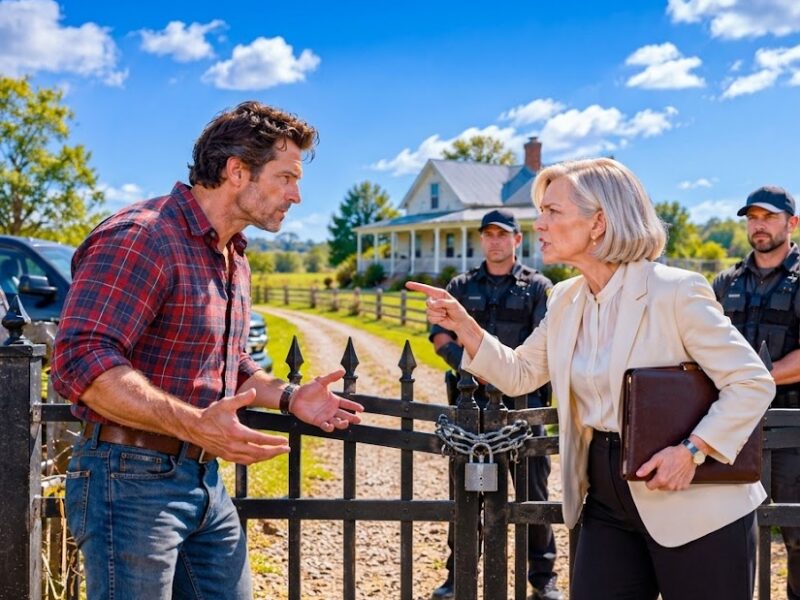
I refused HOA membership after closing. Then Karen locked my gate and called me a trespasser. She had no idea I had the original deed.
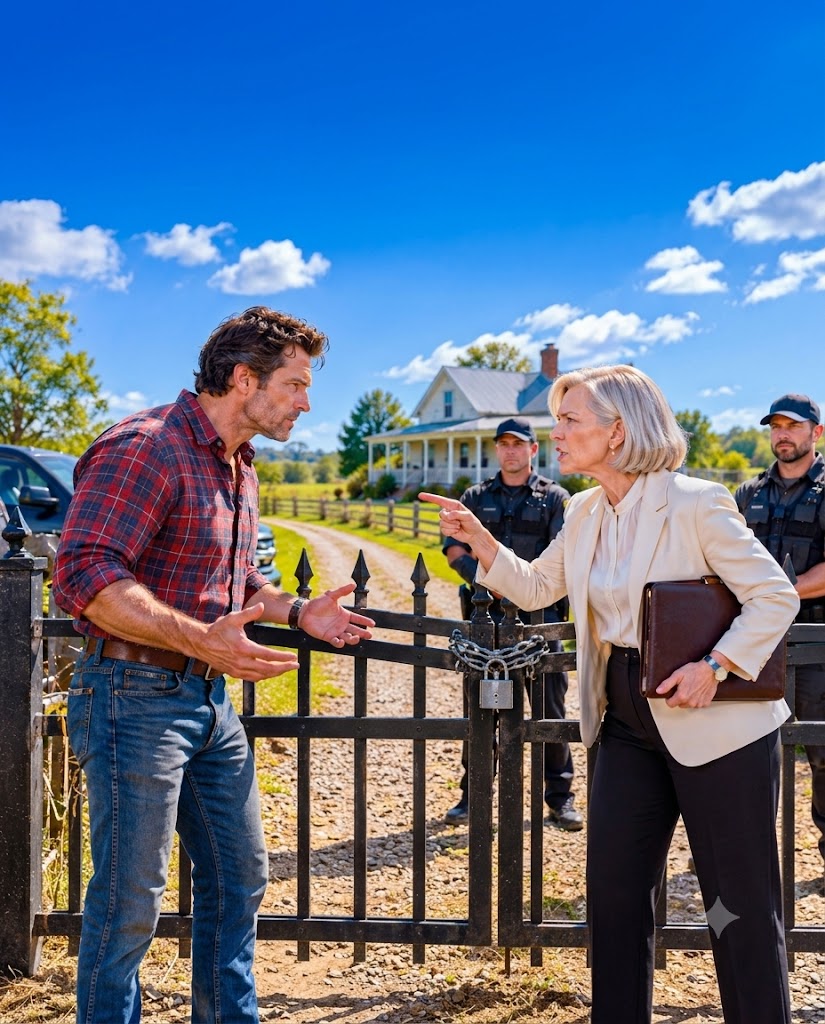
Three days after closing on 5.2 acres, Van Merrick came home to find a steel chain wrapped around his own gate and a blood-red sign branding him a trespasser.
On the other side stood HOA President Darlene Crowell, flanked by two security guards, smiling like she already owned the place.
She claimed he had joined Hawthorne Ridge the moment he signed his deed, but Van had refused every membership form before closing.
Then Darlene called the sheriff’s department and waved a county-stamped map putting his land inside her HOA.
His survey said the exact opposite.
Someone had rewritten the public record, and it happened after he became the owner.
Two weeks earlier, none of that would have seemed possible.
Van Merrick had spent most of a year searching for land that felt like his own, and he finally found it on the eastern edge of Hawthorne Ridge.
5.2 acres of rolling pasture, an aging farmhouse with a wide front porch, a small workshop with a tin roof, and a private gravel driveway that ran from the house to a black iron gate opening onto the county road.
The place needed work, but Van liked work.
He was 46, patient by nature, and the kind of man who read every page before he signed anything.
What sold him was not the porch or the pasture.
It was a single line on the survey.
The property sat right beside the homeowners association, but it did not belong to it.
His real estate agent, a blunt veteran named Gary Pruitt, had warned him early.
Hawthorne Ridge, Gary said, had a habit of leaning on the outlying parcels, sending letters, making phone calls, and treating every neighboring acre as if it were already part of the neighborhood.
Van took the warning seriously.
He asked for the full title commitment and read it line by line.
There was no declaration of covenants tied to his parcel, no assessments, no recorded obligation of any kind to Hawthorne Ridge.
The closing survey was just as clear.
The eastern fence line marked the last boundary of the association, and everything on Van’s side of it, including the gate and every foot of the driveway, belonged to the parcel he was buying.
Two weeks before closing, a thick envelope arrived at the rental where Van was staying.
It was stamped with the Hawthorne Ridge crest and labeled “Welcome Package” in gold lettering.
Inside were a membership application, a demand for a $2,400 initiation fee, a schedule of annual dues, pages of rules about fence heights and approved paint colors, restrictions on outbuildings like his workshop, and a clause granting the association the right to inspect the exterior of his property whenever the board saw fit.
The cover letter was signed by Darlene Crowell, president.
Van read the whole thing standing at the kitchen counter.
Then he picked up a pen and wrote one sentence across the front page in firm block letters.
“Declined. Property is not subject to Hawthorne Ridge HOA.”
He mailed it back the same afternoon.
Darlene called three days later.
Her voice was warm in the way a salesperson’s voice is warm right before the contract comes out.
She explained that every owner within what she called the “community footprint” eventually joined, that it was simply how things worked out there, and that holding out would only create friction with his new neighbors.
Van listened without interrupting.
When she finished, he asked a single question.
“Show me where I signed.”
The line went quiet for a moment.
Darlene did not answer it.
She told him she looked forward to welcoming him properly, wished him a pleasant day, and hung up.
Van wrote the date and time of the call on a notepad and slid it into his closing folder.
Closing day was uneventful in every way that mattered.
Leah Bastwick, the title attorney handling the transaction, walked through the deed, the survey, and the final title commitment one last time at the conference table.
No HOA, no assessment, no covenant.
Van signed where she pointed, initialed where she pointed, and watched the funds wire out of his account.
By late afternoon, the deed was recorded with the county, and Leah slid a set of keys across the table with a small smile.
“Congratulations,” she said.
“It’s all yours.”
Van drove out to the property that evening and stood at the gate for a long time, watching the sun drop behind the pasture.
For the first time in a year, he felt completely settled.
Three days later, he was driving home from the hardware store with a truck bed full of lumber when he saw something glinting at the end of his driveway.
He slowed down.
A brand-new steel chain had been wrapped twice around his gate, and a heavy black padlock hung from the center of it.
Bolted to the iron bars was a red metal sign with white letters: “Private HOA Property. No Trespassing.”
Van stopped the truck on the gravel apron off the county road.
On the far side of the gate, standing on his own driveway as if she had always belonged, was Darlene Crowell.
Two private security guards in gray uniforms stood a step behind her, arms folded.
Darlene was in her late 50s, silver hair cut sharp at the jaw, a leather portfolio tucked under one arm.
She smiled when Van stepped out of the truck.
“Mr. Merrick,” she said.
“You are not authorized to enter through HOA property.”
Van looked at the chain, then at the sign, then back at her.
“That’s my gate,” he said evenly.
Darlene’s smile did not move.
“Not anymore.”
She pulled a phone from her pocket, tapped the screen, and held it to her ear without breaking eye contact.
When the dispatcher answered, her voice turned bright and urgent.
“Yes, this is the president of the Hawthorne Ridge Homeowners Association. I have a trespasser at our common gate who refuses to leave HOA property.”
Van did not touch the lock.
Every instinct told him to grab the bolt cutters from his toolbox and end the nonsense in ten seconds, but he understood exactly what Darlene wanted.
She wanted a man breaking a lock on camera while a deputy was on the way.
So instead, he took out his phone and started recording.
He filmed the chain, the padlock, and the red sign from three angles.
He filmed Darlene and both guards, the HOA logo on the white pickup parked behind them, and its license plate.
Then he walked twenty feet along the shoulder and filmed the orange-capped survey monument driven into the ground just outside the fence, the same marker printed on his closing survey.
Darlene told him to leave at least four times.
Van answered the same way each time, calmly, that he was standing on the public right-of-way beside the county road and was not going anywhere.
The guards shifted uneasily but said nothing.
About twenty minutes later, a county patrol car pulled onto the shoulder, and Deputy Quinton Harwell stepped out.
He was young, broad-shouldered, and visibly tired of property disputes before this one even began.
Darlene reached him before Van could.
She spoke fast and confidently, explaining that Mr. Merrick had been formally notified that his parcel was annexed into the association, yet he insisted on occupying common property and harassing her staff.
Quinton asked to see documentation.
Darlene opened her leather portfolio and handed him a large folded map bearing the county recorder stamp.
Van stepped closer.
His parcel was outlined in bold black ink and labeled “Lot 77A, Hawthorne Ridge Annexation.”
The strip of land where his gate stood, along with the first stretch of his driveway, was shaded gray and labeled “Common Tract C.”
Van felt the ground tilt under him for half a second.
Then he walked to his truck, pulled the closing folder from behind the seat, and unfolded his own survey across the hood.
No Lot 77A, no Common Tract C, no annexation of any kind.
Quinton looked at one document and then the other.
Both were official-looking.
Both carried seals.
Darlene folded her arms.
“His paperwork is outdated, Deputy.”
Van put his finger on the date block of his survey.
It had been completed two days before closing.
Then he pointed at the recording stamp on Darlene’s map.
It had been recorded two days after closing.
“If I became a member of the HOA when I closed,” Van said, “why does this annexation only show up after I already own the land?”
Darlene didn’t blink.
“Administrative processing. Filings lag behind. Everyone knows that.”
But Quinton had stopped writing.
He was staring at the two dates.
The deputy chose his words carefully.
He told them both he would not arrest anyone, but he also could not decide title to land on the side of a county road with two conflicting records in front of him.
He would write an incident report, and the matter would have to be resolved through the proper channels.
Van nodded and asked that the report reflect several specific facts: that the HOA had locked the gate after closing, that Darlene had personally claimed the gate as association property, that no court order had been presented, and that Van had produced his recorded deed and closing survey on scene.
Quinton wrote each point down without argument.
Before he left, Quinton turned back to Darlene.
“Ma’am, one more thing. Do you have Mr. Merrick’s signed consent to this annexation?”
Darlene paused for exactly one beat, the kind of pause a lie needs before it can stand up.
“Of course,” she said.
Van looked straight at her and held the look until she turned away.
He did not need to argue the point on the shoulder of the road.
He knew one fact with absolute certainty, and it was worth more than every stamped map in her portfolio.
He had never signed it.
Van called Leah Bastwick from the cab of his truck before the patrol car was out of sight.
At first, she was calm, almost reassuring.
Counties updated their mapping systems constantly, she said, and a parcel layer could easily be drawn wrong.
But when Van read her the instrument number printed on Darlene’s map, Leah went silent.
When she spoke again, her voice had changed.
She told him not to sign anything, not to pay anything, not to agree to anything with the association, and not to discuss the matter with Darlene again without her.
Then she logged into the county recorder system while he waited on the line.
The document was real.
It had been filed, indexed, and accepted.
Its title read: “Declaration of Annexation and Boundary Adjustment, Lot 77A.”
Leah emailed him a copy, and Van opened it on his phone right there on the gravel.
Page after page of dense legal language bound his 5.2 acres to Hawthorne Ridge forever.
On the final page was a signature line labeled “Van Merrick, Property Owner.”
Above it sat a signature that looked almost exactly like his own.
Not similar.
Almost exactly.
The slant of the V, the long tail on the K, the slight break between first and last name.
It looked like him because, in a sense, it was him.
Leah pulled up the closing package and laid the pages side by side on her screen.
Within minutes, she found the match.
The signature on the declaration appeared to have been lifted from one of the pages Van had signed at her conference table, copied and pasted onto a document he had never seen.
But the forgery carried a fatal flaw.
The notary block claimed Van had signed the declaration on the morning of closing, hours before the deed transferring the property to him was ever executed.
At that moment, he hadn’t owned the land.
He had no legal power to annex anything, and the notary stamp belonged to a name Leah had never heard of.
Leah opened a claim with the title insurance company that same afternoon.
“This isn’t an HOA disagreement anymore, Van,” she told him.
“This looks like a fraudulent recording.”
Later that evening, Deputy Harwell returned at Van’s request after Darlene and the guards had gone.
With the deputy’s body camera running, and based on the recorded deed and the absence of any court order barring him from his own property, Van cut the chain and removed the lock.
He didn’t toss them in the ditch.
He placed the padlock in one evidence bag, the chain in another, and labeled both with the date and time.
Then he mounted two cameras, one aimed squarely at the gate and another at the survey monument.
Darlene’s email arrived that night a little after nine.
The subject line was written in capital letters: “FINAL NOTICE OF TRESPASS AND NON-COMPLIANCE.”
It demanded that Van pay the $2,400 initiation fee immediately, along with $900 in violation penalties.
It ordered him to remove his cameras, surrender a key to the gate, and request written permission from the board before using what it called “the common driveway.”
The tone was cold and final, the voice of someone accustomed to people folding once the penalties started stacking up.
Van read it twice.
Then he wrote back exactly one sentence.
“Please preserve every document, email, recording, and board communication concerning my property.”
He hit send and closed the laptop.
Across the neighborhood, in a large house overlooking the Hawthorne Ridge Clubhouse, Darlene Crowell read that sentence and set her phone face down on the table.
She had dealt with angry owners before.
Angry owners shouted, threatened, and eventually wrote checks.
This was different.
This was the language of someone building a file.
For the first time since she had chained the gate, Darlene understood that Van Merrick was not going to play the game the way she had written it.
Leah ordered a gap review the next morning, a full search of every document recorded against the parcel and its surrounding tracts in the days around closing.
The results landed on her desk two days later, and they were worse than she expected.
There was not one suspicious filing.
There were two.
The first was the declaration of annexation, pulling all 5.2 acres into the association.
The second was an amended plat that carved out the 22-foot strip of driveway in front of the gate and relabeled it “Common Tract C, Association Property.”
Both had been submitted in the same electronic recording session, minutes apart, and the account that submitted them was linked to the law office representing Hawthorne Ridge.
That office belonged to Stuart Bledsoe.
Leah called him directly.
Stuart sounded genuinely startled.
He explained that his office sometimes submitted filings the association prepared internally as a convenience, and that he did not personally verify the substance of every annexation the board sent over.
Leah let him finish.
Then she asked the only question that mattered.
“Who gave you the owner consent?”
The silence on the other end lasted long enough for Leah to hear him breathing.
Stuart finally said he would need to review his records and call her back.
He did not call back that day.
Meanwhile, Van hired an independent surveyor named Wes Gaffney, a retired county engineer with forty years of experience and zero interest in neighborhood politics.
Wes spent a full morning walking the property line with his equipment, checking every monument against the original records.
When he finished, he leaned against his truck and shook his head.
Nothing had moved.
Not a single marker had shifted an inch.
The gate sat well inside Van’s parcel, exactly where the closing survey said it would be.
“This Common Tract C,” Wes said, tapping the amended plat, “doesn’t exist on the ground. It only exists on paper. Somebody drew it.”
At the county recorder’s office, an investigator named Elise Northam had begun pulling the audit trail.
The system tracked every electronic submission, and what she found made her lean closer to her monitor.
The final version of the annexation file had been uploaded at 11:42 p.m., long after the office had closed.
The document had been edited and resaved several times before submission.
Then Elise checked the notary.
The commission number printed in the stamp had expired months before the date written on the declaration.
She called Van and asked whether he had ever appeared before that notary for any reason.
“Never,” he said.
“I’ve never even heard the name.”
By the end of the week, Elise had escalated the file.
Darlene did not retreat.
Instead, she went on offense.
She sent a notice to every household in Hawthorne Ridge, warning that a non-compliant owner on Lot 77A was obstructing the community’s right to use common access.
She named Van Merrick.
In the second sentence, she described him as “hostile, uncooperative, and a threat to property values.”
It was meant to isolate him, to turn three hundred neighbors into a wall of pressure he couldn’t stand against.
But Darlene made a mistake she would not recognize until much later.
She had given people a reason to look at the map, and some of them did.
Kendra Mosley had lived in Hawthorne Ridge for eleven years and served on the board for two.
She pulled up the county records out of simple curiosity, wanting to see Lot 77A for herself.
Then she noticed something on her own parcel she had never seen before.
A boundary correction recorded three years earlier, shifting a sliver of her backyard into an association drainage tract.
She had never requested it.
She had never signed anything like it.
She stared at the screen for a long time.
That evening, Van’s phone rang with a number he didn’t recognize.
The woman on the line didn’t introduce herself right away.
“Mr. Merrick,” she said.
“I think she did something to my land, too.”
Darlene called a special meeting of the association.
The agenda posted on the clubhouse door and emailed to every resident listed a single item: “Addressing Lot 77A Access Violations.”
It was meant to be a public trial.
A room full of neighbors watching the board vote to escalate penalties against a man they had been told was a troublemaker.
On the night of the meeting, the clubhouse was packed.
Folding chairs filled the room, and people stood along the back wall.
Darlene sat at the center of the head table with the other board members on either side and Stuart Bledsoe at the far end.
Then the door opened, and Van Merrick walked in alone.
He brought no attorney, no entourage, and no anger anyone could see.
He carried three thick folders under his arm.
He took a seat in the front row and waited.
Darlene struck first.
Before the meeting was formally opened, she announced that Mr. Merrick owed the association substantial fees and penalties and that his continued refusal to comply was harming every family in the room.
Van let her finish.
Then he stood up.
“On what date did I become a member?” he asked.
Darlene didn’t hesitate.
“The date you closed on the property.”
Van walked to the head table and laid the declaration of annexation in front of her.
“Then why was this recorded two days later?”
Darlene said that paperwork was often filed after the fact.
Van turned to the final page and set it down beside the first.
“Then why does it say I signed it before I owned the property?”
The room went quiet in a way that felt physical.
Somewhere near the back, a chair creaked.
Stuart Bledsoe reached for the document and began turning pages quickly.
Van opened his second folder.
He placed his closing survey on the table beside the amended plat and traced the 22-foot corridor with his finger.
“This is my driveway,” he said.
“On this map, it’s mine. On that one, it’s yours. Nothing moved on the ground. Only the paper changed.”
He looked down the table at each board member, then back at Darlene.
“So here’s my question. Who needed my driveway badly enough to forge my name for it?”
Darlene’s face went red.
She stood and ordered the security guards at the door to remove Mr. Merrick from the meeting.
The guards started forward.
Then Kendra Mosley rose from her seat at the end of the head table.
“No,” she said.
“He stays.”
Darlene turned to stare at her.
Kendra didn’t sit down.
Instead, she told the room that she had found an unrequested boundary correction on her own parcel.
A man in the third row said he wanted to check his.
Then a woman near the window.
Then several more.
Darlene lost the room in under two minutes.
She tried to regain control by raising her voice, insisting that Van had come there only to destroy the community and that everyone was being manipulated.
Van didn’t respond to a word of it.
He opened his third folder and placed one final document in front of Stuart.
It was a formal notice from the title insurance company demanding that the association preserve all electronic records, filing histories, emails, and board communications related to the parcel.
Stuart read it once, slowly.
Then he turned in his chair and faced the woman who had hired him.
“Darlene,” he said quietly, though everyone near the front could hear.
“Did you submit the owner consent yourself?”
Darlene didn’t look at him.
“You’re my attorney,” she said through her teeth.
“Act like it.”
In that moment, Stuart Bledsoe understood that he might not be defending a civil dispute over a driveway at all.
He might be standing next to a forgery with his own office’s login attached to it.
When the meeting dissolved into overlapping arguments a few minutes later, Stuart gathered his papers and walked out alone.
He did not wait for Darlene in the parking lot.
From his car, he called Leah Bastwick.
Stuart’s call opened the door, but it was Leah and Elise who walked through it.
Working from the recording timestamps, they traced the history of the amended plat and found it referenced in another set of documents entirely: a commercial loan application.
Hawthorne Ridge was in the final stages of borrowing $4.8 million.
The money was meant to renovate the clubhouse, build a new outdoor event pavilion, expand the parking lot, and refinance an older debt the association had been struggling to carry for years.
It was the largest project in the community’s history, and Darlene Crowell had championed it from the very first board meeting.
But the bank had flagged a problem early in underwriting.
The clubhouse had only one legal access route, a narrow residential street that could not handle the traffic a commercial event space would generate.
Without a second access point, the expansion could not be approved, and without approval, there would be no loan.
In the final package the association submitted to the lender, that problem had been neatly solved.
A secondary access corridor now ran from the county road through a gate and up toward the back of the clubhouse property.
On the lender’s site plan, it carried a label Van now knew by heart: “Common Tract C, Secondary Access Corridor.”
Suddenly, everything made sense.
Darlene hadn’t chained the gate just to bully a stubborn new owner into paying dues.
She needed his driveway to become association property before the bank’s final inspection.
The membership forms, the phone call, the welcome package, all of it had been an attempt to get his signature the easy way.
When Van refused, the whole story about Common Tract C began to fall apart.
If the lender discovered the association didn’t own the access route listed in its application, the $4.8 million deal would die on the spot.
So Darlene had stopped asking for consent and started manufacturing it.
Ronan Draper from the state real estate fraud unit joined the investigation the following week.
He was a quiet man in a rumpled gray suit who asked short questions and wrote down every answer.
His first request was that the county recorder expand its search beyond Van’s parcel.
The results came back within days.
Over the previous three years, the association had recorded eleven other boundary filings.
Not all of them were fraudulent.
Several were routine corrections with proper signatures and legitimate surveys behind them.
But a handful showed the same troubling patterns: missing consent, inconsistent notarizations, late-night submissions.
Kendra Mosley’s backyard was one of them.
Then Stuart Bledsoe made his decision.
Through his own counsel, he turned over emails preserved in the association’s legal file, messages Darlene had sent him over the preceding months.
One was dated eleven days before Van’s closing.
It read: “Merrick is refusing membership. We still need the corridor reflected before lender inspection.”
Another followed a few days later.
“Use the closing legal description. I’ll handle consent.”
When Stuart first received that message, he had assumed it meant Darlene would obtain a signature through normal channels.
Now, reading it again in a conference room with an investigator across the table, he understood exactly what “handle consent” had meant.
Leah forwarded the emails to Van that evening.
He read them at the kitchen table in the old farmhouse, the porch light throwing long shadows across the floor.
He didn’t celebrate.
He didn’t call anyone.
He set the phone down and stared at the dark window for a long while.
Then he said quietly to the empty room, “She knew I said no before I ever bought the place.”
It was the piece that turned everything.
Darlene Crowell had not misread a map or misunderstood a boundary.
She had known from the very beginning that Van Merrick was not a member of her association, and she had decided it didn’t matter.
Sheriff Tobias Carden had spent twenty-six years in county law enforcement, and he had long ago stopped expecting HOA disputes to be anything more than fences, paint colors, and wounded pride.
When Ronan Draper briefed him in his office, laying out the timeline on the desk one document at a time, the sheriff listened without interrupting.
When Ronan finished, Tobias leaned back in his chair.
“So the trespassing call my deputy answered,” he said slowly, “was the forger reporting the victim?”
Ronan nodded.
The case that had begun as a routine neighbor complaint was now formally a document fraud investigation, and the sheriff’s office was in it.
Ronan worked methodically.
He gathered the PDF metadata from the recorder system, the association’s board emails, its meeting calendars, the invoices from the surveyor who drew the amended plat, every communication with the lender, and the full closing file from the title company.
Then he found the notary.
Her name was Margaret Haskins, and she had retired to a small town two counties away.
She confirmed that she had never met Van Merrick.
More importantly, she said she had never stamped that document.
Her commission had expired, and her seal had last been used years earlier on routine paperwork for the Hawthorne Ridge board.
Someone had copied her stamp from an old association file.
That single fact destroyed any remaining claim of clerical error.
A clerk might mistype a date or misdraw a line.
A clerk did not lift a retired notary seal from an old file and paste it onto a declaration bearing a forged signature.
Word of the notary statement reached the association within days, and Darlene began to come apart.
She called an emergency board session and demanded that the board retroactively approve the annexation of Lot 77A, as though a vote could manufacture consent that Van had never given.
The board refused.
No vote in the world could turn an owner’s refusal into agreement.
Kendra and a growing group of homeowners went further, formally demanding an independent financial audit of the association.
At the same time, the lender received official notice that title to the access corridor was in dispute.
The bank froze the $4.8 million disbursement pending review.
The project Darlene had spent two years building was suddenly hanging by a thread, and in her mind, there was only one person to blame.
She told anyone who would listen that Van Merrick had sabotaged the entire community out of spite.
Fewer and fewer people were listening.
Late that night, Van’s gate camera picked up headlights.
A white association SUV rolled to a stop on the gravel apron.
Two men climbed out of the back, hauling a thick steel bar and a heavy-duty toolbox.
Then the passenger door opened, and Darlene Crowell stepped out into the glare of the motion light.
She walked to the gate, pointed at the latch, and the microphone caught her voice as clearly as if she were standing in Van’s kitchen.
“Make sure he can’t open it this time.”
The men went to work.
This time it wasn’t a chain.
They bolted the steel bar horizontally across both sides of the gate using industrial hardware, drilling straight into the iron posts.
Then they hung a new sign, larger than the first: “Hawthorne Ridge Common Property. Trespassers Will Be Prosecuted.”
The SUV pulled away eleven minutes after it arrived.
Darlene had just done something no attorney could ever explain away.
She had physically altered disputed property after receiving a preservation notice and after learning the documents were under formal investigation.
Inside the farmhouse, Van watched the footage on his laptop a little before midnight.
He didn’t grab a flashlight.
He didn’t walk down the driveway to confront anyone.
He saved the file to three separate drives, picked up his phone, and called the sheriff.
Darlene came back early the next morning with two security guards.
Her plan was obvious to anyone paying attention.
The lender’s inspector was scheduled to visit within the week, and she wanted the association visibly in control of Common Tract C when he arrived.
Guards posted signs up, gate sealed.
But when her SUV crested the hill above the county road, she saw that Van was not standing alone this time.
Sheriff Tobias Carden’s cruiser was already parked on the shoulder.
Deputy Quinton Harwell stood beside it.
A few minutes later, an unmarked sedan pulled in behind them, and Ronan Draper stepped out with a thin folder in his hand.
Darlene got out anyway.
She walked straight toward the sheriff, already talking, explaining that Mr. Merrick was trespassing on association land and that her guards were there to protect common property.
Tobias raised one hand.
“Ma’am, we’ve already heard that allegation.”
He nodded toward the steel bar.
“Who ordered this installed?”
Darlene said the board had.
Kendra Mosley, who had driven over after Van called her, stepped forward.
She told the sheriff that as a sitting board member, she could confirm there had been no vote, no motion, and no discussion of any such action.
Darlene shot her a look of pure contempt and changed her answer.
She said she had acted under her executive authority as president.
Ronan opened his folder and held up a copy of the preservation notice.
He pointed to the delivery confirmation showing Darlene had received it days earlier.
Then he asked, in the same flat tone he used for everything, why she had continued to alter the physical condition of property she knew was under active dispute and investigation.
Darlene didn’t answer the question.
She turned instead toward Van, her finger leveled at his chest.
“This man caused all of this,” she said, her voice rising, “because he refused to join.”
Van met her eyes.
“No,” he said.
“This started because you refused to accept that I didn’t.”
The sheriff signaled to a contractor Van had hired, who stood waiting by his truck with a cordless grinder.
“Take it off,” Tobias said.
Darlene stepped directly in front of the gate, planting herself between the contractor and the steel bar.
Tobias warned her once, clearly and calmly, that she was interfering.
She did not move.
He warned her a second time.
She folded her arms and lifted her chin.
Before the standoff could go any further, Ronan’s phone buzzed.
He stepped away, listened for less than a minute, and came back with an expression that hadn’t been there before.
Elise Northam’s team at the recorder’s office had recovered the full metadata of the original annexation file.
The account that created the very first version of that PDF was not Stuart Bledsoe’s.
It was an administrative account at the Hawthorne Ridge Clubhouse, used exclusively by the association president.
At that same moment, investigators were executing a search authorization on the association’s electronic records.
The clubhouse computers were being imaged and preserved.
Darlene’s access to the association systems had already been cut off.
Ronan told her all of this in four short sentences.
For the first time since she had wrapped that chain around Van’s gate, Darlene Crowell controlled nothing.
Not the documents, not the gate, not the story.
She stepped aside without a word.
The contractor’s grinder whined against the bolts, and the steel bar came free and dropped into the gravel with a heavy clang.
Quinton bagged the hardware and the new sign as evidence.
Van lifted the latch and swung his gate open.
It moved easily on its hinges, the way it had on the evening he first stood there watching the sunset over the pasture.
Nobody tried to stop him.
Darlene stood on the shoulder of the county road, on public land, watching a man walk through his own gate onto his own driveway, and there was nothing left for her to say.
The bank completed its internal review two weeks later.
The conclusion fit on a single page.
The lender could not rely on Common Tract C.
The association had no valid secondary access to the clubhouse property.
There was no evidence that the owner of the parcel had ever voluntarily agreed to annexation, and substantial evidence that he had refused.
The $4.8 million financing was formally withdrawn from closing.
The clubhouse renovation, the event pavilion, the expanded parking lot, and the refinancing of the old debt all collapsed together.
Two years of planning disappeared in a single letter.
That was not the final blow.
The independent audit the homeowners had demanded began turning up the money.
Darlene had spent association funds on the survey that produced the amended plat, on legal filing fees for the forged declaration, on the contractor who installed the chain and later the steel bar, on private security, on consulting fees tied to the loan, and on the documents sent to the lender.
Every expense rested on the same false premise: that Hawthorne Ridge controlled Van Merrick’s land.
The homeowners had been paying for the scheme that nearly cost them everything.
Stuart Bledsoe withdrew as Darlene’s personal counsel and agreed to keep representing the association only where no conflict of interest remained.
The board called a vote on a Thursday evening in the same clubhouse where Darlene had once tried to have Van thrown out.
The motion to remove her as president passed without a single dissenting vote.
Kendra Mosley read the result aloud.
Darlene gathered her portfolio, stood, and tried to leave before the meeting formally ended.
She made it as far as the front doors.
Sheriff Tobias Carden was waiting on the steps outside.
Ronan Draper walked up beside him.
Based on the evidence gathered and the decision of the county prosecutor, Darlene Crowell was placed under arrest for forgery, filing false instruments affecting real property, and related offenses stemming from the annexation scheme.
There was no struggle and no shouting.
Van didn’t say a word.
Darlene was led down the clubhouse steps past the same residents she had once warned about a hostile trespasser on Lot 77A.
Some of them looked away.
Most of them didn’t.
Kendra watched the handcuffs click shut, then turned to look at Van, who was standing near the parking lot with Leah at his side.
He didn’t smile.
He didn’t nod.
He watched the cruiser pull away until its taillights disappeared over the hill.
Then he turned to Leah.
“What happens to the filing?”
Leah tucked her folder under her arm.
“Now?” she said.
“We erase the lie.”
The court acted within a few months.
A judge issued an order voiding the annexation declaration as to Van’s parcel and striking the amended plat’s creation of Common Tract C.
Both instruments were stripped of legal effect, and Lot 77A ceased to exist in the county records.
The association was ordered to restore its boundary records, pay for the full repair of Van’s gate and posts, cover his legal fees and damages, send formal correction notices to the lender and the county, and cancel every fee, penalty, and assessment it had ever imposed on him.
Van Merrick had never been a member of the Hawthorne Ridge Homeowners Association.
Not for a single day.
A few weeks later, the gate was fully repaired.
New posts were set in concrete, the iron was sanded and repainted, and the hinges were replaced.
Van kept one thing from the whole ordeal.
Once the evidence was released back to him, he took the first black padlock out of its bag and set it on a shelf in his workshop between a coffee can of nails and an old level.
It wasn’t a trophy.
It was a reminder that ownership could be threatened without bulldozers or fences, with nothing more than a piece of paper that looked official enough and a person willing to file it.
Leah believed the case was finished.
Then Elise Northam called.
During the county’s broader audit of the association’s filings, her team had pulled an old instrument from the archives, recorded eighteen years earlier by the original developer of Hawthorne Ridge.
It concerned only one parcel: the 5.2 acres Van had just bought.
The language was blunt.
The parcel was intentionally excluded from the association.
It could not be annexed into Hawthorne Ridge without the express written consent of its owner.
There was no alternate interpretation and no loophole.
The developer had drawn that line deliberately and written it into the public record so no one could ever quietly erase it.
But the final revelation wasn’t in the document itself.
It was in the scan history.
When Elise traced who had requested copies of that instrument recently, one name came back.
Nine days before Van’s closing, the association’s lender had pulled the eighteen-year-old restriction during its due diligence and emailed it directly to Darlene Crowell.
The message included a single line that left no room for doubt: “Owner consent would be required before the parcel could be represented as association-controlled access.”
The system logs confirmed that Darlene opened that email within minutes of receiving it.
She read it.
She knew.
She knew before Van wired his money.
She knew before he picked up his keys at Leah’s conference table.
She knew before the forged declaration was uploaded at 11:42 p.m., before the amended plat invented Common Tract C, before she wrapped a steel chain around his gate and stood on his driveway calling him a trespasser to a county dispatcher.
This was never an HOA president who misunderstood a boundary.
This was a woman who knew exactly where the line was, read the document that proved it, and decided to change the paperwork because the owner on the other side refused to obey her.
On a clear morning in early autumn, Van drove home from town with a load of fencing supplies.
He turned off the county road and slowed as he approached the gate.
A small new sign was mounted on the post, plain white with black letters.
It carried no threat and no warning.
It said only four words: “Private Property. No HOA.”
Van stopped the truck for a moment and looked past it across the pasture toward the distant roofline of the Hawthorne Ridge Clubhouse.
The building still stood there, but the nameplate beside the president’s office door had been taken down, and in the county’s records, Lot 77A had disappeared.
He put the truck back in gear and rolled through his own gate, up his own driveway, toward the old farmhouse with the wide front porch.
Somewhere in a county courtroom, Darlene Crowell was facing the simplest truth of the entire story, the one she had spent weeks and thousands of dollars trying to bury under stamped maps and forged signatures.
Van Merrick had never crossed onto HOA property.
The HOA had crossed onto his.
The padlock on the workshop shelf caught the morning light through the window, a small black reminder of the day a stranger decided a piece of paper mattered more than a man’s name.
Van picked up his hammer and walked out to the pasture fence line, where the only boundary that mattered was the one he could see with his own eyes.
Behind him, the farmhouse porch waited, wide and quiet, and the gate stood open to the county road, exactly where it had always belonged.









