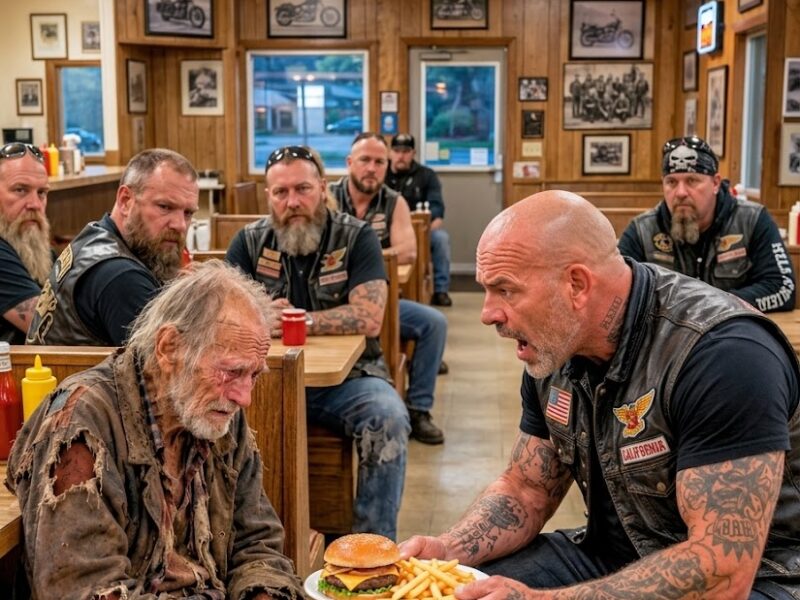
“I haven’t eaten since last week,” the old woman confessed at the diner. The bikers did the unthinkable.
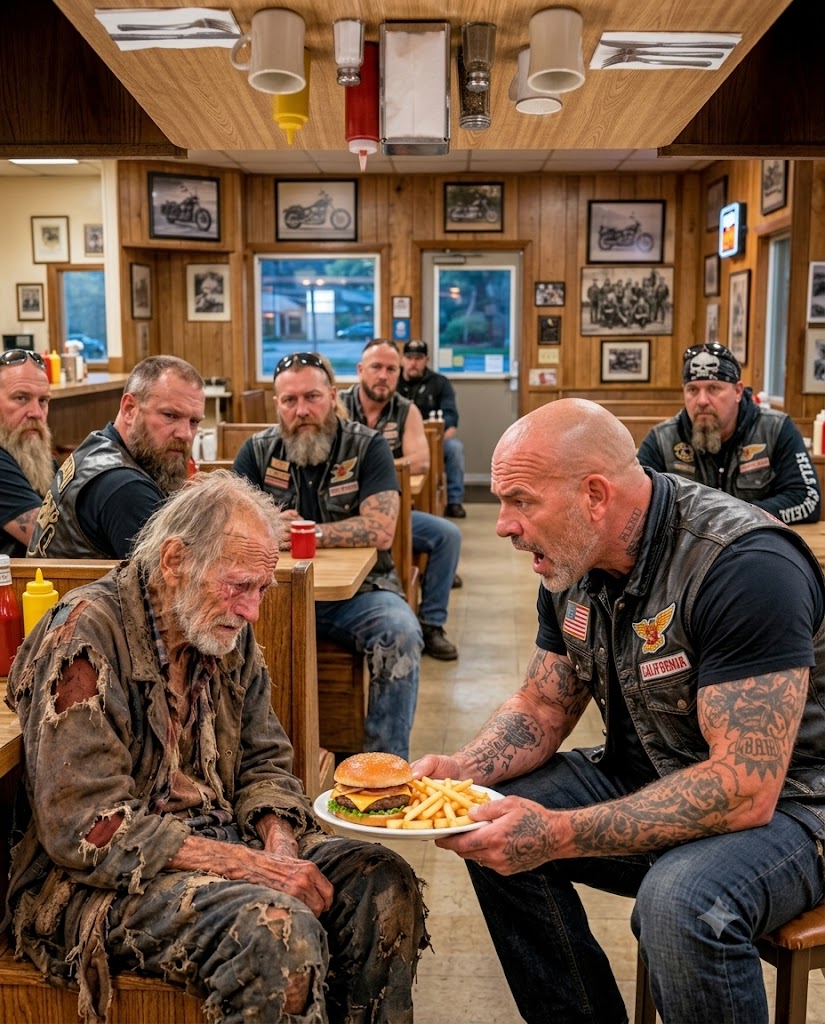
A coffee mug flew off the counter and shattered on the floor. The sound cut through the Copper Kettle like a gunshot in church.
A man’s voice boomed across the diner, loud enough to stop every fork mid-air. “Out. Get out.”
A hand grabbed a thin arm and yanked hard. As she stumbled, her purse spilled open. Coins rolled across the tile, pennies and nickels spinning and dropping flat, catching the fluorescent light like tiny fallen stars.
Nobody moved to help. Nobody said a word.
She bent down slow, her knees shaking, and tried to gather what little she had. The man stood over her, arms crossed, waiting for her to leave. Her hands trembled as she picked up each coin, one at a time, the way you’d handle something sacred.
This was Eunice Marsh, 81 years old, a widow who had not eaten a single thing in a week. And in the corner booth sat six men who had watched the whole thing.
What those men did next emptied that diner in under four minutes.
Stay with me on this one. Now let me take you back to about ten minutes before that mug hit the floor, because you need to understand how a quiet Tuesday afternoon turned into something nobody in that place would ever forget.
The diner was called the Copper Kettle. It sat off a dusty two-lane highway outside Flagstaff, Arizona, the kind of place truckers pull into because there’s nothing else for forty miles. Red vinyl booths, a long counter, a coffee pot that never stopped running. It wasn’t fancy. It was just a stop, a place to fill your tank, fill your belly, and get back on the road.
Eunice Marsh came in a little after two. She moved slow, the way people move when their bones have carried them a long time.
She had on a thin gray coat, buttoned all the way up, even though it wasn’t cold, and her white hair was pinned back neat. You could tell she’d pinned it that morning like it mattered, like a woman who still cared how she looked even when the world had stopped looking back. She was the kind of old woman you’d walk right past and never notice, small, quiet, folded in on herself.
And here’s a thing you couldn’t see from across the room. Her old car had died two months back, and there wasn’t money to fix it. So she’d walked to the bus, then walked from the bus stop down that shoulder of the highway, a mile and change in the heat, because somebody had told her the Copper Kettle sometimes sold a plate cheap at the slow end of the afternoon.
That was her whole plan for the day. One warm meal.
She took a seat at the counter. Not a booth. A booth felt like too much to ask for. She set her purse down careful, like it might break, and she waited with her hands folded in her lap and her back straight, the way her mother had taught her sixty years before to sit in a public place and not be a bother to anyone.
The waitress that day was a young woman named Carla, twenty-three, maybe twenty-four. She’d been working doubles all week because her little boy needed shoes and the rent was late, and the landlord had already slid one of those yellow notices under her door. Carla came over with a menu and a smile, and that smile was real, because she was one of those people who still had kindness left even when life was squeezing her dry.
“What can I get you, hon?” Carla asked.
And here’s where it starts.
Eunice opened her purse. She reached in with those shaking hands and pulled out a small coin purse, the snap kind your grandmother used to have, and she started counting out loud, almost to herself.
A dime. Two nickels. A handful of pennies.
She lined them up on the counter, one at a time, careful, like each one mattered, because to her each one did. Each one was something she’d gone without to keep.
Then she looked up and leaned in close and said something she clearly did not want anybody else to hear.
“I’m sorry to be a bother,” she whispered. “I haven’t eaten since last week. Is there anything at all I could get for this?”
Carla’s smile froze. Not because she was annoyed, because her heart cracked right down the middle. She looked at the little pile of coins, maybe sixty cents in all, and she looked at this frail old woman apologizing for being hungry, and she thought about her own grandmother, gone four years now. She made a decision right there. She was going to feed her, and she’d cover it herself. Rent notice or no rent notice.
“Honey,” Carla said softly. “You just sit tight. Let me get you some soup and some bread, and don’t you worry about the price. It’s on me today.”
Eunice’s eyes filled up. She grabbed Carla’s hand with both of hers and held it and said thank you about four times, and then she said something that about finished Carla off. She said, “You’re a good girl. Your mama raised you right.”
Carla had to turn around fast and pretend she was busy at the coffee machine, because she didn’t want this woman to see her cry.
That should have been the end of it. A kind waitress, a hungry old woman, and a bowl of soup. That’s the whole story right there. And it would have been a good one.
But Dale Pruitt heard every word.
Dale was the manager. Mid-forties, heavy-set, with a golf shirt stretched tight across his gut and a way of walking around the place like he owned it, which he didn’t. He just ran it. And Dale had a thing about charity cases. He’d put a sign by the register that said NO LOITERING, and he meant it. In his mind, a person who couldn’t pay was a person stealing from him. And Dale Pruitt did not get stolen from. He told himself the world was full of people looking for a handout and somebody had to hold the line.
Men like Dale always have a story.
He came out from behind the register fast. Too fast.
“Whoa, whoa, whoa,” he said loud, so the whole room turned. “What’s this?”
Carla stepped in front of him a little. “Dale, it’s fine. I’ve got it covered. I’m paying for her meal myself.”
“No,” Dale said. “You’re not, because she’s not eating here.”
He pointed a thick finger at the coins on the counter. “This isn’t a soup kitchen. These tables are for paying customers. Paying, not beggars.”
And that word. Beggars. He said it loud. He said it so the truckers heard it, so the family in the far booth heard it, so everybody heard it. Eunice shrank down in her seat like she wanted to disappear into the floor. She started gathering her coins back with those shaking hands, not even arguing, because a woman like her had spent a lifetime learning that when a man raised his voice, you didn’t argue. You just made yourself smaller and tried to get gone.
Now, here’s the thing Dale didn’t know. The thing that was about to turn his whole afternoon upside down.
In the corner booth in the back, farthest from the door, sat six men. They’d come in on motorcycles about twenty minutes earlier, parked them in a neat row out front, and ordered nothing but black coffee and a stack of pancakes to share. Leather vests, patches, road dust on their boots. Most folks saw men like that and got nervous. The family in the far booth had scooted their kids to the inside seats when the bikes rolled in.
But those men weren’t dangerous to anybody who didn’t deserve it. They’d been laughing a minute before, swapping stories, giving the youngest one grief about a girl. And right now, every one of them had gone very, very quiet. They’d stopped eating, and they were all looking at the same thing.
The big one in the middle, the one with the gray beard and the scar running down the left side of his face, set his coffee cup down without a sound. He’d gone still the second Eunice started counting those coins. His eyes had locked on her and hadn’t moved since.
At his boots, curled up under the table, a shepherd dog with only three legs lifted its head. Because the dog could feel it, too. The way animals feel a change in the air before a storm.
The man’s name was Boone Garrett. The men who rode with him called him Deacon. And Boone was staring at that old woman like he’d seen a ghost.
Because the thing is, Boone knew exactly who she was. He’d been looking for her for three years. Carried a folded photograph of her in his saddlebag that whole time. And now, out of every diner on every highway in that whole wide state, here she was, forty feet away, counting pennies.
But hold that thought, because before Boone could do anything, Dale was already finishing the job.
Dale didn’t wait for her to get up on her own. He didn’t give her the dignity of leaving under her own steam. He swept his hand across the counter and the coins went flying and the little coin purse hit the floor and Eunice let out a small sound. A sound like a hurt animal.
“Let’s go,” Dale said. “I don’t have all day.”
He grabbed her thin arm right above the elbow and pulled. She came off the stool half falling and her hip hit the counter edge and her purse dumped out. And that’s when the mug went over and shattered on the floor.
That’s the moment I showed you. The coin spinning, the whole room frozen. An 81-year-old widow down on her knees on the tile trying to pick up pennies while a grown man stood over her with his arms crossed and nobody moved.
The truckers looked at their plates. The family looked away. The father in that far booth put his arm around his kids and stared hard at the wall, and you could see it on his face, the shame of a man who knows he should stand up and just can’t make himself do it. Carla was crying and begging Dale to stop. And Dale was telling her to get back to work or she’d be out the door, too.
Nobody moved.
Except in the back, six men stood up at the same time.
You know how sometimes a room changes without a single word being spoken? That’s what happened. No shout, no scrape of chairs being thrown back. Just six men rising out of a booth together, slow and heavy, like a wall standing itself up. The dog stood too, on its three legs, steady, ears forward.
Boone was the first to walk. He didn’t rush. That was the scary part. He didn’t rush at all. He crossed that diner floor one boot at a time, and the closer he got, the quieter everything became, until the only sound in the whole place was the coffee machine hissing and the little gasps of an old woman crying on the floor.
Dale finally noticed. He turned, mouth already open to say something about customers and tables, and then he saw what was coming toward him, and the words died in his throat.
Boone walked right past Dale like he wasn’t even there. He got down. All the way down, both knees on that dirty tile right next to Eunice. This big scarred man in a leather vest folding himself down to the floor beside a crying widow. And he started picking up her coins, gentle, one at a time.
He found her dime. He found her nickels. He got every penny. He even reached under the lip of the counter to fish out the one that had rolled there, and he snapped the purse shut and held it in his big hand like it was something precious.
Then he looked at her face. Really looked. And his voice, when it came out, was soft as anything you ever heard.
“Ma’am,” he said, “are you Eunice? Eunice Marsh.”
She stopped crying for just a second. She stared at him. “Do I know you?”
“No, ma’am,” Boone said. “But I knew your son.”
And the whole room held its breath.
Dale still thought he was in charge. He puffed up and said, “Hey, hey, I don’t know what you people think you’re doing, but she’s got to go. And frankly, so do you.”
Boone didn’t even look up. He just lifted one hand. Palm out. Stop.
And Dale stopped. He actually stopped, because something in that hand, in that calm, told him the next word out of his mouth might be the last good decision he had left. Even a man as thick as Dale Pruitt could feel it.
Boone helped Eunice up off the floor, gentle as you’d lift a baby bird. He put her back on the stool and steadied her till he was sure her legs would hold. One of his men, a younger guy they called Tiny, who was anything but tiny, pulled off his own vest and draped it over her shoulders because she was shivering. And that vest swallowed her whole. She was so small inside it. Another one, an older fellow with reading glasses pushed up on his head, crouched and set her spilled purse back together, folding everything in neat.
And Boone turned and looked at Dale for the first time.
“You put your hands on her,” Boone said. It wasn’t a question. “I watched you do it. Whole room watched you do it.”
Dale’s face went through about four colors. “She was trespassing. She can’t pay. I run a business here.”
“Her son,” Boone said, cutting him off, “was a Marine. Did three tours. Came home and couldn’t settle, like a lot of them can’t. And he found a family with us. We called him Preacher’s Kid, on account of his mama raised him in a church.”
Boone’s eyes flicked to Eunice and something soft crossed his face. “Travis Marsh. Road captain. Best man I ever rode with. Not the biggest, not the loudest. The best. There’s a difference. And if you lived another hundred years, Dale, I don’t think you’d ever learn it.”
Eunice made a sound at her son’s name. Her hand went to her mouth. She hadn’t heard anybody say that name out loud with love in it in three years.
“Three years ago,” Boone went on, “Travis was riding down near Sedona when he came up on a wreck. Family car rolled off the shoulder, catching fire. He stopped. Of course he stopped. That’s who he was. He pulled two kids out of that car, little ones strapped in the back. And he went back for the mother, and he got her out, too. And then he saw the father was still pinned up front. And he went back a third time.”
Boone paused.
“He got that man’s belt loose, shoved him clear, and then the tank went up. He didn’t come back out.”
The whole diner was dead silent. Carla had both hands over her mouth.
“Four people walked away from that wreck,” Boone said. “Travis wasn’t one of them. He was thirty-nine years old. There’s a man in Sedona right now teaches his two kids to ride bikes on a Sunday. And he doesn’t even know the name of the fella who climbed into a burning car three times so he could do that. But we know it. And she knows it now, too.”
He turned back to Eunice and his voice dropped again, soft, just for her.
“We tried to find you, ma’am. After. We wanted you to have his things, his cut, his colors, the flag off his casket. But you’d moved out of the old place, and the address we had was no good, and the mail came back. We looked. We honest-to-God looked for three years. Called churches, called county offices, ran down every Marsh in four states.”
His jaw tightened.
“And we find you here on the floor. Hungry. Three years we hunted. And I walk into a diner to split a stack of pancakes and here you are. I don’t hardly know what to call that. A miracle, maybe. Or just God running out of patience with me.”
Eunice was crying again, but it was different now. She reached out and touched the scar on his face like she needed to make sure he was real. Like she thought if she blinked he might vanish.
“He saved somebody,” she whispered. “My Travis, he saved somebody.”
“For somebody’s mama, ma’am. And more than that. Over the years, he pulled me out of a bad spot once myself. Back when I was somebody you wouldn’t have wanted your boy riding with. He’s the reason I’m the man I am instead of the man I was. I owe your son my life. And that’s not a figure of speech. That’s just arithmetic.”
Boone swallowed. And this big, hard man had to stop and get himself together before he could go on.
“I made him a promise a long time ago, over a campfire. I told him if anything ever happened to him, I’d look after his mama like she was my own. And I failed at that for three years. Every day I failed at it. But I’m here now. And I’m not going anywhere.”
If you’re still with me, and I think you are, do me a favor and hit that subscribe button, because what these men do next is the part nobody in that diner ever stopped talking about. Go on. I’ll wait.
Okay. Here’s what happened.
Boone stood up. He pulled a worn leather wallet out of his back pocket and he turned to Carla and his whole face changed. Warm now.
“You were going to feed her out of your own pocket,” he said. “I saw that. Don’t think I didn’t. In a whole room full of people who found something real interesting about their shoes, you were the one.”
He peeled bills out of that wallet and he kept peeling. And he set them in Carla’s hands and folded her fingers over them.
“That’s for the soup you were going to buy. And that’s for every meal this woman eats in this place for the rest of her life. And that’s for you. For being the only person in this room with a soul.”
Carla looked down at what was in her hand, and her legs almost went out from under her. It was more money than she made in two months. She tried to give it back, actually tried to push it at him, and Boone just closed her hands around it again and shook his head. And that was the end of the discussion.
But Boone wasn’t done.
Now he turned to Dale, and the warmth was gone. “Now you,” Boone said. “You and me are going to have a talk about who actually owns this diner.”
Dale blinked. “I run this place.”
“You run it,” Boone agreed. “You don’t own it. You ever meet the man who owns it?”
Dale’s mouth opened and closed. “He’s—Mister Hollis is a silent partner. He lives up in Phoenix.”
“Frank Hollis,” Boone said. “Yeah, I know Frank.”
A thin smile crossed that scarred face. And it wasn’t a friendly one.
“Frank’s got a boy who rides with a charter down in Mesa. And Frank believes in treating people right, because he came up hard himself. Came up with nothing and never forgot it.”
Boone pulled out his phone.
“You want to know something funny, Dale? Travis did a job for Frank once. Wrote security for his daughter’s wedding. Wouldn’t take a dime for it. Frank loved that kid. Cried at the funeral. Back row. Didn’t tell anybody he was coming.”
He held up the phone.
“So let’s just give old Frank a call, you and me, and you can explain to him exactly what I just watched you do to Travis Marsh’s mother on his restaurant floor.”
And Dale Pruitt, who twenty minutes ago had been the biggest man in that room, went white as the plates on the counter.
“There’s no need to call anybody,” he stammered. “This is a misunderstanding. I didn’t know who she was.”
Boone took one step closer and his voice got very quiet, which was worse than any shout.
“That’s the whole problem with men like you,” he said. “You only decide a person matters once you find out who they’re connected to. You looked at that woman and you saw sixty cents and a thin coat and you decided she was nothing. A beggar. You put your hands on her and threw her coins on the floor, and you did all that when you thought she had nobody in the world to answer for her.”
Boone shook his head slow.
“She always had somebody. Dale had a whole mess of somebodies. You just couldn’t see us from where you were standing.”
He let that sit. You could hear Dale breathing.
Then Boone dialed the phone and put it on speaker, right there in the middle of the diner, so the whole room could hear it ring. It rang twice. A gravel voice answered.
“Boone, that you? Been a while, brother.”
“Frank,” Boone said, eyes locked on Dale the whole time. “I’m standing in your diner off the Flagstaff highway. The Copper Kettle. I need you to hear something, and I need you to hear it from somebody who’s not me.”
And then Boone had Carla tell it. Not him. Carla. He figured the owner should hear it from the one person who’d done right.
So Carla, shaking, wiping her eyes, told Frank Hollis every bit of it. The sixty cents. The whisper about not eating in a week. The soup she’d offered to pay for herself. And then Dale sweeping it all off the counter, grabbing the old woman’s arm, and dragging her onto the floor while a whole room full of grown adults did nothing.
There was a long silence on that phone. The kind of silence that has weather in it.
Then Frank Hollis said, very calm, “Put Dale on.”
Dale took the phone like it was a hot coal. “Mister Hollis, sir, I can explain. There’s context here. The woman was—”
“Dale.” Frank’s voice came through flat. Not angry. Worse than angry. “Done. My wife ran a food bank for thirty years before she passed. You know what she used to say? She said you can tell everything you need to know about a man by how he treats somebody who can’t do a single thing for him. Can’t pay him back. Can’t help his business. Can’t do one thing but need.”
A pause.
“You just told me everything. Dale, you’re done. Clean out the register, leave the keys with Carla, and get off my property before Boone decides to walk you out himself. And don’t you ever let me hear your name again.”
Dale opened his mouth. Nothing came. He looked around the diner for somebody, anybody, to back him up, and found a room full of hard faces and not one friend in it. Even the truckers were staring at him now with open disgust. One of them, a big man in a flannel shirt, actually said out loud, “You heard the man. Go on, get.”
And Dale Pruitt went.
He grabbed his jacket, fumbled the register open with shaking hands, and left the keys on the counter next to Eunice’s little coin purse, which somehow made what he’d done look even smaller and meaner, the two things side by side. And he walked out past that neat row of motorcycles, past the three-legged dog that watched him go with its ears up and a low sound in its chest, and he got in his car and drove off.
And the Copper Kettle was rid of him for good.
Now the room let out a breath. You could feel it, like a storm passing over and the pressure dropping all at once. But the best part, the part that still gets me, happened after Boone picked the keys up off the counter and held them out to Carla.
“Frank’s gonna want somebody to run this place till he sorts it out,” he said. “Somebody he can trust. I expect that’s you now. If you want it. Raise or no raise, I’d bet on the raise.”
Carla just stared at the keys in her hand. The young woman who an hour ago was working doubles and couldn’t make rent, who had a yellow notice under her door and a little boy who needed shoes. She started to laugh and cry at the same time, which is a thing people do when life finally, finally tips the right way after leaning on them so long.
And then Boone turned to Eunice.
He sat down on the stool next to her, this huge man perched on a little diner stool, and he took her two frail hands in his big scarred ones.
“Ma’am,” he said, “I need to tell you the rest. The part I really came to find you for. All these years.”
She waited.
“When Travis passed, the club set something up. We’re not just a bunch of guys on bikes. Whatever folks think when they see us roll in. We take care of our own, and we take care of what our own leave behind. We opened an account in your name. Three years of dues, two benefit rides, a poker run we did every spring in his name. A couple of the brothers kicking in their own money when it was short. It’s been sitting there growing, waiting for the day we found you.”
He squeezed her hands.
“It’s not a fortune. Travis would laugh at me calling it a fortune. But it’s enough that you will never, ever count coins on a counter again. You won’t walk a mile down a highway for a bowl of soup. You won’t go hungry another day in your life. That’s a promise, ma’am. And this time, I’m going to keep it if it’s the last thing I do.”
Eunice Marsh, 81 years old, who had walked into that diner with sixty cents and an apology, put her head down on that big man’s shoulder and wept. Not the scared crying from before. The other kind. The kind that comes out of you when a weight you’ve carried so long you forgot it was there just finally lifts off.
Carla brought the soup and the bread and a slice of pie she put down and refused to charge for, and nobody argued. The bikers sat back down in their booth and pulled a chair over for Eunice to join them. And the three-legged dog, Lazarus, laid his head right in her lap like he’d known her his whole life.
And here’s the thing I keep coming back to. An hour before, that old woman thought she was alone in the world. She thought her son was gone and forgotten. That nobody remembered him. That nobody remembered her. She thought she didn’t matter to a single living soul. That’s a terrible thing to believe. And a lot of people believe it every single day, sitting at counters just like that one, in towns just like that one, all over this country.
She was wrong. She’d been wrong the whole time. There was a whole brotherhood of men who’d spent three years trying to find her, carrying her son’s memory like a torch that never went out. She mattered to all of them. She just never got the chance to know it.
They finished eating slow. There was no rush now. Eunice told them stories about Travis as a boy, about how he could never sit still in church, about the stray dog with a hurt leg he brought home and wouldn’t let his daddy take to the pound, kept it in his room and fed it off his own plate. And Boone looked down at Lazarus, his own three-legged shepherd, and he laughed this quiet rumbling laugh, and said, “Yeah, that tracks. Found this one in a ditch outside Barstow. Vet said put him down. Travis would have done the same as me.”
Before they left, they made sure Eunice had a ride home, and they got her address, the real one this time. And Boone wrote his own phone number on a napkin and pressed it into her hand.
“Anything,” he said. “Day or night. Doctor’s appointment. Light bulbs out. You just want to talk about him. You call. You’re family now. You always were. We just took the long way around to telling you.”
Then the six of them walked out to their bikes, boots heavy on the gravel, and Lazarus hopped up into the sidecar like he’d done it a thousand times, and the engines turned over all at once and filled that quiet afternoon with thunder. Eunice stood in the doorway of the Copper Kettle and watched them roll out onto the highway, a row of taillights shrinking into the Arizona dusk.
And for the first time in longer than she could remember, she wasn’t counting anything. Not coins, not days, not reasons to keep going. She was just standing in a warm doorway, full, and remembered, and loved.
Carla came and stood beside her, with the diner keys still in her apron pocket, and the two of them watched the road until the sound of the engines finally faded out into nothing.
“He really was a hero, wasn’t he?” Carla said softly. “Your son.”
Eunice smiled. A real one. The kind that goes all the way up to the eyes.
“He was,” she said. “And he still is. He just sent his brothers to tell me.”
So the next time you see somebody counting coins at a counter. The next time you see somebody the world’s decided doesn’t matter. Remember Eunice Marsh. Remember, you never know who’s watching from the corner booth. And remember that the smallest, quietest person in the room might be carrying a whole brotherhood behind her that you cannot see.
Dale Pruitt learned that the hard way.
Don’t be a Dale. Be the one who brings the soup.









