
I Came Home With Flowers for My Wife—Then I Heard What She Was Forcing My Father to Sign
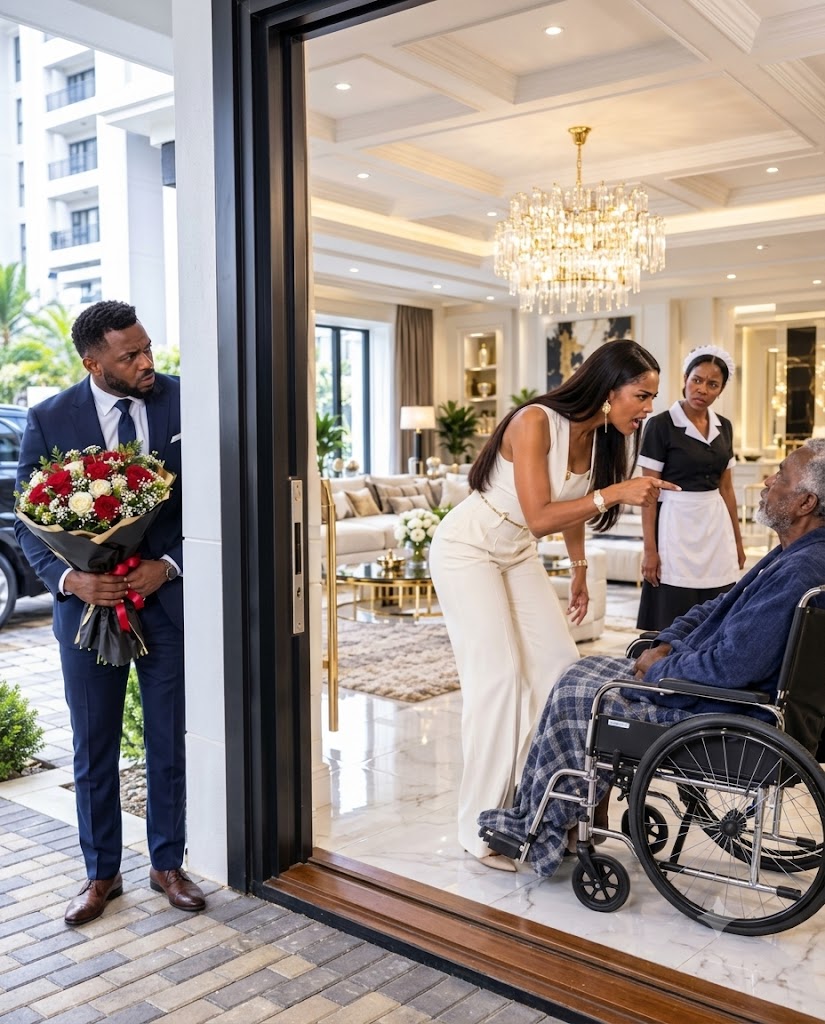
The white roses cost me forty-two dollars at a shop in Greenwich, Connecticut, and I remember thinking that was a small price to pay for the look on Vanessa’s face when she saw them.
I had left the office early for the first time in months, slipping out of Callaway Industries headquarters while the afternoon sun was still high over the Manhattan skyline.
My father built that company from nothing, and lately I had been treating it like a debt I owed him rather than the gift he intended it to be.
The drive home to our estate in Connecticut took just under an hour, and the whole way I kept rehearsing the moment.
Vanessa would be in the living room, probably scrolling through her phone, and I would walk in with the roses behind my back.
She would gasp, and I would kiss her cheek, and for one evening everything would feel the way it did when we first married.
That was the plan.
But plans have a way of dissolving the moment you step through your own front door.
I parked in the garage, walked through the mudroom, and heard her voice before I saw her.
It was not the voice she used when I was around.
That voice was warm, almost musical, the kind of voice that made people lean in closer at dinner parties.
This voice was sharp enough to cut glass.
“How many times do I have to tell you? You are becoming a burden in this house.”
I stopped in the hallway.
The roses were still in my hand, and I felt my fingers tighten around the stems until a thorn pressed into my palm.
My father’s voice came next, and it was barely above a whisper.
“Vanessa, I only asked if you could help me get to the bathroom.”
Richard Callaway had survived a stroke eight months earlier, and the man who once commanded boardrooms with a single raised eyebrow now needed help with things most people never think about.
I had hired a team of medical professionals.
I had paid for every therapy, every piece of equipment, every modification the house needed.
But my father insisted on staying in the family home, and because I was away at work most days, Vanessa and our housekeeper often handled the smaller tasks.
That was supposed to be a temporary arrangement.
That was supposed to be temporary.
“Then call the maid,” Vanessa snapped. “I am not your nurse. I have my own life to live.”
I stepped toward the living room, and through the doorway I saw everything I needed to see.
My father sat in his wheelchair with his head lowered like a schoolboy who had been scolded in front of the class.
Vanessa stood several feet away with her arms crossed, her weight shifted onto one hip, her expression somewhere between boredom and disgust.
Marlene Brooks, who had worked for our family for eleven years, stood frozen near the dining room with a dish towel in her hands.
She looked at me first.
Then Vanessa turned around.
The anger on her face vanished so quickly that I almost wondered if I had imagined it.
“Ethan,” she said, forcing a smile that did not reach her eyes. “You’re home early.”
She glanced at the flowers and hurried toward me with her arms outstretched.
“Are those for me?”
I did not answer.
I looked at my father.
He would not look at me.
I looked at Marlene.
She lowered her gaze to the floor.
Something was wrong in this house, and I had been too busy to notice.
Vanessa reached for the roses, and I let her take them because I did not know what else to do with my hands.
“I heard you shouting,” I said. “What were you saying to my father?”
She launched into an explanation before I could finish the sentence.
She said Richard had misunderstood her.
She said she had only been frustrated because he kept asking for help while she was trying to handle things around the house.
She said she would never disrespect him, that I knew her better than that, that I was making something out of nothing.
I listened without interrupting.
But my eyes stayed on my father.
Richard finally lifted his head and gave me a faint smile.
“It’s nothing, son. Just a minor misunderstanding.”
I looked at him for several seconds.
That answer did not sound like him.
Richard Callaway had never tolerated disrespect from anyone, not from business rivals, not from employees, not from me when I was a teenager testing every boundary I could find.
Yet now he sat quietly in his wheelchair as if saying too much would create a problem he could not afford.
I walked over and placed a hand on his shoulder.
“Are you sure?”
He nodded.
“I’m sure.”
I said nothing more, but I knew I was not convinced.
That night, after Vanessa had gone to bed, I waited twenty minutes and then walked quietly down the hall to my father’s room.
He was sitting beside the window, looking out at the dark garden, and the moonlight caught the silver in his hair.
I pulled up a chair beside him.
“Dad, tell me what really happened.”
He sighed, and for a moment I thought he was going to give me another excuse.
“Ethan, don’t make this bigger than it is. Vanessa is your wife. I don’t want something small to become something that damages your marriage.”
I stared at him.
“Something small?”
He remained silent.
I leaned forward until my elbows rested on my knees.
“Dad, I’ve known you my entire life. You don’t look like a man who just had a minor misunderstanding.”
He finally looked at me, and I saw something in his eyes that I had never seen before.
It was fear, but not fear of Vanessa.
It was fear of what the truth might cost me.
“Sometimes, son, keeping peace means letting certain things go.”
I left his room that night more troubled than I had been before I walked in.
I went to my office and sat in the dark, and I remembered everything my father had done for me.
When my mother, Eleanor, died of ovarian cancer, I was nine years old and the world felt like it had ended.
Richard could have handed me off to a nanny and buried himself in work.
Instead, he made a promise to my mother that their son would never feel abandoned.
He attended every school play, every parent-teacher conference, every baseball game where I struck out more often than I made contact.
He helped me with homework at the kitchen table even when he had board meetings at six in the morning.
Years later, when he found a woman he believed he could build a life with, he ended the relationship the moment he discovered she was cruel to me.
He chose me without hesitation, and he never once made me feel responsible for that sacrifice.
When I became an adult, he handed me control of the company he had built from the ground up.
He told me the business was always meant for the future, and now it was my turn to carry it forward.
I had never forgotten that.
Even after I moved Vanessa into the family home, my father never interfered in our marriage or questioned my decisions.
He did not tell me how to run the company.
He did not dictate what happened under his own roof.
He simply enjoyed having his son nearby, and that was enough for him.
Then the stroke came.
The strong man who had once commanded boardrooms now needed help standing, dressing, and sometimes even eating.
And I had convinced myself that because Vanessa was my wife and lived in the house, my father was being cared for whenever I was away.
That night, I realized how badly I had misunderstood the situation.
The next morning, I found Marlene alone in the kitchen preparing breakfast.
She was slicing strawberries for my father’s oatmeal, and her hands moved with the practiced efficiency of someone who had done this a thousand times.
I stood in the doorway for a moment before speaking.
“Marlene, I need you to tell me the truth. What has been happening with my father when I’m not home?”
She stopped what she was doing.
Her shoulders tensed.
“Mr. Callaway?”
I stepped closer.
“Please. Whatever you tell me, I’m not going to blame you.”
Marlene slowly put down the knife and wiped her hands on her apron.
She had worked for the Callaway family for eleven years, and she had watched me grow from a boy into the man I was now.
She had also witnessed the tenderness between my father and me, the kind of bond that does not need words to prove itself.
“Your father doesn’t want you to know,” she began carefully. “But what happened yesterday wasn’t the first time.”
My expression hardened.
“Tell me.”
Marlene explained that Vanessa had become increasingly impatient with Richard after the stroke.
She complained about the medical equipment in the hallways and the medications on the kitchen counter.
She complained about the physical therapists who came three times a week and the amount of attention my father required.
When I was home, Vanessa acted affectionate and concerned.
But when I left for work, her behavior changed completely.
Marlene had tried to help whenever she could, but there were moments when Vanessa deliberately refused to assist Richard even when she knew he was struggling.
Then Marlene told me about the incident from the previous evening.
My father had needed help getting to the bathroom.
Vanessa had become angry and told him she was tired of serving an old man who contributes nothing anymore.
She had moved his wheelchair just outside his reach and walked away while he struggled on the floor.
Marlene found him minutes later and rushed to help him.
I stood completely still as she spoke.
“Why didn’t you tell me this yesterday?”
Marlene lowered her eyes.
“Because your father begged me not to. He said he didn’t want to come between you and your wife.”
My jaw tightened.
“And you listened to him?”
She nodded sadly.
“He kept saying that Vanessa was your wife and that he could endure whatever she said as long as you were happy.”
I walked away from the kitchen without another word.
I went into my office and closed the door behind me, and for several minutes I simply stood there staring at the photographs on my desk.
There was one of my parents on their wedding day, my mother laughing at something the photographer said.
There was one of my father holding me on his shoulders at a Fourth of July parade when I was five.
There was one of the three of us at my college graduation, my father’s pride so obvious that it seemed to radiate off the paper.
My father had given me everything.
An education, a home, a company, and a childhood protected from the hardships that followed my mother’s death.
Yet now that he needed protection, he had been hiding his suffering to protect my marriage.
I reached for my phone and made a decision.
If Vanessa could pretend to be a loving wife whenever I was around, I needed to know what happened when I wasn’t.
That afternoon, I contacted a security professional and arranged for discreet cameras to be installed throughout the common areas of the house.
I was not looking for a reason to hate my wife.
I wanted the truth, and I was willing to pay for it.
The cameras cost me just under three thousand dollars, installed in a single afternoon while Vanessa was at a spa appointment in town.
The technician was professional and quick, and by the time Vanessa returned home, there was nothing visible that would give anything away.
For the next several days, I watched the recordings in silence.
At first, I hoped Marlene had exaggerated what was happening.
I wanted to believe Vanessa had simply lost her patience once or twice because of the pressure of caring for someone recovering from a stroke.
I wanted to believe the woman I married was still in there somewhere.
But the footage showed something much worse.
Whenever I was home, Vanessa spoke gently to Richard, helped him with small things, and asked about his medication.
She laughed at his jokes and touched his shoulder when she passed his chair.
She played the role of the devoted daughter-in-law so convincingly that I almost felt foolish for installing the cameras.
The moment I left for work, her entire personality changed.
She complained whenever Richard needed assistance and sometimes ignored him for long periods.
One afternoon, I watched Vanessa stand in the doorway while my father struggled to reach for a glass of water that had fallen beside his wheelchair.
She looked at him and said, “You have a maid for this. Stop calling me every time you need something.”
Then she walked away.
The recordings became harder to watch.
I saw Marlene quietly helping my father when Vanessa refused.
I saw Richard apologizing repeatedly for needing assistance, as if his vulnerability was an inconvenience he had chosen.
One evening, Vanessa became angry because Richard had accidentally spilled some water on the carpet.
“Do you know how much this house costs to maintain?” she snapped.
My father lowered his head.
“I’m sorry. I didn’t mean to.”
Vanessa continued, telling him that the entire household revolved around his medical needs.
She told him he should be grateful that she allowed him to stay in the house at all.
I sat alone in my office watching the footage, and my eyes became wet.
I could not understand how the woman I had married could speak to the man who had given us so much with such contempt.
Richard had never demanded that Vanessa serve him.
He had never interfered in our marriage.
He mostly stayed in his room, went to his medical appointments, and tried to make himself as little of a burden as possible.
Then I saw the incident Marlene had described.
My father needed help getting to the bathroom.
Vanessa became irritated, moved his wheelchair away from him, and told him she was tired of serving an old man who contributes nothing anymore.
Richard tried to pull himself toward the chair, but his weakened body could not do it.
Vanessa walked away without looking back.
Minutes later, Marlene rushed into the room and found him struggling on the floor.
I stopped the recording.
I could not watch it anymore.
I sat there with my hands covering my face, remembering the father who had carried me through the hardest years of my childhood.
That night, I did not confront Vanessa.
I needed to see everything first, but deep inside, I already knew that something between us had changed forever.
The following morning, I went to work as usual, but my mind was not on the company.
I sat in my office staring at the city through the windows while memories of my childhood came flooding back.
After my mother’s death, Richard could have hired someone else to raise me while he focused entirely on his growing business.
Instead, he made a promise to Eleanor that their son would never feel abandoned.
He attended my school events, helped me with my homework, and made sure I had every opportunity I needed.
I remembered the night I came home from middle school with a failing grade in algebra, convinced my father would be furious.
Instead, he sat with me at the kitchen table for three hours, working through problems until I understood them.
I remembered the time I crashed his car into a mailbox when I was seventeen, and he did not yell or ground me for a month.
He simply asked if I was hurt, and then we spent the afternoon repairing the mailbox together.
Years later, when Richard found a woman he believed he could build a life with, he ended the relationship after discovering that she was cruel to me.
I was fourteen years old, and I had come home from school to find her mocking the way I dressed.
My father heard it from the other room and asked her to leave that same evening.
He never made me feel responsible for that sacrifice.
When I became an adult, Richard eventually handed me control of the company.
He told me he had built the business for the future, and now it was time for me to carry it forward.
I had never forgotten that.
Even after moving into the family home with Vanessa, Richard never interfered in our marriage or questioned my decisions.
He did not tell me how to run the company.
He did not dictate what happened in the household.
He simply enjoyed having his son nearby.
When the stroke came, everything changed.
The strong man who had once commanded boardrooms now needed help standing, dressing, and sometimes even eating.
I had convinced myself that because Vanessa was my wife and lived in the house, my father was being cared for whenever I was away.
Now I realized how badly I had misunderstood the situation.
That evening, I returned home and behaved as though nothing had happened.
Vanessa greeted me affectionately and asked about my day.
She kissed my cheek and smiled when I told her I had several important meetings.
I looked at her differently now.
I wondered how many times she had smiled at me immediately after making my father cry.
I went to my father’s room later that night and found Richard reading quietly.
I sat beside him.
“Dad, are you happy here?”
Richard looked surprised by the question.
“Of course I am. You’re here.”
I swallowed hard.
“That’s not what I asked.”
Richard stared at me for a long moment, then looked away.
He still refused to speak against Vanessa.
That silence hurt me more than an accusation would have.
I finally understood that my father was not hiding the truth because nothing was wrong.
He was hiding it because he loved me too much to risk destroying my marriage.
Two days later, I decided I had seen enough.
I came home from work earlier than usual and asked Marlene to bring my father into the living room.
Vanessa was already there, sitting comfortably on the sofa and scrolling through her phone.
When she saw me enter, she smiled.
“You’re home early.”
I did not respond.
I walked to the center of the room and looked at my father, then at Marlene, and finally at Vanessa.
“I asked all of you to come here because there is something we need to discuss.”
Vanessa’s expression changed slightly.
Richard looked confused.
I reached for the remote in my hand and turned on the television.
“Dad, before we start, I need you to know something. I know.”
Richard immediately understood.
His face fell.
“Ethan.”
I stopped him.
“No, Dad. Please let me finish.”
I turned toward Vanessa.
“I heard you that day. I heard you calling my father a burden. I asked you what happened and you lied to me.”
Vanessa opened her mouth, but I continued.
“Then I asked Marlene, and she told me what has been happening when I’m not home.”
Vanessa looked toward the housekeeper with anger.
“You had no right.”
I raised my hand.
“Don’t blame her. She told me the truth because she was taking care of the man you refused to care for.”
Vanessa became defensive, insisting that she had only been overwhelmed.
I picked up the remote and began playing the recordings.
The room became completely silent as Vanessa’s own voice filled the living room.
Richard lowered his head as the footage played.
I watched my wife’s face change as each recording exposed what she had done.
When the video showed Richard stranded on the floor while Vanessa walked away, I stopped it.
My voice was quiet.
“That was my father, the man who raised me after my mother died, the man who gave me his entire life.”
I looked at Vanessa.
“And you treated him like he was worthless.”
Vanessa began crying and insisted that she was sorry, but I was not finished.
I turned toward my father.
“And you? You knew she was doing this and you still protected her from me.”
Vanessa stood in the middle of the living room crying, her hands trembling as she tried to explain herself.
She admitted that she had become frustrated with Richard’s condition and claimed she never intended to hurt him.
She promised that she would change and begged me to give her another chance.
I remained silent for several seconds.
Then I looked at my father.
Richard’s eyes were filled with tears, but he still said nothing.
I turned back toward Vanessa.
“You didn’t make one mistake,” I said quietly. “You made a choice every time you treated him that way. And every time you saw him struggling and walked away, you made another choice.”
Vanessa tried to approach me, but I stepped back.
“I’m sorry, but I don’t believe your apology.”
Vanessa began crying harder.
“Ethan, please. I love you.”
I shook my head.
“If you loved me, you would have respected the man who gave me everything.”
I pointed toward my father.
“You knew he was vulnerable. You knew he couldn’t defend himself the way he used to. And you used that.”
Vanessa pleaded with me not to end our marriage over what she called a misunderstanding.
My expression hardened.
“You called my father a burden. You left him on the floor when he needed help. You lied to my face when I asked you what happened. And you only apologized because you were caught.”
I paused before saying the words Vanessa had been desperately hoping she would never hear.
“Pack your things and leave this house.”
Vanessa stared at me in disbelief.
“You’re throwing me out?”
I nodded.
“Yes.”
She looked toward Richard, perhaps hoping he would intervene, but my father remained silent.
I continued.
“This is my father’s home. He built the life that allowed me to have everything I have today, and he deserves to feel safe here.”
Vanessa wiped her tears and walked toward the staircase.
I watched her go without following.
Marlene remained beside Richard, quietly holding his hand.
Once Vanessa disappeared upstairs, Richard finally looked at his son.
“You didn’t have to do this for me.”
I knelt beside my father’s wheelchair.
“Yes, Dad. I did.”
Richard’s eyes filled with tears.
“I only wanted you to be happy.”
I gently held his hand.
“You spent your whole life protecting my happiness. It’s my turn to protect yours.”
The next morning, the house was unusually quiet.
Vanessa had left with her belongings before sunrise, leaving behind a silence that felt completely different from the tension that had filled the home for months.
I walked into my father’s room and found Richard sitting by the window.
For a while, neither of us spoke.
Finally, I sat beside him and said, “Mom would have been proud of you.”
Richard’s eyes immediately became wet.
I reminded him of the promise he had made to Eleanor all those years ago.
He had kept it through every sacrifice, every lonely night, and every difficult decision.
He had raised me into the man I was despite losing the woman he loved.
“You never failed her, Dad,” I said. “And you never failed me.”
Richard shook his head.
“I thought if I told you what was happening, you would hate her. I didn’t want to be the reason your marriage ended.”
I looked at him with tears in my eyes.
“You weren’t the reason. What she did was the reason.”
Richard looked down at his hands.
“I didn’t want you to choose between us.”
I gently squeezed his shoulder.
“There was never supposed to be a choice. You are my father. You raised me. You sacrificed for me. You gave me the company and trusted me with everything you built. The least I can do is make sure you are treated with dignity.”
Richard smiled through his tears.
For the first time in a long time, he seemed relieved.
He did not have to hide his pain anymore.
Later that day, I went into the kitchen and found Marlene preparing my father’s breakfast.
I thanked her for everything she had done and handed her an envelope.
Marlene looked inside and immediately tried to refuse it.
I told her that she had protected my father when I was not there, and I would never forget that.
I increased her salary by fifteen thousand dollars a year and told her that if Richard needed anything while I was at work, she should get it immediately and contact me without hesitation.
“Don’t ever worry about disturbing me,” I said. “If Dad needs something, I need to know.”
Marlene nodded, visibly emotional.
“I will take care of him.”
I smiled.
“I know you will.”
For the first time since my father’s stroke, I left for work without wondering whether the person I loved most was safe at home.
Months passed, and the Callaway household became peaceful again.
I continued running the company, but I made changes to ensure I spent more time with my father.
I arranged for additional professional care and modified parts of the house to make Richard’s daily life easier.
Marlene remained by his side during the hours I was away, and I made it clear that Richard’s needs would never be treated as an inconvenience.
Richard’s health slowly improved, although the stroke had left permanent challenges.
Yet emotionally, something had changed.
The sadness that had once filled his eyes was gradually replaced by peace.
He no longer felt like he had to apologize for needing help.
One evening, I returned home carrying another bouquet of flowers.
This time they were not for Vanessa.
I walked straight into my father’s room and placed the flowers on the table beside him.
Richard laughed softly.
“What are those for?”
I smiled.
“For the man who gave me everything.”
Richard shook his head.
“You don’t owe me anything.”
I sat beside him.
“Maybe I don’t, but I want you to know that I remember.”
I told my father that no company, property, car, or amount of money could ever compare with the years he had given me.
Richard reached for my hand.
“Your mother would have loved the man you became.”
I lowered my head as tears rolled down my face.
That night, I stood outside my father’s room for a moment before turning off the hallway light.
I thought about the woman I had once loved and the painful decision I had made.
I thought about my mother’s final promise, my father’s sacrifices, and the day I had almost failed to notice what was happening under my own roof.
I realized that sometimes the people who love us most will hide their pain because they don’t want to become a burden to us.
Richard had spent his entire life protecting me, and when he became vulnerable, he had still tried to protect his son from the consequences of his own suffering.
I knew I could never repay my father for everything he had done, but I could honor him.
I could stand beside him, and I could make sure that the man who had spent his life making his son feel safe would never again have to feel like a burden in his own home.
The white roses I bought that day cost me forty-two dollars, and they wilted within a week.
But the look on my father’s face when I handed him those flowers in the quiet of his room, that was something that would never fade.
Vanessa called me three times in the weeks that followed, and each time I let it go to voicemail.
Her lawyer sent a settlement proposal asking for the Connecticut estate, half of my assets, and a monthly allowance that would have exceeded my father’s annual medical expenses.
I forwarded it to my attorney with a single instruction: no.
The divorce was finalized six months later, and I did not attend the hearing.
I was at home with my father, watching a baseball game on television, and when the final out was recorded, he turned to me and said, “You know, I never liked her cooking anyway.”
I laughed harder than I had in years.
That was the moment I knew we were going to be alright.
My father lived for four more years, and in that time he saw me remarry a woman named Claire who treated him like her own father.
He walked me down the aisle at my second wedding, using a cane but refusing the wheelchair because he said he wanted to do it properly.
When he held my son for the first time, he cried, and I cried, and Claire pretended she was not crying.
Richard Callaway died peacefully in his sleep at the age of seventy-nine, and the last thing he said to me the night before was, “Thank you for the flowers, son.”
I did not understand what he meant until I found the pressed white rose in the drawer beside his bed, the same one I had given him years earlier, preserved between the pages of my mother’s favorite book.
He had kept it all that time.
He had kept it because it was not about the flowers.
It was about what they meant.
And I like to think that somewhere, wherever he is now, he knows that I finally understood.









