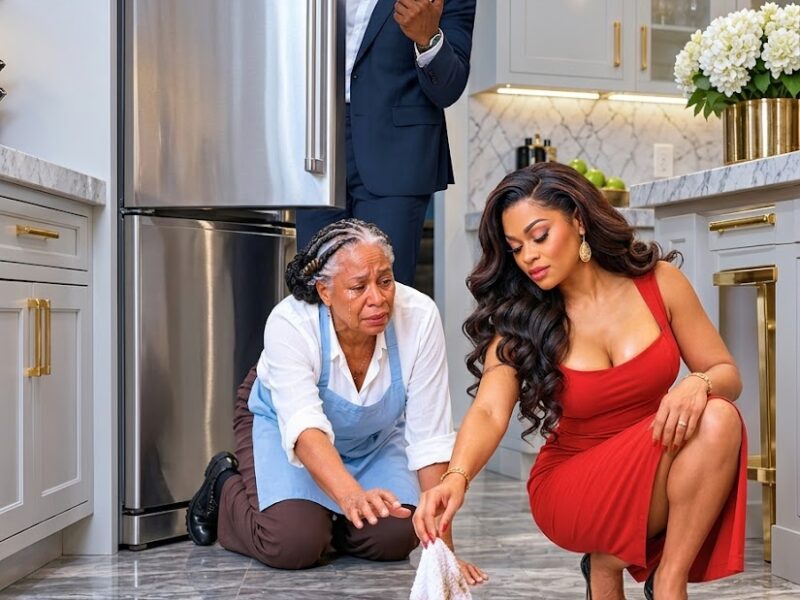
I came home early and saw how my wife’s family treated my mother—so I quietly called my lawyer.

The spot was still dirty. Patrice pressed her finger against the tile and held it there like she was testing paint.
“Do it again,” she said. Not loud. Not angry. Just certain.
My mother pressed the cloth back to the floor without a word. Her surgical knee was bent against the hard tile, and she was leaning her weight on her left hand to keep the pressure off it. Patrice leaned back in her chair and crossed her arms. “The whole left side, not just the middle.”
Joselyn dropped a stack of plates into the sink hard enough that one of them chipped. She didn’t look up. “Can you get those two? I don’t want to deal with them tonight.”
I was standing just outside that doorway. I had been there long enough to hear all of it. My mother, sixty-eight years old, four weeks out from knee replacement surgery, was on her hands and knees cleaning a floor that had already been cleaned twice. And nobody in that kitchen thought anything of it.
What my wife didn’t know was that I had come home two days early. Nobody in that house had any idea I was there.
I took one step back and reached for my phone. I didn’t call anyone yet. I just held it. Sometimes you need something to grip while you figure out what you’re actually looking at.
Kendra walked in then. She stepped over the wet cloth, glanced around the room, and said it the way you’d say almost anything, like it cost her nothing at all. “She’s staying here for free. Least she can do is help out.”
Nobody disagreed. Nobody flinched. It landed in that room like something that had been said before—something everyone present had already agreed to and long since stopped thinking about.
The woman on that kitchen floor was my mother.
The only question now is what she thought would happen once I decided to stop watching.
—
My name is Warren Dorsy. I’m forty-two years old and I co-founded a supply chain management company based in Charlotte about fifteen years ago. I built it slowly. Careful decisions, long stretches where the payoff wasn’t visible yet. Years of work that didn’t feel like they were adding up until suddenly they did.
I don’t tend to lead with money when I tell a story, but the financial context matters here. So I want to lay it out clearly before we get into anything else.
The house where I live is in a neighborhood called Hawthorne Ridge. I purchased it three years before I married Kendra. It sits in a private trust under my name and is protected under the prenuptial agreement we both signed before our wedding. I’m mentioning this now not because it becomes relevant immediately, but because it becomes very relevant later. Nearly every detail in this story does.
The most important person in my life has always been my mother, Lillian. She’s sixty-eight years old. After my father passed away, she stayed in her own home near Asheville and made clear she intended to keep it that way.
Independent doesn’t quite cover what she is. It doesn’t capture the full picture. She would drive forty minutes to a hardware store, watch tutorial videos, and fix something herself before she would consider calling me for help. The idea of depending on anyone—especially on me—was something she actively fought against. She had been fighting it her entire adult life.
Every time I tried to send her money for something she didn’t ask for, she sent it back. Every time I offered to hire someone to fix something around her house, she told me she had already handled it. That wasn’t stubbornness for its own sake. That was a woman who had spent decades building a life she was proud of and intended to protect every corner of it.
So when her doctor said she needed knee surgery and I asked her to come stay with us during recovery, she said no. I asked again a few weeks later. She said no again. She had a plan. She would manage from her own place. She had neighbors she trusted. She would be fine.
It took Kendra calling her one evening to change anything.
I was in the other room and heard the entire conversation. Kendra told her the house had more room than we knew what to do with. She said there was no reason to go through something like this alone. She said the guest room on the second floor had its own bathroom and its own entrance from the hallway and that my mother could come and go exactly as she pleased without feeling like she was in anyone’s way.
And she said something I remember clearly to this day. “Stay as long as you need to. The longer the better.”
My mother said yes.
I want to be careful about how I describe what I felt in that moment because it matters for everything that came after. I don’t believe I was being naive. I think I was being trusting. And I’ve come to believe those are genuinely different things.
Standing in that hallway listening to my wife talk my mother into letting us help her, I thought I understood exactly who Kendra was. I thought I made the right choice. I was looking at something I took for evidence of her character, and I was grateful for it.
I was misreading what I was looking at. But that didn’t become clear for a while.
—
A few days after my mother got settled in, Kendra suggested her own mother come to stay as well. Patrice. The reasoning was practical and made sense on its face. I had an eleven-day business trip to Denver coming up, and she didn’t want Lillian to be alone in an unfamiliar house with no one around. I thought it was a considerate thing to arrange. I told her so.
Then Joselyn came. Kendra’s younger sister, twenty-nine, between jobs and between apartments in the particular way that happens when the people around you have always made it easy to postpone dealing with your own life.
Then Cameron arrived. Kendra’s younger brother, twenty-six, about ten months into what he called figuring out his next move. From what I could observe, figuring out his next move mostly meant deciding which chair to sit in.
I felt genuinely grateful for all of it. I left for Denver believing I had left things in good hands. I had no real understanding of what I was walking away from.
Patrice moved into the largest guest room on the upper floor. Joselyn converted my home office into a personal dressing room, cleared space for a mirror and ring light, spread her clothes across every available surface. Cameron brought friends over on weekends and left the kitchen the way people leave kitchens when they have never in their lives been the one responsible for what comes after. Beer bottles on the counter. Takeout containers on the stove. Dishes stacked in the sink with no apparent concern about whether they would clean themselves by morning—which they wouldn’t, because my mother would be up before anyone else to handle it.
And my mother, the person who was there to rest and let her knee recover, became the one who kept all of it running.
It didn’t happen with an announcement. There was no conversation, no moment where someone sat her down and explained the new arrangement. It built itself one small step at a time, the way these things always do.
Would she mind starting the coffee since she was already up? Could breakfast be ready around eight? The towels in the hall bathroom weren’t folded correctly. The upstairs bathroom needed attention. The guest bathroom on the ground floor—the one closest to the living room—should probably be checked before guests came over on the weekend.
She did all of it.
She was up before six every morning. She cooked full meals. She cleaned rooms that weren’t hers and said nothing about it. She washed Joselyn’s clothes by hand when Joselyn decided she didn’t like sharing the machine. She handled the dishes Cameron’s friends left stacked in the sink on Sunday evenings. She managed the household the way a staff member manages a household—thoroughly, invisibly, and with the constant, quiet awareness that her continued presence depended on no one finding reason to complain.
Kendra watched all of this happen.
When my mother gently mentioned that the family seemed to expect quite a lot, Kendra told her they were just used to being looked after and asked her to be patient with the adjustment period.
My mother was patient. She was patient because she knew what this marriage meant to me. She was afraid of what would happen to it if she told me the truth.
So she kept going. She absorbed everything asked of her and made sure none of it showed up in her voice when I called from Denver.
That’s what people who love you hardest tend to do. They hide their pain so well that the people causing it barely have to think about it. And the people causing it have usually already learned—whether consciously or not—that they can count on that silence to keep things comfortable for everyone except the person doing the hiding.
—
The trip to Denver was eleven days. For the first three or four, my calls with my mother felt normal, or at least they seemed to. We talked about her physical therapy schedule, the weather, small things that don’t require much from either person.
Then the calls started getting shorter.
She was always in the middle of something. Tired from the day. She’d call me back tonight. I didn’t push it because that fit her personality. She had never been someone who liked long phone calls.
But it happened every single day. And after a while, the reasons started sounding slightly too ready, slightly too consistent to be spontaneous—like she’d thought about what she’d say before she picked up.
Around the sixth day, she picked up a video call and I could see she wasn’t in the bedroom I had set up for her. I’d thought about that room carefully. A comfortable chair near the window. A step stool by the bed so she wouldn’t have to strain first thing in the morning. Nothing she’d need to reach for.
She wasn’t there. She was in the laundry room. Baskets stacked behind her, the washing machine running. She said she had taken the call there because it was quieter.
I let that go. I wish I hadn’t.
Two days after that, I noticed her right wrist was wrapped in a bandage. I asked what happened. She said she had caught it on the corner of a cabinet. Kendra stepped into the frame almost immediately and said I shouldn’t worry. Everyone was taking good care of her. She said it with a smile.
I nodded. I didn’t say much else. But something had been building in my chest since that laundry room. A weight I didn’t quite have a name for yet. That specific feeling you get when the pieces of something aren’t adding up and you haven’t let yourself look at what they add up to.
Then came the eighth night.
I was in my hotel room going through documents when my phone lit up. A text from my mother. I looked at it. Within a few seconds, it was gone. She deleted it almost immediately after sending.
I caught three words before it disappeared. *Don’t be angry.*
I called her right back. No answer. Called twice more. Nothing.
I put the phone down and sat there in the dark of the hotel room for a long time. *Don’t be angry.* You don’t type that and delete it by accident. You type it when something has been sitting inside you long enough that it slips out before you can stop it. And then you feel the panic of having said too much and you pull it back as fast as you can.
That’s not a mistake. That’s someone barely containing something they’ve been holding for a long time. That’s the very edge of a person’s ability to keep pretending.
I didn’t sleep that night.
First thing the next morning, I rearranged my remaining meetings, called my assistant, and booked a flight home for that afternoon. I didn’t contact Kendra. I didn’t tell anyone I was coming on the flight.
I want to be honest about where my head was. I wasn’t certain of anything yet. I was working from three words and a feeling. And part of me was still holding out the possibility that I was overreacting—that I’d walk in and find everything fine and feel a little foolish for cutting the trip short.
I wanted that. I genuinely wanted to be wrong about all of it.
—
I pulled into the driveway without calling ahead, came in through the side entrance, heard voices from the kitchen, stopped in the hallway just outside the doorway, and looked in.
My mother was on the floor. Not sitting, not crouching to pick something up—on her knees, her surgical knee against the tile, with a cloth in her hand, cleaning up a spilled drink.
Patrice sat at the kitchen table, pointing to a section of the floor my mother had already cleaned twice and telling her it wasn’t done right. Joselyn stood at the sink, stacking plates without rinsing them. Cameron had his feet up on the chair across from him, eyes on his phone. He hadn’t looked up once in the entire time I’d been standing there. Not once. As if what was happening three feet away from him was simply background noise.
Then Kendra walked in. She stepped around my mother without breaking stride, glanced at the room, and said it with the ease of someone commenting on nothing in particular.
“She’s here for free. Least she can do is help out.”
Nobody reacted. Not a glance, not a shift in posture. It landed in that room like something that had been said before—something everyone present had already agreed to and long since stopped thinking about.
I had my hand on the door frame. Then Patrice said, “Her son’s never going to find out about any of this. Long as she’s smart, this keeps working fine for everybody.”
My mother’s answer was quiet. “I don’t want to ruin his marriage.”
I stood there a moment longer. What I felt wasn’t simply anger. It was something harder to name—a kind of recognition, the slow, settling weight of understanding something you’d been avoiding.
Because what I was hearing wasn’t a snapshot of one bad evening. My mother had been making an active choice day after day to stay quiet about everything happening in this house. She was protecting the marriage she thought I needed. And every person in that kitchen had been relying—whether they fully understood it or not—on her to keep making that choice.
Everything in me wanted to go back in there and end it immediately. Walk into that kitchen, say what I had seen and heard, and have every one of them out of my house before the night was over.
I didn’t do that. Not because the anger wasn’t real. It was very real.
But I understood, sitting alone outside that house for those few minutes, that going in right now was the worst move I could make. The moment I walked through that door angry, I would get exactly what they were prepared to give me. Explanations. Denials. Carefully arranged regret. Kendra would find a way to make my reaction the issue instead of what I had seen. And my mother would almost certainly step in and soften everything to keep things from escalating.
That’s what she did. That’s who she was.
I needed the full picture first—not just what I’d seen in the last ten minutes. Everything. What had been happening for weeks. What my actual legal standing was in my own home. What all of this looked like clearly and completely documented and verified before I made a single move.
So I drove around the block, came back, pulled into the driveway, and closed the car door loud enough to be heard from inside the house. I walked to the front door, pushed it open, and called into the entrance.
“Anybody home?”
—
What happened in the next thirty seconds, I’ve thought about many times since. Patrice was on her feet before I even reached the kitchen doorway. Joselyn had a dish towel in her hand at the sink. Cameron had both feet flat on the floor and was looking toward the hallway. And Kendra was already moving toward me with a smile.
“You’re back early. You should have texted.”
I hugged her. Over her shoulder, I looked at my mother, who was standing near the stove. Her face was composed—carefully so—in a way I now understood had taken practice. She had done this before. Assembled herself quickly, found her expression, stood in the right place, so that nothing about the scene would require explanation.
I looked down at her hands. The knuckles on her right hand were red and swollen. Not from a single day of work. From longer than that. Days of it. Maybe weeks. The kind of wear that builds up gradually and doesn’t announce itself until you’re close enough to see it clearly.
I said nothing about it.
Dinner was the kind of quiet that happens when everyone at the table is managing what they say rather than saying what they actually think. Afterward, Kendra’s family moved to the living room. My mother excused herself early and walked slowly down the hallway toward her room. I watched her go.
A little while later, I told Kendra I needed some air and went out to the car.
I called Graham Bellamy at 9:47 that evening. Graham has been my attorney for more than a decade. He handles my business interests, the family trust, the property, the prenuptial agreement. He is also someone I trust completely—which at that point in the evening was the most important qualification he had.
When he answered, I told him to open my prenuptial file and start preparing documentation for every person currently residing in the house. Then I asked him to run a full review of my accounts—personal and household—going back three months. I wanted to know exactly who had access to what, what had been spent, and where it had gone.
He was quiet for a moment. “How much time do I have?”
“Tomorrow morning.”
—
I sat in the car for another twenty minutes after I hung up. The television light shifted behind the curtains in the living room. I could hear faint laughter from somewhere inside the house. Cameron and one of his friends, from the sound of it. Comfortable and unhurried on a weeknight in a home that wasn’t theirs.
I thought about my mother’s hands. About the apron I didn’t recognize. About the laundry room in the background of a video call she took standing up because she couldn’t afford to stop moving. About three words she typed and then panicked and erased because she had decided in the space of a few seconds that my peace of mind was worth more than her honesty.
What I was about to do was not about revenge. It was not about winning or humiliating anyone or proving a point. My mother had absorbed everything silently, daily, to protect something she thought I needed. The least I could do was make sure I fully understood what had been happening before I decided what to do next.
I went back inside, said good night, lay in the dark. By the time morning came, Graham had already sent me a message. It was time to find out exactly what had been going on in my own house.
—
The next morning, I waited until Kendra’s family had settled into their usual routines before I found a moment alone with my mother in the kitchen.
I want to describe how she looked because it matters. She moved carefully—not the way she always moved, which was purposeful and direct. This was something else. A kind of deliberate management of her body, making sure nothing looked wrong. She was performing *fine* for me, and she had been doing it long enough that it had become automatic.
The performance was seamless. If I hadn’t known what I knew, I might not have seen it at all.
I told her I wanted to talk. She said she had some things to finish up first. I said they could wait.
We sat at the table. I kept my voice level and I asked her as straightforwardly as I knew how to tell me what had been happening while I was gone.
She denied almost everything.
Patrice was just particular about certain things. Joselyn was adjusting to a new environment. Kendra had been under a lot of pressure lately and was doing the best she could. People adjust when they’re living together. There’s always a period of friction, and that was all this was.
I didn’t interrupt any of it. I let her finish.
Then I asked, “Mom, have you been cooking meals for them every day?”
She looked down at the table.
“Are you doing their laundry?”
She adjusted the edge of her placemat.
“Have they asked you to clean their rooms?”
She started to cry. But even then—even with tears on her face—what she said was this: “Don’t break up your family because of me. Please don’t do that.”
I had to take a moment with that. Because it told me something that the camera footage would later confirm in a different way. My mother had been carrying this for weeks—not passively, but actively, making the choice every single day to absorb it, to stay quiet, to protect a version of my life she thought I needed. And the people in that house had figured out, whether by instinct or by design, that she would keep making that choice.
I told her everything was going to be fine. I didn’t tell her what I had seen. I didn’t tell her about the call to Graham. I just said she didn’t need to worry—and I let her believe I was still in the dark.
—
In the days that followed, Kendra noticed my mood had changed and adjusted accordingly. She started making small gestures around my mother. Asking if she needed anything. Sitting near her during meals. Patrice brought flowers and placed them on the dresser in my mother’s room. Joselyn posted a photograph on her social media of all four women at the kitchen table with a caption about family and togetherness. Cameron asked my mother if she needed a ride anywhere—first time since he arrived.
Every single one of these things was a performance. And every single one of them was aimed at me.
I watched all of it without reacting.
Meanwhile, Graham had been working.
The house had a security camera system installed throughout the common areas. I’d had it put in after some break-ins in the neighborhood a couple of years back. I hadn’t reviewed the footage in months. The system had been running the entire time I was in Denver, recording every common space in the house. Kendra’s family had lived there long enough to forget it existed.
That oversight cost them everything.
My mother was up before six every morning. Not once in three weeks of footage did she sleep past 5:50. She was the first person in the kitchen every day, without exception. Making coffee, setting out cups, starting breakfast before anyone in that house was awake enough to ask for it.
I watched Patrice walk in one morning, look at the table my mother had set, and tell her the mugs were wrong. She wanted hers on the left side. She said it in the tone of someone correcting a staff member who should have already known better. Not unkind, exactly. Just utterly certain that this was the appropriate way to speak to the person in front of her.
My mother moved the mug to the left side and said nothing.
I watched Joselyn come downstairs one afternoon with a laundry basket and put it on the kitchen counter directly in front of where my mother was chopping vegetables for dinner. She didn’t ask. She just put it down and said she needed those done separately because she had delicate fabrics. Then she walked out.
My mother set down her knife, picked up the basket, and went to the laundry room.
I watched Cameron come into the kitchen at eleven at night, open the refrigerator, and eat the entire portion my mother had covered and set aside for herself for the next morning. He took it to the couch, ate in front of the television, and left the container on the coffee table. The next morning, my mother was up twenty minutes earlier than usual and cooked from scratch before anyone else was awake.
He never knew. Or if he did, he didn’t consider it worth thinking about.
But none of those clips were the hardest to watch.
The hardest one ran for about four minutes on a Tuesday evening. My mother came to Kendra in the hallway just outside the kitchen and told her quietly that her knee had been bothering her more than usual and she needed to go to bed early that night. She wasn’t asking for anything. She was informing her daughter-in-law as a courtesy that she wouldn’t be available for the rest of the evening.
Kendra listened to the whole thing. Then she said her mother had mentioned wanting the kitchen clean before morning. She said my mother should take care of it before going to bed. She said I was already dealing with enough and my mother shouldn’t add to my stress.
My mother stood there for a moment. Then she asked whether Kendra might be willing to explain to Patrice that she was still in recovery.
Kendra said, “If you want to keep staying here, the best thing to do is not make everything into a problem.”
Then she walked away.
My mother stood alone in that hallway for a few seconds. Then she went to the kitchen and started cleaning.
I closed the laptop.
The house was mine. I had purchased it. I had invited my mother here specifically so she wouldn’t have to be alone while she recovered from surgery. And somehow, inside the walls of a home I owned and paid for, my wife had made my mother believe that her continued presence was conditional on her silence and her service.
That requires consistent reinforcement. My mother had to be told again and again—directly and indirectly—that she was a guest who could be removed and that the cost of staying was compliance.
—
There is a version of this story where Kendra is simply a weak person who couldn’t manage her family. A woman who looked the other way because confronting her mother and siblings was too difficult. I considered that version. It would have been easier to accept in some ways.
But the footage didn’t support it.
Kendra didn’t look the other way. She participated. She reinforced the arrangement. She used my mother’s deepest fear—the fear of damaging my marriage—as a mechanism to guarantee her silence. She did this while telling me on the phone from Denver that everything was fine and everyone was taking wonderful care of her.
Graham’s financial review confirmed something else.
Over the course of three months, my mother had transferred a total of more than $9,000 into an account Kendra managed directly. The notation on every transfer was the same: *household expenses.*
I had never asked my mother to contribute a single dollar to the cost of living in my home. I was covering all of it, the same as I always had. When I asked her about it, she eventually admitted that Kendra had told her the utility bills and grocery costs had gone up significantly since she arrived. She believed that. She felt guilty about it. And so she paid—out of a fixed retirement income—for the privilege of cleaning someone else’s dishes at six in the morning.
Graham’s review also flagged a monthly car payment being drawn from one of my household accounts. Cameron’s vehicle, covered through a transfer arrangement Kendra had set up without a direct conversation with me about it. The amount had been folded into larger household withdrawals in a way that made it easy to miss.
A portion of my mother’s transfers had gone toward Joselyn’s credit card debt. Another portion had funded a resort deposit that Patrice had placed—a trip I had never been told about, and that had been paid for in part with money my mother believed she owed for her own electricity and groceries.
I sat with all of that for a long time. Then I went back to Graham and told him to start preparing the paperwork and to plan on being at the house in person later that week.
Graham’s advice was to move carefully. The house was my separate property, protected by the trust and the prenuptial agreement. But Kendra was my legal spouse and a current resident. Patrice, Joselyn, and Cameron could not simply be removed overnight. Local law required proper notice and a specific timeline. Moving too fast out of anger would give all of them something to respond to and shift the situation from one where I held every advantage to one where I was reacting.
We needed a few days.
In the meantime, I restructured the business assets held under my personal ownership, moving them back into the exact arrangements specified in the prenuptial agreement. Not to hide anything, but to make the boundaries absolutely clear before any formal proceeding began.
I also identified and closed off the financial pathways Kendra had been using to extend resources to her family. Joselyn’s supplemental card tied to one of my accounts was cancelled. The automatic payment covering Cameron’s car note was stopped. The resort reservation Patrice had placed using my account information was cancelled at the booking level.
Every one of these actions had been reviewed with Graham beforehand. None of them were impulsive.
The responses came within forty-eight hours.
Joselyn came to Kendra saying her card wasn’t working. Cameron said there had to be an error with the car payment. Patrice received a cancellation notice from the resort and called Kendra twice in the same hour.
Kendra came to me that evening and said she thought there had been some problem with the accounts. I told her the accounts were fine and walked out of the room.
She tried again the next night. This time she was more direct. “Are you trying to embarrass my family?”
I looked at her for a moment. “Have you ever once asked my mother whether she felt embarrassed in this house while I was gone?”
She didn’t answer. But the way her expression shifted told me she understood something had changed.
She went quiet in a way that wasn’t her usual quiet. Less settled. More calculating. She was trying to figure out exactly what I knew and how I had come to know it—and whether there was still a version of this she could manage.
—
In the days that followed, things in the house grew strange. Kendra became more attentive to my mother in front of me and colder when she thought I wasn’t watching. Patrice switched to a kind of studied pleasantness that didn’t suit her. Joselyn put the laundry basket away. Cameron started clearing his plates.
They were adjusting. Trying to figure out what I knew and how much of it they needed to account for.
They were four days too late.
The afternoon I drove to Graham’s office to finalize the last of the paperwork, Kendra confronted my mother.
I found this out afterward, in pieces, from my mother and from what remained in the camera footage before the system was partially blocked. Someone had moved a plant in front of one of the lenses in the hallway—which told me they had finally remembered the cameras existed.
What I was able to confirm is this: Kendra told my mother that she had been poisoning me against her family. That my change in behavior was proof of what my mother had been saying behind closed doors. That none of this would be happening if Lillian had just been grateful for the hospitality she’d been shown.
Patrice was present for the entire exchange. She told my mother she was selfish. That she was destroying her son’s marriage over nothing. That everything that had happened in that house was normal, and my mother was making it into something it wasn’t.
Cameron stood in the doorway. He didn’t speak. He also didn’t leave.
And then Kendra carried my mother’s two suitcases out of the bedroom and set them outside the front door. She told her, “If you actually love your son, you’ll leave before he loses his whole family over this.”
My mother believed her.
She called a car service, brought her suitcases down the front walk, and left without calling me.
—
When I got back from Graham’s office, I walked to her room to let her know we were ready to move forward. The room was empty. The bed was made—made the way my mother makes a bed. Corners tucked perfectly flat. On top of the comforter, folded neatly, was a piece of paper she had written.
*I’m sorry. Don’t lose your wife because of me.*
I called her phone straight to voicemail. The battery was dead. Called twice more. Nothing.
I got in the car.
It took me close to an hour. I thought through where she would go, what service she would have called, what route she would take. I knew she would want to get as far as possible before I found out—which meant a bus station rather than waiting for a flight.
I found her at the Greyhound terminal on the edge of downtown.
She was sitting alone on a bench outside the main entrance with a suitcase on either side of her. Her back was straight. Her hands were folded in her lap. She was looking at a spot on the ground about ten feet in front of her with the concentrated focus of someone working very hard not to cry in public.
She looked up when I pulled in. Before I could say anything, she told me to go back to Kendra. She said she was fine. She said this wasn’t worth what it was going to cost me, and she needed me to understand that.
I sat down on the bench next to her. I didn’t say anything right away. I sat there and looked at the same stretch of pavement she had been looking at. A few cars moved through the lot. Someone rolled luggage past us toward the entrance. The late afternoon light was flat and gray.
My mother—sixty-eight years old, four weeks out from knee surgery—had been driven out of my house with two suitcases and told to disappear so that the people who drove her out could continue living there undisturbed. And the first thing she said when she saw me coming was to ask me not to make a fuss about it.
That was the moment. Not the footage. Not the bank transfers. Not anything I had reviewed with Graham in the days since I came home from Denver. This was the moment I understood what the actual cost of this situation had been. Not to me—to her.
I picked up both suitcases and walked toward the car. “Let’s go home, Mom.”
She got up slowly, and I could see the stiffness in her knee from sitting on that bench in the cold. She didn’t argue. She didn’t say anything else.
On the drive back, I called Graham. I told him we were on our way to the house and asked him to meet us there with everything ready. Then I said, “The mediation option is off the table. We’re moving forward with everything.”
He said he understood. He said he’d be there.
I drove the rest of the way home in silence. My mother sat in the passenger seat with her hands folded in her lap, looking out the window at the city going by.
—
When we pulled into the driveway, every light in the house was on. I could see movement through the front window—shapes shifting behind the curtains, the particular stillness of people who have been waiting and are now pretending they haven’t been. They had used the hours since my mother left to get their story straight. I understood that before I opened the car door.
I carried both suitcases inside.
Kendra, Patrice, Joselyn, and Cameron were in the living room. They had arranged themselves the way people arrange themselves when they’re trying not to look arranged. Patrice in the armchair. Joselyn on the far end of the couch. Cameron near the window. Kendra standing near the center of the room with her arms crossed loosely in front of her—composed, prepared, ready for whatever version of this conversation they had spent the last hour rehearsing.
Kendra looked at my mother and then at me. “Why is she back here?”
I set the suitcases down just inside the entrance and walked into the living room. I had a folder in my hand—documents Graham had finalized that afternoon. I put the folder on the coffee table and left it there.
“Because this is my house,” I said. “And my mother was never asked to leave it.”
Patrice leaned forward in the armchair. “Kendra is your wife. This is her home, too.”
“The house was purchased three years before we were married. It sits in a private trust under my name. Kendra knew that when she signed our prenuptial agreement. What she may not have shared with the rest of you is that none of you have ever had any legal standing here.”
The room went quiet in a particular way. The way rooms go quiet when a piece of information lands that changes the architecture of everything around it.
Patrice opened her mouth. Before she could speak, Graham walked in through the front door with his associate. He had been parked nearby, waiting for my call.
—
What happened next was not theater. Every step had been reviewed, documented, and executed according to the appropriate legal procedures. What happened next was simply the delivery of paperwork that had been in preparation for longer than anyone in that room understood.
Patrice, Joselyn, and Cameron each received formal notices of their occupancy status at the property—documentation informing them that they were guests without legal tenancy and specifying the timeline and conditions under which they were required to vacate. The timeline was legal, reasonable, and not negotiable.
Kendra received a separate envelope. Inside was a formal request for legal separation, a copy of the prenuptial agreement, and a documented accounting of the transfers made from my mother’s personal accounts during her time in the house, along with a formal demand for restitution of those funds.
Kendra looked at the documents for a long time without speaking. Then she said I was overreacting. That what had happened in this house was being blown out of proportion.
Patrice said Lillian had helped out the way any houseguest would. Joselyn said my mother had done everything on her own initiative—that no one had pressured her into anything. Cameron said, “You’re really doing this to your wife’s family?”
I picked up the remote from the side table and turned on the television. The security system footage was already cued.
The first clip ran forty seconds. Patrice at the kitchen table, pointing to sections of the floor my mother had already cleaned, telling her to do it again because it wasn’t right.
Nobody spoke.
The second clip: Joselyn putting a laundry basket on the counter in front of my mother and walking out without a word.
The third: Cameron in the kitchen at eleven at night, eating the food my mother had set aside for herself, leaving the container on the couch.
And then the fourth. My mother in the hallway telling Kendra her knee was hurting and she needed to rest. Kendra listening to the whole thing and then telling her the kitchen needed to be clean by morning. My mother asking whether Kendra might speak to Patrice on her behalf.
Kendra’s voice clear through the speaker: “If you want to keep staying here, the best thing to do is not make everything into a problem.”
The footage ended. The room stayed quiet for longer than any of them were comfortable with.
Kendra started to cry. She said she hadn’t understood how bad it had gotten. She said she’d been trying to keep the peace between me and her family and had made choices she deeply regretted. She said she was sorry to me. And then she turned toward my mother and said it again.
I don’t doubt that some portion of that was genuine. But I asked her one question.
“If I hadn’t come home early—if I’d finished the trip and walked in on a normal evening—how long would this have continued?”
She looked at me. Her mouth opened slightly. She didn’t answer.
She didn’t answer because there was no answer that helped her. The honest answer was *indefinitely.* For as long as my mother stayed. And possibly longer—until something else forced it into the open.
That silence told me everything the footage hadn’t already told me.
—
The weeks that followed were not dramatic in the way people sometimes expect when a situation like this reaches its conclusion. There was no single blowup, no confrontation that cleared everything at once. There was instead a slow and methodical unwinding. Paperwork. Timelines. Compliance with legal notice requirements. The gradual removal of people from a space they had come to treat as permanently available to them.
Patrice, Joselyn, and Cameron vacated the property within the period specified in their notices. There were phone calls to Kendra that I wasn’t present for. There was a significant amount of anger directed at my mother, at me, at Graham, at the general unfairness of a situation they felt had been manufactured against them. I received none of this directly. Graham handled all communication that required a response.
Cameron left and, for the first time, had to manage the car payment on his own. The monthly note that Graham’s review had surfaced—drawn from my account through an arrangement Kendra had set up without any direct conversation with me. The amount wasn’t enormous, but what landed differently for him, I think, was the realization that he had been operating inside a financial structure he had never once discussed with me directly. He had assumed it was available because no one had told him otherwise. That kind of clarity has a way of being more instructive than any argument.
Joselyn left without saying anything to me. She did send my mother a text three days later. My mother showed it to me without comment. It said that Joselyn hoped she understood that none of it had been personal.
My mother did not respond.
Patrice left on the day her notice required. The resort reservation she had placed using my account—a trip she had apparently already discussed with friends, which made the whole thing harder to sit with the more I thought about it—had been fully cancelled and the deposit recovered.
The financial restitution was handled through our attorneys. The full amount my mother had transferred over three months was returned to her account. Every dollar. Joselyn’s credit card balance was stripped of the portion that had come from those transfers. The portion that had gone toward the resort deposit was recovered as well.
My mother didn’t say anything when the money appeared in her account. I found out she had noticed only because she called me one evening and said simply, “Warren, you didn’t have to do that.”
I told her I did.
—
Kendra tried to save the marriage. I want to be honest about that because it matters that I tell this accurately.
She found a marriage counselor and asked me to go with her. I went to two sessions. She was present in those sessions in a way that seemed genuine. She wasn’t performing. She said she had allowed her sense of loyalty to her family to override her judgment about what was happening in front of her. She said she had told herself it wasn’t as serious as it looked and had kept telling herself that until it became easier to look away than to intervene.
She said she was sorry to me. And she said it again to my mother, in person, without prompting.
And yet what I kept returning to was the footage from that hallway. My mother standing there in pain, asking for something as basic as a word of support. And Kendra’s response was not silence. It was not the passivity of someone too afraid to act. It was a direct statement. A condition. *If you want to stay, stop making this a problem.*
That takes a specific kind of knowledge. Knowledge of what my mother feared most—and the willingness to use it. That doesn’t happen in a moment of weakness. That’s something you arrive at through a sustained, clear-eyed understanding of another person’s vulnerability and a decision made more than once to leverage it.
She apologized after the cameras were running on the television in front of everyone and the legal documents were already on the table. The regret was real. The timing was not a coincidence.
I continued with the divorce proceedings.
Under the terms of the prenuptial agreement, Kendra received what we had built together during the marriage—the joint accounts, the shared investments, the assets we had accumulated as a couple. I made no effort to reduce that beyond what the agreement specified. I did not pursue anything she was legally entitled to keep. What the agreement protected, it protected. The house. The company. The trust. The assets I had brought into the marriage.
Her family had spent months treating those things as communal property. Infrastructure they had access to simply by virtue of their connection to her. They lost access to all of it—not because I took something from them, but because what they had been using was never theirs to begin with.
That distinction seemed to be the most difficult part for all of them to accept.
—
Several months after all of it was over, my mother was still living with me. Her physical therapy had wrapped up, and technically she could have returned to Asheville at any point. She had her house there. Her neighbors. Her routines.
But she stayed. And I didn’t push the question.
After a while, it stopped feeling like a temporary arrangement and started feeling like something else. Like a choice we had both made without formally discussing it—which is sometimes how the right decisions get made.
I had her bedroom repainted in the spring. The color she picked was a pale sage green that I would not have chosen for anything but that looked genuinely exactly right when the walls dried. I converted the small balcony off the back of her room into a garden space. Raised beds, proper drainage, good southern light. She had mentioned years before that if she ever had an outdoor space to herself, she’d want to grow herbs and a few tomatoes. I’d filed it away without thinking about it and only remembered when I was standing on that balcony trying to figure out what to do with it.
She didn’t ask why I did it. She just started planting things the following weekend in her careful, methodical way. And within a few weeks, the space had started to look like somewhere she had always meant to be.
One morning in late spring, I came out to find her sitting in the chair near the railing, drinking her coffee and looking at what she’d grown. I sat down across from her with mine. We were quiet for a while in the easy way you can only be quiet with someone you’ve known your whole life.
Then she said, “I still feel like I caused all of this.”
I looked at her. “You didn’t cause it, Mom. You just made it impossible for me to keep missing it.”
She shook her head slightly—the way she does when she’s considering something but not ready to agree with it yet.
I said, “Someone who actually loved me would not have needed you to stay silent to keep things running. She would not have looked at you in pain and turned it into a condition. That’s not something that happens in a healthy marriage and gets corrected later. That’s the marriage showing you what it is.”
My mother was quiet for a moment. “I kept thinking if I just held on a little longer, things would settle.”
“I know.”
“I didn’t want to be the thing that broke it.”
“You weren’t,” I said. “It was already broken. You just happened to be close enough to feel all the pressure of holding it together.”
She looked back out at the garden. The tomato plants were doing well—better than I’d expected, though she had told me early on that the variety she chose was hearty and I should trust that.
She said, “You sound very certain about all of this.”
“I’ve had time to think about it.”
She nodded slowly. Then, “I just don’t want you to be alone because of me.”
“I’m not alone. I’m having breakfast with the most stubborn, hardest-working, most frustrating-to-convince person I’ve ever met in my life on a balcony she’s already turned into something better than I imagined it could be. I’m not alone.”
She smiled. The real one. The one that reaches her eyes and holds there for a second before she decides it’s enough. She turned back to the garden and drank her coffee.
—
I’ve told this story to a few people since everything settled. The response I get most often is some version of, “I can’t believe she thought she could get away with it.”
I understand why people land there. But I don’t think that framing gets at what actually happened.
Kendra didn’t think she was getting away with something. She thought she had found a system that worked. One where my generosity covered the costs, my mother’s silence covered the discomfort, and my trust covered everything else. She wasn’t calculating in some cold, premeditated way. She was doing what people do when no one has ever clearly said *this is where it stops.*
I had never said that. Not once in six years of marriage. Not about money. Not about the house. Not about the way her family treated the resources I’d spent my life building. I had been generous and called it love. I had been trusting and called it faith. I had been absent when things needed my attention and called it confidence in the people I’d left behind.
My mother paid the price for all of that. She paid it in early mornings and swollen hands and a knee that should have been resting. She paid it in three words she typed and then immediately deleted because she had decided, before I could even respond, that my comfort was worth more than her honesty.
—
Here is what I want to say clearly to anyone who recognizes something in this story.
The people who love you most will often hide the most from you. Not because they’re weak—because they’ve decided that protecting you is more important than protecting themselves. And the people who take advantage of you will count on exactly that. They will count on the silence of the people who love you to keep the arrangement running indefinitely.
The boundary I set wasn’t about money or property or legal documents. It was about deciding that I would no longer allow my silence to be a cost that someone else paid.
If you have someone in your life who has been quietly absorbing things they never should have had to absorb, check on them. Not with a text. Call them. Sit with them. Ask the real question, and then wait long enough for the real answer—not the one they’ve rehearsed to keep you from worrying.
I should have said it years earlier. My mother deserved to hear it a long time ago.
Better late than never is a hard thing to be grateful for. But it’s what I had. And I used it.









