I Bought Mom a $900,000 House—My In-Laws Took Her Bedroom and Sent Her to the Basement, So I Rushed Home
You’re fine down there, Patrice. I already told you. Stop making this a whole thing.
My mother came on the line a moment later. She sounded careful.
Baby, I can’t figure out how to turn on the heater down here.
Down there. Down where?
The basement.
Mom, why are you in the basement?
She started to answer. The only thing that came through clearly was the sound of a folding bed frame taking weight.
I was at Hartsfield Jackson Airport, gate B14. Two hundred forty-three miles from home.
Just tell me how to get it working. It’s not a big deal.
Then Roland’s voice came through, not to me, to her. Casual from somewhere above where she was standing.
Tell her to stay out of our room.
He sounded like a man who had already decided everything.
I pulled up the airline app and changed my flight home. Roland Bennett had been living in my mother’s house for less than two weeks. He hadn’t paid a dollar toward the mortgage, the utilities, or the taxes. His name did not appear on the deed, and yet in one brief sentence thrown across a house he did not own at a woman standing in her own basement, he had made his position perfectly clear. He had already decided the house was his, and she was in it at his discretion. The only question was whether he had any idea what kind of man he had just said that to.
If you’ve ever watched someone you love go quiet when they should have spoken up, you’re going to want to hear how this story ends. Hit subscribe and stay with us because what happened next changed everything I thought I knew about love, loyalty, and what it really means to protect someone.
My name is Desmond Mercer. I’m 37 years old and I run a commercial HVAC maintenance company out of Brier Glenn, Georgia. I built it from nothing. Started as a technician doing service calls in the summer heat, saved every dollar I could, and reinvested until I had a crew of 14 and contracts across three counties. The work is good, but it takes me away from home more than I’d like. Some trips run a week. Some run longer.
My mother, Patrice Mercer, is 65 years old. She worked the night shift at an industrial laundry facility for over 20 years. The kind of job where you stand on concrete for eight hours straight and come home while the city is still dark. Her knees started giving out in her early 60s. By the time I had the money to do something about it, she was taking the stairs one at a time, one hand on the wall.
I bought her a house. Nine hundred thousand dollars. Brier Glenn, Georgia. A four-bedroom colonial on just under an acre with a garden out back and a driveway with no cracks. I paid for it with money I had saved before my marriage and a sum I received when I sold a portion of my equity stake in the company. That money was mine before I met Simone. She knew where it came from. She knew what I intended to do with it, and she signed a document confirming she had no claim to the property.
The house went into my mother’s name the day we closed. I chose her bedroom myself. Ground floor, private bathroom with grab bars I installed on a Saturday morning. A sliding glass door that opened directly onto a flat stone path leading to the garden. No steps, no threshold, nothing she’d have to negotiate. I added a nightlight in the hallway and a second one near the bathroom door. Small things, but I thought about each one.
Simone and I had been married for four years at that point. She works as an event coordinator, and she’s good at it. Organized, charming, someone people trust the first time they meet her. I trusted her, too. Still, I had noticed something over the years that I couldn’t quite name. She had a way of needing her parents to see the life we were building. Not just to share it, but to confirm it. Every dinner, every renovation, every milestone needed to land in front of Roland and Celeste before it felt fully real to her.
Roland and Celeste Bennett needed a place to stay while their rental apartment had its plumbing repaired. Three weeks, maybe a little less. My mother had two empty bedrooms upstairs and a generous heart, and she agreed without hesitation. She told them to bring whatever they needed, and she’d have the rooms ready. I was leaving for a work trip. Eighteen days, three different job sites across two states. Before I left, Simone promised to check in on my mother regularly. Keep her company, make sure she wasn’t sitting alone in that big house, feeling forgotten. I believed her.
The last thing I remember Simone saying to her parents right before I headed to the airport was something I didn’t pay much attention to at the time. Make yourselves at home, she told them. This is family. To my mother, that was hospitality. To Roland, I think it landed differently. I think he heard something else entirely. That his daughter had a say in this house and therefore so did he. He was wrong about that, but no one corrected him and I was already on the road.
None of it happened in a single day. I want to be clear about that. It didn’t start with someone throwing my mother’s belongings into a box and pointing her toward the basement. It started with small requests, each one reasonable enough on its own.
On the third day of their stay, Celeste asked to use my mother’s bathroom. The master bath on the ground floor was larger and had the grab bars I’d installed. Celeste said she felt safer in there. My mother said, Of course.
On the seventh day, Celeste made a different kind of request. Roland wasn’t sleeping well, she explained. The blood pressure medication he took in the evening made the stairs feel unsteady. They wondered if they might switch rooms just for a few nights so Roland could be on the ground floor. My mother didn’t say yes right away. She said she’d think about it. She told me later she had planned to move herself to the upstairs guest room temporarily, give Roland the easier access he needed, and manage her own needs as best she could. She mentioned this to Simone when Simone came by that afternoon.
Simone said that wouldn’t work. The stairs would put too much strain on my mother’s knees. She’d be trading one problem for another. Then Simone offered an alternative. The basement had a separate entrance, a door at the back that led directly to the yard. Simone said it was actually convenient, almost like a private suite. She promised to get it set up properly within a few days. A real bed, better lighting, a space heater. She said it would be comfortable. My mother asked about the bathroom. Simone said they’d figure it out.
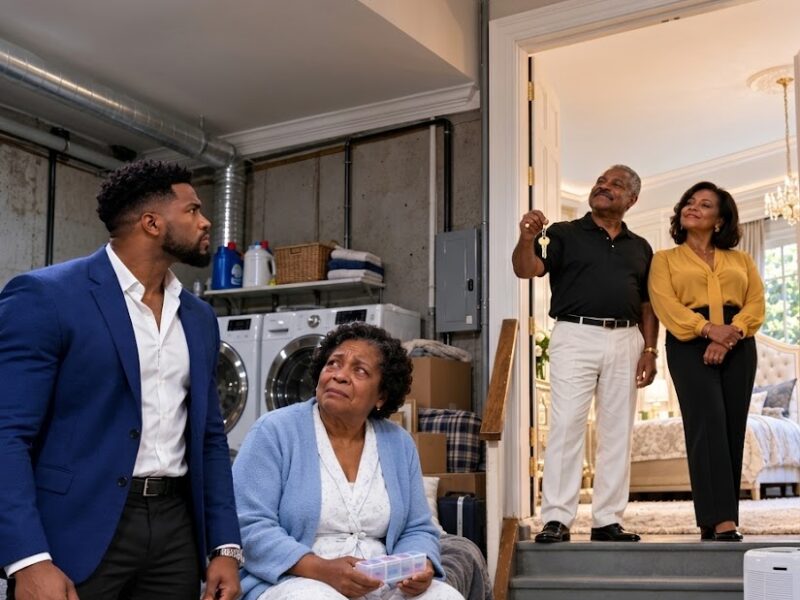
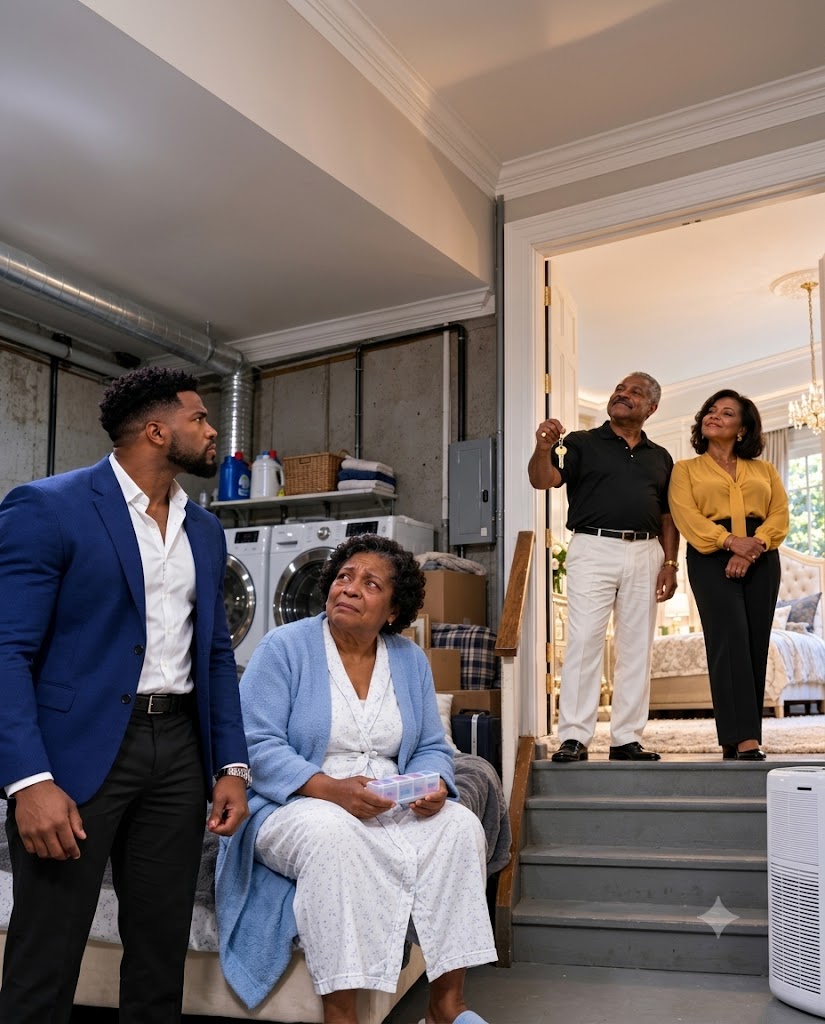
When the folding bed was carried downstairs, my mother walked behind it and understood what she had agreed to. The basement was where the washer and dryer lived. There was no bathroom down there. The only heat source was a dehumidifier running in the corner, which she initially mistook for a space heater. The air smelled like laundry detergent and old concrete.
She told Simone she didn’t want to stay down there. Simone said, Just help me out for a few days, Mom. Desmond is under a lot of pressure with this contract. I don’t want him worrying about things at home. That was the sentence that settled it. Not a command, not a threat. A quiet suggestion that my mother’s discomfort was something I would have to carry if she raised it, and she had spent her whole life not wanting to be a burden to the people she loved. She said, Okay.
Her things were packed into boxes over the following two days. I don’t know exactly who initiated it. What I know is that by day nine, Celeste had replaced the bedding in my mother’s room with linens she’d brought herself. A framed photograph of the Bennett family, Roland and Celeste with Simone and her brothers, taken at some resort years back, was placed on the dresser where my mother’s medication organizer had been. The medication organizer was in a box in the basement. The small mirror my mother kept on the corner of the nightstand, the one she’d had since before I was born, had been put away somewhere. Nobody asked her about any of it.
She didn’t call me to report what was happening. She wasn’t going to do that. Instead, on day thirteen, she called because she couldn’t figure out how to turn on the heater. She had been sleeping in the cold and was trying to solve the problem herself before mentioning it to anyone.
I was at Hartsfield Jackson airport when the phone rang, gate B14, waiting on an early morning flight back to Brier Glenn after finishing my last site visit a day ahead of schedule. She described the unit running in the corner. I recognized it immediately, the dehumidifier I had installed the previous summer to pull moisture out of the basement during the rainy season. Not a heater. Never been a heater. And then I heard Roland’s voice coming through the phone from somewhere above where she was standing, telling her to stay out of the room she had slept in for the better part of a year. He didn’t know I was on the line.
I opened the airline app and changed my flight.
I got home just after eleven that night. The ground floor bedroom, my mother’s bedroom, had light coming under the door. I could hear voices inside. Roland and Celeste had company. Someone was laughing. I went to the basement first. My mother was sitting on the edge of the folding bed in her robe and a cardigan pulled over it. Her boxes were stacked along one wall, each one labeled in her own handwriting. The dehumidifier was still running. The room was cold.
She looked up when she heard me on the stairs. She didn’t look surprised to see me. She looked like she’d been waiting.
I didn’t say anything right away. I sat next to her for a moment, looked at the boxes, looked at the washer and dryer sharing the room with her folding bed, and then I stood up and went upstairs.
I knocked on the bedroom door. Roland opened it. He was holding a glass. Behind him, Celeste and two people I didn’t recognize were seated near the window. The Bennett family photo was on the dresser. My mother’s room had been rearranged to accommodate guests who had been invited for three weeks.
I told them I needed the room back tonight. Roland said my mother had given it up on her own. He said the word voluntarily twice, like repetition made it more true. Celeste stepped in and told me I was making a scene in front of guests, that this wasn’t the right time, that I needed to lower my voice. I was not raising my voice. I told them again.
Simone appeared in the hallway and pulled me toward the kitchen. She closed the door behind us. She told me she had arranged the room switch. She didn’t say it like a confession. She said she’d made a judgment call while I was away, that the arrangement had made sense at the time, and that she had planned to have it resolved before I returned. Then she told me that if I sent her parents out tonight in front of their guests without notice, I would humiliate them in a way she would not forgive. She said it quietly and directly.
I stood there for a moment. Then I went back downstairs. My mother had started folding the blanket at the foot of the bed. Not packing, just tidying, preparing to sleep again so the argument happening above her would have one fewer reason to keep going. I told her to get her coat. She said it wasn’t necessary, that she didn’t want to cause trouble for anyone. I told her she wasn’t causing anything.
I picked up the smaller of her boxes, the one with her medications and the things she’d need overnight, and I carried it up the stairs and out to my truck. She followed me. I drove her to the Hampton Inn off Route 9 and I got her a room on the ground floor. I carried the box inside, made sure the heat was working, and sat with her for about twenty minutes.
Before I left, I called Simone. I said, I’m not letting my mother sleep in that basement for one more night just so nobody has to feel uncomfortable. I meant it as a line in the ground. I thought I had handled the situation, gotten my mother out of a bad place, made my position clear. The problem felt contained, if not resolved.
But sitting in the truck afterward, I kept seeing one image. My mother on the edge of a clean hotel bed in a place that was not her home, holding her medication organizer in both hands. She hadn’t been moved to safety. She had been moved again by someone else without being asked. The house was in her name. She had invited Roland and Celeste as a kindness. She had never surrendered that room and she had never agreed to sleep beside the washing machine and she was still the one who had to leave.
The next morning, Simone called and asked my mother to stay at the hotel a little longer. She said she needed time to smooth things over, to get everyone calm before we tried to resolve anything. She made it sound like a cooling off period, like the problem was the temperature in the room and not what had actually happened inside it.
Roland had no intention of leaving. He made that clear through Simone, who relayed his position without editorial. He felt that I had disrespected him in his own home. That phrase stopped me cold. His own home. A man who had been there eleven days and had contributed nothing toward the mortgage, the taxes, the utilities, or the groceries. When I said that directly to Simone, she told me I was making it about money. I told her it was already about money. Specifically whose money had paid for the house and whose name was on the deed.
That afternoon, Celeste posted in the family group chat. It was a photograph of my mother’s bedroom, clean, sunlit, the way it had looked before any of this started. Celeste wrote beneath it that Patrice had graciously offered them the room because she wanted the first floor to herself and preferred the quieter space downstairs. The language was warm and specific. Anyone reading it without context would have believed it completely.
What Celeste did not include was the week-by-week sequence of requests that had moved my mother from her own bed to a folding cot beside the dryer. She did not include the boxes stacked against the basement wall with my mother’s handwriting on them. She did not mention the dehumidifier my mother had been trying to use as a heater. What she did include was a text message my mother had sent during the first week of their stay. My mother had written, Let them rest comfortably. That’s what matters. Celeste pulled that one sentence out, posted it separately, and let it stand as proof that everything had been consensual.
I called my mother and told her what was being circulated. I asked her to respond, to tell her side of what had happened in her own words to the family. She was quiet for a moment. Then she said she wasn’t going to do that. I started to push back. She stopped me. She said she had watched marriages fall apart over smaller things than this, and she wasn’t going to be the reason her son’s ended. She said it plainly, without self-pity, the way she said most hard things, like it was simply a fact she had accepted before I called.
I contacted a property attorney that week. I wanted my mother to understand her options clearly, that as the legal owner of the home, she had every right to ask anyone to leave, regardless of what text messages existed or what stories were being told in family group chats. The paperwork was unambiguous. The title was in her name. The purchase had been made with funds that predated my marriage and were excluded from marital assets by signed agreement. She thanked me. She said the information was helpful. Then she told me she wasn’t ready to file anything.
I sat with that. I had the documents. I had the legal footing. I had a clear record of what had happened. What I didn’t have, what no paperwork could give me, was my mother’s belief that she was allowed to make people angry in order to protect herself. Decades of absorbing difficulty and adjusting quietly around other people’s comfort did not undo itself because her son showed up with a folder. The right was hers on paper, but she didn’t yet believe it was hers in practice. And until she did, nothing I filed would actually help her.
Four days after I brought my mother to the hotel, I went back to the house to collect more of her things. Her blood pressure medication refills, her good winter coat, a few items she’d asked for specifically. There was a truck in the driveway. Not Roland’s car, a contractor’s truck, white with a logo on the door for a company I didn’t recognize.
I went inside and found two men in the basement with a measuring tape. One of them had a clipboard. They were measuring the far wall, the wall opposite the washer and dryer, and making notes about ceiling height and drain placement. I asked what they were doing. The one with the clipboard said they were doing a preliminary assessment for a conversion project. A client had contracted them to turn the basement into a living suite. Ground level entry from the rear yard, a small bathroom, a bedroom partition, separate utility access.
He handed me the estimate when I asked to see it. The document was dated eleven days before my mother’s phone call. Before I came home. Before I drove her to the Hampton Inn. Before any conversation between me and Simone about what had happened. Eleven days before my mother called me from the cold, asking how to turn on a heater she didn’t have, someone had already drawn up plans to make that basement into her permanent residence.
I called Simone from the driveway. She didn’t answer. I drove to her office. She was in a meeting when I arrived. Her assistant looked at my face and went to get her without asking any questions.
We stood in the hallway outside the conference room. I showed her the estimate. I asked her to explain the date. She didn’t try to tell me I was misreading it. She took a breath and told me the truth, some of it at least. Her parents’ apartment had finished its repairs nearly two weeks earlier. They could have gone back. But Simone had told them they didn’t need to. She had been planning to offer them a longer arrangement, something more permanent. She had wanted the basement properly converted first. A real bathroom, proper heating, a separate entrance. So that when she told me, I would see a finished space instead of a construction project. She thought that would make it easier for me to accept.
She said my mother would still be in the house. She said the basement would be comfortable once it was done. She said her parents were getting older and needed stability and this was a way to solve two problems at once.
I asked her, Did you ask my mother what she wanted, or did you just figure out where to put her?
She didn’t answer that.
I stood in that hallway and looked at the woman I had been married to for four years, and I understood something I hadn’t fully understood before. This was not Simone failing to stand up to her parents. It was not a lapse in judgment or a decision made under pressure. There was a date on that estimate. There were conversations she had held with Roland and Celeste that she had kept from me. There was a sequence of events she had choreographed. The room request, the basement suggestion, the conversion plan, the delay. Each step designed to be completed before I was informed, because she understood that once everything was finished and settled, my objection would cost more than my agreement.
She had not been overrun. She had planned.
I told her to stop the construction. I said I needed time away from our shared space to think clearly and that I would be staying elsewhere for the time being. I wasn’t ready to call it what it was becoming, but I also couldn’t sit in our home and pretend I hadn’t seen that estimate. Simone said she understood. She also said she hoped I would reconsider before I made any decisions that couldn’t be reversed.
I drove back to the hotel. I sat in the parking lot for a while before I went inside. My mother was watching the evening news when I knocked. I sat down in the chair near the window and looked at her. This woman who had worked night shifts on concrete floors for over two decades, who had raised me alone, who had given three strangers the use of her home because she had a generous heart. And I tried to figure out how to tell her that the timeline was longer than either of us had known.
I didn’t tell her that night. I just stayed until she fell asleep in the chair, then turned off the television and let myself out.
Roland shifted strategies. He stopped arguing about the room and started working on my mother directly. He called her at the hotel. I found out later because she mentioned it in passing, the way she mentioned things she wasn’t sure I needed to know. He told her that a good mother-in-law wouldn’t let a disagreement over sleeping arrangements destroy her son’s marriage. He said Simone was under enormous stress. He said my mother had always seemed like a reasonable woman and he hoped she still was. He did not apologize. He reframed her displacement as a test of her character.
Simone went to the hotel to see my mother on a Thursday afternoon while I was handling a service call across town. I didn’t know she was going until after. My mother told me about it that evening. Simone had not gone to explain herself or to say she was sorry. She had gone to ask my mother for help. She had sat across from her and said she only wanted my mother to help them get through this moment.
I asked my mother what she had said back. She told me she had nodded and said she understood. Because she did understand. She understood exactly what was being asked of her. And she understood that the person sitting across from her had moved her belongings into a basement and commissioned renovation plans without telling her son and was now asking her to absorb that, too. She understood. She just wasn’t going to do it.
Meanwhile, I was making decisions on her behalf that she hadn’t requested. I found a furnished short-term apartment two miles from the house. Ground floor unit, parking right outside, a small yard in the back. I signed a two-month lease, arranged a moving service to transfer her boxes from the hotel, and set up a pickup schedule before I called to tell her.
When I called, I told her I had found her somewhere more comfortable to stay while we sorted out the house. She was quiet. I told her it was a good unit, that she’d have a real kitchen and more space, that I had already handled the paperwork.
She said, Dees, did you ask me first?
I told her I was trying to make things easier for her.
She said, If I always have to let someone else decide, then what does it mean that the house is in my name?
I heard the question. I registered the words, but I was in the middle of a situation I was trying to control, and I told myself she was tired and frustrated, and that once she saw the apartment, she would understand I had acted out of care.
I organized a meeting. I told Roland, Celeste, and Simone that we all needed to sit down in the house and reach a concrete resolution. I brought the deed. I brought the original purchase documents showing the source of funds. I brought the signed agreement from Simone acknowledging the property as my mother’s separate asset. I brought the contractor’s estimate with the date on it. I had everything.
But what I did not bring, what I had no document for, was my mother’s consent to be part of a confrontation she hadn’t asked for in a house she wasn’t sure she wanted to go back to in front of people who had spent the last two weeks reshaping the story of what had happened to her. I had taken her medications to the hotel, signed her apartment lease, and scheduled her moving day without once sitting down and asking what she actually wanted to do. I was the fourth person in two weeks to make that mistake. I just hadn’t seen it yet.
The meeting took place on a Saturday afternoon. I had arrived early. My mother came with me, though she had said little on the drive over. Simone was already inside. Roland and Celeste came down from upstairs about ten minutes after we arrived, and Roland positioned himself at the head of the dining room table, the way a man does when he needs everyone in the room to remember who he believes himself to be.
He placed a key on the table. The key to the ground floor bedroom. My mother’s bedroom. He said he would return the room the moment I apologized for how I had spoken to him the night I came home. I said I hadn’t spoken to him in any way that warranted an apology. He said I had come into the house and made accusations and upset his wife in front of guests. He said I had no respect for family.
Simone looked at the table while her father spoke. Then she looked up at me and said that ever since I bought the house, I had made everything about my mother, that her family had never once been made to feel welcome, that they were treated like inconveniences in a place where they were supposed to feel at home.
The room was quiet for a moment.
Then my mother spoke. She looked at Simone and asked her directly: if she had not gone down to the basement, would Simone have let her stay in her own room?
Simone was quiet for longer than the question deserved. Then she said she thought my mother would understand.
That was the answer. Not a yes, not an explanation, a deflection that confirmed everything. The plan had always depended on my mother choosing not to resist.
I lost my composure. I said that a marriage could not continue on the terms Simone was operating under. That if she believed what she had done was reasonable, we did not share a foundation that could hold. I meant it as a statement of principle. It came out as an ultimatum.
And while I was still speaking, my mother stood up. She didn’t raise her voice. She didn’t cry. She walked to where I had set the folder of documents on the sideboard. The deed, the purchase records, the signed agreement. And she placed her key beside them. Not on top. Beside. Like she was returning something she had borrowed.
She said she was going to stay with her cousin Lenora, Lenora Price, who had been her closest family since before I was born, for a while. And that once everyone had moved out, she wanted to sell the house. She said, I don’t want to open that front door every day and remember that I cost someone their family.
I followed her into the hallway. I told her she hadn’t cost anyone anything. I told her the house was hers. I told her I had bought it so she would never have to worry about where she lived. She stopped at the door and turned to look at me.
She said, But since all of this started, everyone has been telling me what to do. Including you.
Then she left.
Lenora’s car was already idling at the curb. She had driven over without being asked, the way she always showed up when my mother needed something and wouldn’t say so directly. My mother got in and the car pulled away.
Simone left shortly after. She said she was not willing to be put in a position where she had to choose, and that she would not be returning to the house until I was ready to have a different conversation.
I stood alone in the entryway of a nine-hundred-thousand-dollar house with my name on none of the paperwork. Roland and Celeste were still upstairs. The deed was on the sideboard. My mother’s key was next to it.
I had done everything right on paper. I had the legal title, the documented source of funds, the signed spousal waiver, the contractor estimate with the date that proved premeditation. I had built an airtight case. And my mother didn’t want to come home. Not because she couldn’t, because every time she had tried to exist in that house in the past several weeks, someone had decided something on her behalf. What room she should sleep in. When she should stay quiet. When she should speak up. When she should move. Where she should go next.
The last person to do it had been me. The house was still hers, but I had made her feel like a problem inside it, and she had walked out because she needed to go somewhere she wasn’t one.
I gave it two days before I went to see her. I didn’t bring the folder. I didn’t bring a revised plan or a new apartment listing or a timeline for how we were going to resolve the situation with Roland and Celeste. I drove to Lenora’s house on a Tuesday evening with nothing in my hands, which was not a thing I was accustomed to doing.
Lenora let me in and pointed toward the back porch without saying much. My mother was sitting in a lawn chair with a cup of tea, watching the yard go dark. She didn’t look surprised to see me. She handed me the other cup that was already on the small table beside her and I sat down.
I told her I was sorry. Not for buying the house. Not for coming home early or for asking Roland and Celeste to leave or for any of the things Simone’s family believed I owed them an apology for. I told my mother I was sorry for picking her up and moving her to the hotel without asking. For signing the lease on the short-term apartment and scheduling her moving day before I called her. For organizing the meeting and bringing the documents and putting her in a room with those people and expecting her to sit through it as though the resolution I needed was the same resolution she needed, and as though my being right about the facts meant I understood what she actually wanted.
She listened to all of it. Then she told me what had hurt her most. It was not the folding bed. It was not the cold basement or the boxes stacked with her own handwriting on them or the Bennett family photograph on her dresser. It was a sentence Simone had said to her in the second week, when my mother had tried to raise the subject of the room. Simone had told her that I was under a lot of pressure with the contract and she didn’t want me worrying about things at home.
My mother said that from that moment she understood that her needs were something I would have to carry. And because she had spent her whole life making sure she did not weigh down the people she loved, she had gone quiet. She had carried the boxes down herself. She had tried to figure out the dehumidifier on her own. She had called me about the heater and not about any of the rest of it, because the heater felt like a practical question and the rest of it felt like a burden.
I sat with that for a while. The yard was fully dark by then. I told her that no amount of money made up for the times I had called and asked if everything was okay and then been relieved when she said yes, because it meant I didn’t have to slow down. For the times I had reported to her what I was building and what I had achieved and forgotten to ask what she was doing with her days in that house. For the gap between what I had given her on paper and how present I had actually been.
She didn’t argue with any of it or tell me I was being too hard on myself. She just nodded slowly, the way she did when she thought something was accurate.
Then I told her that if she wanted to sell the house, I would help her do that. I would find the right agent, handle the paperwork, make sure she came out of it with everything she was entitled to. She did not have to keep living inside a gift in order to prove she was grateful for it.
The porch was quiet for a moment. Then she said she loved the garden. She said she loved the room with the sliding glass door and the path to the yard and the way the morning light came through the windows on the east side. She said she had thought about that garden almost every day since she left. She said she just didn’t want to go back to a place where she had to ask permission.
I heard the difference. For the first time since I had changed my flight home, I heard what she was actually saying. Not that the house was wrong, but that something about what had happened inside it needed to be undone before the house could be hers again. That was the thing I needed to help her with. Not a lease, not a meeting, not a folder of documents. I needed to give her back the house that was already hers.
My mother made the call to Roland and Celeste herself. I offered to do it. She said no. She said she was the one who had invited them in, and she was the one who would tell them it was time to go. She called Roland on a Wednesday morning and told him clearly and without apology that she needed the house returned to her by the end of the following week. She said she would work with them on the logistics, but the date was not a suggestion.
Roland tried to redirect the conversation toward me. Said this was my doing. Said she was being used as an instrument in my conflict with his family. My mother told him the house was in her name. The invitation had come from her and the decision to end the arrangement was also hers. She said it without raising her voice. She told me about it afterward the same way she told me most things. Briefly, without drama, moving on before I had fully processed it.
We drafted a written agreement. A specific move-out date, a walkthrough to document the condition of the rooms, and a clear list of what had been moved or altered that needed to be returned to its original state. I had an attorney review the language. My mother signed it. Roland and Celeste were given a copy.
For the costs that had accumulated, the hotel nights, the contractor’s preliminary assessment that Simone had commissioned without my knowledge, the deposit on the new apartment lease she had encouraged her parents to consider, Simone was responsible. Those expenses came from our shared assets during the separation process. I did not pursue anything beyond what was documentable and fair. I was not interested in punishment. I was interested in a clean accounting.
The photograph that Celeste had posted in the family group chat, the one with the caption implying my mother had cheerfully vacated her room for her own comfort, was taken down and replaced with a correction. Celeste did not write it warmly, but she wrote it. My mother saw it and said nothing except that she was glad it was there.
Simone and I met twice during that period to talk about the marriage. In the first meeting, I asked her the question I had been holding since I stood in that hallway outside her office. If my mother had not called me that night, when had Simone planned to tell me what she had arranged? She said she had intended to show me the finished basement. The converted suite, properly done with a bathroom and a real bed and a separate entrance, presented as a solution rather than a problem. She had calculated that a completed renovation would be harder to undo than a plan I could refuse in advance.
She said it without flinching. She had thought it through.
I asked her whether she wanted to apologize to my mother. She said she would after I apologized to her father for the way I had handled the night I came home. I understood then what she was telling me. She was not protecting her father out of some reflexive loyalty she couldn’t help. She was telling me as plainly as she ever had that in her accounting, what Roland had done and what I had done belonged in the same category. That a man dismissing a woman from her own bedroom and a son defending his mother in front of guests were equivalent offenses requiring equivalent contrition.
We did not share the same accounting.
In the second meeting, I told her that. I told her I understood she had grown up in a family where keeping the surface smooth was the primary goal, and that everything, every discomfort, every conflict, every inconvenience was negotiated against what it would cost the group to acknowledge it. I told her I was not built that way and I was not able to become that way. And I told her that what she had done to my mother was not a miscalculation I could absorb and move past. It had been planned. It had a date on it.
She said she hoped I would take more time before making a final decision. I had already taken the time.
We began the legal separation process the following month. The attorneys handled most of it. There were no dramatic confrontations, no contested hearings, no ugly public moments. The assets were divided according to the agreements we had signed when we married. The house, my mother’s house, was never part of that calculation. Simone’s legal obligation extended to the costs she had incurred on her parents’ behalf. She paid them. It took her several months, and it required her to restructure some financial plans she had made, but she paid them.
I did not feel satisfaction about that. I want to be clear about that. There was nothing in Simone’s losses that made mine smaller. We had been a family. I had believed in what we were building. The ending of it was a real thing, not a victory.
What mattered, what I came back to when I thought about those weeks, was the morning after the move-out when my mother walked through the front door of the house with her key in her hand. She had chosen the contractor herself. She had spent two weeks looking at paint samples and repainted the ground floor bedroom a shade of green that I would not have chosen and that suited her completely. She brought her things back from the boxes in her own order, at her own pace, and she left some of them in storage because she decided she no longer wanted them. She pulled her own photograph out of a box and set it on the dresser. The small mirror she had kept since before I was born went back to the corner of the nightstand. She decided who had a key. She decided who was allowed to visit. Nobody helped her with any of it unless she asked.
A few months after she moved back in, she invited me to dinner. I parked in the driveway and walked up to the front door and knocked. I still had a key on my ring. She had given it to me the day she moved back in. I knocked anyway.
She opened the door and looked at me the way she looked at a thing that was slightly off. She said I was twenty minutes early and the chicken was still in the oven. She said early was the same as inconsiderate, just with better intentions.
I stepped inside. The house smelled like food and something clean underneath it. Not the chemical clean of a place being maintained, but the lived-in clean of a place where someone was comfortable. There was music on, something with horns in it, low and easy. Along the windowsill in the kitchen, she had placed a row of potted herbs in different-sized containers, some terracotta, some painted, one that appeared to have started life as a coffee can. She had arranged them herself in whatever order made sense to her. The table was set for three. Lenora was coming.
I sat at the counter and watched my mother move around her kitchen. She narrated nothing. She did not explain what she was making or ask for my opinion on any of it. She handed me a glass of water when she noticed I was just sitting there and then returned to what she was doing.
We ate when Lenora arrived. The chicken was good. The conversation moved the way it moves between people who have been through something difficult together and are no longer required to discuss it sideways. Easily, about other things. Lenora had opinions about a television program. My mother had opinions about Lenora’s opinions. I mostly listened.
After dinner, while my mother was cutting into something she had baked that afternoon, I asked her if she wanted me to come by on the weekend. Maybe stay over Saturday night, spend Sunday. She said, Come Sunday. I have plans Saturday.
I asked her what kind of plans.
She said, My plans.
I laughed. Not at her. With her. Or maybe at myself. At the version of me that had signed leases and organized meetings and arrived with folders of documents, convinced that protecting someone meant making all their decisions before they had the chance to make them themselves.
The basement door was closed. I had glanced through the laundry room window when I arrived. The folding bed was gone. The washer and dryer were back in their positions. There were plastic bins of seasonal items stacked neatly along the far wall. The kind of ordinary basement storage that a person accumulates over years of actual living. No conversion plans, no partition walls, no space carved out for someone who had been placed there rather than chosen it.
Lenora helped clear the table. My mother put on more music. I washed the dishes because she let me and because it was something I could do without being asked.
Before I left, she walked me to the door. She looked at me for a moment, the same way she had looked at me on Lenora’s porch in the dark. Clear and direct and without performance. She said, Thank you for coming. Just that. Nothing about the house or what had happened or how far we’d traveled to get back to a simple dinner on a weeknight.
I drove home with the radio off. I used to think buying that house meant my mother would never have to absorb anyone else’s decisions again. I had calculated the stair height and the bathroom clearance and the angle of the path to the garden. I had thought of everything except asking her how she wanted to live.
The house was always in her name. But for a stretch of weeks, everyone in it, including me, had treated her presence there as something that needed to be managed rather than respected. What brought her back wasn’t the deed or the legal agreement or any of the things I had prepared. It was the moment I stopped arriving with solutions and started sitting down long enough to hear the question.
She didn’t need me to protect her. She needed me to trust that she could protect herself and to still be there after she did. That was the one thing I couldn’t buy. And it took me longer than it should have to figure out it was also the only thing that mattered.
If this story meant something to you, if you’ve ever loved someone and confused taking care of them with taking over for them, share it with someone who needs to hear it. The people in our lives who go quiet when they should speak up deserve better than our silence, too. And if you haven’t already, hit subscribe. We tell stories like this one every week because sometimes the most important things take a little longer to say.









