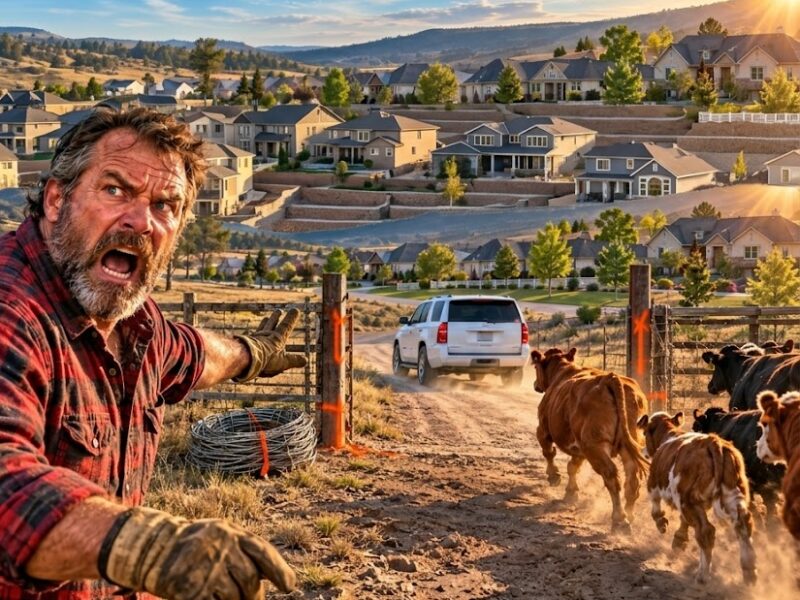
I bought a ranch with a private cattle gate that had been there for fifty years. Then the HOA cut it down for a shortcut—and found out exactly who they were dealing with.
At 6:12 on a Tuesday morning, Daniel Mercer stopped his pickup so hard that a toolbox behind the cab slammed against the bed.
His east gate was gone.
Not open, not hanging from one hinge.
Gone.
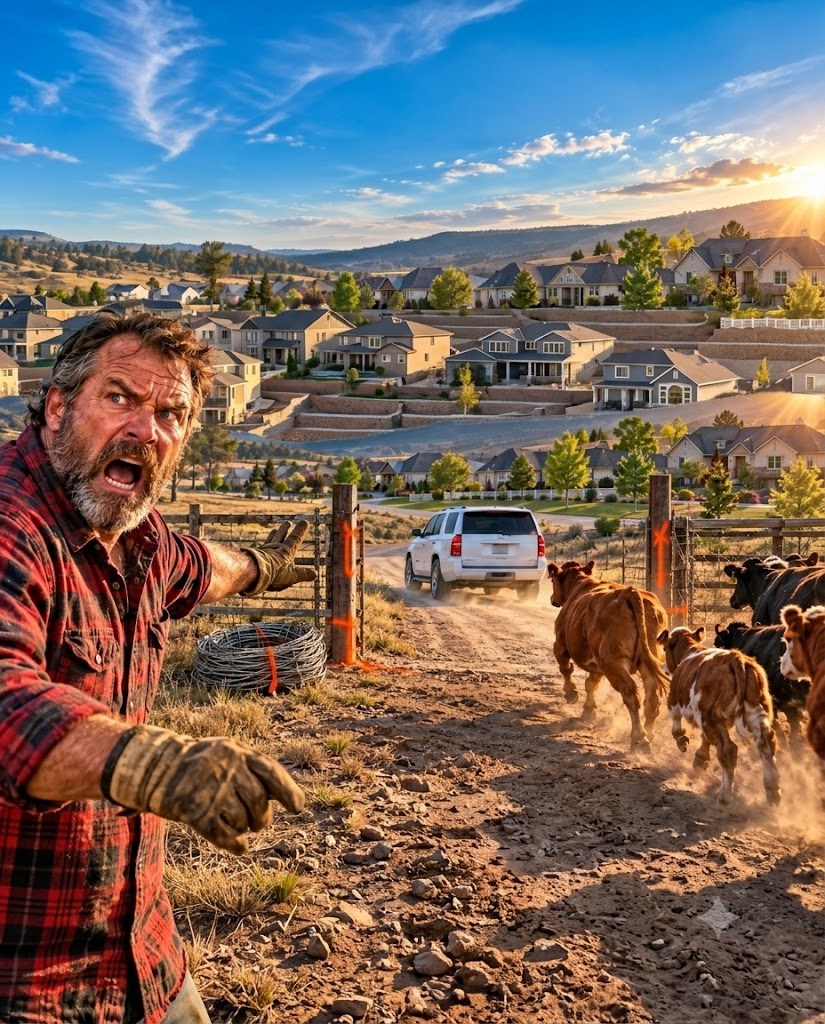
Two steel posts stood twelve feet apart with nothing between them, and the fence wire beside the opening had been cut, rolled into a neat coil, and left along the shoulder like a job site waiting for inspection.
Daniel stayed behind the wheel for three seconds.
Then headlights appeared beyond the opening.
A white SUV came through from Cedar Ridge Estates, straight onto his ranch.
Daniel jumped out and stepped into the road.
“Stop.”
The driver braked.
His window came down.
“What are you doing?”
“What are you doing?” Daniel demanded.
The man frowned.
“Using the access road.”
“This isn’t an access road.”
“They opened it yesterday.”
“Who opened it yesterday?”
“The HOA, I guess.”
Behind Daniel, cattle began bawling.
He turned.
Three cows were walking toward the opening.
Then six.
Then half the nearest group began following them.
Daniel’s stomach dropped.
“Back up.”
The driver looked confused.
“What?”
“Back your truck up now.”
“I just need to get through.”
“And I have cattle coming through the same hole.”
That finally registered.
The SUV reversed.
Daniel ran.
“Emily.”
His nineteen-year-old daughter was already coming from the equipment shed with work gloves half on.
She saw the empty gateway.
“What happened?”
“Get the portable panels.”
“Where’s the gate?”
“I don’t know. Move.”
Daniel spread his arms and pushed toward the cattle at an angle.
“Come on, turn. Turn.”
Most of the cows slowed.
A red heifer broke left.
Two calves followed.
Then one of the younger calves panicked and bolted toward the severed fence.
“Easy.”
It tried to squeeze through the loose wire.
A hind leg caught.
The calf crashed sideways.
Emily screamed.
Daniel reached it before it could kick itself deeper into the wire.
“Don’t pull him.”
Blood appeared just above the hoof.
“Dad, I see it.”
Daniel held the calf against the ground while Emily brought its mother closer.
He eased the wire away.
The calf stood, stumbled, then put weight on the leg.
Not much.
Enough.
Daniel exhaled.
“Call Dr. Walsh.”
Emily stared at the open road.
“Who cuts down a cattle gate?”
Before Daniel answered, another vehicle approached from Cedar Ridge.
A dark gray crossover stopped short of the portable panel Emily had dragged into place.
Patricia Voss stepped out.
Daniel knew her immediately.
President of the Cedar Ridge Homeowners Association.
Even at 6:30 in the morning, her clothes looked pressed.
Her eyes moved from Daniel to the calf and then to the temporary barrier.
“Mr. Mercer.”
Daniel walked toward her.
“Where’s my gate?”
“The board authorized its removal.”
He stopped.
“You did what?”
“The structure was blocking a planned community access connection.”
Daniel stared at her.
“That structure was my cattle gate.”
“The development documents show this route connecting to the county road.”
“Show me the easement.”
Patricia’s expression tightened.
“Our attorney can provide the appropriate documentation.”
“You sent a contractor onto my ranch, cut my fence, and hauled away my gate. Show me what gave you the right.”
“You were informed that the community needed access. You asked for permission, and you refused to discuss a workable alternative.”
Daniel pointed toward the injured calf.
“That gate was the workable alternative.”
Patricia glanced at the blood above the animal’s hoof.
“The association is not responsible for how you manage your livestock.”
Daniel’s voice dropped.
“The fence was how I managed them.”
For the first time, Patricia had no immediate answer.
Then she looked at the temporary panels.
“I would strongly advise you not to install another permanent obstruction while the access issue is under review.”
Daniel stared at her.
“Obstruction?”
“The route is disputed.”
“My ranch isn’t.”
“Your attorney can discuss that with ours.”
She returned to her vehicle.
Daniel watched her leave.
Emily came beside him.
“Dad.”
He was no longer watching Patricia.
He was looking at the dirt beside the post.
Bright orange paint marked the ground.
Another stripe ran beside the severed fence.
Daniel crouched.
He rubbed one mark with his thumb.
Dry.
Dust had already settled over it.
Emily saw his face.
“What?”
“This wasn’t marked this morning.”
“How long?”
Daniel studied the paint.
Then the tire impressions beside the road.
Someone had come onto the ranch before the removal.
They had measured where to cut, marked the posts, planned the job.
Daniel stood slowly.
Patricia had said the board authorized the removal yesterday.
The ground told him somebody had been preparing for it before that.
“They didn’t wake up yesterday and decide to take the gate down.”
Emily looked toward the roofs of Cedar Ridge.
“So when did they decide?”
Daniel stared through the empty opening.
That wasn’t the question anymore.
The question was when they had stopped believing they needed his permission.
—
Six months earlier, that gate had been one of the reasons Daniel bought the ranch.
Not because it was beautiful.
It wasn’t.
The house needed roof work.
The north pasture had been grazed too hard.
One stock tank leaked.
Two troughs depended on galvanized pipe old enough to complain every time pressure changed, and nearly a third of the perimeter fence needed repair.
Emily had walked the property with a yellow legal pad.
She wrote down problems.
Daniel wrote down what each problem would cost.
“Dad, this place is going to eat money.”
“Everything eats money.”
“That is not a reason to buy it.”
They had been standing beside the east gate.
Daniel rested one boot on the bottom rail.
Beyond it ran the ranch road, the working pens, and the connected pastures.
One hundred twenty-six acres.
For twenty-two years, Daniel had managed cattle for other people.
He had pulled calves at two in the morning, repaired fences in August heat, and watched good pasture disappear during drought.
At the end of every season, somebody else still owned the ground.
This was different.
This time, the mistakes would be his.
So would whatever survived them.
Daniel used most of his savings for the down payment and operating reserve.
The loan was large enough that he occasionally woke before the alarm already calculating payments.
There was no room for a heroic failure.
The ranch had to function.
That was why the east gate mattered.
The working pens sat near the ranch road.
The cattle moved between pastures across the same corridor.
A livestock trailer could enter without crossing the center of the herd, close the gate, and Daniel controlled the pressure point.
Open it to neighborhood traffic, and the ranch road became something else entirely.
He planned one modest first year.
Repair water.
Strengthen fence.
Rest tired grass.
Sell a group of cattle in the fall.
Use that money for winter hay, the operating line, and the next round of repairs.
No miracle, just enough margin to make year two possible.
By the fourth month, parts of the plan were working.
The first waterline section had been replaced.
The loading area was stronger.
Grass was returning to a rested paddock.
One evening, Emily watched Daniel install a new float valve.
“Normal people celebrate buying property with champagne.”
Daniel tightened the fitting.
“I bought float valves. Six. They were discounted.”
“That doesn’t improve the story.”
For a while, the ranch almost felt manageable.
Then Patricia Voss emailed.
Cedar Ridge Estates had expanded along Daniel’s eastern boundary.
Its main entrance was becoming congested during school hours and construction traffic.
The HOA wanted what Patricia called a limited access arrangement.
Daniel agreed to meet her at the gate.
She arrived carrying a rolled site map.
“We’re not asking for a public highway,” she said. “Just resident access at certain times.”
“How many vehicles?”
“Only homeowners.”
“How many?”
“Eventually, several dozen households.”
Daniel looked toward the cattle.
“And this gate stays open.”
“During access hours.”
“I move livestock here.”
“We could coordinate schedules.”
Daniel looked at her.
“Cows don’t use your calendar.”
Patricia smiled.
He didn’t.
He explained the practical problems.
Vehicles appearing during cattle movement.
Delivery trucks.
Loose dogs.
Children.
Drivers who forgot gates.
Once a path became routine, enforcing exceptions would get harder.
“There are community needs involved,” Patricia said.
“I understand.”
“Then give us an alternative.”
Daniel rested his hand on the steel rail.
“This is the alternative.”
Patricia waited.
“The gate stays closed.”
Two weeks later, the HOA emailed again.
Daniel declined again.
Then the request stopped.
He assumed the answer had been accepted.
Now, after Dr. Walsh had examined the injured calf and the temporary panels were chained across the opening, Daniel sat in the ranch office searching those old messages.
Emily stood behind him.
He opened Patricia’s first email.
Request to discuss limited access.
The second proposed access arrangement.
The third request for owner cooperation.
Daniel scrolled slowly.
No easement.
No statement that Cedar Ridge already owned crossing rights.
No demand based on an existing legal entitlement.
Every message asked him to agree.
Emily leaned closer.
“So?”
Daniel tapped the screen.
“If that road was already theirs, why did they spend two months asking me to let them use it?”
Emily read the emails again.
Outside the window, the portable panels stood where the gate had been.
Daniel opened the last message Patricia had sent before communication stopped.
We hope Mr. Mercer will reconsider voluntary access.
Voluntary.
Daniel stared at the word.
Somewhere between that email and Tuesday morning, Cedar Ridge had changed its story.
First, they needed his yes.
Then, they decided his no didn’t matter.
—
By noon, Daniel’s missing gate had already cost him a veterinarian, half a day’s work, and tomorrow’s cattle haul.
The hauler called while Daniel was reinforcing the temporary panels.
“I need an answer, Daniel. You’re still loading at seven?”
Daniel looked at the open corridor.
The loading pens sat beyond it.
The cattle would have to cross near the ranch road.
Neighborhood vehicles had already appeared twice.
“No.”
A pause.
“No as in later?”
“No as in give the slot away.”
“If I do, I can’t promise another one this week.”
Daniel shut his eyes.
His fall sale was built around that truck.
The sale paid the operating line.
The operating line kept hay and repairs moving into winter.
“Give it away.”
He ended the call.
Emily had heard him.
“So the sale moves.”
“Looks that way.”
“What does that do to the payment?”
“I don’t know yet.”
That was not true.
Daniel knew exactly which bank payment was due.
He just didn’t know which expense would move when the money didn’t arrive on time.
The injured calf stood beside its mother in a smaller enclosure.
Dr. Walsh had found no obvious tendon damage, but the leg had to be watched for swelling.
Daniel added the veterinary invoice to a clipboard.
Then a pickup appeared from Cedar Ridge.
A man lowered his window at the temporary barrier.
“You opening this?”
“No.”
“They told us it connects to Farm Road 186.”
“It connects through my ranch.”
The man frowned.
“This route saves about twelve minutes.”
Daniel looked behind him at the cattle.
“For you?”
“What does that mean?”
“It means your twelve minutes just cost me a hauling slot.”
The driver rolled his eyes.
“You ranch people act like nobody else lives out here.”
Daniel stepped closer to the truck.
“I know exactly who lives out here. That’s why there’s a gate.”
The pickup backed away.
Two more vehicles tried before mid-afternoon.
Emily painted a sign on plywood.
PRIVATE RANCH LIVESTOCK AREA.
NO THROUGH TRAFFIC.
Daniel added a smaller one.
GATE REMOVED WITHOUT OWNER AUTHORIZATION.
Patricia called within an hour.
“Your sign is misleading residents.”
“My missing gate is misleading them.”
“You are implying the association acted unlawfully before the access issue has been reviewed.”
“The sign says I didn’t authorize it.”
“The board acted on the information available.”
“Then send me the information.”
“Our attorney is preparing it.”
Daniel looked across the pasture.
The calf had lain down beside its mother.
“Your contractor opened a livestock boundary.”
“That does not establish liability for the animal.”
“I didn’t say liability.”
Daniel paused.
“I said, ‘What happened?'”
Patricia’s voice cooled.
“This is not personal, Mr. Mercer.”
Daniel looked at the vet bill.
Then at the empty place where his gate had been.
“That’s easy to say from your side of the fence.”
He ended the call.
Emily was behind him.
“You hung up on her.”
“She was finished.”
“No, you were angry.”
Daniel turned.
“I have a calf hurt, a truck canceled, and strangers trying to drive through the herd.”
“I know the west water line is still leaking.”
“I know.”
“We need heavier panels if this lasts more than a couple days.”
“I know.”
Emily stopped.
“Where is that money coming from?”
Daniel didn’t answer.
Her face changed.
“You’re using the waterline reserve.”
“Only part.”
“Dad, I have to secure the opening.”
“And if that pipe fails, I’ll patch it with what?”
“I’ll handle it.”
Emily stared at him.
“This is what scares me.”
“You think I shouldn’t have bought the ranch?”
“I didn’t say that.”
“You’ve been thinking it since day one.”
“No.”
Her voice sharpened.
“I think every time the ranch gets hurt, you hear something else to save it.”
Daniel went quiet.
Emily pointed toward the pasture.
“You delayed the water line for the fence. You’ll sell cattle for legal bills. Then you’ll call it commitment because quitting scares you more than losing money.”
Daniel’s jaw tightened.
“You want me to walk away because somebody cut down a gate?”
“I want you to understand that keeping this place and destroying yourself are not the same job.”
She walked back toward the calf.
Daniel stood alone in the office doorway.
Near sunset, an email arrived.
Notice regarding east access route.
The HOA requested that Daniel refrain from installing any permanent gate, post, fence, or other barrier across the disputed connection while access rights were under review.
Further interference, the message warned, could result in additional claims or removal costs.
Daniel read it twice.
Emily came inside.
“What now?”
He rotated the screen.
She read it.
“They’re telling you not to rebuild the gate they took down.”
Daniel looked through the window at the chained livestock panels.
The argument had changed.
The HOA was no longer merely defending what it had done.
It was telling Daniel what he could not put back.
—
Helen Brooks did not begin by telling Daniel he was right.
That was the first reason he trusted her.
She spent ten minutes reading everything he brought.
Survey, purchase documents, HOA emails, photographs, the removal notice, vet bill.
Then she placed Daniel’s property survey in front of him.
“One rule before we do anything.”
Daniel waited.
“Do not assume owning the land automatically answers every access question.”
“They cut my gate down.”
“I know.”
“Without permission.”
“I know that, too.”
“Sounds answered.”
Helen shook her head.
“It sounds like a fact pattern. I need the property record.”
Daniel leaned back.
“What exactly are we looking for?”
“Anything that gives somebody else a legal right across this parcel. Recorded easement, reservation, dedication, older agreement, anything.”
“And if there isn’t one?”
“Then we have a very different conversation.”
That afternoon, Cedar Ridge’s attorney sent the document Patricia had been talking about.
Helen printed it.
A development map, neat lots, curving streets.
At the western edge of Cedar Ridge, one street ended in a dashed line.
The line ran almost directly to Daniel’s east gate.
Daniel pointed there.
“So that’s what they saw.”
Helen studied it.
“That’s what they saw. Which means somebody once drew a road.”
Daniel stared at her.
“That sounds like nothing.”
“It may be nothing. It may not.”
She put her finger on the dashed segment.
“What I don’t see is the document that gave them the neighboring land needed to finish it.”
Daniel looked again.
The map felt convincing.
That was the problem.
One clean line could make an unfinished idea look inevitable.
Helen placed Daniel’s survey beside it.
The two documents told different stories.
One showed a future connection.
The other showed private ranch property in its path.
“A map can show intention,” Helen said. “I need to know whether intention ever became a right.”
Back at the ranch, Daniel showed the plan to Ray Collins.
Ray had owned the neighboring ranch for nearly thirty years.
He adjusted his glasses.
“Haven’t seen this copy.”
He tapped the dashed line.
“But I remember them wanting that road.”
Daniel looked up.
“When?”
“Original development. They talked about buying a strip along the Keller place.”
Daniel’s ranch had once belonged to the Keller family.
“Did they?”
“Don’t know.”
“You remember a road survey?”
“I remember survey trucks. Then they disappeared.”
“The road never got built.”
“No.”
“Why?”
Ray handed the map back.
“If I knew that, I’d charge what your lawyer charges.”
Daniel almost smiled.
Ray looked toward Cedar Ridge.
“People over there probably spent years looking at versions of that map.”
“So?”
“So after enough years, a plan starts feeling like a promise.”
That sentence followed Daniel to the county records office the next morning.
Helen had already ordered documents.
Daniel went anyway.
He was tired of waiting for other people to tell him what existed under his own name.
The clerk helped him pull older Cedar Ridge filings.
Utility easements, road dedications, drainage plans, amendments.
Then Daniel found the dashed line.
Not the clean HOA copy.
An older recorded plat.
He leaned closer.
Beside the proposed road were four words.
Proposed future connection.
Below them in smaller type was a reference.
Subject to condition.
The rest pointed to another filing.
Daniel photographed it and sent it to Helen.
His phone rang almost immediately.
“Where are you?”
“Records office.”
“Don’t leave.”
“You see the note?”
“Yes.”
“So the line everyone has been arguing about has an asterisk.”
Daniel looked back at the plat.
“What does the asterisk say?”
“That’s what you’re going to find.”
The clerk searched the reference number.
Nothing.
She tried an older index, then stopped.
“This was cross-filed under the original development entity.”
“Can you pull it?”
She disappeared through a back door.
Daniel remained at the counter, staring at the old map.
Patricia’s map showed a road.
The older record showed something more dangerous.
A road with a condition nobody had bothered to show him.
And somewhere in the county archive was the sentence that explained whether Cedar Ridge had ever earned the right to finish that line.
—
The missing document arrived in a folder thin enough to disappear beneath a newspaper.
Six pages, two exhibits, no dramatic stamp, no sentence saying Daniel Mercer is right.
Helen made him wait until she had read it.
Then she placed the development map on one side of her desk and the older filing on the other.
“Here’s the difference.”
She pointed to the proposed western connection.
“The developer wanted this road.”
Daniel nodded.
Helen moved to the older document.
“But completing it depended on obtaining separate rights over land outside the subdivision. The Keller parcel. Your parcel now.”
Daniel leaned closer.
“The wording required separate acquisition, dedication, or recorded access rights over the adjoining property.”
“And did they get those rights?”
“I have not found a recorded easement across your property.”
Daniel finally breathed out.
Helen immediately added, “That sentence is exactly as far as I am willing to go.”
Daniel smiled without humor.
“You really know how to ruin a moment.”
“I know how to keep a moment from ruining a case.”
She put the HOA’s clean map over the older version.
The dashed road aligned perfectly.
The condition was missing.
“Same line, different meaning.”
Daniel stared at the two pieces of paper.
“That one omission cost me a gate.”
“Maybe.”
He gave her a look.
Helen continued, “Now we find out how the board got from this map to a demolition crew.”
That answer came faster.
The HOA produced its contractor work order.
Daniel read it standing beside Helen’s desk.
West connection. Mercer boundary. Remove existing steel gate and associated fencing obstruction to open designated access route.
“Obstruction,” Daniel said.
Helen turned another page.
Attached were photographs.
The first showed his gate intact.
Orange markings were visible at both posts.
The second showed the gate lying in the dirt.
The third showed it on the contractor’s flatbed.
Daniel stared at that one.
For days, he had been asking where the gate went.
Now he could see it strapped down like scrap metal.
Helen called Mark Ellis, the contractor.
“I completed the scope I was given,” Mark said.
“What were you given?”
“Work order, site diagram, marked location.”
“Did your crew mark the site?”
“No.”
“Survey?”
“Not a full survey.”
“Recorded access document?”
“Not that I saw.”
“Permission from Mr. Mercer?”
“No.”
Daniel looked at Helen.
She raised a finger before he could react.
“Were you told the owner had previously refused voluntary access?”
Mark paused.
“No.”
“Would that have changed anything?”
“I would have asked somebody to confirm the job before cutting.”
It was not an admission of wrongdoing.
It did not need to be.
The job had arrived at Mark as though ownership had already been settled.
Someone upstream had made that decision for him.
The board minutes showed where.
Eleven days before the removal, Cedar Ridge had discussed the western connection.
One board member, Thomas Bell, asked a simple question.
Had legal access across the adjoining ranch been confirmed?
Management was directed to verify.
Preparation could proceed subject to confirmation.
Daniel looked up.
“So they knew it had to be checked.”
“They knew somebody had asked.”
Helen turned to the next set of minutes.
A later meeting.
This one was shorter.
Management had not yet produced a recorded access instrument.
Further legal review was recommended.
Daniel read the entry again.
“When was this?”
Helen gave him the date.
He looked at the calendar on her desk.
“That’s before the gate came down.”
“Yes.”
“How long before?”
“Three days.”
Daniel stopped moving.
Three days before strangers cut his fence, the HOA’s own records said no recorded access document had been produced.
Daniel felt the familiar urge to grab his phone, post the maps, post the minutes, post the photograph of his gate on the trailer.
Let Cedar Ridge residents decide what they thought.
Helen saw it on his face.
“No.”
“I didn’t say anything.”
“You didn’t have to.”
“They should see this.”
“Maybe they will. When showing it helps you more than satisfying you.”
Daniel disliked that answer because he knew she was right.
Helen closed the file.
“Your job now is damages.”
“They took the gate.”
“We can prove that.”
“The calf was injured. Vet record.”
“I lost the haul. Document it.”
“Feed costs went up because the sale moved. Document them.”
Daniel frowned.
“You’re turning my month into receipts.”
“Yes.”
“That feels ridiculous.”
Helen looked directly at him.
“Evidence is what turns something that happened to you into something another person has to answer for.”
Daniel took the files home.
That night, he opened a blank social media post.
This is what your HOA did to my ranch.
He attached the gate photo.
Then the board minutes.
Emily read the screen over his shoulder.
“You posting that?”
“I could.”
“Would it put the gate back?”
“No.”
“Would it help the calf?”
“No.”
“Would it make tomorrow cheaper?”
Daniel stared at the post button.
“No.”
He deleted the draft.
—
The next morning, Helen called before seven.
“I found one more internal record.”
Daniel was standing beside the temporary barrier.
“What now?”
“Someone raised the missing access document again before the contractor was dispatched.”
Daniel looked at the orange paint on the post.
“How much earlier?”
“Before the site was marked.”
Daniel went still.
The timeline had finally become clear.
First they asked permission.
Then someone questioned whether the HOA actually had the right.
Then no recorded access document was produced.
Then the ranch was marked anyway.
Then the gate came down.
Daniel thought finding the missing documents would end the expensive part.
Instead, that was when the expensive part began.
Helen sent a formal demand.
Preserve records.
Identify the people who authorized the removal.
Stop representing the ranch road as a community route.
Reimburse documented physical damage and related losses.
Daniel read the letter twice.
“How long before they pay?”
Helen looked at him.
“Maybe don’t build your winter budget around that question.”
His silence told her he already had.
The cattle sale had moved.
The second hauler cost more.
The cattle stayed on feed longer.
The west water line was still leaking.
A bank payment was approaching.
And the temporary panels across the east road were better than an open pasture, but worse than the gate Daniel had already paid for once.
At the kitchen table, Emily found him with a calculator and a handwritten column.
Vet, panels, welder, extra hauling, feed, legal, waterline.
The last item had been crossed out.
“You canceled the pipe.”
“Delayed.”
“Again.”
“I need cash for what?”
Daniel pointed at the page.
Emily sat across from him.
“How much reserve is left?”
“Enough.”
“Enough isn’t a number.”
“It’s the number I have.”
She stared at him for a moment.
“Sell some cows.”
Daniel looked up sharply.
“No.”
“You already said the herd might be heavy for winter.”
“Not these cows.”
“You’d rather lose money feeding animals you could sell because selling them feels like the ranch is shrinking.”
“That is not what this is.”
“Then what is it?”
Daniel had no answer he liked.
Across the fence, Cedar Ridge was having its own argument.
Residents had learned the west route was closed because of a property dispute.
Someone circulated the meeting minutes.
At the next HOA meeting, people stopped asking when the shortcut would open.
They started asking who authorized the contractor.
Had the board confirmed ownership?
How large was the insurance deductible?
Could homeowners face higher dues?
Patricia kept saying the board had acted in good faith based on development materials.
For the first time, good faith was no longer answering the question.
Two days later, Helen called.
“They’ve proposed settlement discussions.”
“What are they paying?”
“They’re proposing physical repair costs.”
Daniel waited.
“And they still want access.”
His grip tightened around the phone.
“They want to pay me for the gate they cut down so I can open the road they cut it down for.”
“In simplified form.”
“No.”
“Listen first,” Helen explained. “Automated gate, resident-only codes, restricted hours, monthly compensation.”
Daniel looked across the pasture toward the working pens.
“No.”
“You haven’t heard the number.”
“I don’t care about the number.”
“You should.”
“No, I should care what the number buys.”
Helen was silent.
Daniel continued, “That road crosses a livestock movement point. I bring cows through there. Trailers use it. If Cedar Ridge turns it into a commuter road, then every time I work cattle, I’m managing drivers, too.”
“Would you reject every possible deal?”
Daniel looked at the leaking trough beside him.
Water dripped once every few seconds.
He thought about his crossed-out pipe order.
“No.”
Helen waited.
“If they want to buy a separate strip along the outer boundary, away from livestock movement, I’ll listen.”
“That could be expensive for them.”
“So was my gate.”
“Now you’re negotiating.”
“I’m not selling them this road.”
The first formal offer arrived three days later.
The HOA would reimburse the gate, fence, temporary panels, and documented veterinary expense.
Some increased hauling costs were negotiable.
Lost sale value, extra labor, and portions of feed costs were disputed.
Daniel read the number twice.
It was enough to make the immediate pressure easier, not enough to erase what happened.
Then he read the condition.
Controlled resident access along the existing ranch road.
He pushed the paper back toward Helen.
“No.”
“You understand this would put cash back into the operation immediately?”
“Yes.”
“And rejecting it means we keep fighting over damages.”
“Yes.”
“Good.”
Helen closed the offer.
“I needed to hear you reject the trade, not just the people offering it.”
Later that week, Cedar Ridge removed the access condition from the repair discussions.
That felt like progress.
Then Helen showed Daniel the damages spreadsheet.
Several of his numbers were crossed out.
“What happened to those?”
“Too speculative.”
“I spent the money.”
“Some of it would have been spent anyway.”
“The sale moved.”
“Yes.”
“Feed went up.”
“Yes, but proving a loss and feeling a loss are not the same thing.”
Daniel stared at the spreadsheet.
“I hate this.”
“You’re supposed to.”
He leaned back.
“So even if they’re wrong about the road, I don’t automatically get all of this.”
“No.”
Daniel looked toward the ranch through Helen’s office window.
For weeks, he had imagined one decisive discovery.
The missing document, the bad board vote, the contractor order.
Something that would flip the entire story.
Instead, every answer created another narrower question.
Did they have the right?
Who authorized the work?
What did they know?
What did Daniel actually lose?
How much could he prove?
Helen slid the agenda for the settlement meeting across the desk.
At the top was the issue that mattered most.
Status of western access claim.
Underneath it, documented damages.
Daniel folded the page.
He had spent a month proving that Cedar Ridge could not turn a dashed line into a road simply because it wanted one.
Now he had to sit across from the people who removed his gate and decide whether being right was worth what it was still costing him.
—
Helen brought three things to the settlement meeting.
A map, a photograph, and a stack of documents.
Daniel brought one thing.
The old gate latch.
He had removed it after the contractor returned the damaged gate.
It sat in his coat pocket throughout the meeting.
Across the table were Patricia Voss, the HOA attorney, two board members, and an insurance representative.
Mark Ellis sat near the end.
No one looked comfortable.
Patricia began.
“The association never intended to interfere with Mr. Mercer’s ranching operation.”
Daniel said nothing.
The HOA attorney placed the clean development map on the table.
“The western connection was contemplated from the project’s earliest planning.”
Helen nodded.
“That’s true.”
Everyone looked at her.
Then she placed the older recorded plat beside it.
“Here’s what else is true. The same dashed line appeared on both maps, but only the older one showed the condition. The western connection depended on separate rights being obtained across the adjoining property.”
Helen tapped Daniel’s parcel.
“Show us where those rights were obtained.”
The HOA attorney answered carefully.
“We have not located a recorded easement across the Mercer parcel.”
The room went quiet.
Patricia leaned forward.
“But the road was always intended to connect.”
Daniel finally spoke.
“Intended isn’t the same thing as owned.”
Patricia looked at him.
Daniel took the original email from Helen’s folder.
“You asked me for voluntary access.”
He put down the second.
“You asked again.”
Then the board minutes.
“Your own board asked whether you actually had the right.”
Then the later minutes.
“You still didn’t have the document.”
Finally, Helen placed the contractor photograph on top.
Daniel’s gate lay on a flatbed.
“And then you cut it down.”
Nobody interrupted him.
Helen turned to Mark.
“What documentation were you given?”
“A work order and site diagram.”
“A recorded easement?”
“No.”
“Permission from Mr. Mercer?”
“No.”
“Court order?”
“No.”
“Were you told the property owner had already refused voluntary access?”
“No.”
Mark looked toward Daniel.
“If I had known it was disputed like this, I would have stopped and called before cutting anything.”
Patricia looked down.
The insurance representative studied the board minutes.
“When was the second warning?”
Helen gave the date and removal.
“Three days later,” the representative said.
He looked toward the HOA side of the table.
That was the moment Daniel felt the argument change.
Not because anyone shouted, because the evidence no longer needed volume.
The damages came next.
Gate, fence, veterinarian, temporary livestock barriers, welder, hauling difference.
Those numbers had receipts behind them.
Feed, labor, and delayed sale losses were harder.
The insurer challenged them.
Helen withdrew one, reduced another.
Daniel leaned toward her.
“We’re dropping that.”
“We’re dropping what we can’t defend cleanly.”
It bothered him.
Then he looked at the stack of documents that had gotten them this far.
The case was strong because Helen had refused to pretend uncertainty was certainty.
Daniel sat back.
After lunch, the HOA attorney returned to future access.
“Would Mr. Mercer consider a controlled gate?”
“No.”
“Resident-only traffic?”
“No.”
“Limited hours?”
Daniel pulled a ranch map toward himself.
He pointed to the working pens, then the east pasture, then the ranch road.
“This is what everybody keeps missing.”
He traced the cattle route with one finger.
“When I move animals from here to here, they cross this road.”
He moved his finger to the gateway.
“Your shortcut crosses the same pressure point.”
The attorney said, “Traffic could be stopped temporarily.”
“By who?”
No answer.
“Me?” Daniel continued. “So every time I work cattle, I stop a neighborhood.”
He moved his finger again.
“A driver arrives early. A delivery truck gets a code. Somebody’s dog jumps out. Somebody doesn’t close the gate. You keep offering different kinds of access without changing where the access goes.”
The insurance representative asked, “What would you consider?”
“A separate boundary route that does not interfere with livestock operations. If Cedar Ridge wants one, it can negotiate for the land.”
Patricia looked at him.
“You’d consider selling a strip?”
“I’ll consider an offer.”
“You wouldn’t give us this road.”
Daniel looked at her.
“No.”
For the first time that day, the answer no longer sounded angry.
It sounded final.
By late afternoon, the framework was written.
Cedar Ridge withdrew its claim that Daniel’s ranch road functioned as an HOA access route.
The association would pay the documented gate and fence repairs, veterinary expense, temporary barriers, agreed portions of transportation and operational losses.
Not everything Daniel claimed.
Enough of what he could prove.
The HOA would notify residents that the road was private and not a community exit.
Any future connection would require a separate negotiated property agreement.
No assumed right.
No contractor.
No shortcut first and paperwork later.
Near the end, Patricia looked across the table.
“I believed the map meant the road had already been settled.”
Daniel watched her.
“I know.”
“I thought we were removing something that had been put where it shouldn’t be.”
Daniel reached into his pocket.
He set the old steel latch on the table.
The scratches from the removal were still visible.
“That was holding forty-three cows where they were supposed to be.”
Patricia looked at it, then at him.
“I was wrong.”
Daniel had imagined hearing those words many times.
In those imaginary versions, they felt better.
In the real room, he mostly felt tired.
“You were.”
There was nothing else to say.
When the meeting ended, Helen handed him the settlement summary outside.
“You got the important part.”
Daniel read the first paragraph again.
Western access claim withdrawn.
“They’re not paying everything.”
“No.”
“I don’t get the month back.”
“No.”
Daniel folded the paper.
“But the road stays mine.”
Helen smiled slightly.
“The road was always yours. Now everyone in that room understands why they shouldn’t treat it otherwise.”
—
Daniel drove back before sunset.
Emily was fixing a latch at the working pens.
She saw the papers.
“Well?”
“They dropped the access claim.”
She froze.
“For good?”
“For this road. And the money.”
“Enough for the gate, the calf, most of the direct costs.”
Emily smiled.
Daniel didn’t.
Her smile faded.
“What?”
Daniel looked toward the west pasture.
The water line still needed replacing.
The cattle sale had come in below the original plan.
Hay still cost money.
The bank still wanted its payment.
Winning the argument had not repaired the ranch.
Emily followed his eyes.
“Can we make it?”
Daniel looked at the settlement papers, then at the cattle, then at her.
“Yes.”
Emily waited.
Daniel added, “But not if I keep pretending nothing else can change.”
That evening, he marked six cows for sale.
Not because Cedar Ridge had beaten him, because keeping the ranch meant choosing what the ranch could actually carry.
Nineteen days later, Daniel closed the new gate for the first time.
The latch dropped with a heavy metallic click.
He stood there with one hand still on the steel.
The original gate had been returned, bent badly enough that repairing it made little sense.
Daniel ordered another.
Not larger to make a statement.
Stronger, because it had a job.
The welder checked the hinge.
“Want a lock?”
Daniel looked through the bars toward Cedar Ridge.
“No. I need a cattle gate, not a prison.”
Beside it were two signs.
PRIVATE RANCH. NO PUBLIC THROUGH ACCESS.
And underneath:
LIVESTOCK CROSSING. KEEP GATE CLOSED.
Nothing about lawsuits, nothing about the HOA.
Daniel did not want the entrance to become a monument to one bad month.
Emily came down from the smaller pasture.
The injured calf followed its mother behind her.
Its cut had healed.
A slight stiffness remained after it had been lying down, but Dr. Walsh expected no lasting problem.
Daniel watched it walk.
“How’s he doing?”
“You ask me that every day.”
“And?”
“And he’s fine.”
“You sure?”
Emily smiled.
“Fine can change.”
Daniel nodded.
“So can everything else.”
The settlement money repaired damage.
It did not rescue the ranch.
That was important.
Daniel replaced the failing water line.
Paid the welder.
Paid the veterinary bill.
Covered the added hauling costs.
Then he sold the six cows he had marked.
He hated watching them load.
He knew which one calved without help, which one always reached the feed truck first, which one stayed calm in the chute.
But after the trailer left, winter grazing stretched farther for the remaining herd.
The hay budget worked.
The bank payment cleared.
The south pasture project moved to spring.
For the first time since buying the ranch, Daniel postponed something without treating the delay as failure.
Cedar Ridge sent every homeowner a written notice.
The ranch road was private.
It was not a neighborhood exit.
Cars continued slowing near the new gate for a few weeks.
Then fewer did, then none.
The HOA began studying traffic solutions inside its own property.
Daniel heard from Ray that Patricia lost the presidency in the next election.
He expected the news to satisfy him.
It didn’t.
“She lost,” Ray said.
Daniel was replacing a fence staple.
“All right. That’s it.”
“What do you want me to do?”
“I thought you’d enjoy it.”
Daniel drove the staple into the post.
“I wanted my gate back.”
Ray shrugged.
“You got it.”
“Then we’re done.”
A few weeks later, Daniel saw Patricia at the farm supply store.
She held a bag of bird seed.
He carried pipe fittings.
Neither had an easy direction to escape.
Patricia spoke first.
“How’s the calf?”
“Good.”
“I’m glad.”
A pause.
Then she said, “I should have waited for proof.”
Daniel looked at her.
“Yes.”
No speech, no humiliation, no audience, just an answer.
Patricia nodded.
They went to separate registers.
By early spring, the east pasture had greened again.
Emily was back from college for the weekend.
She rode with Daniel while he moved a feed trailer through the east entrance.
He opened the gate, drove through, climbed down, closed it.
Emily watched from the passenger seat.
“You still checking the latch twice?”
Daniel tugged it once.
“No.”
She raised an eyebrow.
He tugged it again.
“That’s inspection.”
“Of course.”
Across the fence, Cedar Ridge was beginning its morning.
Garage doors lifted.
A school bus stopped.
Cars turned toward the neighborhood’s actual exit.
Nobody turned toward the ranch.
Inside the fence, cattle spread across the new grass.
The recovered calf, bigger now, walked beside its mother.
Daniel leaned against the gate for a moment.
When he first bought the property, he thought ownership meant finally having something nobody else could tell him how to run.
The dispute had taught him something less satisfying.
Ownership did not remove responsibility.
It concentrated it.
If cattle escaped, Daniel answered.
If water stopped, Daniel fixed it.
If grass failed, Daniel changed his plan.
If the herd became too large for the winter he could afford, Daniel sold cattle he wanted to keep.
That responsibility was exactly why the boundary mattered.
He could not be accountable for what happened inside the ranch while somebody outside it decided when the gate was inconvenient.
Daniel climbed back into the truck.
Emily looked over.
“Ready?”
He looked once more at the steel gate.
Months earlier, a neighborhood had seen twelve minutes saved.
Daniel had seen cattle, trailers, water bills, debt, and twenty-two years of work finally attached to land carrying his name.
He started the engine.
To the people beyond the fence, it had been a shortcut.
To Daniel, it was the difference between owning a ranch and being able to run one.
—
The morning after he closed the new gate, Daniel woke before his alarm.
Not because of the payment.
Because of the quiet.
For six months, the east entrance had been a wound.
Now it was steel and hinges and a latch that dropped with a sound he trusted.
He walked outside with his coffee and stood at the gate.
The sun was coming up behind Cedar Ridge.
A few cars moved along the neighborhood’s actual exit road.
None turned toward him.
Daniel checked the latch.
Once.
Then again.
He smiled at himself.
Some habits were worth keeping.
Emily came out of the house with her work gloves already on.
“What are we doing today?”
“Water line.”
“The whole line?”
“The section we delayed.”
She nodded.
“No more delays?”
“No more delays.”
They worked through the morning.
The pipe came out in pieces, rusted and thin.
Daniel had known it was bad.
Knowing and seeing were different.
Emily handed him a new fitting.
“You know what I figured out?”
“What?”
“You didn’t buy a ranch.”
Daniel looked at her.
“You bought the right to worry about one specific piece of ground for the rest of your life.”
He laughed.
“That’s not comforting.”
“It’s not supposed to be.”
They kept working.
By afternoon, the new line was in.
Daniel turned the valve.
Water moved through the pipe.
No leak.
No drip.
He stood there listening to it.
Emily wiped her hands on her jeans.
“One thing fixed.”
Daniel nodded.
“One thing.”
That was the ranch.
Not one victory.
One thing fixed, then the next.
—
A month later, Ray came over to help move cattle.
They worked the east pasture, pushing a group toward the working pens.
Daniel opened the gate.
The cattle moved through.
He closed it.
Ray watched from his horse.
“You still think about it?”
“Sometimes.”
“The gate?”
“The whole thing.”
Ray nodded.
“You know what I think?”
“What?”
“I think they never saw you.”
Daniel looked at him.
“They saw a map. They saw a road. They saw twelve minutes. They never saw the man who owned the land.”
Daniel thought about that.
“Maybe.”
“Not maybe. That’s what happened. They made a decision about your place without ever asking what your place was for.”
Daniel looked at the cattle.
“That’s the part that still gets me.”
“The gate?”
“No. The not asking.”
Ray turned his horse.
“Well, they know now.”
Daniel checked the latch.
Once.
“That’s something.”
—
Summer came.
The grass held.
The herd settled.
The bank payment cleared again.
Daniel started the south pasture project.
Emily went back to college for fall semester.
Daniel drove her to the airport.
She hugged him at the curb.
“Don’t sell any cows without telling me.”
“I won’t.”
“And don’t skip meals.”
“I won’t.”
“And check the latch twice.”
Daniel smiled.
“Always.”
She walked toward the terminal.
Then she turned.
“Dad.”
“Yeah?”
“You did good.”
Daniel watched her go.
He drove back to the ranch.
The gate was waiting.
He opened it.
He drove through.
He closed it.
The latch dropped.
He checked it again.
—
Fall came.
The cattle sale went through.
The numbers were better than the year before.
Not by much.
But better.
Daniel paid the operating line.
He bought hay.
He fixed the north fence.
He replaced the last of the old galvanized pipe.
One evening, he sat on the porch with a cold drink and watched the sun go down.
The east gate stood where it had always stood.
Steel posts.
Wire fence.
A latch that worked.
Beyond it, Cedar Ridge was quiet.
A few porch lights came on.
Garage doors closed.
Nobody turned toward the ranch.
Daniel finished his drink.
He walked to the gate.
He checked the latch.
Once.
Then again.
He walked back to the house.
The ranch was still there.
So was he.
That was enough.
—
Winter arrived.
The first hard freeze came early.
Daniel woke to frost on the windows and cattle breathing steam in the east pasture.
He pulled on his coat and walked outside.
The gate was fine.
The water line was fine.
The herd was fine.
He stood at the fence and watched the sun rise.
Cedar Ridge was waking up.
A school bus stopped.
A few cars moved.
Nobody turned toward him.
Daniel checked the latch.
Once.
Then again.
He smiled.
Some things didn’t need to change.
—
Spring came again.
The east pasture greened.
The calves were born.
The water line held.
The bank payment cleared.
Daniel bought six float valves.
They were discounted.
He installed them all.
Emily came home for spring break.
She walked the property with him.
“Anything new?”
“New calves.”
“Anything else?”
“New fence on the north line.”
“Anything else?”
Daniel thought about it.
“No.”
She looked at him.
“You sound disappointed.”
“I’m not.”
“You sound like you’re waiting for something.”
Daniel looked at the gate.
“I’m not waiting.”
“Then what?”
“I’m just here.”
Emily nodded.
“That’s the whole thing, isn’t it?”
Daniel looked at her.
“What?”
“Being here. Owning it. Not waiting for the next bad thing.”
Daniel thought about that.
“Yeah.”
They walked back to the house.
The gate stood behind them.
Steel posts.
Wire fence.
A latch that worked.
Daniel didn’t check it.
Not that time.
He didn’t need to.
—
The HOA sent one more letter.
A notice about a community meeting.
Traffic solutions.
Internal roads.
Nothing about the ranch.
Daniel read it and put it in the recycling.
Emily called that evening.
“Anything in the mail?”
“HOA meeting notice.”
“Anything about us?”
“No.”
“Good.”
Daniel looked out the window at the gate.
“Good.”
—
Ray stopped by a few days later.
They drank coffee on the porch.
“You ever hear from Patricia?”
“Saw her at the store once.”
“What’d she say?”
“She asked about the calf.”
“That’s it?”
“That’s it.”
Ray nodded.
“People change.”
“Some do.”
“You think she did?”
Daniel thought about it.
“I think she learned something.”
“That’s not the same as changing.”
“No.”
Ray finished his coffee.
“You ever think about selling?”
Daniel looked at the pasture.
The cattle.
The gate.
“No.”
“Never?”
“Not anymore.”
Ray stood up.
“Good.”
He walked to his truck.
Then he turned.
“You know what the difference is?”
“What?”
“Between you and them.”
Daniel waited.
“You asked what the land was for. They just asked what it could give them.”
Ray drove away.
Daniel sat on the porch.
The sun was warm.
The grass was green.
The gate was closed.
He checked the latch that evening.
Once.
Then again.
—
Years passed.
The ranch held.
The herd grew.
The debt shrank.
Emily graduated.
She moved back to the area.
She worked the ranch with him.
They bought more cattle.
They fixed more fence.
They replaced more pipe.
The gate stayed.
One afternoon, a young couple stopped at the east entrance.
They were looking for a house.
They had seen the sign.
Private ranch.
No public through access.
The man rolled down his window.
“Excuse me. Is this the road to Cedar Ridge?”
Daniel walked to the truck.
“No.”
“We’re trying to find the neighborhood.”
“Go back to the highway. Turn right. The entrance is a mile down.”
The man nodded.
“Thanks.”
They drove away.
Emily came up beside Daniel.
“You could have just said no.”
“I did.”
“You gave them directions.”
Daniel looked at the gate.
“They weren’t trying to cut through. They were lost.”
Emily smiled.
“You’ve gotten nicer.”
“No. I’ve gotten clearer.”
She laughed.
They walked back to the working pens.
The gate stood behind them.
Steel posts.
Wire fence.
A latch that worked.
Daniel didn’t check it.
Not that time.
He didn’t need to.
—
The last time Daniel thought about the removal was on a Tuesday morning.
Six years later.
He was standing at the east gate with a coffee in his hand.
The sun was coming up.
Cedar Ridge was quiet.
A few cars moved.
Nobody turned toward him.
Daniel checked the latch.
Once.
Then again.
He thought about the morning he had found the gate gone.
The cattle.
The calf.
The orange paint.
The meeting.
The latch on the table.
He thought about Patricia.
He thought about Helen.
He thought about Emily.
He thought about the sign.
Private ranch.
No public through access.
He thought about what ownership meant.
Not control.
Not isolation.
Responsibility.
The gate wasn’t a wall.
It was a boundary.
A boundary that said this land had a purpose.
And Daniel was the one who had to answer for it.
He finished his coffee.
He checked the latch.
Once.
Then again.
He walked back to the house.
The ranch was still there.
So was he.
That was enough.
That had always been enough.









