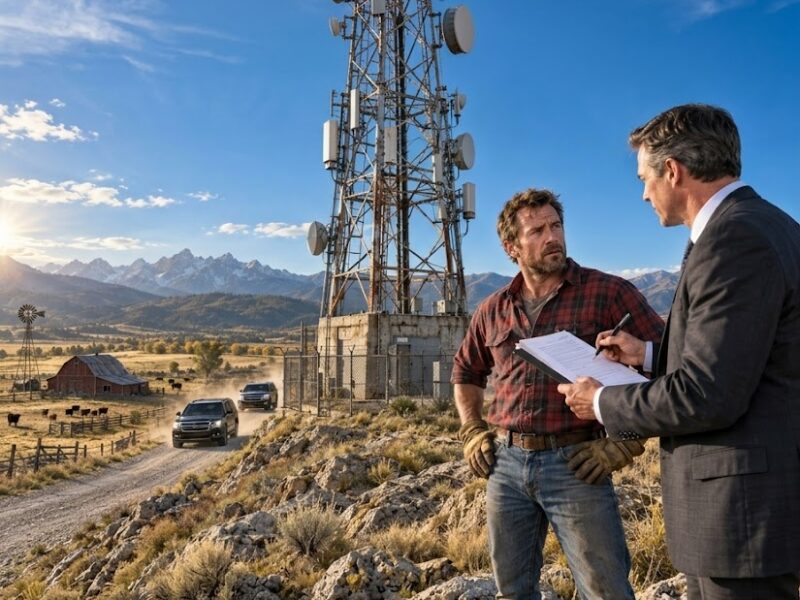
I bought a ranch that came with an old relay tower nobody had touched in years. Then the phone company called and asked to renew the lease.
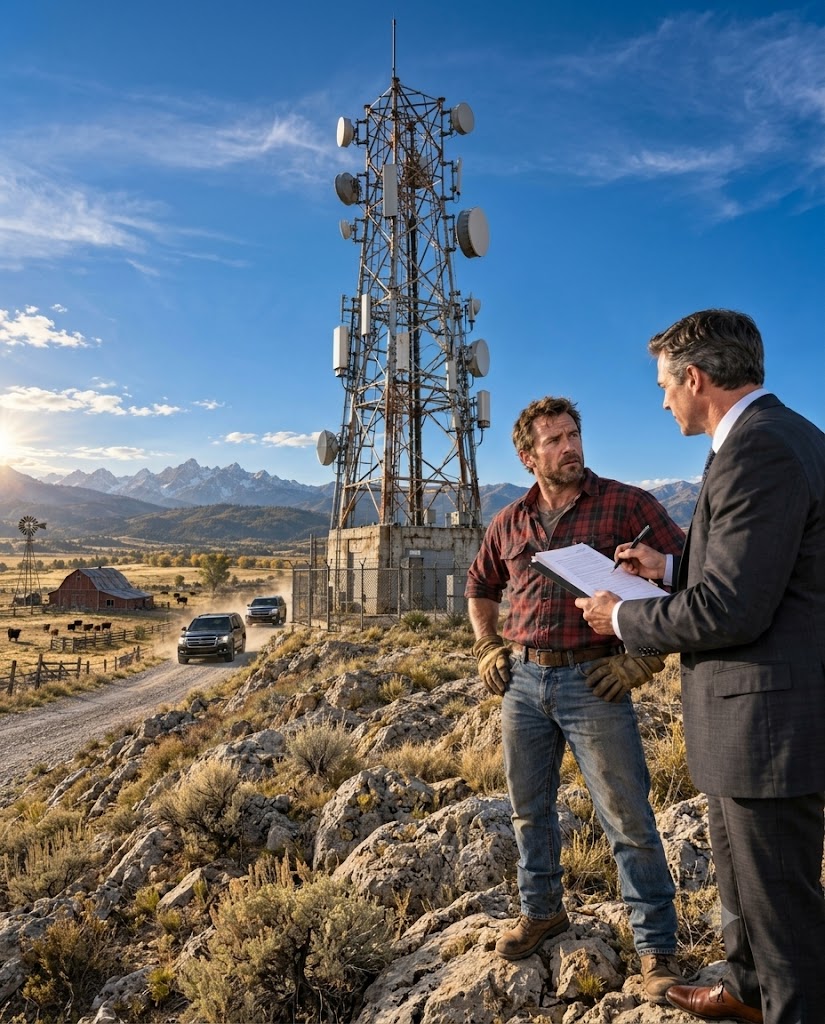
The man from the phone company set a lease agreement on Caleb Morgan’s kitchen table and pointed to the signing payment.
Caleb read the number twice.
It was more than he expected the entire ranch to earn that year.
Three months earlier, the real estate agent had called the relay tower on the northern hill abandoned.
Caleb had pictured paying to tear it down.
Now, a stranger in a dark suit had driven forty miles to keep it standing.
“We can issue the initial payment shortly after the agreement is signed,” the man said.
Caleb glanced through the window at the leaking water trough.
The pump was failing.
Fence wire lay in coils beside the barn.
His fifteen-year-old daughter, Ellie, still had boxes stacked in her unfinished bedroom.
The money could change all of that.
“What’s your name again?” Caleb asked.
“Daniel Price. I handle site agreements for the company.”
“And you’re paying this much for a tower your people barely visit?”
Daniel looked toward the hill.
“We’re renewing the use of the site, Mr. Morgan. The tower is part of it.”
“Then why drive out here instead of mailing the papers?”
“Because we’d like to settle the terms promptly.”
Daniel nudged the pen toward him.
Caleb picked it up.
He thought of the feed bill on the counter, the pump that coughed whenever he started it, and the look Ellie gave the packed boxes as if she didn’t trust another house to hold them.
He could sign and finally tell her they were staying.
Then he noticed a paragraph buried beneath the payment terms.
It referred to additional equipment and future access.
“What does this cover?”
“Room for the company to operate as needed.”
“On how much of my land?”
“The agreement covers the details.”
Caleb turned another page.
The language went on long after the payment figure.
He knew how to rebuild a pump, but he did not know what some of these provisions would let the company do to his land.
He set the pen down.
“I’m taking this to someone who understands it.”
Daniel closed his folder.
“Of course. I should tell you that the offer may not stay open indefinitely.”
“Then leave me a copy.”
Daniel slid the papers across the table and left.
Caleb watched the black SUV disappear down the gravel road.
Then he spread the agreement beside his unpaid bills.
The tower might be the one thing that could save the ranch.
But for the first time, Caleb wondered whether accepting its money could also take away the ground he needed to rebuild it.
—
Three months earlier, Caleb Morgan had stood beside a real estate agent on forty-seven acres of Wyoming pasture, trying to imagine what the property might become.
The fences leaned.
The barn roof sagged.
A rusted windmill stood beside a tank filled with leaves.
Above the northern hill rose an old telecommunications tower.
“That thing comes with the place,” the agent said. “Previous owner never figured out what to do with it.”
“Does anyone still use it?”
“Not that I know of.”
Caleb looked at the tower, then at the asking price.
He could afford this ranch.
That mattered more than anything else.
At forty-three, he had already lost the property his father had worked for thirty years.
Two punishing summers, rising feed costs, and debts he could no longer manage had taken it from him.
Afterward, Caleb spent eighteen months repairing pumps and electrical systems for other ranchers.
He worked on land that belonged to people who could still afford to keep it.
Every dollar he saved went toward another chance.
When he finally bought the neglected ranch, he told himself he wasn’t trying to replace what had been lost.
He only wanted somewhere his daughter could call home.
But Ellie wasn’t ready to believe in another fresh start.
On moving day, she carried a cardboard box into her bedroom and set it beside the mattress.
“Is this really where we’re staying?”
Caleb looked at the peeling walls.
“That’s the plan, sweetheart.”
She nodded without opening the box.
That evening, he found her sitting on the mattress, holding the little wooden horse her grandfather had carved.
Her clothes remained packed.
So did the photographs from their old home.
“You can put your things away,” Caleb said.
“I know.”
“Then why don’t you?”
Ellie looked toward the window.
“It was easier to leave last time when everything was already in boxes.”
Caleb couldn’t answer.
He had promised they wouldn’t lose the family ranch.
Three months after that promise, they had carried their belongings into a moving truck.
The following morning, he began repairing the new property.
He fixed a gate, patched the barn, and spent hours coaxing water through the failing pump.
By evening, his hands were raw.
Ellie brought him a glass of water.
“Are we going to be okay here?”
Caleb wanted to give her the answer she deserved.
Instead, he said, “I’m going to do everything I can.”
She stood beside him as the sun disappeared behind the northern hill.
The old relay tower rose above them.
Caleb saw another thing he might someday have to remove.
He had no idea that three months later, someone would arrive offering to pay him to keep it.
—
The morning after Daniel Price’s visit, Caleb Morgan walked toward the old relay tower carrying the property survey and a notebook.
He needed to understand what the company wanted before he considered its money.
The gravel road climbed toward the northern ridge, crossing a section of pasture where he had hoped to build a water storage system.
Halfway up, he noticed fresh tire tracks.
Someone had been maintaining the road.
At the top, the tower stood behind a chain-link fence.
Its steel legs were streaked with rust, and weeds grew around the concrete foundation, but the padlock looked new.
So did the warning sign.
A newer conduit entered an old equipment cabinet inside the compound.
Caleb stayed outside the fence.
He had spent enough years working around electrical equipment to know better than to touch an unfamiliar installation.
Instead, he photographed the site and returned home.
He spread the purchase documents across the kitchen table.
Buried among the surveys was an old drawing labeled “Telecommunications Lease Area.”
A narrow access road connected the compound to the ranch entrance.
Then he found several pages from the previous owner’s lease.
He read the renewal section twice.
The existing agreement was approaching its final expiration date in less than six months.
Caleb leaned back.
Daniel hadn’t arrived because the company had suddenly discovered the tower.
The company had known exactly when its agreement needed attention.
That afternoon, Caleb visited Walter Briggs, his elderly neighbor.
Walter listened to the story while repairing a saddle outside his barn.
“You know anything about that tower?” Caleb asked.
“Enough to know it isn’t abandoned.”
Caleb looked up.
“Why didn’t anybody tell me?”
“Because you never asked me about it.”
Walter explained that service crews had visited the property for years.
“Some winters, trucks climbed the hill after storms. Other times, months passed without anyone appearing. Last winter, a crew worked up there for two days.”
“Doing what?”
“Couldn’t tell you. But nobody spends two days fixing something they don’t need.”
Caleb returned home with more questions than answers.
That evening, Ellie found him studying the old survey.
“Is this about the man who came yesterday?”
“Yeah.”
“Is he buying the tower?”
“No. He’s asking to keep using the land around it.”
She studied the drawing.
“Does that mean we have to move?”
Caleb looked at her.
“No. It means I need to understand what we’re agreeing to.”
After she went upstairs, he placed the old lease beside Daniel’s proposal.
One document described a narrow compound and an access road.
The other appeared to ask for considerably more.
Caleb reached for his phone.
Tomorrow, he would call someone who understood what those differences meant.
—
Sarah Bennett placed the old lease beside Daniel Price’s proposal and studied them without speaking.
Caleb sat across from her, watching the clock above the office door.
Every minute felt expensive.
Finally, Sarah pointed to the survey.
“The company has rights to a defined portion of your property under the existing agreement. Those rights didn’t disappear when you bought the ranch.”
“I figured that much.”
“But the remaining renewal options have been used. If they want to continue after the current term, they’ll need a new agreement.”
Caleb leaned forward.
“So, I can make them leave?”
“Not immediately. There are notice requirements and other obligations we need to review, but you don’t have to accept whatever terms they propose.”
She turned to the new document.
“This is where I have concerns. The old agreement covered the tower compound and a narrow access road. The proposed agreement allowed additional equipment, expanded utility connections, and broader use of surrounding land.”
“How much more?” Caleb asked.
“That’s what I want them to define.”
Sarah placed a blank sheet over the survey.
“Show me what you were planning to do with this hillside.”
Caleb took her pencil.
He marked the location of the failing well pump, then drew a line toward the northern pasture.
“Someday I want to put a storage tank up here, run water down to the lower grazing areas. Stop depending on that one old pump and a single trough.”
Sarah examined his drawing.
“Have you shown this to the company?”
“No.”
“Then they may not realize their proposed utility corridor interferes with your plans.”
Caleb stared at the two maps.
He had bought forty-seven acres because he wanted to rebuild a ranch.
He hadn’t considered that a few sentences in a contract might determine how he could use some of the most important ground.
Sarah turned another page.
“There are also questions about maintenance, additional equipment, and what happens when the agreement ends.”
“Would you sign it?”
“I would ask for clearer terms before making that decision.”
Caleb looked at the payment figure.
He could almost see Ellie carrying the last of her boxes into her closet.
“How much would it cost to get this right?”
Sarah explained her fee and the work involved.
Caleb winced.
Then he thought about the ranch his father had spent thirty years building and how quickly a pile of papers had taken it away.
“Do it,” he said.
Sarah nodded and began making notes.
Caleb left her office without a new pump or an extra dollar, but he carried something he hadn’t brought in: a list of questions the company would need to answer before he signed away another piece of his future.
—
Daniel Price returned the following Monday with a revised offer and a younger colleague carrying a laptop.
Caleb met them at the farmhouse door.
“Before we start,” he said, “my attorney has concerns about the land you’re asking to use.”
Daniel nodded.
“We’ve reviewed them. That’s why we’re here.”
At the kitchen table, Daniel presented a new payment schedule.
The signing payment had increased.
So had the regular rent.
Caleb felt his pulse quicken.
The money would cover the failing pump, the overdue feed bill, and repairs he had postponed since moving in.
He could almost hear water running steadily into the trough.
Then he turned to the site map.
The company had increased its offer without removing the provisions that troubled Sarah.
The proposed utility corridor still crossed the northern pasture.
“You’ve offered more money,” Caleb said. “But you’re still asking for the same land.”
“The company needs flexibility.”
“I need that hillside for my cattle.”
Daniel folded his hands.
“We’re compensating you for that flexibility.”
Caleb looked toward the window.
“You can’t put a price on something if neither of us knows how much of it you’re taking.”
Daniel’s colleague closed his laptop.
The conversation grew quieter.
Finally, Daniel explained that the company was evaluating alternative locations.
Relocating its equipment wasn’t the preferred option, but it remained possible.
Caleb understood what he was being told.
If he refused, the money might disappear.
After the men left, he carried the agreement into the workshop.
His old electrical testers and specialty tools sat inside a metal cabinet.
He had earned his living with them after losing the family ranch.
Now he began selecting which ones he could sell.
Ellie appeared in the doorway.
“Why are you packing those?”
“Need to free up some money.”
“But you use them.”
“Not all of them.”
She picked up a worn electrical tester.
“Grandpa gave you this one.”
Caleb took it gently from her.
“That one’s staying.”
Ellie watched him close the cabinet.
“Are we in trouble again?”
He couldn’t bear the way she said “again.”
“We’ve got some decisions to make.”
That night, Caleb called Sarah and explained the revised offer.
“Have they changed the land provisions?” she asked.
“No.”
“Then the higher payment doesn’t resolve your original concern.”
“What if they find another hill?”
Sarah was quiet.
“They might. We need to understand how much this location matters to them, not assume they’ll stay.”
After the call, Caleb opened Daniel’s email.
The company was formally reviewing whether to maintain the site beyond the current lease.
For a long time, Caleb stared at the message.
Then he opened his notebook.
If the company had another choice, he needed to understand why it had come to him first.
—
Caleb spent the next three days studying the hill he had once considered worthless pasture.
The tower occupied the highest ridge for miles.
From its base, he could see the highway cutting through the valley, distant grain elevators, and the rooftops of a town nearly twenty miles away.
He had always measured that hillside by the cattle it could support.
Now he wondered what it meant to someone trying to connect places separated by miles of open country.
Sarah recommended an independent telecommunications consultant named Robert Hayes.
Robert arrived carrying a notebook and binoculars.
They walked the access road, examined the survey, and studied the compound from outside the secured fence.
“Elevation matters,” Robert said, “but so do existing access, electrical service, and the work already done to establish a site.”
“Could they move the equipment?”
“Possibly.”
Caleb looked disappointed.
Robert continued.
“But another hill isn’t automatically an equivalent replacement. They’d need to evaluate the new location, secure rights, and determine what infrastructure it would require.”
“So, this place has value.”
“It has characteristics worth examining. I wouldn’t tell you what the company can afford without knowing its network requirements.”
Caleb appreciated that Robert didn’t pretend to know everything.
They returned to the farmhouse where Robert marked the existing access road and the proposed expansion on Caleb’s survey.
“Separate what they need to operate from what they might want later,” he advised. “That gives both sides something concrete to discuss.”
After Robert left, Caleb called Sarah.
He told her about the ridge, the existing infrastructure, and the importance of defining additional equipment rights.
Then he opened his notebook and drew the water system he hoped to build: a new pump, a storage tank above the pasture, pipes running downhill toward the cattle.
For the first time since Daniel’s visit, he could picture how the tower and the ranch might both have a place on the hill.
Then Ellie shouted from outside.
“Dad!”
Caleb dropped his pencil.
Behind the barn, the pump rattled violently.
He hurried to the control box, checked the electrical supply, and tried to restart the motor.
The smell of overheated insulation reached him before he finished testing.
He shut off the power.
Ellie stood beside the trough.
“Can you fix it?”
Caleb looked at the motor.
He had repaired enough pumps to recognize when another afternoon with a wrench wouldn’t help.
“Not this time.”
The remaining cattle gathered near the trough.
Caleb checked the water stored in the old tank.
It would last a little longer, but not long enough to settle the lease negotiations.
He closed the control box.
The hill might be worth more than he had ever imagined, but the cattle couldn’t drink a promise, and tomorrow morning they would need water.
—
Before sunrise, Caleb borrowed a portable water tank from Walter Briggs.
He filled it from Walter’s well, drove across the pasture, and emptied it into the cattle troughs.
Then he went back for another load.
By noon, the Wyoming heat had climbed past ninety degrees.
Dust covered the truck dashboard.
Caleb’s shoulders ached.
Each trip kept the cattle supplied, but hauling water wasn’t a permanent solution.
Walter helped him calculate how long the arrangement could continue.
“We can manage this for a little while,” the older man said. “But you’ve got to reduce what you’re asking that well and that truck to support.”
Caleb looked toward the herd.
He knew what Walter meant.
Three days later, a livestock buyer arrived with a trailer.
Caleb had chosen which animals to sell.
It wasn’t enough to abandon his plans for the ranch, but it would reduce the daily demand for water and provide money for immediate expenses.
He stood beside the loading gate as the cattle moved up the ramp.
One cow stopped.
She had a white patch above her left eye.
The first animal Caleb had brought onto the property.
He rested his hand against her shoulder before guiding her forward.
When the trailer disappeared, the pasture seemed larger and terribly quiet.
The sale proceeds would cover temporary water hauling, essential bills, and a little more time.
They wouldn’t pay for the full replacement system he needed.
That evening, Caleb found Ellie in the workshop.
She was holding the wooden ranch sign they had hung near the entrance.
“Morgan Ranch: A Place to Stay.”
One nail had come loose.
“I was going to fix it,” she said.
Caleb touched the painted letters.
“Leave it here for now.”
Ellie looked toward the empty stretch of pasture.
“Are we going to sell all the cows?”
“No. We sold enough to take some pressure off.”
“Then why does it feel like we’re leaving again?”
Caleb sat beside her.
He wanted to say that everything would be fine.
Instead, he told her the truth.
“I don’t know exactly how this is going to turn out.”
Ellie looked down.
“But I’m not giving up on this place, and I’m not making promises I can’t keep anymore.”
For a moment, neither spoke.
Then she rested her head against his shoulder.
“I just want to stay somewhere long enough to remember what my room looks like without boxes.”
Caleb closed his eyes.
After she went inside, he called Sarah.
He told her he had sold part of the herd.
He told her the pump was beyond repair.
He told her he could no longer afford negotiations that produced nothing.
Sarah listened.
“Then we need to put a workable proposal in front of them,” she said. “Not just keep rejecting theirs.”
Caleb looked at the ranch sign.
“Tell me what you need.”
For the first time, he was ready to negotiate around what the ranch actually required, not simply the number the company offered.
—
Sarah Bennett spread three documents across her desk: the original lease, the company’s latest proposal, and a new map Caleb had drawn with Robert Hayes’s help.
“This is what we’re going to work from,” she said, pointing to the third.
Caleb examined the drawing.
It showed the existing tower compound, the access road, and the hillside where he intended to install his water storage tank.
Instead of arguing over an undefined amount of land, they would propose boundaries both sides could see.
Sarah placed a pencil in his hand.
“Tell me exactly what you need to protect.”
Caleb marked the planned storage area.
Then he traced the proposed water line toward the lower pasture.
“This can’t be blocked. I need access to the tank, and I can’t have them digging wherever they want.”
Sarah nodded.
“What can they reasonably use?”
Caleb studied the map.
He wasn’t trying to drive the company away.
The tower was already there, and he had no objection to crews maintaining it.
He simply needed to know where their work would stop and his ranch could continue.
Together, they prepared a counter-proposal.
It defined the leased area and access road, required approval for additional land use, established maintenance responsibilities, and addressed restoration when the agreement eventually ended.
They also requested regular rent adjustments and a signing payment with a specific deadline.
Caleb needed the money soon enough to replace the pump, but he wanted the ranch to benefit from the agreement long after that first payment was spent.
Daniel called that afternoon.
“I’ve reviewed what you’ve sent.”
Caleb waited.
“Some of these requirements are more restrictive than we’d prefer.”
“I understand.”
“Your proposed equipment boundaries could limit future work.”
“Then show me what space you actually need.”
Daniel was quiet.
Caleb continued.
“I’ve shown you where my water system has to go. I’m not asking you to move the tower. I’m asking you to work around the part of the ranch I need.”
Daniel agreed to have the company’s technical team review the revised map.
Two days later, Sarah received another proposal.
The company had reduced the expansion area and shifted the proposed utility corridor away from Caleb’s planned storage tank.
It wasn’t a finished agreement.
There were still questions about future changes, restoration, and payment timing.
But this time, Caleb could point to something that had actually changed.
That evening, he found Ellie sitting on the porch.
“Did they say yes?” she asked.
“Not yet.”
“Did they say no?”
He sat beside her.
“No.”
She considered that.
“Is that good?”
Caleb looked toward the northern hill.
“It’s better than where we were.”
His phone buzzed.
Sarah had sent him a message.
The company was prepared to meet and resolve the remaining terms.
Caleb put the phone away.
Tomorrow he would sit across from Daniel again.
This time he would bring his own map.
—
Caleb Morgan arrived at Sarah Bennett’s office carrying a folder worn soft at the corners.
Inside were the property survey, the proposed water system layout, and a handwritten list of the things he needed to keep the ranch operating.
Daniel Price arrived with the company’s attorney.
The meeting lasted nearly two hours.
They began with the access road.
The company needed dependable entry to maintain its equipment.
Caleb needed to know that vehicles wouldn’t spread across his pasture whenever a crew arrived.
They agreed on defined access rights and procedures for work outside the established area.
Next came future equipment.
The company could maintain its existing installation, while any expansion beyond the agreed boundaries would require a separate arrangement.
Then they addressed restoration.
Caleb wanted responsibility for damage clearly assigned and end-of-lease obligations documented.
Daniel studied the revised map.
“I hope you understand we’re not trying to take over your ranch.”
Caleb nodded.
“And I’m not trying to stop you from running your tower.”
He placed the water system drawing between them.
“This is where my storage tank needs to go. These are the pipes that will carry water down to the cattle.”
He looked at Daniel.
“If I sign the wrong agreement, I might have enough money to build the system, but no reliable place to put it.”
Daniel examined the drawing again.
Then he turned to his attorney.
The discussion continued.
Neither side received every term it had requested, but by the afternoon, Sarah had a final version she believed Caleb could understand and evaluate.
The agreement defined the land being leased, clarified responsibilities, established the rent structure, and required the initial payment within five business days after execution.
The amount would cover the replacement pump and allow Caleb to begin the larger water project.
He could finally see a practical route forward.
Sarah reviewed the last page.
“The decision is yours, Caleb.”
He looked at the signature line.
Years earlier, he had signed documents surrendering the ranch his father had worked so hard to build.
He remembered carrying the final box out of that farmhouse.
He remembered Ellie standing beside the moving truck, asking whether they would ever have a home again.
Caleb picked up the pen.
This time he understood what he was signing.
When the meeting ended, Daniel offered his hand.
“I’m glad we found an arrangement.”
Caleb shook it.
“Me, too.”
Outside, Caleb sat in his truck before starting the engine.
The signed agreement rested on the passenger seat.
He called Ellie.
“Dad?”
“Yeah, sweetheart.”
“Did it work?”
He looked toward the distant hills.
“We’ve got a real chance to stay.”
Caleb swallowed.
“To build something that can last.”
There was a long silence.
Then Ellie said something he hadn’t heard in years.
“Can I finally unpack everything?”
Caleb looked at the agreement.
“Yeah, sweetheart. I think you can.”
He ended the call and started the truck.
There was still a broken pump waiting at home, but now he had a way to replace it.
—
Five business days after Caleb signed the agreement, the first payment arrived.
He sat at the kitchen table looking at the bank confirmation.
For a moment, he didn’t touch anything.
Then he took the unpaid bills from beside the refrigerator and arranged them in order.
The pump came first.
The essential ranch expenses came next.
The rest would support the water project and provide a reserve for emergencies.
Caleb wasn’t going to spend another opportunity pretending that money could never run out.
Two weeks after the agreement was signed, a delivery truck pulled into the yard carrying the replacement pump and equipment for the new system.
Ellie watched from the porch.
“Is that all from the tower money?”
“Some of it.”
“What about the rest?”
“Some stays in the bank.”
She raised an eyebrow.
“Since when do you leave money alone?”
Caleb smiled.
“Since I learned what happens when you don’t.”
He had spent the previous week working with Walter and a local contractor to finalize the water system plan.
The new pump would move water from the existing well to a storage tank on higher ground.
From there, buried pipes would carry water toward the lower pastures.
The system wouldn’t create water the well couldn’t supply.
But with proper storage and distribution, Caleb could manage the available water without hauling every load himself.
Over the following weeks, the ranch became a construction site.
Caleb worked beside the contractor, installed fittings, and helped prepare the trenches.
Walter repaired the fence around the storage area.
Ellie painted numbers on the pasture gates.
There were delays.
A fitting leaked.
One delivery arrived late.
A section of trench needed additional work.
But the project kept moving.
Finally, on a cool Thursday morning, they were ready to test the system.
Caleb stood beside the old trough.
Walter waited near the storage tank.
Ellie held the radio.
“Ready, Dad?”
“Ready.”
Caleb opened the valve.
For several seconds, nothing happened.
Then air escaped through the pipe.
A low vibration followed, and water began pouring into the trough.
Clear, steady water.
Caleb watched it rise over the rusted bottom.
He remembered the cattle waiting for his truck before sunrise.
He remembered the livestock trailer disappearing down the road.
He remembered Ellie asking whether they were leaving again.
Now she stood beside him, holding her hand beneath the stream.
“It works,” she whispered.
Caleb nodded.
“Yeah, sweetheart.”
Ellie looked toward the tower on the distant hill.
“That old thing helped us do this. It gave us the chance.”
She smiled.
Caleb rested his hand on the side of the trough.
He had spent months trying to convince his daughter that the ranch could become a home.
Now, for the first time, he had something more than words to show her.
Water kept flowing, and neither of them hurried away.
—
The ranch didn’t turn green overnight.
Even after the new water system was running, Caleb still had broken fences, thin pasture, and a smaller herd than he had planned.
But the emergencies no longer controlled every morning.
He could finally make decisions based on what the ranch needed next month, not merely what might go wrong before sunset.
That autumn, he began dividing the grazing land into smaller sections.
He watched how quickly the grass recovered, moved the cattle when necessary, and kept fewer animals on the property than he once hoped to own.
The water system made it easier to use the available pasture without concentrating the herd around a single trough.
When a section needed rest, Caleb closed the gate.
When the grass grew slowly, he waited.
Walter watched him work one afternoon.
“Your father ever teach you to manage a place like this?”
Caleb smiled.
“He taught me to pay attention. I guess it took me a while to listen.”
By the following spring, rain had given the rested pastures a better start.
Caleb knew the water system hadn’t made the rainfall.
It had simply helped him prepare the ranch to use what nature provided.
Meanwhile, the lease payments continued arriving.
He used part of the income for maintenance, part for improvements, and kept the rest as a reserve.
An unexpected repair no longer meant selling another tool or another cow.
One afternoon, Walter stopped beside a new pasture gate.
“Place looks different.”
“Still plenty left to do.”
“There always is.”
Walter looked toward the hill.
“Funny how that tower turned out.”
Caleb followed his gaze.
“Yeah, I spent three months thinking it was something I’d have to get rid of.”
That evening, Ellie joined him while he checked the cattle.
A young calf stood beside its mother near the lower pasture.
“Can we get more cows next year?” she asked.
“Maybe.”
“How many?”
“Depends on the grass, the water, and what we can afford.”
Ellie laughed.
“You always say that now.”
“Because I wish I’d learned to say it sooner.”
They walked along the fence together.
After a while, Ellie slipped her hand into his.
“Dad?”
“Yeah?”
“I think Grandpa would have liked this place.”
Caleb stopped.
For years, he had believed losing the family ranch meant failing everyone who had worked before him.
He couldn’t bring that land back.
He couldn’t erase the day they had driven away.
But he could give his daughter something worth staying for.
Caleb looked across the pasture.
“I think he would have liked seeing you here.”
Ellie smiled.
Then she ran ahead to check the calf.
Caleb remained beside the fence.
The old ranch was gone.
This one was becoming their home.
And for the first time, he no longer needed those two things to be the same.
—
On the first cool morning of October the following year, Caleb found Ellie in the workshop with a paintbrush in her hand.
The old wooden ranch sign lay across two sawhorses.
“Morgan Ranch: A Place to Stay.”
She had sanded away the peeling paint and filled the holes where the nails had pulled loose.
“I thought we could put it back up,” she said.
Caleb set down his coffee.
“You sure?”
Ellie looked at him.
“Where else would it go?”
They spent the morning repainting the letters.
When the paint dried, they carried the sign to the ranch entrance and fastened it between two new posts.
Caleb stepped back.
“Looks a little crooked.”
“Your side needs to come up.”
He adjusted it.
“Now, perfect.”
Beyond the sign, the pasture stretched beneath a pale blue sky.
Not every fence was new.
The barn still needed another coat of paint.
Caleb’s truck still rattled on cold mornings.
But the water system worked.
The remaining cattle were healthy.
The pastures had recovered enough for him to begin rebuilding the herd carefully.
There was money set aside for repairs.
There was food in the kitchen.
And Ellie’s belongings were no longer packed in cardboard boxes.
That afternoon, Caleb drove up the northern hill to check the fence along the access road.
A company maintenance truck stood near the relay tower.
Two technicians were inspecting equipment inside the secured compound.
One of them waved.
Caleb waved back.
The tower looked much as it had when he bought the ranch.
Weathered steel, an old concrete foundation, a narrow road climbing through the pasture.
He remembered the day Daniel Price arrived with a contract and a pen.
He remembered the failed pump, the cattle trailer, the night Ellie asked whether they were leaving again.
He remembered how close he had come to signing an agreement he didn’t fully understand.
The tower hadn’t made him rich.
It hadn’t repaired a single fence or brought rain to the dry pasture.
It had given him an opportunity, and he had learned to protect that opportunity long enough to build something from it.
By sunset, Caleb was back near the barn.
Ellie stood beside the young calf she had insisted on naming Hope.
“Dad, are you coming in a minute?”
He looked toward the northern hill one last time.
For years, he had measured his life by the ranch he had lost.
Now he could see the one standing in front of him.
Caleb walked toward the barn.
Ellie waited beside the gate.
At the entrance, the freshly painted letters caught the last light of the day.
“Morgan Ranch: A Place to Stay.”
This time, Caleb didn’t need to promise his daughter they would never face another difficult year.
He only needed to keep building the life they had finally begun.
And when Ellie reached for his hand, neither of them looked back toward the road.
—
That brings Caleb and Ellie’s story to a close.
What stands out isn’t just that Caleb found unexpected value in an old tower.
It’s that he learned to look beyond the money being offered and ask what accepting it would mean for the life he was trying to rebuild.
He could have signed the first agreement and solved his immediate problems.
Instead, he took the harder path of protecting the land his daughter hoped to call home.
And that final image of Ellie reaching for his hand says more than any promise could.
The ranch wasn’t perfect and the future wasn’t guaranteed, but she finally had a reason to believe they were building something worth staying for.
So, here’s what I’m curious about.
If you were in Caleb’s position, would you have accepted the first offer to protect your family from immediate hardship, or would you have risked losing it to negotiate for a more secure future?









