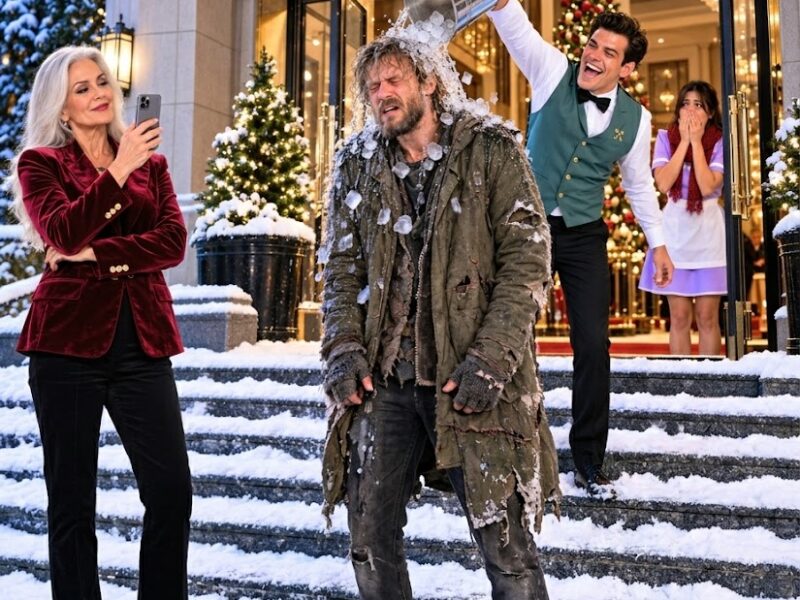
Hotel Staff Drenched a Freezing Beggar With Ice Water—Then the General Manager Whispered, “He Owns This Hotel”
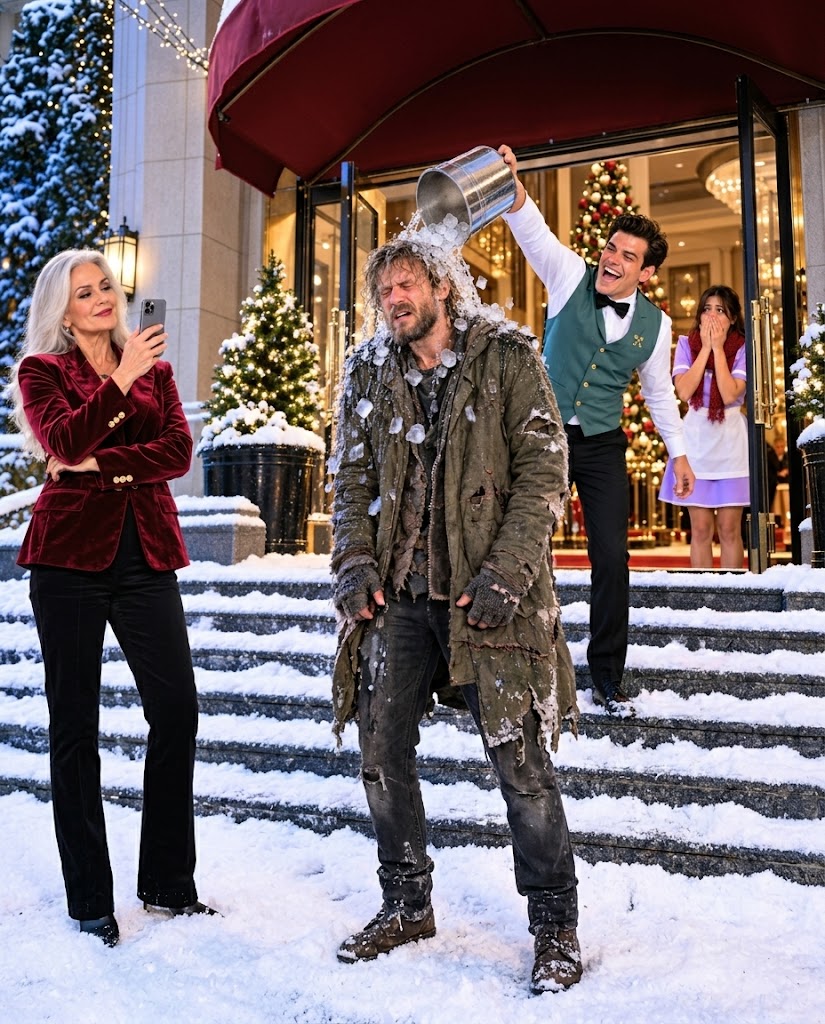
The snow fell like shredded paper over Manhattan that Christmas Eve, blanketing the sidewalks in a hush that swallowed the usual city roar. A man in a threadbare coat pressed his palm against the brass door of The Hale Grand, his breath fogging the glass as he peered inside at the crackling fireplace. His fingers were raw, his shoes soaked through, and he had exactly $7.43 left in his pocket—not that anyone at the front desk would ever know.
“Sir, these doors are for guests only.”
The voice cut through the warmth like a blade. A woman in a burgundy blazer stood behind the reception desk, her silver name tag reading *Celeste Whitmore, General Manager*. Her smile was the kind you’d find on a shark—all teeth, no soul.
“Just until the snow stops, ma’am,” the man said, his voice steady despite the shiver racking his frame. “Please. I’ll sit by the fire and I won’t touch a thing.”
“You’re already dripping on my marble.”
A young bellhop—Bryce, according to his tag—snickered from behind the luggage cart. A family in matching Burberry scarves glanced over from the lobby chairs, their expressions shifting from curiosity to disdain.
“Oh, the guests are going to love this,” Celeste muttered, then raised her voice. “Bryce, get rid of him.”
“Is he staying here?” a silver-haired man in a three-piece suit asked, not bothering to look up from his phone.
“Of course not, sir,” Celeste said, her tone sugared with apology.
The lobby erupted in polite, cruel laughter. The man on the steps took a breath. He could have said something—could have told them exactly who he was, exactly what he owned. Instead, he just nodded.
“You look like you needed to cool off,” Bryce said, grabbing a pitcher of ice water from the refreshment station. Before anyone could react, he yanked the door open and dumped it over the man’s head.
The lobby went silent. Then the laughter returned, louder.
“Please,” the man whispered, water streaming down his face. “Don’t.”
“It’s Christmas, ma’am,” someone called out.
“Not for you,” Celeste said, already turning away. “Merry Christmas.”
—
The man walked three blocks before he found the bus stop on Fifth Avenue, its plastic shelter offering little more than a windbreak. He sat on the cold metal bench, water still dripping from his hair, and stared at the hotel he’d purchased just seven days ago.
He’d bought it sight unseen—a hedge fund acquisition, part of a portfolio that included fourteen other properties across the Eastern Seaboard. He’d never stepped foot inside. He’d never met the staff. He’d never known that the woman running his newest asset would toss a human being into a blizzard like yesterday’s trash.
“Hey, you’re freezing.”
The voice was soft, cautious. He looked up to see a young woman in a hotel uniform—housekeeping, by the look of it—holding a knit scarf in both hands. Her name tag read *Ella Rios*.
“Come here,” she said, already wrapping the scarf around his neck. It was handmade, the stitches uneven but tight, the yarn a deep crimson that matched the hotel’s awning.
“I’m all right, miss.”
“The cold doesn’t ask who you are,” she said quietly. “Neither should we.”
He touched the scarf. It smelled like cinnamon and laundry soap. “This is beautiful. I can’t take it.”
“You’re not taking it. I’m giving it.”
“Why are you doing this?”
She paused, her dark eyes meeting his. “Because somebody once did it for my mom.”
The snow kept falling. A bus hissed past, then another. Ella checked her watch—a cracked plastic thing held together with electrical tape.
“What’s your name?” she asked.
“Ella. And yours?”
He almost told her the truth. He almost said, *Adrian Hale, I own the building you just walked out of.* Instead, he said, “Daniel.”
“There’s a shelter on Fifth, but the bus stop has a heater.”
“The bus stop is fine.”
“Then I’ll walk you there. My shift starts again in ten minutes.”
“Then go before they notice you’re gone.”
She reached into her bag and pulled out a sandwich wrapped in foil. “Turkey and cheese. It’s all I’ve got.”
“It’s more than anyone gave me tonight.”
She smiled—a real smile, the kind that reached her eyes. “Keep the scarf until tomorrow.”
“And then?”
“Then bring it back, Daniel.”
—
The lobby was still buzzing when Ella slipped back through the service entrance, but she’d barely made it past the linen closet before Bryce appeared, his face twisted in that particular smugness that came from knowing you’d just gotten someone killed.
“Look,” he said, loud enough for the front desk to hear. “The housekeeper’s playing nurse.”
Celeste emerged from her office, heels clicking against the marble like a countdown. “On my property.” She turned to Bryce. “Did she take anything with her?”
“Two hotel towels. I’m sure of it.”
“Ella.” Celeste’s voice was ice. “You gave hotel property to a beggar.”
“I gave him my own scarf, Ms. Celeste.”
“And two of our towels.”
“That’s not true, Bryce.”
“Cameras don’t lie, sweetheart.” Celeste pulled up her phone, already reviewing the footage. “You’re finished here, effective tonight.”
“Please, it’s Christmas week and my father needs me working.”
“Then your father should have raised a smarter daughter.” Celeste turned away. “One day you’ll regret how you treat people. I never have.”
Ella felt the words land like a slap. She wanted to scream, to cry, to throw her name tag at Celeste’s perfectly coiffed head. Instead, she walked to the employee locker room, grabbed her coat, and said goodbye to the only job she’d held for three years.
“Say bye to the followers, Ella,” Bryce called after her.
She didn’t look back. But as she pushed through the service door into the alley, she touched the empty space at her neck where the scarf used to be. *Worth it,* she thought.
—
The man who called himself Daniel stood in the shadows of the hotel’s underground parking garage, watching as a black SUV pulled up. The driver’s window rolled down.
“Mr. Hale, you’re frozen solid.”
“Not here, June. Here I’m Daniel.”
June—his assistant, his confidante, his only real friend for the past decade—stepped out of the car and opened the back door. “Where did you get that scarf?”
“From the only person who opened a door tonight.”
She followed his gaze toward the hotel. “Your suite, sir, in the hotel you bought last week.”
“I bought it, but tonight was the first time I really saw it.”
“And what did you see?”
He climbed into the backseat, still wearing the scarf, still shivering. “Everything I needed to.”
June pulled onto Fifth Avenue, the windshield wipers fighting a losing battle against the snow. “You don’t have to do it this way, sir.”
“I do, June.” He stared out the window at the bus stop, already disappearing behind a curtain of white. “I’ve been on those steps before. Twenty years ago, they threw a boy and his mother out of that lobby.”
“I know, sir.”
“A woman at that bus stop gave him her scarf.”
“And you never found her?”
“Never.”
June was quiet for a moment. “What do you want to do about the managers?”
“Nothing yet. First I want to know who they fire.”
She nodded, already typing on her phone. “They fired a housekeeper an hour ago. Ella Rios.”
“Find her.”
—
Ella lived in a two-bedroom apartment in Washington Heights with her father, Miguel, who’d been diagnosed with early-onset Parkinson’s five years ago. The rent was $1,850 a month, which they split—her $1,200 from the hotel, his $650 from disability. Now that she’d been fired, they had exactly enough saved to make it through February. Maybe.
“Mija, you’re home early,” Miguel said from his recliner, his hands trembling as he reached for the remote. “And where’s your scarf?”
“Long story, Papa.”
He noticed her swollen eyes, the way she clutched her coat like armor. “You gave away that scarf?”
“A man was freezing outside the hotel, Papa.”
He was quiet for a long moment. Then he smiled—a tired, knowing smile. “Your mother would have done the same thing.”
“That’s exactly why I did it.”
The phone rang. Miguel answered, listened, then hung up. “The heating company called again.”
“Put it on the credit card.”
“Ella—”
“And I just lost my job, Papa.”
He set down the remote. “Because of the scarf?”
“Because I helped a man on their steps.”
Miguel shook his head slowly. “Then they don’t deserve you, Mika.”
She sat on the arm of his chair, resting her head against his shoulder. “Papa, why did Mama love that scarf so much?”
He reached into his shirt and pulled out a chain. On it hung a small silver locket, and inside was a photo of a woman with Ella’s eyes and a smile that could light up a room. “She knitted it the winter you were born. She knitted two that winter, and one Christmas she gave the other one away.”
“To who?”
“A little boy at a bus stop. She never knew his name.”
Ella lifted her head. “Then I guess it runs in the family.”
“Giving away scarves?”
“Apparently.” She kissed his cheek. “Get some sleep, Papa.”
“Goodnight, Mika.”
—
The next morning, Daniel stood at the bus stop on Fifth Avenue, the scarf wrapped tight around his neck. He’d been there since 6 a.m., waiting. He didn’t have to wait long.
“Daniel, you found me.”
Ella approached from the direction of the subway, her breath curling in the cold. She was wearing a different coat today—older, thinner—but she smiled when she saw him.
“Your scarf, Ella.”
“Keep it one more night. It’s colder than yesterday.”
“I heard they fired you.”
“News travels fast at bus stops.”
“Because of me?”
“Because of them, not because of you.” She nodded toward a coffee cart on the corner. “Hot chocolate? It’s a Christmas tradition.”
“You’re spending money you don’t have.”
“Some things are worth it.”
They sat on the bench, two cups of hot chocolate steaming between them. Daniel took a sip—real whipped cream, the good stuff—and felt something loosen in his chest.
“Tell me about your mom.”
Ella smiled, and for the first time, he saw the grief behind it. “She knitted, sang badly, and gave everything away. She died when I was twelve.”
“I’m so sorry, Ella.” He meant it. “What did you want to be before all this?”
“A hotel manager. Can you believe it?”
“I can.”
“A hotel manager who lets anyone in when it snows.”
“That’s the best kind.”
—
They spent the rest of the afternoon together, walking through Central Park as the snow turned to slush under their feet. Daniel insisted on buying her lunch—just hot dogs from a cart, but she accepted with a grudging smile. They passed a frozen pond where a few brave souls were skating, and Daniel stopped to watch.
“Knees bent, Daniel. Arms out.”
“I’m bending everything.”
“You’ve never skated?”
“Not since I was a boy.”
“Then let’s make up for it.”
She rented skates—$18 for the both of them, which she paid for despite his protests—and led him onto the ice. He fell four times. She laughed every time. By the end, his tailbone ached and his cheeks hurt from smiling.
Later, they sat on a bench near the pond, and Ella pulled a small towel from her bag—hotel-issue, he noticed—and twisted it into a crude snowman shape.
“A towel snowman. My specialty.”
“You made this for me?”
“Housekeepers have hidden talents.”
He held the towel snowman like it was made of glass. “Nobody has made me anything in twenty years.”
“Well, now somebody has.”
—
The days that followed blurred into a rhythm. Daniel met her at the bus stop every morning, and every evening she’d walk him to the shelter on Fifth—though he never actually went inside. He learned that she’d been a hotel housekeeper for seven years, that she’d put herself through community college at night, that she’d applied for assistant manager positions three times and been rejected three times.
“You’re not what I expected,” she told him one night, as they shared a bag of pretzels on the bench.
“What did you expect?”
“I don’t know. Someone who’d taken more than he’d given.”
“And now?”
She looked at him—really looked—and something shifted in her expression. “Now I think you’re the saddest person I’ve ever met.”
He laughed, but it came out broken. “You might be right.”
—
On the third day, Daniel took her to a diner on 42nd Street. They ordered pancakes and coffee, and Ella told him about her father, about the heating bills, about the $7,000 in medical debt that kept her up at night.
“I’m sorry,” she said, suddenly embarrassed. “You don’t need to hear all this.”
“I want to hear it.”
“Why?”
Because I can fix it, he wanted to say. Because I own the building you were fired from, and the bank that holds your father’s medical debt, and the company that keeps calling about the heating. Because I’ve spent twenty years building an empire so I’d never have to feel powerless again, and none of it means anything if I can’t help the one person who helped me.
Instead, he said, “Because you’re the first person who’s treated me like a human being in a long time.”
—
On the fourth day, Ella invited him to her apartment for dinner. Miguel was wary at first—”That’s a fancy watch for a man without a coat,” he said, eyeing Daniel’s Rolex—but by the end of the meal, he was clapping Daniel on the shoulder and calling him “son.”
“Eat, son. You look like a coat hanger.”
“Ella said the same thing.”
“That’s a fancy watch for a man without a coat.”
Daniel touched the watch. “It was my father’s.”
“Then keep it close, son. A father’s things matter.”
“I know, sir.”
After dinner, Ella walked him to the door. “Ella, there’s something I need to tell you.”
“That you hum badly?”
“I noticed.” He smiled, then sobered. “No, it’s about who I am.”
“Tell me tomorrow. That’s my bus.”
He watched her go, the words dying in his throat. Tomorrow. He’d tell her tomorrow.
—
But tomorrow never came—at least not the way he’d planned.
At 7:45 the next morning, Daniel stood at the bus stop with a bouquet of flowers and a confession on his lips. He’d rehearsed it a hundred times: *Ella, I’m not who you think I am. I own The Hale Grand. I watched them throw you out. I watched them throw me out. I’ve been on those steps before.*
Instead, he saw a little girl—maybe seven years old—sitting on the bench, clutching a scarf. His scarf. The one Ella had given him.
“Waiting for someone?” he asked.
“My mom.” She pointed across the street. “She’s talking to the hotel.”
Daniel followed her gaze. A woman in a cleaning uniform was arguing with a security guard outside The Hale Grand. Even from here, he could see the tension in her shoulders, the way she kept pointing at the building.
“Here, keep this until she comes back.”
He handed the girl the scarf.
“But it’s yours.”
“Now it’s yours.”
She wrapped it around her neck, too big, swallowing her up to the chin. “The cold doesn’t ask who you are.”
Daniel felt his heart stop. “What did you say?”
“That’s what my mom always says. ‘The cold doesn’t ask who you are.'”
—
He found Ella at the coffee cart, her face pale.
“What’s wrong?”
“My mother’s scarf—”
“I gave it to a little girl.”
“You did what?”
“She was waiting for her mom. She looked cold.”
Ella stared at him, and for a moment, he thought she might cry. Then she laughed—a real, surprised laugh—and shook her head. “You’re unbelievable.”
“I’m sorry—”
“Don’t be.” She reached up and touched his cheek. “That’s exactly what my mom would have done.”
—
That afternoon, Daniel stood in the lobby of The Hale Grand, watching as Celeste and Bryce paraded around like they owned the place. He was still wearing the same threadbare coat, still unshaven, still looking every bit the beggar they’d thrown out three nights ago.
Except this time, he wasn’t alone.
“Sir, did you find her?” June asked, appearing at his side.
“I found her daughter.”
June raised an eyebrow. “Her daughter?”
“Ella’s mother was the woman at the bus stop. Twenty years ago. The one who gave me the scarf.”
June’s expression softened. “Sir—”
“Call a staff meeting for tomorrow. Invite Ella Rios.”
“As a guest?”
“As the reason for it.”
—
The next morning, the employees of The Hale Grand gathered in the ballroom, buzzing with rumors. A new owner. A tech billionaire. Someone who’d never worked a day in his life.
“The new owner wants to meet the staff,” Celeste announced, her voice dripping with forced cheer. “So, smile and say nothing.”
“I heard he’s a tech billionaire who’s never worked a day,” Bryce whispered.
“Perfect. Then he’ll never notice anything.”
The doors opened. Ella walked in, still wearing her coat, still looking confused. She’d received the invitation an hour ago—hand-delivered by a courier—and had almost thrown it away.
“Ms. Celeste, the fired housekeeper is here.”
Celeste’s head snapped up. “Who let her in? Ella, you don’t work here anymore. Leave.”
“I was invited, Ms. Celeste.”
“Invited by who? The beggar?”
“Maybe.”
The ballroom doors opened again. This time, it was Daniel—but not the Daniel they’d seen on the steps. He was clean-shaven, dressed in a charcoal suit that cost more than most people’s rent, and flanked by June and two security guards.
“Everyone, please welcome the new owner of The Hale Grand,” June announced. “Mr. Adrian Hale.”
The room went silent. Celeste’s face drained of color. Bryce dropped his clipboard.
Adrian walked to the center of the room, his eyes never leaving Celeste’s. “Two nights ago, a man walked into this lobby during the storm. He only asked to sit by the fire until the snow stopped.” He paused, letting the words sink in. “Bryce poured ice water over his head, and Celeste threw him back into the snow.”
“Sir, we didn’t know it was you,” Celeste stammered.
“That’s exactly the problem.”
“Mr. Hale, a hotel has standards—”
“So do I. And you don’t meet them.” He turned to June. “Celeste, Bryce—June will walk you out. And the only person who opened the door that night was fired for it. Ella Rios.”
Ella was frozen, her face a mask of shock and betrayal. “Daniel isn’t even your name.”
“It’s the name my mother called me.”
“You let me give you my mother’s scarf, my sandwich, my bus stop.”
“And they were the warmest things I’ve had in twenty years.”
“You could have told me.”
“I tried at the bus stop, and then your bus came.”
She shook her head, tears spilling down her cheeks. “I need to go home, Mr. Hale.”
“Ella, wait—”
But she was already walking away.
—
June found him an hour later, sitting alone in the ballroom, the towel snowman in his hands. “Shall I have a car follow her home, sir?”
“No. Give her tonight, June.” He stared at the towel snowman, at its crooked smile and lopsided head. “I should have told her at the bus stop.”
—
Ella didn’t go home. She went to her father’s apartment, where Miguel was waiting with a cup of tea and a worried expression.
“Mija, how was the meeting?”
“Daniel owns the hotel, Papa.”
“Your beggar owns The Hale Grand?”
“And he let me feel sorry for him for three days.” She slammed her bag on the table. “I’m not some charity case for a rich man, Papa.”
“Nobody said you were, Mija.”
There was a knock at the door. Ella froze.
“At this hour?”
“If it’s him, I’m not here.”
Miguel opened the door. Adrian stood in the hallway, still in his suit, still holding the towel snowman.
“Mr. Hale, I suppose.”
“Daniel, sir.”
“Just for tonight.”
“She doesn’t want to see you, son.”
“Then may I talk to you, sir?”
Miguel hesitated, then stepped aside. Adrian walked into the small apartment, his eyes landing on a framed photo above the couch—a woman with Ella’s eyes, wearing a familiar crimson scarf.
“Where did you get that?”
Miguel followed his gaze. “Twenty years ago. At the bus stop across from the hotel.”
Adrian pulled the scarf from his pocket—the real one, the one he’d retrieved from the little girl that morning. “Rosa’s stitches. I’d know them anywhere.”
Miguel’s hands trembled. “You were the boy.”
“They threw my mother and me out of that lobby. A woman gave me this, and I never even learned her name.”
“Her name was Rosa, and she’s been gone fifteen years.”
Adrian closed his eyes. “I came too late to thank her.”
“Is that why you bought the hotel?”
“I bought it so nobody gets thrown out of it again.”
Miguel was quiet for a long moment. Then he nodded. “You were the boy at the bus stop.”
“I was the boy.”
“Why didn’t you just tell me that first?” Ella’s voice came from the doorway. She’d been listening, her face wet with tears.
“Because I wanted to know you, not pay you back.” Adrian turned to face her. “Assistant manager of The Hale Grand, starting Monday.”
“That makes us even, and I don’t take charity. I helped you because you were cold, not because you were rich.”
“I know. That’s why it has to be you.”
Miguel stepped between them. “Mija, your mother planted a seed at that bus stop.”
“Papa, please.”
“It grew all the way back to your door, Mija. So don’t call it charity.”
Ella wiped her eyes. “Then I have conditions.”
“Name them.”
“On storm nights, the lobby doors stay open to anyone.”
“Agreed.”
“I start as head housekeeper, and I earn the rest.”
“Agreed.”
“And you give me back my scarf.”
Adrian smiled. “I hoped you’d forget that one.”
“Never, Daniel.” She took the scarf from his hands and wrapped it around her neck. “And Papa gets the best chair by the fire every Christmas.”
“That one I would have offered anyway.”
Miguel clapped his hands. “Sit down, both of you. The stew’s getting cold.”
—
The Hale Grand reopened on New Year’s Day with new leadership and a new policy: on storm nights, the lobby doors stayed open to anyone. The first night it snowed, forty guests checked in—not paying guests, but people who needed shelter. They sat by the fire, drank hot chocolate, and left in the morning with warm scarves and full stomachs.
“How many came back?” Adrian asked, reviewing the quarterly report.
“Everyone,” June said. “To say thank you.”
Ella stood by the fireplace, directing a team of housekeepers who’d all been hired from the shelter on Fifth. She’d implemented a training program, a living wage, and a policy that no employee would ever be fired for showing kindness.
“Best seat in the house, Mija.”
She turned to see Miguel settled into the leather armchair by the fire, a cup of hot chocolate in his hands.
“Reserved for the man who raised me.”
Adrian appeared at her side, two cups of hot chocolate in his hands. “Hot chocolate? It’s still a Christmas tradition.”
“Then this year I’m paying.”
“You can try, Daniel.”
—
The following Christmas, Ella stood on the steps of The Hale Grand, watching the snow fall. A man in a threadbare coat approached, his breath fogging the glass.
“Sir, these doors are for guests only.”
“Just until the snow stops, ma’am. Please.”
She smiled and opened the door. “The cold doesn’t ask who you are. Neither do we.”
“Who are you?”
“Someone who stood on these steps once.” She gestured inside. “Come in. The fire’s warm.”
The man stepped into the lobby, his eyes wide at the marble floors and crystal chandelier. A young bellhop—not Bryce, who’d been fired along with Celeste—approached with a towel and a cup of hot chocolate.
“Eat, son. You look like a coat hanger.”
The man looked up to see Miguel in his armchair, a knowing smile on his face.
“Thank you, sir. That was me once.”
“And look at you now.”
—
Adrian found Ella in the ballroom, hanging the towel snowman on the Christmas tree. It was frayed now, the stitches loose, but she refused to replace it.
“You kept it.”
“Of course I kept it.” She turned to face him. “It’s the first thing anyone ever made for me.”
“I love you, Ella.”
She blinked. “What?”
“I love you. I’ve loved you since the moment you wrapped that scarf around my neck and told me the cold doesn’t ask who you are.”
She laughed—that real, surprised laugh he’d come to adore. “You’re unbelievable.”
“Is that a yes?”
“It’s a maybe.” She stepped closer. “Ask me again at the bus stop tomorrow.”
—
The bus stop on Fifth Avenue was still there, still cold, still smelling of exhaust and snow. But now it had a small plaque bolted to the bench:
*In memory of Rosa Rios, who gave a scarf to a stranger and changed everything.*
Adrian knelt on the icy sidewalk, a ring in his hand.
“Ella Rios, will you—”
“Yes.”
“You didn’t let me finish.”
“I don’t need to hear the rest.” She pulled him to his feet and kissed him. “Yes, Daniel. Yes.”
—
The wedding was small—just family and a few friends—but the reception was held in the lobby of The Hale Grand, the doors propped open despite the December chill. Guests sat by the fire, drank hot chocolate, and told stories about the beggar who’d become a billionaire and the housekeeper who’d given him her scarf.
“Knees bent, Ms. Rios. Arms out.”
“I’m bending everything.”
“You’ve never skated?”
“Not since I was a boy.”
“Then let’s make up for it.”
They skated on the frozen pond in Central Park, surrounded by twinkling lights and falling snow. Adrian fell four times. Ella laughed every time.
Later, she presented him with a gift—a hand-knitted scarf, the stitches crooked but tight.
“Mama knitted two scarves, so I knitted the third.”
“It’s crooked.”
“So was my first towel snowman.”
He wrapped it around his neck, and for the first time in twenty years, he felt warm.
“Then I’ll never be cold again.”
—
The Hale Grand became a landmark—not for its luxury suites or Michelin-starred restaurant, but for its policy of open doors. Every storm night, the lobby filled with strangers who became friends, with stories that became legends.
Ella implemented a program that trained homeless individuals for hospitality jobs. Over 200 people graduated in the first five years. Seventy-three were hired at The Hale Grand. Forty-one went on to work at other hotels. Every single one of them knew the story of the scarf.
“The cold doesn’t ask who you are,” Ella said at the program’s fifth anniversary gala. “Neither should we.”
Adrian stood in the back of the room, watching his wife command the stage. She wore the original scarf—frayed, faded, held together by love—and he wore the one she’d knitted for him.
“Mr. Hale?”
He turned to see a young woman in a housekeeping uniform, holding a towel snowman.
“I made this for you.”
He took it, his eyes stinging. “Thank you.”
“Someone once did it for my mom,” she said. “So I’m passing it on.”
Adrian looked at the towel snowman—crooked, imperfect, beautiful—and thought about the bus stop, the scarf, the woman who’d changed everything.
“What’s your name?”
“Rosa. Rosa Rios.”
—
The snow fell softly over Manhattan that Christmas Eve, blanketing the city in a hush that swallowed the usual roar. Inside The Hale Grand, the fire crackled, the hot chocolate steamed, and the doors stayed open.
A man in a threadbare coat approached the entrance, his breath fogging the glass.
“Sir, these doors are for guests only.”
He hesitated. “Just until the snow stops, ma’am. Please.”
A young woman in a housekeeping uniform appeared at the door, a scarf in her hands.
“The cold doesn’t ask who you are,” she said. “Neither do we. Come inside.”
She wrapped the scarf around his neck. He touched it, his fingers trembling.
“What’s your name?”
“Daniel. And yours?”
“Ella.”
“Ella.” He smiled. “That’s a beautiful name.”
“It was my mother’s.”
—
The video ended with a shot of the bus stop on Fifth Avenue, the plaque gleaming under a streetlight. Snow fell gently, covering the bench, the sidewalk, the world.
*This video took me 6 hours to make. If you’d like to support me for free, please subscribe and leave a like. Thank you so much for watching.*
—
**THE END**









