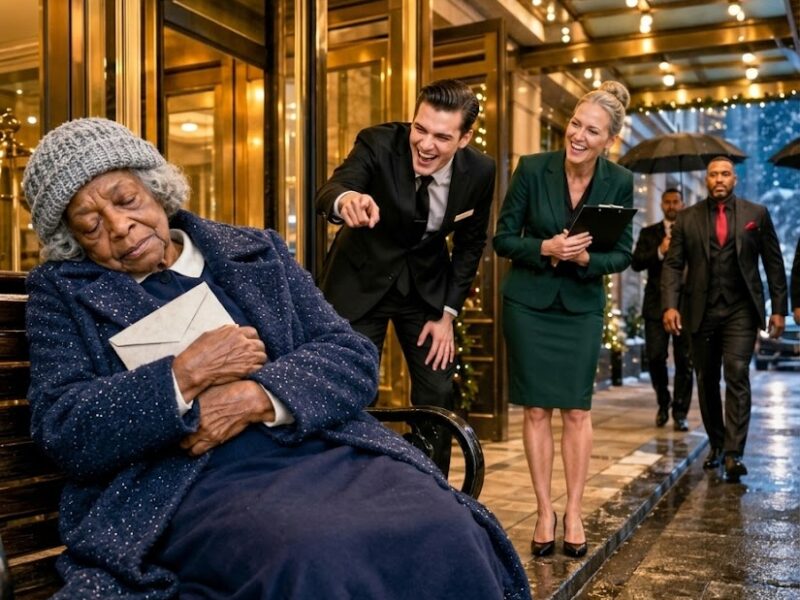
Hotel Clerk Made an Old Black Woman Wait Outside in the Cold — Then Her Son the Governor Arrived
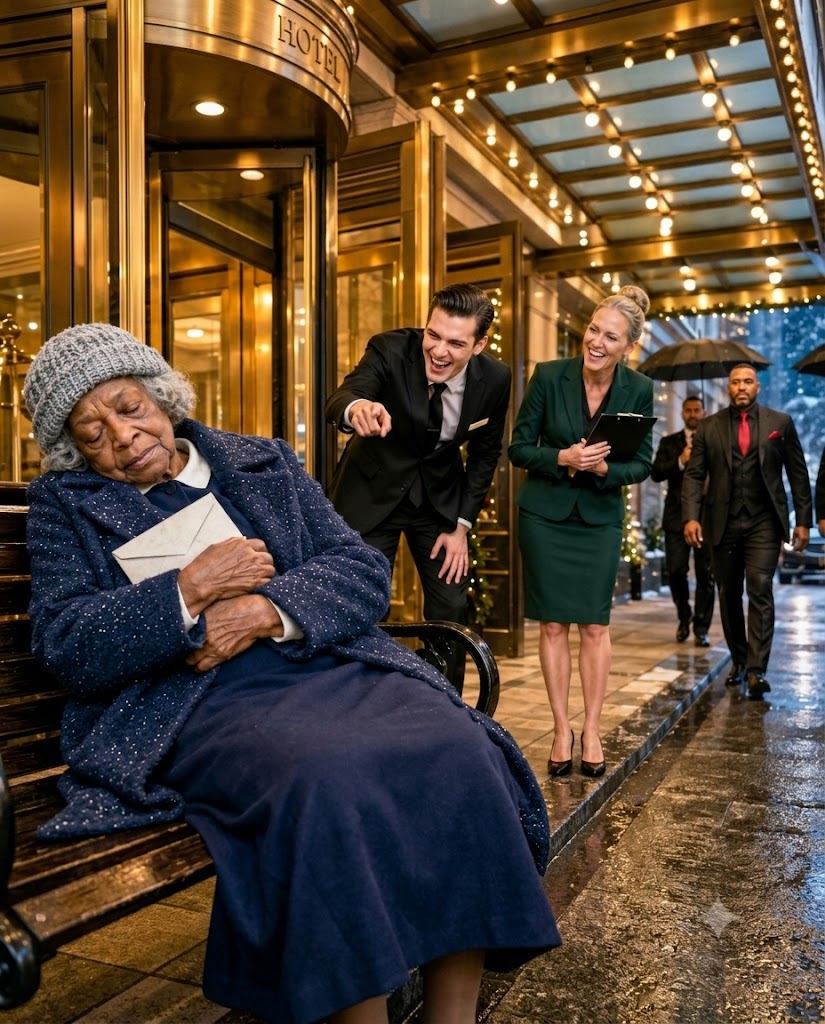
Snow fell in slow, deliberate flakes past the brass letters of the Grand View Hotel, each one catching the amber glow of the lobby chandelier before dissolving against the frozen pavement of Whitfield Avenue.
It was the kind of December night in the capital city that made people hurry, heads down, collars up, breath steaming in short bursts.
Bernice Walker did not hurry.
She stood on the sidewalk in her navy dress with the white collar, the one she had ironed that morning with careful, practiced strokes, and she watched the automatic doors part for her like a mouth opening to swallow her whole.
She had passed this building hundreds of times over the years.
Forty-one years it had stood on this corner, its brass doors gleaming even in winter, its lobby smelling of cedar and fresh orchids, its windows glowing like promises to people who belonged inside them.
Bernice had never walked in.
Not because she couldn’t.
Because she’d never had a reason to.
Until now.
—
Her son Nathaniel hadn’t been home for Christmas in three years.
Work kept him away, important work, he always said, and Bernice never pressed because she understood that some children grow into lives too large for the rooms that raised them.
But this year was different.
This year he had promised.
The whole family would be together, Nathaniel and his wife, her daughter Lorraine and her husband, all under one roof for the first time since Bernice’s husband had passed.
She wanted it to be special.
Her house on Albemarle Street had two bedrooms and one bathroom, a kitchen with yellow curtains, a living room barely big enough for the tree she bought every year from the lot on the corner.
Four adults in two bedrooms was love.
Four adults in two bedrooms for a week was a test of patience.
So Bernice had an idea.
She would book rooms at a nice hotel.
Not for herself.
For them.
A Christmas gift paid with a full year of pension savings, one thousand two hundred dollars in an envelope inside her coat pocket, counted twice that morning at her kitchen table.
She had taken the bus forty minutes across town in the snow.
The automatic doors parted.
Warm air rushed over her face like a greeting she hadn’t expected.
Her wet shoes squeaked against marble that gleamed like frozen water, and for a moment she felt small in a way that had nothing to do with her height.
The lobby was nearly empty.
A young white couple stood at the counter laughing with the clerk, their coats draped over their arms, their faces flushed with the particular glow of people who had never been told they didn’t belong anywhere.
Behind the desk, a man with slicked-back hair and a name tag that read Craig Ellison leaned forward, smiling wide, recommending the penthouse suite.
Bernice waited.
She stood six feet from the counter, hands clasped in front of her the way her mother had taught her, patient, polite, invisible in the way that only certain people are allowed to be invisible.
She didn’t clear her throat.
She didn’t wave.
She waited the way people wait when they believe the world will notice them if they’re quiet enough.
The couple left.
Craig’s smile vanished like someone had flipped a switch.
He sorted papers without looking up.
A full minute passed.
Then two.
Bernice took a small step forward.
“Excuse me,” she said.
Her voice was soft, steady, the voice of a woman who had spent thirty-five years speaking to rooms full of people who didn’t always want to listen.
“I’d like to book two rooms, please, for Christmas week.”
Craig’s eyes lifted.
They moved from her wet shoes to her damp coat to her gray hair pinned under a knitted hat, and something behind them calculated and dismissed in the same breath.
His mouth didn’t smile.
His fingers didn’t reach for the keyboard.
“We’re fully booked,” he said.
He looked back down at his papers.
Bernice didn’t move.
She had been a school teacher for thirty-five years.
She had stood in front of classrooms full of students who didn’t want to listen, parents who didn’t want to hear, administrators who didn’t want to change.
She had learned the difference between someone who was busy and someone who was choosing not to see her.
Craig Ellison was choosing.
“Sir,” she said, her voice still calm, still steady, still polite.
“Are you sure? I can be flexible on the dates. Any two rooms during Christmas week would work.”
Craig exhaled through his nose.
He didn’t look up.
“I said we’re fully booked. Which part of that confuses you?”
The lobby was quiet.
The chandelier hummed above them, a sound so faint it was almost imagination.
Snow tapped against the tall windows like fingers asking to be let in.
Somewhere near the elevator, a couple sat on a leather sofa, flipping through a travel magazine.
They glanced over, then looked away.
Bernice glanced past Craig’s shoulder at the computer screen behind the desk.
Rows of green squares filled the calendar grid.
Green meant available.
She had booked hotels before, twice for teacher conferences in Richmond, and she knew what green meant.
“Sir, I can see the availability right there on your screen. There are open rooms.”
Craig’s jaw tightened.
He reached over and turned the monitor away from her line of sight.
The movement was sharp, deliberate, like closing a door in someone’s face while they were still talking.
“You don’t know how to read a booking system,” he said.
His voice was louder now.
Loud enough for the couple on the sofa to hear.
Loud enough for the bellhop arranging luggage carts near the revolving door.
“You probably don’t know how to read at all.”
The words landed in the silence like stones dropped into still water.
Bernice’s fingers curled around the edge of the counter.
She had taught reading to hundreds of students.
She had spent decades placing books into the hands of people who had been told they would never understand the words inside.
She had written lesson plans and recommendation letters and year-end reports in longhand until the school finally gave her a computer.
And now a twenty-eight-year-old hotel clerk was telling her she couldn’t read.
She didn’t raise her voice.
She reached into her coat pocket and pulled out the envelope.
It was white, slightly bent from the bus ride, sealed with tape she had pressed down carefully that morning at her kitchen table.
She placed it on the counter gently, the way you set down something precious.
“I have the money,” she said.
“One thousand two hundred dollars cash. I saved it over the past year.”
Craig looked at the envelope, then at Bernice.
A smirk crawled across his face.
The kind of smirk that doesn’t try to hide itself.
“Where’d you get that?” he said.
“Did you empty out every jar in your kitchen? Scrape together your neighbor’s loose change?”
Bernice said nothing.
Her hand stayed on the envelope.
Craig leaned forward on the counter.
He rested both elbows on the marble and spoke slowly, as though explaining something to someone very far beneath him.
His voice carried across the lobby now.
He wanted people to hear.
He wanted an audience.
“Let me explain something to you. The cheapest room in this hotel costs more per night than your entire pension check for a month. You could hand me everything you’ve ever saved and you still wouldn’t belong in this lobby, let alone in one of our rooms.”
A man near the elevator pulled out his phone and started recording.
He didn’t say anything.
He didn’t step forward.
He just held the phone steady and watched.
“This is a five-star establishment,” Craig continued.
He straightened his tie with two fingers.
His voice had shifted from dismissive to something more deliberate, more theatrical.
“We have standards. We have a reputation. And I don’t know what made you think you could walk in here like you own the place, but let me help you understand something.”
He pointed at Bernice without touching her.
“Look at yourself. Your coat is dripping all over our floor. Your shoes are falling apart at the seams. Your dress looks like it came from a donation bin twenty years ago. You are embarrassing yourself. And frankly, you’re embarrassing everyone in this room who has to stand here and watch this.”
Bernice’s chest rose and fell.
Her lips pressed together.
The fluorescent light above the counter buzzed faintly in the silence.
The couple on the sofa shifted uncomfortably.
The woman whispered something to the man beside her.
Neither of them spoke up.
“I taught school for thirty-five years,” Bernice said.
Her voice was quiet, but it didn’t break.
“I saved this money one month at a time. I skipped things. I went without because I wanted my family to have a nice Christmas together. That’s all I’m asking for. Two rooms. I can pay.”
Craig tilted his head.
The smirk didn’t leave.
If anything, it widened.
“Thirty-five years of teaching,” he said.
“And this is all you’ve got to show for it?”
He gestured at her coat, her shoes, the envelope.
“A wet coat, worn-out shoes, and a stack of small bills. Thirty-five years, and you couldn’t even buy yourself something decent to wear to walk into a hotel?”
He shook his head slowly.
“That’s not my problem, sweetheart. That’s yours.”
The words hung in the air like smoke.
Thirty-five years.
A career.
A life’s work.
Every early morning, every lesson plan, every student she’d believed in when no one else would.
Reduced to a punchline by someone who had probably never stood in front of a classroom, someone who had never stayed late to help a struggling student sound out a word.
Bernice didn’t respond.
Her hand was still on the envelope.
Her eyes were steady, but something behind them was sinking.
Not anger.
Something worse.
The slow, quiet recognition that nothing she said would matter in this room, that she had already been measured, weighed, and discarded before she opened her mouth.
—
A door opened behind the front desk.
The sound of heels on marble, sharp and rhythmic.
Diane Hargrove stepped out from the back office, her reading glasses pushed up on her head, a clipboard tucked under her arm.
She was forty-five, sharp-faced, with blonde hair pulled into a tight bun.
Her name tag said Night Manager.
She carried herself the way people do when they’ve had a small amount of power for a long time and have learned to make it feel larger.
She looked at Bernice, then at Craig, then at the small crowd that had begun to gather in the lobby doorway.
“Is there a problem here?” she asked.
Her tone said she already knew the answer.
Bernice felt a flicker of hope.
A manager.
Someone with actual authority, someone who might look at this situation and see what was wrong with it.
“Ma’am, please,” Bernice said, turning to face Diane.
“Your clerk won’t even check availability for me. I can see on the screen that rooms are open. I have the money right here. I just want to book two rooms for my family for Christmas.”
Diane looked at Bernice the way someone looks at a stain on a white tablecloth.
From the shoes up.
Slowly.
Without a single shift in expression.
Her eyes paused on the wet collar of Bernice’s coat, on the small puddle forming near her left shoe.
Then she turned to Craig.
“Has she been told we’re full?”
“Twice,” Craig said.
He crossed his arms.
Diane turned back to Bernice.
Her voice was flat, practiced.
“Ma’am, this hotel reserves the right to refuse service to anyone. I’m going to have to ask you to leave.”
“But I haven’t done anything wrong,” Bernice said.
Her voice rose for the first time, not in anger, in disbelief.
“I walked in. I waited my turn. I asked politely. What exactly did I do wrong?”
Diane didn’t blink.
“You’re disturbing our guests. You’re dripping water all over the floor. You smell like a wet bus seat.”
She paused, let the words settle.
“This is not a shelter, ma’am, and we are not a charity.”
The man near the elevator kept filming.
His hand was steady.
His face showed nothing.
The couple on the sofa looked at each other, but said nothing.
Bernice’s mouth opened, then closed.
She had been called many things in seventy-two years.
She had been overlooked, underestimated, and talked down to by people who assumed her silence meant she had nothing to say.
But she had never been told she smelled too poor to stand inside a building.
She had never had someone say it to her face in public without flinching.
Diane lifted the phone on the front desk.
Her finger hovered over the keypad.
“If you don’t leave in the next sixty seconds, I’m calling the police. And believe me, we’ve dealt with people like you before.”
The words sliced through the lobby like a blade through paper.
People like you.
Everyone heard them.
The couple on the sofa, the bellhop by the luggage cart, the man with the phone, Craig, who nodded once as if the phrase confirmed something he’d believed all along.
No one said a word.
The silence in that room was its own verdict.
“People like me,” Bernice said quietly.
She wasn’t asking for clarification.
She was marking the moment.
The moment when the meaning behind everything Craig and Diane had said stopped pretending to be about hotel policy and showed its true face.
Diane didn’t answer.
She set the phone back down and turned toward the security desk near the side corridor.
“Randall, escort this woman out. Now.”
Two men in dark suits approached from the corridor, both broad-shouldered, both expressionless.
The taller one stepped forward.
“Ma’am, let’s go.”
Bernice looked down at her envelope.
It had slipped to the edge of the counter during the conversation.
She reached for it.
Her fingers were three inches away when Diane stepped forward and swept it off the counter with the back of her hand.
The envelope hit the marble floor.
It burst open.
Bills fanned out across the polished stone.
Fives, tens, twenties.
The savings of a woman who had skipped the hairdresser for twelve months, who had bought store-brand coffee and turned the heat down on cold nights, all so that this moment could exist.
Lying flat on a hotel lobby floor like litter.
Bernice stared at the money on the ground.
“Don’t bother picking that up,” Diane said, looking down at the scattered bills.
“Money from someone like you would stain our register.”
Bernice bent down.
One of the security guards took her arm, not roughly, but firmly, enough to stop her from reaching the floor.
The other guard took her other arm.
She felt her feet leave the ground for half a second before they set her upright.
They walked her across the lobby.
Her shoes slid on the marble.
She didn’t resist.
She didn’t scream.
She didn’t beg.
She let them guide her the way a current takes you when you are too tired to swim against it.
Craig called after her.
His voice echoed off the marble walls.
“And don’t come back. Next time I won’t bother with an escort. I’ll have you arrested for trespassing.”
The glass doors opened.
Cold air hit Bernice’s face.
Snow blew sideways across her shoulders.
The guards released her arms on the sidewalk and stepped back inside without a word.
Diane watched from behind the counter.
She smoothed her hair with one hand, straightened her clipboard with the other.
Then she spoke to Craig, loud enough that Bernice could still hear through the narrowing gap of the closing doors.
“Lock the front entrance. She’s bad for our image just standing out there.”
The doors shut.
The lock clicked.
The sound echoed in the cold night air.
—
Bernice stood on the sidewalk.
December wind cut through her damp coat like it wasn’t there.
The temperature had dropped below freezing.
Her envelope was still inside on the marble floor, surrounded by bills that no one would pick up.
A year of saving, lying on a floor that people walked across without looking down.
She looked through the glass.
Craig was already back at his computer, typing something.
Diane had disappeared into the back office.
The bellhop was arranging luggage.
The lobby had moved on as if Bernice Walker had never set foot inside it, as if she had never existed at all.
She turned around.
The snow was coming down harder now.
The nearest bus stop was four blocks away.
Her legs were stiff from standing.
She didn’t know if they would carry her that far.
She lowered herself onto a stone bench beside the hotel entrance.
The bench was covered in a thin layer of snow.
The cold seeped through her dress immediately, through her stockings, into her bones.
She sat there, seventy-two years old, a retired teacher, a mother, a woman who had never in her life asked anyone for something she hadn’t earned.
And in the pocket of her damp coat, her phone glowed faintly against the dark.
—
Bernice sat on the bench for a long time.
She wasn’t sure how long.
Time moves differently when you are cold and alone and trying to understand what just happened to you.
The snow kept falling.
It gathered on her shoulders, on the brim of her knitted hat, on the tops of her shoes.
She didn’t brush it off.
She sat with her hands folded in her lap and her eyes fixed on the sidewalk in front of her.
She thought about the envelope, one thousand two hundred dollars spread across a marble floor inside a building she was no longer allowed to enter.
She thought about the bills, the fives and tens, mostly a few twenties.
Each one earned, each one set aside on the first of every month before she paid anything else.
Before groceries, before the electric bill, before the prescription refill she sometimes delayed by a week because the co-pay had gone up again.
That money was supposed to be a surprise.
She hadn’t told Nathaniel.
She hadn’t told Lorraine.
She wanted to see their faces when she handed them the room keys.
She had imagined it a hundred times.
The look on Lorraine’s face, the way Nathaniel would shake his head and say, “Mama, you didn’t have to do that.”
And she would say, “I know. That’s why I did it.”
Now the money was on a floor and she was on a bench.
The distance between those two things felt like the distance between who she was and who they had decided she was.
A man walked past.
He wore a long wool overcoat and carried a briefcase.
He glanced at Bernice, then looked up at the hotel, then kept walking.
She saw it in his face.
The quick calculation.
Old woman, bench, cold night.
Must be homeless.
She wasn’t homeless.
She owned her house.
She had paid it off eleven years ago, the month after she retired.
The bank had sent her a letter.
She had framed it and hung it above the kitchen sink.
She could see it every morning while she washed her coffee cup.
But none of that mattered on a bench in the snow.
None of that was visible.
A security guard stood just inside the glass doors, arms crossed, watching her.
Not to make sure she was okay.
To make sure she didn’t try to come back in.
Bernice looked through the glass one more time.
She could see Craig leaning against the counter, scrolling through his phone, laughing at something on the screen.
She could see the marble floor where her money still lay untouched, as though the bills themselves were contaminated.
No one had picked them up.
No one had set them aside.
They just lay there in the middle of the lobby like something that didn’t matter.
She turned away from the glass.
She thought about walking to the bus stop.
Four blocks in the snow with legs that had been standing for the better part of an hour.
She tried to stand.
Her knees ached.
The cold had settled deep past the skin, past the muscle, into the joints.
She sat back down.
She thought about calling Lorraine, but Lorraine lived forty minutes away and it was late and Bernice didn’t want to explain, didn’t want to hear her daughter’s voice go from confused to angry to heartbroken all in one phone call.
She thought about calling a taxi, but her wallet was inside the envelope inside the hotel on the floor.
For the first time in a very long time, Bernice Walker had no plan.
Just the cold and the snow and the quiet hum of the hotel behind her, where life went on without her.
She pulled her phone from her coat pocket.
The screen was dim.
The battery was at nine percent.
Her fingers were stiff and slow.
She scrolled through her contacts, past her daughter, past her doctor, past the church office, until she found the name she was looking for.
Nathaniel.
She didn’t want to call him.
She had never called him for help.
Not when the roof leaked.
Not when the furnace broke in February.
Not when the grocery store on Albemarle Street closed and the nearest one became a twenty-minute bus ride.
She had handled it.
She always handled it.
That was who she was.
That was the deal she had made with herself a long time ago.
Nathaniel had a big life, an important life.
She would not be the reason he had to stop and look backward.
But tonight, she wasn’t calling for help.
She just wanted to hear his voice.
She pressed the green button.
The phone rang three times.
“Mama.”
“Hey, baby.”
Her voice cracked.
She cleared her throat quickly.
“I’m fine. I just wanted to hear your voice for a second. It’s a little cold out here, that’s all.”
—
Nathaniel Walker was forty-eight years old.
He had given speeches in front of ten thousand people.
He had negotiated budgets worth hundreds of millions of dollars.
He had stood at podiums under hot lights and answered questions designed to make him stumble.
None of that mattered right now.
Right now, he heard his mother’s voice shaking.
He had heard that voice every day of his life until he left for college.
He had heard it read bedtime stories, correct homework, sing hymns off-key in the kitchen.
He had heard it steady and strong and unbreakable for forty-eight years.
And right now it was shaking.
The slight tremble on the word cold.
The pause before that’s all.
She said, “I’m fine.”
The same way she always did when she wasn’t.
He was at a state dinner twenty minutes away.
Two hundred people, white tablecloths.
The lieutenant governor was mid-toast.
“Mama, where are you?”
“I’m just sitting outside a hotel. The Grand View over on Whitfield. I was trying to book some rooms, but they were full. It’s nothing. I’m going to catch the bus home in a minute.”
She said it lightly, casually, as though she were talking about the weather.
But Nathaniel heard everything she wasn’t saying.
He heard the wind behind her voice.
He heard the way she said sitting outside instead of waiting inside.
He heard the pause where she almost said something else and chose not to.
“Stay there,” he said.
“Don’t move. I’m coming.”
“Nathaniel, no, baby, don’t—”
He had already hung up.
He pushed back from the table.
The lieutenant governor stopped mid-sentence.
Two hundred heads turned.
Nathaniel leaned toward his chief of staff.
His voice was low, controlled, and absolutely final.
“Cancel everything. Right now.”
He didn’t explain.
He didn’t need to.
The chief of staff had worked with him for six years.
She had never heard that tone before.
She stood up immediately.
—
Three black SUVs pulled out of the state dinner parking lot ninety seconds later.
The lead vehicle carried a small state flag on its roof.
The tires hissed through the snow.
Across town, Bernice Walker sat on a frozen bench and stared at a phone with eight percent battery.
She didn’t know her son was coming.
She didn’t know that the most powerful man in the state had just walked out of a room full of dignitaries.
All because he heard his mother’s voice tremble on a single word.
She just sat and waited and hoped the bus would come soon.
The wind picked up.
It came from the north, sharp and steady, carrying ice crystals that stung her cheeks.
She pulled her collar tighter.
Her fingers were so numb she could barely feel the fabric.
Inside the hotel, the lobby was warm and bright.
She could see the chandelier through the glass, glowing gold.
She could see the leather sofas.
She could see a guest walking toward the elevator holding a cup of something hot, steam curling above the rim.
Bernice closed her eyes.
She didn’t pray.
She didn’t cry.
She just breathed.
And somewhere across town, three black SUVs were cutting through the snow, their headlights carving white tunnels through the storm.
—
The first thing Craig Ellison noticed was the headlights.
Three vehicles, large, black, moving fast.
They turned off Whitfield Avenue and pulled up directly in front of the hotel.
A tight formation, engines still running, exhaust rising in white clouds against the night air.
He frowned.
VIP arrival, maybe.
This time of year, the hotel occasionally hosted politicians and executives passing through for holiday fundraisers, but nobody was booked tonight.
He checked the screen.
No incoming reservations flagged for special handling.
The doors of the lead SUV opened.
Two men in dark overcoats stepped out first.
They moved quickly, but without urgency, scanning the sidewalk, the entrance, the perimeter.
Earpieces, lapel pins, government-issue shoes.
Then Craig saw the flag.
Small, mounted on the front corner of the lead vehicle.
The state flag.
His stomach dropped half an inch.
The rear door of the first SUV opened.
A tall man stepped out.
He wore a long black overcoat over a dark suit.
His shoes hit the snow-covered pavement, and he didn’t pause.
He didn’t look at the hotel.
He didn’t look at Craig through the glass.
He looked to his left.
At the bench.
His stride changed.
It went from measured to fast in a single step.
He crossed the sidewalk in three strides and dropped to one knee beside the woman sitting on the frozen bench.
Bernice Walker looked up, her eyes red from the cold, blinked twice.
“Nathaniel.”
“Mama, I’m here.”
He pulled off his overcoat and draped it around her shoulders.
It was warm from his body.
She felt the weight of it settle over her like an answer to a question she hadn’t asked.
“Baby, you didn’t have to come,” she said.
“I told you I was fine.”
Nathaniel looked at his mother’s hands.
They were gray.
The tips of her fingers had gone white.
Her lips were pale.
There was snow on her shoulders, on the folds of her hat, on the hem of her dress.
She had been sitting here long enough for the cold to settle into her body like a tenant that wouldn’t leave.
He looked at the hotel doors.
Locked.
The security guard inside had stepped away from the glass when the SUVs arrived.
“How long have you been out here?” Nathaniel asked.
“Not long,” Bernice said.
“I was just about to catch the bus.”
“Mama.”
“Twenty minutes,” she said quietly.
“Maybe a little more.”
Nathaniel stood.
He helped her to her feet.
She winced when her knees straightened, the joints stiff and aching from the cold.
He kept one arm around her shoulders.
“We’re going inside,” he said.
“No, baby. Let’s just go home. It doesn’t matter.”
“It matters.”
He walked her toward the glass doors.
Two members of his security detail stepped ahead and rapped on the glass.
The security guard inside fumbled with the lock.
His hands were shaking.
He had seen the state flag.
He had seen the detail.
He was doing the math.
The doors opened.
Warm air poured out.
Nathaniel walked his mother into the lobby of the Grand View Hotel.
Her wet shoes left marks on the marble again.
The same marble she had been dragged across twenty minutes earlier.
—
Craig Ellison saw them first.
He was standing behind the front desk, phone in hand, mid-scroll.
He looked up when the doors opened.
He saw the security detail first, the earpieces, the formation.
Then he saw the tall man in the dark suit with his arm around an old woman in a damp navy dress.
For a moment, nothing registered.
Then it did.
Craig had seen that face before.
On television, on the front page of the Whitfield Gazette, on the campaign billboard that stood at the intersection three blocks from this hotel for six months straight last year.
Governor Nathaniel Walker.
Craig’s phone slipped from his fingers.
It bounced off the counter and clattered onto the marble floor.
He didn’t pick it up.
He looked at Nathaniel, then he looked at Bernice, then back at Nathaniel.
The same eyes.
The same steady, quiet gaze.
The same patient expression that didn’t flinch and didn’t look away.
The same last name that was sitting in the booking system he had refused to open.
Walker.
The air left Craig’s lungs in a single breath.
He stepped backward, his heel catching the edge of the floor mat behind the desk.
His face drained of color, not slowly, all at once, like someone had pulled a plug.
The bellhop near the luggage cart stopped moving.
The couple who had been on the sofa were now standing, watching.
The man who had been filming earlier raised his phone again.
Diane Hargrove appeared from the back office.
She had heard the commotion.
She walked out briskly, clipboard in hand, ready to manage whatever was happening.
She saw the security detail first, then the state flag patches on their lapels, then the tall man standing in the center of her lobby with his arm around the same woman she had ordered thrown into the snow.
Her face went from professional composure to blank confusion to slow, terrible recognition in the span of three seconds.
Her clipboard lowered.
Her lips parted.
Her right hand began to tremble against her thigh.
Bernice looked up at her son.
Her voice was barely above a whisper.
“Nathaniel, let’s just go. You don’t need to do anything. I don’t want trouble.”
Nathaniel looked down at his mother.
He saw the snow melting on her shoulders.
He saw the red marks on her wrists where the guards had gripped her arms.
He saw her envelope on the floor ten feet away, surrounded by scattered bills that no one had touched.
He turned to face the lobby.
When he spoke, his voice was low and clear.
It carried the weight of a man who had learned something.
The most powerful thing you can do with authority is use it quietly.
“My name is Nathaniel Walker. I am the governor of this state.”
He paused, not for effect, because the next words were not political.
They were personal.
“And this is my mother. She called me twenty minutes ago. Her voice was shaking. She told me she was sitting outside a hotel in the cold.”
He looked at Craig, then at Diane, then at the security guard who had helped drag Bernice out.
“She came here tonight to book two rooms for her family for Christmas. She saved for an entire year to afford it. And you threw her out.”
The lobby was completely silent.
No one moved.
No one breathed loudly enough to be heard.
Craig’s mouth opened.
“Governor, I—there was a misunderstanding. We were fully—”
“Your screen shows fourteen available rooms right now,” Nathaniel said.
His voice didn’t rise.
It didn’t need to.
“I can see it from where I’m standing.”
Craig looked at the monitor.
The green squares glowed in the dim light behind the counter.
Fourteen rooms.
Available.
Just as they had been when Bernice asked.
He closed his mouth.
He had nothing left to say.
Nathaniel turned to Diane.
“And you. You’re the manager on duty.”
It wasn’t a question.
Diane straightened.
Her training kicked in for half a second, the instinct to project control.
“Governor Walker, I assure you that our hotel follows strict protocols, and our staff acted in accordance—”
“Your protocol,” Nathaniel said, “is to tell a seventy-two-year-old woman she smells like a bus seat.”
He let the question sit.
“Your protocol is to sweep her money off the counter onto the floor. Your protocol is to have security drag a retired school teacher out of your lobby and lock the doors behind her in December.”
Diane’s mouth opened.
Nothing came out.
The clipboard in her hand trembled visibly.
The man with the phone was still recording.
The red light blinked steadily.
Nathaniel knelt and picked up the envelope from the floor.
One by one, he gathered the scattered bills.
Fives, tens, twenties.
He straightened them against his knee and placed them back in the envelope.
Nobody in the lobby moved to help him.
They just watched the governor of the state in a tailored suit on his knees on a hotel lobby floor, picking up his mother’s pension money.
When he stood, he handed the envelope to Bernice.
She took it with both hands.
“I counted it twice this morning,” she said quietly.
“It’s all there.”
“I know, Mama.”
He turned back to face Craig and Diane.
His jaw was set.
His eyes were steady.
The room waited.
“I want the name of the general manager of this hotel,” he said.
“And I want the name of the ownership group. Tonight. Not tomorrow. Not next week. Tonight.”
Craig fumbled behind the counter.
His fingers shook as he pulled out a business card and slid it across the marble.
Diane stood frozen.
She hadn’t moved from her spot.
Her face had gone from pale to gray, the color of someone watching their career fold in on itself in real time.
Nathaniel took the card.
He pulled out his phone and dialed the number right there in the center of the lobby, in front of everyone.
He pressed the speaker icon.
The dial tone filled the room.
A voice answered on the third ring, groggy, annoyed.
“Hello?”
“This is Governor Nathaniel Walker. I’m standing in the lobby of your hotel on Whitfield Avenue. I need you to listen carefully.”
The voice on the phone changed immediately.
“Governor Walker. Yes, sir. What can I—what’s going on?”
“I’ll tell you what’s going on,” Nathaniel said.
He didn’t raise his voice.
He didn’t need to.
The speakerphone carried every syllable to every corner of the lobby.
“My mother came to your hotel tonight to book two rooms for Christmas. She’s seventy-two years old. She’s a retired school teacher. She saved her pension for an entire year to pay for it.”
He paused.
“Your front desk clerk refused to check availability for her. He told her she couldn’t read. He told her thirty-five years of teaching wasn’t worth anything. He mocked her money. Your night manager came out, told my mother she smelled like a bus seat, threatened to call the police on her, then ordered security to physically remove her from the building. They swept her money onto the floor. They dragged her across your lobby and locked the doors behind her. She’s been sitting on a bench outside your hotel in below-freezing temperatures for over twenty minutes.”
The silence on the other end of the phone was absolute.
“Governor, I—” The voice was no longer groggy.
It was sharp with fear.
“I had no idea. I am deeply, deeply sorry. I will be there within the hour. I will personally—”
“You’ll do more than that,” Nathaniel said.
“The clerk who did this. What’s his name?”
He looked at the name tag.
“Craig Ellison. Is he a full employee of this hotel?”
“Yes, sir. I believe so.”
“Not anymore. I want him terminated tonight before I leave this lobby.”
Craig flinched.
The words hit him like a door slamming shut.
He looked at Diane as if she might intervene, as if there was still some version of this story where he walked away intact.
Diane didn’t look back.
She was staring at the floor.
The general manager’s voice came through the speaker, shaken, but immediate.
“Done. Consider it done. I’ll process the termination paperwork myself. Governor, I want you to know that this does not represent—”
“I’m not finished,” Nathaniel said.
“Your night manager, Diane Hargrove. She not only supported every action this clerk took, she escalated it. She told my mother—and I’m quoting what my mother told me on the phone—that she’d dealt with people like her before. She threatened police. She ordered the physical removal. She locked the doors. And then she said my mother was bad for the hotel’s image.”
Another silence.
“She’s suspended immediately,” the general manager said.
“Pending a full internal investigation. Governor, I give you my word—”
“Your word means very little to me right now,” Nathaniel said.
“What means something is what happens next. I want a written report on my desk within seventy-two hours detailing every complaint filed against this hotel for discriminatory conduct in the past five years. I want the full employment record of both individuals. And I want your corporate office to understand that the state human rights commission will be formally notified in the morning.”
The general manager agreed to everything.
His voice had the particular quality of a man who understood that his career was now balanced on a very thin wire.
Nathaniel ended the call.
He placed his phone back in his pocket.
The lobby was still.
The man with the camera had stopped recording.
He was just standing there, phone at his side, mouth slightly open.
The couple near the sofa hadn’t moved.
The bellhop stood motionless by the luggage cart.
Craig Ellison stood behind the counter.
He was no longer the man who had laughed at a seventy-two-year-old woman’s pension money.
He was something smaller now.
His shoulders had collapsed inward.
His hands hung at his sides.
His name tag—Craig Ellison—caught the light.
For the first time all night, he seemed aware that his name was something people would remember.
Diane Hargrove stood three feet away from him.
She had not spoken since the phone call began.
Her clipboard hung loose in one hand.
The reading glasses on top of her head had slipped sideways, and she hadn’t fixed them.
The authority she had carried thirty minutes ago—the clipped voice, the rehearsed phrases, the effortless cruelty—had evaporated.
What remained was a woman standing very still in a very bright room, waiting for the floor to finish opening beneath her.
Nathaniel turned to his mother.
“You want to stay here tonight? I can book the rooms right now. Any room you want.”
Bernice shook her head.
“No. I don’t want their rooms. I want to go home.”
Nathaniel nodded.
He understood.
He put his arm around her shoulder and began walking her toward the door.
The security detail parted to let them through.
Before they reached the exit, Nathaniel stopped.
He turned back toward Craig.
The two men were fifteen feet apart.
Nathaniel’s voice dropped.
It was no longer for the room.
It was for Craig alone.
“She didn’t need me to be the governor tonight. She just needed a room. And you couldn’t even give her that.”
Craig said nothing.
His eyes were wet.
Whether it was shame or fear or something else, no one in that lobby would ever be certain.
His mouth moved once, as though he were trying to form the word sorry, but nothing came out.
Some words, it turns out, come too late to be spoken.
Diane watched them leave.
She didn’t move.
She didn’t try to apologize.
She didn’t offer a room or a cup of coffee or a word of regret.
She just stood there, clipboard still in hand, and watched the glass doors close behind the woman she had called a stain on the hotel’s image.
The man who had been filming lowered his phone.
He looked at the screen.
Seven minutes and fourteen seconds of footage.
He would upload it that night.
By morning, it would have two million views.
By the end of the week, eleven million.
Every news outlet in the state would carry the story.
The clip of Diane saying “People like you” would be played over and over on cable news panels, dissected, quoted, printed on protest signs.
But that was later.
In this moment, the lobby was just a room full of people standing in silence, each one privately calculating what they had witnessed and what they had failed to do about it.
Nathaniel walked his mother out into the cold.
The snow was still falling, but this time she was wearing his coat.
This time his arm was around her shoulders.
This time she wasn’t alone.
The SUVs idled at the curb.
Nathaniel opened the rear door himself.
He helped Bernice into the warm seat.
She settled in and let out a breath she might have been holding for an hour.
“Take us home,” Nathaniel said to the driver.
“Albemarle Street.”
The vehicles pulled away from the Grand View Hotel.
The state flags on the lead SUV caught the streetlight as they turned the corner and disappeared into the snow.
—
The video hit the internet at 11:42 that night.
By midnight, it had fifty thousand views.
By 6:00 a.m., it had crossed a million.
By the time the morning news anchors sat down at their desks, one clip dominated every feed.
Diane Hargrove saying, “We’ve dealt with people like you before.”
It was the most shared video in the state.
The headline wrote itself.
“Hotel clerk made an old Black woman wait outside in the cold. Then her son, the governor, arrived.”
The story spread the way stories do when they touch something true.
Not because it was shocking, because it was familiar.
Because everyone who watched the video knew someone like Bernice Walker, a grandmother, a teacher, a woman who stood in line and waited her turn and spoke politely and still got told she didn’t belong.
Craig Ellison was formally terminated the next morning.
His termination letter cited gross misconduct and discriminatory behavior toward a guest.
HR noted it was the fastest termination in the company’s forty-one-year history.
No appeal, no hearing, no second chance.
Within a week, Craig’s face was on every local news channel and half the national ones.
He deleted his social media accounts, but screenshots of his old posts had already been archived and circulated.
He applied to three hotels in neighboring counties.
All three rejected him before the interview stage.
His name had become a search result that no employer wanted to be associated with.
He left the state two months later.
He moved back in with his parents in another town three states away, where nobody knew his face.
He found work at a warehouse.
He never worked in hospitality again.
Diane Hargrove’s fall was slower but deeper.
She was suspended the night of the incident and formally removed from her position the following week.
But the investigation didn’t stop there.
The State Human Rights Commission opened a formal inquiry into the Grand View Hotel’s practices under Diane’s management.
What they found was worse than one bad night.
Eleven formal complaints of discriminatory conduct had been filed against the hotel over the past four years.
All eleven had occurred during Diane’s shifts.
All eleven involved guests of color being denied service, redirected, or asked to leave without cause.
And all eleven had been quietly buried, reports misfiled, complaints marked as resolved without follow-up, witnesses never contacted.
Diane Hargrove had not simply participated in discrimination.
She had built a system to hide it.
She was permanently barred from working in the hospitality industry within the state.
The commission’s report named her directly.
It would follow her for the rest of her career.
The Grand View Hotel issued a public apology three days after the incident.
The general manager appeared on local television, flanked by the hotel’s owners, and read a prepared statement that used the words deeply regret four times.
The hotel committed to a complete retraining of all staff on anti-discrimination policies.
It submitted to a two-year oversight agreement with the state human rights commission, which included quarterly audits, mandatory reporting, and an independent ombudsman stationed on site.
The hotel offered to name a conference room after Bernice Walker.
She declined.
“Name it after a teacher who’s still in the classroom,” she told them.
“They need to be seen more than I do.”
—
Christmas came nine days later.
Bernice’s house on Albemarle Street had two bedrooms and one bathroom, a kitchen with yellow curtains, a living room barely big enough for the tree Nathaniel had delivered that morning.
It was not a suite at the Grand View Hotel.
It was not spacious.
It was not elegant.
It was full.
Nathaniel and his wife arrived first, then Lorraine and her husband.
Four adults and Bernice, shoulder-to-shoulder around a table meant for three.
The turkey was slightly overcooked.
The gravy was perfect.
The cornbread was from Bernice’s mother’s recipe, handwritten on a card so old the ink had faded to brown.
They didn’t talk about what happened at the hotel.
Not at dinner, not that night.
Bernice didn’t bring it up, and the family followed her lead.
There would be time for that conversation later, in smaller rooms and quieter moments.
But not tonight.
Tonight was for the thing Bernice had wanted all along.
Not hotel rooms, not apologies, not justice.
Just her family under one roof, passing dishes and bumping elbows and laughing at stories they’d all heard before.
After dinner, Nathaniel sat beside his mother on the old sofa in the living room.
The house was warm.
The dishes were done.
Lorraine and her husband had gone to the guest room.
The house was settling into the kind of quiet that only comes when everyone is exactly where they’re supposed to be.
Bernice looked at her son.
“I never wanted them to know who you are,” she said.
“I never wanted special treatment. I just wanted them to treat me like a person. That’s all anybody wants.”
Nathaniel put his arm around her.
He didn’t say anything.
There was nothing to say that she hadn’t already said better.
—
The story you just heard is fiction.
But the emotions in it are not.
The humiliation of being judged before you speak.
The loneliness of standing in a room where no one will look at you.
The quiet devastation of being told that everything you’ve worked for isn’t enough.
Those things happen every day, in lobbies and waiting rooms and offices, to people who have done nothing wrong except exist in a space where someone decided they didn’t belong.
Bernice Walker didn’t win because her son was the governor.
She won because she deserved dignity from the moment she walked through those doors.
So here’s my question.
What would you have done if you were standing in that lobby?
Not after the governor arrived.
Before.
When it was just an old woman in a wet coat holding an envelope, being told she wasn’t welcome.
Would you have spoken up?
Tell me in the comments.
And if this story made you feel something, share it with someone who needs to hear it.
She didn’t need the governor.
She just needed a room.
That’s it.
Dignity shouldn’t require a famous last name to unlock it.
And standing there filming while an old woman freezes outside is not enough.
Put the phone down and open the door.
Be the person who moves.









