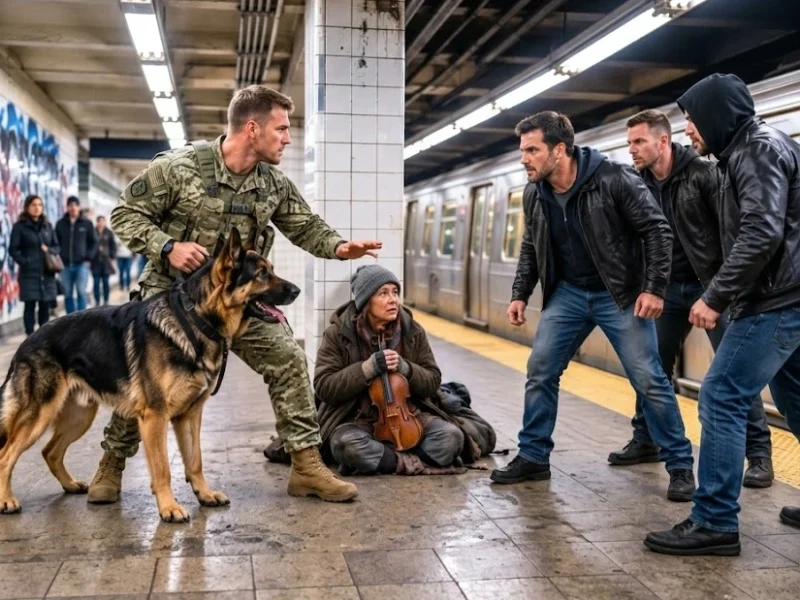
homeless woman was cornered in a subway station by a man nobody dared to stop — until a Navy SEAL and his German Shepherd exposed the monster hiding in plain sight.
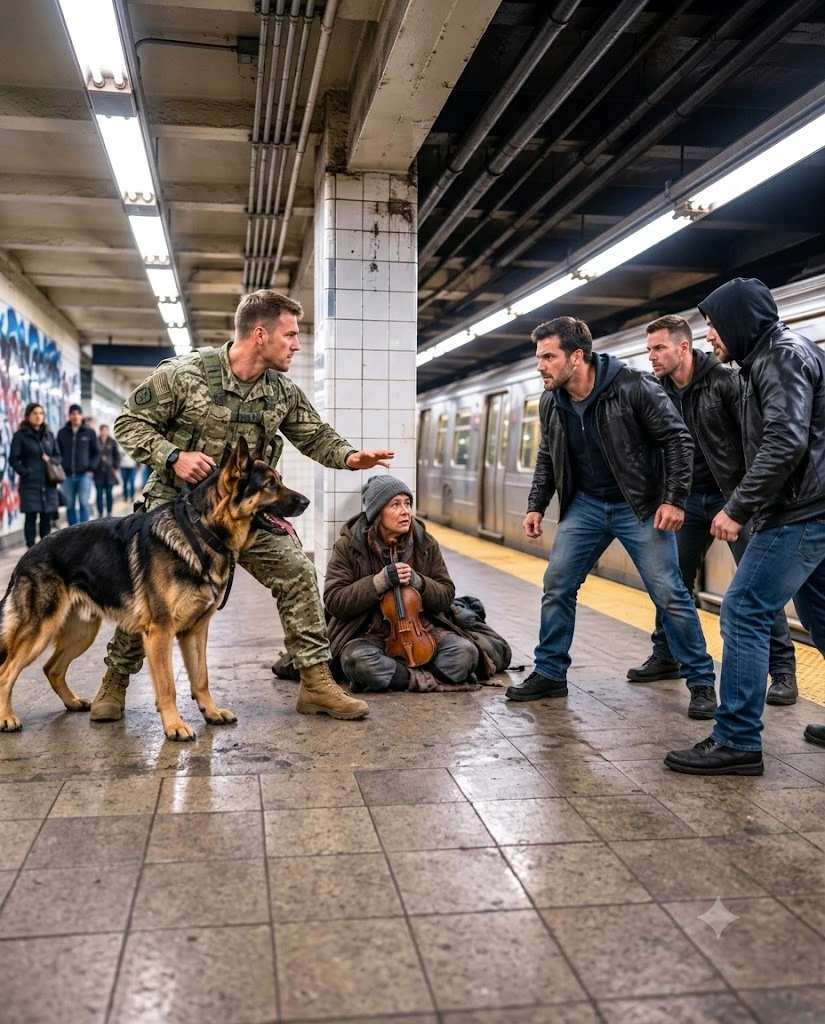
The dog stopped first, and Julian felt the leash snap taut like a tripwire in the dark.
He turned, expecting Apollo to be fixed on a pigeon or a dropped pretzel on the platform floor of the Broad Street Line station.
But Apollo was not looking at food.
The big German Shepherd stood completely still, his dark ears angled toward a dim corridor branching off the main platform, nostrils flaring once before he looked back at Julian with that specific expression.
Julian had learned to trust that look more than radar.
He glanced at his watch—just past nine in the evening—and remembered he had nowhere to be.
He was on leave, which was a word the military used to describe the uncomfortable space between one war and the next.
He loosened his grip on the leash, and Apollo moved immediately, pulling them down the narrow side corridor with quiet purpose.
The music reached Julian before he saw its source: a violin.
The notes floated through the stale underground air with a rawness that had nothing to do with technical skill and everything to do with grief.
It was the sound of someone playing for themselves alone, with no expectation that anyone would ever listen.
They rounded the corner.
A woman sat on a flattened cardboard box against the far wall of the corridor, small and wrapped in so many layers of clothing that her outline was difficult to read.
A gray wool hat was pulled low over her forehead, and her fingerless gloves were so worn the wool had frayed down to bare threads at the fingertips.
Her name was Alice, though Julian would not know that for another twenty minutes.
She played with her eyes closed, the bow moving across the strings in slow, deliberate strokes.
An open violin case lay in front of her, and inside it were four quarters and a bus transfer someone had apparently decided she could use.
Apollo sat down beside the case without being told, tucking his front paws together and resting his chin on them, his eyes half-closing.
Julian had never seen the dog behave this way around a stranger, because Apollo was trained to assess and maintain distance.
He was not trained to be a music critic.
Julian leaned one shoulder against the tiled wall and let her play.
Alice did not notice them for nearly two full minutes.
When she finally opened her eyes and saw the massive dog three feet away, she gasped and scrambled backward against the wall, nearly dropping the violin.
“He won’t touch you,” Julian said, keeping his voice exactly the way he kept his posture on a dark street—calm, unhurried, non-threatening.
“He just likes the music.”
Alice stared at Apollo, and Apollo stared back with the patient expression of an animal that already knew this person was not a danger and was waiting for her to figure out the same about him.
Slowly, Alice pressed herself back to her original position and tucked the violin under her chin again.
Her hands trembled for the first few notes, then steadied.
The melody came back fuller this time, as if the audience of one soldier and one dog had given it permission to breathe.
Julian listened without moving, and something about the song felt like a bruise he had not known was there.
The sound of boots changed that.
Four men entered the corridor from the main platform, moving with the loose, confident stride of people who owned every space they walked into.
The leader was broad and young, wearing a red jacket unzipped over a hoodie despite the cold, and he had a metal pipe hanging from his left hand like it was nothing—like he carried it the way other men carried umbrellas.
Alice saw them and stopped playing.
The men spread out to block the corridor exit, and the leader looked from Alice to Julian with the calculating eyes of someone deciding whether the calculation changed anything.
“You’re in the wrong place,” the leader said to Alice, though he did not look at her when he said it; he was still watching Julian.
“We told you last week. This spot is managed.”
Alice pressed the violin tightly against her coat, her breathing gone shallow.
“The violin,” the leader said. “That thing’s worth something. Put it in the case and slide it over.”
Julian stepped away from the wall without saying anything, moving to stand directly between Alice and the four men as Apollo rose smoothly to take position at his left knee.
The dog did not bark.
He made a sound much lower than a bark, a sound that started somewhere deep in his chest and came out through his teeth as something close to a promise.
The leader looked at Julian.
“Walk away, man. This does not involve you.”
“It does now,” Julian said.
What happened next took eleven seconds.
The man with the pipe swung first, and Julian stepped inside the arc before the swing fully extended, absorbed the forearm on his shoulder rather than his skull, and drove his palm into the man’s sternum hard enough to put him into the wall.
The second man came around from the left, and Julian caught his wrist, redirected his momentum, and let him introduce himself to the concrete floor.
The third man took one look at Apollo’s teeth from a distance of four feet and made a personal decision to stop advancing.
The leader backed up two full steps before his pride stopped him.
Then he looked at his three companions in various states of incapacitation and recalculated.
“You’re going to regret this,” the leader said.
Julian watched him the way Apollo watched everything—without blinking.
The four men left, their footsteps fading quickly, the way pride always does when the math stops working.
Julian turned around.
Alice had not moved, sitting against the wall with the violin clutched against her chest, staring at him with an expression he recognized from places very far from Philadelphia.
It was the look of someone who had been waiting for violence for so long that when help arrived instead, they did not know what category to file it under.
He crouched down to her level, and Apollo walked forward and pressed his nose gently against her wrist.
“Those men,” Alice said, her voice a thin, careful thing. “They’ll come back.”
“Not tonight,” Julian said.
He did not leave.
He sat down on the cold concrete ten feet from her, his back against the opposite wall, and Apollo returned to his position beside her case.
After a few minutes, Alice lifted the violin and began to play again.
Julian closed his eyes.
The melody moved through the underground air like something alive, rising and falling with an irregular quality that he could not name—a pattern beneath the pattern, a logic beneath the song.
He had heard complicated music before.
He had heard signal embedded in noise before.
This felt like both simultaneously.
He opened his eyes and looked at Alice, at the line of her jaw, the set of her eyes, the way she held her shoulders forward when she played—the same slightly forward lean he had observed in one other person in a different posture entirely on the other side of the world.
The thought hit him like stepping off a curb in the dark.
“Where did you learn that melody?” Julian said.
Alice lowered the bow, her expression shifting.
“Why would that matter to you?”
“Please,” he said, keeping his voice level. “I need to know.”
She looked at him for a long time, and Apollo rested his chin on her knee.
“My son taught it to me,” Alice said finally. “He said it was our song. Something just for us.”
Her voice thinned at the edges.
“He’s gone now.”
Julian’s heart took one very slow beat.
“What was his name?” he asked, and the question sat in the air between them.
“Brennan,” she said.
Julian stopped breathing.
Petty Officer First Class Brennan Walsh.
Julian had known him for six years, had run forty missions with him, had eaten terrible food with him in three different countries, and had argued about baseball standings in the dark between rotations.
He had watched Brennan hum that specific uneven melody under his breath every single time they were about to go through a door.
Julian had assumed it was a nervous habit.
He had assumed a lot of things about that last mission that turned out to be wrong.
Brennan had died fourteen months ago in a collapsed building in a place Julian was not allowed to name in any official document.
The mission had been wrong from the start in ways that Julian could not prove but could not stop thinking about.
“My name is Julian,” he said, his voice coming out rougher than he wanted it to. “I served with Brennan. He was my brother.”
Alice’s bow fell from her hand and clattered on the concrete.
She did not speak for a long time, and Apollo leaned his full weight against her side, and she let herself cry into the thick fur of his neck.
Julian sat with her and did not look away, and did not offer words, because words were the thing people offered when they had nothing real to give, and he had something real.
He had the truth.
Between the sobs, over the next hour, sitting on the cold floor of that corridor while the last trains rumbled past, Alice told him everything.
She had lost Brennan to the military’s notification knock.
She had lost herself to the grief.
A man who introduced himself as a financial consultant—who had apparently been watching for exactly this kind of vulnerability—had arrived at her door three weeks after the funeral with paperwork and condolences.
She had signed things she should not have signed.
Within eight months, she had no savings, no house, and no explanation that made any legal sense.
She had ended up in the station with the violin because the violin was the only thing of Brennan’s she had managed to keep.
Julian listened to all of it.
Then he stood up and held out his hand.
“You’re not sleeping here tonight,” he said.
She started to object, and he waited.
Alice looked at the scattered quarters in her case, then at Apollo, who was already on his feet, already watching the corridor entrance with calm authority.
She took Julian’s hand.
They took a cab to the apartment Julian was renting month-to-month in South Philly—three rooms, a window that rattled in the wind, and not much else.
He made soup from a can and set it in front of her at the small kitchen table.
Alice ate with her hands shaking around the spoon, and Julian sat across from her and said nothing, because sometimes silence is the only honest response to what a person has survived.
She fell asleep on the couch before nine-thirty, and Apollo curled himself on the floor between the couch and the front door.
Julian sat in the one chair the apartment had come with and let his mind work.
The melody would not leave him alone.
He had been in signals intelligence long enough to know that the irregular rhythm of a tune was not always just a tune.
He replayed it in his head—the long notes, the short notes, the pauses between phrases that were slightly too long to be musical choices.
He got up and found a notepad in a kitchen drawer, then sat back down and hummed the melody softly to himself, tapping his finger on the paper for each note.
Long tap. Short tap. Short tap. Pause. Long tap.
He stared at the paper, went through it again, then again.
His hand went still.
Dots and dashes, short and long.
Brennan had encoded a message inside a melody and taught it to the one person in the world he trusted completely—not a recorded file, not a written note, but a song hidden in a place that could not be confiscated, could not be seized, could not be deleted, hidden inside his mother’s memory.
Julian closed his eyes and ran the whole sequence once more, slowly translating.
When he opened his eyes and looked at what he had written, the cold that moved through him had nothing to do with the apartment’s poor heating.
The message was seven words.
Basement, brick, east wall, third from floor.
The address Brennan had built into the last eight notes—the address of the house Alice had lost.
Julian sat very still for a long time.
Then Apollo lifted his head from the floor, his ears going forward, the fur along his spine rising in a slow, even ridge.
Julian was out of the chair before Apollo made a sound.
He moved to the window without turning on any lights, keeping his body flat against the wall and looking through the gap at the edge of the blind.
Below on the dark street, two SUVs had parked without their headlights on.
Men were stepping out.
Julian counted five.
They moved in coordinated sequence—one going around to the back of the building, two positioning at either side of the front entrance, two approaching the main door directly.
They were not police.
Police announced themselves.
These men moved like people who needed no announcement, and Julian had seen this type of deployment in three countries.
He knew exactly what it meant.
He crossed the apartment in silence and touched Alice’s shoulder, and she woke instantly, her eyes wide.
“Don’t make any sound,” he said, his voice barely breath. “Get your coat. Get the violin. We’re leaving right now.”
Alice looked at his face and did not ask questions.
She was on her feet in ten seconds.
They went out through the bathroom window onto the fire escape, and Apollo jumped the rail to the landing below and waited.
The metal grating was iced over, and Julian held Alice’s arm the entire way down.
They hit the alley as the front door of the building crashed open three floors above.
Apollo led them into the dark without being asked.
Three blocks away, Julian pulled Alice into the recessed doorway of a closed laundromat and listened.
No running footsteps.
The snow was falling heavily enough to muffle sound and cover tracks, and Apollo sat at the doorway’s edge, watching the street with mechanical patience.
“They’re going to kill me,” Alice said.
It was not a question.
“They think you know something,” Julian said. “They think Brennan told you something before he died.”
“He didn’t tell me anything.”
“He did,” Julian said. “He just told you in a way you didn’t know to recognize.”
He explained the melody, the code, the address, the seven words.
Alice put her hand over her mouth.
“He knew,” she said. “He knew something was wrong before he went.”
Her voice cracked along its edges.
“He was protecting me.”
“He was doing exactly what he was trained to do,” Julian said. “He hid the evidence, and he sent you the map.”
They moved through the back streets of South Philly for the next forty minutes, Apollo navigating by instinct through alleyways Julian would not have found on his own.
The snow covered everything in equal gray.
Twice they stopped and pressed flat against walls while headlights swept past.
Once Julian spotted a man on the opposite sidewalk moving parallel to them with the particular alert posture of a trained searcher, and he pulled Alice and Apollo into a recessed loading dock and did not breathe for ninety seconds.
The man moved on.
They reached the neighborhood of Brennan’s childhood home just before midnight.
It was a rowhouse on a quiet block in northeast Philadelphia, bank-owned and dark, with a foreclosure notice stapled to the front door and half pulled loose by the wind.
The windows were boarded.
Julian stopped one house short and studied the property from the shadow of a large maple.
One guard at the front, one visible at the side gate, both carrying themselves like professionals.
Julian watched the front guard for ninety seconds and timed the cadence of his movement.
He looked down at Apollo.
“East side of the block,” Julian said quietly. “Make some noise. Give me two minutes.”
Apollo looked at him for one second, then disappeared into the darkness at a run.
The bark that erupted from the far end of the block was not Apollo’s normal bark.
It was the full-throated aggressive sound Julian had heard him use exactly twice before—once at a suspect during a naval base exercise, and once at a man who had actually been carrying a weapon.
Both guards reacted immediately, moving toward the sound and away from the house.
Julian took Alice by the hand and crossed the street at a run.
The side gate was locked, and Julian used his shoulder on the rotted wood of the fence panel beside it, and it gave on the second hit.
They moved through the narrow side yard and reached the basement door.
It was padlocked.
Julian found a landscaping brick half buried in the frozen ground, worked it free, and hit the padlock hasp four times until the screws pulled out of the rotted wood frame.
The basement smelled of old water and mildew.
Julian used his phone’s flashlight, keeping it low and pointed at the floor.
East wall.
He found it in under a minute—a rough brick slightly lighter than the ones around it, its mortar cracked and repointed badly.
The amateur work of someone who needed to open and close this space and could not afford a professional to conceal the evidence.
Julian worked his fingers into the edges.
The brick came out with resistance and then all at once.
Behind it was a hollow space the size of a shoe box.
Inside was a waterproof bag sealed with military-grade tape.
Julian opened it.
A USB drive, a micro SD card, a single-folded document handwritten four pages in Brennan’s tight, careful print.
Julian read the first paragraph.
The cold settled into him differently now—not the cold of the basement, but the cold of understanding what someone had done and who had helped them do it.
The document was a record: names, dates, coordinates, wire transfers.
It described a contractor operation that had never appeared in any official filing, funded through diverted military procurement accounts, authorized by a signature Julian recognized with a sensation like falling.
The general who had sent their team into that building fourteen months ago.
Brennan had found it three weeks before the mission.
He had known.
He had known the mission was not a mission.
He had known it was a sentence.
He had gone anyway because four other men were going, and Brennan Walsh did not leave his people behind.
Julian held the papers and did not speak for a moment.
Alice stood beside him, reading over his shoulder, her breathing very controlled and very quiet.
“He knew they were going to kill him,” she said.
“He knew,” Julian said. “And he still went.”
“Yes.”
Alice looked at the dark wall for a long time.
“Because of you,” she said. “Because you were all going.”
Julian folded the document carefully and sealed it back into the waterproof bag.
He put the USB and SD card into the interior pocket of his jacket against his chest.
Upstairs, a door shattered.
They had found the side fence.
Julian grabbed Alice’s wrist and pulled her toward the basement stairs.
Apollo came through the broken basement door at the same moment—all forward momentum and controlled silence—cutting past them and going up the stairs first.
The next four minutes were the kind Julian never described to anyone afterward, because the words for them did not exist in ordinary language.
It was the compressed violent arithmetic of a man who had spent fifteen years training for exactly this.
He moved through the dark house with Apollo as a unit—two trained operatives with seventeen combined years of operational instinct between them.
The first man through the front door met Julian’s elbow before his eyes adjusted to the darkness.
The second tried to use the staircase as an advantage and learned quickly what it meant to fight someone who treated confined spaces as a preference rather than a problem.
Apollo handled the third.
Julian did not think about it as violence while it was happening.
He thought about it as geometry—angles, timing, the precise application of force to specific targets.
Three men, four minutes, zero shots fired.
When the house went quiet again, Julian found Alice exactly where he had left her, standing against the basement wall with the violin case held against her chest like a shield and her eyes steady and dry.
“Apollo,” Julian called.
The dog appeared at the top of the basement stairs and came down.
He was unmarked, and his tail moved once.
They left through the side yard and walked six blocks before Julian used a pay phone outside a gas station.
He had committed one number to memory that he trusted absolutely—a colonel named Whitmore based at the Pentagon who had been Brennan’s original recruiter and who Julian knew had been quietly investigating the same disappearing funds trail for three months without finding the downstream end.
Julian gave him the end.
He gave him everything: the documents, the names, the account numbers, the coordinates of the unauthorized sites, the identity of the contractor death squad currently unconscious in a row house in northeast Philadelphia.
Whitmore was quiet for a long time.
“How long have you had this?” Whitmore said when Julian finished.
“About forty minutes,” Julian said.
Another silence.
“I’ll need you and the evidence at a secure location by 0600.”
“We’ll be there,” Julian said.
He hung up and turned around.
Alice was standing in the yellow light of the gas station canopy with Apollo sitting at her feet.
She looked very small and very tired and very much like a woman who had been carrying something enormous for a long time and had just in the past hour been allowed to set it down.
The arrests were not quiet.
They could not be made quiet given the scale of what the documents proved.
By 0900 the following morning, federal vehicles were positioned outside an estate in Virginia.
And the man whose digital signature appeared on the bottom of Brennan’s four handwritten pages was escorted out of a glass and marble lobby in front of three news cameras that had been tipped by someone with a sense of occasion.
Julian watched it from a secure room at a naval facility in South Philly.
Alice sat beside him, and Apollo lay on the floor between their chairs.
Alice did not cheer.
She watched the screen with the measured expression of someone collecting what they were owed, not celebrating a windfall.
When they turned the news off, she was quiet for a while.
Then she said, “He should have told me.”
“He was protecting you,” Julian said.
“I know.”
She looked at her hands.
“But I would have kept it. I kept the song, didn’t I?”
“You kept it for fourteen months,” Julian said. “In a subway station through everything.”
Alice was quiet again.
“What do you do now?” she asked him.
Julian looked at the wall across the room.
Extended leave. An empty apartment. A city he had chosen for no particular reason.
He thought about the specific quality of the silence in that station corridor before everything had started—how Apollo had pulled him toward the music with an insistence that Julian had never been able to fully explain and had long since stopped trying.
There are moments in a person’s life that only make sense in retrospect.
Two broken people finding each other in an underground station in the middle of winter, held together by a dog and a melody and a name neither of them had expected to hear that night.
You cannot plan for those moments.
You can only recognize them when they arrive and refuse to walk away from them.
“I don’t know yet,” Julian said.
But he stayed.
The military cleared Alice’s debts in full.
The wrongful foreclosure was reversed through an emergency injunction that moved faster than such things typically moved, because the paperwork carried the weight of a federal treason investigation and the name of a dead Navy SEAL.
The financial consultant who had preyed on her grief was located in Tampa, arrested, and declined to be creative with his defense given the federal context surrounding the case.
By early spring, Alice was home.
The rowhouse on the northeast block was repainted, the boards came off the windows, and a small garden started in the front yard—not yet much, just some dirt turned over and a few seeds laid in.
Alice spent her evenings in the front room playing violin for whoever happened to be nearby, which was usually Julian and Apollo and no one else, which was enough.
Julian sat in the armchair by the window most evenings.
He drank bad coffee and read and let Apollo take up too much of the floor and did not think very hard about where he was supposed to be or what came next.
Apollo had known before either of them.
That was the part Julian thought about sometimes in the quiet after Alice put down her bow.
The dog had stopped in that corridor and refused to move for reasons that no amount of training fully explained.
Some decisions arrive before we make them.
Some paths are chosen for us by something that moves ahead of our understanding, patient and certain, already knowing where the music leads.
Julian set down his cup and listened to Alice play.
The melody moved through the warm house, nothing like a code now, nothing like a grief.
It was just what it had always been underneath everything else—a mother’s voice and a son’s memory, and a love that had refused through all of it to go quiet.
This is what the narrator carries away from that story.
Courage is not only the soldier’s gift.
It belongs also to the woman who kept playing in the dark, who kept the song alive without knowing why, who held on to the one thing she had left until the night it turned out to be everything.
Some people are rescued.
Some people do the rescuing without ever realizing they have done it.
Alice was both.
So in his own way was Apollo.
And Julian, who had come underground looking for nothing but a way home, found instead the only home that had ever asked him to stay.









