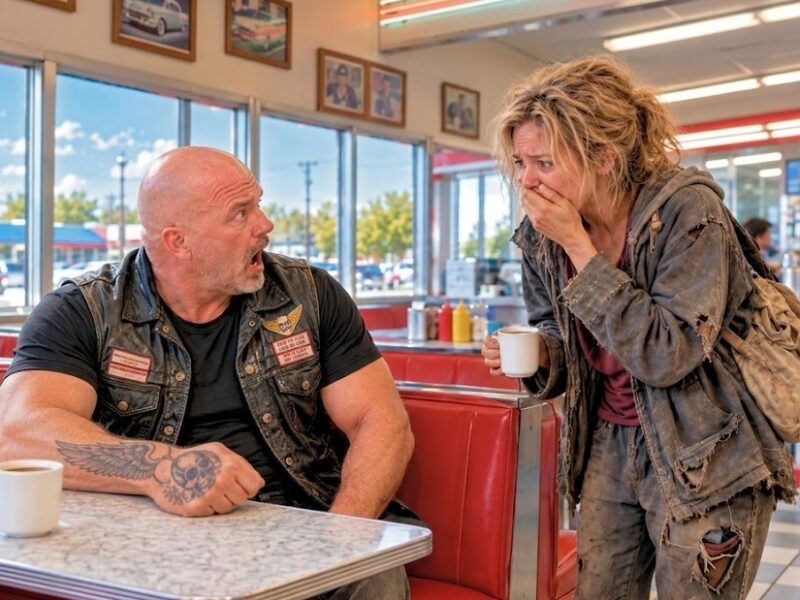
Homeless Girl Said, “My Mother Has Your Tattoo”—The Hells Angels Leader Froze in Shock
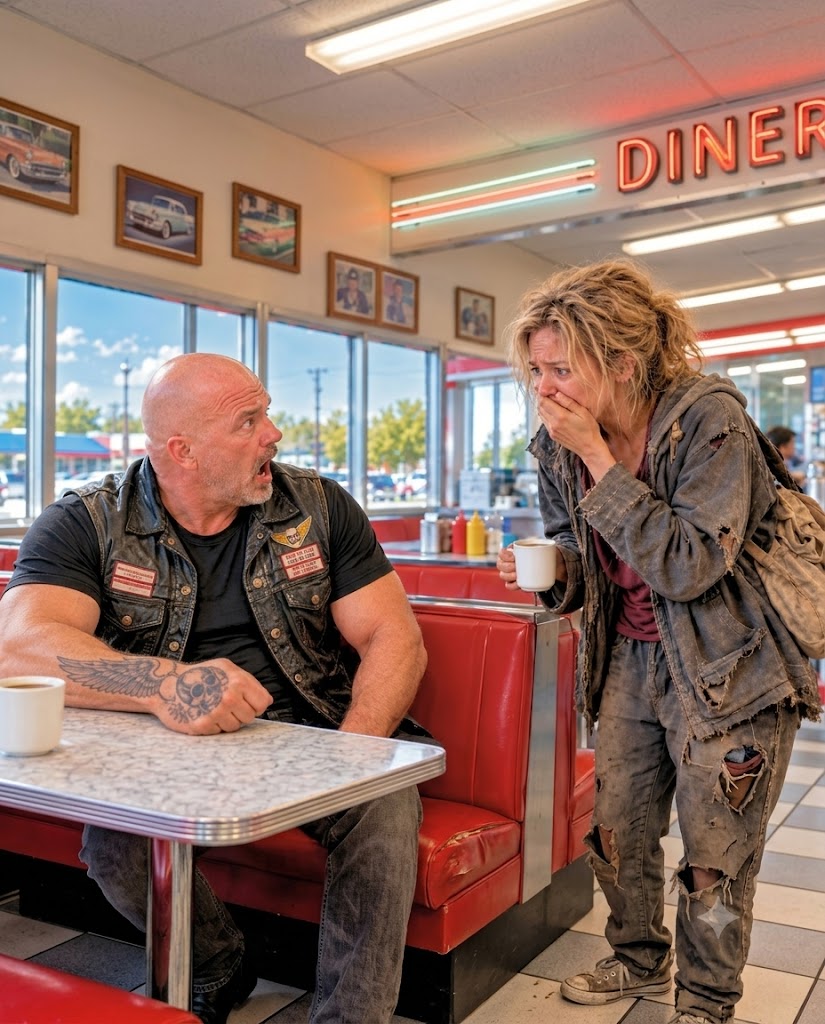
The heavy boot came down on the gravel with a crunch that sounded like a bone breaking, stopping just inches from a girl’s outstretched hand. She didn’t pull back. She couldn’t. Her fingers were wrapped so tightly around a paper cup with a few coins in the bottom that her knuckles had gone white, and she was too damn tired to flinch. A shadow fell over her, big and wide, the kind of big that blocks out the sun and makes you forget it was ever there. Leather creaked.
A chain rattled against a belt. Then a low growl rolled out of a dog the size of a small couch, and the whole parking lot went still. The girl lifted her chin. She looked up at the man standing over her, at the ink running down his thick forearm, and she said six words that stopped him cold. “My mother has your exact tattoo.” The man’s name was Dutch Caldwell, and he had buried that tattoo secret for nineteen years. What did that girl know that he didn’t?
Stay with me. Now, here’s what you need to understand about Dutch Caldwell. When he rode into a town, the town noticed. He was built like a man who hauled freight for a living—thick through the chest, gray in the beard, hands that could bend a tire iron in half. For twenty years, he’d run the local chapter of the club, and nobody had ever made the mistake of testing him twice. People stepped off the sidewalk when his boots hit it.
He’d learned a long time ago that the quietest man in a room is usually the one you ought to worry about. And Dutch was almost always the quietest man in the room. That afternoon, he pulled his Harley into the gravel lot of a diner off the highway. A cracked old place with a half-dead neon sign that buzzed like a trapped fly. He’d ridden two hours in the heat, and all he wanted was coffee—black—a plate of eggs, and to be left alone.
Diesel, his Rottweiler, rode in a sidecar rig Dutch had welded himself, and the dog jumped down the second the engine died. Diesel had been with him seven years. They’d come up together out of some bad country, and most days Dutch trusted that dog’s read on a stranger more than his own.
Dutch almost didn’t see the girl. She sat against the wall near his bike, knees pulled to her chest, that paper cup set out in front of her. Thin. Too thin. Dirt on her face, sneakers split along the sides. She couldn’t have been more than sixteen. And people walked past her the way folks walk past a crack in the sidewalk. A couple came out laughing, parted around her without looking down, got in their car and drove off, and the girl watched them go with no expression at all. That was the thing. She wasn’t begging anymore. She was just waiting. Like she’d stopped expecting people to be people. A trucker came out wiping his mouth, a big loud fellow in a stained ball cap, and on his way to his rig he kicked her cup. Not by accident. He saw it, and he kicked it, and the coins went skittering across the gravel. “Get a job,” he said, and laughed like he’d done something clever. A couple of folks near the door smiled along, the way people do when they want a mean man to like them. The girl didn’t cry. That’s the part that got Dutch. She got down on her hands and knees and started picking the coins back out of the dirt, one at a time, careful, like each one mattered. Because to her, each one did. She found a dime under the lip of the curb, wiped it on her shirt, dropped it in the cup, and never once looked up to see who was watching. Dutch had seen a thousand hard things. He’d buried friends. He’d done time. He had a wall inside him thick enough that most things bounced right off. But the way that girl didn’t cry put a crack in it. He knew that look. He’d worn it himself a long time ago in rooms he didn’t talk about. It’s the look of a kid who learned early that crying only tells the wrong people where it hurts. Still, he was tired. And it wasn’t his business. So, he set the kickstand and started for the door, telling himself the kid would be gone by the time he came back out. That the world was full of lost kids, and a man couldn’t carry all of them. That he’d seen worse and kept walking, and that was just the arithmetic of staying alive. That’s when Diesel wouldn’t move. The dog planted himself right next to the girl, 130 pounds of muscle, and leaned into her side. Dutch snapped his fingers. Diesel didn’t even look at him. That dog had been to war and back. He’d pulled men out of ditches. He’d never once broken a command. But now he just pressed against this filthy, starving kid like he’d found something he’d been looking for. Diesel. Come. Nothing. The girl put one hand on the dog’s broad head, hesitant, like she expected to get bit. And Diesel, who had taken a bite out of men twice her size, closed his eyes and leaned harder. He let out a long breath, a sound Dutch had only ever heard him make lying by the fire at the end of a hard day. A sound that meant safe. Dutch walked over, meaning to grab the collar and haul the dog off, meaning to say something gruff and be done with it. And that’s when his boot came down on the gravel next to her hand, and she looked up. And she saw the tattoo running down his forearm. The club rocker. The wings. And under it, half hidden, a small private design most people never even noticed. A little mark Dutch had carried so long he’d forgotten it was there. Her whole face changed. “That tattoo,” she said quietly. “My mother has that tattoo. The exact same one. The little one under the wings.”
Dutch went very still. Let me tell you about that little mark. It wasn’t a club design. It wasn’t shop flash anybody could walk in and get. Dutch had drawn it himself back when he was young and stupid and in love. Two initials wound together into something that looked almost like a knot, almost like a bird taking off. He’d drawn it on a napkin first, then on the back of her hand in pen. Then when she laughed and said she wished it would never wash off, he’d taken her to a man he knew and had it put into her skin and then into his own, so neither one of them could ever lose it. He’d drawn it for one person in the entire world. One. Her name was Ronnie Vale. And Ronnie Vale had been dead for nineteen years. Dutch lowered himself down. A man his size doesn’t kneel easy, but he knelt right there in the gravel, so his eyes were level with the girl’s. His heart was slamming against his ribs in a way it hadn’t in a very long time. “Say that again,” he said. His voice came out rough. “Slow.” “My mom has that same tattoo,” the girl said. “On her shoulder. The little knot thing. I used to trace it when I was small. She said a man made it up for her once. She said it was the only thing anybody ever gave her that was just hers.” She swallowed. “I’m sorry. I didn’t mean to bother you. It’s just I’ve never seen it anywhere else. Not ever. I’ve been looking at people’s arms for days and I was starting to think I made the whole thing up.” Dutch couldn’t breathe. “What’s your mother’s name?” he asked. And the girl said, “Veronica. Everybody calls her Ronnie.” Now here’s the thing you have to understand. Dutch had been told to his face nineteen years ago that Ronnie Vale was dead. That she’d run her car off a mountain road on a bad night in the rain. That there was nothing left to bury that would mean anything. That the river had taken most of it. The man who told him was a brother in the club. A man Dutch trusted with his life. A man named Cyrus Boone. Dutch had believed every word. He’d grieved her for nineteen years. He’d gotten harder every one of them. Told himself the softest thing he ever had was gone. And built the whole rest of his life on that one flat fact. How old are you? Dutch said, and he already knew. He already felt it climbing up his spine like cold water. Seventeen, the girl said. I’ll be eighteen in the spring. Seventeen. Which meant she’d been born two years after the night Ronnie supposedly drove off that road. Which meant Ronnie had been alive two years after she died. Which meant somebody had lied and kept lying for a very long time. Dutch put one hand flat on the gravel to steady himself. What’s your name? he managed. Danny, she said. Danielle. He looked at her then. Really looked. The way you look at something when the floor’s gone out from under you. The shape of her jaw. The gray in her eyes that wasn’t quite blue. He’d woken up next to those eyes a lifetime ago. And the jaw, Lord, the jaw was his own. “Danny,” he said, and his big voice broke on the one small word. “When’s the last time you ate?” She shrugged like it didn’t matter. “Yesterday. Maybe. There was a church in the last town that gave out sandwiches, but I missed the time.” Dutch stood up and held out his hand, and after a second she took it, and he lifted her off the ground like she weighed nothing, because she almost did. “Come on,” he said. “You’re eating right now.”
And here’s where, if you’d been watching, you’d have let out a breath. Because it looked like the hard part was over. Inside, Dutch put her in a booth by the window and told the waitress to bring whatever the kitchen had. Eggs, bacon, pancakes, a tall glass of milk and another behind it. Diesel lay down under the table with his chin on the girl’s feet. The owner started to say something about the dog, took one look at Dutch, and found something to do behind the counter instead. The girl ate like she’d forgotten food could taste like anything. She ate with one arm curved around the plate, the way a person eats when they’ve had to protect their food from somebody. Dutch noticed that. He noticed everything now. He sat across from her with his coffee going cold, and for the first time in nineteen years, something warm was moving around loose in his chest. He didn’t know what came next. He didn’t know how much was true. But she was here, this kid. She was real. She had Ronnie’s mark in her memory and Ronnie’s eyes in her face. And for the length of one quiet meal, Dutch Caldwell let himself feel like a man who’d just been handed back a piece of his life. He reached across the table slow and set one of his huge scarred hands next to her small one. Not touching. Just close. “You’re safe now,” he said. “You hear me? Whatever’s been going on, it’s done. You’re with me.” The girl stopped chewing. She looked at his hand. Her eyes filled up and she whispered, “You shouldn’t have said that.” The fork slipped out of her fingers and clattered on the plate. “They’re going to come looking for me,” she said. “And when they find out I talked to somebody, they’re going to hurt her.” Dutch leaned forward. “Who’s going to hurt her? Who’s they?” Her hands were shaking now. “The man who keeps my mom,” she said. “He doesn’t let her leave. He never has. I got out because I’m fast and nobody watches me close. But she can’t run. She’s sick. And if he thinks she sent me to find anybody—” Danny couldn’t finish it. Everything in Dutch went cold and sharp at once. See, up until that moment, this had been a story about a lost girl and a man getting a miracle. Sweet. Simple. But it wasn’t that story anymore. In one sentence, it had turned into something with teeth. Because now Dutch understood that Ronnie wasn’t dead, had never died, and somebody had spent nineteen years keeping her like property while telling the world she was gone. This wasn’t a miracle he’d stumbled into. It was a crime. One still happening right now, two hours up the road. “Danny,” he said very quietly. “This man who keeps your mother, does he have a name?” “Everybody calls him Boone,” she said. Cyrus Boone. The brother Dutch had trusted with his life. The man who’d looked him in the eye nineteen years ago and told him the only woman he ever loved had died in the rain. The man who’d ridden beside him to the funeral. Who’d put a hand on his shoulder at the graveside and said, “She’s at peace now, brother. Let her rest.” Something happened in Dutch’s face then. The girl shrank back a little, not because she was scared of him, but because she’d never seen a grown man’s grief turn into something that could kill. He put both hands flat on the table to keep them still. “Listen to me. I need you to tell me everything. Where? How many men? And I swear to you, on anything you want, nobody is ever going to hurt your mother again.”
And this is where I’ve got to stop and say one thing to you directly. If you’ve made it this far, if this story’s got its hooks in you the way it had its hooks in me, do me a favor and hit that subscribe button. That’s all. It tells me you want to hear the rest, and believe me, there’s more. All right. Back to that diner, where Dutch Caldwell was about to tear his own life open to get the truth out of it. Danny told him, in pieces between bites she’d stopped taking, she laid it out. Boone lived a couple hours north, past the pass, on a stretch of land behind a chain-link fence with three mean dogs, and a gate that was always locked. He ran a chop operation out of the back barns, stolen bikes, stolen cars, parts moving in and out at night. He had five or six hard men around him most of the time. Men who did what he said without asking. And he had Ronnie in the house. Had her for as long as Danny could remember. Danny had grown up on that land thinking that was just how the world worked. That mothers lived behind fences and didn’t go to town and flinched when a man raised his voice. I used to think everybody’s house had a lock on the outside of the bedroom door, Danny said, so plain and near about broke Dutch in half. I didn’t know that wasn’t normal until I was maybe ten. There was a TV show. A kid just opened the front door and walked outside, walked to a friend’s house. And I remember thinking that was the most unbelievable thing I ever saw. She told me about the tattoo when I was little, Danny went on. She’d trace it and tell me there was a man once who thought she was worth something. She never said his name. I think she was scared Boone would hear it in her sleep. But a couple weeks ago, she got real sick. Coughing blood into a rag and hiding it so he wouldn’t know how bad. And one night she grabbed my hand and said, “Danny, you’ve got to go find him.” The man with the wings. If I ever saw those exact wings with the little knot under them, I was to tell him her name and nothing else, and he’d know. So, I waited for a night nobody was watching, and I went under the fence where it’s loose by the wash, and I ran. I’ve been walking and hitching for eleven days. I slept in a laundromat two nights. A woman at a gas station gave me a coat. I didn’t even really know what I was looking for. I just kept checking arms. And then you parked your bike right next to me, and I looked down, and there it was. Dutch looked at his own forearm. At the wings. At the little knot he’d drawn as a stupid lovesick kid. The one thing that had traveled nineteen years and two hundred miles in eleven days and found its way back to him through a starving girl in the dirt. “She sent you to me,” he said. “She’s been trying to reach me the whole time.” “She didn’t know if you were alive,” Danny said. “She didn’t even know if you’d care.” Boone told her you forgot her. Told her that for years. And I think part of her believed it. But a bigger part didn’t, or she wouldn’t have sent me. Dutch stood up so fast the booth shook. He threw a fold of bills on the table that would have bought the whole diner twice over. “Finish your milk,” he said. “We’re going.”
Now, Dutch could have called the law. I know that’s what you’re thinking. Nineteen years of false death, a woman locked behind a door, that’s a case any decent cop would kill to make. But understand the world these people lived in. The law up in that county and Cyrus Boone had an understanding. And that understanding ran on envelopes of cash passed across a tackle shop counter twice a month. A deputy showing up at that gate meant Boone got a phone call an hour before the car even turned off the highway. And by the time anybody looked, there’d be nothing to find but a clean house and a sick woman who’d learned to smile and say she was fine, honey. “Everything’s fine.” No. There was only one thing Cyrus Boone still feared, and it was the man he’d lied to. Dutch made two phone calls from the diner’s payphone. By the time he hung up the second, nine of his brothers were kicking their bikes to life across that valley and pointing them north. He told them Boone had taken something of his and kept it for nineteen years, and that was enough. In that club, a lie like Boone’s was the worst thing a man could do. You didn’t take a brother’s dead and keep her alive in a locked house for yourself. You didn’t stand at a graveside and squeeze a man’s shoulder while the woman he was weeping over was tied up two hours away. There is no forgiving that. None. He put Danny in the diner’s back office with the owner’s wife and a twenty and strict orders not to move. The woman who’d raised four of her own took one look at that skinny haunted kid and pulled her in under one arm and Danny let her, which told Dutch something, too. Diesel, he took with him. The dog had known from the first second, leaning into that girl in the parking lot, and Dutch wasn’t about to argue with him now. They rode north into the dark, ten headlights climbing the pass. Dutch rode out front with the wind tearing at his beard and nineteen years of grief turning slowly into something he could use. He thought about every time he’d stood at Ronnie’s name carved into a cheap stone up in that northern cemetery, a stone Boone had insisted on paying for, a stone over an empty hole. The flowers he’d left there, the things he’d said out loud to a patch of grass, and all that time she’d been two hours up the road, tracing a tattoo on her own skin and telling a little girl there was a man once who thought she was worth something. Every mile Dutch did math he didn’t want to do and every number landed like a fist. They cut their engines a quarter mile from the gate and walked the bikes the rest of the way in the dark. The three dogs started up first, barking and lunging at the fence. Then the floodlights came on, washing the whole yard white, and Cyrus Boone came out onto his porch with a shotgun in his hands and four of his men fanning out behind him. Boone was older now, lean and silver, but Dutch would have known that face in his sleep. He’d grieved beside that face. Dutch, Boone called out, careful, friendly, like old friends on a surprise visit. Little late for a ride, brother. Dutch stood at the gate with Diesel pressed hard against his leg, growling low. Open it, he said. Now, what’s this about? Boone came down one step, easy, like a man who still thought he could talk his way across the gap. You want to talk, we’ll talk. But you don’t roll up on a man’s home in the night with his whole chapter behind you and— Her name was Veronica Vale, Dutch said. And there it was. Boone’s face did the thing a man’s face does when the one lie he built his whole life on finally comes due. The jaw slackened. The eyes went somewhere for half a second. He covered it fast, pulled the friendly mask right back up. But Dutch had been reading faces across card tables and bar fights for forty years, and he’d seen it. She died, Boone said. You know she died. I was there, Dutch. I’m the one who came and told you. I held you up at the funeral, for God’s sake. You’re the one who told me, Dutch said. That’s the only true thing you ever said about it. And I believed you because you were my brother, and because I couldn’t imagine any man alive doing what you did. His hand found the gate. Her daughter walked two hundred miles and sat down in the dirt next to my bike today. Seventeen years old, Cyrus. Born two years after you put her mama in the ground. She’s got Ronnie’s eyes. She’s got my jaw. And she told me her mama is up in that house coughing blood behind a door that bolts from the outside. So, I’m going to ask you one time to open this gate. And then, I’m not going to ask anymore. For a second, nobody moved. The dogs barked. Somewhere behind Boone, up in the dark house, a light clicked on in a high window and Dutch’s eyes went to it. And his whole body went to it. Then, Boone made the worst decision of his life. He raised the shotgun.
What happened next happened fast. Dutch hit the gate with his shoulder and the chain snapped. And the night came apart into shouting and the sound of bodies hitting ground. Boone’s men were hard, but Dutch’s brothers had ridden two hours on nothing but the word that one of their own had been wronged. And there is no fury in this world like that. Diesel went through Boone’s dogs like they were made of paper. Settled it in about four seconds. Then was across the yard with his teeth in the shotgun man’s sleeve, dragging him off his feet before the man could get the barrel up. Dutch never slowed. He walked through the whole thing like a storm walks through a field. Men swinging at him and bouncing off. One catching him across the cheek and getting flattened for his trouble. And he went straight up those porch steps to Cyrus Boone, who was backing up now, who had dropped the gun, who had his hands coming up. Dutch, wait, listen. I did it for the club. She knew too much. She’d seen the books. She was going to talk. I did it for all of us. Dutch hit him once. Just once. Boone went down and stayed down. Then Dutch stepped over him and put his boot through the front door. The house was dark and close and smelled of sickness and old smoke. He went room to room shouting her name. His voice breaking it in half. Ronnie, Ronnie, knocking doors open with the flat of his hand. And at the end of a hall behind a door with a bolt on the outside, a bolt on the outside of a bedroom door, he found her. She was sitting up in a narrow bed with a blanket around her thin shoulders, gray now, so much smaller than he remembered. And when the door banged open, she threw up one arm to protect herself the way a person does when they’ve learned that doors opening in the night mean pain. Then she saw him. Dutch stood in that doorway, this huge wrecked man with blood on his knuckles. And the two of them just looked at each other, and neither one could make a sound. Her lips moved. No voice came out. She tried again. “They told me you stopped looking,” she whispered. “Boone said you remarried. Said you had other kids, a whole life, that you forgot me by winter. Every year he told me. On the bad days, I believed him. He told me you were dead. Dutch said. He crossed the room and went down on his knees beside the bed. The second time that man had knelt in one day. And he took her small cold hand in both of his huge ones. He told me you died in the rain. I buried you, Ronnie. There’s a stone up here with your name on it. He paid for it. I’ve stood at it. I’ve talked to it a hundred times. His voice came apart completely. I never stopped. Not one day. There was never any other life. Never any other anybody. He lied to both of us so he could keep you in a box. And I swear to God I never once stopped. She put her shaking fingers against his beard. Against the wet on his face. And she started to cry. Nineteen years of it all at once. These deep broken sounds like something tearing loose. Danny, she said suddenly. Gripping his hand with a strength that surprised him. My girl. She went to find you. Eleven days ago. Did she? She found me, Dutch said. And she’s safe. She’s waiting on us right now with a woman who’s feeding her pie. She did exactly what you told her. She saw the wings and she said your name and nothing else. And here I am. He pressed her hand to the tattoo on his forearm. To the little knot under the wings. And watched her recognize the mark she traced on her own skin for nineteen years in the dark. You hear me? Here I am. I’m never leaving this room without you again.
Outside, the yard had gone quiet. Boone’s men were sitting in the dirt with their hands behind their heads. Boone himself was zip-tied on his own porch. And for the first time in nineteen years, the fear was in his eyes instead of hers. They carried Ronnie out of that house, wrapped in a clean blanket. And Dutch wouldn’t let anybody else do it. He carried her himself across the yard under the floodlights, slow and gentle, like she was made of glass, like one wrong step might undo everything. The brothers took their caps off as he passed. Big, rough men, men with records and scars and names the law knew. And not one of them had dry eyes, because every one of them understood now what had been done and what had just been undone. They got her to a real hospital that night, a good one, hours away where Boone’s money didn’t reach. The sickness in her lungs was far along, the doctor said, further than it should have been because nobody had ever brought her to be looked at. But it wasn’t the end, not yet, not with care and time and someone fighting for her. And Dutch Caldwell, who had never in his life fought for anything soft, pulled a chair up to that bed and settled in to fight for this. As for Cyrus Boone, well, the club has its own way of handling a man who does what Boone did. And it isn’t a quick way, and it isn’t a kind one, and that’s all I’ll say about that. He was never going to lock another door on anybody. The chop operation got picked apart barn by barn. And Ronnie, when she was strong enough, told the right people in the right county the whole of it. And this time there was no envelope big enough to make it go away. Because this time the man collecting the envelopes was looking at a woman who’d been declared dead sitting alive in front of him. And even a bought man has a limit to what he’ll sign his name under. Here’s how it settled in the end. Ronnie got better. Slow, but she got better. Months of it, good days and bad. And Dutch was there for every one, learning to do things with his big scarred hands he’d never thought he’d do. Holding a straw to her lips. Reading her the paper. He bought a little place out past the edge of town. Nothing fancy. A porch and some shade trees and room for a garden. The kind of quiet life he’d have laughed at a year before. He hung up a lot of the hard parts of the old life. Not all of them. A man is what he is. But he found he’d rather spend a Sunday teaching Danny how to change her own oil than almost anything else the world had to offer. And Danny. That girl who sat in the dirt and picked her coins up one at a time and didn’t cry. Turned out she was Dutch, blood and bone. Born behind that fence and raised in that locked-up dark. And he spent the rest of his days making sure she never again wondered whether anybody thought she was worth something. She filled out. Color came back into her. She learned to leave a door open behind her without checking over her shoulder. She laughed easy once she learned how, and she had a laugh just like her mother’s, which Dutch could not hear without having to look away for a second. She kept Diesel at the foot of her bed every night. That dog who’d known before anybody, who’d planted himself against a starving stranger and simply refused to move. You remember that trucker. The one who kicked her cup and told her to get a job and laughed. I’d love to tell you Dutch tracked him down. He didn’t. He had better things to do with his hands now. But I’ll tell you this. A year or so on, that same man rolled through town and stopped at that same diner. And he found it full of leather and chrome. A whole chapter at the big table in the back. And at the head of it, a gray-bearded giant with a teenage girl on one side and a recovering woman on the other. And a Rottweiler sprawled under the table. And the trucker took one look and something crossed his face and he remembered. And he went very quietly back out to his rig and found somewhere else to eat. Some justice is loud. Some is just a man realizing what he nearly stepped on. Dutch never did get the little knot touched up or changed. People asked him sometimes what it meant, the small mark under the wings. He’d roll his sleeve down and say it was private and the way he said it, nobody asked twice. But every now and then, on the porch in the evening, he’d push the sleeve back up and let Ronnie trace it with one finger, the way she had in the dark all those years. And he’d watch his daughter chasing the dog across the yard in the last of the light. He’d thought the softest thing he ever had was dead and buried under a stone with the wrong name on it. Turned out it had been walking toward him the whole time, two hundred miles on split sneakers, carrying nothing but a tattoo it had memorized, and a mother’s hope that somewhere out there was a man who thought she was worth something. He had. He always had. And a boot that came down hard in the gravel that afternoon, inches from a girl’s outstretched hand, turned out to be the sound of a whole broken family finally, finally coming home.









