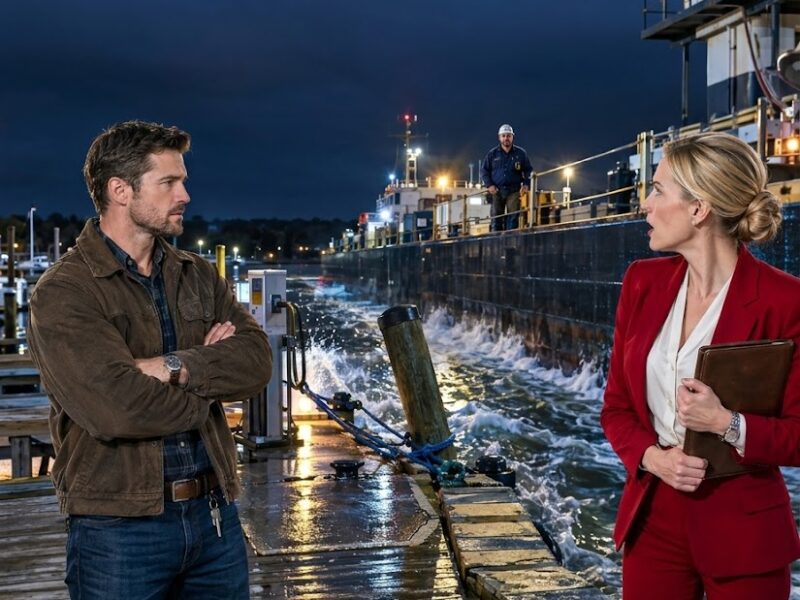
HOA Karen built a luxury marina right across my commercial barge slip. She laughed in my face and said, “There’s nothing you can do.” Then a fully loaded barge arrived.
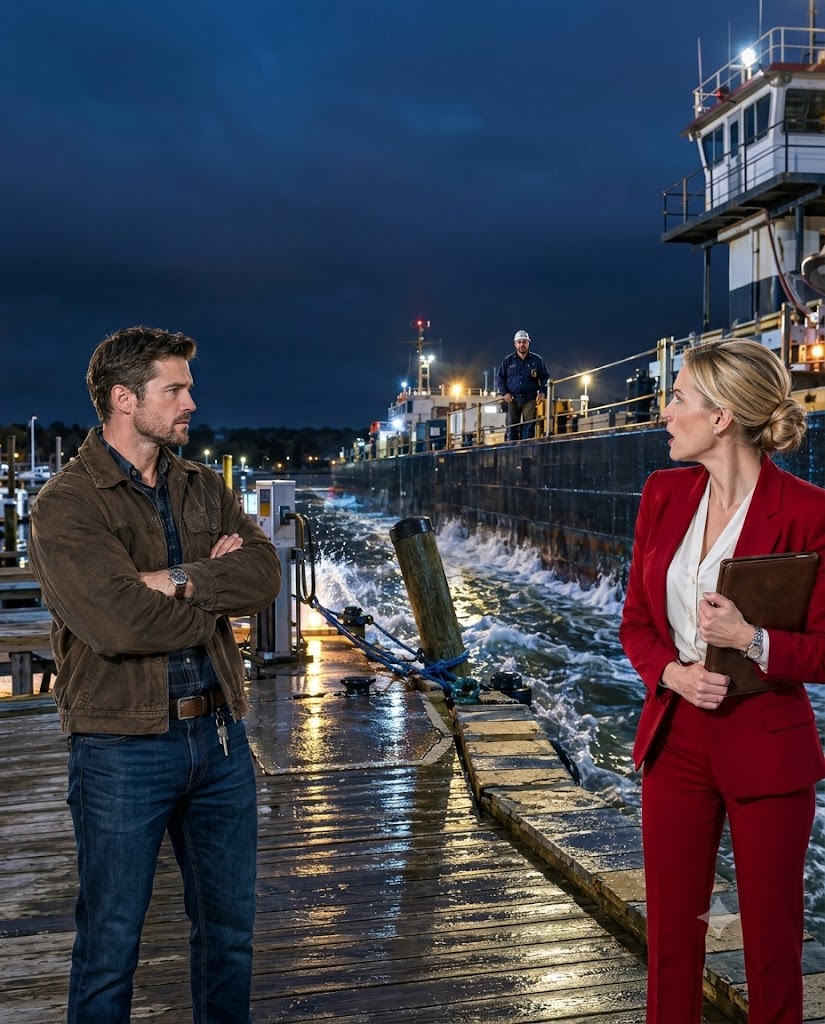
The steel pilings went in before sunrise, and by the time Dorian Mercer reached the water, they stood like a row of gray teeth across the mouth of the commercial barge slip he had legally operated for eighteen years.
Behind them, a brand new luxury marina gleamed under the dock lights, all white composite decking, brushed chrome railings, and fresh cedar trim.
The kind of construction that costs millions of dollars and wants everyone to know it.
At the end of the new pier stood Mara Witcom, president of the Heron Bend Homeowners Association, her arms folded across a camel-colored designer coat.
She did not raise her voice.
She did not need to.
She had spent most of her life in rooms where people did what she said the first time.
“You won’t be bringing another vessel through here,” she said as calmly as if she were reading a weather report.
Dorian did not argue.
He did not point a finger or quote a contract or ask to speak to anyone else.
He simply looked at the pilings, then at the dark stretch of river beyond them, and then he turned his wrist and looked at his watch.
Mara took that for surrender.
She was wrong, because somewhere down river, pushing slowly against the current with its running lights burning red and green, a fully loaded commercial barge was already on its way to that exact slip, and it was due to arrive at 3:00 in the morning.
When its horn finally split the darkness over Heron Bend, Mara Witcom would understand that she had blocked the wrong man and the wrong waterway.
Dorian Mercer was forty-two years old, and nothing about him looked like power.
He ran Mercer River Freight, a midsized marine transport company with eleven employees, two tugboats, a leased crane, and an office that smelled permanently of diesel and coffee.
He was not a billionaire.
He did not own a mansion on the bluff.
His name had never appeared in the business pages, and he preferred it that way.
He drove an old pickup truck and wore the same canvas work jacket every winter.
But Dorian owned something far more valuable than attention.
He held the legal commercial operating rights to a barge slip on the Sable River, a deep-water berth cut into the eastern bank more than fifty years ago, long before anyone had imagined building houses there.
The slip had been dredged in the early 1970s to serve a lumberyard that no longer existed.
The lumberyard closed, the land was sold, and the berth passed through two owners before Dorian bought the operating rights at twenty-four with every dollar he had, and a loan his banker called reckless.
Over the next eighteen years, that berth became the backbone of his business.
Through it came construction materials for county bridges, heavy machinery for the paper mill up river, industrial cargo too wide for the highways, bulk fuel for the rural co-ops, and oversized shipments that no truck on earth could carry.
When a hospital needed a generator the size of a school bus, it came through Dorian’s slip.
When the county rebuilt the Route 9 overpass, the steel came through Dorian’s slip.
The river did not care who was rich.
It only cared who knew how to use it.
Heron Bend came later.
Roughly twelve years ago, a developer bought the old lumberyard property, cleared the scrub pines, and built one hundred forty upscale homes along the curve of the river, each with tall windows, stone patios, and a view of the water.
The brochures promised serenity.
Dorian never objected.
The development had been built beside his slip, not on top of it, and for years the arrangement worked.
His barges came and went on schedule.
The residents waved from their decks, and a few of the children even learned to recognize the sound of his tugboat horn.
That peace ended on a cold Tuesday morning in late October, when Dorian walked down to inspect the slip at 6:00, as he did every morning, and stopped cold at the edge of the bulkhead.
A line of new steel pilings had appeared directly in front of the entrance to his berth.
Not near it.
In front of it.
A pile driver sat on a work barge in the channel, thumping another column into the riverbed with a sound like a slow heartbeat, and a crew in orange vests was bolting aluminum gangways onto a floating dock that had not been there on Friday.
Dorian walked down the bank until he reached the nearest worker, a young man with a clipboard and a sunburned neck.
“Who authorized this?” Dorian asked.
The worker glanced at him, then pointed up the hill without a word toward the glass-and-timber clubhouse that sat at the center of Heron Bend like a crown.
Dorian turned.
Someone was already coming down the path.
Mara Witcom walked the way people walk when they have never once been told to wait.
She was forty-eight, tall, silver-blonde hair swept back from a sharp face, and she wore a tailored coat that probably cost more than Dorian’s first tugboat engine.
A leather folder was tucked under one arm.
She stopped three feet from him, looked him over from his muddy boots to his weathered cap, and smiled with the polite coolness of a woman greeting a delivery driver.
“Mr. Mercer,” she said, “I was hoping we’d have this conversation.”
She explained pleasantly that the Heron Bend Homeowners Association was constructing a private luxury marina for the exclusive use of its residents, with sixty slips, a fueling station, and a waterfront lounge.
“And the approach to my commercial slip?” Dorian asked.
Mara’s smile did not move.
“It doesn’t exist anymore.”
For a moment, Dorian assumed it was a bluff, the kind of opening move people make when they want to negotiate from a position of intimidation.
Then Mara opened her folder and handed him a glossy rendering of the finished project.
Dorian studied it the way he studied a river chart before a difficult run.
The marina was not simply built near his slip.
It was designed around it, like a hand closing over a mouth.
The outer breakwater curved across the old approach line.
The fuel dock sat exactly where a barge would need to swing its stern.
The last row of pilings sealed the entrance completely.
There was no accident in this drawing.
Someone had looked at his berth, measured it, and deliberately drawn it out of existence.
Dorian lowered the page and looked up at her.
Mara tilted her head as though waiting for him to finish being slow.
“We’ve decided,” she said, “that this area is no longer suitable for commercial activity.”
The pile driver thumped again behind them.
A gull cried somewhere over the water.
Dorian let the silence sit long enough that Mara’s expression flickered with the smallest trace of impatience.
“You just said ‘we,'” he said quietly.
Mara lifted her chin.
“The HOA,” she answered, as if the three letters settled everything.
To understand Mara Witcom, one had to understand that she was not an ordinary homeowners association president.
Most HOA presidents argued about mailbox colors and overgrown hedges and then went home.
Mara ran Heron Bend the way some people run corporations.
She had been elected six years earlier on a promise to raise property values, and she had kept that promise with relentless precision.
She controlled the board of directors, three of whom owed their seats to her campaigning.
She controlled the renovation budget, which had grown to nearly four million dollars.
She chose the contractors.
She wrote the waterfront use rules.
She set the resident fees and decided who received warning letters and who quietly did not.
In Heron Bend, very little happened without Mara’s signature, and nothing happened against her wishes for long.
She had a vision, and she believed in it completely.
Heron Bend was not supposed to be a nice neighborhood near a river.
It was supposed to become the most desirable waterfront address in the county, the kind of place that appeared in glossy regional magazines under headlines about coastal elegance.
In that vision, there were sailboats and cocktail cruises and teak-decked yachts gleaming at sunset.
There were not rust-streaked barges loaded with gravel and steel beams.
Every time one of Dorian’s tugboats pushed a cargo barge past the community, Mara felt it like a stain on a white tablecloth.
She had tolerated it for six years.
Now she had decided she was finished tolerating it.
“People bought homes here for peace and quiet,” Mara told him, standing on the fresh decking of her marina as if it were a stage.
“They paid a great deal of money for that view.
They did not pay for industrial traffic.”
Dorian answered without heat.
“I bought the operating rights to this slip before those houses existed.
Your residents bought homes next to a working river.
It was in their closing documents.”
Mara waved the point away with two fingers, as if brushing lint from her sleeve.
Then she drew a single sheet of paper from her folder and held it out.
It was printed on heavy cream stock with the Heron Bend crest at the top, and it was titled Notice to Cease Commercial Operations.
Dorian read it once.
The language was formal and confident, and the stated reason sat in the middle of the page in bold type.
Commercial activity inconsistent with community standards.
The notice gave him thirty days to discontinue all barge operations at the slip, remove his equipment, and cease what it called disruptive industrial use of the waterfront.
At the bottom was Mara’s signature, large and looping.
Dorian folded the notice in half and slipped it into his jacket pocket.
Then he asked the only question that mattered.
“Does the HOA own the water?”
Mara did not answer right away.
It was only a few seconds, but Dorian noticed it the way a pilot notices a shift in the current before the boat feels it.
Her eyes moved to the river and back.
“We have the authority to manage this area,” she said finally.
It was a careful sentence, built by someone who had chosen each word, and in that careful sentence, Dorian saw the entire shape of what was happening.
The HOA had authority over its own common grounds, its landscaping, its clubhouse, its parking lots, and its homeowners.
Mara was trying to stretch that authority past the shoreline and into the river itself.
Turning the power to manage a neighborhood into the power to control a commercial waterway.
He could have told her that.
He could have argued, raised his voice, threatened lawsuits in front of the work crew.
Instead, Dorian simply nodded.
“I’ll check the records,” he said.
Mara smiled, and this time the smile reached her eyes, because she had seen men walk away from her before and she knew what it usually meant.
“You should,” she said.
“I think you’ll find the records are very clear.”
Dorian turned and walked back up the bank toward his office, his boots sinking slightly in the wet ground, and he did not look back once.
Mara watched him go.
When he was out of earshot, she turned to Trent Halloway, the board treasurer, a nervous man in a quarter-zip sweater who had been hovering near the clubhouse path.
“Tell the contractor to finish the rest of the pilings tomorrow,” she said.
“All of them.
I want that entrance closed by the weekend.”
Trent hesitated.
“Mara, shouldn’t we wait until we hear from his lawyer?”
She looked at him the way a teacher looks at a student who asked a foolish question.
“By the time he finds a lawyer,” she said, “it won’t matter anymore.”
That night, Dorian sat alone in his office above the warehouse with a single lamp burning and the river moving black and silent outside the window.
He did not go home.
Instead, he pulled a steel storage box down from the top shelf of the back closet, a box he had not opened in almost ten years.
It held the original documents that had come with the slip when he bought it.
Papers that had passed from the lumber company to the second owner to the third and finally to him.
He lifted out yellowed leases, stamped deeds, and old correspondence with typewritten letterheads.
At the very bottom, folded into careful quarters and wrapped in a plastic sleeve, was something he had almost forgotten existed.
It was a navigation and riparian rights map, hand-inked on linen-backed paper and dated 1986, forty years old.
Dorian unfolded it slowly across his desk and held the corners flat with a stapler and a coffee mug.
Every line of the eastern bank was there, the slip, the bulkhead, the depth soundings.
And running from the center of the river directly into the mouth of his berth was a wide shaded band marked in precise engineering lettering with two words that Mara Witcom had apparently never read.
Recorded access.
Everett Sloan had served as harbor master for the Port of Sable Landing for twenty-three years, and before that he had worked tugboats on the same river for fifteen more.
He was fifty-seven, broad through the shoulders, with a white beard trimmed close and reading glasses he kept pushed up on his forehead and never seemed to use.
When Dorian walked into his office at 7 the next morning with a plastic sleeve under his arm, Everett took one look at his face and poured him a cup of coffee without asking.
Dorian spread the map across the harbor master’s desk.
Everett pulled his glasses down for the first time in years and leaned close.
He was quiet for a long moment, tracing the shaded band with one thick finger.
Then he let out a slow breath through his nose.
“I remember when they recorded this,” he said.
“The lumber company fought the county for two years to get it filed.
They wanted to make sure nobody could ever cut them off from the channel.”
He tapped the paper.
“They’re not just blocking your slip, Dorian.”
Dorian waited.
“Then what else are they doing?”
Everett slid his finger along the shaded corridor until it passed beneath the ink outline of the place where the new marina now stood.
“They’re building that marina right on top of the commercial approach corridor.
The whole thing sits across a recorded access channel.”
That changed everything.
Dorian’s slip was not just a parking space for barges, a patch of water he happened to rent.
It came with a recorded access channel, a defined legal corridor through which commercial vessels had the documented right to approach and depart.
The right did not belong to Dorian personally so much as it belonged to the berth itself, attached to it the way a driveway belongs to a house.
And when anyone built a permanent structure that destroyed a legally recorded access to a navigable waterway, they were no longer arguing about community standards.
They were stepping into property law and maritime law at the same time, and neither one was known for its patience.
Dorian called Gideon Voss from Everett’s office.
Gideon was fifty-one, a real estate and maritime attorney who had represented Mercer River Freight for over a decade, and he had the rare quality of never sounding surprised by anything.
He listened to the entire story without interrupting.
When Dorian finished, Gideon asked for everything.
The operating lease, the deed history, the survey, the historical plat, every permit on file, every easement, every navigation record Everett could pull from the harbor archives.
“Don’t send me a summary,” Gideon said.
“Send me paper.
Summaries lose cases.”
Dorian spent the rest of the day scanning, copying, and driving boxes across town.
By nightfall, Gideon’s conference table was buried under forty years of documents.
Gideon studied them for three days.
He read slowly and wrote little, his notes in a narrow, precise hand on a yellow legal pad.
On the evening of the third day, he called Dorian into his office, closed the door, and folded his hands on top of the stack.
“Here’s the situation,” he said.
“Mara Witcom can build a marina.
The HOA owns the upland, and with proper permits, they can build docks off their shoreline.
That part is legitimate.”
Dorian nodded slowly.
He had expected that.
“But,” Gideon said.
He looked at Dorian over the top of his glasses.
“She cannot build it in a way that cuts off your recorded access.
Not legally, not with that map on file with the county.”
It was the first real turning point, and Dorian felt it settle in his chest like ballast.
He had the evidence.
He had the right.
But Gideon was not smiling, and Dorian understood why before he said it.
The marina was nearly finished.
Almost every piling was in the riverbed.
The floating docks were bolted.
The power pedestals were wired.
The lounge was framed and roofed.
The HOA had already spent roughly three point two million dollars, much of it borrowed against future resident assessments.
Courts moved slowly.
Contractors moved fast.
By the time a judge heard the case, the damage to Dorian’s business might already be permanent, and a judge who saw a finished three-million-dollar structure would think very hard before ordering anyone to tear it apart.
Gideon was halfway through explaining their options when his laptop chimed.
He glanced at the screen, then glanced again.
The email came from a paralegal he had assigned to pull the marina’s construction permits from the county portal.
Attached was a scanned copy of the full approval package.
Gideon opened it, paged through the site plans and the environmental checklists, and reached the final page.
He zoomed in.
Then he zoomed in again.
Dorian watched the lawyer’s face, a face that had never once looked surprised in ten years, and saw it go completely still.
Gideon did not speak.
He simply turned the screen around so Dorian could see the signature at the bottom of the page.
The name beneath the signature line was Warren Ashby, deputy director of the county permitting office.
A man who had spent nineteen quiet years approving septic systems, boat ramps, and backyard seawalls without once appearing in a headline.
On its own, his signature meant nothing.
Signatures belonged at the bottom of permits.
What made Gideon go still was the date printed beside it.
The marina permit had been approved on the twelfth of September, but Everett’s harbor logs showed the contractor’s pile driver working in the channel on the twenty-ninth of August, two full weeks earlier.
The HOA had started building in the river before anyone had given them permission to build in the river, and then someone had signed the paperwork afterward as though nothing unusual had happened.
Gideon laid the two documents side by side on the table and said only four words.
“This is out of order.”
Dorian understood what Gideon was implying, and he did not like it.
He had never been a man who threw accusations at people he had not met.
“I’m not here to ruin anybody’s career,” he said.
“I just want my slip to work the way it worked for eighteen years.”
Gideon nodded.
“Then we don’t accuse anyone.
We read.”
For the next two days, they pulled every public filing connected to the marina, including the county’s archived submissions, the reviewer’s notes, and the earlier drafts that had been uploaded and quietly replaced.
And in the very first version of the site plan, dated the previous spring, they found something that made Dorian set down his coffee.
The original design included a gap, a clear forty-foot opening in the outer row of pilings labeled in small print as a commercial navigation passage.
Someone had designed the marina correctly.
Someone had left room for the barges.
The second version still had the opening.
The third version did not.
It had simply vanished, replaced by two additional pilings and an extended fuel dock, with no explanation in the review notes and no hearing on record.
Dorian stared at the two drawings side by side, the one that respected his access and the one that erased it.
“Who asked for the change?” he said.
Gideon flipped through the transmittal sheets, then flipped through them again.
The revision request had come through the HOA’s project manager, but the page that should have named the person who authorized it was missing from the public file.
“We don’t know yet,” Gideon admitted.
“But somebody wanted that door closed badly enough to redraw the whole plan.”
The answer to part of that question walked into Gideon’s office the following afternoon, uninvited and slightly out of breath.
Nolan Pierce was thirty-nine, a marine structural engineer with a reputation for being annoyingly thorough, and he had heard through Everett that someone was finally asking questions about the Heron Bend Marina.
He had been hired early in the project as a consultant, brought in to evaluate wave loads and piling spacing on the first draft of the design.
He had submitted a report.
Then three weeks later, his contract had been terminated without explanation.
He set a thick bound document on Gideon’s table and tapped the cover.
“I warned them,” he said.
“In writing.
Nolan’s report was blunt.
The revised layout narrowed the navigable approach to a dangerous degree.
It would create unusual eddies and crosscurrents near the fuel dock.
It shrank the turning basin below what any loaded commercial barge would need to swing safely.
It raised the risk of collision between yachts and working vessels.
It obstructed the existing commercial corridor, and it made it nearly impossible for a long tow to turn around once inside.
Worst of all, Nolan explained, the pilings themselves had not been specified to handle the wake and displacement forces of heavy traffic, because the revised plan assumed there would be no heavy traffic at all.
“They designed it for a world without barges,” he said.
Dorian asked the obvious question.
“Then why did they build it anyway?”
Nolan gave a short, tired laugh.
“Because the people making the decisions don’t drive boats.”
That Thursday evening, the Heron Bend Clubhouse filled with residents for a community meeting that had been advertised as a celebration.
A large watercolor of the finished marina stood on an easel beside the podium.
Mara stood at the front of the room in a navy dress, a wireless microphone in one hand, and spoke for twenty minutes without once looking at her notes.
“When this marina opens,” she said, “Heron Bend will become one of the most valuable waterfront communities in the entire state.”
The room broke into applause.
Several residents raised their wine glasses.
Trent Halloway clapped the loudest of all.
Dorian sat in the very last row near the door in his canvas jacket.
He had come because the meeting was open to anyone with property adjoining the community, and technically his slip adjoined it.
He did not stand.
He did not raise his hand.
He did not say a single word.
He simply listened the way he listened to an engine that was about to fail.
Near the end, Mara’s eyes found him across the room, and the corners of her mouth lifted.
She paused, let the room settle, and spoke directly to him without saying his name.
“Some people,” she said, “still haven’t understood that their time here is over.”
The official letter arrived at Mercer River Freight on Monday morning by certified mail, and this time it was not printed on cream stock with a pretty crest.
It came from the HOA’s attorneys, and it was eleven pages long.
It demanded that Dorian immediately cease all commercial operations at the slip.
If he refused, the association would file suit for nuisance and trespass.
It would seek daily fines of five thousand dollars for every day his barges continued to operate.
It would report what it called unsafe industrial activity to state and county agencies.
And in a paragraph that Dorian read three times, it announced that the association would formally notify his commercial clients that his berth was the subject of pending litigation and could no longer be considered reliable.
That last paragraph was not law.
It was pressure, and it worked faster than Mara could have hoped.
By Wednesday, two small clients had quietly postponed shipments.
On Thursday afternoon, Dorian’s phone rang with a call he had been dreading.
It was Hollis Grant, the operations director for Grant Structural, the largest contractor Mercer River Freight had ever served.
Grant Structural was building a new hospital wing forty miles inland, and its steel frame and two massive electrical transformers were already loaded aboard a barge down river, worth nearly two million dollars.
“Dorian,” Hollis said carefully, “I’ve got a letter on my desk that says your slip is closed.
Tell me I have a place to put my steel.”
Dorian understood exactly what was at stake.
If the cargo could not be offloaded on schedule, the hospital project would stall.
The crane crews would sit idle at eight thousand dollars a day, and Grant Structural would have every right to hold Mercer River Freight responsible under the delivery contract.
Dorian could lose his biggest client, face damages he could never pay, and watch eighteen years of work sink in a single week.
Dorian did not shout.
He looked out his office window at the new marina glittering in the afternoon sun, at the pilings that had crept closer every day, and at the narrow strip of open water that still ran along the old recorded line.
“You’ll have your steel on Saturday morning,” he said.
“Just like the contract says.”
He did not say it blindly.
Before calling anyone, he walked back to the harbor master’s office, and Everett pulled up the official navigation records.
The recorded corridor had never been vacated.
No agency had closed it.
No court had closed it.
The pilings stood beside the corridor and crowded it badly, but the legal channel itself, the one on the forty-year-old map, was still open water.
It was tight.
It was ugly.
It would take a steady hand and a captain who had run that bend a hundred times, but it was lawful.
Gideon confirmed it by phone within the hour.
“The HOA can send letters,” he said.
“They can’t close a recorded channel with a letter.”
Then Dorian called Calder Boone.
Calder was forty-five, a tugboat captain with twenty-six years on the Sable River, and a voice like gravel in a bucket.
He had pushed barges into Dorian’s slip more times than either of them could count.
The call connected on the second ring, the rumble of diesel engines filling the background.
“Where are you?” Dorian asked.
“Sitting at the mouth of the river,” Calder said, “waiting on the tide.”
Dorian asked the next question slowly.
“Are you loaded?”
There was a short laugh on the line.
“To the marks.
She’s sitting about as deep as she can sit.”
Dorian looked out at the marina one more time.
The pile driver had gone quiet for the day.
The newest pilings were still wet from the river.
“Don’t turn around,” he said.
There was a pause on the line long enough that Dorian could hear the water slapping against the hull.
“What does that mean?” Calder asked.
“It means run the channel,” Dorian said.
“The recorded one.
The same line we’ve always run.
Come in on the flood tide, stay on the old heading, and bring her all the way home.”
Calder was quiet for another moment.
Then he said the only thing a river captain ever needs to say.
“Understood.”
The flood tide peaked just before 3:00 on Saturday morning.
The river was black and glassy under a thin moon, and the new marina sat in perfect silence, its decorative dock lights reflecting in long white ribbons across the water.
Mara Witcom was awake.
She had not been able to sleep since the security company called her at 2 to report unusual radio traffic on the marine channel, and she had walked down to the end of her new pier in a long wool coat with a flashlight in her hand.
That was where she was standing when she saw it.
Far down river, rounding the point below her bend, a shape was emerging from the dark, enormous and low and steady, its red and green navigation lights burning like eyes.
Then a floodlight snapped on across the bow, and a deep rolling horn blast shook the air across the whole neighborhood.
Mara gripped the railing and screamed at no one and everyone.
“Who let that thing in here?”
It was not a pleasure boat.
It was not a fishing skiff or a wandering sailboat that had lost its way in the dark.
It was a fully loaded commercial barge, two hundred ninety feet from bow to stern, with Calder’s tugboat locked tight against its stern and pushing it forward like a fist pushing a wall.
Under the floodlights, the cargo rose from the deck in dark heavy shapes, stacked steel columns, bundled girders strapped down with chain, and two enormous gray transformers wrapped in weatherproof sheeting.
The weight had pressed the hull so deep that the river nearly lapped at the deck edge.
A barge that heavy did not stop quickly.
It did not turn quickly.
Once it committed to a line, it followed that line with the patience of a glacier, and every ton of it was now aimed at the mouth of Dorian’s slip.
Dorian was already standing on his bulkhead, a handheld marine radio clipped to his jacket.
Two of his dock hands waited beside the mooring bollards with heavy lines coiled at their feet.
Mara came off the marina pier at a near run, her flashlight beam jerking wildly across the wet grass until it landed on his face.
“What do you think you’re doing?” she demanded.
Dorian did not raise a hand against the glare.
“Receiving a delivery,” he said.
Mara’s voice climbed.
“I have banned commercial activity on this waterfront.”
Dorian looked past her at the approaching lights.
“You don’t have the authority to ban it,” he said in the same tone a man might use to mention that it was going to rain.
Mara pulled out her phone and called the overnight security guards.
Within two minutes, two men in dark jackets came jogging down from the clubhouse, radios bouncing on their belts.
They stopped at the edge of the bulkhead and looked uncertainly from Mara to Dorian to the massive vessel sliding closer through the dark.
“Stop that boat,” Mara ordered them.
One of the guards looked at the barge, then looked back at her with honest bewilderment.
“Ma’am,” he said slowly.
“How?”
The radio on Dorian’s jacket crackled.
Calder’s voice came through, calm and deliberate, pitched loud enough that everyone on the bank could hear.
“Dorian, this is the Mary Kate.
I’ve got a crowd on the marina and lights in my eyes.
Before I commit to this bend, I need to hear it from you.
Do we have the legal right to come in?”
Dorian pressed the transmit button and did not hesitate for even a heartbeat.
“Affirmative, Calder.
Recorded channel, open water, full right of passage.
Bring her in.”
Mara lunged a step toward him as though she could physically grab the words out of the air.
“No!” she shouted across the river.
“No, you do not have permission.”
But the barge did not slow down, because rivers do not take orders from homeowners associations.
The air on the bank grew so tense that even the security guard stopped moving.
The barge slid into the bend, and for the first time, Dorian saw the problem clearly with his own eyes.
The newest row of pilings, the ones driven that very week, had been set so close to the recorded channel that the gap between them looked from a certain angle like the correct way in.
It was not.
The spacing between those pilings was far too narrow for a barge of that beam and weight.
A captain unfamiliar with the new construction, reading the dock lights instead of the chart, could easily steer straight into the trap.
Dorian was already reaching for the radio when a voice cut through the dark from the far end of the marina.
Nolan Pierce was running down the floating dock in untied boots, a headlamp bouncing on his forehead.
Everett had called him an hour earlier, and he had driven over half asleep.
“Dorian!” he shouted, waving both arms.
“Don’t let it go between those two rows.
The gap won’t hold it.”
Dorian keyed the radio instantly.
“Calder, hold your heading.
Do not follow the dock lights.
Stay on the old line.
Hug the red marker and keep her tight to the east bank.”
There was a moment of pure silence.
Then the tugboat’s engines changed pitch, deepening into a low, grinding growl, and the enormous bow began to swing a few degrees slowly, almost gently, back onto the invisible path drawn forty years earlier on a linen map.
The barge followed the old corridor exactly as it had been recorded.
It passed the outer pilings with only a few feet to spare, close enough that the dock hands on the bank could hear the water hissing along the hull.
Calder brought her through without touching a single structure.
But a vessel that heavy does not move through water without moving the water too.
As the barge pushed through the narrowed approach, it drove a long, heavy swell ahead of it and dragged a powerful current behind it, and all of that force slammed into the marina from beneath.
The floating docks heaved.
The entire new structure began to shudder as though something underneath it was trying to shake itself loose.
Mara stood frozen on the bank, the flashlight trembling in her hand, and in the reflected glare of the floodlights, every trace of color drained out of her face.
Then came a sound that every person on that riverbank would remember for the rest of their lives.
A sharp metallic crack, loud as a rifle shot, rolled out across the water.
One of the brand new steel pilings at the corner of the fuel dock lurched sideways, tilting several degrees off vertical, and the section of decking attached to it sagged with a long splintering groan.
For a few seconds, nobody moved.
Then the dock hands threw their lines, and the barge settled gently into Dorian’s slip with the practiced softness of a vessel that had come home a hundred times before.
No one had been hurt.
No one had fallen into the water.
The cargo was secure.
But the corner of the million-dollar marina now leaned drunkenly toward the river.
The fuel dock hung at an angle, and a fresh crack ran across the composite decking like a lightning bolt.
Mara turned on Dorian so fast her coat snapped around her legs.
“You destroyed association property,” she shouted.
“You did this deliberately.”
Dorian looked at the bent piling, then back at her.
“I never touched it,” he said quietly.
“Neither did the barge.”
Mara did not want to hear it.
She dialed the county sheriff’s office and demanded that deputies come arrest him for vandalism, trespassing, and reckless operation of a vessel.
Twenty minutes later, a patrol car rolled down the service road with its lights turning slowly, and Sergeant Dale Rohr stepped out, zipped his jacket, and walked to the water line.
He took in the barge, the leaning piling, Mara still talking, and Dorian saying nothing.
Dorian simply handed him a copy of the recorded access map, a copy of Calder’s navigation license, and the delivery contract for the hospital steel.
Then he waited.
Gideon Voss arrived at a quarter to five in the morning wearing a gray overcoat over a pair of flannel pajama pants, and he did not look the least bit embarrassed about it.
He did not raise his voice or argue with Mara’s version of events.
He simply began requesting things in a calm, orderly voice, and he asked Sergeant Rohr to note each request in his report.
He wanted the marina’s security camera footage preserved immediately.
He wanted the final engineered drawings.
He wanted the hydrological data used in the design.
He wanted the permits, the inspection certificates, and the load specifications for every piling.
“When a structure fails,” Gideon said, “the first question isn’t who was nearby.
The first question is why it failed.”
Nolan was already answering that question.
At first light, he crawled across the tilted section of the fuel dock with a flashlight and a tape measure, then leaned over the edge to examine the base of the damaged piling.
When he climbed back onto the bank, his jaw was tight.
The piling had been driven only a fraction of the depth his original report had recommended, and its lateral bracing had been reduced to cut costs.
The marina had been engineered without properly accounting for wake and displacement forces from commercial barge traffic, even though that traffic had used the corridor for decades.
“The barge didn’t break this dock,” Nolan told the sergeant.
“The barge just revealed that it was already broken.
Any big storm surge would have done the same thing.
The only question was when.”
Dorian turned to Mara.
“Then let’s have it independently inspected,” he said.
“Someone neither of us hired, someone neither of us pays.”
Mara refused instantly.
The HOA would use its own contractor, she said.
The same firm that had built the marina, and that firm would determine the cause of the damage.
It was the first moment anyone had seen her grip slip.
She was no longer trying to win an argument.
She was trying to control a story, and the story was beginning to escape her.
That was when Everett Sloan stepped forward and handed Gideon a thin manila folder.
Inside was a copy of the harbor authority’s commercial traffic log for the Sable River, showing barges moving through that exact corridor to that exact slip every single month for more than fifty years.
Beneath it was something even more damaging.
It was the original recorded plat for the Heron Bend subdivision, filed by the developer twelve years earlier, and in its margin, in plain type, was a note stating that the waterfront lots were subject to an existing commercial navigation corridor and adjacent barge operations.
It had been in the HOA’s own founding documents.
No one could claim Heron Bend had not known the barges were there.
Gideon read the page twice, then closed the folder and turned to face Dorian with the patient expression of a man who had just found the load-bearing wall of an entire case.
“We’re no longer arguing about a boat slip,” he said.
He set the folder on the hood of the patrol car, squarely between Mara and the sergeant.
“We’re talking about an association that knowingly built a structure it understood would destroy an existing recorded commercial right.”
Over the next two weeks, Dorian and Gideon kept pulling threads, and each one led somewhere deeper.
The marina, it turned out, had never been simply a neighborhood amenity.
It had been the centerpiece of a financial strategy.
A private investment group called Tidewater Crest Partners had quietly purchased nine waterfront lots at the northern end of Heron Bend during the previous two years.
The group planned to build a row of luxury riverfront townhomes, each priced above two million dollars, and every one of its marketing projections depended on a single promise.
A private yacht marina with no industrial traffic.
If the marina was completed exactly as redesigned, the math was simple.
Property values across Heron Bend would rise.
The association’s fees would rise with them, funding the ambitious projects Mara loved.
Tidewater Crest would sell its riverfront townhomes at premium prices.
And the one inconvenient feature of the waterfront, a working commercial barge slip with fifty years of recorded rights, would disappear.
Not through a court or a negotiation, but through slow, relentless pressure.
Dorian was not against any of it.
He had nothing against wealthy neighbors, expensive homes, or beautiful yachts.
What he refused to accept was that anyone could build their dream by quietly erasing his.
The proof came from an unexpected source.
Trent Halloway, the board treasurer, had grown increasingly sick about what he had seen that night at the fuel dock.
One morning, without warning, he walked into Gideon’s office carrying a printed stack of emails that had passed between the marina’s project manager, a Tidewater Crest representative, and Mara herself.
One of them stood out.
It was written eight months earlier, just days before the commercial passage vanished from the design.
Near the bottom, in a single line, the investor had written a sentence that made the room go cold.
“The barge operator will eventually leave.”
Dorian read that line three times.
He understood it completely.
There had never been any intention to negotiate.
No one had ever planned to call him, offer him a relocation, or propose a shared schedule.
The entire strategy had been built on the assumption that a small operator with eleven employees would eventually run out of money, patience, or courage and simply go away.
When Gideon sent the emails to the association’s attorneys, Mara issued a statement denying any knowledge of the investors’ intentions and calling the emails misinterpreted private correspondence.
But Gideon no longer needed her to admit anything.
He had the map, the plat, the traffic logs, Nolan’s report, the permit dates, and the emails.
That afternoon, he sent a formal demand to the association and its insurers.
The letter was precise.
It demanded an immediate halt to all remaining marina construction.
It demanded the restoration of the full recorded commercial access corridor.
It demanded an independent structural inspection of the entire marina.
It demanded that the county verify the validity of the construction permit and the timeline of its approval, and it demanded written recognition of Dorian’s legal rights to operate his slip.
Copies were sent to the county attorney, the association’s insurance carrier, and every member of the HOA board.
Mara read her copy standing alone in her kitchen, and for the first time in six years, she did not know what to do next.
Three days later, another envelope arrived at Mara’s front door.
It was heavier than the first, sealed with an official seal, and it did not come from Dorian or from Gideon Voss.
The return address belonged to the district office of the United States Army Corps of Engineers, the federal agency responsible for regulating any structure built in the navigable waters of the United States.
The letter informed the association that the Corps had opened a formal review of the Heron Bend Marina.
Construction on every structure within the recorded commercial corridor was suspended, effective immediately.
For the first time since Mara had taken office, the question was no longer what the HOA wanted.
The question was what the law allowed.
Federal inspectors arrived the following week with survey boats and sonar equipment.
They measured the position of every piling.
They measured the width of the navigation channel and the size of the turning basin.
They modeled current flows and wake forces around the fuel dock.
They reviewed the permit timeline, the missing revision page, and the recorded commercial access that the final design had erased.
Within a month, the county had placed Warren Ashby on administrative leave, pending an inquiry into why he had signed a permit for a structure already half built.
Inside Heron Bend, the mood changed almost overnight.
The same residents who had toasted Mara at the clubhouse now filled the board meeting with hard questions.
Ruth Galloway, a retired schoolteacher who had lived on the river for eleven years, stood up with a copy of the subdivision plat in her hand.
“Mara, this was in our closing documents,” she said.
“Why didn’t you ever tell us about the commercial access?
Why did we borrow three million dollars to build something across a legal channel?”
The room waited.
Mara opened her mouth, then closed it.
For the first time in six years, the president of the Heron Bend Homeowners Association had nothing to say.
The board asked Dorian to attend the next session.
He arrived in the same canvas jacket, sat in the front row this time, and waited until he was invited to speak.
He did not mock Mara.
He did not demand an apology or threaten anyone with lawsuits.
When he finally stood, his first sentence surprised everyone in the room.
“I don’t want the marina to disappear,” he said.
People turned to one another in confusion.
Dorian continued.
“I want it to exist the right way.”
Then he laid out a plan.
Keep the marina.
Reopen the commercial corridor at its full recorded width.
Mark the channel with lighted buoys.
Remove and rebuild the unsafe pilings to Nolan’s original specifications.
Create a shared schedule so yachts and barges never met in the approach.
And submit the finished structure to an independent inspection every year.
Nolan stood and endorsed every point.
Everett stood beside him and said the harbor authority would help manage the schedule.
After the meeting, Mara found Dorian alone in the parking lot.
She looked tired in a way money could not fix.
“You could have destroyed this entire project,” she said.
“Everything we built.”
Dorian nodded.
“I know.”
She searched his face, genuinely confused.
“Then why didn’t you?”
Dorian unlocked his truck and looked back at her.
“Because I only wanted what was mine,” he said.
“Not what was yours.”
Two weeks later, with the Corps review completed and the board voting nine to zero, the ruling was entered into the record.
The Heron Bend Marina would be redesigned.
The work took five months.
By early spring, the contractor had pulled the offending pilings out of the riverbed and driven new ones farther north, deeper and properly braced.
The fuel dock was rebuilt on the upriver side.
A forty-foot commercial passage, almost exactly where it had appeared on the very first drawing, was reopened and marked with four lighted green and red buoys.
Mercer River Freight kept operating without interruption, and Grant Structural renewed its contract for three more years.
Calder’s barge returned on its regular schedule, and this time the yacht owners watched the corridor and waited their turn, because everyone now understood where the lines were.
Mara remained president of the association, but she governed differently, with open budgets, published minutes, and a standing seat on the waterfront committee for Everett Sloan.
On a bright April morning, Mara walked down to the end of the rebuilt pier while a loaded barge eased toward Dorian’s slip.
She stood beside him for a while before speaking.
“I honestly thought you would try to shut the marina down,” she said.
Dorian kept his eyes on the water.
“I thought you would try to shut my slip down.”
Mara smiled a small, real smile this time.
“Maybe we were both wrong.”
Dorian watched the barge slide perfectly between the buoys.
“No,” he said.
“I just needed you to read the map correctly.”
The barge settled into the slip as gently as a sleeping animal.
Beside it, the luxury marina gleamed in the morning light, white decks and polished chrome, sailboats rocking softly in their berths.
Two worlds shared the same river now.
No one had lost their property.
No one had been crushed.
But something important had changed on that stretch of water.
No association, however wealthy or powerful, could ever again use the authority of a neighborhood to erase the lawful rights of one quiet man.
Calder stepped off the tugboat and onto the bulkhead, pulling off his work gloves.
“Another run?” he asked.
Dorian looked over the cargo stacked on the deck.
“Another run,” he said.
Calder grinned and nodded toward the marina.
“And nobody’s building a wall in front of us this time.”
Dorian glanced at the gleaming pier, then at the lighted buoys marking the open channel.
“If they ever do,” he said, and a slow smile crossed his face, “they’d better check the map.”









