“His Police Dog Kept Barking at a Soldier’s Bag — What Happened Next Left Everyone Stunned”
The mid-morning rush at Portland International Airport was a cacophony of rolling suitcases, blaring announcements, and a frantic shuffle of thousands of travelers trying to make their connections.
For me, Officer Aaron Whitlock of the Port Authority Police, it was just another Tuesday.
Walking on my left was Bruno, an 85-pound German Shepherd built like a furry torpedo with a badge.
Bruno wasn’t just a dog.
He was a highly decorated explosive and narcotics detection K9, responsible for securing one of the busiest transit hubs in the Pacific Northwest.
He’d been trained to filter out the overwhelming sensory overload of an airport — the spilled coffee, the fast food, the perfume, the fear sweat of anxious flyers.
When Bruno worked, he was a guided missile, sweeping the concourse with a rhythmic side-to-side snuffling I’d learned to read like a book.
Narcotics meant he’d scratch.
Explosives meant a passive alert — sitting completely still, nose pointed at the source.
He was never wrong.
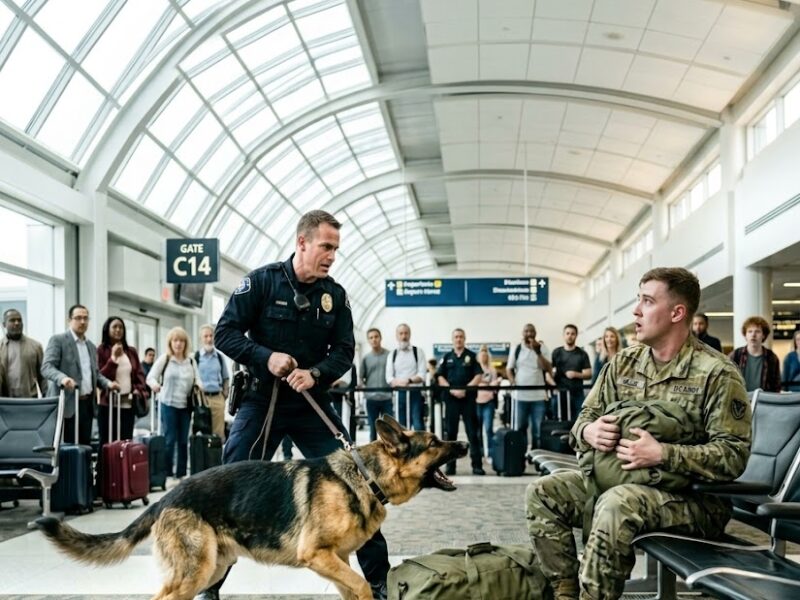
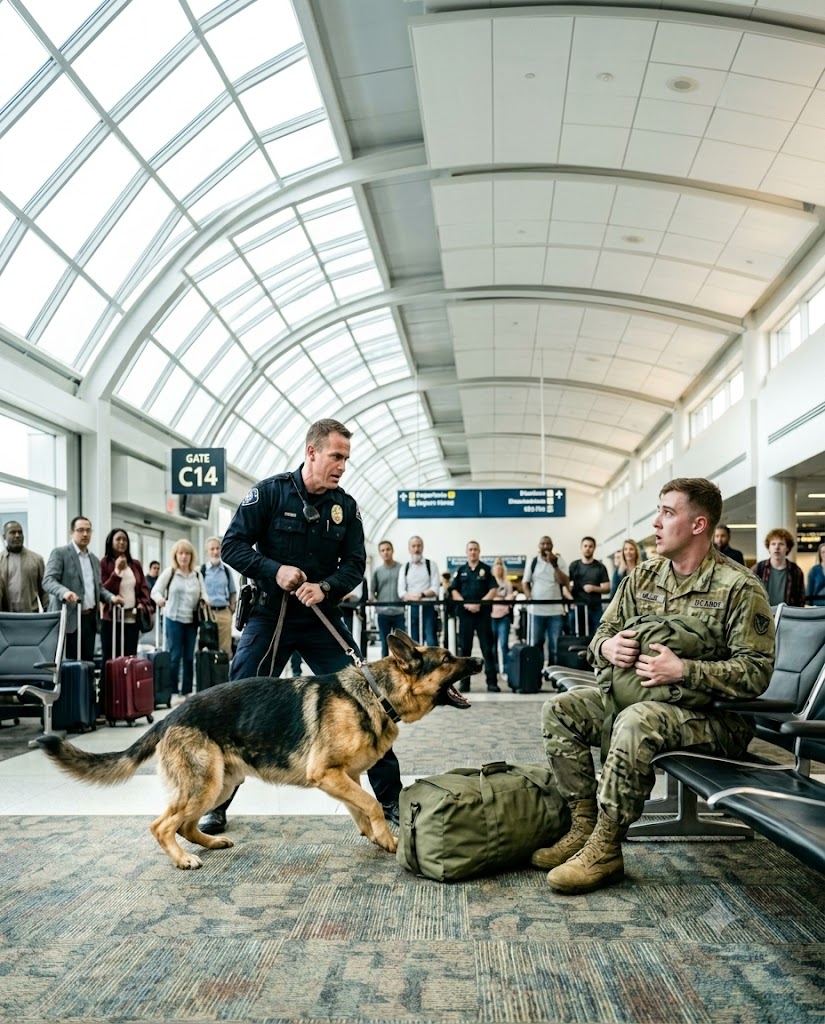
We were patrolling near Gate C14, where a flight from Frankfurt had just deplaned.
Passengers were slumped in the unforgiving vinyl chairs, exhausted from the transatlantic haul.
Among them sat a young man in a wrinkled army combat uniform.
His name tape read REYES, Corporal Marcus Reyes.
He was hunched forward, elbows on his knees, staring blankly at the floor.
Tucked firmly between his boots was a massive olive drab military duffel, bulging at the seams, the brass zipper strained to its limit.
As we passed within twenty feet, Bruno’s behavior changed instantly.
Not a gradual shift — a violent snap of attention.
His ears pinned back.
His spine stiffened.
His hackles stood straight up.
He hit the end of his leather lead so hard it nearly pulled me off balance.
“Whoa, buddy, easy,” I muttered, tightening my grip.
I expected him to track the scent and sit, indicating explosive residue on the soldier’s gear — common for troops back from a combat zone.
But Bruno didn’t sit.
He lunged toward the soldier, dragging me across the concourse, and let out a deep, guttural bark that echoed off the glass ceiling.
Then he threw his front paws onto the duffel and clawed frantically at the canvas, whining and barking in a frenzy.
I was stunned.
In four years together, Bruno had never broken protocol.
Never aggressively assaulted luggage.
Never barked at a suspect during a search.
This wasn’t a standard alert.
This was an act of desperation.
Corporal Reyes jolted backward, his face draining of color.
He didn’t reach for a weapon or try to swat the dog away.
His eyes went wide with sheer terror, and he threw his arms protectively over the duffel, shielding it with his own body.
“Get him off!” he yelled, voice cracking. “Get the dog away from the bag, please!”
“Sir, do not touch the dog. Step away from the bag now.”
My hand dropped to my radio.
I held back on the leash, pulling Bruno a few feet away, though he kept thrashing, his dark eyes locked on the green canvas.
“I can’t do that,” Reyes stammered, pulling the bag to his chest, knuckles white.
Sweat beaded on his forehead despite the aggressive air conditioning.
“You don’t understand. You can’t look in here.”
The terminal shifted from bustling annoyance to palpable dread.
Civilians backed away.
Mothers pulled their kids behind them.
A perimeter of empty space formed around the gate.
“Sir, this is the police. I’m ordering you to step away from the bag,” I repeated, dropping my voice an octave.
“My dog is indicating a positive alert. If you don’t release that bag, you’ll be placed under arrest.”
For a fraction of a second, I didn’t see a hardened soldier.
I saw a terrified, desperate kid about to shatter.
“If you open it, they’ll take it,” Reyes whispered.
“If you open it, they’ll take it away from me. It’s all I have left.”
I keyed my shoulder mic, never taking my eyes off him.
“Dispatch, K9-4, uncooperative suspect, highly irregular K9 indication at Gate C14. Suspect is military. Refusing to separate from a large duffel. I need backup and roll Yoti now.”
The radio crackled back.
“Copy, K9-4. Units on route. Yoti notified.”
Bruno let out another piercing howl, straining against his collar until he choked, desperate to get into that bag.
Whatever was inside, to him, it was the most important thing in the world.
Within ninety seconds, the terminal swarmed with Port Authority police and TSA agents.
Sergeant Dalton, a towering veteran with a shaved head and a no-nonsense attitude, arrived first with three armed officers, pushing the crowd back and establishing a fifty-yard perimeter.
“Talk to me, Whitlock.”
“Bruno locked onto his bag,” I said, struggling to hold the 85-pound dog back.
“It wasn’t a standard explosive sit, Sarge. He went out of his mind, tried to tear through the canvas. Suspect refuses to separate from the luggage.”
Dalton leveled his gaze at Reyes.
“Son, I don’t care what uniform you’re wearing. You’re in a federal airport in violation of about ten federal laws. You’re going to stand up, let go of the bag, and put your hands on your head. If I have to ask again, we put you on this floor.”
Reyes looked at the circle of armed officers.
The fight drained out of him, replaced by heavy defeat.
Tears spilled, tracking through the grime on his face.
“Okay,” he choked, hands shaking as he released his grip.
“Okay, but please be careful with it. Just don’t drop it.”
They cuffed him and patted him down — not rough, but taking no chances.
“We can’t process this in the open,” I said, looking at the isolated green bag.
“If that’s a makeshift IED, it could take out this whole concourse. We need the blast room.”
Security Room 4B was deep in the bowels of the airport — reinforced concrete walls, a heavy steel door, designed to contain accidental detonations.
The walk down was agonizing.
Bruno hadn’t calmed at all.
Every time the officer carrying the duffel took a step, Bruno whined, eyes glued to the swaying canvas.
It was deeply unsettling.
Dogs alert to a scent, get their reward, and move on.
Bruno was acting like his own puppy was zipped inside that bag.
We set the bag in the center of the concrete floor and sat Reyes in a bolted steel chair.
He was hyperventilating, staring at the duffel.
“Corporal Reyes,” I started, Bruno trembling at my feet, eyes fixed on the zipper.
“I need you to tell me exactly what’s in that bag. If it’s a weapon, contraband, something you brought back you shouldn’t have, tell me now. The bomb squad is two minutes out and they’ll find out either way.”
He buried his face in his bound hands.
“You don’t understand. I couldn’t leave it over there. My CO said it had to be left behind, destroyed. But it saved my life. I couldn’t just abandon it.”
Dalton and I exchanged a dark look.
Stolen ordnance.
It happened more than civilians realize — soldiers with PTSD trying to bring home grenades, shell casings, even C4 as morbid souvenirs.
“What saved your life, Marcus?” I asked, softening.
“What did you pack in there?”
Before he could answer, the steel door unlatched with a clank.
Captain Harlan, head of the EOD unit, strode in wearing his heavy blast suit, holding a portable X-ray scanner.
Everyone except the handler and the suspect cleared the room.
Dalton and the others stepped out, sealing the door.
“Keep your dog back, Whitlock,” Harlan said, approaching the bag with extreme caution.
“I’ll set the X-ray plate behind it and scan. If there’s a trigger, I’ll see the wires.”
He positioned a flat sensor plate behind the duffel, stepped back with a ruggedized tablet, aimed the emitter, and pressed the button.
A soft beep.
He stared at the screen for five seconds.
He didn’t move.
He didn’t breathe.
“Cap?” I asked, my chest tightening like a vise.
“Talk to me. Are we looking at a bomb?”
Harlan slowly unlatched his helmet and pulled it off.
His face was chalk white, his jaw hanging open.
He looked from the screen to the terrified soldier, then down to Bruno whining on the floor.
“Whitlock,” he breathed, turning the tablet so I could see.
“You need to see this. That’s not a bomb. It’s not drugs. Good God, it’s alive.”
I stepped forward, eyes locking onto the screen.
It didn’t show the rigid lines of a pipe bomb or the chaotic wires of an IED.
Glowing in pale ethereal green against the black was a skeletal structure — a spine, an expanding rib cage, the distinct angled slope of a canine skull.
The air left my lungs in a rush.
The skeleton was curled into a tight fetal position, crammed into the unforgiving confines of the duffel.
And as Harlan adjusted the contrast, a rhythmic pulsing blur appeared near the center of the rib cage.
A heartbeat.
Agonizingly slow, erratic, dangerously faint — but undeniably there.
“You have a dog in there,” Harlan breathed, turning to Reyes.
“You smuggled a live animal in a sealed bag on a ten-hour transatlantic flight.”
Reyes sobbed, chest heaving against his restraints.
“He’s heavily sedated. I gave him the last of the field medkit tranquilizers before we boarded in Frankfurt. I left the side zipper cracked for air, I swear. You have to open it. He might be suffocating.”
I didn’t wait.
I dropped to my knees, ignoring protocol, ignoring the lingering threat, and reached for the brass zipper.
Bruno pushed forward, but the aggression was gone, replaced by a low, mournful whimper.
He pressed his nose to the canvas, tail tucked low.
He’d smelled the heavy sedatives, but more than that, he’d smelled the profound distress of one of his own kind.
I pulled the zipper and the canvas parted.
Inside, swaddled in a blood-stained military thermal blanket, lay a Belgian Malinois.
The dog was horrifyingly emaciated, ribs protruding sharply against a thin coat.
Its front left leg was wrapped in thick, dirty gauze, and a jagged scar ran down its muzzle.
Completely unconscious, breathing so shallow I had to press my bare hand to its chest just to confirm it was alive.
“His name’s Diesel,” Reyes cried, his voice echoing off the concrete.
“Multi-purpose canine, route clearance and bomb detection. We deployed together in Kunar Province.”
I pulled the blanket back and the heat radiating off the dog was intense — a massive infection, likely from the leg.
“What happened to him, Marcus?”
Bruno moved in and gently licked the unconscious dog’s ear, a stunning display of empathy.
“We got hit,” Reyes choked.
“IED in a culvert. Diesel caught the scent at the last second. He broke command, sprinted ahead, threw himself over the pressure plate. He took the brunt of the shrapnel. He saved my whole squad. He saved my life.”
Harlan knelt beside me.
“If he’s a military working dog, why is he stuffed in a duffel? Why wasn’t he medevac’d through official channels?”
Reyes’s face twisted with grief and anger.
“Because he’s old and his leg was shattered beyond repair. The base vet in Germany said he’d never work again. He was considered excess equipment, deemed aggressive because of his PTSD. The CO ordered him euthanized. They were going to put him down like a broken rifle.”
I felt a cold spike of fury.
I knew the history.
For decades these dogs were classified as mere equipment, and even after the law gave handlers the right to adopt their partners, bureaucratic red tape and harsh field commanders still led to tragic outcomes.
“I couldn’t let them do it,” Reyes whispered, breaking completely.
“I paid a transport mechanic three thousand dollars to look the other way while I loaded onto a cargo pallet. I kept him sedated. I just wanted to get him home. I have a farm in Oregon. I wanted him to see the grass. I wanted him to die in the sun, not on a cold metal table in a foreign country.”
Diesel let out a shuddering, rattling breath, his chest barely rising.
He was fading fast.
The sedation, the lack of oxygen in the cargo hold, the raging infection shutting down his organs.
“Harlan, get on the radio,” I said, voice sharp.
“I need an emergency veterinary trauma team at the curb in five minutes. Call Dr. Bennett at Rose City Emergency Animal Hospital. Tell him it’s an urgent police escort.”
“Whitlock, you can’t,” Harlan warned.
“This is a federal crime. Smuggling, theft of military property, customs violations. The TSA and DOD are going to crucify this kid. We walk out with this dog, we’re aiding and abetting.”
“I don’t give a damn about the TSA right now,” I roared.
“This dog is a decorated combat veteran, and he’s dying on the floor of my airport. We’re getting him out of here.”
I scooped my arms under the unconscious Malinois, blood and grime soaking into my uniform.
Bruno barked sharply, like he was ordering us to move faster.
“Dalton!” I yelled at the door.
It swung open, revealing the sergeant and a dozen armed officers who stared in shock as I emerged carrying the broken war dog.
“Cut those zip ties off the corporal,” I ordered, locking eyes with him.
“And get a squad car out front. We’re going to save this soldier’s partner.”
Sirens tore through the traffic like a chainsaw.
I drove the Interceptor at terrifying speed, light bar flashing.
In the backseat, Reyes cradled Diesel’s head in his lap, whispering reassurances into his floppy ears.
Bruno sat in the passenger seat, head turned back, keeping a protective eye on the injured Malinois.
We skidded to a halt at Rose City Emergency Animal Hospital, where Dr. Bennett, a seasoned surgeon who worked closely with our canine unit, was already waiting with a gurney and two techs.
“What do we have?” he shouted over the dying sirens as we transferred Diesel.
“Shrapnel wounds, severe infection, massive overdose of field sedatives, extreme dehydration,” I listed as we ran through the doors.
“He’s a military working dog. He needs everything you’ve got. Document blank check — the union covers the bill.”
“Get him to trauma bay one. One milligram atropine. Start massive fluid resuscitation,” Bennett ordered, vanishing through the swinging doors and leaving Reyes, Bruno, and me alone in the bright waiting room.
The adrenaline drained out of Reyes, leaving him hollow.
He collapsed into a chair, face in his hands.
“They’re going to arrest me,” he mumbled.
“As soon as the MPs track my flight manifest, they’re coming. I stole government property. I’ll be court-martialed. I’ll go to Leavenworth.”
I sat beside him, a hand on his shoulder.
Bruno walked over and rested his chin on Reyes’s knee with a soft sigh.
“You didn’t steal government property,” I said firmly.
“You rescued a fellow soldier left behind enemy lines. There’s a difference.”
But I knew the reality was grim.
The DOD doesn’t take lightly to missing assets, and TSA was already demanding answers about the breach.
The airport was in lockdown, and my radio buzzed relentlessly with furious calls from command.
Two agonizing hours passed.
Finally, the doors opened and Dr. Bennett emerged, scrubs stained, exhausted, but with a faint, weary smile.
“He’s stable,” he announced.
“We had to amputate the remainder of the shattered leg to stop the necrosis, and we pumped his stomach to clear the sedatives. He’s weak, with a long road ahead, but his vitals are strong. The stubborn old boy is going to live.”
Reyes broke down, weeping openly, collapsing to his knees.
Bruno licked the tears right off his face.
Before we could even celebrate, the clinic doors slid open.
Four stern-faced men in dress uniform strode in, led by Colonel Hartman, commanding officer of the military police detachment from the nearby base.
His face was a mask of cold fury.
“Corporal Marcus Reyes,” he barked.
“You are under arrest for theft of military property, insubordination, and smuggling. Officers, place him in irons.”
“Hold on, Colonel,” I said, stepping directly into their path, squaring my shoulders.
“You’re out of your jurisdiction. This man is under the protection of the Port Authority Police.”
“Step aside, officer,” Hartman warned.
“That dog belongs to the United States Army. It was slated for standard disposal. Corporal Reyes stole it, and he’ll face a tribunal.”
“He didn’t steal a damn thing,” a new voice boomed from the doorway.
An older man in a tailored civilian suit stood there with a leather briefcase.
Walt Hardgrove, regional director of a respected national nonprofit dedicated to saving retiring military working dogs.
I’d quietly texted him the moment we left the airport.
Hardgrove strode in and shoved a stack of stamped documents against the colonel’s chest.
“What is the meaning of this?” Hartman demanded.
“That’s a federally expedited adoption transfer, signed by a federal judge ten minutes ago,” Hardgrove said coldly, “under Robbie’s Law and the relevant defense authorization amendments. A handler has the absolute right of first refusal to adopt their working dog before any euthanasia order can be legally executed. Your base veterinarian bypassed protocol to save a few dollars in transport fees.”
Hartman turned crimson.
“This is highly irregular. The dog was classified as a danger.”
“The dog is a triple-decorated war hero who threw himself on a bomb to save his squad,” Hardgrove shot back.
“My organization has assumed all liability. This dog is now legally the private property of Corporal Reyes. You touch that animal or attempt to prosecute this soldier for protecting his legal property, and I’ll have every major news network in this country broadcasting how you tried to execute a wounded veteran.”
The silence was absolute.
Hartman stared at the documents, the PR nightmare dawning on him.
His jaw clenched so tight it looked like his teeth might shatter.
“Fine,” he spat, throwing the papers back.
“The mutt is yours. But Reyes’s military career is over. He’s getting a less-than-honorable discharge.”
“I think he’ll survive,” I said quietly.
Hartman turned on his heel and marched out, his men trailing behind.
As the doors closed, a collective breath of relief washed over the room.
Reyes looked at me and Hardgrove, overwhelmed.
“How — how did you do that?”
I smiled and scratched Bruno behind the ears.
“I told you, Marcus. We don’t leave our partners behind. Brotherhood of the leash.”
Six months later, the chaos at the airport was just a wild memory.
On a quiet, sprawling farm in rural Oregon, the afternoon sun cast a warm golden glow over green pastures.
Marcus Reyes sat on his farmhouse porch with a cup of coffee, and lying at his feet, happily gnawing a massive rawhide bone, was Diesel.
The three-legged Malinois had gained forty pounds, his coat shining with health.
The haunted, hollow look of war had vanished from his dark eyes.
A police cruiser rolled up the long gravel drive.
I stepped out, immediately greeted by Bruno’s enthusiastic barking as he leapt from the backseat and sprinted across the lawn.
Diesel looked up, dropped his bone, let out a joyful yip, and hobbled down the porch steps to greet him.
The two massive dogs tackled each other in the grass, rolling and playing in the warm sun, entirely free of their pasts.
I walked up to the porch and leaned against the railing, watching a profound peace settling over me.
I had broken protocol, risked my badge, and defied the military — all for the cargo hidden inside that duffel bag.
And watching Diesel chase Bruno across the open fields, I knew I’d do it all over again in a heartbeat.
Sometimes the bond between a handler and their dog transcends every rule.
Diesel, the war hero, finally got the peaceful retirement he deserved.
If this story of loyalty, bravery, and the ultimate rescue touched your heart, hit that like button, share it with your friends, and subscribe for more amazing real-life stories.









