His Mother Visited While He Was Away—He Returned to Find Her Humiliated by His Wife
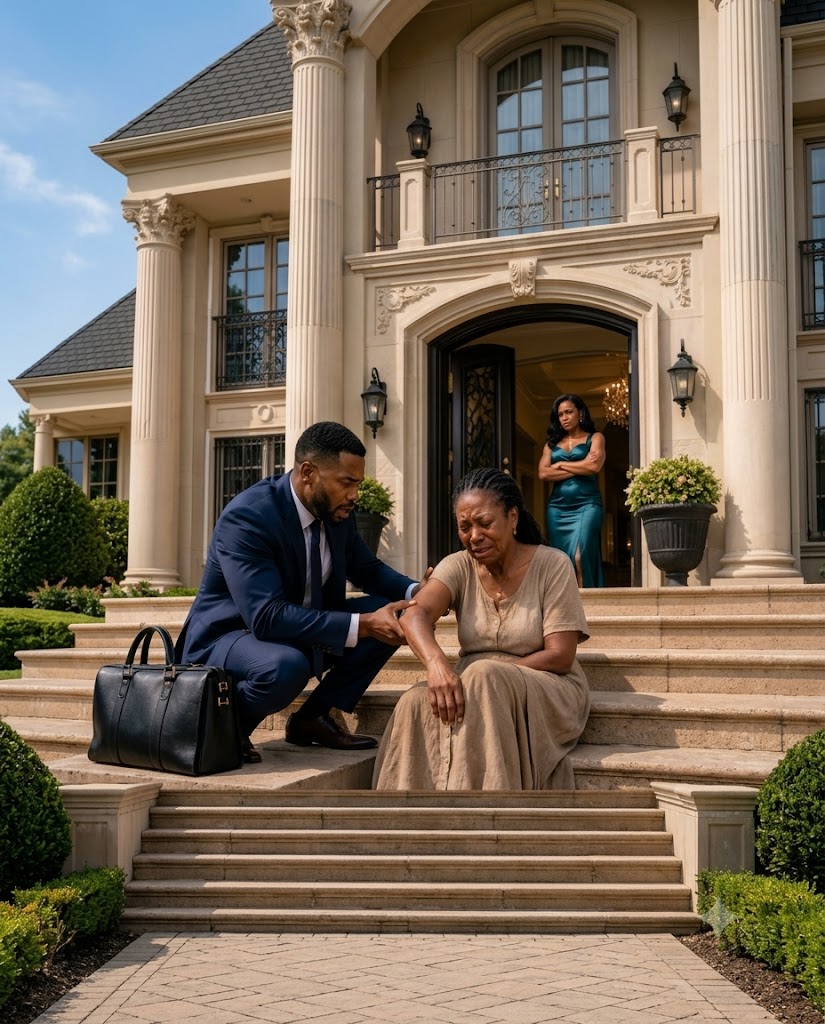
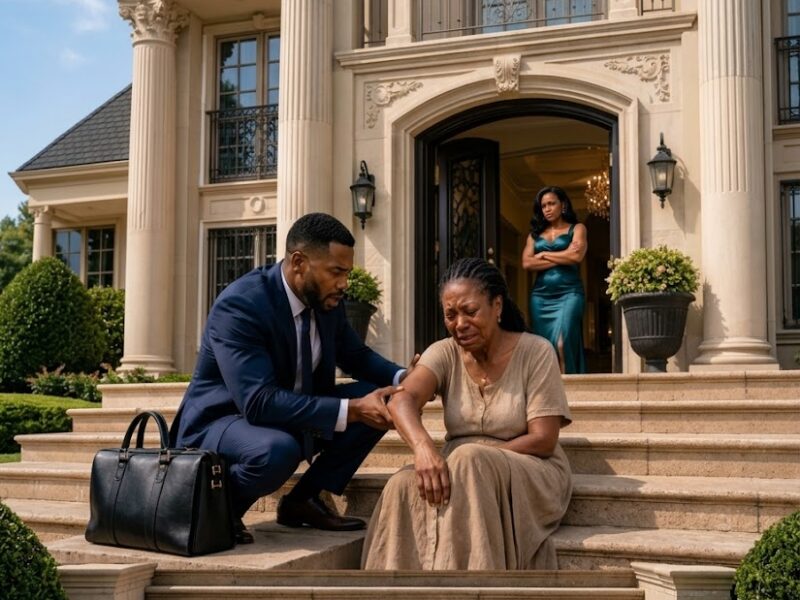
The driveway of the Thompson estate had never looked so cold under the Texas sun.
A small figure sat on the front step, surrounded by scattered belongings, her silver hair catching the afternoon light like spun glass.
Jacob Thompson’s hands trembled on the steering wheel as his Mercedes rolled to a stop at the end of the long paved drive.
He had changed his flight, rented a car at DFW, and driven ninety minutes with his heart in his throat.
Now he understood why his mother’s phone had gone to voicemail seventeen times.
Now he understood why his assistant had sounded so strange when she said, “Mr. Thompson, I think you should come home.”
The woman who had carried him on her back through a Houston heatwave when he was seven years old was sitting outside his own front door like a stranger who had overstayed her welcome.
Jacob killed the engine and sat frozen for three full seconds.
Then he saw the bruise on her forearm, purple and yellow, and something inside him cracked open.
“Mama,” he whispered, though she could not hear him.
Grace Thompson looked up at the sound of the car door.
Her eyes were red, her lips pressed together in that familiar way she had when she was trying not to cry.
She had been trying not to cry since she was twenty-three years old, widowed with a son and no safety net.
Jacob ran to her, his Italian leather shoes skidding on the pavement.
He dropped to his knees on the concrete, not caring that it scraped his tailored trousers.
“Mama, what happened?”
Grace opened her mouth, but no words came.
She simply reached for him, and Jacob pulled her into his arms, feeling how small she was, how fragile.
This was the woman who had once lifted him onto her shoulders to see a Fourth of July parade in downtown Houston.
This was the woman who had worked three jobs when he was in middle school, sleeping only four hours a night.
This was the woman who had sold her wedding ring, the last thing she had from his father, to pay for his SAT prep course.
And now she was sitting on his driveway, her belongings thrown around her like trash.
“Jacob,” she finally whispered, “I’m so sorry.”
He pulled back and looked at her face, searching for answers.
“Sorry for what? Mama, what are you sorry for?”
Grace’s chin trembled.
“I should have called first. I should have waited until you were home.”
Jacob felt his blood turn to ice.
“Where is Jessica?”
Grace looked away.
“Mama, where is my wife?”
“She’s inside,” Grace said quietly. “She told me to leave.”
Jacob stood slowly, his knees aching from the concrete.
He looked at the house he had bought three years ago, the house with the six bedrooms and the chef’s kitchen and the pool that Jessica had insisted on.
The house that was supposed to be a home.
“Stay here,” he said, his voice dangerously calm.
“Jacob, please don’t—”
“Stay here, Mama.”
He walked toward the front door, and with each step, he remembered.
—
**PART 2**
—
Two days earlier, Jacob had been in Denver, closing a deal that would add $2.3 million to his company’s annual revenue.
He had kissed Jessica goodbye on Thursday morning, told her he would be back Sunday night.
“Be safe,” she had said, her lips brushing his cheek.
“I’ll call you when I land.”
He had called.
She had not answered.
Now, as he pushed open the front door of his own home, Jacob understood why.
Jessica was in the living room, sitting on the white leather sectional, scrolling through her phone.
She looked up when he entered, and for a split second, her face registered surprise.
Then it shifted to something else.
Something Jacob had never seen before.
“Jacob,” she said, standing quickly. “You’re home early.”
“Where is my mother?”
Jessica’s expression flickered.
“She’s outside. She was—”
“Why is my mother outside, Jessica?”
His voice was quiet, but there was a tremor beneath it, like the ground before an earthquake.
“She was disrespectful,” Jessica said, crossing her arms. “She came into my kitchen, used my things without asking, and when I tried to talk to her about boundaries, she—”
“My mother,” Jacob interrupted, “is sitting on our driveway with bruises on her arm.”
Jessica’s eyes widened slightly.
“She fell. She was being dramatic, and she—”
“Did you touch her?”
The question hung in the air like a blade.
Jessica hesitated.
“Did you put your hands on my mother?”
“She was in my space, Jacob. She wouldn’t listen. I just—I pushed her a little, but she—”
Jacob felt something inside him shut down.
It was not anger, not exactly.
It was colder than that.
It was the realization that the woman he had married, the woman he had defended to his mother, the woman he had given everything to, had hurt the one person who had never hurt anyone.
“Get out,” he said.
Jessica blinked.
“What?”
“Get out of my house.”
“Jacob, you can’t be serious. This is our home. You can’t just—”
“I said get out.”
He walked past her, toward the staircase, and took the steps two at a time.
In the master bedroom, he pulled open the closet and grabbed Jessica’s designer suitcases, the ones she had insisted on buying for their honeymoon in Paris.
He threw them on the bed and began filling them with her clothes.
“Jacob, stop!” Jessica shouted from the doorway. “You’re overreacting! She’s fine! She’s just trying to come between us, don’t you see that?”
Jacob did not look at her.
He did not speak.
He simply packed her things with the methodical precision of a man who had learned to control his emotions in boardrooms and negotiation tables.
But this was not a negotiation.
This was the end of something.
When he had filled three suitcases, he carried them downstairs and out the front door.
Grace was still on the step, watching with wide, tearful eyes.
“Jacob, what are you doing?”
“Go inside, Mama. Please.”
He set the suitcases on the driveway, next to Grace’s scattered belongings.
Then he walked back inside and faced his wife.
Jessica was crying now, her mascara running down her cheeks.
“Jacob, please. I’m sorry. I lost my temper. It won’t happen again.”
“You’re right,” he said. “It won’t.”
“What does that mean?”
“It means you’re leaving.”
He reached into his pocket and pulled out his phone.
“Jacob, don’t do this. We can talk about it. We can go to counseling. I’ll apologize to her, I swear.”
Jacob dialed.
“911, what’s your emergency?”
“My wife assaulted my mother,” he said, his voice steady. “She’s sixty-eight years old. She has bruises on her arm. My wife threw her out of the house and threw her belongings on the driveway.”
“Sir, is the victim in need of medical attention?”
“I’m taking her to the ER now.”
“Officers are on their way.”
Jessica stared at him, her face pale.
“You called the police? On me? Jacob, you can’t—”
“I can,” he said. “And I did.”
He pocketed his phone and walked past her, out the door, to where his mother sat trembling.
“Mama, we’re going to the hospital.”
“I don’t need—”
“You’re going.”
He helped her stand, gently, carefully, and led her to the car.
As he opened the passenger door, he glanced back at the house.
Jessica stood in the doorway, her face a mask of disbelief.
Jacob looked away.
—
**PART 3**
—
The ER at Memorial Hermann was busy for a Saturday afternoon.
Jacob sat in the waiting room, his elbows on his knees, his head in his hands.
Grace was in an examination room, being treated for minor burns on her arm from the tea Jessica had thrown.
The tea.
Jacob could not stop thinking about it.
His mother had wanted a cup of tea, and his wife had thrown it on her.
He had received a text from Jessica’s mother twenty minutes ago.
*Jacob, please call me. We need to talk about this. Jessica is devastated.*
He had not responded.
Another text, this time from Jessica’s brother.
*Bro, I know she messed up, but calling the cops? That’s cold. Let’s talk.*
Jacob had turned off his phone.
The doctor emerged, a young woman with kind eyes and a clipboard.
“Mr. Thompson?”
Jacob stood.
“How is she?”
“Your mother is going to be fine. She has some minor burns on her forearm and a bruise on her hip from the fall. We’ve cleaned and dressed the burns. She’ll need to keep them covered for a few days and avoid direct sunlight, but there should be no lasting damage.”
“Can I see her?”
“Of course. She’s asking for you.”
Jacob followed the doctor through the double doors and into the examination room.
Grace was sitting on the edge of the bed, her arm wrapped in white gauze, her eyes tired but clear.
“Mama.”
She looked up and smiled, and Jacob felt his heart break all over again.
“My son.”
He crossed the room and sat beside her, taking her hand.
“I’m sorry,” he said. “I’m so sorry.”
“For what?”
“For not seeing what kind of person she was. For letting this happen.”
Grace squeezed his hand.
“You didn’t let anything happen. You weren’t even here.”
“I should have been.”
“You can’t be everywhere, Jacob. You’re one man.”
“I should have protected you.”
Grace was quiet for a moment.
Then she said, “You are protecting me. Right now.”
Jacob shook his head.
“It’s too late.”
“It’s not too late. I’m fine. I’m alive. I’m here.”
He looked at her arm, at the gauze, at the evidence of his wife’s cruelty.
“She threw hot tea on you.”
“I know.”
“She pushed you.”
“I know.”
“She threw your things outside like you were garbage.”
Grace closed her eyes.
“I know.”
Jacob’s voice cracked.
“How can you be so calm?”
Grace opened her eyes and looked at her son.
“Because I have lived long enough to know that anger does not heal wounds. It only makes them deeper.”
“She hurt you, Mama.”
“Yes.”
“She humiliated you.”
“Yes.”
“And you’re just going to forgive her?”
Grace was quiet for a long time.
“Forgiveness,” she finally said, “is not the same as forgetting. And it is not the same as allowing someone to hurt you again.”
Jacob stared at her.
“What does that mean?”
“It means I can forgive her in my heart, and still know that she should not be in our lives.”
Jacob exhaled.
“I called the police.”
Grace nodded.
“I know.”
“She’s probably in custody by now.”
“Probably.”
“Do you think I did the wrong thing?”
Grace reached up and touched his face, her fingers cool against his skin.
“I think you did what you needed to do. And I think you need to decide what comes next.”
Jacob looked at the floor.
“I can’t be married to her anymore.”
Grace did not argue.
She did not tell him to reconsider.
She simply said, “Then don’t be.”
—
**PART 4**
—
The next morning, Jacob met with his attorney, a sharp-eyed woman named Patricia Okonkwo who had handled his business contracts for years.
She listened to the story without interrupting, her pen moving across a legal pad.
When he finished, she set down her pen and looked at him.
“You want to file for divorce.”
“Yes.”
“And you want to press charges for the assault?”
“I want to withdraw the complaint.”
Patricia raised an eyebrow.
“That’s unusual, given the circumstances.”
“My mother asked me to.”
“Your mother asked you to withdraw the complaint against the woman who assaulted her?”
“Yes.”
Patricia was quiet for a moment.
“She sounds like a remarkable woman.”
“She is.”
Patricia nodded and made a note.
“I’ll prepare the divorce papers. Given the circumstances, we can file for a fault-based divorce on grounds of cruel treatment. That will affect the division of assets.”
“I don’t care about the assets.”
“You should. You’re worth approximately $14 million, Jacob. She’s entitled to a portion of marital property unless we can prove fault.”
“Then prove fault.”
Patricia nodded.
“I’ll need your mother’s medical records, the police report, and any documentation of the incident.”
“I’ll get them.”
“And Jacob?”
He looked up.
“Your mother is lucky to have you.”
Jacob shook his head.
“I’m the lucky one.”
—
That afternoon, Jacob drove to the police station.
Jessica had been in custody for two days.
When he walked into the lobby, he saw her family sitting in the waiting area.
Her mother, Diane, stood immediately.
“Jacob, thank God. We’ve been trying to reach you.”
“I know.”
“Please, you have to drop the charges. Jessica is beside herself. She hasn’t eaten. She hasn’t slept. She’s—”
“She threw hot tea on my mother.”
Diane flinched.
“I know. I know she did. And it was terrible, and she knows it was terrible. But she’s your wife, Jacob. You made vows.”
“I made vows to protect her. Not to let her hurt my family.”
“Your mother is fine! She’s not pressing charges. Why are you?”
“Because my mother is too kind to press charges. I’m not.”
Diane’s eyes filled with tears.
“Jacob, please. We’re family.”
Jacob looked at her, at the woman he had helped when her husband was diagnosed with cancer, at the woman whose mortgage he had paid for six months when she fell behind.
“I helped your family,” he said quietly. “I paid your husband’s medical bills. I gave your son $40,000 to start his business. I renovated your house when the roof collapsed. I never asked for anything in return.”
Diane looked away.
“But when it came to my own mother, Jessica couldn’t stand it. She couldn’t stand that I loved someone else as much as I loved her.”
“That’s not true.”
“It is true. And you know it.”
Diane was silent.
Jacob turned to the officer at the desk.
“I’m here to withdraw the complaint.”
The officer nodded and began the paperwork.
Twenty minutes later, Jessica walked out of the holding area.
She looked terrible, her hair disheveled, her clothes wrinkled, her eyes swollen from crying.
When she saw Jacob, she burst into tears.
“Jacob. Oh my God, Jacob.”
She ran toward him, but he stepped back.
“I’m here to take you home,” he said. “Not to forgive you.”
She stopped.
“What?”
“Your things are packed. I’ll drive you to your mother’s house.”
“Jacob, please. Let’s talk about this. I made a mistake. I’ll apologize to your mother. I’ll do anything.”
“You’ll do anything except respect her.”
Jessica’s face crumpled.
“Why are you doing this? I love you.”
“I loved you too. But love without respect is just possession.”
He turned and walked toward the door.
Jessica followed, her voice rising.
“You’re choosing her over me? Your own wife?”
Jacob stopped.
He turned slowly.
“I’m not choosing anyone over anyone. I’m choosing to stop pretending that I can love someone who hates the woman who gave me everything.”
Jessica opened her mouth, but no words came.
Jacob walked out the door.
—
**PART 5**
—
The driveway looked different in the morning light.
Jessica’s suitcases were lined up near the garage, exactly where Jacob had left them.
She stood beside them, her face pale, her eyes red.
When Jacob’s car pulled in, she straightened, hope flickering across her features.
Then she saw Grace in the passenger seat.
The hope died.
Jacob stepped out of the car and walked around to help his mother.
Grace moved slowly, her arm still wrapped, but she was steady on her feet.
Jessica watched them approach, and for the first time, she seemed to understand what she had done.
“Jacob,” she said, her voice shaking. “Please.”
He stopped a few feet away.
“I brought the papers.”
He reached into his jacket and pulled out a manila envelope.
Jessica took it with trembling hands.
She opened it and stared at the documents inside.
Divorce papers.
“No,” she whispered. “No, you can’t.”
“I can.”
“Jacob, I’m your wife. We made promises. We stood in front of God and—”
“You also promised to love my family as your own. You promised to respect my mother. You promised to be my partner, not my adversary.”
Jessica’s tears fell freely.
“I’m sorry. I’m so sorry. I’ll change. I’ll go to therapy. I’ll do whatever you want.”
Jacob shook his head.
“You don’t get to decide that anymore.”
He looked at Grace, who stood quietly beside him.
“My mother asked me to forgive you. And I have. But forgiveness doesn’t mean I have to keep you in my life.”
Jessica turned to Grace.
“Please,” she begged. “Please, Mrs. Thompson. I know I hurt you. I know I was terrible. But please, don’t let him do this.”
Grace looked at her for a long moment.
Then she said, “I forgive you, Jessica.”
Jessica’s eyes widened.
“But forgiveness,” Grace continued, “does not mean I have to pretend you didn’t hurt me. It does not mean I have to welcome you back into my home. It means I am releasing you from the debt you owe me. But the debt you owe my son is not mine to release.”
Jessica collapsed onto her knees, sobbing.
Jacob watched her for a moment, then turned to his mother.
“Let’s go inside, Mama.”
Grace nodded.
As they walked toward the house, Jacob paused and looked back.
“I spent years trying to understand why you hated my mother,” he said. “She never competed with you. She never tried to take your place. I never compared you to her because there was nothing to compare. You were my wife. She was my mother. Both of you had different places in my life.”
Jessica looked up at him, her face streaked with tears.
“But you kept trying to make me choose,” Jacob said. “And you never understood that I shouldn’t have had to choose at all.”
He opened the front door and led his mother inside.
The house was quiet.
It smelled like lemon and lavender, the candles Grace had brought as a housewarming gift three years ago.
Jacob helped her to the guest room, the same room she had stayed in during every visit, the same room Jessica had complained about.
“Rest,” he said. “I’ll make you some tea.”
Grace smiled.
“You remember how I like it?”
“Two sugars, no cream.”
Grace’s eyes filled with tears.
“You remembered.”
“I remember everything, Mama.”
He kissed her forehead and walked to the kitchen.
As he boiled water, he thought about the last three years.
He thought about the way Jessica had slowly, quietly, tried to separate him from his mother.
He thought about the arguments, the cold silences, the subtle manipulations.
He thought about the way he had started hiding his visits, hiding the money he sent, hiding the parts of himself that belonged to his mother.
And he realized that he had known, somewhere deep down, that something was wrong.
He had just been too afraid to see it.
The water boiled.
Jacob poured it into a cup, added two sugars, and carried it to the guest room.
Grace was sitting up in bed, looking out the window at the garden.
“Here, Mama.”
She took the cup and smiled.
“Thank you.”
Jacob sat in the chair beside the bed.
“Mama?”
“Yes?”
“I’m sorry I didn’t see it sooner.”
Grace sipped her tea.
“You see it now.”
“I should have seen it before.”
Grace set the cup on the nightstand.
“Jacob, you are a good man. You are a good son. You are a good husband—”
“I’m not a husband anymore.”
“You were a good husband. But you were married to someone who could not share your heart. That is not your fault.”
Jacob looked at his hands.
“She hated you, Mama. She hated you so much, and I never understood why.”
Grace was quiet for a moment.
“She hated me because she was afraid.”
“Afraid of what?”
“Afraid that you would love me more. Afraid that she would always be second. Afraid that she could never measure up to a woman who had sacrificed everything for you.”
Jacob shook his head.
“I never compared them.”
“She didn’t need you to compare. She needed you to choose.”
Jacob looked at her.
“And I chose.”
Grace smiled.
“Yes. You chose.”
Jacob stayed by her side until she fell asleep.
Then he walked outside to the driveway, where Jessica still knelt, the divorce papers scattered around her.
She looked up when she heard his footsteps.
“Jacob—”
“The car is coming to take you to your mother’s.”
“You can’t do this.”
“I can.”
“I love you.”
“I know. But love isn’t enough.”
“I’ll change.”
“I hope you do. For yourself. Not for me.”
He turned and walked back toward the house.
Jessica’s voice rose behind him.
“You’ll regret this! You’ll be alone forever!”
Jacob stopped at the door.
He looked back at her.
“No,” he said. “I won’t.”
And he walked inside, closing the door behind him.
—
**PART 6**
—
Three months passed.
Jacob sold the house and bought a smaller one, a ranch-style home with a garden in the back and a guest room that was always ready.
Grace visited every weekend.
Sometimes she stayed for a few days, sometimes just for dinner.
They cooked together, watched old movies together, laughed together.
Jacob had not realized how much of himself he had hidden during his marriage.
Now, he felt like he could breathe.
Jessica had moved back to her mother’s house.
She had called Jacob twice in the first month, begging him to reconsider.
He had not answered.
The divorce was finalized in the spring.
Jessica received a settlement of $800,000, far less than she would have gotten if Jacob had not documented the abuse.
She had not contested it.
Her family had stopped calling.
Jacob heard from a mutual friend that Jessica had started seeing a therapist.
He hoped it was true.
He hoped she would heal.
But he never spoke to her again.
One evening, as Jacob sat on his porch watching the sunset, Grace came out with two cups of tea.
She handed one to him and sat beside him.
“Thank you, Mama.”
“You’re welcome.”
They sat in silence, watching the sky turn orange and pink.
Then Grace said, “Are you happy?”
Jacob considered the question.
“Yes,” he said. “I think I am.”
“Good.”
“Mama?”
“Yes?”
“I’m sorry it took me so long to see the truth.”
Grace sipped her tea.
“You saw it when it mattered.”
“But I hurt you.”
“You didn’t hurt me. She did.”
“I let her.”
Grace set down her cup and looked at him.
“Jacob, you are not responsible for the choices of another person. You are only responsible for how you respond.”
Jacob nodded slowly.
“I responded late.”
“You responded exactly when you were ready.”
Jacob looked at his mother.
“How are you so wise?”
Grace laughed.
“Because I have lived a long time. And because I have loved you for even longer.”
Jacob leaned over and kissed her cheek.
“I love you, Mama.”
“I love you too, my son.”
They sat together until the stars came out.
And Jacob realized that he had been wrong about one thing.
He was not alone.
He had never been alone.
He had always had his mother.
And that, he realized, was more than enough.
—
**EPILOGUE**
—
A year after the divorce, Jacob met someone new.
Her name was Elena, a pediatric nurse who volunteered at the same community center where Grace taught sewing.
Grace introduced them.
“She’s kind,” Grace said. “And she doesn’t need to compete.”
Jacob was cautious at first.
He had learned that love could be complicated, that people could hide their true selves, that trust had to be earned.
But Elena was different.
She asked about his mother with genuine interest.
She laughed at his jokes.
She never made him feel guilty for the time he spent with Grace.
And when Grace visited, Elena welcomed her with a warmth that seemed to come naturally.
“They have a good relationship,” Jacob told his mother one evening.
Grace smiled.
“Yes.”
“You like her.”
“I do.”
“You approved of Jessica too.”
Grace shook her head.
“No. I never approved of Jessica. I just didn’t want to hurt your feelings.”
Jacob laughed.
“You could have told me.”
“You weren’t ready to hear it.”
“And now?”
“Now you’re ready to hear everything.”
Jacob looked at Elena, who was playing with a neighbor’s dog in the yard.
“I think she’s the one.”
Grace patted his hand.
“I think so too.”
Jacob married Elena a year later.
Grace wore a lavender dress and cried through the whole ceremony.
At the reception, Jacob stood and raised his glass.
“To my mother,” he said. “The woman who sacrificed everything for me. The woman who taught me what love really means.”
Grace blushed and waved him off.
Jacob looked at Elena, then at Grace.
“To the two most important women in my life,” he said. “Not because of the roles they play, but because of the love they give.”
Elena raised her glass.
“To family,” she said.
“To family,” everyone echoed.
And Jacob knew, with a certainty that settled deep in his bones, that he had finally found the life he had always wanted.
—
The driveway of the new house was never cold.
It was lined with wildflowers in the spring and pumpkins in the fall.
Grace’s car was always welcome.
Her teacup was always ready.
Her seat at the table was always set.
And Jacob never forgot the lesson he had learned.
Love is not about choosing between people.
It is about honoring the people who deserve to be honored.
And the woman who had given him everything deserved to be honored most of all.
**THE END**









