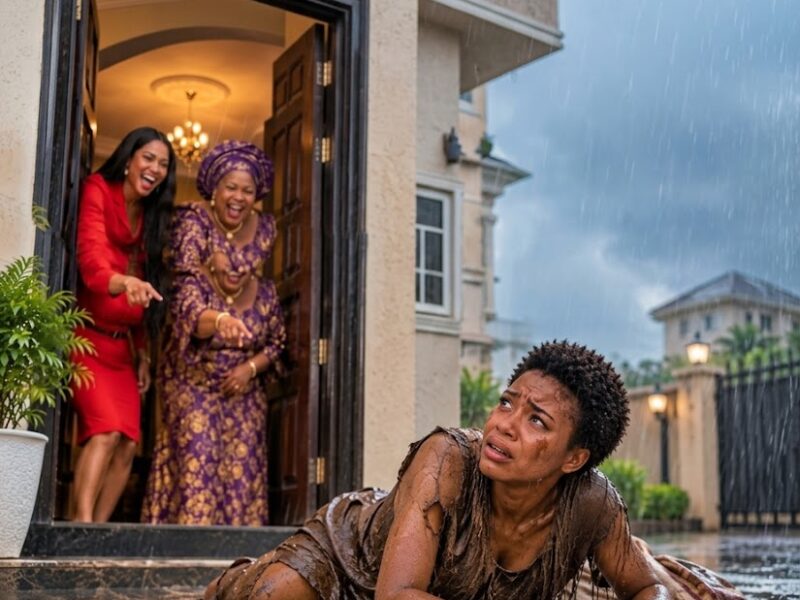
His Family Left Her Standing in the Mud—Then Her Quiet Husband Revealed Who Really Owned Their Estate
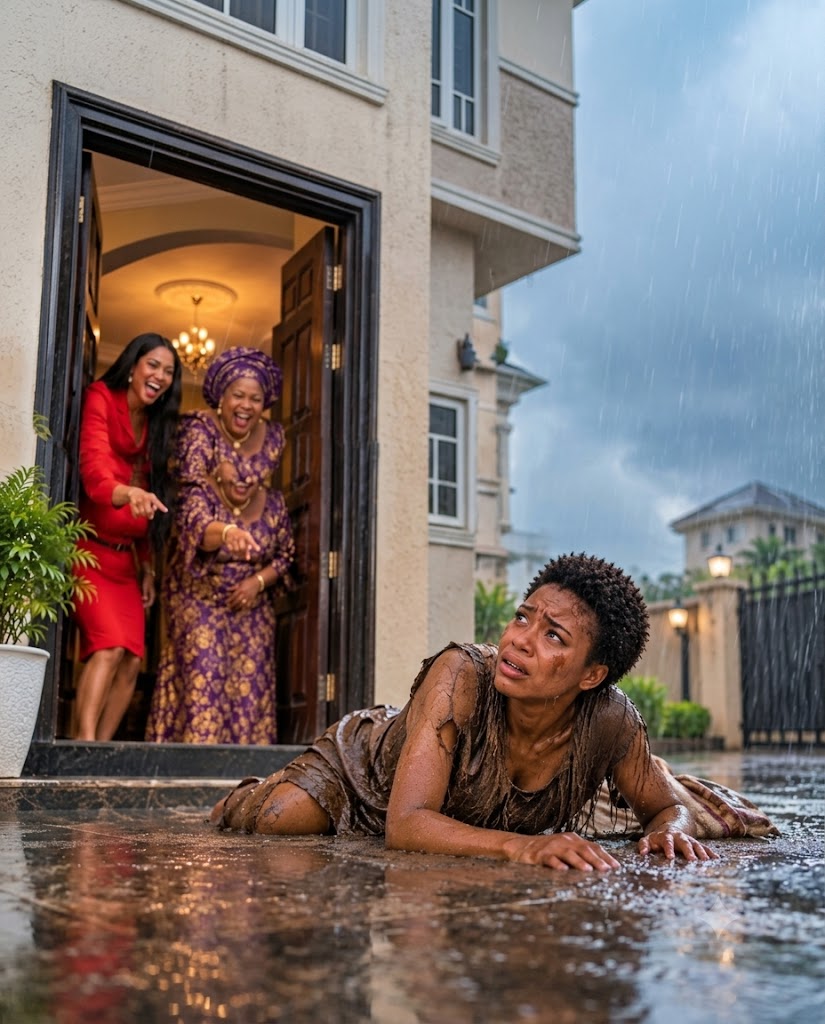
The rain had turned the dirt road into a river of brown mud, and Amaka stood in the middle of it, her one good dress clinging to her skin like a second punishment. She had walked three miles from the bus stop because she couldn’t afford the cab fare, and now she was supposed to deliver a freshly ironed blue dress to a woman who couldn’t even remember her name. The house loomed ahead, all glass and white columns, the kind of house that made you feel small before you even knocked. Amaka wiped her feet on the mat three times, but the mud followed her anyway, tracking across the marble floor like a confession she couldn’t take back.
“Amaka! Have you ironed my blue dress? I was going to do it after preparing breakfast.”
The voice came from upstairs, sharp and impatient, the same voice that had been barking orders at her since she arrived in this country two years ago. Amaka clutched the hanger tighter, feeling the plastic bite into her palm. She had ironed the dress twice because the first time, Mrs. Caldwell had found a wrinkle near the collar and made her do it again. Now the dress was perfect, not a crease in sight, but Amaka knew perfection wasn’t the point. The point was that she was here, in this house, because she had nowhere else to go.
“Who asked you what you were going to do? Go and iron it. You should be grateful.”
The words hit her like they always did, a slap she had learned to absorb without flinching. Amaka climbed the stairs slowly, her wet shoes squeaking against the polished wood. She had learned to be grateful. She was grateful for the small room above the garage, grateful for the leftovers Mrs. Caldwell sometimes remembered to leave out, grateful that she wasn’t sleeping under a bridge somewhere. But gratitude had a way of curdling in her stomach when she was reminded of it every single day.
“If we didn’t bring you into this house, where would you be?”
Amaka didn’t answer because the question wasn’t meant to be answered. She had been asking herself the same thing for two years, and the answer was always the same: nowhere good. She had arrived in America with a suitcase full of dreams and a sponsor who disappeared the moment she landed at JFK. The Caldwells had found her through a church program, and Mrs. Caldwell had looked at her the way you look at a stray dog you’re not sure you want to keep. But she had kept her, and Amaka had learned to keep her head down and her mouth shut.
“Poor people shouldn’t be choosing food.”
The words followed her into the laundry room, where the ironing board was still set up from earlier. Amaka plugged in the iron and waited for it to heat, watching the steam rise like a small prayer. She thought about the market she had passed on her way here, the one where she sometimes stopped to buy tomatoes and peppers with the little money she saved from her monthly stipend. She had learned to haggle, to walk away when the price was too high, to come back later when the vendor was desperate to make a sale. It was a skill she had learned from her grandmother back in Nigeria, a skill that felt useless in a country where everything was prepackaged and priced.
“Fresh tomatoes, sweet peppers here. How much for these onions?”
The memory came unbidden, sharp and clear. She had been standing at the market stall, counting coins in her palm, when a woman had approached her with a smile that seemed too bright for the gray morning. The woman had asked about the onions, and Amaka had answered without thinking, slipping into the familiar rhythm of the market. For a moment, she had felt like herself again, not the invisible maid who cleaned other people’s houses, but Amaka, the girl who knew the difference between a good tomato and a bad one just by looking at it.
“200, sister. Ah, too much. 150? Okay, take it. Thank you.”
The memory faded as the iron reached the right temperature. Amaka pressed the dress one more time, running the hot metal over the fabric until it was smooth as water. She hung it carefully on the back of the door and stepped back to admire her work. It was a beautiful dress, the kind of dress that cost more than her entire wardrobe, the kind of dress that would never hang in her closet. She allowed herself one moment of longing, one moment to imagine what it would feel like to wear something so lovely, and then she pushed the thought away.
“You don’t have to do this.”
The voice came from behind her, soft and unexpected. Amaka spun around to find a man standing in the doorway, his hands in his pockets, his eyes kind. He was tall, with the kind of easy confidence that came from never having to worry about where his next meal was coming from. Amaka had seen him around the neighborhood, always in expensive cars, always with a different woman on his arm. She had assumed he was one of Mrs. Caldwell’s friends, another wealthy person who would look through her like she was made of glass.
“Helping somebody doesn’t make me poorer. Hi, I’m Kelvin. I don’t think I’ve seen you around here before.”
Amaka blinked, caught off guard by the introduction. She was used to being invisible, used to being treated like part of the furniture. People didn’t introduce themselves to her; they talked over her, around her, through her. But this man was looking at her like she was a person, like she mattered.
“I’m Amaka. Maybe you haven’t been looking properly.”
The words came out sharper than she intended, a defense mechanism honed by years of being overlooked. But Kelvin just smiled, and something in his expression shifted, like he had just discovered something valuable.
“Then I’ve definitely been looking in the wrong places.”
Amaka didn’t know what to say to that, so she said nothing. She gathered her cleaning supplies and left the room, feeling his eyes on her back as she walked away. She told herself it didn’t mean anything, that men like Kelvin didn’t notice women like her. But the way he had looked at her stayed with her all day, a small warm ember in the cold ash of her life.
—
The festival was the first time Amaka had been allowed out of the house for something other than errands. Mrs. Caldwell had given her the evening off, a rare gift, and Amaka had spent an hour deciding what to wear. In the end, she had chosen a simple sundress she had bought at a thrift store, the kind of dress that didn’t try too hard. She had walked to the park where the festival was being held, the sounds of music and laughter growing louder with each step.
“Mama, please don’t tell me this man came looking for me.”
The words were out of her mouth before she could stop them. Kelvin was standing by the food trucks, looking as out of place as a peacock in a henhouse. He was wearing a linen shirt and tailored pants, and he was scanning the crowd like he was looking for someone specific. Amaka’s heart did something complicated in her chest, a mix of panic and pleasure that she didn’t want to examine too closely.
“Mama, that’s Kelvin, the man I met at the festival.”
She was talking to herself, she realized, a habit she had developed during the long days of silence in the Caldwell house. She hadn’t meant to speak out loud, but the words had escaped anyway. She watched as Kelvin’s gaze landed on her, watched as his face broke into a smile that made her stomach flip.
“Mhm, so this is Kelvin. My daughter, this one looks like a serious man.”
Amaka turned to find an older woman standing beside her, a knowing look in her eyes. The woman was a stranger, but she spoke with the authority of someone who had seen enough of life to recognize a moment when it was happening.
“Business has been keeping me very busy. Properties, contracts, I travel quite a lot, too.”
Kelvin had materialized beside them, answering a question Amaka hadn’t asked. She realized with a start that the older woman must have spoken to him, must have drawn him into conversation while Amaka was lost in her own head.
“Ah, you are really doing well for yourself. This is the kind of man a woman should marry.”
The older woman nodded approvingly, and Amaka felt her cheeks burn. She wanted to disappear, to sink into the ground and never come back. But Kelvin was looking at her with that same warm expression, and something in her chest loosened, just a little.
“Amaka, I like you. And I’m serious about you. I would like to marry you.”
The words landed like stones in still water, sending ripples in every direction. Amaka stared at him, certain she had misheard. They had spoken exactly once, for less than five minutes. And now he was talking about marriage?
“Marry me? Amaka, I barely know you.”
She said her own name by mistake, a slip of the tongue that made her want to crawl under the nearest table. But Kelvin didn’t laugh. He just nodded, his expression patient and kind.
“I understand. I’m not asking you to decide today. I just wanted you to know my intentions.”
Before Amaka could respond, Mrs. Caldwell’s voice cut through the crowd like a knife.
“Amaka, when you finish those clothes, make sure you clean my room. And don’t take all day.”
The moment shattered, the warmth draining out of the air. Amaka felt herself shrink, felt herself become small and invisible again. Kelvin was watching her, his brow furrowed, and she knew he had heard everything.
“Are you their daughter?”
The question came from the older woman, her voice gentle but curious. Amaka shook her head, the words sticking in her throat.
“No, I’m nobody’s daughter.”
She said it because it was true, because she had learned long ago that she belonged to no one and nowhere. But saying it out loud made it feel more real, more permanent. She excused herself and walked away, leaving Kelvin and the older woman behind. She didn’t look back, because she knew if she did, she would see pity in their eyes, and she couldn’t bear that.
—
The months that followed were a blur of work and waiting. Amaka cleaned the Caldwell house from top to bottom, scrubbed floors and folded laundry and cooked meals that she wasn’t allowed to eat at the table. She saved every penny she could, hiding the money in a sock at the back of her drawer. She didn’t know what she was saving for, exactly, but she knew she needed an exit strategy. She had learned that much from her grandmother, who had always said that a woman without her own money was a woman without her own voice.
“Mama Papa, I came to speak with you because I am interested in marrying Amaka.”
Emeka had been coming around for weeks, helping with odd jobs, fixing things that didn’t need fixing. He was quiet and kind, the kind of man who didn’t need to fill every silence with words. Amaka liked him, but she didn’t love him, and she wasn’t sure if that mattered.
“Amaka? At least the poor man knows his level.”
Mrs. Caldwell’s laughter was sharp and cruel, and Amaka felt her face burn. She had told Emeka not to come, had warned him that Mrs. Caldwell would only humiliate him. But he had come anyway, because he was stubborn and hopeful and he believed in things that Amaka had stopped believing in long ago.
“You’re going to marry Emeka.”
Mrs. Caldwell made the pronouncement like it was a done deal, like Amaka had no say in the matter. Amaka felt the familiar tightness in her chest, the one that came whenever she was reminded that her life was not her own.
“But Mama, I hardly know him.”
The words came out before she could stop them, and she immediately regretted them. Mrs. Caldwell’s eyes narrowed, and Amaka braced herself for the explosion.
“You should be thanking me. Do you think wealthy men are waiting somewhere to marry a homeless maid?”
The words were meant to wound, and they did. Amaka felt the sting of them, felt the shame rise up in her throat like bile. She wanted to argue, to fight back, to say that she wasn’t homeless, she had a room, she had a job, she had a life. But she knew it wouldn’t matter. To Mrs. Caldwell, she was nothing more than a charity case, a project, a person to be managed and controlled.
—
Kelvin came back the next week with gifts. Flowers for Mrs. Caldwell, a watch for Mr. Caldwell, a necklace for Amaka that sparkled like sunlight on water.
“Kelvin, this is beautiful. Thank you.”
Amaka held the necklace in her hands, feeling the weight of it, the coldness of the metal. She had never owned anything so expensive, had never even touched anything so expensive. She felt like she was holding someone else’s life, someone else’s dreams.
“You deserve beautiful things.”
Kelvin’s voice was warm and sincere, and Amaka felt something in her chest shift. She wanted to believe him, wanted to believe that she deserved beautiful things. But she had spent so long being told otherwise that the words felt foreign, like a language she had once known but had long since forgotten.
“Kelvin, all these are for me?”
Mrs. Caldwell’s voice was honeyed and sweet, a tone Amaka had never heard her use before. It was the voice she used for people who mattered, people who could do something for her.
“Yes, Mama. I saw them and thought you would like them. Papa, I brought this for you.”
Kelvin handed Mr. Caldwell a watch that probably cost more than Amaka made in a year. Mr. Caldwell looked at it with wide eyes, turning it over in his hands like it was a sacred relic.
“Kelvin, this is a very expensive watch.”
“Nothing is too much for family.”
The word “family” hung in the air like a promise, and Amaka felt a strange ache in her chest. She had never had a family, not really. Her parents had died when she was young, and her grandmother had raised her until she passed away. Since then, she had been alone, drifting from place to place, looking for somewhere to belong.
“Kelvin, you really know how to make a woman feel special.”
Mrs. Caldwell was practically glowing, her eyes fixed on Kelvin like he was the answer to all her prayers. Amaka watched the exchange with a growing sense of unease. She knew what Mrs. Caldwell was thinking, what she was hoping for. And she knew that Kelvin, despite his kind words and his expensive gifts, was not the answer to anyone’s prayers.
“You haven’t seen anything yet. I have big plans for us.”
Kelvin’s eyes were on Amaka when he said it, and she felt her heart skip a beat. She didn’t know what his plans were, but she knew they were dangerous. She knew that getting involved with someone like Kelvin could only lead to heartbreak, that she would end up hurt and alone, just like always.
“Mama, what exactly is Kelvin what you are for? Don’t pressure him. Wealthy men don’t make decisions like poor men.”
Mrs. Caldwell’s words were meant for Amaka, a warning disguised as advice. Amaka nodded, keeping her eyes down, not trusting herself to speak. She knew that Mrs. Caldwell wanted her to marry Kelvin, wanted the money and the status that came with him. But Amaka also knew that Mrs. Caldwell didn’t care about her, didn’t care about her happiness or her dreams. She only cared about what Amaka could bring her.
“I know, Mama, but I don’t want to wait too long. Kelvin, this is beautiful.”
Amaka realized with a start that Mrs. Caldwell was talking to her, expecting her to participate in this charade. She looked up to find Kelvin watching her, his expression unreadable. She wanted to tell him the truth, wanted to warn him about Mrs. Caldwell’s schemes. But she didn’t know how, and she didn’t know if he would believe her.
“I love it. Thank you. You keep talking about our future. When exactly does that future begin?”
The question came from Mrs. Caldwell, who was clearly growing impatient. Kelvin smiled, that warm, easy smile that made Amaka’s heart ache.
“Very soon. I’m arranging something special.”
—
“This man has been coming here for months. When will he marry you?”
Mrs. Caldwell was relentless, her questions like arrows that found their mark every time. Amaka was exhausted, tired of being asked the same thing over and over, tired of being treated like a pawn in a game she didn’t want to play.
“He said he’s planning something special.”
Amaka’s voice was flat, devoid of hope. She had stopped believing in Kelvin’s promises weeks ago. She had seen the way he looked at other women, had noticed the way he always seemed to be juggling a dozen different things at once. She knew he was not the kind of man who could be tied down, and she knew that if she married him, she would spend the rest of her life waiting for him to come home.
“Then don’t chase him away. Men with that kind of money have plenty of women around them.”
Mrs. Caldwell’s words were meant to be reassuring, but they only made Amaka feel worse. She didn’t want to be one of many, didn’t want to spend her life competing for a man’s attention. She wanted to be someone’s only, someone’s always.
“Amaka, I told you before that I wouldn’t pressure you. I just came to know if you’ve thought about what I asked you.”
Emeka was standing in the doorway, his hat in his hands, his eyes full of hope. Amaka felt a pang of guilt. She had been avoiding him for weeks, unable to face the question in his eyes.
“I have, Emeka, but I’m still not ready to give you an answer.”
Emeka nodded, his expression gentle and patient.
“That’s all right. Take your time. I want your answer to come from your heart.”
Amaka watched him walk away, and she felt something shift inside her. Emeka was good and kind and patient. He was everything she should want. But he wasn’t what she wanted, and she didn’t know how to reconcile those two truths.
—
“What do you want?”
Mrs. Caldwell’s voice was sharp, her patience clearly wearing thin. Amaka had been standing in the kitchen, trying to gather her thoughts, but Mrs. Caldwell had followed her, her eyes boring into Amaka’s back like lasers.
“Emeka wants to marry you, and you’re still saying you don’t know him.”
“Mama, please. I only said I need time. Marriage is for life.”
The words came out louder than she intended, and she saw Mrs. Caldwell’s face darken. She knew she had crossed a line, but she didn’t care. She was tired of being pushed and pulled and told what to do. She was tired of being treated like a child who couldn’t make her own decisions.
“After everything we’ve done for you, you still have the mouth to choose.”
Mrs. Caldwell’s voice was cold, her eyes hard. Amaka felt the familiar shame rise up in her chest, but this time, she pushed it down. She was tired of feeling ashamed. She was tired of feeling grateful. She was tired of feeling like she owed her life to people who treated her like a burden.
“Look at all the girls their age. One after another, they are getting married. I just want to see Ibe and Amaka married and settled, too.”
Mr. Caldwell’s voice was softer, more reasonable, but the words still stung. Amaka didn’t want to be compared to other girls. She didn’t want to be settled, like a debt that needed to be paid.
“Marriage is good, but you cannot force it. They must marry the right men. I know, but I’m tired of waiting. I want husbands in that house.”
Mrs. Caldwell’s voice was rising, her frustration spilling over. Amaka saw Ibe, the Caldwells’ daughter, slip out of the room, clearly unwilling to be part of this conversation. Amaka wished she could do the same, wished she could disappear and never come back.
“Ebere, will you marry me?”
Kelvin’s voice came from the living room, followed by a scream of delight. Amaka realized with a start that he had just proposed to Ebere, that he had chosen the Caldwells’ daughter over her. She felt something break inside her, something she hadn’t even known was fragile.
“Mama, please. Marriage is for life. I can’t marry somebody simply because you want me out of this house.”
Amaka was surprised to hear her own voice, strong and steady. She had been silent for so long, had learned to swallow her words and her feelings. But something had shifted inside her, some last reserve of strength she hadn’t known she possessed.
“After everything this family has done for you? I am grateful. But please, don’t choose my husband for me.”
Mrs. Caldwell’s eyes widened, her face flushing with anger. Amaka knew she had gone too far, knew she had crossed a line she couldn’t uncross. But she didn’t care anymore. She was tired of being told what to do, tired of being treated like she didn’t matter.
“Then leave my house.”
The words were cold and final, and Amaka felt her heart stop. She had known this moment would come, had known that eventually, she would wear out her welcome. But she hadn’t expected it to hurt this much.
“Please, Mama. Let me stay until morning. I have nowhere to go.”
Mrs. Caldwell’s eyes were hard and unforgiving.
“That’s no longer my problem.”
Amaka felt the tears prick at her eyes, felt the panic rise up in her throat. She had nowhere to go, no one to turn to. She was alone, just like always.
“Enough. Look at what you’re doing to this girl.”
Kelvin’s voice cut through the tension, sharp and angry. Amaka looked up to find him standing in the doorway, his face contorted with rage. She had never seen him like this, had never seen him anything but calm and smiling.
“Amaka. What happened?”
Kelvin was beside her, his hands on her shoulders, his eyes searching her face. Amaka shook her head, unable to speak. She didn’t know what had happened, didn’t know how everything had gone so wrong.
“I asked you to marry me because I want you, Amaka. Not because they gave you to me. If you don’t want me, I will still help you. You don’t owe me marriage because I helped you.”
Amaka stared at him, her mind reeling. She had thought he had chosen Ebere, had thought he had abandoned her. But here he was, standing in front of her, telling her that he wanted her, that he had always wanted her.
“When Mama Ebere told me to marry you, I thought she was giving me another punishment. But now I’m choosing you myself.”
Emeka’s voice came from behind her, and Amaka turned to find him standing in the doorway, his expression earnest and determined. She realized with a start that he had been there all along, that he had heard everything.
“She had one opportunity to escape poverty and married poverty instead.”
Mrs. Caldwell’s voice was bitter and mocking, but Amaka barely heard her. She was looking at Emeka, really looking at him for the first time. She saw the kindness in his eyes, the strength in his jaw, the patience in his smile. She saw a man who had been waiting for her, who had never given up on her, who had believed in her when no one else did.
—
The wedding was small and simple, held in a church that smelled of old wood and candle wax. Amaka wore a dress she had bought at a thrift store, a dress that cost less than the necklace Kelvin had given her. But it was her dress, her choice, her day. And when she looked at Emeka standing at the altar, his eyes full of love and hope, she knew she had made the right decision.
“Everybody meet Kelvin, my daughter’s husband, my wealthy son-in-law.”
Mrs. Caldwell’s voice was loud and proud, her arm linked through Kelvin’s like she was showing off a prize. Amaka watched from across the room, a glass of punch in her hand, and felt nothing but pity. Mrs. Caldwell had gotten what she wanted, had married her daughter to a wealthy man. But Amaka knew what Mrs. Caldwell didn’t: that wealth was not the same as happiness, that money could not buy love or loyalty or respect.
“Kelvin, where are you? Stop. I told you not to call me.”
Amaka heard the words from the other room, heard the panic in Ebere’s voice. She didn’t know what was happening, but she knew it wasn’t good. She knew that Kelvin was not the man everyone thought he was, that his wealth was a mask, a performance, a lie.
“Stand up. You’re my wife, Amaka. You’re not my servant.”
Amaka heard the words and felt a chill run down her spine. She realized with a start that Kelvin was talking to her, not to Ebere. She turned to find him standing behind her, his eyes dark and dangerous.
“I told you not to call me. Stand up. You’re my wife, Amaka.”
Amaka shook her head, backing away from him. She didn’t understand what was happening, didn’t understand why he was calling her his wife. She was married to Emeka, not to Kelvin. She had chosen Emeka, had chosen love over money, had chosen happiness over comfort.
“I am not your wife. I am not your anything.”
Kelvin’s face twisted with anger, his hands balling into fists. Amaka felt a flash of fear, but she pushed it down. She was not the same person she had been a year ago, not the same person who had been pushed around and told what to do. She had found her voice, and she was not going to let anyone take it away from her.
“You owe me. I helped you. I gave you money. I gave you gifts. You owe me.”
Amaka shook her head, her heart pounding in her chest.
“I don’t owe you anything. You helped me because you wanted something from me. You gave me gifts because you wanted to control me. I don’t owe you anything.”
Kelvin took a step toward her, his eyes blazing with anger. Amaka took a step back, her mind racing. She needed to get away, needed to find Emeka, needed to get out of this house.
“Kelvin, I want my money. You’ve been avoiding me for too long.”
The voice came from behind Kelvin, and Amaka saw a man step out of the shadows. He was tall and broad, with the kind of face that had seen too much and forgiven too little. Kelvin turned to face him, his expression shifting from anger to fear.
“Ebere, please go upstairs.”
Amaka realized with a start that Ebere was standing in the doorway, her face pale and frightened. She had been watching the exchange, had heard everything. She looked at Kelvin with an expression that was equal parts hurt and horror.
“Who was that? Business. He looked angry. That’s how business works.”
Kelvin’s voice was smooth and reassuring, but Amaka could hear the strain beneath it. She could see the cracks in his facade, the lies he had told to maintain his image. She knew now that Kelvin was not a wealthy businessman, that his money was borrowed or stolen, that his entire life was a house of cards waiting to collapse.
“What are you doing? Where are you taking my husband’s car?”
Amaka heard Ebere’s voice from outside, heard the panic in her tone. She ran to the window and saw two men hooking a tow truck to Kelvin’s luxury car. Ebere was standing on the lawn, her hands raised, her voice shrill with disbelief.
“Madam, this car does not belong to your husband. He has failed to make the payments. We’ve been instructed to take it back.”
Amaka watched as the car was towed away, watched as Ebere’s face crumpled with confusion and fear. She felt a strange mix of emotions: pity for Ebere, who had been deceived just like everyone else, and a grim satisfaction that Kelvin was finally being exposed for who he really was.
“What do you mean it doesn’t belong to him? Madam, Kelvin is not the owner of this vehicle. Kelvin! Those men said the car doesn’t belong to you. What’s going on?”
Ebere’s voice was rising, her composure crumbling. Amaka saw Kelvin step outside, his face pale, his hands raised in a gesture of surrender.
“Amaka, calm down. It’s just a temporary business understanding. I’ll sort it out.”
Amaka shook her head, a bitter laugh escaping her lips. She was not going to be calmed down. She was not going to be placated. She had been lied to and manipulated for too long, and she was done.
“Good afternoon, sir. Welcome. It’s a pleasure to have you here.”
The voice came from the front door, and Amaka turned to see a man stepping into the house. He was well-dressed and confident, the kind of man who was used to being in charge. Amaka felt a flicker of recognition, a sense that she had seen him somewhere before.
“Emeka. Yes.”
Amaka’s heart stopped. She knew that name. She knew that face. Emeka was the man who had proposed to her, the man she had rejected, the man she had thought was poor and simple. But looking at him now, standing in the Caldwells’ living room with an air of quiet authority, she realized she had been wrong about him. She had been wrong about everything.
“Who exactly are you? Soon. Kelvin, we’ve given you enough time. You owe us a lot of money. Please, we can discuss this privately.”
Emeka’s voice was calm and measured, but there was steel beneath it. Amaka saw Kelvin’s face go white, saw him take a step back. She realized with a start that Emeka was not just a man who had proposed to her. He was someone important, someone powerful, someone who had been watching Kelvin for a long time.
“Owe you money? Kelvin, what is he talking about?”
Ebere’s voice was shrill, her eyes wide with panic. Amaka saw Kelvin’s mouth open and close, saw him struggle to find words. But there were no words that could save him now. The truth was out, and it was uglier than anyone had imagined.
“Madam, this house belongs to our client. Your husband is only a tenant and the rent is overdue.”
The words landed like bombs, shattering the careful illusion Kelvin had constructed. Amaka saw Ebere’s face crumple, saw her turn to Kelvin with an expression of pure betrayal.
“Kelvin, you told me this house was yours. Kelvin, these debts are overdue. And those companies you claimed were yours, some are failing and some don’t even belong to you.”
Emeka’s voice was calm and relentless, each word a nail in Kelvin’s coffin. Amaka watched as the man she had once thought was her savior was revealed for what he truly was: a fraud, a liar, a thief.
“Then where did all that money come from? Borrowed money, madam. Even the money he used to buy those expensive gifts.”
Emeka’s words were directed at Ebere, but Amaka felt them like a punch to the gut. She thought about the necklace Kelvin had given her, the one she had never worn, the one she had hidden in the back of her drawer. She thought about the promises he had made, the future he had painted, the life he had offered her. It had all been a lie, a beautiful, glittering lie.
“You lied to me. And why did you marry me? Was it because you loved me? Or because you thought I had money?”
Ebere’s voice was broken, her eyes filled with tears. Amaka felt a pang of sympathy for her, despite everything. Ebere had been deceived just like Amaka had been, had been used just like Amaka had been. The only difference was that Ebere had been born into wealth, and Amaka had been born into poverty. But in the end, they were both victims of the same man, the same lie.
“Mama, Kelvin has nothing. What about his businesses? Lies. The cars? Not his.”
Amaka heard the words from the other room, heard Mrs. Caldwell’s voice rise in disbelief. She knew that Mrs. Caldwell was learning the truth about her son-in-law, learning that the wealth she had coveted was nothing but smoke and mirrors. Amaka felt a grim satisfaction, a sense of justice finally served.
“Amaka, get ready. We’re going to the city.”
Emeka’s voice was gentle but firm, and Amaka turned to find him standing beside her. She looked at him, really looked at him, and saw something she had missed before. She saw strength and kindness and integrity. She saw a man who had been watching her, protecting her, waiting for her.
“The city? What are we going there for? You’ll see. Good morning, sir. We’re ready.”
Amaka followed Emeka out of the house, her mind reeling. She didn’t know where they were going or what was waiting for her. But for the first time in a long time, she felt something she had almost forgotten: hope.
“Emeka, this car came for us? Yes, come. Emeka, where are we?”
The car pulled up to a gate, and Amaka’s breath caught in her throat. The house beyond the gate was beautiful, a sprawling estate with manicured lawns and flowering trees. It was the kind of house Amaka had only seen in movies, the kind of house she had never dared to dream about.
“Emeka, whose house is this? Ours. This is our home. This is where we’ll be living. My family has been wealthy for years. I also own businesses and investments in the city. I chose to live simply because I wanted people to see me, not my money.”
Amaka stared at him, her mind struggling to process what he was saying. Emeka was wealthy. Emeka had always been wealthy. He had chosen to live simply, to drive an old car and wear plain clothes, because he wanted to know who would respect him when there was nothing impressive to see.
“Why didn’t you tell me? Because I needed to know who would respect me when there was nothing impressive to see.”
Amaka felt tears prick at her eyes. She thought about all the times she had dismissed Emeka, all the times she had chosen Kelvin because he seemed more successful, more impressive. She had been fooled by appearances, just like everyone else. She had judged Emeka by his clothes and his car, not by his character.
“No, this cannot be true. The money is gone? I warned you not to put our family savings into that investment. You judged everybody by money. Now, look where money has brought this family.”
Amaka heard Mrs. Caldwell’s voice from somewhere behind her, heard the anguish and regret in her tone. She knew that Mrs. Caldwell was learning a hard lesson, learning that money was not the same as worth, that wealth was not the same as value.
“Ever since I came back from visiting Mama and Papa, Kelvin hardly comes home anymore. Sometimes he doesn’t even come home at all. What is going on? No, Kelvin, you’ve left me. He ran away.”
Amaka heard Ebere’s voice, heard the devastation in her tone. She felt a pang of sympathy for the woman who had once been her rival, the woman who had married Kelvin for his money and was now paying the price.
“My people, a wealthy businessman has generously funded a major development project for our community. He and his wife will be here personally for the official opening ceremony.”
Amaka heard the announcement, heard the cheers and applause. She turned to see Emeka standing at the podium, a smile on his face. She realized with a start that he was the wealthy businessman, that he was the one who had funded the project. And she was his wife.
“We should go. Maybe we can speak to them.”
Amaka heard Mrs. Caldwell’s voice, heard the desperation in her tone. She watched as the Caldwells approached the podium, their faces a mix of hope and shame. She saw Ebere standing behind them, her eyes red from crying.
“Emeka. She had one opportunity to escape poverty and married poverty instead.”
Amaka heard the words, heard the mocking laughter. She turned to see Kelvin standing in the crowd, his face twisted with bitterness. She realized with a start that he was talking about her, that he was still trying to hurt her, even now.
“Amaka, can you forgive me? I treated you like you were nothing. I was poor. I was homeless, but I was never nothing. I should have protected you when I had the chance. I’m sorry.”
Amaka turned to find Ebere standing beside her, her eyes filled with tears. She saw the regret in Ebere’s face, the shame, the longing for forgiveness.
“I laughed when Mama forced you to wear the Amaka. I thought I was better than you because Kelvin had money. After everything we did to you, why would you ever help us? If I become wicked because you were wicked to me, then wickedness has won twice.”
Amaka spoke the words from her heart, words she had learned from her grandmother, words she had carried with her through all the dark times. She saw Ebere’s face crumple, saw the tears stream down her cheeks.
“There’s nothing shameful about starting again. Thank you, Amaka. I accept the job offer. I’m ready to work and start again.”
Amaka watched as Ebere walked away, watched as she began her new life. She felt a sense of peace settle over her, a sense that everything had happened exactly as it was meant to.
“The Amaka Hope Foundation was created to give homeless girls, orphans, and mistreated domestic workers education, useful skills, and a second chance. People may judge you by where you come from. They may even make you believe you are worthless. But where you started does not decide where you will finish.”
Amaka stood at the podium, looking out at the crowd. She saw faces filled with hope, faces filled with gratitude, faces filled with determination. She saw herself in those faces, saw the girl she had been, the woman she had become.
“What is it? This is where I thought my life had ended. Maybe it was where your life started.”
Amaka smiled, feeling the weight of the words. She thought about the blue dress she had ironed all those years ago, the dress that had led her to Kelvin, the dress that had set her on a path she could never have imagined.
She thought about the mud on her shoes, the mud that had followed her into the Caldwell house, the mud that had marked her as an outsider. She thought about how far she had come, how much she had grown, how much she had learned.
The necklace was in her pocket, the one Kelvin had given her, the one she had never worn. She pulled it out and looked at it one last time, seeing it for what it truly was: a symbol of everything she had escaped, everything she had overcome.
She dropped it into the donation box at the entrance of the community center, watching as it disappeared among the other discarded things. It was just a necklace, just a piece of metal and stone. It had no power over her anymore.
Amaka walked out into the sunshine, feeling the warmth on her face. She thought about the future, about all the girls who would come through the Amaka Hope Foundation, about all the lives that would be changed.
She thought about Emeka, waiting for her at home, his love steady and true. She thought about the life they would build together, the family they would create, the dreams they would share.
She thought about the mud, the mud that had once felt like a curse. And she realized that it had been a blessing in disguise, a test that had made her stronger, a trial that had led her to where she was meant to be.
Because where she started did not decide where she finished. And that, she knew, was the most important lesson of all.
*She had walked through mud and come out clean on the other side.*









