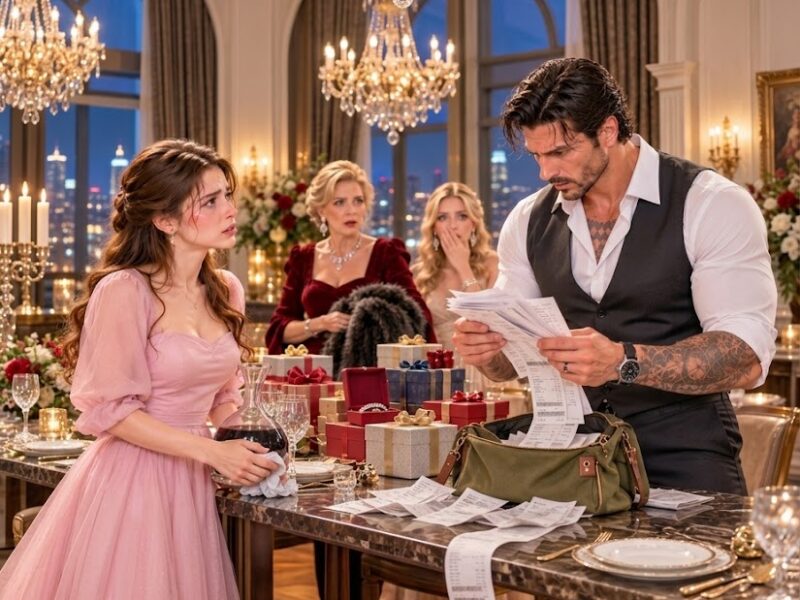
His family gave gifts to everyone at Christmas—everyone except his wife. She said nothing. She smiled. She served dinner. Then the mafia boss found receipts in her bag—and everything changed.
**Part 1**
The brownstone on Mount Vernon Street smelled of pine resin and roasting meat, the way it did every December when the Calloways gathered to celebrate themselves. Eleven gifts changed hands that evening at the long mahogany table.
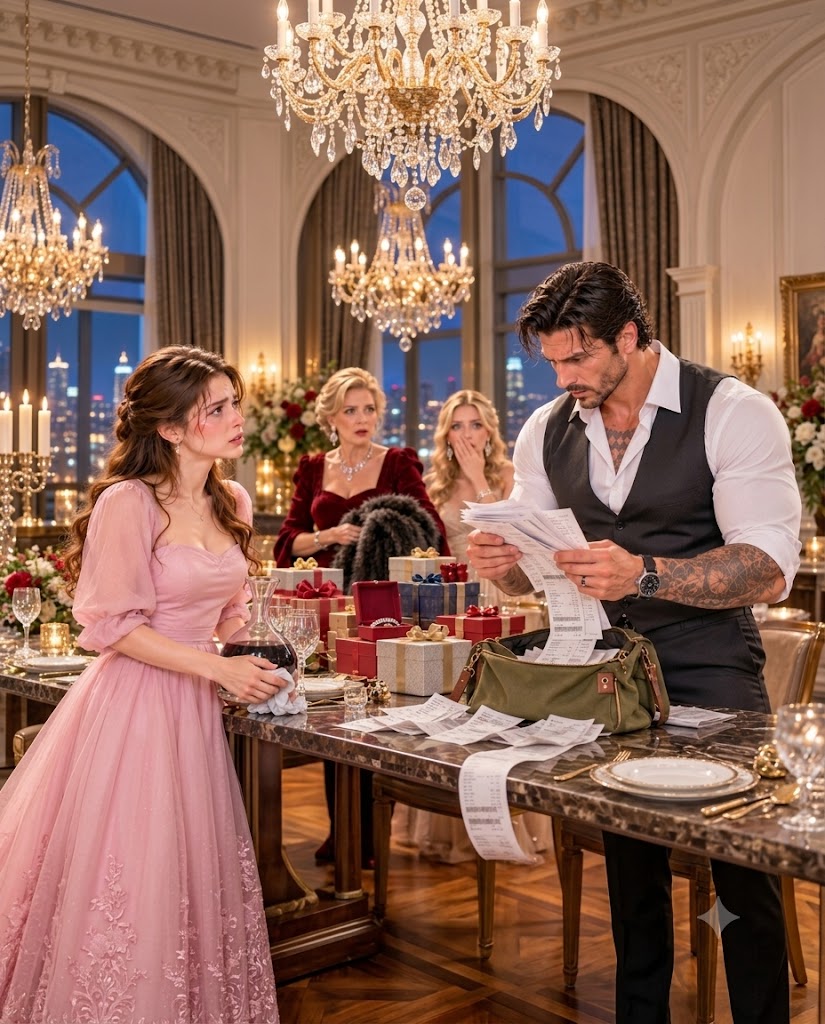
A rose gold bracelet from Copley Place. A sable-trimmed coat. A watch that cost more than most people’s cars. Only the woman who filled the glasses was left without a present.
She stood at the sideboard, her own plate untouched, a skin already forming over the sauce. Nobody looked up at her.
Later, the most feared man in Boston would search through her handbag for his grandmother’s heart spray and therein find a collection of receipts spanning eight years. But that came after the screaming started, after the ambulance lights painted the snow blue, after everything the Calloways believed about themselves cracked down the middle like ice on a frozen pond.
Colette Calloway let out a cry of joy, a sound which caused the candle flames to tremble and flicker. She had just pulled the ribbon from a rose gold bracelet and was holding her wrist over the roast so that everyone present could admire the piece of jewelry she was wearing.
“From all of us, my dear,” Diana Calloway said, placing a hand against her chest as if she had labored personally over the gift herself.
“The family won’t forget them.”
At the other end of the dining room, nineteen people applauded. Silver cutlery clinked against china. Wine was passed around. Voices rumbled with delight.
June Calloway stood next to her sister-in-law with a decanter of Barolo and poured her more. No one looked up at her. The annual winter dinner at the brownstone on Mount Vernon Street was going on as usual.
Diana received a sable-trimmed coat. A cousin’s newlywed husband got cufflinks. Perry Calloway, Rowan’s cousin and right-hand man, weighed his new watch in his hand and whistled appreciatively.
So this is the reward for loyalty.
Even the housekeeper was given an envelope and a kiss upon her cheek. June was asked for more wine. She poured out a drink and smiled whenever someone smiled at her, which only rarely occurred.
Her own plate stood untouched on the sideboard. A skin had already formed over the sauce.
Rowan Calloway watched his wife from above. They had been married for many years, and silence had gradually become the most reliable habit that he possessed.
In Boston, people relieved themselves when his car pulled up to their houses. Judges took his calls behind closed doors. Here in his own home, he watched as June stood there at dinner just like a common household servant.
He discovered a fine red cut located on her right thumb. That is what a wound looked like, which a taut ribbon on a pair of scissors had left behind. He couldn’t tear his eyes from it.
Then his grandmother’s fork paused.
May Calloway sat three seats away, barely ninety pounds. She had few words left since a stroke four winters ago. Year after year, the family had seated her at this table as if she were part of the furniture.
Now her hand felt across the tablecloth. Her knuckles turned white, her lips ashen. The people gathered all around her had risen to celebrate Perry’s watch. No one noticed.
June saw it from thirty feet away.
The decanter smacked against the sideboard. Dark wine spilled over the white linen. She was around two chairs and kneeling beside May before anyone turned their head.
“May, look at me.”
Two fingers felt for a pulse in her thin throat. Then she called Rowan by name, not as a plea but with the sharpness of a command. For the first time in eight years.
“My bag is in the hall closet, it’s green canvas, check the front pocket, now run.”
He ran. The man who ruled over the Calloway family rushed through his own hallway just like a messenger and then flung open the closet door wide. A green canvas bag hung among the furs. It had cost nine dollars. Hand-stitched repairs on the strap held together an old damage.
Rowan reached inside, pushed her lipstick and rosary to the side, and eventually found a small red spray can that had the word Nitroglycerin printed on it. Beneath it lay a stack of papers tied together with rubber bands, measuring almost as thick as his own fist.
He took the spray and stormed back. June put the dose under May’s tongue, carefully lifted her chin, and counted out loud, calmly and evenly, as if to a frightened child.
“Four. Five. Stay with me. Six.”
At ten, the gray drained from the old woman’s lips. At fifteen, her breath returned. Harsh, but strong enough to make the room sigh. May’s hand closed firmly around June’s wrist and refused to let go.
The relief lasted only a moment.
“You scared the living daylights out of everyone,” Diana said, smoothing her necklace. “And look at the tablecloth. It’s older than you.”
The wine stain spread. Colette said something about people who always had to be the center of attention. June was still kneeling next to May, whose fingers were clutching her wrist.
“I’m sorry, I’ll get some soda water.”
That was the end of the matter for the family. They turned back to the wine.
Rowan remained in the hall with the purse. He untied the elastic bands and pulled out the top sheet.
Four days old. Cartier, Copley Place. A rose gold bracelet, paid for in cash, $4,380. On the back, in June’s small, careful handwriting: *Colette from the family.*
Below that was the receipt for Perry’s watch. One thousand dollars from a dealer on Newbury Street, also paid in cash a few days earlier. Rowan turned the pages.
Diana’s coat. The cufflinks. Even the amount in the housekeeper’s envelope was written down to the exact dollar.
Then came the receipts from the previous December and the year before. Birthdays, graduations, flowers for the sick. Rowan recognized specific events during which he had stood beside beds, all the while refraining from asking any questions about the gifts.
Among the receipts lay a slip from a credit union in Dorchester that he did not recognize, as well as an installment plan from the very first winter of their marriage. Back then, a scarf had moved nineteen-year-old Colette to tears of joy.
For eight years, June had selected every single ribbon, written every card, and had carried, wrapped, and paid for every single gift herself. The names upon them were those of the family who had not even invited her to sit down for a moment.
The last piece of paper was not a sales receipt. It was a pawn ticket from three weeks ago. A woman’s gold wedding ring. Nine hundred dollars. Attached to it was an invoice for zero dollars, marked as paid in full for May’s new hearing aids.
Rowan recognized the ring. June had worn it at the time when her father’s debts were settled by way of a marriage, rather than by means of a funeral.
He stood in the hallway, papers in hand, calculating. Every year he had transferred one thousand dollars to the household account Diana called the family fund. It was to pay for gifts and those outward tokens of affection that passed for love among the Calloways.
December 8. One thousand dollars. Not a single dollar of it was to be found on any of these receipts.
Perry had stood up to propose a toast and was holding the new watch up high. He was talking about blood and loyalty when Rowan returned to the dining room.
“Sit down, Perry.”
Perry sat down. Then everyone sat down. The radiator ticked in the silence.
Rowan went first to June at the end of the table. She had no chair, she had no name tag, there was only the food that had meanwhile grown cold on the sideboard.
He turned around, pulled out the chair to his right, and then he said, “Stand up, Perry.”
The cousin cleared the table. Rowan offered June his hand and pushed her chair out for her. No one missed how the dreaded man from Boston escorted his wife to take a seat at his own private table.
The pile of receipts landed on the white cloth. Rowan dealt the sheets of paper one by one like playing cards and read out the item, the business, the price, and the date.
Colette learned that June had paid for her bracelet in cash four days ago, using money she had earned during a work shift that had commenced well before the sun even rose. Diana heard the price of her coat. Perry saw the receipt for his watch, purchased eleven days earlier, while he had told Rowan about the reward for loyalty.
With each sheet, the faces grew quieter. Finally, the recipients were just staring at their hands.
Rowan put down the pawn ticket last.
“Three weeks ago, she sold her mother’s wedding ring, just so that my own grandmother would be able to hear this particular dinner.”
He didn’t have to be loud. Each gift that the family had taken credit for and thanked themselves for had actually come out of June’s own pocket. For eight years, she had been left standing at her own table. She had tied the ribbons anyway and had signed all of the cards in someone else’s name.
May slowly raised her still-mobile hand and then placed it down upon the nearest receipt, as though she were trying to confirm a particular statement.
Rowan turned to Diana. “Eight years ago, I set up the fund. One thousand dollars a year, just for expenses like this. If June has paid for everything, where are my dollars?”
No one answered. Perry put his glass down very carefully. Dinner was over.
Under the yellow light at the front door, the family left the house and disappeared into the December cold. No one said goodnight to June.
—
**Part 2**
After midnight, Rowan found her in the kitchen. She had rolled up her sleeves and was rubbing soda water into the stained linen. When he came in, she winced. Years of marriage and his wife was terrified of him.
“You shouldn’t have done that,” she said to the tablecloth. “It is worse for me now. They all go back home whenever you are not looking at them. I am still living here.”
Rowan stepped around the counter and took the cloth from her hands. “Then it’s time for me to look.”
There were fine white streaks of flour under her fingernails and in the creases of her knuckles. New ones were added every day, but they never completely washed away.
“Where did you get $4,380 in cash?” he asked. “If you’re not allowed to work.”
June was silent for a long time. Finally, she mentioned Corbin’s, which was the bakery on Seven Hill Avenue where she had already been employed before she had entered into her marriage. On Tuesdays, Thursdays, and Saturdays, her shift began at 4 a.m. and ended at 8 a.m. She had told the house that she was going to early mass.
Her short laugh sounded tired. “No one has checked for eight years. No one gets up at nine anyway.”
“Why did you do that?” Rowan asked.
June finally looked at him. She had entered this family burdened by her father’s outstanding debts, which she had paid off through their marriage. From that very first day, she had firmly resolved that she would never cost him another cent. There would be no coat for her, no Christmas gifts. Whatever the Calloways required to maintain the outward appearance of a functional family, she would provide for herself.
Rowan, whose commanding presence could silence an entire courtroom, found himself unable to formulate an answer at first. When he finally spoke, it was not an attempt at justification, but rather the quiet admission of a grave error.
“I truly thought that keeping my distance would protect you,” he said. “But instead, everything has simply rusted away.”
His father had taught him, from the empty seat that was once his mother’s, that everything one loved could be discovered and ultimately used against him. No one was ever allowed to see love. He had desperately wanted to keep June out of the dangerous power game.
“I honestly believed that doing so would keep you safe.”
He looked down at the weary hands with which she had labored for others for eight long years.
“My family interpreted my silence as their permission to act.”
June did not absolve him. She merely handed him the other half of the tablecloth.
Until 2 a.m. they worked on the stain together. Never before in their marriage had they spoken to each other for this long.
After that, Rowan began to show up. On Tuesday at 4:40 a.m., his black Bentley was parked outside Corbin’s Bakery, as out of place as a battleship. Inside, Rowan held a paper cup of coffee and watched as June laughed between the sounds of the roaring industrial ovens. He didn’t know this June.
After her shift, she climbed into the back of the car out of eight years of habit. Rowan stepped out into the snow, opened the front door, and waited for her to sit down next to him.
On Sunday, he found her in his grandmother’s room on the third floor. June had spent every Sunday there for four years. She read May the racing pages, for the old woman had loved the racetrack since the days of Eisenhower. The new hearing aids fitted May’s ears like two small miracles.
When she spotted Rowan in the doorway, she reached for the notepad that replaced her voice. Slowly, she wrote three words.
*She never walked.*
Below that, with even greater difficulty:
*The others did.*
The lines made him blush.
—
**Part 3**
The warmth lasted for five days. Then what lay hidden beneath the family peace came to light.
Diana suddenly spoke to Rowan in a tone that sounded just like a lawyer. He should go ahead and have the fund audited, but to remember that an audit would affect everyone. Perry was even more accommodating. Twice he offered to personally go through the household books, ensuring that no outsiders would be in a position to expose the family.
Rowan thanked him and quietly fetched a forensic accountant from Providence. The man owed him his life, and he did not reveal to anyone that he was working at that time.
On Friday evening, his folder lay on Rowan’s desk. The gift fund was merely the loose thread of a much more extensive and complex web. Disbursements from the household. Bills for repairs that were never carried out. A sham charity with a post office box on Beacon Street.
Over eight years, $340,000 had patiently disappeared from the family in small amounts. Every single disbursement slip and every authorization form bore the exact same elegant, curved signature.
*June Calloway.*
Rowan was still staring at her name when Diana entered the study without knocking. She already had her own copy of the papers. Triumph was written all over her face.
“I warned you. Trials come to everyone.” She bled you dry for eight years, and then last night you decided to drop her off at Paris Square.”
A floorboard creaked behind her. June stood in the doorway holding May’s dinner tray, and she was pale down to her very lips. She had heard every word.
The tray did not fall. It was precisely her self-control that made the moment so difficult. With both of her hands, she set it down on the sideboard, walked over to the desk, and then picked up the topmost payment slip. She read her name.
“That looks like my signature,” she said quietly. “I have never signed this document. I have never been in this bank before.”
Diana laughed briefly and in a satisfied manner. “The flour was merely a disguise,” she claimed. “That is where the money ended up in Dorchester, just like June, every single Tuesday before the sunrise.”
Rowan answered neither of them. He laid the banknotes down next to those gift receipts whose backsides June had inscribed with a pencil. The sweeping strokes of the signatures matched each other, arc by arc, perfectly. A feeling of coldness began to spread through his stomach, yet the comparison alone did not reveal the truth regarding who had actually authorized those disbursements.
Twenty minutes later, Perry appeared with the expression of a man who takes no pleasure in delivering bad news.
“I hate this, cousin,” he said, spreading out further papers.
The post office box for the fake charity on Beacon Street had been opened under June’s maiden name. A storage unit in Saugus was also rented in her name. Photographs taken that same afternoon showed one thousand dollars in bundles of bills inside it. Perry spoke of a long game that June had been playing with everyone.
Now Rowan had to decide whether the family would settle the matter quietly or whether the commission would find out about it. The mention of that word caused the room to grow cold.
Hour by hour, the mountain of evidence became thicker. Perry had had eight long years to be thorough. By the next morning, the accusations were circulating throughout the house. The staff avoided June’s gaze entirely.
Colette came into the kitchen, stared down at the floor, and demanded her bracelet back. Even the auditor from Providence closed his briefcase and stated: “On paper, she is guilty. I’ve sent men to federal prison with less evidence.”
Rowan listened. The folder remained between him and June.
Then Perry took a step which was to change everything later on. At the moment, no one noticed how far he was going with this. In a gentle voice, he suggested that May be taken to a nursing home, given the excitement. She spent the whole day scribbling nonsense on her pad anyway, pointing at people, and thus not doing justice to the family. The transport was booked for Sunday morning, which is scheduled before the official meeting. May was to be gone before a decision was made about June.
Sunday came gray and hard. The Calloways gathered in the dining room of all places. The long table was still there, now without presents and without candles. June waited at the bottom of it, where she had stood for eight years. This time, ten people were looking at her.
It was worse than her previous invisibility. Rowan sat at the head, the file in front of him. His hands lay flat on the wood so that their trembling would not be noticed.
The evening before, in the study, he had asked her whether she had taken the money that had been left there. The papers had demanded this question. That did not make it any less painful for June. She had looked at him for a long time.
“For years I have paid for the love of your family with my wages from the bakery,” she said. “And you have to ask me that?”
He carried her answer with him ever since as the family sat down. Perry rose with an expression of regretful reason. He had taken off his new watch.
“Nobody wants blood,” he said. “So I offer mercy.”
Two documents slid across the table. A confession and an annulment of the marriage. June was required to sign both of them. Then she could take a bus, go somewhere, and the family would simply forget her name. Otherwise, as Perry left it unspoken in the room, the committee would be forced to decide her fate. They certainly did not hand out bus tickets there.
Pens and papers lay scattered on the table. Nineteen faces were waiting in silence. The radiator ticked exactly as it had on that evening when Rowan had handed out the receipts.
June let her gaze wander over the people for whom she had lovingly tied bows and picked out gifts. In the end, it rested upon Rowan.
“Before I touch anything, bring me my purse.”
Diana rolled her eyes in annoyance. The purse again.
June repeated her request firmly.
—
**Part 4**
Finally, the green canvas bag lay before her, the strap that she had purchased for nine dollars still repaired with visible stitches. The cheap, much-mended piece lay between the confession and the documents with which they intended to send her out of the house. Everyone present remembered the receipts that Rowan had found in there. So now they were following every movement of her fingers.
This time, however, June didn’t reach for the receipts. Instead, she pulled out a thin manila folder, which was approximately the same size as a standard mailing booklet. She smoothed it out on the table until it lay flat, then she looked around at the others once more. Her voice was firm.
“Fourteen of the withdrawal slips,” she explained, “were supposed to have been signed in person at the branch. The bank recorded every single point in time at the top of the paper. Perry had taken care to make it look as if I had been there myself. However, the dates and times printed upon them were not merely a part of his own personal story. They could be compared to another record.”
June opened the folder, and inside were her time cards from Corbin’s Bakery. Eight years of work. Mr. Corbin kept the paperwork for his tax return.
Just as Rowan had laid out the gift receipts, June now slid card after card across the table.
March. The bank receipt was dated 7:12 a.m. She had arrived at the bakery at 3:58 a.m. She clocked in at 6:40 a.m. and stood among the dough until 8 a.m. Two bakers and a driver could witness her.
June 14. Bank, 6:40 a.m. Bakery, work started at 4:02 a.m.
Then there is November 2, January 21, and a number of other dates as well. Fourteen notes, fourteen mornings. On none of these days had she departed the bakery before 8 a.m. The times were not founded upon memories before them, but were instead written down for all to see in black and white.
No one at the table moved. Just a moment ago, Perry had presented the papers as if they were an incontestable verdict. Now June forced everyone to read these papers. Line by line and time by time.
Perry’s jaw went hard. “She had a week to prepare this,” he said.
But June was not finished yet. The time cards proved her presence. Now she went on to show them exactly why the signatures themselves were false.
She pulled a napkin toward herself and wrote down her name with a pen, and all of the people who were there watched her do it. Next to this fresh handwriting she placed the gift receipts from the first year of marriage, including the installment payment slip from that frightening December 1st. At that time she had been twenty-three and had been afraid of this house. Her hand had trembled; the letters remained restless throughout those first two years, long before her unique style of writing finally began to settle down.
June fanned out the payment slips. They all bore the same immaculate signature. The first year looked like the eighth, without development, without deviation.
Her gaze met Perry’s directly.
“No one signs their name exactly the same way for years,” she remarked. “Unless someone else wields the pen.”
The word *theater* was hanging there between the cards and the bank notes. Perry took a breath to speak of preparation again.
At that moment the double doors opened.
June had visited May on the third floor as early as 6 a.m., just before the car that had been ordered was able to come and take her away. Now she pushed the old woman through the double doors to the table.
In May’s ears sat the hearing aids for which June had pawned the ring belonging to her own mother. On her lap lay the writing pad. The hand that had obeyed her after the strokes was already in the process of movement.
June stopped right beside the wheelchair and allowed May to show her for herself what she already knew.
The old woman lifted the sheet of paper. The large, shaky letters were hard to miss.
*Perry practiced her name on the glass in the study window. I saw it for four years.*
For years she had seen what was happening before her, even if she lacked the words to say it aloud.
A sound passed through the entire room, soft as the sound of ice that is working upon a frozen pond.
Perry laughed too loudly. “May has suffered two strokes. She scribbles and points at people. Does Rowan really want to believe a sick woman?”
May continued writing while he talked. Then she turned the pad again.
*He forgot that I can hear now. Two weeks ago. Telephone call. Beacon Street post office box. Key in right coat pocket.*
Perry’s coat was hanging on the coat rack in the hall. Rowan didn’t send any of his men. He went himself.
His footsteps could be heard all the way to the table, while everyone looked at the open door. He returned with his cousin’s coat, reached inside the right pocket, and then he set down a small item.
A brass key on the white cloth. *Beacon Street* was embossed into the shaft. The words on the keychain lay beside it.
The key was small enough that it could disappear underneath a single hand. But at this table, it attracted more attention than any of the precious gifts at the winter dinner. What had been dismissed for years as a pointless scribble was now a verifiable clue.
Perry ran. He made it four steps toward the kitchen. Then two of Rowan’s men filled the doorway.
It ended quickly and quietly. They held his arms tight. No shots were fired. The new watch slipped halfway out of his jacket pocket and fell to the floor.
Rowan walked slowly over to him. The family waited for the answer they had come to expect from their leader.
“Perry stole money. I would have settled that within the family,” Rowan said. “But you have been working for eight years in order to wipe out my wife.”
He stepped back.
“You won’t get a family settlement. You’ll get the courts. You’ll be treated like everyone else.”
The folder from Providence, every single payment slip, and the records of the shell company, the lease for the warehouse, and the key were all passed on to the Attorney General’s Office by a lawyer. This lawyer owed no one an answer.
—
**Part 5**
Eleven days later, Perry was arrested at Logan Airport. He had a ticket to Costa Rica with him. The charges against him were nine individual counts of document forgery and wire fraud. The documents he had used in his attempt to make June disappear were the very things that had ultimately landed him before the court.
June did not have to assume a new name or board any bus for the sake of these particular walls. She had read the times on his receipts and had placed her own times right next to them.
Diana was not charged. There was no evidence that she had even drawn a pen on any of the receipts. Her words in the study and at the table still stood. Rowan took away her control of the household and the fund. She also had to surrender the key to the front door of the brownstone. He sent her with a suitcase to the apartment in Palm Beach.
At the door, Diana paused and looked at June for a long, cool moment. Her voice still carried that particular tone of a lawyer, just as it had done before the examination.
“You’re an excellent counter,” she said. “Me too.”
Then she closed the door, and for the time being, nothing further occurred.
Inside the house, the memories of those two evenings spent at the table remained present. Once, the Calloways had accepted June’s work inside those shiny boxes without ever once mentioning her name. The second time, they had finally looked at her and were simultaneously prepared to send her away.
The receipts and the time cards remained the very same objects from her daily existence. This was money she had earned, hours of labor that another person could have verified, and handwriting that had shifted alongside her own life. Their inherent meaning had not changed at all, only the willingness of the others to look at them.
May was sitting in the house again, listening through the new devices and requiring no other person to invent her observations for her. Rowan could leave Perry to the mercy of the courts and take the house key away from Diana. Yet, what he himself had neglected over eight years of marriage could not be undone by such actions.
June had flinched away from him when he had entered the kitchen late that night. He had asked the one question that she had least wanted to hear from him. Even his place at the head of the table was only a place if he didn’t understand what it meant for her to live there.
A week after Diana had left, he came back into the kitchen at midnight. It was now the hour when they spoke.
This time he was carrying two things. Rowan set them on the kitchen counter.
The first was a stack of papers. The annulment of the marriage, with his part already signed, plus a car in the garage registered in June’s name, and a bank account over which she alone held full authority and control. Lying on the table was no request for her to trust him once again. Rowan had prepared for the possibility that she would leave.
The same kitchen where they had worked on the wine stain that night was now the place where he showed her the exit.
“The door is open,” he said.
His voice remained calm. His hands, however, did not.
“That door should have been standing open years ago.”
June looked down at the documents. Eight years earlier, her father’s debt had determined the path into this house. Now, there lay before her papers with which she could determine the path out all on her own.
Rowan stated that she had never been a debt to him. He had owed her the choice and was finally going to answer for his own failures, for every single receipt that he had once overlooked. She could leave this very night and would never have to tie another gift ribbon for the Calloways again.
He did not move the documents any closer to her. They were clear enough as they were.
For a long time, June contemplated the signature beneath the cancellation. She remembered the other table, the fourteen time cards, and exactly how she had slid them one by one across the wood until the family was forced to listen.
With that same calm movement, she pushed the papers back to Rowan.
“I did not stand at this table for eight years because I had to,” she said. “May needed me. And God help me, you too.”
She wanted to stay. It was her own decision, and not the fulfillment of any debt. Then she established a boundary that left absolutely no room for any misunderstanding.
“But I will never pour the wine again.”
“No,” Rowan replied. Something in his face loosened. “You won’t.”
The words couldn’t change the past winters. They meant that at the next meal, June would no longer be standing behind the chairs with the carafe, while her own food was left to grow cold on the sideboard. For the first time, her place at the table was not just a gesture toward the family, but rather part of a decision that she herself had clearly articulated.
The second item that sat upon the counter was a small box. Rowan had wrapped it himself, and it was obvious. Crooked paper, far too much tape, and a bow tied by hands which had, throughout their entire lives, always left such meticulous work to other people.
June held onto the box for a moment in her hands before she finally opened it. Inside was her mother’s wedding ring. Rowan had bought it back from the pawnshop for nine hundred dollars, apparently summoning every ounce of self-control that he possessed.
The gold was the same one that June had worn on that very day when her father’s debts had been paid off by means of her own marriage. She had parted with it for May’s hearing aids. Now it lay before her again.
Attached to the box was a small tag written in Rowan’s own distinctive handwriting. In all those years, not a single Calloway in the house had ever written such a gift tag for her personally with their own hand.
*To my wife. From me. Only from me.*
June wept against his chest. Flour still clung to her hands, just as it remained on the fingers of a woman who began her work three mornings a week long before anyone else had even started theirs.
Rowan held her as a faint, raspy, and unmistakably genuine laugh drifted out from the hallway toward where they were. May heard the race results and laughed at them. The ring, the flour, and her voice were all part of that moment, without anyone being able to turn it into a family heirloom or a gift of some kind.
At the next Sunday dinner, there was clean linen on the table. To the right of the headboard was a name card for June. Her place was not to disappear again as soon as the guests had finally departed.
She sat down and ate for the first time in a while. After eight years, her dinner was hot. No glass was waiting for her to fill it. The card bore her name. The plate was in front of her instead of off to the side on the sideboard.
Rowan had sat her down on Perry’s chair that time, in full view of the entire family. This time she stayed there because she had decided to stay.
On a Tuesday in January, an envelope arrived with no return address. The postmark was from Palm Beach. Inside was only a photocopy of a receipt. A gold ladies’ herringbone chain. Nine hundred dollars.
Beneath the copy were five words written in a handwriting that no one could possibly prove to be the handwriting of Diana.
*Anything bought can be sold.*
The sentence was not intended as a reply to what June had decided. But it made the coldness behind Diana’s departure palpable once more.
June had spent eight years buying love for people who barely saw her. It was only when the man everyone feared opened her purse and read the receipts that it finally became apparent exactly what she had been carrying all along.
The door had been open, after all. She had decided for herself on which side she wished to take her stand.
The green canvas bag still hung in the hall closet, the nine-dollar strap stitched and restitched, holding together what eight years of silence had nearly torn apart.









