Her Husband Threw Her Out While She Was Pregnant—Unaware Her Brother Led a Hells Angels Chapter
**Part 1**
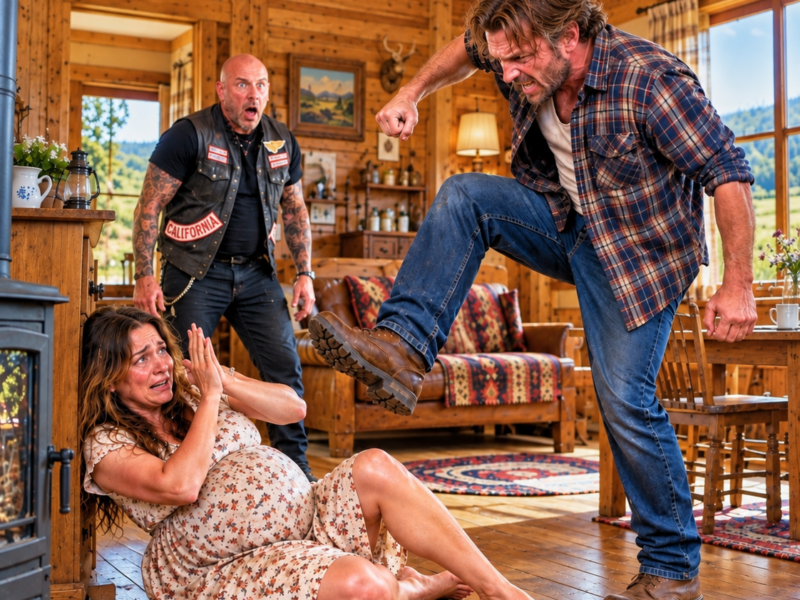
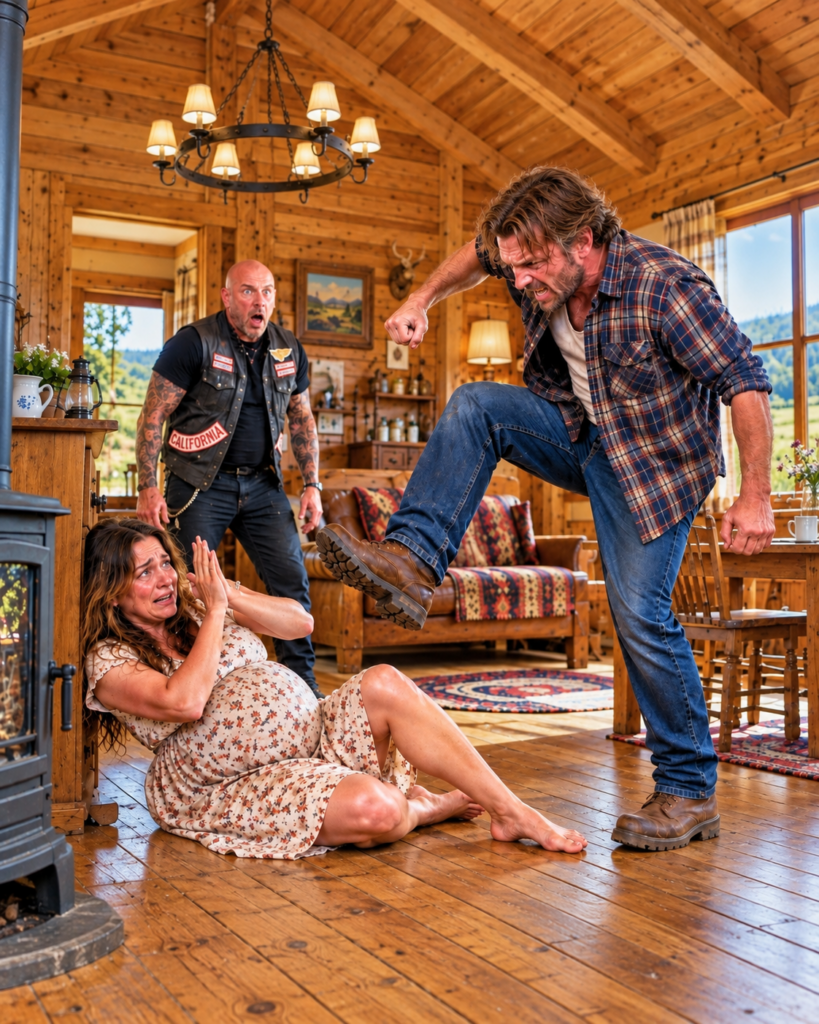
A boot drove into a pregnant woman’s stomach. She hit the kitchen floor hard, both arms wrapped around her belly. A glass shattered above her head. She couldn’t breathe. She couldn’t scream. A second kick caught her hip and sent her sliding into the cabinets. A man stood over her, swaying a beer bottle in his hand. He spat on the floor and told her she brought this on herself. Then the door slammed and a truck roared off into the dark.
Her name was Delia Vance, seven months along, alone on the floor of a house four miles from town. The man who kicked her was her husband. What that husband never bothered to learn was who Delia’s brother was. And her brother was not a man you wanted to meet. What happened when he found out would empty a street in under a minute.
So stay with me. Let me back up because you need to understand how she ended up on that floor. Delia was 26 years old. She lived at the edge of Barstow, California, out where the town stops being a town and turns into desert and dirt road.
The house wasn’t much. A little gray thing with a sagging porch and a yard full of gravel, a good four miles from the nearest gas station. When Delia married Garrett Vance three years back, she thought the quiet out there was peaceful. Now she knew better. Out there nobody could hear anything. And Delia had learned that, too.
He worked at a garage in town, pulled cars off the highway with a tow truck, came home smelling like oil and beer. In the beginning he was charming. That’s how it always goes, isn’t it? Charming until the ring was on. Then the charm started coming off in pieces.
First it was the words, the names he called her, the way he’d stand too close when he was angry just to watch her flinch. Then one night about a year into it, the words weren’t enough for him anymore, and he grabbed her by the hair. She told herself it was once. She told herself a lot of things.
By the time she got pregnant, the once had become a pattern. He drank more. He blamed her for everything. The bills, the heat, the job he hated. And every few weeks the pressure in him would build until something broke, and that something was always her.
Now, here’s the thing you have to know about Delia. She wasn’t weak. People love to ask why a woman stays, like staying is the easy choice. It isn’t. She had no car of her own. Garrett kept the only keys. Her phone was three years old and half the screen was dead.
Her mother had passed when she was a girl. Her father, Hank Rourke, a hard old rancher with hands like cinder blocks, had died the winter before. And when Hank died, the only thing he left her was a dog. His name was Diesel, a pit bull, grayed around the muzzle, one ear torn and healed crooked, a long scar running down his shoulder from some fight nobody talked about.
Diesel was old now, slow in the mornings, but that dog loved Delia with everything he had left, and he’d made himself one job in this world. Whenever Garrett’s truck came crunching up that gravel drive, Diesel would get up, walk to the kitchen, and plant himself square between Delia and the door. Wouldn’t growl. Wouldn’t bark, just stand there, watching Garrett with those flat dark eyes.
Garrett hated that dog, called it a mangy mutt, threatened to shoot it a dozen times, but some part of him, some drunk coward part, was scared of Diesel, and Diesel knew it. Around Diesel’s neck was a collar, thick leather hand-stitched, old as the dog himself. Hank had made it at his workbench years ago, punched every hole himself, and riveted a brass tag onto it.
Remember that collar. It matters more than you’d think. There was one more thing Garrett didn’t know or didn’t care to know. Delia had a brother, an older brother, Cole. Cole Rourke left home when Delia was 16 after a blow-up with their father that shook the walls. Hank and Cole were too much alike, that was the trouble. Both proud, both stubborn.
Cole walked out and disappeared into a world Hank never approved of, and the two of them never spoke again. Delia had seen her brother maybe twice in 10 years. A funeral, a gas station once by accident. What Delia knew and never once told Garrett was where Cole ended up. Cole rode with the Hells Angels, and not as some hang-around.
Cole Rourke was the president of the Barstow charter. The man the whole desert knew by his first name. The man you did not cross. Garrett never asked about her family, why would he? In his mind, Delia had nobody. That was the whole point of a house four miles from town. That was why he felt safe doing what he did. He was wrong. He just didn’t know it yet.
Now, the night it all turned, Garrett came home worse than usual. He’d been drinking since noon. Lost money on something, a bet or a card game, Delia never did find out. He came through the door already shouting, and Diesel got up slow and walked to his spot by the kitchen. Delia was at the stove. She didn’t even get the chance to turn around before Garrett started in on her.
She tried to say the right things. You learn the right things living with a man like that. Soft voice, don’t argue, agree with everything. But there was no right thing that night. He wanted a reason, and when a man wants a reason bad enough, he’ll make one out of air. He threw his beer bottle first. It smashed on the wall behind her. Then he grabbed her arm, and she pulled back on instinct, and that was all he needed.
He shoved her. She went down. And then he did the thing no man should ever do to anyone, let alone a woman carrying a child. He kicked her. Once, twice, standing over her while she curled around her belly and begged him to stop. Diesel moved. The old dog crossed that kitchen and put himself between Garrett and Delia, and for one second Garrett raised his boot toward the dog instead.
Diesel didn’t back off, didn’t even blink, and something about those flat old eyes made Garrett stop. He spat on the floor. He told Delia she’d brought it on herself. And then, because he was a coward and cowards always run, he grabbed his keys and stormed out. The truck roared off down the gravel, tail lights shrinking into the dark, and the quiet came rushing back in.
Delia lay there a long moment, both hands on her stomach, waiting. Waiting for the baby to move. “Please,” she whispered, “please move.” And the baby kicked. One small, strong kick against her palm. She let out a sob of pure relief. That’s when she noticed Diesel at the door. The old dog was pacing, whining low in his throat, nosing at the gap where the door hadn’t latched all the way. He kept looking back at her, then at the door, then back at her. Like he was trying to tell her something. Like he’d made a decision.
She tried to get up. The pain in her hip folded her back down. By the time she got a hand on the counter and dragged herself halfway to her feet, Diesel had pushed his gray head against that door, and it swung open into the night. Delia called his name. “Diesel, no. Diesel, stay.” But the old dog didn’t stay.
Here’s the thing about that collar. It was old, and the leather had stretched over the years, and lately it hung loose. Delia had meant to punch a new hole in it, hadn’t gotten around to it. So when Diesel lowered his head and pulled backward hard, that loose old collar slid right up over his ears and dropped onto the porch boards with a soft thump. And Diesel was free.
He went down the steps and across the gravel and out into the desert dark, moving faster than Delia had seen him move in a year. Not toward the road Garrett had taken, the other way, toward town. Delia stood in the doorway holding her hip, calling a name into the night that nobody answered. Her father’s dog was gone. The last piece of Hank she had left, running off into the black, and she couldn’t take 10 steps to go after him.
She sank down onto the porch step, and she cried. Cried for the dog, for the bruises blooming on her side, for the baby, for the whole broken shape of her life. She stayed out there until the cold pushed her back inside. And then slowly, something strange settled over her. The house was quiet. Garrett was gone, and when Garrett left like that, drunk and furious, he didn’t come back till morning. She knew his rhythms the way you know a storm. He’d go to the bar or to somebody’s couch, and she’d have the night to herself. The night was hers.
So she did the small things you do when you’re trying to feel human again. She picked up the big pieces of broken glass and wrapped them in newspaper. She wiped the beer off the wall. She ran a cloth under warm water and held it against her hip. She put the kettle on, because her father always said there was nothing a cup of tea couldn’t make one in more bearable. And Hank had been right about most things.
She lowered herself into the kitchen chair, slow and careful, and wrapped both hands around the warm cup. The baby shifted inside her, settling, and Delia let out a long breath. The worst was over. He was gone for the night. The dog would come home by morning the way dogs do. Tomorrow she’d figure out the rest. Tomorrow she’d be brave. For the first time in hours, her shoulders came down from around her ears. She closed her eyes.
Out on the desert road, four miles off, a pit bull with no collar was still running. And that’s when she saw the light. Headlights washing across the kitchen wall, swinging as a truck turned up the gravel drive. The sound of an engine she knew better than her own heartbeat. Garrett was back. He was never back this early. Never. The cup slipped in Delia’s hands, and tea splashed across the table. Because if Garrett was coming back now, this soon, drunk and still burning, it meant something had changed. And whatever had changed, it wasn’t in her favor.
The truck door slammed. Boots on the gravel, uneven, heavy. Then his voice carrying through the thin walls, and it wasn’t the shouting from before. This was lower, meaner. The quiet kind of mean that’s so much worse. “Delia,” he called, almost singsong. “Where’s your dog, Delia?” he hummed. “Where’s that mutt now?”
She was on her feet, backing toward the far wall, both hands over her belly. The door banged open. Garrett filled the frame, and he had something in his hand this time. Not a bottle. A tire iron, the long steel kind he kept behind the seat of the truck. “Lost him,” Garrett said, and grinned. “Saw him running off up the road. Good. Nobody between you and me now.”
And there it was. The whole nature of the thing had changed in a single sentence. Before, Diesel had been the wall. Before, even at his worst, Garrett had always stopped, always stormed off because the old dog stood in his way and some animal part of Garrett knew it. The dog was the one line he never crossed. Now the line was gone. And Garrett knew it.
“You think I don’t know you’ve been calling your girlfriends,” he said, stepping in, tapping the tire iron slow against his own leg. “Telling them about me. Making me look like something. You’re not telling anybody anything anymore.” This wasn’t a drunk man blowing off steam. This was a man who decided something out there on that dark road. Delia could see it in his eyes. He wasn’t looking to hurt her and feel big. He was looking to end this, to make his problem go away for good, and he’d come back with the tool to do it.
She was out of rooms to back into, out of soft voices and right things to say. Four miles from town, no car, no dog, a cracked phone on the counter she’d never reach in time. Just her and her baby and a man with a steel bar closing the distance. Now I want to pause here for just one second because if you’re the kind of person who believes men like Garrett always win in that house at the edge of nowhere, I need you to stay right with me. Because something was coming up that gravel road that Garrett had never once imagined.
If you’re still with me and you want to see a coward finally meet the reckoning he earned, do me a favor and hit that subscribe button right now because the next part is the whole reason I’m telling you this story. Let me take you four miles the other direction. Back to where Diesel was running.
The Barstow charter of the Hells Angels kept a clubhouse off an old frontage road. Cinder block building, a yard full of bikes, a chain link fence. That night maybe a dozen men were out front. The usual, somebody’s birthday, music playing low, the smell of a grill. Cole Rourke stood near the gate with a cigarette he wasn’t really smoking, listening to one of his younger guys tell a story. Cole was 41. Big across the shoulders, beard going gray at the edges, a face that had been broken and rebuilt more than once. He didn’t talk much. He didn’t have to. When Cole Rourke spoke, men who’d done time leaned in to hear it.
He’d built this charter from almost nothing, held it together through things that would have torn other men apart, and he ran it on one simple rule that his own father, for all his faults, had drilled into him as a boy. You protect the ones who can’t protect themselves. You stand in the door. He was thinking about none of that when the dog came out of the dark. It trotted straight through the open gate, past the bikes, past the men who turned and reached for the animal the way bikers do, half fond and half wary.
The dog ignored all of them. It walked a line across that yard like it had somewhere to be, and it stopped in front of Cole Rourke, and it sat down, and it looked up at him. Cole went still. He knew that dog. Older now, grayer, scarred up worse than he remembered, but he knew him. He’d been there years back, the day his father brought that pup home. He’d watched Hank name him. Diesel. And he knew the second he looked down that this was no stray.
“Hey,” Cole said softly, and crouched. His knees cracked. He put a hand out, and the old pit bull pushed his head into it like he’d been waiting 10 years to do exactly that. Hey, old man, where’d you come from? That’s when Cole noticed the dog had no collar. And that’s when the thing started crawling up the back of his neck. The thing a man gets when he knows before he can explain it that something is badly wrong.
Because Diesel didn’t belong to Hank anymore. Hank was in the ground. Cole had stood at the back of that funeral and left before anyone saw him. Diesel belonged to Delia now, his little sister. The girl he hadn’t protected, hadn’t called, hadn’t done a single thing for in years because he was too proud and too ashamed and too sure she was better off without a brother like him. And Delia’s dog had just run God knew how far through the desert, alone in the dark with no collar on to sit down in front of him.
Something’s wrong, Cole said standing up fast. One of his men, big guy named Tank, looked over. What’s up, Prez? Cole was already moving. This is my sister’s dog. He said it loud enough for the whole yard to hear. The music cut off. Men set down bottles. This is my sister’s dog and he came four miles through the desert by himself. You don’t do that unless something’s wrong at home. He didn’t need to say more. These were men who understood signals, who’d learned to read the world through instinct and scar tissue. A loyal dog doesn’t leave its person. A loyal dog leaves its person only to go get help.
Where she live? Tank asked, already pulling on his gloves. Out past the wash, the old Rourke place. Cole swung a leg over his bike. The dog spun in a circle ready to run again and Cole pointed at Tank. Get him in the truck, he’ll never keep up. Everybody else on me. Now. Here’s a thing about these men that Garrett never would have believed. Nobody asked why. Nobody said it was late or none of it’s business or maybe the dog just got loose. Twelve men got on their machines in under a minute because their president’s blood was in trouble and that was the only fact that existed.
The desert night cracked open with the sound of it. A dozen engines turning over at once. A sound like thunder deciding to walk. Headlights swung toward the frontage road and the whole pack pulled out together. Cole at the point, the old dog riding shotgun in Tank’s truck with his nose jammed against the glass pointing the way home. Four miles. Cole did it fast. Faster than was smart on a dark road. And the whole way one thought turned over and over in his head sharp as a blade. He’d left her alone all these years. Too proud to pick up a phone. And if he got to that house and he was too late, he would carry it for the rest of his life.
He wasn’t too late, but it was close. Inside the house Garrett had backed Delia into the corner by the stove. He’d been toying with her. That was his way. He liked the fear more than the hitting truth be told. He’d knocked the chairs over, swung the tire iron into the wall above her head twice. Close enough that plaster dust came down in her hair. Close enough to say the next one wouldn’t miss.
Delia had stopped begging. She’d gone somewhere quiet inside. Both arms locked around her belly. Her whole body curled toward the one thing that mattered. The child that hadn’t been born yet. “Nothing to say now.” Garrett breathed. He raised the iron, and that’s when the night outside caught fire with sound. Garrett froze the bar over his shoulder. The windows lit up white, then red, then white again, headlight after headlight pouring across the glass as engine after engine came roaring up the gravel drive and fanned out across the yard. It sounded like the end of the world arriving on two wheels.
Garrett’s face changed. The meanness drained right out of it and left something small and pale behind. “What the” he started. The front door didn’t open. It came off its hinges. Cole Rourke put his boot through it without breaking stride, and then the kitchen was full of men, big men, leather and road dust and cold desert air, and at the front of them a gray-bearded giant whose eyes went to his sister in the corner, to the bruise on her face, to the plaster in her hair, to the swell of her belly under her crossed arms. And then those eyes went to Garrett.
Garrett did what cowards do. He swung. He brought that tire iron around at the nearest man, at Cole, with everything he had. And Cole Rourke, who had been hit by far worse than a drunk mechanic with a tire iron, simply caught Garrett’s wrist out of the air and stopped it dead. Just stopped it. Like catching a thrown toy. For one second the two men stood locked together, and Garrett stared up into the face of the man whose wrist did not move no matter how hard he pulled.
“You don’t know who I am.” Cole said, quiet, almost gentle. Then he took the tire iron out of Garrett’s hand, bent it a few degrees against his own knee just to watch Garrett’s eyes follow the steel, and tossed it clattering into the corner. “But you’re about to.” Garrett tried to Of course he did. He bolted for the busted doorway and ran straight into Tank, who filled it like a wall. And Tank turned him around by the collar and walked him back into the middle of his own kitchen. And sat him down in the one chair still standing.
The old dog came through the door then, Diesel. And he crossed the room and climbed up beside Delia and pressed himself against her side. And she put her face down into his gray fur and finally let herself break. Cole crouched in front of Garrett. The other men made a circle. And there was no way out of that circle, and Garrett knew it. “My name is Cole Rourke.” Cole said. “That woman you were about to put a tire iron into, that’s my baby sister. That’s Hank Rourke’s girl. That dog you lost on the road tonight, that’s my father’s dog. And he ran four miles in the dark to come get me. Because he had more decency in one torn ear than you’ve got in your whole body.”
Garrett’s mouth opened and closed. “I didn’t We were just It’s a misunderstanding, man. It’s between me and my wife.” “No.” Cole said. “See, that’s the part you got wrong. You thought she had nobody. That’s why you picked a house out here. That’s why you felt safe. You looked at a woman alone and you figured there’d never be a knock on that door.” He leaned in close. “There’s always a door, Garrett. And there’s always somebody who stands in it. You just never bothered to find out who hers was. Now I know what you want. You want Cole to take that tire iron and go to work. I understand it. After everything that man did, part of you wants the ugly kind of justice. And Cole wanted it, too. You could see it in him. That whole room could see it. The pure and simple want to break this coward across his knee.”
But Cole Rourke had buried men. He had done time. He had spent 20 years learning the exact shape of the line you don’t come back from once you cross it. And sitting there on the floor behind him was a sister he just gotten back. And a baby that hadn’t taken its first breath yet. And Cole was not going to spend the rest of that child’s life behind glass in a visiting room. That wasn’t protecting her. That was just feeding the dark.
So he did something harder. He stood up and he took out his phone and he called the Barstow Sheriff’s Station himself on speaker so the whole room could hear him do it. Reported an assault. Gave the address. Said a pregnant woman had been beaten and the man who did it was being held for them right now. Then he hung up and he looked down at Garrett and he smiled without any warmth in it at all. “You’re going to sit in that chair.” Cole said. “My men are going to stand around you. And when the deputies get here, you’re going to tell them exactly what you did in front of the bruise you put on her face. And then you’re going to learn what the inside of a cell feels like. And when you get out, if you get out, you’re going to remember one thing every single day. You’re going to remember that there are 12 men in this county who know your face. And if you ever ever come within a mile of my sister or that child again, there won’t be a phone call next time.”
He let that sit. “You understand me?” Garrett nodded. Fast then faster, a small man who’d finally met the one thing he couldn’t bully. He understood. He understood completely. The deputies came about 20 minutes later. They found a dozen bikers standing silent in a wrecked kitchen, a weeping pregnant woman wrapped around an old pit bull, and a man in a chair who couldn’t get his confession out fast enough. It’s a strange thing, a scene like that. The deputies knew exactly who Cole was, and it would have been easy to make trouble. But the senior deputy looked at Delia’s face, and looked at the bent tire iron in the corner, and looked at Garrett babbling his guilty heart out, and he just said, “Quiet. We’ve got it from here, Mr. Rourke.”
They put Garrett in the back of the cruiser. Delia watched through the broken doorway as the tail lights carried him away down the same gravel road he’d roared off on a few hours before, except this time he wasn’t coming back in the morning. This time he wasn’t coming back at all. And then it was quiet again. The real kind of quiet. The good kind. Let me tell you how it ended, because the ending is the part that matters.
Cole sat down on the kitchen floor next to his sister. This huge man, all that leather and scar tissue, folded himself down onto the linoleum so he’d be at her level, and for a long moment neither of them said anything. Diesel lay across both their laps like he was stitching them back together. “I should have called you,” Cole finally said. His voice wasn’t steady. “After Dad, I should have called. I told myself you didn’t need me messing up your life. Truth is I was just too much of a coward to pick up the phone.” He shook his head. “I’ve got no business saying one word about cowards tonight.”
Delia reached over and took her brother’s hand. That huge rough hand that had just stopped a tire iron out of the air, and she held it in both of hers. “You came,” she said. “A dog ran four miles in the dark and you came. That’s all I ever needed to know. They got her to a hospital that night just to be sure. The baby was fine. Strong heartbeat, strong kick, a little girl, the doctor said, and Delia cried all over again, the good kind of crying this time. Cole stood in the hallway the whole night with his arms crossed and his men took turns sitting out in the waiting room. And when a nurse asked who all these people were, Delia smiled and said, “That’s my family.”
Garrett took a plea. With the confession, the injuries, the witnesses, his lawyer didn’t have much to work with. He went away for a good long while. And by the time he got out, Delia and the baby were long gone from that gray house at the edge of the desert. Cole had seen to that. She moved into a little place in town with neighbors close enough to hear, with people around, with a brother who called every single day now, sometimes twice, like he was making up for 10 years of silence one phone call at a time.
The baby came in the spring. Delia named her Hannah after their father Hank. And the first thing that little girl ever learned to crawl toward, the first warm thing she ever grabbed a fistful of, was the gray fur of an old scarred pit bull who never once left her side. Diesel lived another two good years. Long enough to watch Hannah take her first steps. Long enough to stand in a doorway or two more just out of habit, just to be sure. And when he finally passed in his sleep in the sun, old Hank’s dog, they buried him out behind the new house and Cole built the box himself. And a dozen bikers stood around a small grave with their heads bowed like it was one of their own, because it was.
Delia kept the collar. That old loose leather collar that slipped off a dog’s head on a dark porch and set everything that followed into motion. She kept it on a hook by her door where she’d see it every day coming and going. Remember how this started. A boot coming down on a woman who thought she had nobody. A man who built his whole cruelty on the idea that no one was coming. That’s what he got wrong and that’s the thing I want you to carry out of this story. There’s always a door. And standing in it, whether you can see him or not, there is always somebody who loves you enough to kick it off its hinges. Delia found that out on the worst night of her life. It took a coward’s boot and a brother’s pride and four miles of dark desert and the oldest, most loyal heart that ever wore a leather collar. But she found it out. She was never alone. She just hadn’t met her door yet.









