
Her Brother’s Wife Treated Her Mother Like a Maid in the House She Bought—Then Her Korean Mafia Boss Fiancé Walked In
Part 1
The tray trembled in Loretta Bennett’s hands, and the bleach had cracked her knuckles into tiny bleeding rivers she’d stopped feeling months ago.
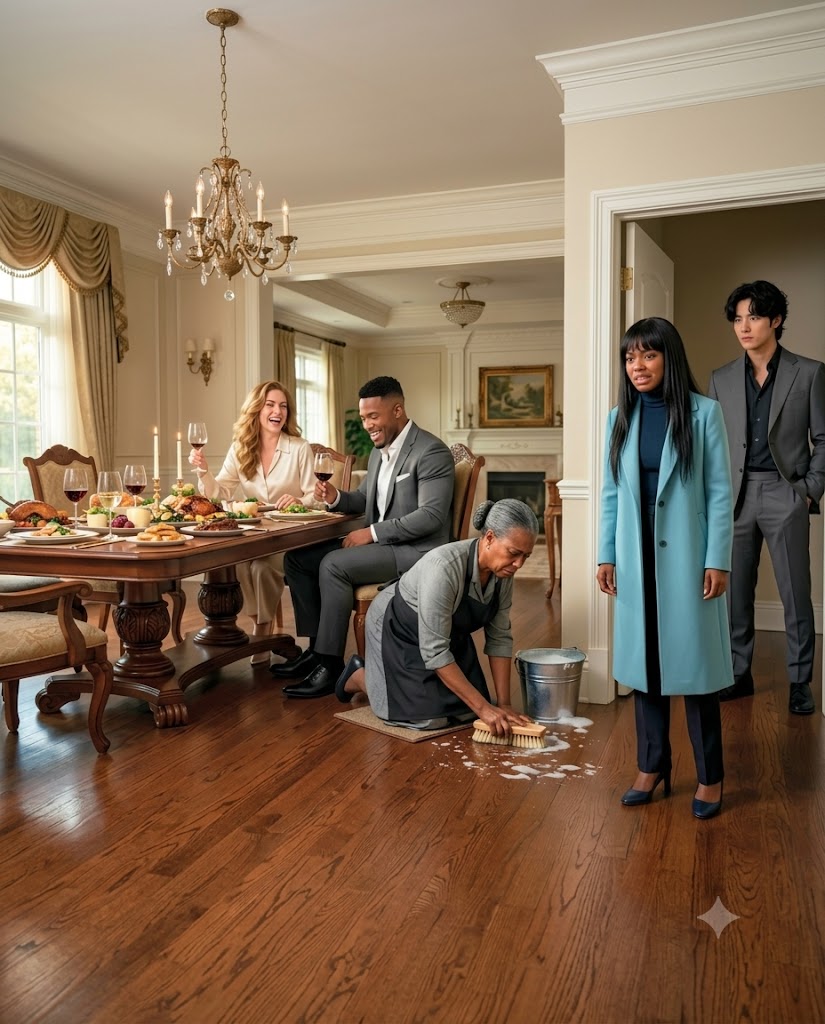
She stood beside the dining table in a black apron while twelve guests lifted crystal glasses and praised the house that her daughter had bought with money earned in flooded apartments and burned-out buildings and airports at three in the morning.
Vanessa Bennett smiled at the head of the table, cream silk catching the candlelight, and said, “She’s been helping with the house since before we moved in.”
Loretta’s thumb twitched beneath the tray, and Vanessa noticed, and Vanessa gave her a look that carried an entire argument without a single sound leaving her throat.
Behind them, a screen displayed a $2.4 million proposal in gold lettering, and at the head of the table sat Kang Do-hyun, thirty-five years old, Korean, impossibly calm, a man who had buried enemies and built empires and learned to eat dinner without showing a single card.
Marcus believed Kang was only an investor.
Vanessa believed one perfect dinner would make him sign.
Neither of them knew he was the head of a Korean syndicate, or that he was Nia Bennett’s fiancé, or that he had come to Chicago to ask Loretta for her blessing before the engagement was announced.
Nia stood behind her mother in the uniform Vanessa had handed her, a gray dress that smelled like someone else’s choices, and she watched the chemical burns around Loretta’s fingers.
Do-hyun saw them too.
His gaze darkened, but he did not move, because he had promised this moment would belong to Nia.
Marcus raised his glass and said, “This home is the foundation of everything we’re building.”
Nia stepped forward and placed the remote beside his hand.
“Before Mr. Kang invests in this house,” she said, “wouldn’t you like to tell him whose name is on the deed?”
No one answered.
A bead of water slid down Do-hyun’s glass.
Loretta’s tray stopped trembling.
The most dangerous person at that table was not the Korean syndicate boss.
It was the woman holding the remote.
—
Eight years earlier, before the black apron and the frozen dining room, Nia Bennett had believed money could solve almost anything.
She was twenty-four when her father died.
Walter Bennett collapsed on a Tuesday morning while carrying groceries up the steps of their rented duplex in South Chicago, and oranges rolled into the street while Loretta shouted his name.
By the time the ambulance reached Mercy Harbor Medical Center, Walter’s heart had stopped twice.
He survived long enough for Loretta to hold his hand and promise that their children would be fine.
They were not.
The hospital bills arrived before the sympathy cards stopped coming.
Loretta spread the envelopes across the kitchen table, and the numbers climbed past anything a seamstress could sew together in a lifetime.
Emergency transport, cardiology, intensive care, medication, final services, and by midnight the total had reached $73,418.26, not including two personal loans Walter had taken for earlier treatment.
Marcus came by after work and stood over the table without sitting down.
He was newly promoted and planning a wedding, and he offered to cover utilities for a few months.
“I have commitments, too, Mom.”
No one accused him.
After he left, Loretta removed her wedding ring and placed it beside the largest bill.
Nia picked it up.
“No.”
“Honey, it’s only a ring.”
“It’s forty-one years.”
“It could pay something.”
“Not enough.”
Nia slid it back onto Loretta’s finger, and then she opened her laptop.
Loretta returned to work twelve days after the funeral, and for almost forty years she had altered wedding dresses, hemmed school uniforms, and repaired winter coats.
Her hands were already stiff with arthritis, and after Walter died she accepted rush orders late at night, and Nia watched her fall asleep at the sewing machine twice in one week.
That was when Nia stopped waiting for life to become fair.
—
Nia was a junior construction cost analyst for an independent consulting firm, and she investigated inflated renovation budgets, false insurance claims, and contractors who billed for materials that never reached a job site.
Difficult assignments paid more, so she volunteered for all of them.
In Florida, she spent fourteen weeks inspecting storm-damaged apartments where mold climbed the walls faster than repairs could begin.
One night she called Loretta from a rental car beneath a flickering gas station light.
“Did you eat?” Loretta asked.
“Yes.”
Nia looked at the vending machine crackers in her lap and lied.
In California, ash settled on her windshield every morning, and she entered burned homes, traced invoices, and discovered a contractor had charged insurers for forty-two roofs that had never been replaced.
In Texas, she slept in an airport after a canceled flight, and at 3:17 a.m. she transferred another payment toward Walter’s debt.
Every assignment ended the same way: a temporary room, a laptop, a transfer home.
First the smallest loans, then the next, then the hospital.
She missed Loretta’s sixtieth birthday at a flooded retirement complex, an aunt’s funeral after a canceled flight, and Marcus’s courthouse wedding because a subcontractor threatened to destroy evidence.
Each time she told herself the same thing.
Absence was the price of rescue.
By the fourth year, Walter’s debt was gone.
Nia sat alone in a hotel room outside Fresno when the final payment cleared, and the air conditioner rattled, and there was no one to celebrate with.
She stared at the zero balance.
Then she opened a new savings account and named it Morning Roses.
When Nia and Marcus were children, Loretta slowed the car whenever they passed homes with wide porches and sunlit gardens.
She never asked for one.
She only said, “Roses need morning light. Afternoon sun makes them tired.”
Nia remembered.
For two more years she saved with the same discipline she had used to kill the debt, renting smaller rooms, driving the same used sedan, turning down vacations.
Then she found 1187 Alder Briar Lane.
Two stories, four bedrooms, a deep porch, an east-facing reading room, and most importantly a backyard with clean morning sun.
The price was $684,730.
Nia paid $238,450 down.
On the day she took Loretta to see it, she pretended they were meeting a realtor for a client inspection.
Loretta stepped onto the porch and ran one hand over the railing.
“This house has been loved,” she said.
Nia gave her an envelope containing a brass key.
Loretta smiled as if it were a joke.
Then she looked at Nia.
“No.”
“Yes.”
“Nia, this is too much.”
“It is exactly enough.”
The letter inside explained that the house was hers to live in for life while the deed remained in Nia’s name until a trust could be finalized.
Loretta pressed the key to her chest and cried into Nia’s shoulder on the porch she had imagined for forty years.
Marcus joined by video call, and he congratulated his mother and said the right things, but when Nia mentioned the down payment, his eyes shifted away.
Loretta noticed.
After that, she told relatives Nia had only helped with part of the purchase, and she did it to protect Marcus from feeling smaller.
Kindness often looks harmless while opening the wrong door.
—
The first thing Loretta did was plant six rose bushes, and she brought them in the trunk before unpacking a single plate.
She named the place Morning Roses House.
For a while it became everything Nia had imagined.
Loretta sent photographs of tea on the porch, and Ruth Coleman visited after church, and Walter’s photograph returned to the mantel, and the east room became a sewing space filled with morning light.
Then Marcus lost his job.
Bennett Services collapsed after its owner was charged with payroll fraud, and Marcus’s position disappeared in a week.
Six weeks later, the bank began foreclosure proceedings on the house he shared with Vanessa.
Nia offered him a private loan, no interest, no deadline.
He refused.
“I don’t need my little sister rescuing me.”
His pride lasted longer than his savings.
Fourteen months before the dinner, Loretta called Nia during an assignment in Alaska.
“Don’t be upset,” she began.
Marcus and Vanessa needed somewhere to stay for six weeks, just until he found work.
The house had four bedrooms, and Loretta was alone.
Nia asked Marcus to join the call.
He appeared ten minutes later sitting in his car.
“Six weeks,” Nia said.
“You help with groceries and utilities. Mom makes every decision. And she doesn’t lift anything heavier than a coffee cup.”
Marcus looked offended.
“I’m her son.”
“Then promise.”
He exhaled.
“Six weeks. I’ll pay utilities, help with groceries, and make sure Mom never lifts anything heavier than a coffee cup.”
Vanessa leaned into the frame.
“We’ll take care of her. You won’t have to worry.”
Three months later, Vanessa’s mother arrived for a weekend.
Donna Price never left.
The changes came quietly.
Loretta stopped attending Wednesday church meetings, and her calls became shorter, and Marcus always seemed to be nearby.
The camera no longer showed the rose garden.
Loretta said the plants had been moved because Vanessa needed better light for design videos.
Nia sent her mother a new phone after the old one began losing calls, and delivery records showed it arrived at 11:42 on a Monday morning.
Loretta said she never received it.
Then Ruth Coleman emailed Nia.
“Your mother keeps saying she is fine. But she looks at the door before answering simple questions.”
Nia read the message three times.
That evening she booked a flight to Chicago without warning anyone.
—
Do-hyun came with her, intending to ask Loretta for her blessing before they announced their engagement, but when their car stopped outside Morning Roses House, Nia asked him to wait.
“I need to see my mother first.”
Do-hyun studied the unfamiliar vehicles in the driveway and an upstairs window closing.
Then he nodded.
Nia walked to the door wearing jeans, a long coat, and a backpack containing the original deed.
Vanessa opened it.
She had met Nia only through old video calls, and that afternoon a temporary server was expected for an investor dinner, and Vanessa saw plain clothes and a travel-worn face and decided who Nia must be without asking her name.
“The maid is in the backyard,” she said. “She’ll tell you what still needs cleaning.”
Nia crossed the threshold of the house she had bought.
From behind the kitchen came the steady scrape of a brush against stone.
She already knew who was holding it.
—
**Part 2**
The sound came from the backyard.
Scrape.
Pause.
Scrape again.
Nia followed it through the kitchen and stopped at the patio door.
Loretta Bennett was kneeling on a thin foam pad scrubbing a pale stain from the stone, wearing a black apron over an old gray dress, and beside her sat a bucket of cloudy water and industrial cleaner strong enough to burn Nia’s eyes from six feet away.
Her mother’s right knee was still healing from surgery.
“Mom.”
Loretta froze, the brush stopping in the middle of a circle, and she turned, and for one second her face filled with joy.
Then her gaze flicked toward the kitchen window.
The joy disappeared behind caution.
“Nia,” she whispered. “You should have called.”
Not because she was angry.
Because she was afraid someone would hear.
Nia crouched beside her, and Loretta’s knuckles were split.
“How long have you been out here?”
“It’s almost finished.”
“That wasn’t my question.”
Loretta reached for the brush again.
“Vanessa wants the patio ready before the investors arrive.”
Nia took it gently from her hand.
“This is your house.”
Loretta looked down at the foam pad.
“That is not how it feels anymore.”
The six rose bushes Nia remembered had been pushed against the western fence where the garage blocked the morning sun, and two had lost nearly all their leaves.
The brightest section of the yard now held a staged dining table and boxes stamped Alder House Living.
Vanessa had moved the roses because they interrupted the brand.
Nia helped her mother stand, and Loretta flinched when she placed weight on her right leg, then straightened quickly.
“Why didn’t you tell me?”
Marcus had lost his job and his house.
“I thought if I kept things peaceful, he would find his feet.”
Loretta rubbed her hands against the apron.
“Vanessa said you were traveling with someone important. She said you were happy. I did not want you canceling contracts because your mother could not manage one house.”
“You are not a burden.”
“I know that when you say it.”
The sentence landed harder than accusation.
“Six weeks became three months, then a year. Every time I decided to call, Marcus said he needed one more month.”
Nia looked at the apron.
“They made you believe asking for help would destroy him.”
Loretta did not answer.
—
Inside, the house looked familiar only in pieces.
Walter’s photograph remained above the mantel, but the furniture had been arranged for cameras, neutral pillows and gold lamps and decorated books no one had read.
A ring light stood in the corner like a second sun.
Vanessa’s logo was printed on the wall.
Alder House Living.
Design your way home.
Marcus and Vanessa occupied the primary bedroom, and Loretta’s old hooks were still visible beside the closet where her wedding photograph had once hung.
Donna had taken the former guest room.
A third bedroom had become Vanessa’s studio, product boxes filling the shelves, and on one wall large photographs showed Vanessa posing in Loretta’s kitchen, bedroom, and garden.
The refrigerator held expensive food for guests.
A plastic container on the bottom shelf held Loretta’s soup, one portion, labeled Lori.
Do not use for content.
In the breakfast room, Loretta’s old wooden chair stood against the wall.
“Why is that there?”
“Vanessa said it looked too worn on camera.”
“Where do you sleep?”
Loretta led her downstairs to a narrow space beside the laundry room.
A folding bed stood between the dryer and a metal rack, and her clothes hung from a portable rail, and Walter’s photograph sat beside bleach and dryer sheets.
No lamp.
No window.
Nia’s breathing changed.
Loretta touched her arm.
“Please don’t shout.”
“I’m not going to shout.”
That frightened Loretta more.
On the refrigerator, Vanessa had taped a weekly schedule.
Monday, laundry and breakfast preparation.
Tuesday, guest bathrooms.
Wednesday, kitchen floors and filming support.
Thursday, linens.
Friday, deep clean before content day.
Loretta’s name appeared beside every task.
Nia photographed the schedule, the folding bed, the medication cabinet, and the damaged rose bushes.
She did not open private drawers or take anything she had no right to possess.
She did not need to.
Vanessa had published half the evidence herself.
Alder House Living had 186,000 followers.
In one video, Vanessa stood in Loretta’s kitchen and said, “Marcus and I rebuilt this home from the foundation up.”
In another, Loretta crossed the background carrying towels.
“That’s Miss Lori, our long-time housekeeper. She keeps everything beautiful.”
The clip had 431,700 views.
Nia let it continue past the polished ending.
The camera remained on for three extra seconds.
Vanessa’s smile vanished.
“Take it again,” she said off camera, “and don’t look at the lens this time.”
Loretta lowered her face.
The video cut.
Sponsors had paid Vanessa to sell products inside a house she did not own.
Loretta looked away.
“She said people would not understand if they knew I was Marcus’s mother.”
“They understood exactly what she wanted them to understand.”
—
The front door opened.
Marcus entered carrying two garment bags, and he stopped when he saw Nia, then recovered.
“Look who finally came home.”
He hugged her before she could decide whether she wanted him to, and for half a second she remembered the brother who once waited outside her school when she was bullied.
Marcus asked about her work and whether she was still traveling too much.
Then he explained everything.
The bed was temporary.
The schedule was physical therapy.
The locked medicine was a safety measure.
“You’re seeing one bad afternoon,” he said. “I’ve been here every day. I’m the one taking her to appointments. You send money. I’m the one who stayed.”
Marcus softened his voice.
“You could invest in Bennett Renewal yourself. Keep it in the family.”
“What exactly am I investing in?”
“The model. The brand. This house proves it works.”
Vanessa appeared at the stairs, recognition crossing her face, followed by calculation.
“Oh,” she said. “Nia.”
No apology followed.
The server canceled anyway.
“Since you’re here, you could help tonight.”
Marcus frowned.
“Vanessa.”
“What? Family helps family.”
Nia asked who was coming.
Marcus brightened.
“Kang Do-hyun. Han-Yul Meridian Holdings.”
He wanted $2.4 million to expand Bennett Renewal Group.
The house, Marcus explained, was the company’s proof of concept.
Nia glanced at Loretta.
Her mother’s hand closed around the apron.
—
Later, while Marcus and Vanessa argued upstairs, Loretta opened the bottom drawer of her sewing cabinet.
Inside were bank statements, receipts, and printed emails.
Over thirteen months, $8,450 had been transferred to Marcus under descriptions such as groceries, transportation, and home care.
Then another $4,286.73 had been charged to Loretta’s store card for restaurants, spa services, clothing, and camera equipment.
There was also an application for a $92,000 credit line using 1187 Alder Briar Lane as collateral.
Loretta’s electronic signature appeared at the bottom.
“I never agreed to borrow this.”
“Do you remember signing anything?”
“Marcus brought papers after my surgery. He said they were for insurance.”
The renovation schedule included $7,600 in upgrades.
Nia found the problems within minutes.
Duplicate invoice numbers.
Two contractors without active registrations.
A supplier address matching Vanessa’s private mailbox.
Photographs labeled before showed a staircase the house had never possessed.
The actual work could not have cost more than $8,931.40.
This was not bad bookkeeping.
It was a constructed story.
Loretta removed a small notebook wrapped in floral fabric.
“They kept saying I was confused,” she said. “So I wrote everything down.”
She opened to a marked page.
March 3rd.
Marcus said the document was for insurance. I had taken two pain tablets. Vanessa held the tablet where I could not read the top.
Another page.
April 18th.
They moved my bed after midnight. Marcus said it would only be until Donna’s back improved.
Then another.
June 21st.
Vanessa filmed me carrying tea. She told the audience I was the housekeeper.
Dates, amounts, witnesses.
The day Marcus took the debit card, the morning the new phone arrived and disappeared, the nights Loretta signed papers after medication.
Her mother had not been waiting helplessly.
She had been building a record.
Then a folded brochure slipped from Loretta’s Bible.
Hawthorn Glenn Seniors Residence.
Loretta had completed the application.
“They allow two flower pots,” she said quietly.
Through the window, six rose bushes stood in shadow.
Nia closed the brochure.
“Do you want me to take you away, or do you want to take your home back?”
Loretta was silent for a long time.
Then she removed the black apron.
“I want to sit at my own table tonight,” she said. “And I want them to use my name.”
Nia nodded.
She had her mother’s evidence.
What she did not yet have was proof that Marcus knew exactly whose house he was trying to sell.
That proof was waiting inside a document edited at 2:17 in the morning.
—
**Part 3**
At 1:18 that afternoon, Loretta Bennett sat inside a private office at Hawthorn Community Bank with both hands folded over the floral notebook.
Nia sat beside her.
Across the desk, fraud specialist Elaine Morris reviewed thirteen months of transactions without speaking to Loretta as if age had made her less capable.
She asked direct questions.
Did Loretta authorize the $8,450 transferred to Marcus?
“Some of it,” Loretta said. “Not all.”
Did she recognize the spa charges?
“No.”
Had she applied for the $92,000 credit line?
Loretta’s back straightened.
“Absolutely not.”
Each answer was recorded in her own words.
When Elaine reached the March 3 transfer, Loretta hesitated.
She remembered being tired.
She remembered Marcus saying the document related to insurance.
She did not remember approving a cash withdrawal.
Embarrassment crossed her face.
“I should have read it more carefully.”
Nia opened her mouth, then stopped.
This was Loretta’s account.
Her voice had to return one answer at a time.
Elaine leaned forward.
“Mrs. Bennett, confusion after surgery does not give another person permission to decide for you. Not remembering one transaction does not make you unreliable. It is why we verify.”
Loretta nodded.
The bank canceled the compromised card, opened a new account, changed every access code, and removed Marcus as an authorized contact.
Loretta’s retirement deposits would move into the protected account.
A fraud alert was placed on her profile, and the bank agreed to preserve transaction records, call logs, electronic signature data, and branch footage.
Elaine offered to add Nia as the primary contact.
“Emergency contact,” Loretta said, “not owner, not controller.”
Elaine made the change.
When she asked whether Loretta wanted Nia to speak for her, Loretta answered without looking at her daughter.
“My daughter can sit with me. I will answer for myself.”
—
By 2:36, they were in the office of Angela Brooks.
Angela was fifty-seven, silver-haired, and precise.
Her practice focused on elder law, trusts, and financial exploitation inside families.
She read the notebook, the bank documents, the unsigned trust papers in Nia’s backpack, and the photographs from the house.
“The property is legally yours,” she told Nia, “but ownership does not erase residency.”
Angela explained that Marcus, Vanessa, and Donna had established occupancy.
“You cannot throw their possessions outside tonight, shut off utilities, or change the locks while they still reside there.”
“What if they refuse to leave?” Nia asked.
“Then we give proper notice and use the court.”
Loretta looked toward the photographs.
“They moved me beside the washing machine.”
“I know,” Angela said. “But legal protection becomes weaker if your family creates another violation while trying to fix the first.”
She also explained the difference between preserving evidence and declaring someone guilty before an investigation.
“They could dispute the transactions and notify the bank, but not turn suspicion into a criminal verdict at dinner.”
“Accuracy protects you,” Angela said. “Anger does not.”
Nia nodded.
“What can we do today?”
Angela turned to Loretta.
“What do you want?”
Loretta looked at the documents.
“I want the house protected. I want my accounts protected, and I want them out without anyone getting hurt.”
Angela began building exactly that.
The old medical power of attorney was revoked.
A new one named Nia and Ruth Coleman with Loretta retaining authority unless two independent physicians declared otherwise.
The lifetime residence trust was completed, ensuring Loretta could remain in the house for as long as she chose.
Angela explained every clause before Loretta signed.
Could Marcus borrow against the house?
No.
Could Loretta be removed by a future spouse, creditor, or relative?
No.
Did the trust give Nia control over Loretta’s choices?
Also no.
The first signature was careful.
The last was firm.
Angela prepared two paths.
The first was voluntary settlement, repayment, surrender of access, removal by an agreed date, and no further use of Loretta’s image.
The second was litigation, occupancy civil claims, and referral of suspected financial exploitation.
“No threats,” Angela said. “No shortcuts. Their choices create the consequences.”
—
At 4:07, Nia stepped into the hallway and found Do-hyun near the elevators.
He had removed his tie, and Min-jae stood several feet behind him with a thin black folder.
Nia saw it first.
“What is that?”
Do-hyun did not answer quickly enough.
“You investigated Marcus?”
“I reviewed the risk connected to the investment proposal.”
“That is not what I asked.”
The hallway became quiet.
Do-hyun glanced toward Min-jae.
The younger man moved away.
“I needed to know whether your family was in danger,” Do-hyun said.
“My family was not yours to investigate, Nia.”
“You promised me.”
He did not deny it.
Eighteen months earlier, Nia had made one boundary clear.
Protect me if danger reaches me.
Do not enter my family’s life without permission.
“When I was twenty-three,” Do-hyun said, “my uncle asked me not to investigate a threat against his son. I waited. Forty-eight hours later, the boy was dead.”
Nia understood the wound.
She refused to live inside it.
“I am sorry,” she said, “but your fear does not get to become my cage.”
“In my world, waiting for permission can get someone killed.”
“This is not your world. That house is being used in a fraudulent investment proposal. Your mother’s name is attached to a loan she did not authorize. And you still do not get to decide that control becomes acceptable because you call it protection.”
For several seconds, Do-hyun said nothing.
Then he took out his phone.
“Min-jae.”
The younger man returned.
“Delete every inquiry outside public records and the materials Marcus submitted voluntarily. Destroy the summaries and backups.”
“Yes, sir.”
“Do it now.”
Min-jae opened the secure application and began the deletion in front of them.
Do-hyun handed Nia the folder.
“I was wrong.”
The admission sounded unfamiliar but sincere.
“I will stand beside you, not in front of you.”
Nia did not forgive him immediately.
She accepted the folder but not his hand.
Inside were only the materials Marcus had submitted to Han-Yul Meridian.
The original draft identified the house correctly.
Property owned by Nia Bennett.
Residence granted to Loretta Bennett.
The final draft said, “Family-controlled residential asset available as collateral upon investment approval.”
Nia turned to the metadata report.
The change had been made three days earlier.
2:17 a.m.
Edited by Marcus Bennett.
He had also removed Nia’s name from the ownership appendix and replaced the title report with an evaluation summary that did not identify the legal owner.
Vanessa had created false invoices.
Marcus had made them investable.
He knew.
Nia closed the folder.
“Will you still attend dinner?”
“I will, but you will not speak until it is your part of the presentation.”
“You are giving a Korean syndicate’s boss instructions at a family dinner.”
“I am giving my fiancé instructions in my mother’s house.”
That ended the discussion.
—
At 6:52, Nia and Loretta returned to Alder Briar Lane.
Ruth arrived through the side entrance carrying a garment bag.
Inside was a dark blue dress Loretta had worn to a church anniversary dinner.
In the laundry room mirror, Ruth helped fasten the pearl buttons.
Loretta studied her reflection.
For months, Vanessa had chosen gray dresses and black aprons for filming days.
The woman in the mirror wore her own color again.
“I look tired,” Loretta said.
“You look present,” Ruth answered.
Loretta touched the collar, then straightened it herself.
Vanessa intercepted them near the stairs.
“What is she wearing?”
“Her own clothes,” Nia said.
Vanessa held out the black apron.
“The investors are expecting staff.”
Loretta looked at the apron, then at Vanessa.
“Tonight?” she said. “I will wear my own clothes.”
—
At 8:41, headlights crossed the front windows.
A black sedan stopped at the curb.
Only Do-hyun and Min-jae stepped out.
No crowd of guards, no visible weapons.
Vanessa opened the door with a practiced smile.
“Mr. Kang, welcome to our home.”
Do-hyun entered.
His eyes found Loretta immediately.
He walked past Marcus and Vanessa’s extended hand, then stopped before Loretta and bowed deeply.
“Mrs. Bennett,” he said, “thank you for allowing me into your home.”
Vanessa’s hand remained suspended in the air.
For the first time that evening, someone had named the house correctly.
—
**Part 4**
Marcus believed the presentation would push ahead and restore everything he had lost.
He had no idea that every slide was about to become evidence.
At 8:53 p.m., Marcus Bennett dimmed the lights.
The living room became a showroom.
Alder House Living glowed across the screen in gold lettering.
Beneath it: From One Home to a National Brand.
Twelve guests sat around the extended dining table.
Ruth Coleman sat beside Loretta, her hands folded calmly in her lap.
Marcus stood near the television in a charcoal suit holding a wireless clicker.
Vanessa sat beside him in cream silk, smiling toward Kang Do-hyun as though the agreement had already been signed.
Loretta sat at the far end of the table.
Nia stood behind her chair.
No apron.
No tray.
Marcus began with the vision.
Bennett Renewal Group would purchase neglected homes in Chicago, Indianapolis, and Milwaukee.
Marcus would oversee construction.
Vanessa would turn each property into content through Alder House Living.
The company would sell renovated homes while earning advertising income from the process.
Twenty-eight properties in eighteen months.
Projected return: seventeen percent.
Requested investment: $2.4 million.
The money would fund acquisitions, construction, staff, marketing, and reserves.
Then came the house.
A photograph of 1187 Alder Briar Lane filled the wall.
“Our first transformation,” Marcus said. “The property that proved Vanessa’s design concept and my construction model could work together.”
He clicked again.
The next slide showed alleged before and after images.
Vanessa leaned toward the guests.
“When we arrived, the home was outdated and emotionally empty. We rebuilt it as a family.”
One of the brokers raised his hand.
“Who holds title?”
Marcus smiled.
“The property is controlled by the family and available to support the expansion structure.”
It was not an answer, but it sounded enough like one.
Ruth looked at Loretta.
Loretta’s fingers tightened around her napkin, then slowly relaxed.
Do-hyun noticed.
He said nothing.
Marcus continued through a renovation budget claiming $147,600 in improvements, structural reinforcement, flooring, kitchen restoration, lighting, exterior work, and landscaping.
A guest smiled toward Loretta.
“You keep the place beautifully.”
Vanessa answered for her.
“She does. Miss Lori is very particular.”
Another guest asked, “How long has she worked for your family?”
Vanessa did not hesitate.
“Long enough to feel like family.”
Donna Price added, “Keeping her active gives her purpose. Older people decline when they stop feeling useful.”
Vanessa gestured toward the tea service.
“Miss Lori, would you pour for Mr. Kang?”
Loretta looked at the teapot, then at Nia, then at Ruth.
Ruth gave the smallest nod.
Loretta placed both hands flat on the table and rose.
Her chair moved half an inch against the floor.
Everyone heard it.
“My name is Loretta Bennett,” she said.
The screen behind Marcus still showed a photograph of her house.
“I am not the help. I am the woman this home was bought for.”
Marcus lowered the clicker.
“Mom, sit down.”
Loretta remained standing.
A single drop of tea slipped from the spout and darkened the white tablecloth.
No one reached for it.
“This is not the time,” Marcus said through his teeth.
“No,” Loretta replied. “This is the first time.”
Nia stepped forward.
She took the clicker from Marcus.
Then she placed it back in his palm.
“Finish your presentation.”
Marcus stared at her.
“What?”
“You invited an investor. You built the numbers. Finish.”
He looked toward Do-hyun.
Do-hyun’s expression gave him nothing.
Marcus resumed less steadily.
He described Alder Briar Lane as the company’s prototype and said it could support the initial financing package.
Then came the slide titled Collateral Strategy.
The house was listed as a family-controlled residential asset.
Marcus read the phrase aloud.
Nia waited until he spoke every word.
Then she held out her hand.
This time, Marcus gave her the clicker.
—
The screen changed.
Forensic Construction Review, prepared by Nia Bennett, Certified Forensic Construction Auditor.
The first page showed the property record owner: Nia Renee Bennett.
Purchase price: $684,730.
Down payment: $238,450.
Mortgage payer: Nia Bennett.
Property tax payer: Nia Bennett.
Insurance policy holder: Nia Bennett.
Marcus gave a strained laugh.
“Nia’s name is on the deed for convenience. The house was always intended for the family.”
Nia advanced the slide.
Mortgage records appeared, followed by tax payments, insurance renewals, and the down payment transfer.
“My name is not on it for convenience,” Nia said. “I purchased it.”
Vanessa leaned forward.
“But we increased the value. Without our work, this place would not be worth what it is now.”
Nia clicked again.
Claimed renovation cost: $147,600.
Verified renovation cost: $8,931.40.
Two false contractor invoices appeared.
Two registration numbers were invalid.
One supplier address matched Vanessa’s private mailbox.
Three invoices reused the same sequence.
A lighting company listed on the documents had dissolved twenty-two months earlier.
Vanessa shook her head.
“Those files came from Marcus’s construction contacts.”
Marcus turned sharply.
“You assembled the invoices.”
“Because you told me which totals we needed.”
Nia advanced the slide.
The alleged before photograph showed a staircase with eleven risers.
Alder Briar Lane had thirteen.
The windows were wrong.
The fireplace was on the opposite wall.
“The image came from a property listing in St. Joliet,” Nia said. “Sold four years ago.”
Marcus stepped toward the screen.
“There are accounting errors. We had a bookkeeper helping with the draft.”
Nia clicked again.
The original investment document appeared.
Property owned by Nia Bennett.
Residence granted to Loretta Bennett.
Beside it was the final version.
Family-controlled residential asset available as collateral upon investment approval.
At the bottom: Edited by Marcus Bennett, 2:17 a.m., three days earlier.
The room froze.
Marcus looked at Vanessa.
Vanessa looked back.
Nia said nothing.
Marcus had rewritten the truths.
Do-hyun spoke for the first time since the presentation began.
“If this property belonged to the family,” he asked, “why did you remove your sister’s name at 2:17 in the morning?”
Marcus had no answer.
“That was preliminary language,” he said finally. “We were going to correct it before closing.”
“You removed my name from the ownership appendix,” Nia replied. “You replaced the title report with an evaluation summary. Then you sent it to an investor.”
Marcus turned toward Do-hyun.
“This is a family dispute.”
“No,” Do-hyun said. “You submitted it as a business fact.”
—
Nia changed the screen.
A secure video call opened.
Angela Brooks appeared to confirm the completed legal documents.
Nia owned the property.
Loretta held a legally protected lifetime right of residence.
The house could not be sold, pledged, refinanced, or used as collateral by Marcus, Vanessa, Donna, or anyone acting through them.
The previous medical authorization had been revoked.
Any future transaction involving Loretta required direct, independently verified consent.
Vanessa folded her arms.
“This is humiliating.”
Loretta looked at her.
“No. Humiliation was sleeping beside the washing machine while you filmed yourself in my bedroom.”
Then she placed the floral notebook on the table.
Loretta opened to the first marked page.
January 9th.
“Marcus asked for my debit card to buy groceries. He did not return it.”
Marcus looked down.
March 3rd.
“Marcus said the document was for insurance. I had taken two pain tablets. Vanessa held the tablet where I could not read the top of the page.”
Vanessa shifted in her chair.
April 18th.
“They moved my bed after midnight. Marcus said it would be for one week.”
Loretta turned another page.
June 21st.
“Vanessa filmed me carrying tea. She told the audience I was the housekeeper. When I looked at the camera, she made me repeat it.”
The guest who had praised her lowered her eyes.
Loretta closed the notebook.
“I wrote it down because you kept telling me it didn’t happen.”
Marcus looked down.
Donna stared at the table.
Vanessa whispered, “You were living here for free.”
Loretta turned toward her.
“My daughter paid for this house. You did not give me shelter.”
Min-jae placed a black folder before Do-hyun.
Do-hyun opened it slowly.
“Han-Yul Meridian declines the $2.4 million investment.”
Marcus’s face tightened.
“Based on a family argument?”
“Based on false collateral, inflated construction costs, misrepresented brand revenue, unverified signatures, and the deliberate removal of the legal owner’s name.”
Do-hyun closed the folder.
“In the world I inherited, men stole with weapons. You attempted it with documents. The method changes. The theft does not.”
Vanessa looked at Nia.
“Why does he care so much about you?”
Do-hyun stood and walked to Nia’s side.
“I came here as an investor because Mr. Bennett invited me,” he said. “I came to Chicago as Nia’s fiancé because I intended to ask Mrs. Bennett for her blessing.”
Vanessa finally understood why the man she had tried to impress had bowed to Loretta.
—
Nia placed two documents on the table.
“The first is a voluntary settlement. Repayment of $12,736.73. No further access to Loretta’s accounts, medical records, or identity. Removal from the house within the lawful agreed period. Deletion of all content using Loretta’s image. A public correction stating that the property did not belong to Marcus or Vanessa.”
“The second,” Nia continued, “is formal notice of termination of occupancy, followed by civil action and referral of the financial records.”
Marcus turned on Vanessa.
“You pushed the brand. You made the invoices.”
Vanessa laughed without humor.
“You edited the ownership file. You said the house would be ours eventually. And you believed that because it was easier than asking your sister. You held the tablet when Mom signed. You kept her medication locked. You moved her bed. You told me we needed the room for content.”
Their voices rose, confirming what neither wanted to carry alone.
Then Loretta lifted one hand.
Both stopped.
“You did not lose this family tonight,” she said. “You traded it away one small lie at a time.”
—
**Part 5**
At 10:17 p.m., Loretta went upstairs.
She returned carrying Walter’s photograph, her medication, the floral notebook, and one small rose plant in a clay pot.
She did not ask permission.
Nia carried her bag.
Do-hyun opened the front door.
Marcus stood as if he might follow.
Loretta looked at him once.
“Not tonight.”
He stopped.
She stepped outside under her own name.
Behind her, untouched food cooled beneath the projection of Marcus’s 2:17 a.m. edit.
They were not removed from the house that night, but the moment Loretta crossed that threshold, they lost the one thing they had mistaken for ownership.
Control.
—
Twelve days later, the conference room at Brooks Elder Law held no flowers, cameras, or presentation screens.
Marcus sat at one end of the table.
Vanessa sat beside him, although the space between their chairs looked wider than the room.
Across from them were Nia, Loretta, Angela Brooks, and a bank representative.
Do-hyun waited near the window.
He had no speaking role, and he accepted that.
Angela reviewed the agreement one section at a time.
Marcus and Vanessa would leave Alder Briar Lane by August 31.
They would surrender every key, garage remote, access code, and document connected to the property.
They would repay $12,736.73 at a minimum rate of $275 each month.
The $92,000 credit line application would be withdrawn.
Alder House Living would remove every video identifying Loretta as a housekeeper.
Vanessa would publish a correction confirming the home belonged to Nia and was intended for Loretta’s lifetime use.
Donna would move in with her older daughter in Peoria.
If the settlement was violated, Nia could proceed with civil claims and formal termination of occupancy.
Angela turned the agreement toward Loretta.
“Do you understand each condition?”
“Yes.”
“Are you accepting this because anyone pressured you?”
“No.”
“Do you want criminal charges filed today?”
Loretta looked at Marcus.
His eyes were red, but she did not confuse tears with change.
“Not today,” she said. “Preserve the evidence. If they break this agreement, we continue.”
Loretta signed.
So did Nia.
Marcus hesitated before signing.
Vanessa hesitated longer.
Eventually, both pens touched paper.
The house was returned lawfully, not dramatically.
No belongings were thrown outside.
No midnight eviction was disguised as justice.
—
On August 31, Angela supervised the final inspection.
The rooms were half empty by noon.
Boxes lined the hallway.
Pale rectangles marked the walls.
Marcus carried the last box from the garage at 4:26 p.m.
He stopped near the rose garden.
For fourteen months, he had walked past those plants without asking why they were dying.
Now he seemed to see them.
“I’m sorry,” he said.
Loretta held out her hand.
Marcus looked confused.
“The key.”
He removed the brass key from his ring.
For a moment, he held it between his fingers as though it represented more than entry to a house.
Then he placed it in his mother’s palm.
The metal made a soft sound against her wedding ring.
“Be different longer than you were sorry.”
Marcus nodded.
He left without asking for forgiveness.
—
Vanessa’s fall was faster.
Within six weeks, three sponsors terminated contracts with Alder House Living.
Two requested partial repayment.
Her most viewed videos disappeared, along with the story she had built around a house that was never hers.
She moved into a one-bedroom apartment near Cicero.
The rent was $1,487 a month.
Vanessa again lived inside walls owned by someone else.
She could no longer call renting humiliation while treating another woman’s home as ambition.
She and Marcus separated before Thanksgiving.
During mediation, Vanessa admitted that every staged room had made her feel farther from the twelve-year-old girl who once watched her family’s mattress being placed on a curb.
Angela said, “You tried to protect that child by becoming the landlord she feared.”
Vanessa did not answer.
—
Marcus took night work at a building material distribution center.
The job was physical and honest.
His first repayment arrived four days late.
He called Angela before anyone contacted him.
“My overtime was delayed. The payment will clear Friday.”
It did.
The second payment arrived on time.
So did the third.
He also began therapy.
He had spent years telling himself that Nia wrote checks while he showed up.
Now he faced what he had done while present.
Three months after leaving, he mailed Loretta a seven-page letter.
She placed it unopened in the desk drawer beside her sewing scissors.
Nia asked whether she planned to read it.
“When his actions become longer than that letter,” Loretta said, “I’ll open it.”
—
After the final move out, the locks were changed legally.
Old access codes were erased.
New cameras were installed only after Loretta approved their locations.
She refused one near the kitchen.
“I will not feel watched while making tea.”
The folding bed beside the laundry room was removed.
Donna’s former room became a reading room.
Vanessa’s studio was cleared of ring lights and product boxes.
Loretta walked through the house slowly.
She switched on the lamp in the primary bedroom, opened the curtains, and returned Walter’s photograph to the dresser.
In the bathroom, she placed her medication inside a cabinet she chose herself.
No lock.
No one else held the key.
Then she went downstairs and stood in the laundry room.
The machines were still there, but the folding bed was gone.
For several seconds, Loretta listened to the dryer turn.
Then she closed the door.
She returned to the primary bedroom.
At the doorway, she stopped.
Her hand rested on the bed frame as if she were waiting for someone to say she could sit.
Then she sat down.
No one gave permission.
No one needed to.
Loretta tore the Hawthorn Glenn application into narrow strips and placed them in the garden compost.
“They only allowed two flower pots,” she reminded Nia.
Together, they carried the six rose bushes back into the morning sun.
—
Do-hyun came without staff.
He removed his jacket, rolled up his sleeves, and took a shovel from the shed.
He had commanded rooms full of dangerous men.
He did not know how to move a rose bush.
He cut too close to one root.
Loretta tapped his shovel with hers.
“Not there.”
He adjusted his grip.
“You cannot force a damaged thing to recover faster,” she said.
Do-hyun looked toward Nia.
“I am beginning to understand that.”
He could have hired gardeners.
Instead, he stayed until soil worked beneath his fingernails.
Nia watched Loretta show him how to loosen the roots without tearing them.
No speech passed between them.
Respect did.
—
Nia did not leave her career.
She changed how she lived inside it.
Her schedule became eight weeks on assignment followed by four weeks in Chicago.
She stopped accepting consecutive long-distance contracts.
On Sundays, she called Loretta privately and asked different questions.
Not, “Did the mortgage clear?”
Not, “Do you need money?”
She asked, “How did you feel this week?”
At first, Loretta did not know how to answer.
Then she learned.
—
Do-hyun changed more slowly.
He established a review process inside Han-Yul Meridian for transactions involving elderly owners, family assets, and powers of attorney.
Independent verification became mandatory before residential property could be accepted as collateral.
He continued moving the Kang organization away from illegal systems.
Some older members accused him of weakening the family.
Do-hyun answered that an empire dependent on fear was already weak.
He did not become a different man overnight, but he stopped investigating Nia’s family without permission.
For him, that was a surrender of instinct.
—
Six months after the dinner, Do-hyun returned to Alder Briar Lane alone.
No convoy, no security team.
He carried rice cakes made by his mother and a ring inside his coat.
Loretta was pruning roses when he approached.
He bowed.
“Mrs. Bennett, may I become part of this family?”
Loretta rested both hands on the pruning shears.
Do-hyun continued before she answered.
“I protected Nia badly once. I believed love gave me permission to control the ground beneath her feet. It does not. I am learning how to walk beside her.”
Loretta looked past him toward Nia, who stood near the porch.
She did not answer for her daughter.
She made sure the choice remained where it belonged.
“I do not give my daughter to anyone,” Loretta said. “She is not property.”
Do-hyun lowered his head.
“But if you understand how to walk beside her, this door will remain open to you.”
Only then did Do-hyun turn to Nia.
He knelt because humility had finally become more important than image.
Nia said yes.
—
The following June, the first rose opened.
Loretta cut it and placed it in a glass vase at the center of the dining table.
She sat at the head.
Nia took the chair to her left.
Do-hyun sat to her right.
There was no apron in the room.
No one stood behind them.
Through the window, the roses that had nearly died in shadow were opening beneath the morning sun.
A house does not belong to the person who speaks the loudest inside it.
It belongs to the place where human dignity is allowed to live.
—
**Extended Epilogue: The Weight of Numbers**
Six months after the settlement, Angela Brooks sent Nia a single-page summary.
Marcus had made six payments of $275, each one arriving within the grace period.
Vanessa had made two.
The remaining balance stood at $10,586.73.
Nia printed the page and placed it in the floral notebook, not as proof of victory, but as a reminder that recovery moves slower than betrayal.
Loretta found it there one afternoon while looking for a spool of blue thread.
She read the numbers without expression.
Then she closed the notebook and returned it to the drawer.
—
Ruth Coleman came by every Wednesday after church, the same as before, but now she parked in the driveway instead of the street.
She brought lemon cake and gossip and a folding chair for the porch.
One afternoon she asked Loretta the question everyone else avoided.
“Do you miss him?”
Loretta watched the roses for a long time.
“I miss the boy who waited outside Nia’s school,” she said. “I do not miss the man who moved my bed.”
Ruth nodded and poured more tea.
—
The correction video went live on a Tuesday.
Vanessa filmed it in her one-bedroom apartment near Cicero, sitting on a secondhand couch with a blank wall behind her.
No ring light.
No gold lettering.
No brand.
She read from a printed statement for two minutes and seventeen seconds.
“The home featured in Alder House Living content at 1187 Alder Briar Lane is owned by Nia Bennett and was purchased for the lifetime residence of Loretta Bennett. Loretta Bennett was never a housekeeper. She is the mother of Marcus Bennett and Nia Bennett. I apologize for any misrepresentation.”
The video received 12,400 views in the first week.
The comments were not kind.
Vanessa turned off comments after three days.
She did not post again for four months.
—
Donna Price moved to Peoria and lived with her older daughter in a two-bedroom apartment above a garage.
She called Vanessa twice a week.
Vanessa answered maybe once.
During one call, Donna said, “I didn’t know it would go this far.”
Vanessa laughed, but there was no humor in it.
“You held the tablet, Mom.”
Donna was silent.
“I held the tablet because you asked me to.”
“And I asked because you never told me no.”
—
Marcus’s therapist suggested he write the letter again, not to send, but to understand.
He wrote nine pages this time.
On page four, he admitted something he had never said aloud.
He had known the house was Nia’s.
He had known from the beginning.
He had told himself it didn’t matter because Nia was never there, because Nia chose work over family, because Nia sent money instead of showing up.
He had told himself that presence was a form of ownership.
He had told himself that Loretta needed him more than she needed a deed.
On page seven, he wrote: “I made her into a tenant in her own life.”
He did not send the letter.
He placed it in a drawer and went to work.
—
Nia returned to Chicago for Thanksgiving.
She cooked in Loretta’s kitchen, using Loretta’s pots, following Loretta’s instructions.
Do-hyun arrived with a bottle of wine and a box of pastries from a Korean bakery in Albany Park.
Ruth came with her granddaughter.
The table held five chairs.
No one stood behind anyone.
After dinner, Nia found her mother in the east room, sitting at the sewing machine with a piece of blue fabric in her lap.
“Are you working on something?”
“Just mending.”
Nia sat on the floor beside her.
“Mom.”
“Yes.”
“I’m sorry I wasn’t here.”
Loretta’s hands stopped moving.
“You were here when it mattered.”
“I should have been here before.”
Loretta set down the fabric.
“You were building the thing that saved me,” she said. “I will not let you apologize for that.”
Nia leaned her head against her mother’s knee.
They stayed like that until the light changed.
—
Three days before Christmas, Marcus called.
Loretta answered on the fourth ring.
“Hello.”
“Hi, Mom.”
Silence.
“I wanted to ask if I could come by. Just for an hour. I won’t stay.”
Loretta looked at the drawer where the letter sat unopened.
“Not yet.”
“I understand.”
“Do you?”
Marcus paused.
“No. But I’m trying to.”
“That’s something.”
She hung up.
Then she went to the kitchen and made tea.
—
Vanessa took a job at a home staging company in Oak Park.
She arranged furniture in empty houses for photographers and realtors, and she was good at it, and she hated it.
One afternoon she staged a four-bedroom colonial with a deep porch and an east-facing kitchen.
She stood in the backyard and looked at the rose bushes along the fence.
She thought about the six rose bushes she had ordered moved because they interrupted her brand.
She thought about Loretta kneeling on the foam pad with the brush.
She thought about the moment she had said, “Miss Lori, would you pour for Mr. Kang?”
She sat down on the back steps and cried for eleven minutes.
Then she wiped her face and finished staging the house.
—
Do-hyun’s mother flew in from Seoul for the wedding.
She stayed at the Peninsula and wore a hanbok to the ceremony.
Loretta wore the dark blue dress.
Nia wore ivory.
The ceremony was small, thirty people, held in the backyard under a white tent.
The roses were in full bloom.
During the toast, Ruth raised her glass and said, “To the woman who bought the house, and the woman who made it a home.”
Everyone drank.
Loretta did not cry.
She smiled.
—
Six months after the wedding, Marcus made his twelfth payment.
He had not missed one.
He mailed a second letter, shorter this time, three pages.
Loretta placed it in the drawer beside the first.
She did not open it.
Not yet.
—
The following spring, Nia received a call from a producer at a national news program.
They wanted to do a segment on elder financial exploitation.
They had found the public court records.
They had found the correction video.
They wanted to interview Loretta.
Nia asked her mother first.
Loretta thought about it for two days.
Then she said yes.
The interview aired on a Thursday evening.
Loretta sat in a chair in her own living room and answered every question in her own voice.
The producer asked, “What would you tell other families?”
Loretta folded her hands.
“Check more than the bank balance,” she said. “Check who has access. Check who answers the phone. And check whether your mother still speaks in her own voice.”
The segment was four minutes and twelve seconds long.
It received 2.1 million views.
—
That summer, Angela Brooks sent Nia another summary.
The balance was $7,436.73.
Vanessa had made four more payments.
Marcus had made twelve.
Nia filed the page in the notebook.
She walked outside and found Loretta in the garden.
“The roses are doing well,” Nia said.
“They need morning light,” Loretta said.
“I know.”
They stood together in the sun.
—
A house does not belong to the person who speaks the loudest inside it.
It belongs to the place where human dignity is allowed to live.
Loretta Bennett sat at the head of her own table, and no one stood behind her, and no one called her the help, and the roses opened every morning because she had finally been allowed to plant them where the light could reach.
**[END]**









