Her Billionaire Mother-in-Law Offered Her $1 Million to Leave on Christmas Eve—But Someone Else Paid the Price
## Part 1
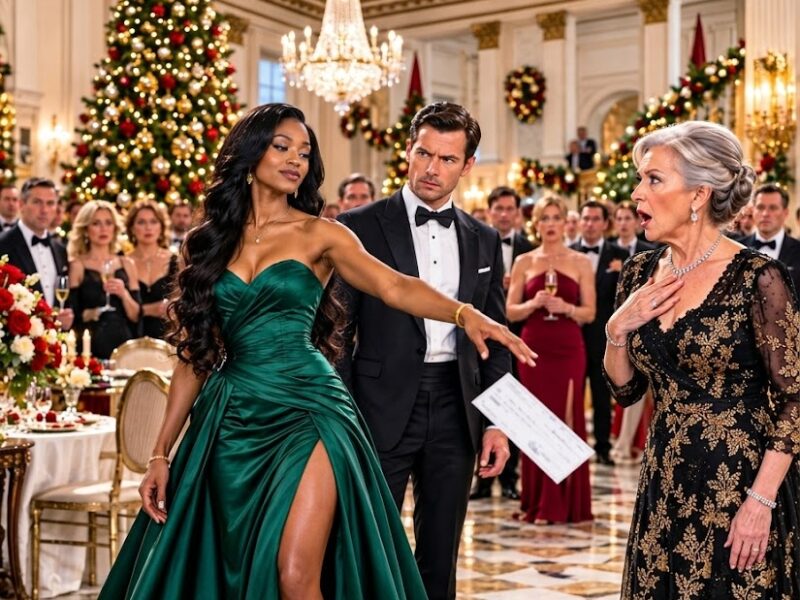
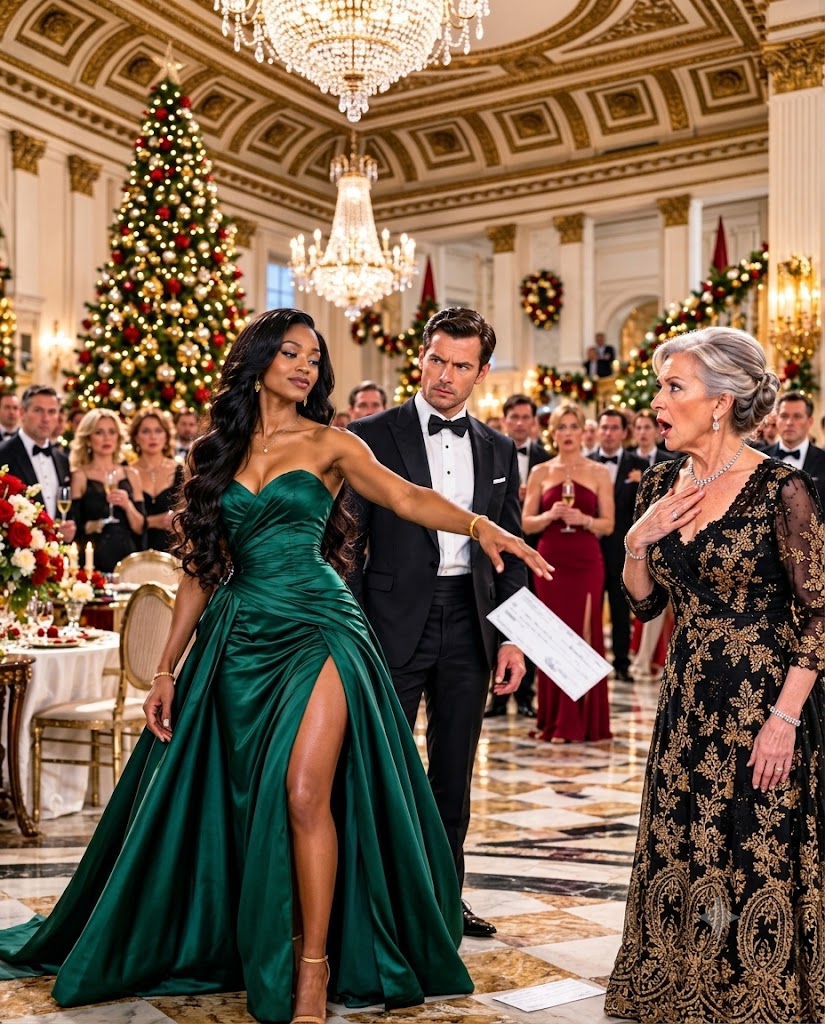
On Christmas Eve, inside a mansion buried under fresh snow, Cordelia Langford slid a check for one million dollars across a mahogany desk and looked at her daughter-in-law as if she were merchandise.
“Take the money and disappear from my son’s life before midnight,” she said.
Zaryia Witcom was a Black woman from an ordinary Boston neighborhood, and the family she had married into controlled an empire worth billions.
For one long second, she meant to tear the check in half.
Then a single line buried in the papers beneath it made her pick up the pen instead.
No one in that room knew who would ultimately pay the price.
If you believe that dignity can never be bought, stay with this story until the very last moment.
The Langford estate sat on twelve wooded acres west of Boston, and on Christmas Eve, it glowed like an old holiday card.
Snow piled against tall glass windows while valets parked cars worth more than most people’s homes.
Inside, a string quartet played beneath a twenty-foot fir trimmed in gold and crystal.
The guest list read like a directory of Massachusetts power.
Bankers, hospital trustees, a retired federal judge, and old money families who measured each other by the age of their silverware.
Zarya Whitcom stood near the fireplace in an emerald dress she had bought with her own salary.
She was thirty-two, an architect who brought crumbling historic buildings back to life, and she had learned long ago that rooms like this had load-bearing walls made of money and silence.
Cordelia Langford moved through her party like a queen inspecting her territory.
At sixty-three, the chairwoman of Langford Holdings wore silver hair in a perfect chignon and a smile that never reached her eyes.
When a cluster of guests drifted near, she placed a cool hand on Zarya’s shoulder and turned her toward them.
“And this,” Cordelia said, pausing until the room leaned in, “is the woman Everett brought home from one of those neighborhoods.”
She did not say daughter-in-law, and she did not say architect, and everyone understood which word she had left out.
A banker’s wife laughed softly behind her hand.
Zarya said nothing, her face as composed as when a contractor insisted a load-bearing beam could simply be removed.
Across the room, her husband, Everett Langford, thirty-six, head of the family’s real estate development division, stood among investors.
He had heard his mother’s voice carry, his jaw tightened, and then he turned back to the investors and laughed at something no one had actually said.
Zarya watched him do it.
It was not the first time, and some quiet part of her had stopped expecting anything different.
At ten minutes after eleven, the house manager, a gray-haired man named Graham, murmured that Mrs. Langford wished to see her in the private library.
The room was paneled in dark walnut, lit by a single brass lamp, with snow pressing against the windows.
On the enormous desk lay a cashier’s check made out to Zarya Whitcom for one million dollars and a thick separation agreement already drafted and waiting for a signature.
“Sit down,” Cordelia said, and it was not an invitation.
The terms were simple.
Zarya would leave the estate before midnight, end her marriage to Everett, never speak of this offer to anyone, and walk away one million dollars richer.
Then Cordelia leaned back and delivered the line she had clearly rehearsed.
“One million dollars is the largest sum of money someone like you will ever see in her lifetime.”
She said it the way other people state the weather because to her it was not cruelty but arithmetic, the kind she had used for forty years to make inconvenient people vanish.
Women like Zarya, she believed, always took the money.
But Zarya had spent a decade reading documents other people skimmed.
She turned the pages slowly, past the separation terms and confidentiality provisions, until she reached an appendix labeled Schedule C.
Buried inside was a clause requiring her to release all claims, findings, and professional opinions from any prior consulting work connected to a property called Blackstone Wharf, held in part through an entity called the Ashgrove Fiduciary Trust.
Her pulse quickened, though her face did not move.
A divorce agreement had no reason to mention her professional work, and certainly no reason to mention Ashgrove, a name she had seen once before in a file she had walked away from.
She did not tear the check or raise her voice.
She asked quietly for a complete copy of every page before she would consider anything.
Cordelia’s lips thinned, but she slid a second bound set across the desk along with a single page acknowledging that Zarya had received the offer.
On the evening of December 24th, Zarya signed only that page and wrote the exact time beside her name.
Cordelia smiled, believing it was the first step of surrender.
She thought she had just bought Zarya’s marriage, but she had no idea she had just handed her daughter-in-law the very thing that could bring the Langford empire to its knees.
Two years earlier, Zarya had been standing on rotting scaffolding inside the Fenwick Exchange, a nineteenth-century trading hall near the Boston waterfront that the city had nearly condemned.
Everett Langford arrived one gray morning representing the developer that had bought it, expecting a consultant who would tell him what he wanted to hear.
Instead, he found a woman covered in plaster dust who told him that if his engineers removed the east colonnade, the northern wall would fail within five years.
He argued with her for twenty minutes.
Then he asked to see her calculations, and by the end of the afternoon, he had changed the plan.
What drew Everett to her was nothing his mother would have recognized as value.
Zarya had grown up in a Dorchester triple-decker, the daughter of a bus driver and a school librarian, and had paid for her degree with scholarships and night shifts at a hardware store.
She cared whether a building would still stand in a hundred years, and whether the people around it could still afford to walk through its doors.
Everett had spent his life surrounded by people who agreed with him because of his last name, and Zarya was the first who disagreed with him because she was right.
Within a year, he proposed on the steps of the restored Fenwick Exchange.
Cordelia opposed the marriage from the start.
She called Zarya’s family unsuitable and her career a hobby for people who enjoyed dust, and she threatened to delay Everett’s promotion.
He married Zarya anyway in a small chapel in Jamaica Plain, and his mother stayed exactly forty minutes.
For a brief season, Zarya believed that the man who had stood up to his mother once would keep standing.
The humiliations that followed were never loud enough to be called cruelty in public.
At family dinners, Cordelia asked whether Zarya’s parents had ever been abroad, then answered for her.
At a charity luncheon, she introduced her as “Everett’s little project.”
At a hospital fundraiser, a member of Cordelia’s staff directed Zarya to a side door near the catering kitchen, explaining that her arrival through the front would not be consistent with the family’s image.
Zarya walked through that door with her chin lifted, refusing to give Cordelia a scene.
She never told anyone how long she sat in her car afterward.
Each time, Everett held her and said the same thing.
“She just needs time. She’ll come around.”
He meant it, and that was the worst part.
His patience left Zarya standing alone in every room where his mother held power, and slowly the distance between them grew.
Everett grew skilled at changing the subject, and Zarya grew skilled at not raising it.
She protected the one thing Cordelia could not touch: her work.
She refused Langford money and kept her own small firm, Whitcom Restoration Studio, in the South End.
About fourteen months before that Christmas, Langford Holdings had retained her to assess Blackstone Wharf, a waterfront property with a granite customs warehouse dating to 1852.
Her report identified the warehouse and its annex as historically significant structures requiring additional review before redevelopment.
Then, checking the ownership history, she noticed the chain of title did not match her documents and that the Ashgrove Fiduciary Trust appeared in one filing and vanished from the next.
When she asked questions, the answers grew vague and then stopped.
Zarya withdrew in writing, citing ownership irregularities she could not certify, and assumed the matter had ended.
Now, seeing that same name in Schedule C, she understood that nothing had ended at all.
The offer on the desk was not only about separating a husband from a wife.
Someone wanted something buried, and they wanted Zarya to help bury it.
Back in the library, the grandfather clock struck eleven.
“Why tonight?” Zarya asked. “Why must it be signed before midnight on Christmas Eve?”
Cordelia regarded her like a chess player whose opponent had finally noticed the board.
Everett, she explained, was about to be named lead executive on a transaction worth two point four billion dollars, the largest in the company’s history.
Investors, the press, and the board would all be watching, and a wife from the wrong side of the city was a liability the family could no longer carry.
“Everett knows about this,” Cordelia added. “He will not object.”
Those words struck harder than any insult because they reached the one place Zarya had kept protected.
She pressed her palm against the cool wood of the desk to steady herself, but she did not let a single tear fall.
If her husband had agreed to this, she said, she would hear it from him, and she asked to speak with Everett alone.
“No,” Cordelia replied.
There would be no private conversations and no negotiations.
If Zarya refused, Cordelia would make a few calls after the holidays.
The museum trustees, university boards, and city partners who gave Whitcom Restoration Studio its largest contracts all owed Langford favors.
Within a year, she promised, Zarya would be lucky to restore a garden shed.
She never raised her voice because she had never needed to.
Something in Zarya went still and clear.
This was not an offer but a threat dressed in a cashier’s check.
Knowing Massachusetts law prohibited secretly recording a private conversation, she gave Cordelia no legal weapon.
Instead, she asked her to confirm the deadline and terms in writing.
Supremely confident, Cordelia scrawled two lines on her personal stationery stating the offer expired at midnight and was not negotiable, then signed it.
Zarya photographed every page, the note, and the attorney’s cover letter, then emailed herself a timestamped account of everything that had been said.
The door opened, and Everett stepped inside, his eyes moving from his mother to his wife to the check.
“Did you know?” Zarya asked quietly. “Did you know she was going to offer me money to leave you?”
Everett opened his mouth, closed it, and looked at the floor.
“Zarya, it’s not that simple,” he said, and then nothing at all.
Cordelia watched with quiet satisfaction because his silence was exactly the answer she had promised.
That silence cut deeper than every insult his mother had ever delivered.
In his mind, Everett was searching for a sentence that would protect his wife without destroying his future, and he could not find one fast enough.
In hers, a door was quietly closing.
She thought of the man who had once argued with her for twenty minutes and then admitted she was right, and she wondered when he had disappeared.
Zarya slid the uncashed check and the documents into a leather folder and stood.
“I am taking these. I have signed nothing except the page saying I received them.”
Cordelia laughed softly and told her she would be back before morning begging for the money.
Zarya walked through the grand hall without looking at anyone and stepped out into the snow.
The cold hit her face like a slap, and it was the first honest thing she had felt all night.
At the iron gates at the bottom of the drive, her phone buzzed in her coat pocket.
The message came from a number she did not recognize, and it contained only two short sentences.
“Don’t sign anything. Check the Blackstone Wharf project file.”
Zarya stood in the falling snow, staring at the glowing screen, while behind her, the mansion blazed with light and music.
Someone inside the Langford empire knew exactly what Cordelia was trying to hide, and that someone was afraid.
By one o’clock in the morning, Zarya sat in the small apartment above her South End office, the one she had kept because it belonged only to her.
The radiator hissed.
Snow drifted past the street light, and the leather folder lay open on her drafting table.
Every few minutes, she reread the anonymous message.
She was not crying, and that frightened her a little because some wounds are too deep to bleed right away.
At two o’clock, Everett knocked, snow melting on his shoulders.
He confessed that weeks earlier, his mother had mentioned offering Zarya a settlement.
He had called it a terrible idea, and then let the conversation drift the way he always did.
He swore he had never known she had drafted papers or written a check.
“Then why didn’t you warn me?” Zarya asked. “You knew what she is capable of.”
Everett sank into a chair and pressed his hands against his eyes.
His mother, he admitted, controlled the timing of his promotion, a large transfer of family shares, and the board votes that decided his future.
He had told himself that once the Blackstone Wharf deal closed, he would finally be free to stand up to her.
In that moment, Zarya saw her husband clearly.
He loved her, but he had let fear of his mother’s power stand taller than his promises.
Everett felt the weight of it, too.
He had always thought of himself as the peacemaker, and he now understood that peace bought with his wife’s dignity had never been peace at all.
Zarya did not ask for a divorce, and she did not tell him everything would be fine.
“I am not leaving because your mother paid me to,” she said. “But I am not coming back because you feel sorry. Stop speaking for her. Stop telling me she needs time. If you want this marriage, show me with what you do, not with what you say at two in the morning.”
Everett nodded and for once did not argue.
He left before dawn.
On Christmas morning, while church bells rang across the rooftops, Zarya called Marin Bellamy, forty-four, an independent attorney who specialized in corporate disputes and took cases larger firms considered too dangerous.
Marin arrived by noon with a thermos of coffee and read every page of the agreement twice before saying a word.
When she finally looked up, her expression was grim.
Schedule C, she explained, was not a standard divorce provision.
It required Zarya to permanently waive any right to raise concerns, file complaints, or offer testimony relating to any professional work she had performed in connection with Blackstone Wharf or the Ashgrove Fiduciary Trust.
It also required her to deliver all her working files on the project to Langford’s attorneys within ten days.
None of that had anything to do with ending a marriage.
It was designed, Marin said, to silence an expert witness.
Zarya walked to the window and watched a city plow crawl down the empty street.
“She doesn’t care about the marriage at all,” she said quietly. “Not really.”
Marin closed the folder and tapped it with one finger.
“Oh, she cares,” Marin replied. “She would love to get rid of you, but nobody writes a clause like this to end a marriage. One million dollars might be the price Cordelia Langford is willing to pay to keep you from seeing a much bigger secret.”
That afternoon, Zarya and Marin spread public records across the drafting table: city planning filings, Massachusetts Historical Commission records, deeds, and the Blackstone Wharf redevelopment application.
Langford Holdings was preparing to sell the development rights to a consortium of private equity investors who had been told every structure on the site was cleared for demolition and conversion into luxury towers.
Without that clearance, the two point four billion dollar valuation would collapse like a building with its foundation cut away.
Then Zarya found her own work.
Buried in the application was a preservation assessment bearing her firm’s letterhead and her professional seal.
It was her report, and it was not.
The granite warehouse had been reclassified as a non-contributing building.
The annex she had marked for mandatory review had vanished from the site plan, and her call for further study had become a single sentence certifying that no historic resources would be affected.
Her hands trembled as she laid her archived original beside it.
But Zarya knew every stone of that warehouse, from its 1852 cornerstone to its rare iron roof trusses.
Under state and city rules, part of the property should have triggered additional review, which could delay the project for years and cut its value by hundreds of millions.
Someone had needed that review to vanish, and someone had used Zarya’s name to make it vanish.
As they traced the chain of title backward, the Ashgrove Fiduciary Trust appeared again, this time in a deed transfer from nearly eleven years earlier.
Ashgrove had quietly acquired a portion of the waterfront before Langford Holdings publicly purchased the rest, and its trustees were listed only through a law firm in Delaware.
Marin circled the name in red ink and said nothing, but Zarya could see her mind working.
The same entity sat in Cordelia’s divorce agreement and in the property’s hidden history, and it was not a coincidence.
That evening, the unknown number called.
The man introduced himself as Nolan Mercer, forty-nine, managing director of the family’s investment funds for nearly twenty years.
He had sent the warning after overhearing Cordelia order the separation papers ready before midnight.
Over the past year, he had seen internal documents suggesting something on Blackstone Wharf was being hidden from the buyers and the board.
Nolan was painfully careful.
He would not hand over confidential files because that would break the law and taint anything they found.
Instead, he pointed her toward documents she was entitled to see: her own engagement letter, the commission filings, and minutes of a public planning hearing where a Langford representative had quoted her altered report word for word.
If formal proceedings began, he promised he would tell the truth about what he had personally seen.
“She knew,” he added quietly. “She was warned, and she pushed the deal forward anyway.”
Over the following hours, the public record confirmed what Nolan had hinted at.
In a filing attached to a routine zoning appeal, a Langford compliance officer had written that the preservation status of the warehouse may present material legal risk, a sentence that had somehow survived inside an appendix nobody had bothered to remove.
The memo was dated four months before the deal was announced and was addressed to the office of the chairwoman.
Cordelia had received a warning about precisely the problem Zarya had identified, and she had chosen to keep the sale on schedule.
Zarya sat back in her chair, and the room seemed to rearrange itself around a new truth.
The check had never been only about getting rid of a poor daughter-in-law who embarrassed the family at parties.
It was about buying the silence of the one person with the expertise and the credentials to recognize that her own work had been falsified.
Cordelia had not simply looked at Zarya and seen someone unworthy.
She had looked at her and seen a risk.
Now Zarya understood why the deadline had been midnight on Christmas Eve, why the agreement had been prepared in advance, and why Cordelia had refused to let her speak with Everett.
The deal was set for final approval within days, and once Zarya’s signature waived her right to object, no one with her knowledge would ever be able to stand up and say the report was a lie.
Marin began drafting a formal letter to preserve all relevant evidence, and Zarya began assembling a side-by-side comparison of every altered drawing.
At seven o’clock on the morning of December 26th, Marin called with her voice tight and urgent.
Langford Holdings had just released a statement to the press.
It claimed that Zarya Whitcom had demanded one million dollars from her husband’s family in exchange for ending her marriage quietly and that the family was considering legal action for attempted extortion.
Cordelia had moved first, as she always did.
Crafted by an expensive crisis firm, the statement described a difficult family matter and noted that the family remained deeply saddened.
By breakfast, it had spread through Boston’s business community.
By lunch, a local television station was running it beside an old gala photograph of Zarya, her smile frozen in a way that suddenly looked calculating.
The coverage followed a familiar script.
A woman from a poor neighborhood had married into billions and now wanted to cash out.
A radio host joked about the most expensive Christmas gift in Massachusetts history.
None of them asked why a woman supposedly demanding money had never deposited a single dollar.
Cordelia knew a story did not need to be true to do damage.
It only needed to be told first and loudly.
The damage came quickly.
By the afternoon, two clients had called to postpone signed contracts with Whitcom Restoration Studio, citing the need to let things settle.
A university that had hired her firm to restore its nineteenth-century library sent a polite email suspending further work pending a review.
Zarya’s project manager, a young woman named Kelsey Hartman, sat at her desk with red eyes, asking whether the firm would survive the month.
Zarya told her the truth.
She did not know, but she knew exactly what she was going to do next.
That afternoon, Zarya attended a business council luncheon she had committed to months earlier, refusing to hide.
Conversations thinned into whispers as she walked in alone.
Cordelia, holding court by the windows, raised her glass.
“How brave of you to come,” she said loud enough for half the room. “Some women will do anything to climb into a world where they simply don’t belong.”
A few people laughed, and many more looked away.
Cordelia waited, hungry for an outburst.
Zarya gave her nothing.
She smiled politely, wished the room a happy holiday, and left.
In the car, she called Marin, who had already drafted demands for correction to every outlet and a letter instructing Langford Holdings to preserve every document connected to Blackstone Wharf and the separation agreement.
Paper, evidence, and patience were the only weapons that would last.
Meanwhile, in a glass-walled conference room on the forty-first floor of Langford Tower, Everett faced the board’s executive committee.
Several directors wanted him to issue a public statement supporting his mother’s account and distancing himself from his wife before the deal was finalized.
Cordelia joined the meeting late and laid a single typed page in front of him.
It stated that Zarya had sought payment from the family and that Everett supported the company’s response.
“Sign it,” his mother said, “or you will lose the deal, your division, and your shares. All of it. Tonight.”
Everett stared at the page and heard every excuse he had offered his wife over two years.
He picked up the pen, and his mother relaxed.
Then he set it down.
“No. Zarya never asked you for a dime. And you know it. I won’t sign a lie about my wife.”
For the first time, Everett watched his mother lose control of a room.
When he called Zarya that night, she thanked him and meant it.
But one act of courage, she said quietly, did not erase two years of silence.
Marin, meanwhile, built a wall of evidence: written confirmation from the bank that the check had never been deposited, the original check sealed in her office safe, Zarya’s timestamped notes, the signed acknowledgement of receipt, and Cordelia’s handwritten deadline.
Every claim in the press statement could be disproved by documents Cordelia herself had created.
That evening, Zarya found the final piece.
A special board meeting had been called for the morning of December 27th to approve the Blackstone Wharf sale.
Once the board voted, the altered report would become part of a binding two point four billion dollar contract.
Cordelia believed that boardroom was the one place her power was absolute.
That was exactly where the truth needed to be heard.
At nine o’clock, a black sedan pulled up outside the studio, and Graham announced that Mrs. Langford requested a private word at Langford Tower.
Zarya agreed on one condition, and Marin Bellamy walked in beside her.
Cordelia’s eyes narrowed at the attorney, but she gestured toward the white leather chairs overlooking the glittering harbor.
Cordelia did not waste time.
She opened a slim folder and announced that she was prepared to be generous.
The one million dollars was clearly insufficient, she admitted, for a woman of Zarya’s apparent talents for negotiation.
She would increase the offer to three million dollars, retract the press statement, and quietly restore every client Zarya had lost.
In exchange, Zarya would sign the separation agreement, including Schedule C, by eight o’clock the next morning.
“Three million dollars,” Cordelia said almost kindly. “Think of what that would mean for your parents.”
Zarya glanced at Marin.
“Any offer you make will go through my attorney in writing with every term spelled out.”
Cordelia’s composed face flushed red.
She rose and told Zarya she did not understand who she was dealing with.
No one, she said, had ever stood against the Langford family and walked away with anything left.
Zarya let the threat hang in the air, then asked a single quiet question.
“If this is about my marriage,” she said, “why does the separation agreement mention Blackstone Wharf?”
For a heartbeat, Cordelia looked genuinely startled.
Then her pride took over, and she answered with the contempt she had been saving for two years.
“Because your report was hysterical, Zarya. Forty pages about a warehouse full of pigeons. That annex was never worth saving, and your little recommendation for further review would have cost this company three years and four hundred million dollars. I read every word of it, and I know precisely who wrote it.”
Marin’s pen stopped moving.
Zarya’s original report had never been filed with the city.
Only the altered version had been made public.
By her own admission, Cordelia had read the original, understood its conclusions, and known exactly whose expertise the filed version was misrepresenting.
Zarya kept her expression perfectly neutral.
She said she would need the night to think about the money, and she allowed Cordelia to believe that three million dollars had finally found her price.
Cordelia smiled as the two women left, certain she had won again.
In the elevator, Marin exhaled.
“She just told us she knew.”
By midnight, she had prepared a submission to the Massachusetts Historical Commission and the city’s inspectional services department documenting the discrepancies and requesting an investigation, plus a petition urging every independent director to suspend the vote.
Each filing stated carefully that the allegations were unproven because the strongest case is one that does not overreach.
Near one in the morning, Nolan Mercer called again.
He had spoken with his own attorney, and he was prepared to testify truthfully about the internal warnings he had personally seen and received, limited strictly to documents he had lawful authority to access as managing director of the investment funds.
He would not speculate or exaggerate.
He would only confirm what he knew.
“It’s time somebody in this company stopped looking away,” he said quietly.
At two o’clock, Everett read Marin’s petition in his car outside the Whitcom Restoration Studio, the engine running against the cold, the color drained from his face as he compared the two versions of the report page by page.
He had signed off on the Blackstone Wharf financial projections himself, never once suspecting they rested on a falsified document.
Before dawn, he sent a formal letter to the chair of the board’s audit committee requesting a full independent audit of the Blackstone Wharf transaction before any vote took place.
Then came a revelation that changed everything Zarya thought she understood.
Among the materials Marin obtained through the formal engagement records, a brief email surfaced from fourteen months earlier, sent from Cordelia’s office to the head of the development division.
It instructed staff to retain Whitcom Restoration Studio for the Blackstone Wharf assessment specifically.
“Her name carries weight with the commission,” the email read. “Use it.”
Cordelia had personally chosen Zarya for the project, not out of respect, but to borrow her reputation.
When Zarya refused to certify a story she knew was false, Cordelia had used her seal anyway, and now she needed Zarya gone.
At eight forty-five on the morning of December 27th, Cordelia Langford stepped out of her car in front of Langford Tower wearing a cream wool coat and the confidence of a woman who had never once lost a vote.
She expected the meeting to take ten minutes.
She expected the deal to pass unanimously, the champagne to be poured by noon, and Zarya Whitcom to be signing papers in some lawyer’s office by lunch.
She did not notice that Nolan Mercer was already waiting in a small conference room on the forty-first floor, or that two independent directors had arrived early and were reading something in silence.
The boardroom occupied the northern corner of the forty-first floor, its windows framing the frozen harbor and the distant gray sprawl of Blackstone Wharf itself.
Eleven directors sat around a polished table, several of them holding Marin’s petition, and coffee went untouched.
At the head of the table, Cordelia sat perfectly upright, radiating the calm of someone who had already counted the votes.
She opened with a polished presentation: renderings of glass towers above the water, two decades of projected revenue, and one figure in bold gold lettering, two point four billion dollars.
She called Blackstone Wharf the crowning achievement of her career and the deal that would secure the Langford legacy for another generation.
Then she called for an immediate vote.
Before anyone could raise a hand, Everett stood up.
“Before we vote,” he said, his voice steady in a way it had never been in front of his mother, “I am formally requesting that this board review the petition and the supporting documents submitted by Attorney Marin Bellamy, along with my letter to the audit committee. I signed off on the financial projections for this deal, and I now have serious reason to believe they rest on an altered preservation report.”
A murmur ran around the table.
Cordelia did not look at her son.
She looked straight ahead, and a single muscle in her jaw pulled tight.
“This is absurd,” Cordelia said coldly. “My son’s wife has been rejected by this family, and now she is trying to destroy this company out of spite. She is a woman with a grievance and a press problem, and this board should not dignify her fantasies with a single minute of its time.”
She delivered the words with complete conviction.
For a moment, several directors seemed to waver because Cordelia had been right about so many things for so long.
Then the chair of the audit committee, a silver-haired former federal prosecutor named Harold Whitaker, cleared his throat and said the board would hear from the expert who had written the original report.
Zarya walked into the boardroom wearing a simple charcoal suit and carrying a single portfolio.
She did not look at Cordelia.
She addressed the directors directly, introducing herself not as Everett’s wife but as the licensed preservation architect whose professional seal appeared on the Blackstone Wharf filing.
Then she placed the evidence on the screen, one document at a time.
Her original report, archived on her firm’s servers with its creation date.
The version filed with the city, bearing her seal but not her conclusions.
Side-by-side drawings showing the reclassified warehouse and the vanished annex.
The deed transfer naming the Ashgrove Fiduciary Trust.
The compliance officer’s warning of material legal risk, addressed to the chairwoman’s office four months before the deal was announced.
Marin rose next and explained in the precise language of someone who had argued before judges for twenty years that the one million dollar separation agreement contained a clause requiring Zarya to waive any right to raise concerns about her work on Blackstone Wharf and to surrender her files.
She noted that a provision like that had no conceivable purpose in a marital agreement and that its presence raised serious questions requiring independent investigation.
She did not accuse anyone of a crime.
She did not need to.
Then Nolan Mercer took his seat at the end of the table.
In a quiet, even voice, he confirmed that internal warnings about the preservation status of the warehouse had been circulated to senior leadership, including the office of the chairwoman, well before the deal was publicly announced.
He described what he had personally seen, nothing more and nothing less.
And when a director asked whether those warnings had been shared with the buyers, Nolan answered simply that he had found no record that they were.
Cordelia’s composure began to crack.
She leaned forward and spoke rapidly, insisting that every decision she had made had been to protect the family, the company, and the thousands of employees who depended on this deal.
She said that Zarya’s report had been overcautious, that preservation boards always exaggerated, and that leaders sometimes had to make hard choices that weaker people could not understand.
But each justification only confirmed what the documents already showed.
She had known about the risk, and she had chosen to bury it.
Zarya opened her portfolio one final time and laid a photocopy of the cashier’s check on the polished table directly in front of her mother-in-law.
One million dollars, payable to Zarya Whitcom, dated December 24th, never cashed.
She looked at Cordelia for the first time that morning, and her voice was quiet enough that every director leaned forward to hear it.
“You may be able to put a price on my silence,” she said. “But you have no right to put a price on the truth.”
The room fell completely still.
Then Everett spoke again, and this time he turned to face his wife in front of every director.
He said that he had failed her not once but many times, by staying silent when his mother humiliated her and by putting his position ahead of his promises.
He said he would not fail her again and that he fully supported an independent audit and complete cooperation with every regulatory authority.
Cordelia stared at her son as though she no longer recognized him.
Harold Whitaker called the question.
By a vote of nine to two, the board of Langford Holdings voted to suspend the Blackstone Wharf transaction indefinitely, to retain an independent forensic auditor, to cooperate fully with the Massachusetts Historical Commission and city regulators, and to suspend Cordelia Langford’s approval authority over the deal pending the outcome of the investigation.
Cordelia sat motionless as the hands went up around her, one after another, like doors closing in a long hallway.
The bitter irony was not lost on anyone in that room.
If Cordelia had simply ignored her daughter-in-law, Zarya might never have connected her withdrawn engagement to a filing she had never seen.
It was the check itself and the clause hidden inside the agreement that had led her straight to the truth.
The very plan designed to buy silence had become the clearest evidence that something needed silencing.
Cordelia had written the case against herself, signed it on her own stationery, and handed it across her own desk on Christmas Eve.
As the directors filed out, Cordelia’s phone buzzed on the table.
She glanced at the screen, and the color left her face.
Her two largest financing partners on Blackstone Wharf had each sent formal notice that they were reviewing all commitments connected to the project, effective immediately.
For the first time in forty years, Cordelia Langford sat alone in a boardroom with nothing left to buy.
In the weeks after the vote, Langford Holdings retained one of the most respected forensic accounting firms in the country and opened its records to the Massachusetts Historical Commission and the city’s regulatory offices.
The company issued a formal public statement retracting its earlier claims about Zarya, acknowledging that she had never requested or accepted any payment from the family.
The same television station that had run her photograph beside the word extortion now ran a brief correction at the end of the evening news.
It lasted twenty seconds, but Zarya watched every one of them.
The preliminary findings arrived in February.
Investigators confirmed that the preservation report filed with the city had been materially altered without the knowledge or consent of its author and that its conclusions did not follow proper review procedures.
The question of exactly who had ordered the changes and who bore individual responsibility remained under active investigation.
Langford’s attorneys spoke carefully.
Regulators spoke even more carefully, and no one rushed to pronounce a final verdict.
Zarya understood that justice built on rushed conclusions would crack as easily as Cordelia’s lies had.
Cordelia was placed on temporary leave while the investigation continued.
The financing partners withdrew.
Others demanded new terms, and board members who had once competed for her approval stopped returning her calls.
The two point four billion dollar deal was suspended indefinitely, and the company absorbed significant legal fees and lost commitments, though the full damage would depend on what the investigation found.
The deeper cost was the Langford name itself, now tied to a falsified document and a check written to buy a woman’s silence.
Alone in her library one evening in late January, Cordelia sat behind the same mahogany desk where she had once laid out the check, and for the first time she allowed herself to look honestly at what she had done.
She had protected her empire the only way she knew how, with money and threats, and every move she had made had dragged her deeper into the very disaster she was trying to prevent.
She had spent her entire life believing that everything had a price.
It had never once occurred to her that the most dangerous person in her family might be the one who refused to be bought.
In early March, on a gray afternoon heavy with melting snow, Cordelia arrived unannounced at the Whitcom Restoration Studio.
She came alone, with no attorney, no assistant, no bodyguard, and no driver waiting at the curb.
Kelsey Hartman stared at her in astonishment before showing her upstairs.
Zarya rose from her drafting table and did not offer her a chair, but she did not ask her to leave either.
The two women stood facing each other across a room full of blueprints and old photographs of buildings that had been saved from demolition.
Cordelia began by saying she had come to apologize, and for a moment the words seemed almost sincere.
Then, as if she could not stop herself, she began to explain.
She had only wanted to protect Everett’s future.
She said she had only wanted to secure the company her father and grandfather had built.
A mother, she insisted, sometimes had to do terrible things for her child.
Zarya let her finish.
Then she answered quietly, without anger, which somehow made every word land harder.
“Protecting your family,” she said, “can never mean destroying someone else’s dignity. You didn’t protect Everett. You taught him to be afraid of you. And you didn’t protect your company. You put my name on a lie and tried to buy my silence when I wouldn’t sign it.”
Cordelia opened her mouth to respond, then closed it again, and for once in her life, she had nothing ready to say.
That evening, Everett visited the studio, as he had done every week since Christmas.
He no longer asked when she was coming home.
Instead, he told her he had resigned from the development division and sold the shares that had kept him tethered to his mother’s approval.
He admitted that he had paid his own price for staying silent and that the cracks in their marriage were his responsibility, not hers.
He did not ask for forgiveness.
He asked only whether she would let him keep trying.
Zarya told him the truth.
She was not ready to move back into the life they had shared, and she would not be rushed into it.
She needed time, and she needed to see real changes that lasted longer than a single brave moment in a boardroom.
Everett nodded and accepted it, because he finally understood that love which demanded immediate forgiveness was just another form of control.
In the end, the price had been paid by more than one person.
Cordelia had paid with her power, her reputation, and the empire she had believed was untouchable.
But Everett had paid, too, with something harder to rebuild than any company: the trust of the woman who had once believed he would always stand beside her.
Money could be earned again.
Trust had to be constructed slowly, stone by stone, the way Zarya restored old buildings.
Before Everett left that night, Zarya handed him an envelope addressed to his mother.
Inside was the original cashier’s check for one million dollars, released from Marin’s evidence safe after the investigators had copied and documented it.
Still uncashed and still crisp.
There was no note.
Zarya did not need one.
She had never needed one million dollars to know exactly what she was worth.
One year later, Boston welcomed another white Christmas.
Snow drifted down over the brick sidewalks of the South End, and the city glowed with strings of lights wrapped around lamp posts and wrought iron railings.
Whitcom Restoration Studio had moved into a larger office two blocks from the old one, with eleven employees instead of four, and Kelsey Hartman had been promoted to senior project manager.
The clients who had abandoned the firm during the scandal had nearly all returned, and many new ones had followed, drawn by the story of the architect who had refused to put her name on a lie.
That autumn, the city had selected Zarya’s firm to restore the Roxbury Community Hall, a neglected nineteenth-century meeting house where generations of Black Bostonians had organized, celebrated, mourned, and voted.
It was the most meaningful project of her career.
She spent her mornings on scaffolding beneath its cracked plaster ceiling and her evenings meeting with neighborhood elders who remembered weddings and funerals held within its walls.
It was the kind of building that money alone could never have saved.
Langford Holdings had undergone a sweeping governance overhaul.
An independent chair now led the board.
A new compliance office reported directly to the audit committee, and the company had publicly released the conclusions of its investigation, announcing the personnel actions and regulatory settlements that followed through the proper legal process.
The Blackstone Wharf plan had been redesigned from the ground up, and the granite customs warehouse would be preserved as part of a public waterfront space.
Cordelia no longer held absolute control over anything.
She had retired from the board as part of the company’s settlement with regulators, and she spent most of that year in the quiet estate west of Boston, facing the consequences of decisions she could no longer undo.
Her calendar, once filled with galas, now held mostly meetings with attorneys.
For the first time, she had time to think, and the thinking was not always comfortable.
Everett had built something of his own.
He founded a small development company focused on affordable housing in historic neighborhoods, funded without a single dollar of Langford money.
It was harder, slower, and far less glamorous than anything he had done before, and he had never felt more like himself.
He also spent every other Thursday evening in a marriage counselor’s office in Brookline, sitting beside Zarya, learning to say difficult things out loud instead of letting them disappear into silence.
After many months of counseling and many small promises kept, Zarya agreed to begin again slowly.
They did not move back into the old house in Weston.
Instead, they rented a modest brick townhouse in Jamaica Plain, not far from the chapel where they had married, and they built their life room by room, the way she restored buildings, testing every beam before trusting it with weight.
In mid-December, a handwritten letter arrived in Cordelia’s elegant script.
There was no check inside, no gift, no conditions, and no explanation about protecting the family.
For three short paragraphs, Cordelia simply admitted that she had been wrong, that her contempt had been cruel, and that she was sorry for every door she had forced Zarya to walk through.
Zarya read the letter twice.
She accepted it as a first step, and she wrote back a brief reply saying so, but she did not invite Cordelia for Christmas.
Some bridges needed more than one letter to rebuild.
On Christmas Eve, Zarya and Everett stood in the small living room of their Jamaica Plain townhouse, hanging ornaments on a modest six-foot tree they had carried home together through the snow.
There was no string quartet, no champagne, no crystal, and no guest list.
Zarya’s mother had baked sweet potato pie.
Her father had told the same old jokes he told every year, and Everett had laughed at every single one.
In that small, warm room, nobody needed to prove what they were worth by what they owned.
Late that night, after everyone else had gone to bed, Zarya stood at the window, watching the snow fall softly over the quiet street.
One year earlier, a billionaire had placed one million dollars on a desk to drive her out into the cold.
This Christmas, she did not need that check, and she did not need that mansion.
She only needed to know, with a certainty that no one could ever buy or take away, that no one would ever again make her feel unworthy.
If you believe that self-respect and genuine love are worth more than any fortune, share this story with someone who needs to hear it.
Because sometimes the richest person in the room is not the one with the most money, but the one who never sold herself.









