
Her Billionaire Husband Threw Her and Their Newborn Daughter Out—Then a DNA Test Exposed His Family’s Secret
The rain hammered against the hospital windows like fists demanding entry.
Nia cradled her newborn daughter against her chest, still trembling from eighteen hours of labor, her body torn and stitched and bleeding, while her mother-in-law stood at the foot of the bed with a face carved from ice.
“You told me we would finally have an heir,” Malikica said, her voice low and venomous, designed to wound without being overheard by the nurses station just beyond the door. “Instead, you gave this family a girl.”
Nia looked down at the perfect creature in her arms, ten tiny fingers, a tuft of dark hair, lips like rosebuds, and felt her heart split in two directions at once.
“She is healthy, strong, and perfect,” Nia whispered, more to her daughter than to anyone else. “How can you stand here and call her failure?”
Malikica’s laugh was a dry, brittle thing, like autumn leaves crushed underfoot.
“Do you understand what you have done?” Malikica demanded, stepping closer, her designer heels clicking against the linoleum like a countdown. “This family name needed a son to survive. I have waited years for a grandson. You have failed this family completely.”
“Mother, please.” Dawit’s voice came from somewhere behind his mother, weak and wavering. “She just gave birth hours ago. This is not the time for this.”
Nia watched her husband, the man who had promised to love her beyond wealth, beyond name, beyond everything his family represented, and saw him shrink under his mother’s gaze.
She had carried life for nine months, had endured the sickness and the swelling and the sleepless nights, had pushed a human being from her body, and now she was being asked to apologize for the gender of that miracle.
“I will not beg you to love your own granddaughter,” Nia said, her voice steadier than she felt. “Nia, she is exhausted.” Dawit tried again, reaching for his mother’s arm.
“Mother, lower your voice before the entire hospital hears you.”
“Let them hear,” Malikica snapped, pulling away. “Let them know the heir we prayed for will never come from her.”
Nia felt something shift inside her chest, a door closing, a lock turning, a chapter ending.
“Then remember this moment, Malikica,” Nia said, and for the first time, she used her mother-in-law’s name without the honorific, without the respect that had never been earned. “Because you will regret every cruel word you spoke tonight.”
Malikica turned to the two bodyguards standing in the hallway, men who had driven Nia to prenatal appointments and carried her shopping bags and called her Mrs. Dawit with genuine warmth.
“Pack her things,” Malikica ordered. “I will not have disappointment living under my roof another night.”
“You are ordering staff to throw my clothes like trash,” Nia said, watching as one of the guards, a man named Thomas who had brought her ginger tea when the morning sickness was unbearable, looked at the floor instead of at her. “Have you lost all dignity?”
“Mother, stop this humiliation.” Dawit finally stepped forward, positioning himself between his wife and his mother. “She is my wife. You cannot discard her like this.”
“She brought shame when she could not produce an heir. The staff must see consequences.”
Malikica gestured broadly, ensuring every nurse, every visitor, every janitor pushing a cart down the corridor could witness the scene she was orchestrating.
“Let them watch,” Nia said, and her voice carried now, loud enough for the gathered crowd. “Let everyone see how a billionaire treats a woman who just gave birth.”
“You had one duty,” Malikica hissed. “One. And you failed. Dawit needs a wife who understands legacy.”
Nia looked at her husband, really looked at him, and saw the boy who had never learned to stand, the man who had been given everything except a spine.
“Nia, please say something.” Dawit’s voice cracked. “Tell her you will try again. Give me words to defend you.”
The request hung in the air like smoke, toxic and choking.
Nia looked at her daughter, at the tiny chest rising and falling, at the perfect fingers curled against her breast, and made her decision.
“I will not apologize for my daughter’s existence to earn a place in this house,” Nia said.
Malikica smiled, and it was the smile of a predator who had finally cornered its prey.
“Then leave. Take your few things and learn what life is without our name protecting you.”
She turned to her son, and her eyes held something worse than anger, something that looked almost like triumph.
“Choose now, Dawit. Your mother, your empire, or a woman who cannot give you sons.”
“You are asking me to divorce my wife days after she gave birth,” Dawit said, his face pale. “Mother, be reasonable.”
“Reason is protecting billions.” Malikica pulled an envelope from her designer handbag, the kind of bag that cost more than most people’s monthly rent, and held it out to her son. “Sign these papers and I will double your shares tomorrow.”
The hospital room had gone completely silent, save for the soft cooing of the newborn who knew nothing of the war being waged over her worth.
“Dawit, look at me,” Nia said, and her voice was calm now, calm in the way of someone who had already accepted a terrible truth. “If you sign anything tonight, you sign away who you claim to be.”
“He knows what happens if he leaves with you,” Malikica said. “No fortune, no company, nothing at all.”
Dawit looked between them, his mother with her checkbook and her threats, his wife with her newborn and her dignity, and Nia watched him make the calculation that would define the rest of her life.
“Nia, I am trapped.” His voice was barely a whisper. “My entire life, my employees, everything depends on her approval.”
“And I depended on you to stand when it mattered.” Nia nodded slowly, as if confirming a suspicion she had carried for years but had never allowed herself to fully believe. “That was my entire mistake, wasn’t it?”
“If you leave tonight, I will find you later.” Dawit stepped toward her, reaching for her hand. “I swear I will make this right somehow.”
Nia pulled away before he could touch her.
“I didn’t lose your family today,” she said. “I lost the man I thought loved me more than money.”
A nurse appeared in the doorway, a middle-aged woman with kind eyes and gray-streaked hair who had checked on Nia every hour through the night.
“Ma’am, you shouldn’t be moving around so soon after delivery. You need to rest.”
“I appreciate your concern,” Nia said, already rising from the bed, already feeling the pull of stitches and the rush of blood that reminded her of what her body had just accomplished. “But I need to leave.”
“At least take the car,” Dawit pleaded, following her as she gathered her daughter against her chest and walked toward the door in her hospital gown. “Take money. Please do not walk into this storm alone tonight.”
Nia stopped at the threshold and turned to face the family she had married into, the family that had promised to cherish her and had instead measured her worth in chromosomes.
“I do not want your jewelry, your gifts, or your pity,” she said. “I want my dignity intact. I walked into your family with love. I will walk out of it with the same love for myself.”
“Nia, the rain is brutal.” Dawit’s voice was desperate now, the voice of a man watching his life split into before and after. “My mother is watching. Show her we are not completely heartless.”
Nia laughed, and it was a hollow sound, empty of humor.
“Your mother is watching? Then let her watch a woman survive without her permission tonight.”
She stepped into the corridor, her bare feet cold against the institutional floor, her daughter warm against her heart, and she did not look back.
Behind her, she heard Malikica’s voice, sharp and satisfied.
“She will be forgotten by morning. Rain always makes the weak disappear without a trace.”
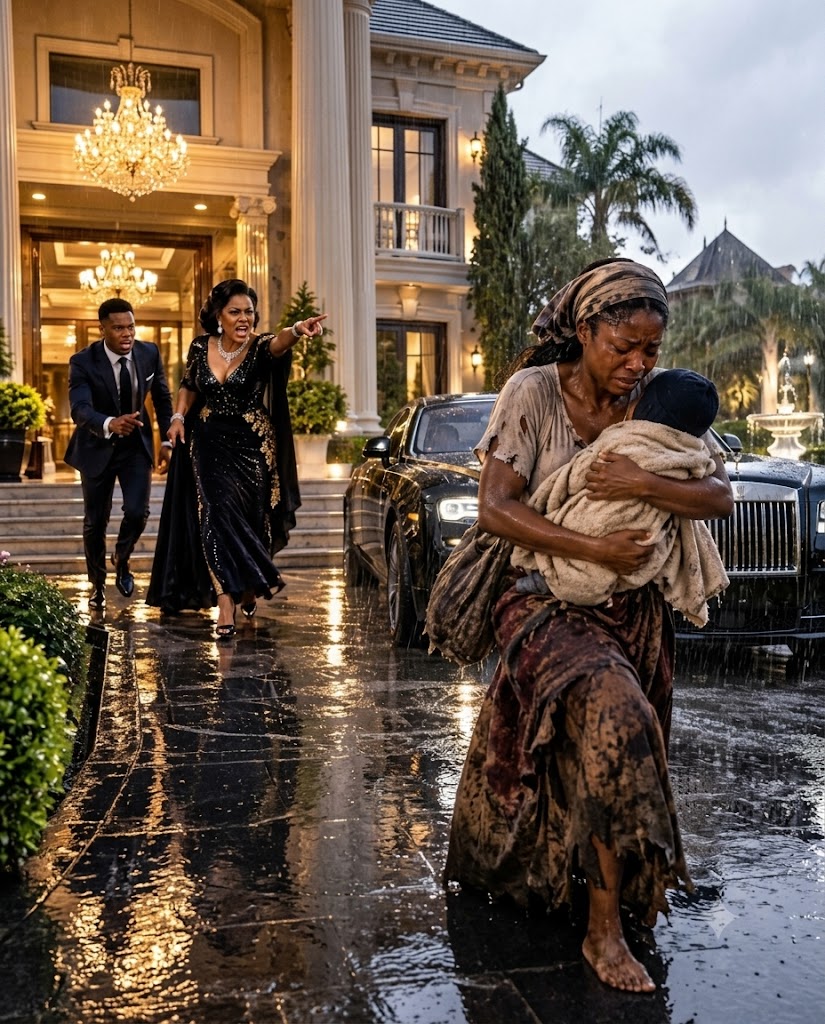
Nia walked through the hospital lobby in her gown, past the security guard who looked away, past the receptionist who pretended not to see, past the glass doors that slid open to reveal a parking lot transformed into a shallow lake.
The rain was not just falling; it was falling with intent, with malice, with the kind of force that made you understand why ancient peoples believed in angry gods.
Nia stepped into it without hesitation.
The water soaked through her gown immediately, plastered her hair to her skull, ran in rivers down her face so that no one could tell if she was crying, and she was crying, crying for the marriage she had believed in, the man she had loved, the future she had imagined.
But she was also walking, each step taking her further from the mansion that had never been her home, further from the family that had never been her family, further from the life that had always been a lie.
She had twenty-three dollars in her pocket, the remains of a tip she had received from a stranger at a coffee shop three weeks ago, back when she still believed she had a husband who would protect her.
She had no phone, no coat, no shoes, no plan.
She had a daughter who needed her, and somehow, impossibly, that was enough.
The rain continued for hours, as if the sky itself was grieving.
Nia found shelter in a bus station, the fluorescent lights buzzing overhead, the plastic seats cold and unforgiving, and she held her daughter against her chest and sang lullabies her own mother had sung to her, songs from a childhood that had ended too soon.
She had been fifteen when her father died, old enough to understand loss but young enough to still need him.
He had been a quiet man, a man who worked with his hands and read poetry in the evenings, a man who had told her that the measure of a person was not in what they accumulated but in what they gave away.
She had not understood then.
She understood now.
The bus station emptied as the night deepened, and Nia sat alone with her newborn, watching the rain streak down the windows like tears on a face.
She thought about calling someone, but who was there to call?
Her mother had died when she was twelve, her father when she was fifteen, and she had spent the years since then building a life out of nothing, working three jobs to put herself through community college, then a state university, then law school, always believing that if she worked hard enough, loved deeply enough, she would find a place where she belonged.
She had found Dawit instead.
He had been charming and handsome and seemingly kind, the heir to a fortune he pretended to be embarrassed by, and she had believed him when he said he loved her for who she was, not for what she could give him.
She had believed him when he said his mother would accept her eventually.
She had believed a lot of things that were not true.
The bus station clock ticked toward midnight, and Nia’s daughter stirred against her chest, rooting for milk that Nia’s body was still learning to produce.
“Miss?” A voice came from somewhere to her left, and Nia looked up to see a woman in a bus company uniform, her name tag reading “Dorothy,” her face lined with concern. “Miss, you need to come with me.”
Nia’s arms tightened around her daughter.
“I don’t have money for a ticket.”
“I don’t care about tickets, honey.” Dorothy knelt beside her, and her voice was gentle in a way that made Nia’s carefully constructed walls begin to crumble. “You just had a baby. You’re sitting here in a hospital gown. You need help.”
“I don’t need—”
“You need help,” Dorothy repeated, and she said it not like an accusation but like a fact, like stating that water was wet or fire was hot. “And there’s no shame in that. I’ve got a daughter myself. She’s thirty-two now, but I remember what it was like, those first days. Come on.”
Nia should have refused.
She had spent her whole life refusing help, had built her identity around self-sufficiency, around the belief that needing others was weakness.
But she was tired, so tired, and her daughter was hungry, and the rain was still falling, and Dorothy’s hand was warm on her shoulder.
She let herself be led.
Dorothy took her to a small room at the back of the station, a break room with a couch and a microwave and a coffee maker that had seen better days.
She brought Nia a blanket, a bottle of water, a sandwich that Nia couldn’t bring herself to eat, and a nursing pillow that she said had belonged to her daughter.
“I’ll be back in the morning,” Dorothy said. “You rest now. You’re safe here.”
Safe.
The word felt foreign, like a language Nia had once spoken but had forgotten.
She lay down on the couch with her daughter on her chest, the baby’s heartbeat matching her own, and she closed her eyes and did not dream.
Morning came gray and cold, the rain finally reduced to a drizzle, and Nia woke to find Dorothy standing over her with a cup of coffee and a worried expression.
“There’s a man asking about you,” Dorothy said quietly. “Says his name is Tendai. Says he knew your father.”
Nia sat up so fast her head spun.
“My father has been gone for two years.”
“I know. He told me. He also told me he’s your father’s attorney, and he has something important to give you. I checked his credentials; he’s legitimate. Do you want to see him?”
Nia’s first instinct was to refuse.
Her father’s death had been the second great loss of her life, and she had spent years building walls around that grief, refusing to let anyone near it.
But Tendai had been her father’s attorney, had handled the modest estate that had paid for her last year of college, had sent her a letter of condolence that she had read once and then burned.
“Five minutes,” she said.
Tendai was a small man with kind eyes and a suit that had been pressed so many times the fabric had gone shiny at the elbows.
He carried a leather briefcase that looked older than Nia, and he sat down across from her with the careful deliberation of someone who had spent decades delivering news that changed lives.
“Miss Nia,” he said, and his voice was accented with something Nia couldn’t place, something that spoke of different countries and different lives. “I am Tendai, your late father’s attorney. Something important has waited for you.”
“My father has been gone two years.” Nia’s voice was flat. “Whatever he left, I asked not to be contacted about it.”
“I know. You instructed us to hold everything except a small emergency stipend that paid your apartment when you left. I respected that request.”
“I married without his money because I wanted love that wasn’t bought.” Nia looked down at her daughter, at the tiny face that was a mirror of her own. “That was my choice, and he respected that.”
“Yes.” Tendai nodded. “Which is why he created a private trust you never had to earn.”
Nia’s head snapped up.
“Are you saying there is still an inheritance after all this time I have struggled alone?”
Tendai opened his briefcase and withdrew a folder thick with documents, the kind of folder that spoke of complexity and consequence.
“Not just an inheritance. Properties, investments, and assets worth more than you can imagine.”
“How much?” Nia’s voice was barely a whisper. “Tendai, please speak plainly. I need to understand what you are telling me.”
Tendai met her eyes, and in his gaze she saw something that looked almost like pride.
“Enough to buy the mansion that threw you into the rain times over. And more.”
Nia felt the world tilt beneath her.
“Your father, Chief Akini, owned coastal estates, vineyards, logistics shares, and prime city property.”
“He never spoke of wealth like this.” Nia shook her head, trying to reconcile the man she remembered, the man who had worn the same watch for twenty years, who had driven a fifteen-year-old sedan, who had taught her to garden and to fish and to find joy in simple things. “He taught me to work, to be humble, to earn everything.”
“That humility was the condition.” Tendai’s voice was gentle now, as if he understood the weight of what he was delivering. “He made you heir only if you learned to live without it.”
Nia thought about the years she had spent working minimum wage jobs while putting herself through school, the years she had worn secondhand clothes and eaten rice and beans, the years she had refused to ask for help even when she was drowning.
“So while Malikica called me a gold digger,” she said slowly, “I was quietly heir to more than her entire empire.”
“Precisely. And if we activate the trust today, you control everything by week’s end.”
Nia looked at her daughter, at the perfect creature who had been deemed worthless by a woman who measured human value in trust funds and gender.
“I do not want revenge, Tendai,” she said. “I want security and a way to help women like me.”
Tendai smiled, and it was the smile of a man who had waited years to hear exactly those words.
“Then let me suggest a foundation. Wealth with purpose heals faster than revenge ever will.”
He slid a pen across the table.
“With one signature, Miss Akini, you become one of the most powerful women in Cape Town.”
Nia looked at the pen, at the documents, at the future that was being offered to her like a gift she had never known she was owed.
Her daughter stirred against her chest, and she made her decision.
“Where do I sign?”
Six months passed like water through fingers.
Nia learned to be a mother in the quiet hours of the night, learned to read her daughter’s cries and anticipate her needs, learned that love was not a finite resource but an infinite well that deepened with every draw.
She also learned to be a businesswoman, to navigate the complex world of trusts and investments and property law, to transform her father’s careful stewardship into a foundation that served mothers who had been told they were not enough.
The Akini Foundation opened its first shelter three months after Nia signed the papers, a converted warehouse near the harbor that could house thirty families.
By the sixth month, they were serving three hundred mothers and counting, providing housing and legal aid and scholarships for women who had been discarded by families who valued sons over daughters.
Nia hired Dorothy as the shelter’s first employee, a decision that felt like coming full circle.
She also hired a team of lawyers who specialized in family law, women who had seen the worst of what families could do and had dedicated their lives to fighting it.
And she began to heal, slowly, painfully, in the way that only time and purpose can facilitate.
She did not think about Dawit.
She did not think about Malikica.
She did not think about the rain.
Until the night of the gala.
The invitation arrived at her office three weeks before the event, printed on heavy cardstock that cost more than most people’s monthly grocery budget.
“The Annual Charity Gala,” it read. “Benefiting the Children’s Hospital of Cape Town. Hosted by the Malikica Foundation.”
Nia’s first instinct was to throw it away.
But then she thought about the mothers in her shelter, the women who had been told they were worthless, the daughters who had been taught to believe their value was measured by the sons they might one day produce.
She thought about her own daughter, who would grow up in a world that still, despite everything, valued boys over girls.
And she thought about Malikica, who had wounded her in ways that would never fully heal, who had taught her what cruelty looked like when it wore designer clothes and spoke in measured tones.
She accepted the invitation.
Not for revenge.
For visibility.
Because sometimes the most powerful thing a woman can do is show up.
The gala was held at the Cape Town Convention Center, a glass and steel monstrosity that glittered like a jewel against the night sky.
Nia arrived alone, dressed in a gown she had purchased that afternoon, a deep burgundy silk that made her feel like herself for the first time in months.
She walked through the entrance with her head high, and the room fell silent.
“Ladies and gentlemen,” the announcer said, and his voice cracked with surprise, “please welcome the founder and chairwoman, Miss Nia Akini, our host tonight.”
Nia heard the whispers as she walked to the stage, heard the gasps of recognition, heard someone say, “Isn’t that the woman Malikica threw out?”
She heard Dawit’s voice, somewhere in the crowd.
“That voice, Dawit. That is Nia. Why is everyone standing for the woman we discarded?”
She heard Malikica’s response, sharp and disbelieving.
“Impossible. She left with one suitcase in the rain. How is she on that stage tonight?”
Nia reached the podium and looked out at the sea of faces, at the powerful and wealthy, at the people who had once looked through her as if she were invisible.
“Good evening, Cape Town,” she said. “Thank you for supporting mothers who were told they were not enough.”
The room erupted in applause.
Nia waited for it to subside, then continued.
“Six months ago, I left a house with nothing. Tonight, I welcome you into a home for many.”
She spoke about the foundation, about the shelter, about the mothers who had found refuge there, and with every word, she felt the weight of the past six months lift from her shoulders.
She was not the woman who had been thrown into the rain.
She was not the wife who had been discarded.
She was not the daughter-in-law who had been deemed worthless.
She was Nia Akini, and she was just getting started.
When she stepped off the stage, she was immediately surrounded by well-wishers, by donors, by people who wanted to shake her hand and claim a connection to her success.
She was answering a question from a reporter when she felt a hand on her arm.
She turned to find Dawit standing beside her, his face pale, his eyes red.
“Nia, please,” he said. “Just five minutes.”
Nia looked at the man she had once loved, the man who had promised to protect her, the man who had chosen his mother’s approval over his wife’s dignity.
“You had a lifetime to speak when it mattered,” she said. “Why should five minutes change anything now?”
Dawit flinched as if she had struck him.
“I have rehearsed this apology every night since you left. I know I failed you. I know I chose wrong. I know—”
“Stop.” Nia’s voice was calm, the kind of calm that came from months of healing, of therapy, of learning to value herself without external validation. “You don’t get to apologize your way back into my life. That’s not how this works.”
“I don’t want to come back into your life. I just want—”
“What exactly are you asking me to give you now?”
Dawit was silent for a long moment, and when he spoke, his voice was barely a whisper.
“Not love. Just a chance to earn forgiveness. I was the one who abandoned you when you needed me.”
Nia looked at him, at the man who had watched her walk into the rain and done nothing, and felt something shift inside her.
Not forgiveness.
Not yet.
But something that might, one day, become peace.
“Shame does not rebuild trust, Dawit,” she said. “But it might be a start. We’ll see.”
She turned and walked away, and this time, she was the one leaving him behind.
The next person to approach her was Malikica.
The older woman looked older than Nia remembered, her face drawn, her eyes shadowed, her designer dress hanging on a frame that had grown thinner in the months since Nia had seen her.
“Nia,” Malikica said, and the word came out like a plea. “I came to say what my pride has choked for months. I was cruel beyond reason.”
Nia waited.
“Cruel.” Malikica nodded, as if confirming a diagnosis. “You threw a recovering mother into a storm because her child was not male.”
“I obsessed over a male heir until I could not see the worthy woman already in my house.”
“You did not just fail to see me.” Nia’s voice was steady, but the words came from a deep well of pain she had spent months learning to process. “You ordered staff to erase me like a stain to hide.”
Malikica’s composure cracked, and for the first time, Nia saw something she had never seen before: guilt.
“My own mother was cast aside for bearing girls,” Malikica said. “I swore I would never be that weak again.”
“So you became what hurt you.” Nia shook her head, not in judgment but in recognition of a tragedy that had been repeating for generations. “You wounded my daughter to avenge your own old wound.”
“Yes.” Malikica’s voice broke. “And now I stand here broken, asking forgiveness from the daughter-in-law I should have cherished.”
Nia looked at the woman who had once held such power over her, at the woman who had reduced her to tears and shame and a long walk in the rain, and felt something unexpected: compassion.
“Do you hear yourself for the first time?” Nia asked. “You sound like a mother instead of a master.”
Malikica reached out, then stopped herself, as if unsure whether she had the right to touch.
“I have lost my son’s respect and my soul. Please, Nia. Do not leave me in this darkness.”
Nia stood there for a long moment, feeling the weight of the decision before her.
She could refuse.
She could turn away, as she had been turned away, and no one would blame her.
But her daughter would grow up watching, and Nia wanted her to learn that forgiveness was possible, that wounds could heal, that people could change if they were given the chance.
“I will forgive you, Malikica,” Nia said slowly. “But forgiveness will never mean forgetting what you taught me.”
Malikica’s eyes widened.
“Tell me what you need. Money, apology, public honor. I will give everything you demand.”
“I don’t need your money or your honors.” Nia’s voice was firm. “I need you to ensure no woman in your house is ever measured by the gender of her child.”
“Done.” Malikica said it without hesitation. “I will rewrite my will. Equal inheritance, equal respect, equal voice for every grandchild forever.”
Nia studied her mother-in-law, looking for the lie, the manipulation, the trick she had come to expect.
She found none.
“Then we’ll see,” she said. “You’ll have to prove it. Words are easy in moonlight. Show me in daylight when no cameras are watching.”
Malikica nodded, and for the first time since Nia had known her, she looked human.
“I will. I swear on my father’s name.”
Nia turned to leave, but a voice stopped her.
“Nia.” It was Dawit, stepping forward, his face twisted with anguish. “I have to tell you something. Something my mother has been hiding.”
Malikica’s face went pale.
“Dawit, don’t—”
“She paid a doctor,” Dawit said, and his voice broke. “She paid a doctor to say you could not bear sons. She needed justification to remove you. She chose a lie over admitting her fear.”
Nia’s blood went cold.
“What?”
“The original report.” Dawit pulled a folded paper from his pocket, yellowed and creased. “I found it in my father’s files. Tendai helped me. It says you were perfectly healthy. There was no reason you couldn’t have more children. There was never any reason except—”
“Except your mother’s pride.” Nia stared at Malikica, and something inside her that had been healing tore open again. “You told staff I was barren of sons while I was still recovering from giving birth. You invented reasons to hate me.”
Malikica stood frozen, her face gray, her hands shaking.
“I did,” she whispered. “And I told your board Nia demanded money to leave. Both lies to protect my pride.”
“So every humiliation was built on your fabrication.” Nia’s voice was calm again, calm in the way of someone who had moved past rage into something deeper and more permanent. “My wife left while you invented reasons to hate her.”
Malikica sank onto a nearby chair, and she looked like what she was: an old woman, broken by her own cruelty.
“Your father found the original clean report,” Dawit said softly. “He had it safeguarded always. Even after death, he protected you from a lie you never knew existed.”
Nia thought about her father, about the quiet man who had raised her to work and love and find joy in simple things.
He had known.
He had known, and he had protected her, and he had built an inheritance that would set her free.
And he had done it all in silence, asking nothing in return.
“Two years ago, I walked into the rain with one suitcase,” Nia said, and her voice carried now, loud enough for the crowd that had gathered to watch the drama unfold. “Today I walk beside you without fear of judgment.”
She looked at Malikica, at Dawit, at the family that had once been hers, and she made a decision.
“I’m going to save the mansion.”
Dawit’s head snapped up.
“What?”
“Tendai found something else in my father’s files. The mansion has been in secret default for eight months. The bank will auction on Friday.”
Malikica made a strangled sound.
“After you left, investors pulled out,” she admitted. “I borrowed to keep appearances intact. I thought cruelty would keep us looking powerful.”
“The debt is 12 million dollars shortfall,” Nia continued. “Without payment, the family loses the estate by week’s end. Completely.”
“Legally, you could buy the debt for half its value and own the mansion outright,” Tendai said, appearing at Nia’s elbow. “You could make them pay. You could buy it and evict them.”
Nia looked at Malikica, at the woman who had thrown her into the rain, and made her choice.
“Or I could do something no one expects.”
She turned to Tendai.
“Call the bank. I will not purchase their shame. I will clear it. This draft clears the full 12 million plus penalties. The mansion is secure, debt-free today. I am saving Dawit’s childhood home. And I am saving your granddaughter’s right to know her roots someday.”
Malikica stared at her, speechless.
“You are saving the house that humiliated you after we showed you no mercy at all,” she finally managed. “You could have bought it, owned us, humiliated us as we humiliated you. Why didn’t you, Nia?”
“Because becoming you would have meant the rain actually defeated me.” Nia met her eyes. “I refused to become what hurt me.”
“How do we repay 12 million?” Dawit asked. “We have nothing left worthy enough to offer you in return.”
“Repay by respecting every woman under that roof. By teaching your staff, friends, family that daughters are heirs.”
“We will,” Malikica said, and her voice was fierce with determination. “I swear on my father’s name. This mercy will be the foundation’s most told story.”
Nia nodded.
“Then sign this deed. The house returns to the family trust with a clause. It can never evict a mother again.”
Malikica signed.
Dawit signed.
And Nia watched the family she had once belonged to commit themselves to a future she had created out of the ashes of their cruelty.
The gala continued, but Nia had already had her moment.
She had faced the people who had hurt her, and she had chosen mercy over revenge.
She had shown the world that she was not a victim but a victor, not a woman to be pitied but a woman to be reckoned with.
And she had done it all while raising a daughter who would never know the rain.
In the months that followed, the world began to learn what Nia Akini had built.
The foundation grew, serving more mothers, providing more legal aid, offering more scholarships.
Dorothy was promoted to director of operations, and she ran the shelter with the same compassion she had shown Nia in the bus station.
Malikica, true to her word, ran the foundation’s mentorship program for grandmothers, teaching what she had once refused to learn.
She was not gentle, but she was honest, and honesty, it turned out, was a kind of gentleness after all.
Dawit resigned as CEO of the family company, a decision that shocked the business world but surprised no one who knew the story.
He did not ask for Nia’s love back.
He did not expect her trust.
He simply showed up every day, unpaid, working at the foundation, doing whatever needed to be done, and slowly, painfully, becoming the man he should have been.
Nia forgave him.
Not completely, not yet, but enough to share parenting duties, to let him hold his daughter, to allow him to be part of a life he had nearly destroyed.
“We are not remarried,” she told a reporter who asked about their relationship. “We are rebuilt. Friendship, co-parenting with respect, and honest boundaries now guide us. I was forgiven without being excused. That mercy taught me more than any punishment ever could.”
She was stronger now, a woman who knew her worth was not measured by her husband’s name or her mother-in-law’s approval.
She was Nia Akini, chairwoman of the Akini Foundation, mother of a daughter who would grow up knowing she was valued not for the sons she might one day produce, but for herself.
And if someone ever asked her about the rain, about the night she walked out of a mansion with nothing, about the husband who let her go and the mother-in-law who threw her away, she would tell them the truth.
Sometimes the person you throw away in the rain is the very person who returns to shelter you.
Remember that.
The mansion now houses mothers.
It is filled with laughter and crying babies and the smell of cooking and the sound of women supporting women.
And on the wall of the main hallway, framed in gold, hangs a single photograph.
A woman, walking through rain, holding a newborn against her chest, her head high, her eyes forward, her dignity intact.
Below the photo, in Nia’s own handwriting, are the words:
“She left in the rain but never bowed.”
Her daughter will grow up seeing that photo.
She will ask about it one day, and Nia will tell her the story.
And when she is older, when she understands, she will know that her mother was not a victim but a survivor.
She will know that she was born in the middle of a storm and that she was worth fighting for.
She will know that she is not defined by her gender but by her heart.
And she will know that sometimes, the best revenge is not revenge at all.
Sometimes, the best revenge is walking forward, one step at a time, into a future you built with your own two hands.
The rain stopped, eventually.
It always does.
And when the sun came out, Nia was standing in it, warm and whole and free.
_Keep sharing the hope._









