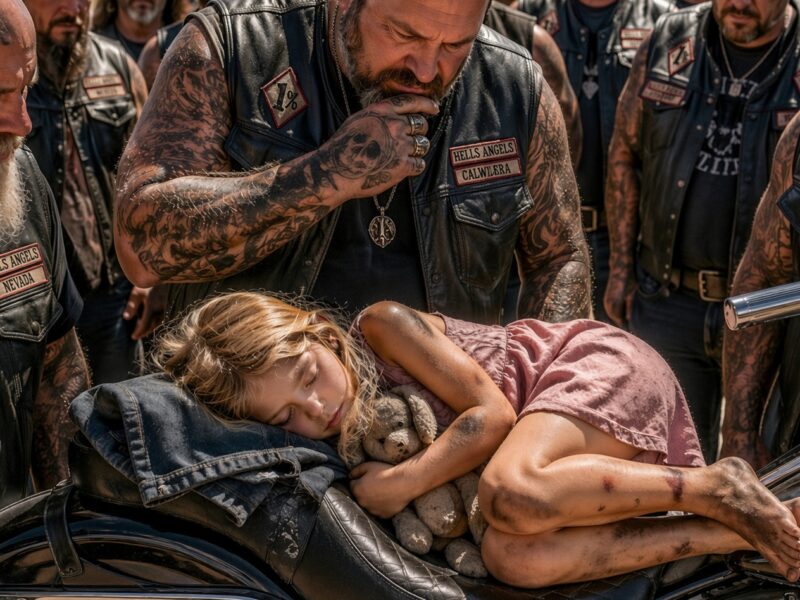
Hells Angels Found a Little Girl Sleeping on Their Bikes — The Reason Made 200 Bikers Go Silent
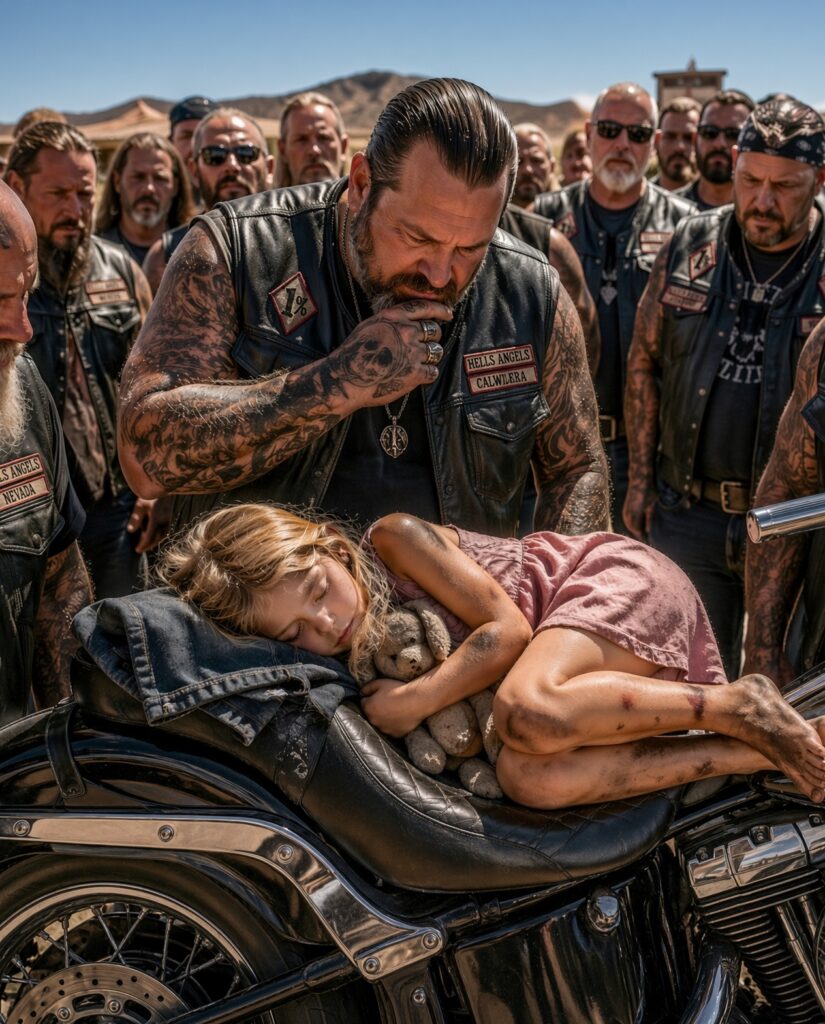
The mid-July sun beat down on the Nevada asphalt like a blacksmith’s hammer, the kind of heat that made the air itself warp and shimmer above the highway.
A procession of two hundred motorcycles tore through the barren landscape, a rolling thunder of chrome, roaring V-twins, and stitched leather that sent sagebrush tumbling across the cracked earth.
This wasn’t a weekend riding club.
This was the Hells Angels, members from the California, Nevada, and Arizona charters merged for a cross-country run that would stretch from Sacramento to Sturgis and back again.
Leading the pack was Big Jim Callahan, a man carved from granite with a face weathered by thousands of miles of wind and hard living.
His arms were wrapped in a tapestry of faded ink that told the story of a life lived strictly on his own terms, and his eyes held the cold calculation of a man who had survived things that would have broken lesser men.
Beside him rode his sergeant-at-arms, Tommy O’Connor, a heavily scarred veteran whose fierce loyalty to the club was legendary, a man who had taken three bullets for the patch and never once complained about the scars.
And Rick Dalton, a younger but equally hardened enforcer, rode on Jim’s other flank, his eyes constantly scanning the horizon for threats that only men like him could sense.
The pack had been riding for six hours straight, the vibration of the engines sinking deep into their bones, the desert heat pressing down on them like a physical weight.
They needed fuel, cold beer, and shade.
Up ahead, rising like a rusty mirage out of the sagebrush, was the Iron Horse Saloon, a sprawling dirt-lot establishment that catered to truckers, drifters, and the occasional lost tourist.
The sign out front flickered with a dying neon horse, and the parking lot was half-filled with eighteen-wheelers and pickup trucks that had seen better decades.
As the two hundred bikers pulled into the lot, the sheer volume of their engines rattled the diner’s plate glass windows, sending dust billowing into the sky and coating the neon signs and parked rigs in a fine gray powder.
Inside the diner, the usual lunchtime chatter died instantly, replaced by the kind of silence that made people pray for invisibility.
Waitresses froze with coffee pots in hand, their eyes wide as they watched the leather-clad army descend.
Patrons stared into their plates, praying the bikers would just pass through without incident, without violence, without the kind of chaos that made small-town newspapers.
Jim kicked down the stand of his custom Harley-Davidson Road King, cut the engine, and pulled off his heavy leather gloves, flexing fingers that had been curled around handlebars for hours.
One by one, the deafening roar of two hundred engines died out, replaced by the symphony of cooling metal, heavy boots crunching on gravel, and the rough booming laughter of men who bowed to no one.
They spent an hour inside, taking over the entire establishment, eating burgers and drinking cheap draft beer and shooting pool on tables that had seen better days.
Despite their intimidating presence, it was a peaceful stop, the kind of pause that made men reflect on the freedom of the open road.
But the peace was a fragile glass that was about to shatter the moment they stepped back outside.
Jim was the first to push through the swinging wooden doors of the saloon, squinting against the harsh afternoon glare as he reached into his vest for a cigarette.
He was chatting over his shoulder with Tommy about the next leg of the route, about the long stretch of highway that would take them through Tonopah and into the heart of Nevada.
But as his eyes adjusted to the sunlight and locked onto his motorcycle, his boots stopped dead in the dirt.
His cigarette dropped from his fingers, landing unnoticed in the dust.
Tommy bumped into him, nearly knocking him off balance.
“What is it, boss?”
Jim didn’t answer, just raised a massive calloused hand and gestured toward his bike.
Draped awkwardly across the wide black leather seat of Jim’s Road King was a filthy oversized denim jacket, the kind that had seen years of hard work and harder living.
It wasn’t club colors.
It was a faded, generic trucker jacket stained with grease and dirt and something that looked disturbingly like dried blood.
But that wasn’t what had stopped Jim Callahan in his tracks.
The jacket was moving.
It was rising and falling in a slow, rhythmic motion, the kind of motion that could only mean one thing.
Someone or something was breathing underneath it.
Instantly, the atmosphere shifted, the relaxed joking demeanor of the bikers vanishing like smoke in a hurricane.
A cold, predatory tension rippled through the crowd as wordlessly dozens of Hells Angels fanned out, their hands instinctively resting on heavy belt buckles, thick chains, or reaching into their cuts.
“Rival club,” Rick Dalton whispered, stepping up beside Jim, his eyes scanning the empty highway and the desert scrub behind the diner.
“Could be a message. Could be rigged. Could be a trap.”
“Nobody touches my bike,” Jim growled, his voice a low, dangerous rumble that made the hair on the back of Rick’s neck stand up.
He stepped forward, his heavy boots crunching loudly in the dead quiet lot, the sound echoing off the diner walls like a gunshot.
Two hundred men watched him, perfectly still, perfectly silent, the kind of silence that preceded violence.
The tension was thick enough to choke on.
Jim stopped right next to the bike, his shadow falling across the denim jacket and whatever lay beneath it.
He reached out with thick, tattooed fingers and pinched the collar of the dirty denim, his jaw set like stone.
He took a breath, bracing for a threat, a bomb, or a gruesome message from an enemy club.
With a swift motion, he yanked the jacket back.
Jim staggered back half a step, the breath knocked out of him more effectively than if he had taken a heavyweight’s punch to the ribs.
Tommy let out a sharp gasp, his hand flying to the knife on his belt.
A collective murmur of profound confusion rippled through the ranks of the gathered bikers, men who had seen everything the world had to offer suddenly rendered speechless.
Curled up on the leather seat, using Jim’s rolled-up sleeping bag as a pillow, was a little girl.
She couldn’t have been older than six, her small body curled into a protective ball against the harsh world.
She was wearing a faded pink sundress that was torn at the hem and covered in dirt, the kind of dress that had once been pretty but had been through hell.
Her bare feet were blistered and caked with dark mud, and her blond hair was a tangled rat’s nest matted with sweat and dust and tiny bits of sagebrush.
But what made Jim’s stomach twist into a cold, hard knot were the bruises.
Dark purple fingerprints were visible on her small, fragile arms, the kind of marks that could only come from a grown man’s grip.
A fading yellow and green bruise painted the left side of her jaw, the kind of bruise that told a story no child should ever have to tell.
In her arms, clutched against her chest like a lifeline, was a ragged one-eyed stuffed rabbit and a crumpled envelope.
The sudden removal of the jacket made the girl stir, her small face scrunching against the blinding Nevada sun.
She squeezed her eyes shut, letting out a soft whimpering yawn that made something deep in Jim’s chest crack.
Then she slowly opened her eyes.
She found herself surrounded by a wall of giant menacing men, men wrapped in black leather and adorned with death’s head skulls and chains and combat boots.
Men who looked like monsters from a child’s nightmare.
Jim braced himself for the inevitable scream, the kind of terror that would echo across the desert and haunt his dreams for years.
He expected her to burst into tears, to shrink away in sheer terror, to do what any sane child would do when confronted by two hundred outlaws.
He slowly raised his hands, palms outward, trying to look as non-threatening as a six-foot-four outlaw biker possibly could.
“Hey there, little one,” Jim whispered, his voice uncharacteristically soft, the kind of voice he reserved for wounded animals and broken things.
“We ain’t going to hurt you.”
But the girl didn’t scream.
She didn’t cry.
She simply sat up, her small hands shaking slightly, her eyes never leaving Jim’s face.
She looked at the giant men with eyes that were far too old for her face, eyes that held a bone-deep exhaustion and a terrifyingly numb acceptance of the world’s cruelty.
She looked directly into Jim’s eyes, sensing with the intuition of a child who had learned to read danger that he was the leader of this terrifying pack.
Without a word, she extended her trembling bruised arm, holding out the crumpled envelope to him.
Jim stared at the small grimy envelope, his mind racing through a thousand possibilities, none of them good.
It had his name written on it in frantic messy handwriting, the kind of handwriting that came from a hand that was shaking with fear.
Jim Callahan, Howzangs.
It wasn’t addressed to the club in general.
It was addressed to him specifically, by name, as if the writer knew exactly who he was and exactly where he would be.
He took the envelope from her delicate fingers, the paper feeling heavy as lead in his hand.
He looked around, scanning the lot for anyone who might be watching, anyone who might have left this child here as bait.
“Where’s your mama, kid?” he asked softly, his voice barely above a whisper.
The girl just shook her head, pulling her stuffed rabbit tighter against her chest, her eyes welling with silent tears that carved clean tracks down her dirty cheeks.
Tommy, get us some water, and tell the diner to bring out some pancakes or something. Move.
Jim barked, his authoritative tone snapping his men out of their stunned stupor.
Tommy sprinted toward the diner, his boots pounding against the gravel, while a few of the older bikers instinctively stepped closer, forming a protective human wall around the bike and the girl.
Jim tore open the envelope, his thick fingers surprisingly gentle on the fragile paper.
Inside was a piece of lined notebook paper stained with what looked suspiciously like drops of dried blood, the kind of blood that came from a split lip or a broken nose.
He unfolded it, his eyes scanning the frantic handwriting, and as he read the words, the harsh Nevada sun seemed to lose its warmth.
The blood drained from his weathered face, and his jaw locked so tightly the muscles fluttered under his beard.
Rick stepped closer, noting the terrifying shift in his president’s demeanor, the kind of shift he had only seen a handful of times in twenty years.
“Boss, what is it? Who left her here?”
Jim didn’t look up from the letter.
“Her name is Lily,” he said, his voice dropping to an octave that made the hair on the back of Rick’s neck stand up.
Jim slowly raised his head, looking around at the two hundred brothers surrounding him, men who had ridden with him through hell and back.
He cleared his throat and began to read the letter aloud, his voice carrying across the silent lot like a funeral bell.
“Jim, you might not remember me, but I remember you. My name is Sarah Harper. I was a waitress at the Broken Spoke down in Fresno ten years ago.”
“When my old man, Rusty Miller, got sick, you and your boys quietly paid his hospital bills so he wouldn’t die in the street. You told me the club takes care of its own, even the ghosts.”
“I’m begging you now to take care of my ghost.”
“By the time you find my daughter, Lily, I will likely be dead.”
“My husband David Trent is a sheriff’s deputy in Washoe County. Everyone thinks he’s a hero. He’s not. He’s a monster.”
“He has been running girls and narcotics across the border using his badge as a shield. I found his ledgers. I found out what he was doing. He found out that I know.”
“He beat me nearly to death last night, but I managed to escape with Lily while he was coordinating a drop. He has the whole county police force in his pocket.”
“I can’t go to the cops. I can’t go to the FBI. He intercepts the local dispatch.”
“I tracked your run schedule through a friend. I hid her on your bike while you were inside. Trent is hunting us with tracking dogs and corrupt deputies right now.”
“If he finds Lily, he will kill her to punish me or worse, sell her into the very rings he protects to ensure my silence.”
“You are outlaws. I know that, but I also know you have a code.”
“Please, Jim, take her away from here. Hide her. Protect her. She is an innocent.”
“Please, don’t let my little girl pay for my mistakes.”
Jim finished reading and slowly lowered the letter, his hands trembling with a rage he hadn’t felt in years.
For ten seconds, there was absolute ringing silence.
Two hundred men known for chaos and brawling and lawlessness stood as still as statues, the only sound the wind whistling through the sagebrush and the faint tick-tick of the motorcycle exhaust pipes cooling down.
No one spoke.
They didn’t need to.
The Hells Angels operated on a fringe of society that was dark and violent, but there were lines.
Children were sacred.
A man who put his hands on a woman or a child was considered lower than dirt, a target worthy of no mercy.
Then a badge who did it while hiding behind the law.
That ignited a specific, terrifying kind of fury in the hearts of outlaws who had spent their lives being hunted by the very system that was supposed to protect the innocent.
Tommy pushed his way back through the crowd holding a cold bottle of water and a plate of scrambled eggs, his face twisted with confusion.
He froze when he saw the faces of his brothers, the kind of faces that meant someone was going to bleed.
“What happened?” he asked, looking at Jim.
Jim handed the letter to Tommy, watching as the vice president’s eyes scanned the words.
As Tommy read, his face contorted into a mask of pure, unadulterated rage, the kind of rage that made men do terrible things.
He looked at the little girl, taking in the bruises on her arms and jaw once more, his massive hands clenching into fists.
“Is this true, Lily?” Jim asked, crouching down so he was eye level with the girl still sitting on his bike.
“Did your stepdaddy do this to you?”
Lily hesitated, her small eyes flicking between the giant men who surrounded her.
She looked at the tough men, then down at her rabbit, her small fingers stroking the worn fur.
She gave a small, almost imperceptible nod.
“He… he hit Mommy with a heavy flashlight,” she whispered, her voice tiny and hoarse, the voice of a child who had learned to be quiet.
“Mommy told me to stay under the jacket and not make a sound until the loud motorcycle stopped. She said the giant men would keep the bad police away.”
A young prospect named Jesse Bowman, barely twenty-one and standing near the back, cracked his knuckles, the sound loud in the quiet air.
“So, what’s the play, boss?” Jesse asked, his voice shaking with adrenaline and something that might have been fear.
“We can’t just leave her.”
“Leave her?” Rick Dalton scoffed, spitting in the dirt with disgust.
“If we leave her, that badge is going to put her in a shallow grave next to her mother.”
Jim stood up to his full height, his shadow stretching across the dirt lot like a promise.
He looked at his men, two hundred pairs of eyes staring back at him, waiting for the command.
They knew the risks.
Aiding and abetting a fugitive, kidnapping in the eyes of the corrupt law, directly clashing with armed dirty police officers.
It could mean life in prison.
It could mean a shootout where brothers died.
But as Jim looked back at Lily, who was now tentatively sipping the water Tommy had given her, the decision was already made.
“Listen up,” Jim roared, his voice echoing off the diner walls and the distant mountains.
“We got a change of plans. The Nevada run is officially suspended. We are now a protective escort.”
“Tommy, you and the Arizona boys take the vanguard. Rick, you and the San Joaquin charter take the rear. We put the girl in the center of the pack.”
“Boss,” Tommy interrupted, looking out toward the horizon, his eyes narrowed against the glare.
“We might have a problem.”
Jim turned, following Tommy’s gaze.
About two miles down the long straight stretch of desert highway, the unmistakable shimmer of red and blue lights was breaking through the heat waves.
It wasn’t just one car.
It was a fleet of four Washoe County Sheriff’s cruisers tearing down the asphalt at ninety miles per hour, heading directly for the Iron Horse Saloon.
David Trent had found them.
“Mount up,” Jim bellowed, his voice carrying across the lot like thunder.
“Nobody fires first, but if those dirty badges try to take this girl, you make damn sure they don’t leave this parking lot.”
The silence of the bikers was instantly shattered.
Two hundred men moved in perfect lethal synchronization, the kind of coordination that came from years of riding together, fighting together, bleeding together.
They didn’t run.
They marched to their bikes with a terrifying deliberate purpose, their faces set like stone.
Engines roared to life, a deafening mechanical war cry that shook the air and sent birds scattering from the sagebrush.
Jim gently lifted Lily off the seat, his massive hands surprisingly gentle on her small frame.
“Hold on to me tight, kid,” he said, wrapping a spare thick leather vest around her small shoulders to protect her from the wind and whatever else was coming.
He set her in front of him on the gas tank, shielding her with his massive body, his arms forming a cage of muscle and ink.
“Are you going to let the bad man take me?” Lily asked, burying her face into Jim’s chest, her small voice muffled by leather and denim.
Jim kicked his bike into gear, gripping the handlebars as the two hundred bikers formed an impenetrable wall of iron and flesh between his bike and the highway entrance.
“No, Lily,” Jim growled, his eyes locked on the approaching police sirens, his jaw set like a bear trap.
“They have to go through us first. And nobody goes through us.”
The Washoe County Sheriff’s cruisers skidded into the dirt lot of the Iron Horse Saloon, their tires locking and kicking up a massive cloud of gray dust that washed over the front lines of the Hells Angels.
The sirens died with a series of sharp mechanical yelps, leaving only the low guttural growl of two hundred idling Harley-Davidsons.
The cruisers were parked aggressively, angled to block the highway exit, their doors popping open in unison.
Four deputies stepped out, their hands resting on their holstered weapons, their eyes wide as they took in the wall of leather and muscle before them.
Leading them was a tall, broad-shouldered man with a high and tight haircut, aviator sunglasses, and a sharply pressed tan uniform.
His brass nameplate glinted in the sun.
Trent.
David Trent rested his right hand casually on the grip of his holstered service weapon, the kind of casual that was anything but.
He walked forward with the swagger of a man who owned the county, completely accustomed to people cowering the moment he flashed his badge.
But as the dust settled, Trent’s swagger faltered for a fraction of a second.
He wasn’t facing a handful of scared civilians.
He was facing a solid wall of leather and denim and tattooed muscle.
Two hundred members of the Hells Angels shoulder to shoulder, their faces completely unreadable, their eyes locked on him with predatory stillness.
In the center of the formation, towering over his bike, stood Jim Callahan.
Little Lily was hidden securely behind Jim’s massive frame, clutching Tommy O’Connor’s leather vest around her small shoulders.
“Afternoon, gentlemen,” Trent called out, his voice dripping with forced authority, the kind of voice that came from years of bullying people who couldn’t fight back.
He stopped about twenty feet from the biker front line, his three deputies fanning out behind him, looking significantly less confident than their boss.
“I’m Deputy Trent. We got a call about a missing child in the area. A little girl, blonde, pink dress.”
Jim didn’t say a word.
He just stared down at the dirty cop, taking a slow drag from a fresh cigarette he’d lit moments before, the smoke curling around his weathered face like a veil.
Trent’s jaw tightened, his patience wearing thin.
“Now, I see a lot of saddlebags and a lot of places a scared little girl could hide. I’m going to need to inspect this convoy.”
“No warrants, no searches,” Jim rumbled, his voice easily carrying over the idling engines.
“This is a private ride, Deputy. You’re interrupting.”
“I don’t need a warrant to search for a kidnapped minor,” Trent snapped, his polite facade cracking like old paint.
He took two steps forward, his hand gripping his gun a little tighter.
“I know she’s here. I tracked the mother’s scent with the canines right up to the diner, and the diner folks said a little girl was sleeping on one of your bikes.”
“Hand her over, Callahan, or I arrest every single one of you for accessory to kidnapping.”
A low collective chuckle rumbled through the ranks of the bikers, a terrifying sound that was dark and mocking and utterly devoid of fear.
Rick Dalton stepped out from the line, spitting a sunflower seed into the dirt near Trent’s boots.
“You’re going to arrest two hundred men with three deputies? You better call the backup, badge. A lot of it.”
Trent sneered, his face twisting with contempt.
“I have the entire county police force on speed dial. You want to spend the rest of your miserable lives in a state penitentiary? Produce the girl. Now.”
“The only place this girl is going,” Jim said, his voice dropping to a dangerous gravelly whisper, “is far away from you.”
Jim stepped aside just enough for Trent to see Lily sitting on the gas tank of the Road King, her small body trembling.
Lily let out a terrified whimper and buried her face into the leather vest, her small body shaking violently.
“Lily, baby, it’s Daddy,” Trent said, suddenly putting on a sickeningly sweet voice, the kind of voice that made snakes seem trustworthy.
“Come here, sweetheart. Your mom is worried sick.”
“Her mom is bleeding out on a floor somewhere because you put a Maglite to her skull, you piece of garbage,” Tommy snarled, stepping up beside Jim, his hand resting on the combat knife at his belt.
The color drained from Trent’s face, his secret exposed in front of his deputies.
The three deputies behind him exchanged nervous, confused glances, their confidence wavering.
“I don’t know what lies that woman told you,” Trent barked, drawing his gun and pointing it directly at Jim’s chest.
The three deputies, operating on pure adrenaline and training, instantly drew their weapons as well.
The atmosphere in the parking lot snapped like a dry branch.
The bikers didn’t run.
They didn’t put their hands up.
Instead, a metallic symphony echoed through the lot.
Heavy chains were unspooled from belts, the links clinking with deadly promise.
Thick steel crowbars were pulled from saddlebags, catching the desert sun.
Large hunting knives appeared in calloused hands, their blades gleaming.
Jesse Bowman, the young prospect, racked the slide of a heavy sawed-off shotgun he’d pulled from a custom scabbard, the sound loud and final.
Two hundred heavily armed outlaws against four cops.
“Lower the weapons, deputy,” Jim said, completely unfazed by the barrel of the Glock pointed at his heart.
“You pull that trigger, you might get me. But I promise you, neither you nor your boys will live long enough to hear the shell casing hit the dirt.”
“You’re protecting a fugitive and holding a child hostage,” Trent screamed, sweat pouring down his face as the reality of the situation finally sank in.
His deputies were shaking, their guns wavering as they looked at the sheer overwhelming odds.
“I am the law out here.”
“You ain’t the law,” Jim replied coldly, pulling Sarah’s blood-stained letter from his pocket and tossing it into the dirt at Trent’s feet.
“You’re a cartel mule with a tin star. We know about the ledgers. We know about the border drops. And now we know about you beating women.”
Trent stared at the letter in the dirt, his eyes going wide as his secret was laid bare.
His secret was out, and it was in the hands of the most dangerous men in the state.
Cornered, desperate, and losing his mind, Trent’s finger tightened on the trigger.
He was going to shoot Jim, grab the girl, and try to shoot his way out.
It was a suicidal plan, but it was the only one he had left.
“Boss,” Tommy warned, his hand gripping the handle of a heavy combat knife.
Trent closed one eye, aiming dead center at Jim’s chest.
“Last chance, biker trash.”
“I wouldn’t do that, David.”
The voice didn’t come from the bikers.
It came from behind the deputies.
Trent whipped his head around, his face contorting with confusion and fear.
Tearing down the opposite side of the highway, completely silent with no sirens, but with blue and red lights blazing, were six unmarked black Chevrolet Tahoes.
They swerved violently into the dirt lot, boxing in the Washoe County cruisers.
Before the SUVs had even fully stopped, the doors flew open.
A dozen men in tactical gear, wearing bulletproof vests emblazoned with three bold yellow letters, FBI, swarmed the lot.
They were armed with M4 carbines, and every single weapon was trained on Trent and his deputies.
“Federal agents, drop your weapons. Drop them now,” a booming voice commanded over a megaphone.
Walking calmly out of the lead SUV was Special Agent Frank Donovan.
He was an older, no-nonsense fed who had spent his career dismantling cartels and putting dirty cops behind bars.
Jim Callahan finally allowed a tight, grim smile to cross his face.
Twenty minutes earlier, while he was reading Sarah’s letter inside the diner, he had quietly handed a burner phone to his youngest prospect.
He told the kid to call a number he kept hidden in his wallet, a direct line to Agent Donovan in the Las Vegas field office.
Jim had worked with Donovan once before, feeding him intel on a rival cartel that was stepping on Hells Angels territory.
They weren’t friends, but Donovan knew Jim Callahan didn’t lie about dirty cops.
Trent’s deputies immediately dropped their guns, raising their hands in surrender.
They wanted no part of a federal shootout.
Trent, however, was frozen.
He looked at the FBI agents, then back at Jim, his gun still raised in the air.
“Put it down, Trent,” Agent Donovan barked, stepping forward.
“We raided your house ten minutes ago. We found the ledgers hidden in the floorboards.”
“We also found your wife. Paramedics have her. She’s in rough shape, but she’s going to make it.”
At the news that her mother was alive, a tiny, ragged gasp escaped Lily’s lips.
She clutched Jim’s leather vest tighter, crying tears of pure relief.
Trent’s shoulders slumped.
The empire he had built on corruption and fear had just crumbled into dust in the middle of the Nevada desert.
Defeated, he let his gun fall to the gravel.
Two federal agents immediately tackled him to the dirt, viciously wrenching his arms behind his back and snapping heavy steel cuffs onto his wrists.
Trent’s face was pressed into the very dirt he had threatened to bury his stepdaughter in.
Agent Donovan walked over to the biker front line.
The Hells Angels slowly lowered their chains and weapons, though they didn’t put them away entirely.
“Callahan,” Donovan said, nodding at the massive biker president.
“Donovan,” Jim replied, his voice flat.
“Took you long enough.”
“Las Vegas is a long drive, Jim. You’re lucky I had a tactical unit running drills in Carson City.”
Donovan looked past Jim and saw the little girl sitting on the motorcycle.
His hard eyes softened.
“Is that the kid?”
“Yeah, that’s Lily,” Jim said.
He turned and gently picked the little girl up off the bike.
She was still trembling, but the terror in her eyes had faded.
Jim walked forward and knelt in the dirt so he was eye level with her.
“Listen to me, Lily,” Jim said, his massive hands gently resting on her tiny shoulders.
“The bad man is going away for a very long time. He can never hurt you or your mama ever again.”
“This man here is going to take you to the hospital to see your mom. You understand?”
Lily looked at Donovan, then back at Jim.
She nodded slowly, then did something that made two hundred hardened outlaws collectively hold their breath.
She stepped forward and wrapped her tiny arms around Jim’s massive tattooed neck.
She hugged him with all the strength she had left.
“Thank you, giant man,” she whispered into his leather vest.
Jim Callahan, a man who had survived prison riots and high-speed crashes and the kind of violence that would break most men, felt a sudden lump form in his throat.
He awkwardly patted her back, his massive hand nearly covering her entire small frame.
“You’re a tough kid, Lily. Take care of your mama.”
Lily pulled back, her small face serious.
She looked down at the dirty, one-eyed stuffed rabbit she had been carrying all day.
She held it out to Jim.
“For keeping me safe.”
Jim took it gently from her hands, his thick fingers surprisingly careful with the worn fabric.
“I’ll guard it with my life, kid.”
Agent Donovan gently took Lily’s hand and led her toward an SUV.
He turned back to Jim.
“Technically, I should run the names of every man here. I’m sure a few of these guys have outstanding warrants.”
Jim stood up, slipping the stuffed rabbit into the breast pocket of his cut.
“We were just having some lunch, Frank. Saw a kid. Made sure she was safe. Civic duty.”
Donovan smirked, shaking his head.
“Yeah, civic duty. I suggest you boys finish your lunch and get back on the road.”
The federal convoy pulled out of the dirt lot, sirens blaring again, heading back toward civilization to reunite a little girl with her mother.
Jim watched them go, then turned back to his men.
Two hundred bikers stood in absolute silence, waiting.
“All right, boys,” Jim roared, his voice carrying across the desert.
“Run’s back on. Let’s ride.”
The deafening thunder of two hundred V-twin engines exploded to life as the Hells Angels pulled out onto the highway, riding toward the horizon.
They left behind a ruined corrupt cop and a story that would be whispered in biker bars for decades to come.
They were outlaws, yes.
But on that hot July day, they were a little girl’s guardian angels.
—
The story spread like wildfire through the underground network of motorcycle clubs, from the dive bars of Reno to the backrooms of Chicago to the sun-scorched garages of Southern California.
Within a week, every chapter of the Hells Angels from coast to coast had heard about Big Jim Callahan and the two hundred bikers who had stood down four armed deputies to protect a six-year-old girl.
Within a month, the story had crossed the ocean, reaching clubs in London and Berlin and Sydney.
The details varied depending on who was telling it, each retelling adding new layers of mythology.
Some said there were five hundred bikers, not two hundred.
Some said Jim Callahan had personally disarmed Trent with his bare hands.
Some said the FBI had been in on the plan from the beginning, that the whole thing was a coordinated sting.
But the core of the story remained the same, the part that mattered, the part that made hardened men in leather vests grow quiet and thoughtful.
A little girl had been hurt.
A badge had done the hurting.
And two hundred outlaws had said no.
The stuffed rabbit sat on Jim Callahan’s mantle for years, a one-eyed sentinel watching over a man who had spent his life on the wrong side of the law.
He never washed it, never repaired the torn ear or the missing eye or the worn patch where Lily had clutched it against her chest.
It was perfect the way it was.
When reporters came around, years later, asking about the day at the Iron Horse Saloon, Jim would just shrug and say he didn’t remember much.
“We were just having lunch,” he’d say, his weathered face giving nothing away.
“Saw a kid. Made sure she was safe.”
But the rabbit on the mantle told a different story.
It told the story of a man who had built his life on rebellion and violence, who had spent decades fighting the system, who had the tattoos and the scars and the prison record to prove it.
And who, on one hot July day in the Nevada desert, had looked at a bruised and terrified little girl and made a choice.
The choice wasn’t about the law.
It wasn’t about politics or publicity or public relations.
It was about something older and deeper and more fundamental, something that transcended the patch on his back and the colors he wore.
It was about the simple, undeniable truth that children were sacred.
That innocence deserved protection.
That some lines, once crossed, could never be uncrossed.
Sarah Harper survived her injuries.
She spent three weeks in a Reno hospital, her body slowly healing from the damage her husband had inflicted.
She testified against David Trent at his trial, her voice steady despite the terror in her eyes.
Trent was convicted on seventeen counts, including attempted murder, child endangerment, drug trafficking, and human trafficking.
He was sentenced to forty-seven years in federal prison, the kind of sentence that ensured he would die behind bars.
The ledgers he had kept, the meticulous records of his crimes, brought down eleven other corrupt officers in Washoe County.
The FBI launched a sweeping investigation into law enforcement corruption across northern Nevada, resulting in thirty-two arrests and the dismantling of a network that had been operating for years.
Sarah and Lily moved to a small town in Oregon, far from the desert and the memories and the fear.
Sarah got a job at a diner, waiting tables like she had before, but this time with a future that didn’t include a man who hurt her.
Lily grew up, the bruises fading, the nightmares slowly diminishing, the terror of that day in the desert becoming a distant memory.
But she never forgot the giant man with the tattoos and the leather vest who had shielded her with his body.
She never forgot the two hundred bikers who had formed a wall between her and the monster who wanted to hurt her.
When she turned eighteen, she wrote a letter to Jim Callahan, care of the Hells Angels clubhouse in Oakland.
She told him she had graduated high school with honors.
She told him she was going to college to study social work, to help children who had been through what she had been through.
She told him she still had the pink sundress, the one she had been wearing that day, tucked away in a box of keepsakes.
She told him she thought about him often, about the day he had saved her life, about the rabbit he had promised to guard with his life.
Jim Callahan read that letter three times, his weathered face unreadable.
Then he walked to his mantle, picked up the one-eyed rabbit, and held it in his massive hands.
He was getting older now, his beard more gray than brown, his hands more scarred than they had been.
The club had changed, too, some of the old ways giving way to new realities, new challenges, new battles.
But the rabbit remained the same, a reminder of a day when everything had been simple, when right and wrong had been clear, when two hundred outlaws had stood together and said no to a monster.
Jim Callahan carefully placed the rabbit back on the mantle, adjusting it so it faced the room.
Then he sat down at his desk, pulled out a piece of paper, and began to write.
He wrote to Lily about the day at the Iron Horse Saloon, about the fear and the rage and the decision.
He wrote about the letter from her mother, about the words that had changed everything.
He wrote about the moment she had hugged him, her tiny arms around his neck, her voice whispering thank you.
He wrote about what it meant to him, to a man who had spent his life on the wrong side of the law, to be called a guardian angel by a child.
He wrote about the rabbit, about the promise he had made, about the fact that he had kept it all these years.
He wrote about what it meant to be a man, a real man, not the kind of man who wore a badge and hurt women and children.
He wrote about the code, the unwritten rules that governed the lives of outlaws, the things that mattered more than money or power or respect.
He wrote about how proud he was of her, of the woman she had become, of the life she was building.
He wrote about how he would always be there, if she ever needed him, no matter what.
He signed it simply: Jim.
He mailed the letter the next day, and then he went back to his life, to the club, to the road.
But something had changed.
The story of Lily and the two hundred bikers had become a legend, a tale told around campfires and in clubhouses and in the kind of bars where men in leather vests gathered to drink and remember.
And Jim Callahan, the man who had led those two hundred bikers, had become something more than an outlaw.
He had become a symbol of the code, of the unwritten laws that governed the lives of men who lived outside the system.
He had become proof that even outlaws had lines they wouldn’t cross, that even men who had spent their lives fighting the law had things they would fight for.
The years passed, as they always do.
Jim Callahan grew older, his body finally starting to betray him after decades of hard living and harder riding.
The club elected new leadership, younger men with new ideas and new battles.
Jim stepped back, becoming an elder statesman of sorts, a living legend who was consulted on matters of importance.
He never married, never had children of his own.
But he had Lily, in a way, and the other children like her, the ones whose stories never made the news, the ones whose lives had been touched by the strange and unexpected kindness of outlaws.
When Jim Callahan died, at the age of seventy-three, of a heart attack in his sleep, the Hells Angels held a funeral that was legendary even by their standards.
Five thousand bikers from around the world descended on Oakland, a sea of leather and chrome and roaring engines.
They rode in a procession that stretched for miles, from the clubhouse to the cemetery, a final tribute to a man who had meant something to all of them.
Lily was there, standing in the crowd, a woman of forty now, with children of her own.
She had brought her daughter, a little girl of six with blond hair and a pink dress and a stuffed rabbit.
She had told her daughter about Jim, about the giant man with the tattoos who had saved her life, about the two hundred bikers who had formed a wall to protect her.
She had told her about the rabbit, the one-eyed rabbit that Jim had promised to guard with his life.
She had told her about the letter, the one she had written to him, and the letter she had received in return.
Lily walked to the grave after the ceremony, after the engines had fallen silent and the crowd had dispersed.
She knelt in the grass, her daughter beside her, and placed a small pink sundress on the grave.
It was the dress she had been wearing that day, the day Jim Callahan had found her sleeping on his motorcycle, the day everything had changed.
She stayed there for a long time, remembering, grateful, changed.
Then she stood up, took her daughter’s hand, and walked back to the car.
The story of Jim Callahan and the two hundred bikers didn’t end with his death.
It lived on, in the clubs and the bars and the roadhouses, in the stories that bikers told their sons and their grandsons.
It lived on in the code, the unwritten rules that governed the lives of men who lived outside the system.
It lived on in the lives of the children who had been protected, saved, changed by the strange kindness of outlaws.
The story was a reminder, a lesson, a warning.
It was a reminder that heroes came in unexpected forms.
It was a lesson that right and wrong were not always defined by the law.
It was a warning to anyone who thought they could hurt the innocent without consequence.
Because there were two hundred bikers in the Nevada desert who had proven otherwise.
Two hundred bikers who had stood together, their hands on their weapons, their eyes locked on a dirty cop.
Two hundred bikers who had said no.
And at the center of it all, a little girl sleeping peacefully on a custom Harley, clutching a one-eyed rabbit and a crumpled envelope.
The rabbit sat on Jim Callahan’s mantle for decades.
When he died, it passed to Lily, the woman who had once been the girl, the child who had been saved.
She kept it on her own mantle, in her own home, in the small town in Oregon where she had built a life.
Her children knew the story, the story of the giant man and the two hundred bikers and the day everything changed.
They knew about the code, about the things that mattered more than money or power or respect.
They knew about their mother, the little girl who had been saved, the woman who had become a social worker, who spent her life helping children who had been through what she had been through.
The story was their inheritance, their legacy, their reminder of who they were and where they came from.
The story was proof that even in the darkest corners of the world, there was light.
The story was proof that even outlaws had hearts.
The story was proof that sometimes, the most unlikely people were the ones who made the biggest difference.
And somewhere, in a clubhouse in California, in a bar in Nevada, in a garage in Arizona, the story was still being told.
A story of two hundred bikers and a little girl and a day that changed everything.
A story of the Hells Angels and the child they saved.
A story of the code.
A story of the rabbit.
The one-eyed rabbit that Jim Callahan had promised to guard with his life.
The rabbit that had become a symbol of everything the club stood for, everything the club believed in, everything the club would fight for.
The rabbit that sat on a mantle in a small town in Oregon, watching over the woman who had once been a girl, the child who had been saved, the innocent who had found a family in the most unexpected place.
The rabbit that reminded everyone who saw it that sometimes, the most important things in life were the smallest, the most fragile, the most precious.
The rabbit that reminded everyone that heroes came in all shapes and sizes.
The rabbit that reminded everyone that even outlaws could be guardian angels.
And that was the story.
That was the story of the Hells Angels and the little girl and the day that made two hundred bikers go silent.
That was the story that would be told for generations, passed down from father to son, from mother to daughter, from rider to rider.
That was the story that would never die.
—









