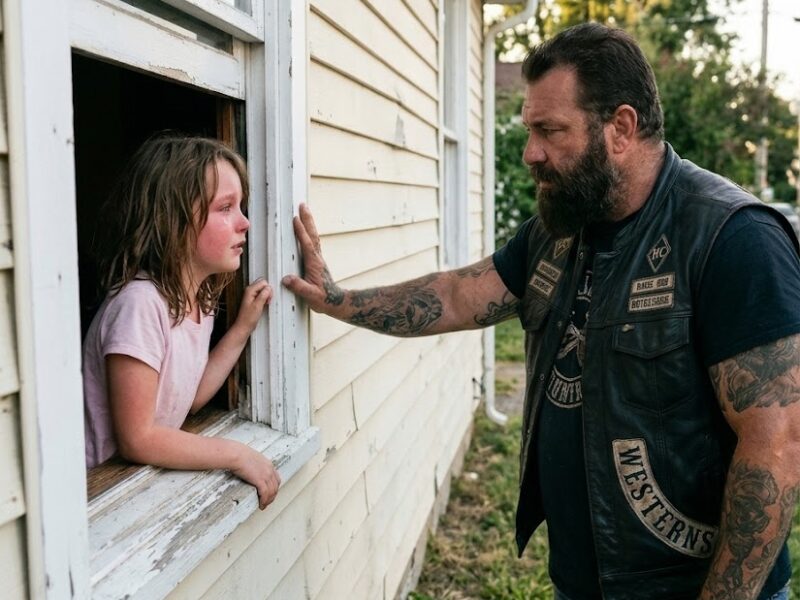
“He Told Me Not to Open the Door for Anyone” — The Girl Whispered Through the Window
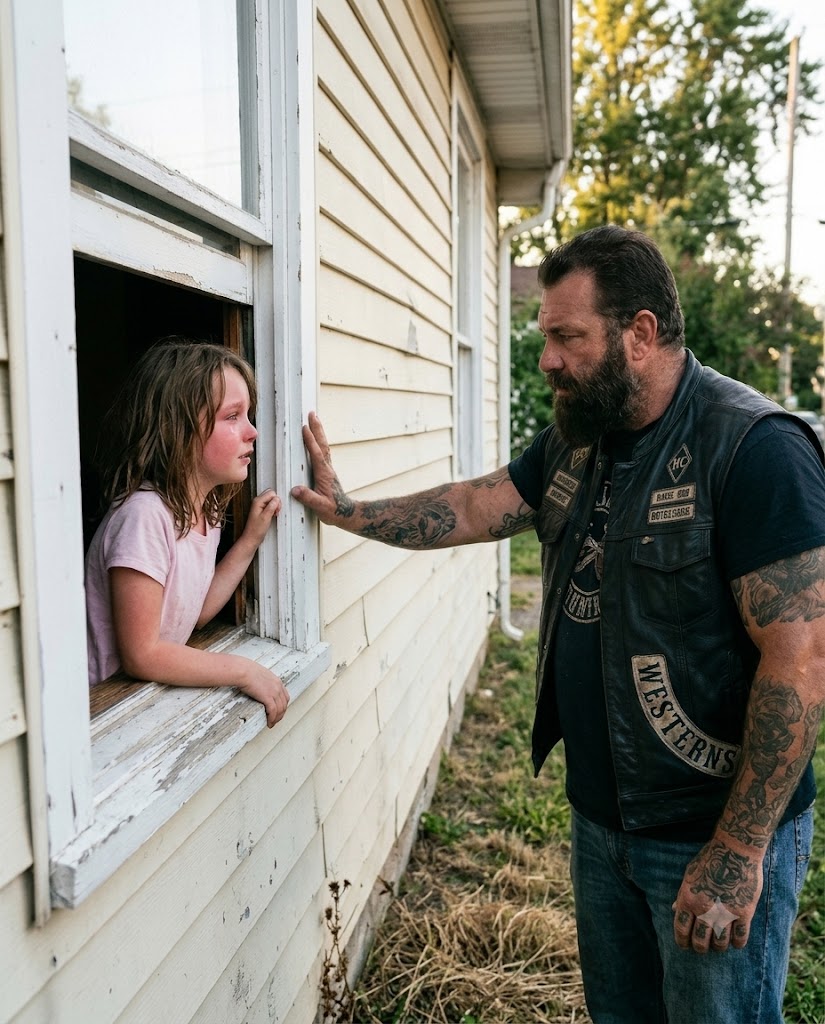
The girl pressed her palm against the glass and I saw the frost break around her fingers.
“He told me not to open the door,” she whispered. “For anyone.”
Behind me, an engine idled at the curb, low and patient.
Its headlights were off, but I could smell the exhaust curling up the hill in the freezing air.
I’d been home for four minutes.
I’d never even met this child.
And somewhere in the dark, a man who knew exactly where she was hiding was deciding to knock.
The girl looked past my shoulder and her whole face changed.
“Mom,” she breathed. “Please don’t turn around.”
—
The wind came off Lake Superior like it had a grudge.
Audrey Whitfield felt it the moment she stepped out of her car at the top of the hill, a razor of cold that slid between her scarf and her collar and straight down her spine.
It was 11:40 on the Tuesday before Thanksgiving and she had spent thirteen hours at St. Luke’s adjusting ventilators for people who could not breathe on their own.
Her scrubs smelled like hand sanitizer and burnt coffee.
All she wanted was a hot shower and a bed.
Below her, Duluth tumbled down the hillside in crooked rows of streetlights toward the black water.
Somewhere out in the dark, the foghorn by the aerial lift bridge gave its long, low groan.
Eight months she had lived on this steep street and she could name exactly one neighbor.
That was how she liked it.
After the divorce, after the lawyers and the split furniture, Audrey had decided that quiet was a kindness she could give herself.
She nodded at people.
She did not stay to talk.
She climbed the porch steps with her key in her hand and she stopped.
Something had tapped on glass.
It was so soft she almost decided she had imagined it.
Then it came again.
Three small taps.
And beneath it a sound so thin it barely counted as a sound at all.
*Mom.*
Audrey went completely still.
The voice was coming from her left, from the gap of six feet between her porch and the house next door.
That house had been dark since before she moved in.
A gray two-story with peeling paint and a for-sale sign that the first snow had flattened.
Marjorie Tate, the one neighbor Audrey knew, had told her the old woman who lived there had died years ago and that her son could never bring himself to sell.
In the small ground-floor window, level with her railing, a curtain had been pulled back an inch.
A child’s face hung in the dark behind the glass, pale as paper, framed by two lopsided braids the color of wet sand.
A small hand was pressed flat against the pane and the frost around her fingers had melted into a ragged circle.
“Oh,” Audrey said.
“Oh, honey.”
“Please don’t yell,” the girl whispered.
Her voice shook but she kept it low and careful, like someone who had been practicing quiet for a long time.
“I’m not supposed to talk to anybody.”
Audrey took a step toward the stairs, meaning to go straight to that front door, and the girl said sharply, “Don’t—don’t go to the door.”
Audrey froze.
“He told me not to open the door for anyone,” the girl said.
Her eyes were enormous and very blue.
“He said anyone, so I can’t. I’m sorry. But I’m so hungry and nobody’s come and I saw your kitchen light. You look tired but nice.”
A laugh tried to rise in Audrey’s chest and came out as a breath.
“What’s your name, sweetheart?”
“Emma.”
“Emma, I’m Audrey. Who told you not to open the door?”
“My dad. He said he’d be back in one night. That was Saturday.”
Audrey did the math and the math was terrible.
Three nights in an empty house in a Minnesota November with the furnace surely shut off.
She could see now that the girl wore a yellow winter coat that hung to her knees, zipped to the chin, and that she was shivering inside it.
“Emma, listen. I’m going to get you food and a blanket. You don’t have to open the door. You only have to open this window just a crack. Can you do that?”
The girl hesitated, a nine-year-old weighing a rule against a stomach.
“The window isn’t a door,” she said finally.
“No,” Audrey agreed. “The window isn’t a door.”
The sash groaned up two inches.
—
Audrey ran inside and moved through her kitchen faster than she had moved all day.
Chicken noodle soup into a thermos, two slices of buttered bread, the heavy gray wool blanket from her couch.
She packed it all into a canvas grocery bag, tied the handles to the end of a long garden rake from the mudroom, and carried it back to the porch.
It took three tries to swing the bag across the gap.
On the third, a small hand shot out and caught it.
For a few minutes there was only the wind and a child eating the way hungry children eat, too fast, with a hiccup of a sob caught in the middle.
Audrey leaned against the porch post and did not trust her voice.
She was a respiratory therapist.
She had spent eleven years watching people fight for air.
She knew what it looked like when someone had been holding their breath for a very long time.
“Emma,” she said at last. “Does your dad have a phone I can call?”
“He took a different one. A black one.”
Emma wiped her mouth with her glove.
“But he left me a paper. If he doesn’t come back by Thursday, I’m supposed to give it to a policeman, only one. Officer Owen Sutter. He said not to talk to any other ones.”
“Why not?”
“Because of Mr. Pruitt,” Emma whispered, and the name fell out of her like something cold.
“Mr. Pruitt knows people.”
An engine rumbled below and Audrey turned her head.
A gray pickup sat at the curb, forty feet down the hill.
Its headlights were off.
Exhaust curled from the tailpipe in a slow white ribbon, and behind the windshield she could see the outline of a man’s shoulders, perfectly motionless, his face turned toward the dark house next door.
He was not looking at Audrey.
He was looking at the window.
Her skin went tight.
Slowly, she turned back.
Emma had gone rigid behind the glass, one hand clamped over her own mouth, her eyes fixed on something over Audrey’s shoulder.
“Mom,” Emma breathed through her fingers, barely a sound at all.
“Please don’t turn around again.”
—
Audrey did not sleep.
She sat in her dark living room with the curtains open a finger’s width and watched the gray truck.
It stayed fifty-one minutes.
She knew because she watched the clock on the cable box the whole time, counting the way she counted breaths per minute at work.
When it finally rolled away toward the lake, she let out a breath so long it made her dizzy.
Then she crept to the porch, whispered across the gap that Emma should wrap herself in the blanket and sleep, and heard a small voice answer, “Okay.”
By six a.m. the sky over the water had gone the color of dishwater.
Audrey made coffee she did not drink and stared at her phone.
She could dial 911.
That was what any reasonable person would do.
A child alone in an abandoned house, a stranger idling outside in the night.
It was a textbook emergency.
But she kept hearing Emma’s voice.
*Mr. Pruitt knows people.*
Audrey had been married to a man who knew people.
Her ex-husband could erase a parking ticket with one phone call, and she remembered the cold clarity of learning that a system you trusted was really a handful of friends.
She did not know whether a nine-year-old’s fear could be trusted, but the fear was real.
Nobody could fake the way Emma had gone rigid at the sight of that truck.
At seven a.m. she called in sick for the first time in four years.
Then she packed a second bag with oatmeal, an orange, water, and wool socks, and went out to find the little face already waiting in the window.
“He came back,” Emma whispered. “The man in the truck.”
“Before it was light, he walked all the way around the house. He tried the back door.”
Audrey’s stomach dropped.
“Did he see you?”
“I hid in the closet under the stairs like Dad said. I counted to a thousand. Twice.”
Emma held up a sock as though it were treasure.
“He didn’t get in. The door has three locks.”
—
They talked in pieces across the gap through a window open two inches.
Audrey learned that Emma’s mother had died when Emma was four, and that her father, Frank Sanderson, kept books for a company called Pruitt Hauling and Excavation.
Two weeks ago something had changed in him.
He stopped sleeping.
He locked the kitchen door at dinner.
He carried a gray folder everywhere.
“He said if anybody asked, I should say I didn’t know where his work papers were,” Emma said.
“But I did. They were in my backpack.”
A cold weight settled in Audrey’s chest.
“Where’s the backpack now?”
“In the closet. With me.”
Audrey did not ask what was inside.
She was not ready for the answer.
At nine a.m. her doorbell rang.
She went to the front window and the man on her porch looked back and smiled.
He was in his mid-forties, broad through the shoulders, in a neat gray wool coat with the clean, easygoing face of a man who coached Little League.
He looked like someone’s favorite uncle.
She would have trusted him on sight, which made her skin crawl.
She opened the door with the chain on.
“Morning, ma’am. Sorry to bother you so early.”
His voice was warm with the faintest rasp.
“Dennis Pruitt. I own a hauling company up on the range. I’m looking for an old friend, Frank Sanderson. His mother used to live in the house next to yours.”
“I’ve only been here eight months,” Audrey said, and was surprised at how steady she sounded.
“I don’t know who owned it.”
“Understandable.” He nodded. “It’s just that Frank’s been missing since Saturday and his little girl hasn’t been to school. The family’s worried sick. You haven’t seen a girl around? Nine years old, blonde, yellow coat?”
There was nothing in his face but concern.
That was the horror of it.
Audrey felt as if she stood at the edge of a drop with a hand reaching out that looked so kind.
“No,” she said. “I haven’t seen anyone.”
His eyes moved very briefly toward her kitchen window, then back.
“That’s a shame. If you do, I hope you’ll call me.”
He slid a card through the gap in the chain.
“I’m worried about them. Sincerely.”
She shut the door and stood with her back against it, her hands trembling.
The card held a phone number, a yellow dump truck, and nothing else.
It was heavy stock.
It was a very nice card.
Through the curtain she watched him stop in the gap between the houses and rest one gloved hand on the siding of the old gray house, studying the little first-floor window.
It was closed.
The curtain was drawn.
There was nothing to see.
Then a door banged open across the street.
“Yoo-hoo, Audrey, is that you? Oh, good, I need a word.”
Marjorie Tate came stumping down her porch steps in a purple parka and slippers.
A sixty-eight-year-old retired school secretary with a cane she mostly used for pointing.
She crossed the road with startling speed and addressed Dennis Pruitt before he could turn.
“Young man, are you selling something? Because there’s a sign at the corner that says no soliciting and I wrote it myself.”
Pruitt’s smile never wavered.
“No, ma’am. Just looking for a friend. I’ll be on my way.”
“Good,” said Marjorie. “The wind’s picking up.”
He left.
A gray truck parked a block farther down than before pulled out after him.
Only then did Marjorie lean on her cane and say, in a voice much lower and sharper than the one she had just used, “Now, you want to tell me why a man like that is poking around old Mrs. Sanderson’s house and why you looked like you’ve seen a ghost?”
Audrey opened her mouth ready to lie.
Instead she said, “Can you come inside? I need to show you something. And I need you to promise you won’t say a word to anyone.”
Marjorie studied her.
Her eyes were small and gray and shrewder than anyone gave her credit for.
“Honey,” she said, “I was a school secretary for thirty-one years. I have kept more secrets than the Pope.”
—
They brought Emma over that night.
It took three hours to plan.
Marjorie, who had spent her retirement noticing what the neighborhood did, knew that the gray truck circled the block every ninety minutes and that a dark sedan had parked twice by the corner store.
She also knew the fence behind both properties had a loose board because she had been complaining to the city about it since 2019.
At 9:40, with the wind screaming off the lake and fresh ice glittering on the steps, Audrey went out the back door in her boots and dark coat, crouched at the fence, and eased the board aside.
On the other side stood a small shape in a yellow coat, a backpack hugged against her chest like a life preserver.
“I’m not opening the door,” Emma whispered, as if confessing.
“I climbed out the window. Is that okay?”
“That’s okay,” Audrey whispered back, and her voice cracked down the middle.
“Hold my hand.”
The girl’s glove was freezing.
Her fingers wrapped around Audrey’s with a fierceness no child should have needed, and together they crossed twenty feet of frozen yard and slipped through the kitchen door.
Inside, Marjorie waited with the lights off and a plate of grilled cheese.
She took one look at Emma and said, “Well, aren’t you a brave little thing?” and then turned away and blew her nose for much longer than necessary.
Emma ate.
She slept, finally, on Audrey’s couch under three blankets with a nightlight Marjorie had hunted up from somewhere glowing beside her.
Audrey sat in the armchair and watched the small chest rise and fall.
Something moved in her that she had not felt in years, a tight protective fury.
It was the thing that had made her want to work at a bedside in the first place.
She was terrified, too.
She was a thirty-four-year-old respiratory therapist with a mortgage, a car payment, and a very careful life.
And she had just hidden a child from a man who owned a fleet of trucks and apparently a few people in uniform.
—
In the morning she learned the rest.
Emma told it at the kitchen table, hunched over a bowl of cereal, much too small for the chair.
Her father had been Pruitt’s bookkeeper for nine years.
A month ago he had noticed invoices for jobs that were never done and payments to companies that did not exist.
He had looked further.
What he found, as far as Emma understood, was that Pruitt Hauling and Excavation was moving a lot more than gravel.
Stolen money from county contracts meant to fix roads, and Frank had been afraid it was something worse than money.
“He took copies of everything,” Emma said.
“He talked to some people from the government. They said they could keep us safe if Dad testified, but he needed one more week.”
She stirred her cereal in a slow circle.
“Then Mr. Pruitt came on Saturday. He was really nice. He and Dad talked in the garage with the door shut. When Dad came inside, his face was gray. He took me to Grandma’s house and said, ‘Don’t open the door for anyone. I’ll knock three times when I come back. Three knocks, then two.'”
“Three then two,” Audrey repeated quietly.
“So I’d know it was him.”
Emma looked up.
“Nobody knocked like that. Just the man in the truck, and he didn’t knock the right way.”
Marjorie had gone quiet at the counter.
Audrey took the folded paper Emma slid across the table.
The handwriting was a bookkeeper’s tidy print gone ragged.
*Officer Owen Sutter, Duluth Police. If I’m not back by Thursday, give him this. Nobody else. Not even if they say they’re helping.*
Below it was a phone number and below that one line.
*Emma, I’m sorry. I love you more than anything. Be brave a little longer.*
Audrey’s eyes burned.
“It’s only Wednesday.”
“Then we wait one more day,” Marjorie said.
“And we keep her out of sight.”
That plan lasted until three o’clock in the afternoon when Audrey’s phone rang with the hospital’s number.
“Hate to bother you,” said a bright apologetic voice from staffing.
“But someone called this morning asking about your schedule. Said he was family. A Mr. Pruitt. I didn’t tell him anything. I just thought you should know.”
Audrey sat down hard.
Dennis Pruitt knew where she worked.
By evening he would know where she parked and what she drove.
She thought of her eleven years of patience and paychecks.
And how easily one anonymous complaint could end a licensed career.
She thought of her little house.
The one fragile thing she had built after everything fell apart.
And a small ugly rational voice asked the question she had been avoiding.
*Who is this child to you?*
Nobody.
A girl she had known for two days.
Calling Officer Sutter now and stepping back would not be cowardice.
It would be sensible.
Someone with a badge and a department behind him could carry this weight.
Except that Frank had trusted only one name.
And what if that man was Pruitt’s?
What if she handed Emma over and the door closed behind them?
—
The doorbell rang.
Marjorie lifted her cane and pointed it toward the basement stairs.
Without a sound, Emma took her backpack and followed her down into the dark.
Audrey went to the door alone.
Dennis Pruitt stood on the porch no longer smiling.
The gray coat was gone, replaced by a canvas work jacket, and two men waited on the sidewalk behind him, one heavyset, one lean, with the flat patience of people paid to wait.
“Ms. Whitfield, I think we should talk.”
“I have nothing to say to you.”
“Then listen.”
He stepped close enough that she smelled the cold on his coat.
His voice stayed gentle.
“I know the girl is in your house. I’m not going to hurt anybody. I want what her father took, a folder. Hand me the backpack and I go away and nobody gets into trouble. I’m even prepared to be generous. Twenty thousand dollars cash tonight.”
Audrey stared at him.
She thought of her mortgage.
She thought with absolute clarity of what twenty thousand dollars would weigh in her hands.
Then she thought of a small voice.
*I counted to a thousand twice.*
“You said you were worried about them,” she said sincerely.
Something behind Pruitt’s eyes went out like a pilot light, and what remained was very still and very cold.
“That was a mistake. Think about the hospital tonight. Think about how fragile a person’s life can be when somebody decides to take an interest.”
He turned, then paused on the top step.
“I’ll be back for the backpack, Ms. Whitfield. One way or another.”
A gray truck rolled up and parked across the end of her driveway, engine running, as the winter light bled out of the sky.
Audrey locked all three locks, leaned her forehead against the wood, and began very quietly to shake.
A small hand slid into hers.
She had not heard Emma come up the stairs.
The girl stood beside her in socks, looking up, her blue eyes steady in a way Audrey would think about for the rest of her life.
“You didn’t give me to him,” Emma whispered.
“No,” said Audrey. “I didn’t.”
“Are you scared?”
Audrey told the truth.
“Terrified.”
Emma nodded gravely, as if this were the correct answer.
“Me, too. But we can be scared together.”
—
The call came at 4:12 on Thursday morning.
Audrey was awake.
She had spent the night at the kitchen table with the lights off, listening to the truck idle outside and the old furnace ticking in the walls.
Emma was upstairs finally asleep in the spare room with Marjorie dozing in the chair beside her and the cane across her lap like a sentry’s rifle.
The landline on the kitchen wall rang once.
Audrey had kept it only because the cable company bundled it for free, and in eight months she had never heard it ring.
She grabbed it before the second ring.
A long silence.
She heard wind on the other end and a breath and a man trying very hard not to make a sound.
“Is she with you?”
The voice was ragged.
It cracked on the last word.
“Is my daughter with you?”
Audrey’s knees went weak.
“Frank?”
“Is she safe?”
“She’s safe. She’s asleep. She’s been eating and she’s warm. She’s been so brave, Mr. Sanderson.”
The words tumbled out.
“How did you get this number?”
“Marjorie Tate was my mother’s friend. I called every number on the old Rolodex until one rang.”
He drew a shaking breath.
“I watched you last night from the hill with binoculars. You carried her across the yard. I almost cried like a baby.”
“Where are you?”
“I can’t say. Pruitt has a man in the sheriff’s office and I think someone in the police department here, which is why I couldn’t go to anyone. I went to his office Sunday night to copy the last file. They caught me. I got out, but I’m hurt. I’ve been hiding in an old warehouse down by the harbor with a cracked rib and a bad leg and a phone at eight percent.”
“Let me call Officer Sutter,” Audrey said.
“Emma kept your paper safe.”
“Owen was the best man at my wedding. If there’s anyone on that force I’d trust with my kid, it’s him. But I can’t prove he isn’t being watched.”
He coughed, a wet and terrible sound.
“I need you to bring her to the pier by the lift bridge at 6:30, just before the light. I want to see her. Then I’m walking into the federal building on my own. They’ll put me in protective custody, and Pruitt can’t touch her after that.”
“Frank, that’s exactly what a trap looks like.”
“Maybe,” he said quietly, “but I’d rather be the bait than the hunted. If I’m out in the open, they’ll come for me. They’ll leave her alone. Please, I need to look at her one more time before everything changes.”
The line went dead.
—
Audrey stood holding the receiver, her whole body humming.
She had a choice, and she knew it.
She could do exactly what he asked, or she could break his one rule.
She dialed the number on the paper.
“Sutter,” said a voice thick with sleep.
“My name is Audrey Whitfield. I’m calling about Frank Sanderson.”
The silence was so complete she thought the call had dropped.
Then, very softly, “Where is he?”
She told him everything, fast and level, the way she gave report at shift change.
The window, the soup, the three locks, the offer of twenty thousand dollars, the voice on the phone.
Owen Sutter did not interrupt once.
“I’ve been looking for Frank since Sunday,” he said when she finished.
“I filed a missing person’s report and it vanished from the system within an hour. I figured out why a few hours later.”
A zipper rasped.
“Don’t take her to that pier alone. I’ll bring two agents from the FBI field office. We meet at the lift bridge at 6:30, but we do it my way.”
“How do I know I can trust you?”
“You don’t,” Owen said.
“But Frank Sanderson taught me to drive a stick shift in the parking lot at Denfeld High School and I have never forgotten it.”
It was such a strange, human, unprovable thing that Audrey almost laughed.
Because it was so strange, she believed him.
—
At 6:15, Marjorie stayed behind with the doors locked, a rolling pin by the window, and a phone in her lap.
Audrey carried Emma to the car wrapped in her yellow coat.
The gray truck had left its post sometime before dawn.
That should have felt like relief.
It did not.
Canal Park lay silent under a sky the color of slate.
Lake Superior breathed beneath the pier, steaming in the cold, plates of ice grinding against the breakwater.
The aerial lift bridge loomed up out of the dark, a black skeleton of steel.
“Is Dad going to be there?” Emma asked.
“I hope so. Don’t let go of my hand, no matter what.”
They walked out along the pier, two small figures under the huge sky.
At the far end, by the lighthouse, a tall man leaned on the railing with one arm clutched to his ribs.
His brown jacket was torn.
He was limping.
When he turned, even in the half-light, Emma went still beside her.
“Dad.”
She whispered it.
Then louder, a cracked, joyful cry that echoed off the water.
“Dad!”
She tore out of Audrey’s grip and ran.
Frank Sanderson dropped to his knees on the icy concrete and caught his daughter in both arms.
He was thin and gray and blood had soaked through the knee of his jeans.
He buried his face in her braids and his shoulders shook.
Audrey, ten steps behind, felt tears running down her own face and did not wipe them.
Then she heard the engine.
—
It was not the gray truck.
A black SUV rolled fast along the service road with its headlights off and stopped at the base of the pier.
Dennis Pruitt stepped out in that same neat gray coat, wearing the same patient smile.
“Frank!” he called warmly over the wind.
“I’ve been looking everywhere for you.”
Frank lifted his head.
He looked at the SUV.
He looked at his daughter’s face.
And Audrey watched a man make a decision with the awful calm of someone stepping off a ledge.
“Take her,” he said low and quick.
“Go left, behind the lighthouse, and keep going until you see Owen.”
He pressed his black phone into Emma’s palm and kissed her forehead.
“I love you. Three knocks, then two. Remember.”
“Dad, no—”
“Go.”
He stood, wincing, and walked toward Pruitt with both hands raised as if surrendering, as if drawing every eye onto himself.
Audrey grabbed Emma and ran.
She made it perhaps forty yards before she heard boots pounding behind her.
The heavyset man from her porch had circled the pier from the other side and he was closing fast.
She shoved Emma ahead and turned because there was no time for anything else, and put her body between them.
He hit her at full speed.
Pain exploded through her shoulder.
She went over the low rail, the world tilting, and caught the icy iron with one hand.
Her wrist wrenched sideways with a crack she felt more than heard.
For a second she hung there with the dark lake roaring below and the man’s fist closed on her collar.
“Let her go.”
It was a high, furious little voice.
Emma had not run.
She stood ten feet away, white-faced, holding her father’s phone with the screen glowing and the camera aimed at the man’s face.
“I’m recording you,” she screamed.
“It’s going to the FBI, lady. It’s already going.”
It was not true, quite.
But the man hesitated, and in that half second another voice rose from the end of the pier, huge and flat and calm.
“Duluth police. Hands where I can see them. Everyone down.”
Owen Sutter came across the ice at a dead run, two figures in dark windbreakers on his heels.
The thin gold light spilling from the east caught the letters on their jackets.
*FBI.*
The heavyset man let go.
Audrey dropped onto the concrete, and the last thing she saw before the dark took her was a small yellow coat running toward her across the pier.
—
The ceiling above her was white and a machine was counting her heartbeat.
Audrey lay still and took inventory, the way she had taught a thousand patients to do.
Left wrist in a cast, right shoulder wrapped and aching, a dull throb along her ribs.
Her mouth tasted like pennies.
The window beside the bed looked out over the gray harbor with winter sun on the water, which meant a lot of time had passed.
“You’re awake,” said a voice.
Marjorie Tate sat in the corner chair with a knitting bag in her lap and her cane against her knee.
She looked as though she had not slept in two days, and also as though she had never been more alive.
“Where’s Emma?” Audrey rasped.
“Down the hall with a very kind woman from the county bringing her cocoa. She hasn’t left this floor in thirty hours. She’s been sleeping on three waiting room chairs pushed together and nobody had the heart to move her. Frank’s across the hall. They stitched his knee and set two ribs. He’s going to be all right.”
The relief was so huge it hurt.
“And Pruitt?”
“In federal custody,” said Marjorie with immense satisfaction.
“Along with both of his men and a deputy from the sheriff’s office. Owen Sutter says Frank’s evidence was backed up on three different servers. Eight months of ledgers plus the photographs. The agents had been building a case for a year and Frank was the piece they were missing.”
She sniffed.
“I always said that man had a bad chin.”
Audrey laughed.
It hurt.
She laughed anyway until the tears came and Marjorie took her good hand and held on without a word.
—
They let Emma in at noon.
She came through the door in a hospital sweatshirt three sizes too big, her braids undone and her hair standing out in a halo.
A tall woman in a gray cardigan with a lanyard and a kind tired face waited in the doorway.
Emma did not wait.
She crossed the room in four steps, climbed onto the edge of the bed with her shoes still on, and pressed her forehead against Audrey’s collarbone.
“You fell,” she said, muffled.
“I did.”
“You could have died.”
“I really didn’t plan to.”
“I know.”
Emma sniffled hard.
“But you stood in front of me anyway.”
Audrey wrapped her good arm around the girl.
She had no answer because the honest one was too simple to say aloud.
She had not decided to be brave.
She had looked at a small yellow coat and known where she needed to be standing.
The woman in the cardigan stepped forward.
“Ms. Whitfield? I’m Carla Jennings with St. Louis County Social Services. When you’re feeling up to it, there are decisions coming, and I’d like you to be part of them.”
—
The conversation that followed was quiet and careful.
Carla did not rush and did not talk down.
Frank would testify in a closed hearing in January.
The government could offer relocation, a new city, a new name, though the agents were already saying that with Pruitt’s network broken the danger might pass.
Until Frank was out of the hospital and cleared, Emma needed somewhere safe to stay, somewhere she had already asked for repeatedly by name.
“I don’t have much,” Audrey said, and meant it.
“A small house, a spare room, a job I’m probably going to lose because I missed three days without calling in properly.”
“I called your hospital,” Carla said gently.
“Several people have already called me. Your supervisor says you can have as many sick days as you need. One of the physicians said anyone who risks a broken wrist for a stranger’s child has earned them.”
Something in Audrey’s chest, a knot she had carried so long she had forgotten it, loosened a little.
She had lost things, and she wanted to be honest with herself about that.
She had lost her sleep and the quiet little shell she had built around her life.
She would lose the use of her left hand for eight weeks.
She had given up a tidy, comfortable loneliness she had once mistaken for peace, and with it the illusion that she could keep her distance and stay safe.
But there was a nine-year-old girl in her arms, alive and warm and furious with relief.
Against that, the ledger did not balance, and it never would.
“Yes,” Audrey said.
“Of course she can stay as long as she needs.”
—
Frank came that evening on crutches with Owen Sutter holding the door.
He stood at the foot of her bed for a long time without speaking.
Up close he was younger than she had imagined, with a tired, handsome face and the permanent crease of a man who worried for a living.
His arm was in a sling.
A bruise was fading along his jaw.
“I’ve been practicing this for two days,” he said at last.
“I left my daughter alone in a freezing house with a rule that nearly got her killed. I trusted too long, and then I trusted nobody. And when I couldn’t protect her, a stranger did. A woman with every reason to close her curtains.”
His voice shook.
“I can’t repay that. I won’t insult you by trying.”
Audrey shook her head.
“She’s the one who spoke up. She trusted a stranger through a window, even though she’d been told to trust no one. That took more courage than anything I did. I just opened the window.”
Frank laughed, a short, cracked sound, and wiped his eyes with his good hand.
“I told her not to open the door for anyone. I thought that rule was keeping her safe, but I think it’s the one thing that made her try. She couldn’t open the door, so she opened her mouth.”
He swallowed.
“I’ll spend the rest of my life grateful that she did.”
—
Pruitt pleaded guilty in February after Frank’s testimony and three weeks of agents hauling records out of a warehouse in Hibbing.
The sentence was nineteen years.
Two county officials resigned.
The deputy who had fed him information went to prison.
And the county roads that had been billed and never built were finally, slowly repaired.
Frank and Emma did not disappear.
Frank took a bookkeeping job at an honest firm near Canal Park and rented a duplex four blocks from Audrey’s house.
He came every Sunday for dinner.
So did Marjorie, with her terrible casseroles and her opinions.
So, once in a while, did Owen Sutter, who had stopped calling Audrey *Ms. Whitfield* around Christmas, and who laughed at her bad jokes a little longer than they deserved.
—
The first snow of the new year came on a Friday night.
Audrey stood in her kitchen one-handed, wrestling a jar of pickles with a dish towel, when someone knocked on her front door.
Three knocks.
Then two.
She went still.
Then she laughed out loud, set down the jar, and walked to the door.
Emma stood on the porch in her yellow coat, which she still refused to outgrow, with her father waiting in the yard behind her and a plate of badly burnt cookies in her mittens.
Her cheeks were pink with cold.
She looked up with that steady blue gaze, and a grin spread across her face that Audrey would remember for the rest of her life.
“I knocked,” Emma said, “the right way.”
“You did,” said Audrey.
“So you can open the door.”
Audrey stepped back, and the warm yellow light of her kitchen spilled out across the snow.
She opened the door wide, wider than she had ever opened it for anyone, and the little girl in the yellow coat walked in.









