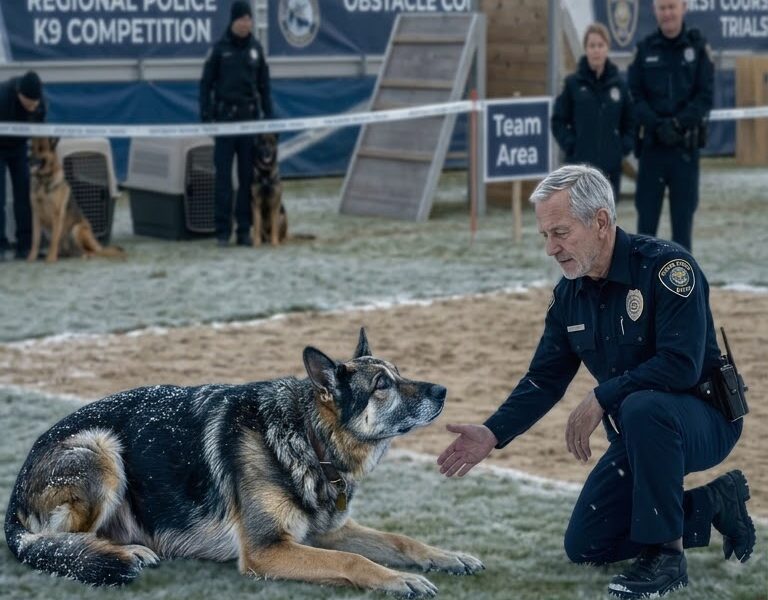
He spent his whole life serving — then failed one test and was thrown away like he meant nothing. What this police officer did next left everyone speechless.
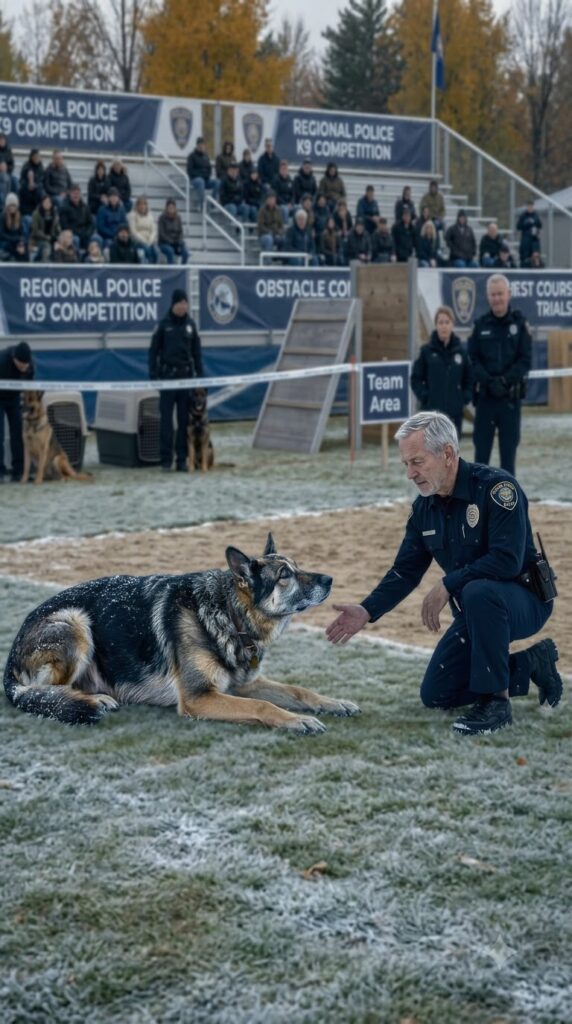
The wind coming off Lake Pend Oreille had a bite that cut through even the thickest patrol jacket, the kind of cold that made October in northern Idaho feel like a warning shot from winter.
Officer Leonard Grady had been with the Cordelane Police Department for thirty-one years, and at sixty-two, he knew every back road, every shortcut, and every place where the county fairgrounds turned into a wind tunnel after sunset.
He was finishing a routine patrol near the fairgrounds when he saw the old German Shepherd standing alone beside a row of departing trucks, gray around the muzzle, posture quiet and watchful.
The dog did not bark. He did not pull at the leash. He simply stood there, as if he had been trained to wait for something that might never come.
Leonard had arrived just as a local working dog event was ending, the kind of competition where young shepherds raced through obedience courses and scent exercises while handlers shouted commands and judges scribbled scores.
He had seen only enough to understand that the old shepherd had failed his final exercise.
The dog had slowed halfway through the routine, stopped when he should have continued, and lost whatever score he needed to stay in the competition.
That was all Leonard knew about the trial, and it was all he needed to know.
The younger dogs were being praised, watered, and loaded into vehicles, their handlers laughing and exchanging handshakes.
Benji stood near a folding table while a man signed several papers without looking at him.
The man was Eric Danton, forty-eight, a professional dog trainer who had taken Benji through a foster-to-adopt arrangement three months earlier.
Eric had read Benji’s old training history and believed there was still enough ability left in the aging shepherd to return him to limited competition.
For a while, practice had gone well. Benji remembered commands, his focus was strong, he still wanted to work.
But wanting to work and being ten years old were not the same thing.
Benji tired sooner than Eric expected. His speed had dropped. Some days his body simply could not match what his training remembered.
That afternoon had been enough for Eric.
He finished signing the surrender papers, handed them back to the rescue volunteer, and walked toward his truck.
Benji watched him. Leonard did, too.
Eric loaded a bag, closed the tailgate, then returned for one last piece of equipment.
Benji stood as soon as he saw him coming back. For a moment, the old dog’s ears lifted.
Eric stopped beside him and rubbed his shoulder once. “Take care, Benji.”
Then he handed the leash to the volunteer.
Benji remained standing. Eric got into the truck. The engine started.
Benji moved forward one step. The truck rolled away.
Benji took another step until the leash became tight. Then he stopped.
Leonard expected barking. There was none. He expected Benji to pull after the truck. He did not.
The truck reached the road and disappeared. Benji stood completely still.
People continued packing around him. Folding chairs scraped across pavement. Doors slammed. Engines started.
The event was nearly over. And within minutes, the place that had been full of noise became a mostly empty parking lot.
Benji kept looking toward the road.
Leonard walked over. The rescue volunteer holding the leash was a middle-aged woman who looked tired from a long day.
She explained quickly that Eric had formally surrendered Benji and that someone from the rescue would collect him the next morning.
They were trying to arrange somewhere safe for him to stay overnight.
Leonard barely heard the last part. Benji was no longer looking in the direction Eric’s truck had gone.
He had turned slightly toward the main entrance. Another vehicle appeared. Benji’s ears rose.
The vehicle came closer. Benji straightened. It was an SUV carrying two people from the event.
It passed without stopping. Benji watched it go, then slowly relaxed again.
Leonard frowned. He’s not waiting for the trainer.
The volunteer looked at him.
Leonard crouched a few feet from Benji. The dog glanced at him once, polite but uninterested, then looked back toward the entrance.
That was when Leonard noticed the old leather collar. It was worn differently from the newer leash.
The leather had softened with years of use, and the metal tag hanging beneath Benji’s chin had been rubbed smooth around the edges.
Leonard leaned close enough to read it. Clive Morgan. Benji.
Who’s Clive Morgan?
The volunteer’s face softened. His owner.
Leonard looked at the road again. Where is he?
He died eight months ago.
The words landed harder than Leonard expected.
Benji was his dog for most of his life, the woman continued. After Clive passed, there wasn’t anyone able to keep him permanently. He’s been moved around since.
Leonard looked back at Benji.
Eight months, several homes, different people, different doors, different vehicles, and every time perhaps the old dog had waited for the one person who had always come back before.
Another truck turned into the fairgrounds. Benji rose again.
Leonard watched his whole body change. Not excitement exactly. Something more careful than that.
Hope without confidence.
The truck stopped near another trailer. A man stepped out. Benji watched him.
The man was not Clive. Benji sat down again.
Leonard felt something tighten behind his ribs. He had spent enough years in police work to know that grief did not always look dramatic.
Sometimes it looked like someone checking the same doorway over and over because part of them still believed the right person might appear.
The volunteer adjusted Benji’s leash. We’ll find somewhere for him tonight.
Leonard looked at the old shepherd. Benji was still watching the road.
Where?
We’re working on it.
Leonard glanced toward his patrol car, then back at Benji. He lived alone in a modest house on the quieter side of Cordelane.
There was no fenced dog run, no kennel, no special setup, but there was heat, an empty living room, and a floor large enough for one old dog to sleep on.
I can take him tonight.
The woman looked relieved immediately. Just tonight?
Leonard hesitated. Yes, until the rescue gets him tomorrow.
The words sounded simple enough. The handoff took only a few minutes.
Benji came with a small bag of food, his old collar, a newer leash, and basic instructions.
No complicated medication, no special treatment, just an aging dog who needed a quiet place until morning.
Leonard opened the rear door of his vehicle. Benji stopped.
Leonard waited. The dog looked into the car, but did not move.
For the first time, Leonard wondered how many vehicles Benji had climbed into during the last eight months without knowing where he would be sleeping that night.
He did not pull the leash. Take your time.
Benji sniffed the door frame. Then slowly he climbed inside.
During the drive home, Benji remained sitting upright. Every time Leonard slowed near another vehicle, the shepherd looked through the window.
Leonard did not try to distract him. He drove. Benji watched.
When they reached the house, Leonard showed him the water bowl first.
Benji drank, then walked carefully through the living room, sniffing the furniture and checking the hallway.
He was calm, but Leonard noticed that he never wandered far from the front of the house.
Leonard folded an old blanket beside the couch. There, Benji approached it. He sniffed once, then walked away.
The old shepherd lowered himself onto the floor beside the front door.
Leonard stood with one hand on his hip. The blanket is warmer.
Benji closed his eyes. Leonard gave up.
He ate a late dinner at the kitchen counter while Benji stayed by the door.
Once headlights moved across the front window. Benji’s eyes opened immediately. His head lifted.
The vehicle passed. His head went back down.
It happened again twenty minutes later, then again.
By ten o’clock, Leonard had stopped pretending not to notice.
Benji did not react to every sound. A branch tapping the window meant nothing. The refrigerator clicking on meant nothing.
Leonard moving through the kitchen meant nothing. But an engine slowing outside the house changed everything.
Benji would raise his head, listen, wait, then settle again.
Leonard went to bed shortly before eleven. He woke sometime after midnight when a bright line of headlights moved across the ceiling.
Before he was fully awake, he heard Benji’s nails on the living room floor.
Leonard got up and walked down the hallway. Benji was standing at the door.
The headlights passed. The sound of the engine faded. Benji remained standing for several seconds.
Then he lowered himself back onto the same patch of floor.
Leonard stayed in the hallway. The old metal tag rested against Benji’s chest. Clive Morgan.
Leonard finally understood what he had been watching all evening.
Benji was not waiting for Eric Danton. Eric had only been part of the last three months.
Benji was waiting for the man who had been part of almost his whole life.
The man whose name was still hanging from his collar. The man who had been gone for eight months.
Leonard leaned against the wall and looked at the old dog.
Tomorrow the rescue would come. Someone else might take Benji.
There might be another house, another car, another stranger holding the leash. That had been the plan.
But as Benji settled beside the door again, Leonard found himself thinking about how many times a dog could be asked to start over before he stopped believing any place was home.
Another car passed outside. Benji lifted his head.
Leonard watched the hope return for one brief second, then disappear again.
He did not know yet what he was going to do in the morning.
But for the first time that night, Leonard was no longer thinking about where the rescue would take Benji next.
He was thinking about what would happen if nobody finally decided to let the old dog stay.
Morning came cold and clear over Cordelane, and Leonard found Benji awake before he was.
The old shepherd was still near the front of the house, but he had changed position sometime before dawn, moving from directly against the door to the small rug beside the entryway.
It was only a few feet. Leonard noticed anyway.
The plan was simple. He would take Benji to a veterinary check arranged through the rescue, then hand him over once the organization confirmed his next placement.
That was what Leonard had agreed to the night before, and he reminded himself of it while filling Benji’s water bowl.
Benji ate slowly, then followed Leonard outside.
When Leonard opened the rear door of the car, the dog stopped.
The hesitation was stronger than it had been the previous evening.
Benji looked into the vehicle, then back toward the house. His ears lowered slightly.
Leonard understood enough not to pull. He sat on the edge of the driver’s seat and waited.
You’re not being left anywhere yet.
Benji could not understand the sentence, but he understood that no one was forcing him forward.
After several minutes, he approached the car. One front paw went up, then the other.
His back legs took more effort, but eventually Benji climbed inside and settled on the seat.
Leonard closed the door gently.
At the veterinary clinic, Dr. Bethany Crane, fifty-two, a veterinarian who had worked with rescue animals for nearly twenty years, examined Benji without rushing him.
She checked his heart, joints, eyes, teeth, and movement, then watched him walk across the room and back.
He’s old, Bethany said.
Leonard looked at her.
That’s the diagnosis. It’s a condition with a very poor cure rate.
Leonard almost smiled.
Bethany rested a hand along Benji’s back. Mild arthritis, less endurance than he probably had a few years ago. Nothing here surprises me for ten. His heart sounds good. He’s alert, and from the notes, his scent work is still very strong.
So, the competition didn’t tell us much.
It told you he shouldn’t be judged like a five-year-old dog.
That answer stayed with Leonard.
Bethany stepped out to collect a form from the front desk. A moment later, Leonard’s phone rang and he moved into the hallway to answer it.
He was gone less than a minute. When he returned, Benji was standing.
The old dog faced the doorway with his body completely still. Bethany had noticed it, too.
Leonard stepped back inside. Benji looked at him, then sat.
Bethany watched the change. Try something.
She asked Leonard to step into the hallway again. He did. Benji rose immediately.
Leonard waited out of sight for several seconds, then returned. Benji sat again.
Bethany crouched beside the shepherd. He isn’t afraid of this room.
Leonard knew what she meant before she finished.
He’s afraid I’m leaving. He’s afraid people leave and don’t come back.
The sentence was simple. That made it worse.
Leonard looked at Benji and thought about eight months of unfamiliar houses, unfamiliar cars, unfamiliar hands on the leash.
Clive had disappeared first. Everyone after that had eventually disappeared, too.
The rescue called before Leonard left the clinic. Their coordinator had reviewed Benji’s recent placement history and asked whether Leonard would consider a thirty-day foster.
Moving the dog into another temporary home immediately, they explained, might only add to the instability.
Leonard looked at Benji. Thirty days sounded very different from one night.
He had work. He lived alone. He had never planned on adopting a dog, much less an aging German Shepherd who had arrived with more history than luggage.
Benji was watching him.
Leonard sighed. Thirty days.
That afternoon, Benji returned to the same house he had left that morning.
For the first few days, Leonard began noticing patterns.
Keys were the strongest. The moment Leonard picked them up, Benji stood.
The police uniform was almost as powerful. When Leonard buttoned his shirt and reached for his jacket, Benji followed him toward the front room.
On the first morning, Leonard went back to work. Benji reached the door before he did.
Leonard clipped nothing to his collar. He simply crouched in front of him. I’m coming back.
Then Leonard left.
When he returned after his shift, Benji was near the entrance.
The dog did not jump or bark. He stood and stared at Leonard for several seconds as if confirming something.
Leonard had left. Leonard had returned.
The next morning happened the same way. I’m coming back.
And the next, Benji still watched the door after Leonard left, but slowly the ritual became familiar.
On the fifth day, Leonard came home and found Benji several feet away from the entrance instead of directly beside it.
He did not celebrate. He only noticed.
That week, Leonard stopped at a small feed and pet supply store he had used for years.
Sharon Bell, sixty-eight, the owner, had run the shop long enough to know most local dog owners by both name and preferred brand of food.
She spotted Benji through the front window before Leonard had finished parking.
So, that’s the old fellow everyone’s talking about.
People talk too much in this town.
Never.
Sharon came around the counter and let Benji approach on his own.
Benji sniffed her hand, accepted one biscuit, then positioned himself beside Leonard again.
A few minutes later, another customer entered.
Gene Rutherford, seventy-three, a retired utility worker who lived alone and spent much of his free time walking the wooded trails around Cordelane, carried a pair of worn hiking gloves in one hand.
He moved with the easy patience of someone who had no reason to hurry.
Sharon introduced them.
Gene looked down at Benji’s gray muzzle. Well, somebody finally brought in a customer older than me.
You’re losing badly, Leonard said.
Gene ignored him and held out his hand. Benji smelled it for several seconds.
Then he stepped closer. Gene scratched gently under his chin. There you go.
There was no dramatic connection, no sudden burst of affection. Benji simply stayed beside him longer than Leonard expected.
Two days later, Gene came by Leonard’s house after Sharon sent over a bag of food she thought Benji might tolerate better.
He stayed for coffee on the porch. Benji settled between their chairs.
Gene slipped him a treat. Leonard saw it.
Bethany said not too many.
Gene looked innocent. I dropped it.
You handed it directly to him.
Remarkable reflexes for an old dog.
Leonard shook his head. For the first time since Benji arrived, the porch felt less quiet than usual.
Over the following days, Gene stopped by twice more during his afternoon walks.
He never asked Benji to perform anything. Sometimes he talked to Leonard.
Sometimes he sat in silence and watched the trees move in the wind. Benji seemed perfectly satisfied with either arrangement.
The change Leonard had been waiting for came late one night.
He woke and went to the kitchen for water. Out of habit, he looked toward the front door.
Benji was not there.
For one sharp second, Leonard thought something was wrong.
Then he saw him.
Benji was sleeping beside the chair where Leonard had left his police jacket.
His body was still close enough to see the entrance, but his head rested across one sleeve.
Leonard stood quietly in the dark.
The old dog had not forgotten the door. He had not forgotten Clive.
Nothing that deep disappeared in a week.
But sometime during the night, Benji had chosen something that smelled like the man who kept leaving every morning and so far kept coming home every evening.
Leonard did not move the jacket. He returned to bed and left it exactly where it was.
Tomorrow morning, he would pick up his keys again. Benji would probably stand.
Leonard would crouch beside him, and he would say the same three words until the old dog no longer needed to wonder whether they were true.
I’m coming back.
By the second week, Leonard had learned that Benji’s age had taken more from his speed than from his mind.
The old shepherd moved carefully when he first stood in the morning, especially after sleeping for several hours, but once his joints loosened, his attention sharpened quickly.
Leonard discovered that by accident when he misplaced one of his work gloves before a shift.
He searched the kitchen, the hallway, and the chair where he usually dropped his jacket.
Benji followed him with quiet interest.
Leonard finally held up the matching glove. You know where the other one is.
Benji’s ears lifted.
Leonard let him smell it. The change was immediate.
Benji lowered his nose, moved across the room, checked near the couch, then turned toward the bedroom.
Less than a minute later, he stopped beside a laundry basket and looked back at Leonard.
The missing glove was underneath it.
Leonard stared at him. Well, that was embarrassing.
Benji sat. He was waiting.
Leonard understood the posture. He gave him a small piece of treat. Good job.
The next afternoon, Leonard tried again, this time deliberately.
He hid a cloth behind a chair while Benji waited in another room. The old dog found it quickly.
A day later, Leonard placed a worn handkerchief near the back fence.
Benji took longer outdoors, sorting through damp earth, pine needles, and wind, but eventually found that, too.
Benji seemed different while working. His body was still old, but his uncertainty disappeared.
He knew where to look, how to move, and what was expected when he found the answer.
Leonard enjoyed seeing that confidence return.
Then he noticed what happened afterward.
Benji always came back and sat directly in front of him waiting.
If Leonard praised him, the old shepherd relaxed.
If Leonard said nothing, Benji stayed alert, watching his face as though the exercise were not truly over until he knew whether he had succeeded.
That bothered Leonard.
One Saturday morning, he carried a glove onto the porch, planning another simple search.
Benji followed and stood beside him.
Leonard looked at the glove, then at Benji. He put it on the table instead.
Benji stayed standing.
Leonard sat in the porch chair. Benji looked toward the yard, then back at him.
Nothing happened. Thirty seconds passed. Then a minute.
Benji remained ready.
Leonard realized the dog was waiting for a command.
He patted the porch boards beside his boots. No job today, buddy.
Benji looked at his hand, but did not move.
Leonard stopped patting. He did not say sit. He did not say down. He did not point.
He simply leaned back and watched the trees beyond the yard.
Benji stood for another long moment. The silence seemed to confuse him more than any difficult scent trail had.
Finally, the old shepherd lowered his front legs, eased his body down, and settled beside Leonard’s chair.
No command, no reward, no task completed.
Leonard looked down at him. Benji rested his chin on his paws.
For some reason, that simple movement hit Leonard harder than finding the glove had.
Maybe Benji had spent too many years learning that approval came after performance.
Find the object, follow the command, finish the exercise, do it correctly, and someone would be pleased.
And after Clive died, perhaps that belief had become something more dangerous.
Be useful and maybe this place will keep you.
Leonard reached down and rubbed the fur behind Benji’s ear. Nothing was asked in return.
They stayed on the porch that way until the coffee in Leonard’s cup went cold.
Two days later, Leonard heard almost the same question directed at himself.
His deputy chief, sixty-one, a career officer who had supervised Leonard for years, stopped him after morning briefing.
There was no formal meeting and no bad news.
He simply mentioned that an administrative position might open soon and said Leonard should consider it.
Less time in the patrol car. The deputy chief said better hours.
Leonard knew what he meant. The offer was not an insult.
At sixty-two, Leonard was one of the oldest officers still working regular patrol.
His knees complained after long shifts. Night duty took more out of him than it once had.
He knew all of that.
Still, on the drive home, one sentence stayed in his mind. Better hours.
People often found gentle language when they were beginning to wonder how much longer someone could keep doing what they had always done.
When Leonard arrived home, Benji was sleeping in a patch of afternoon light near the living room window.
The dog heard him enter and started to rise. His front half came up easily. His back legs took another second.
Leonard watched him. Yeah, he said quietly. I know.
Benji walked over. Leonard did not tell him what he knew. He did not need to.
The world had begun asking both of them the same question, not whether they still mattered, whether they could still do things the way they used to.
Leonard was beginning to understand those were not the same thing.
Gene continued visiting occasionally. He liked the porch and Benji liked Gene because Gene rarely expected anything from him except company.
Some afternoons the two older men talked while Benji slept between them.
Other times, Gene arrived, accepted coffee, and spent ten minutes scratching Benji’s neck without saying much at all.
One afternoon, Sharon stopped by while Gene was there. She had brought a bag of dog food Leonard had ordered.
Gene stood to help her carry it inside, then frowned. My keys.
He checked one pocket, then another. Sharon looked at him.
Gene checked the porch table, his jacket, and the chair where he had been sitting.
They’re in your left hand, Sharon said.
Gene looked down. The keys were there. He laughed first. So they are.
Sharon did not.
It was a small moment, and Leonard might have forgotten it if something similar had not happened several days later.
Gene had planned a short afternoon walk along a familiar trail and stopped by Leonard’s house afterward.
By the time he arrived, daylight was fading.
You’re late, Leonard said.
Walked farther than I meant to.
How much farther?
Gene shrugged. Enough to make the return trip annoying.
Sharon, who had come over to drop off a receipt, gave him a sharp look. You need to start telling someone which trail you’re taking.
Gene smiled. I’ve been walking those trails longer than Leonard has been writing traffic tickets.
That does not make you impossible to get lost.
I didn’t get lost.
You came back an hour late.
I came back.
The answer ended the conversation for Gene.
Leonard recognized the tone. It was not stubbornness for the pleasure of being difficult.
Gene lived alone. He chose his own schedule, his own routes, his own meals, and when to come home.
The possibility that other people might begin monitoring those choices bothered him more than the possibility of taking a wrong turn.
Leonard did not push. Neither did Sharon.
But Benji had been listening.
When Gene eventually started down the walkway, Benji followed him to the porch edge.
Gene turned. Stay here, old man.
Benji did not follow. He simply watched Gene walk toward the road until the older man disappeared from sight.
For the next few days, life settled again. Leonard worked. Benji rested more easily.
The old dog still responded when Leonard picked up his keys, but he no longer rushed to the door every time.
Some mornings, he only raised his head.
Leonard continued saying the same thing. I’m coming back. And he did.
Then late one afternoon, a truck stopped in front of Leonard’s house.
Benji had been lying beside the porch chair. The moment the driver’s door opened, his head came up.
Leonard recognized the man before Benji did.
Eric Danton stepped out of the truck.
Benji rose slowly to his feet, and Leonard understood at once that whatever Eric wanted, the quiet routine they had built was about to be tested.
Eric Danton stood beside his truck at the edge of Leonard’s driveway while Benji watched from the porch.
The old shepherd did not rush forward. He simply rose, ears alert, as if a familiar part of his past had suddenly appeared where it did not belong.
Leonard stepped outside and closed the door behind him.
Eric removed his cap, turned it once in his hands, then looked toward Benji. I heard he’s doing well.
He’s doing fine.
I heard more than that.
Leonard waited.
Eric explained that someone connected with the working dog community had mentioned Benji’s scent ability.
Apparently, the old shepherd had never lost the part of his training that depended on patience, memory, and his nose.
Eric had been thinking about it since the event.
I may have been asking the wrong things from him, Eric said. Speed, obedience routines, timed exercises. He’s not built for that anymore.
Leonard looked toward Benji. That didn’t change after you left him.
I know.
Eric did not sound defensive. That kept the conversation calmer than Leonard had expected.
He had spent years training dogs for structured work, and he still thought in terms of ability, placement, and what type of job suited what kind of dog.
To Eric, recognizing that Benji might still succeed at senior scent activities was an admission that he had made the wrong professional judgment.
To Leonard, it sounded like the same question, wearing different clothes. What could Benji still do?
Eric continued. There are scent trials where age isn’t as much of a disadvantage. No jumping, no speed requirement like before. He could be good at it.
He probably could.
Eric looked surprised by the agreement.
Leonard had no reason to deny the obvious. Benji was good with scent.
The problem was not whether the dog still had talent. The problem was why that talent suddenly made Eric interested again.
I’d like another chance with him, Eric said.
Leonard glanced at Benji. You surrendered him.
I know what I signed. The rescue knows, too.
Eric nodded. I’m not here to pretend that didn’t happen.
The foster-to-adopt agreement had ended the day Eric signed the surrender papers.
Leonard’s own application was already moving toward final approval.
There was no complicated ownership battle waiting to happen, and Leonard had no interest in creating one.
Still, Eric looked at Benji with enough certainty that Leonard understood what he wanted, not paperwork. A response.
Eric stepped closer to the porch. Benji.
The dog’s ears came forward.
Eric used a hand signal Leonard had never seen. Benji immediately sat.
There was no hesitation.
Eric gave another familiar command. Benji stood and moved two steps toward him.
Leonard felt something drop inside his chest.
It was not jealousy. Benji had known Eric before him. Three months of training did not disappear because a truck had driven away.
What bothered Leonard was the speed of the response.
Benji had spent the last two weeks learning that nothing terrible happened when no one gave him work.
He had begun sleeping without waiting for instructions.
He had begun sitting beside Leonard simply because there was a place beside him.
Yet one old command from Eric and Benji’s entire body changed.
Back straight, eyes focused, waiting for the next instruction, ready to be useful.
Eric noticed it, too, but interpreted it differently. You see, he remembers everything.
Leonard said nothing.
Eric walked toward the truck. Benji followed several feet behind him.
The movement was so automatic that Leonard almost called the dog’s name. He stopped himself.
Eric reached the passenger side and opened the rear door. Benji halted for a second.
The driveway became very quiet.
Eric looked at him. Come.
Benji moved. One step, then another.
Leonard remained beside the porch. Every instinct told him to say something.
Stay. Benji. Come here. Anything that would pull the dog back.
He said nothing.
If Benji came back only because Leonard gave a stronger command, then nothing had changed.
It would simply be one man’s instruction competing with another’s.
Benji reached the truck. He looked inside.
A folded training mat sat on the seat. A leash hung from the headrest.
The arrangement was ordinary, but Leonard wondered what Benji remembered when he saw it.
Practice fields, commands, rides to unfamiliar places, the afternoon at the fairgrounds.
Eric waited. Benji did not climb in.
Come on, Benji.
The old shepherd turned his head. He looked toward Leonard.
Leonard kept his hands at his sides. No signal, no command, not even the familiar words he used every morning.
For once, Benji had no correct answer to give.
Eric was offering something Benji understood very well. A job.
Leonard was offering nothing at all. No treat, no praise, no task waiting to be completed.
Benji stood between them.
Then his body softened. He turned away from the truck.
Eric did not call again.
Benji walked slowly across the driveway, passing the place where he had first stopped, then continued until he reached Leonard.
He sat beside Leonard’s leg.
Leonard looked down. Benji looked up once, then faced the yard.
Leonard rested one hand behind the dog’s gray ear. He almost said the words that had followed every successful exercise. Good boy.
He stopped. Benji had not completed an exercise. There was nothing to grade.
Leonard simply kept his hand there.
Eric closed the truck door for several seconds. Neither man spoke.
Then Eric nodded. I understand.
Leonard believed he did.
Eric had not come to hurt Benji. He had simply returned because he believed usefulness had changed the equation.
What he had not understood until that moment was that Benji was beginning to live somewhere usefulness was no longer the price of admission.
Eric put on his cap. He’s a good dog.
I know.
Eric gave Benji one final look, then returned to the driver’s side.
This time, when the engine started, Benji did not stand. He remained beside Leonard.
The truck backed out, turned onto the road, and disappeared.
Benji watched it go. Then he lowered himself onto the porch.
Leonard sat beside him. Neither moved for a while.
That afternoon, Leonard called the rescue and told them he wanted to finish the adoption.
There was no speech behind the decision. No dramatic realization.
He had already been feeding Benji, adjusting his schedule around him, leaving the old police jacket where Benji liked to sleep, and checking the floor each morning to make sure the dog had risen comfortably.
The paperwork only gave a name to something that had already begun.
A few days later, the adoption was finalized.
Benji became Leonard’s dog before finding anyone, saving anyone, winning anything, or proving that Eric had been wrong.
That mattered to Leonard.
If Benji spent the rest of his life sleeping in warm patches of sunlight and accepting treats from Gene, it would be enough.
That evening, Leonard expected Benji to settle near the front room as usual.
Instead, the old shepherd walked past the door.
He circled once in the center of the living room and lowered himself onto the rug.
No jacket, no doorway within reach, just the middle of the room.
Leonard noticed, but he did not make a ceremony of it.
He sat down with a cup of coffee. Benji slept.
For almost an hour, the house was quiet.
Then Leonard’s phone rang.
Sharon’s name appeared on the screen. He answered.
Her voice was different from the easy tone he knew from the store.
Leonard. Gene’s truck was found at a trailhead north of town.
Leonard sat forward. What do you mean found?
He hasn’t come back.
Benji lifted his head at the sound of Gene’s name.
Sharon continued. No one knows where he is.
Leonard looked across the room. Benji was already on his feet.
By the time Leonard reached the trailhead north of Cordelane, darkness had settled into the trees, and the temperature was dropping fast.
Gene’s truck stood alone near the edge of the parking area, exactly where Sharon had said it had been found.
Search and rescue volunteers were already working the surrounding trails, using the route Gene had most likely taken and the time he had left home to narrow the search area.
Leonard brought Benji out of the car on a long leash.
No one there treated the old German Shepherd as a trained search and rescue dog, and Leonard made sure they did not.
Benji had never been certified for this kind of work.
He knew Gene. He knew Gene’s scent, and he still had a good nose. That was all.
The team had already identified one section of trail where Gene might have turned away from his usual route.
The ground there was manageable without steep drops or dangerous terrain.
So they agreed Leonard could take Benji through it while the trained search teams continued covering the larger area.
Leonard walked to Gene’s truck and opened the driver’s door.
A pair of hiking gloves rested near the seat.
He picked up one and brought it to Benji.
The change in the dog was immediate.
Benji smelled the glove once, then again more carefully.
His nose moved along the leather, taking in something Leonard could not see.
A moment later, Benji turned toward the trail.
Leonard did not give a formal command. He simply followed.
Benji started slowly. That was the first thing Leonard noticed.
There was no sudden sprint into the woods, no dramatic pulling at the leash.
Benji moved with the same deliberate pace he used when getting up after a long nap.
His nose stayed low. Every few yards he paused, checked the air, then continued.
Leonard let him choose the pace.
The trail narrowed between pines and low brush. Fallen needles softened their steps.
Somewhere farther away, voices from another search group carried through the trees, then disappeared again.
Benji stopped near a fork. He smelled the ground to the left, then the right.
He chose the right trail.
Leonard followed for several minutes before Benji slowed again. This time the dog turned back.
Leonard led him.
Benji retraced nearly thirty yards, checked the edge of the trail, then crossed toward a patch of brush.
He searched there for a while before returning to the main path.
Whatever scent he had found was not strong enough.
Leonard could see the effort beginning to show.
Benji’s breathing had become heavier. His steps were still steady, but the old stiffness had returned to his back legs.
Leonard stopped. He offered water. Benji drank.
We can quit whenever you want.
Benji looked toward the trail.
Leonard rested a hand against his shoulder.
He remembered Eric’s driveway only days earlier.
Benji standing between the truck and Leonard, waiting for someone to tell him what the correct choice was.
This was different. There was no competition here. No score.
No one would send Benji away if he failed.
Leonard had already signed the adoption papers.
If Benji found nothing tonight, tomorrow morning, he would still wake up in Leonard’s house.
The thought mattered more than Leonard expected.
They continued.
Another fifteen minutes passed before Benji lost the scent again. This time, he stopped completely.
Leonard saw the tiredness in him.
The old dog stood with his head lowered, chest moving more quickly than before.
Leonard crouched beside him. That’s enough, buddy.
Benji looked at him.
You’ve done enough.
Leonard loosened the leash so there was no tension on it. You don’t have to prove anything.
Benji stayed where he was.
Leonard was ready to turn around. He meant it.
Whatever happened next with the search would be handled by the trained teams.
Benji had given them another section to check, and that was already more than anyone had expected from him.
Leonard started to stand.
Benji lifted his head. His nose moved once toward the wind, then again.
The dog turned slightly.
Leonard waited. He gave no command.
Benji took one step toward a narrow opening in the brush. Then another.
Leonard followed.
The path there was barely a path at all, more like a place where someone had pushed through low branches while trying to find a shorter way back toward the main trail.
Benji moved more slowly now, but with purpose.
After perhaps two hundred yards, he stopped.
He looked back at Leonard, then toward a cluster of low trees.
Leonard heard something. Not a shout, a weak voice.
Hello.
Leonard moved forward.
Gene was sitting against the base of a tree a short distance from the trail, wrapped partly in his jacket.
He looked exhausted and cold, but he was awake.
Leonard felt the tension leave his body so quickly that his knees almost weakened.
Gene.
Gene lifted his head. For a second, he looked confused. Then he saw Benji.
A tired smile appeared. Of course, they sent the oldest cop and the oldest dog.
Leonard laughed once, more from relief than humor. You’re going to hear about that later.
I figured.
Leonard called the search team and gave their location.
Gene explained in broken pieces that he had taken a familiar trail, turned onto what he thought was a connecting path, then realized too late that he had gone the wrong direction.
By the time he tried to return, the light had changed, and the woods no longer looked as familiar as he expected.
He had decided to stay in one place rather than keep wandering.
It was a sensible choice. It had probably helped save hours of searching.
Benji walked over to Gene and sat beside him.
Gene placed one hand on the dog’s neck. You found me.
Benji did not react like a dog waiting for praise.
He did not sit straighter. He did not look back at Leonard for approval.
He simply stayed beside Gene.
That more than anything struck Leonard.
Benji had chosen to keep searching.
Now that he had found the person he knew, the job seemed to disappear from him.
There was only Gene.
The rescue team arrived soon after.
They checked Gene, gave him warm coverings, and helped him back toward the trail in a controlled, careful walk.
Benji followed for the first part.
Then Leonard noticed him slowing.
By the time they reached the parking area, the old shepherd stopped beside Leonard’s car and looked at the open door.
He tried to lift one front paw, then put it down again.
Leonard understood. Not tonight.
He crouched, slipped one arm beneath Benji’s chest and the other beneath his back legs, and lifted him carefully.
Benji was heavier than Leonard expected.
The dog did not resist. He let his body rest against Leonard as he was carried to the car.
Leonard placed him gently on the seat.
For a moment, neither moved.
Months earlier, Benji had watched people drive away.
He had climbed into cars without knowing where they would take him.
Tonight, there was no uncertainty.
Leonard closed the door, walked around to the driver’s side, and got in.
Benji was already lying down. Leonard reached back and rested a hand against his shoulder.
You’re going home.
Benji did not lift his head. He did not need to.
He had already learned where home was.
By early winter, snow had begun settling along the quieter streets of Cordelane, softening the edges of yards, rooftops, and parked cars.
Gene recovered well from the night on the trail, though Sharon made sure he heard about it for several weeks afterward.
He agreed to carry a small location device when he went walking and to tell Sharon which trail he planned to take before leaving.
He complained that everyone was making too much of one mistake, but he kept the device charged and clipped it to his jacket every time.
No one tried to take away his independence. That mattered to him. They simply made it easier for him to keep it.
Benji’s life changed, too, though in a quieter way.
Leonard made one decision and never reconsidered it.
There would be no more competitions, no demonstrations, no attempt to turn Benji into a police dog, no photographs proving that Eric had been wrong.
Benji had already spent enough of his life being asked what he could do.
Now Leonard wanted him to discover what it felt like when nobody needed an answer.
So Benji retired completely.
His days became simple.
Breakfast, a slow walk when the weather allowed, long naps near the living room window, an occasional trip with Leonard to Sharon’s store, where everyone knew better than to ask Benji to perform anything.
Leonard bought him an orthopedic dog bed after Bethany recommended something softer for his joints.
It cost more than Leonard thought any dog bed reasonably should.
Benji inspected it carefully.
He stepped onto it once, turned around twice, then walked away and stretched out on the old rug beside Leonard’s chair.
Leonard stared at him. You know that cost me eighty dollars.
Benji closed his eyes.
A few days later, Gene came over and found the expensive bed empty.
He looked at Benji on the rug. Smart dog.
Don’t encourage him.
I’m saying he knows value.
He’s lying on a rug I’ve had for twelve years.
Exactly.
Gene sat down and slipped something from his coat pocket. Leonard saw it immediately.
No.
Gene froze. What?
What’s in your hand?
Nothing.
Benji was already sitting in front of him.
Leonard pointed. He’s gaining weight.
He nearly froze finding me.
That was weeks ago.
Recovery takes time.
You’ve been using that excuse since Thanksgiving.
Gene handed Benji half the treat instead of the whole one.
Apparently, considering that a reasonable compromise.
Leonard shook his head, but he was smiling.
Those small arguments became part of the house. So did Gene’s visits.
So did Sharon stopping by with something from the store that Leonard had supposedly forgotten to buy.
The house had been quiet for years before Benji arrived.
Leonard had never considered that a problem.
He still appreciated silence, but now the silence felt different. It had company inside it.
Benji no longer followed Leonard from room to room.
He did not need to know where Leonard was every second.
Some afternoons, Leonard would be reading in the kitchen and realize he had not seen Benji for half an hour.
He would find the dog asleep in the living room, not near the front door, not watching the windows, just asleep.
Leonard learned not to wake him.
The old German Shepherd still had habits left from the months after Clive died.
A slowing engine outside could make his ears lift.
A truck door closing in front of the house could still pull his attention toward the window.
But the reaction passed more quickly now.
Benji listened, then rested again. He was no longer treating every sound as a possibility.
Leonard noticed the change without speaking about it.
The greatest change came on a cold morning in January.
Leonard was preparing for work before sunrise.
The kitchen lights were on and the windows reflected the room back at him because it was still dark outside.
Benji was lying on the old rug.
Leonard finished his coffee, buttoned his uniform shirt, then reached for his keys.
The sound used to change Benji immediately. Keys meant departure. Departure meant waiting.
For weeks, even after Benji began sleeping farther from the door, the sound had still made him stand.
That morning, his ears moved. Nothing else did.
Leonard looked toward him. Benji raised his head.
Their eyes met. Leonard waited.
Benji did not get up.
For a moment, Leonard almost laughed. Then he understood what he was looking at.
He walked across the room and crouched beside the old dog.
I’m coming back.
He had said those words so many times that they had become part of the morning.
The first time they had meant nothing to Benji.
Later, perhaps they had become a pattern.
Leonard left. Leonard returned. Morning after morning, shift after shift.
A promise proved through repetition rather than explanation.
Benji looked at him, then slowly lowered his head back onto the rug.
Leonard stayed there for another second.
That was all. No dramatic gesture, no sudden burst of affection.
Benji simply went back to sleep.
Leonard stood and picked up his jacket.
Before leaving, he looked at the leather collar around Benji’s neck.
The old metal tag was still there. Clive Morgan. Benji.
Leonard had never wanted to remove it.
Clive had not been a mistake that needed replacing.
He had been Benji’s home for most of his life.
Whatever Benji had become before Leonard met him had been shaped by years Leonard would never see and could never recreate.
A week earlier, Leonard had added another tag.
It carried his own name, his phone number, and the Cordelane address where Benji now slept.
The two pieces of metal rested beside each other.
Leonard touched them lightly. Then he left for work.
When the front door closed, Benji did not rise.
The house became quiet, and for the first time since Leonard had known him, the old dog did not wait beside the door for proof that somebody would come back.
That afternoon, Leonard returned earlier than usual.
He opened the door and expected, out of habit, to find Benji somewhere nearby.
The entryway was empty.
Leonard stepped inside.
Benji was asleep in a wide patch of winter sunlight across the middle of the living room floor.
One ear lifted at the sound of the door, then the other.
Benji raised his head, his tail struck the floor once, then again.
Leonard smiled. I told you.
Benji took his time standing. His back legs needed a moment as they always did now.
Leonard did not hurry him.
When Benji reached him, Leonard sat in the chair and the old shepherd rested his gray muzzle across Leonard’s knee.
Leonard placed one hand on Benji’s neck.
The two tags touched, a small metallic sound. Clive Morgan. Leonard Grady.
One belonged to the man who had given Benji nearly a lifetime of love.
The other belonged to the man who had arrived after that life changed.
Leonard did not think of himself as replacing anyone.
Some places in a heart were not meant to be replaced. They were meant to remain.
There was simply room beside them.
Outside, snow had begun falling again over Cordelane.
Inside, Benji closed his eyes with his head still resting on Leonard’s knee.
He had spent months being moved from one place to another, wondering which door would close behind him next.
He had once believed that being useful might be the price of being wanted.
Now there were no contests left to win, no commands left to prove, no reason to stay awake beside the front door.
There was only an old rug, a warm house, a man who kept coming home, and two names resting together on the same collar.
For Benji, that was enough.









