He Shielded a Biker’s Daughter From a Runaway Car—Her Hells Angels Father Returned With 300 Riders
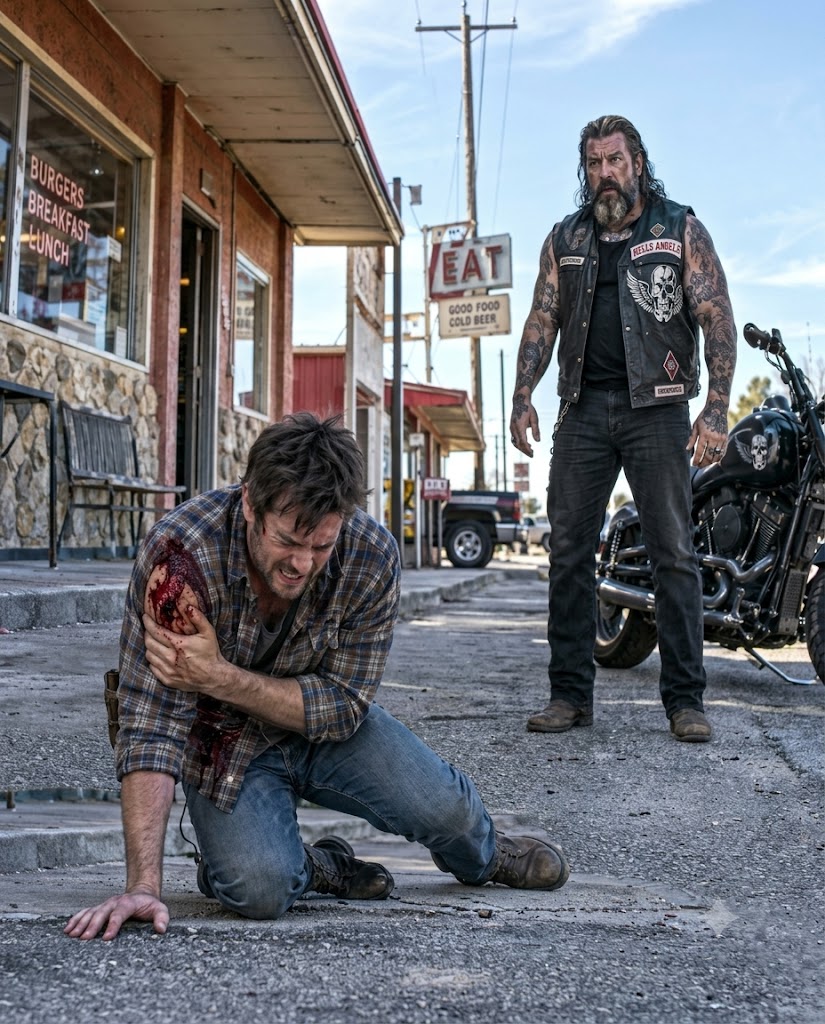
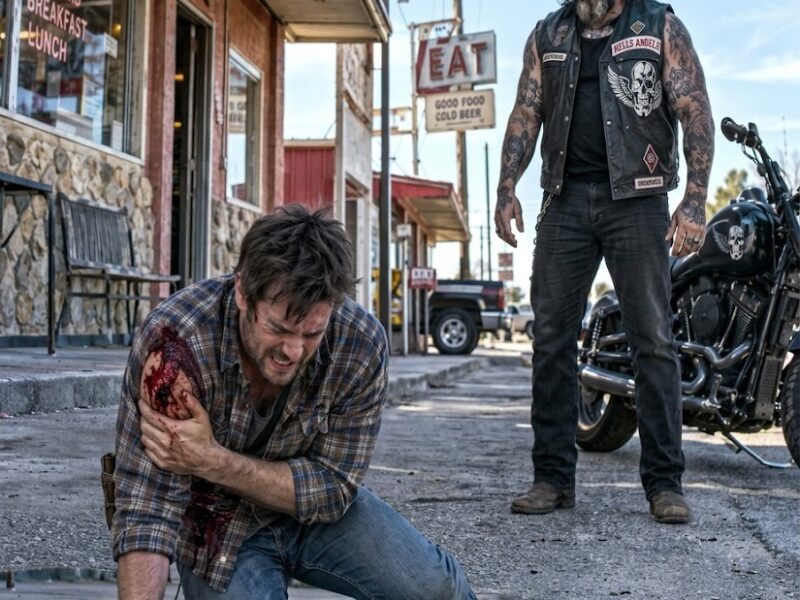
Blood on the asphalt.
The deafening roar of a modified Harley.
A little girl screaming when a quiet, unnoticed man took a bullet meant for a ruthless Hells Angels enforcer’s daughter.
He thought his life was over.
Instead, it was the violent, unimaginable beginning of a bond that defied every law.
The heat in Bakersfield, California, doesn’t just warm you.
It presses down on your shoulders like a physical weight.
On a blistering Tuesday afternoon in August 2014, the air above the asphalt outside the Rusty Spoon Diner was shimmering with mirages.
Arthur Higgins was a man who lived his entire life in those hazy, forgettable backgrounds.
At thirty-four, Arthur—or Arty, to the few people who bothered to remember his name—was a ghost.
He worked inventory at a local hardware supply, lived in a cramped one-bedroom apartment, and had no family to speak of.
His parents had passed away a decade prior, leaving him with a modest pile of medical debt and a profound sense of isolation.
Arty wasn’t unhappy, exactly.
He was just adrift, a man who left no footprints.
That Tuesday, Arty was sitting on a cracked concrete bench outside the diner, peeling the label off a cold bottle of root beer, waiting for his bus.
Just ten feet away stood a man who was the exact opposite of a ghost.
Ronnie “Ironclad” Haddock took up space.
He was six-foot-four, built like a brick wall, and covered in ink that told stories of violence, loyalty, and a life lived on the razor’s edge.
He wore the legendary death’s head patch of the Hells Angels Motorcycle Club on his leather cut, specifically the local Northern California charter.
Ronnie was the sergeant-at-arms, a man whose literal job description was to enforce the club’s brutal laws and protect its members.
But right now, Ronnie wasn’t an enforcer.
He was a father.
Holding his thick, calloused hand was a seven-year-old girl named Lily.
She wore a bright yellow sundress that looked almost painfully innocent against the backdrop of her father’s intimidating leather and the row of polished, roaring choppers parked along the curb.
She was laughing, holding a melting strawberry ice cream cone, her blonde hair catching the harsh California sun.
Arty watched them with a faint, wistful smile.
He admired the fierce, protective way the giant biker looked down at his little girl.
Then the world shattered.
It didn’t happen like it does in the movies, with dramatic music and slow-motion realization.
It happened with the sickening screech of cheap tires on hot pavement.
A matte black Chevy Impala, heavily tinted and lacking license plates, violently hopped the curb.
Ronnie’s instincts were legendary, but he was facing the diner, pulling out his wallet to pay a vendor.
His back was to the street.
Arty was facing the street.
He saw the Impala’s rear window slide down.
He saw the dull matte-gray barrel of a MAC-10 submachine gun slide out, resting on the window sill.
The gun was pointed squarely at Ronnie’s broad back, but the trajectory—the sheer spread of an automatic weapon—meant that the little girl in the yellow dress was directly in the fatal funnel.
Arty didn’t think.
There was no time for a moral debate, no time to weigh his empty life against the bright, blossoming life of a seven-year-old child.
A primal, dormant instinct fired in his brain.
As the first deafening crack ripped through the afternoon air, Arty launched himself off the concrete bench.
He didn’t yell.
He just moved.
He tackled Lily right as the street erupted into a chaotic symphony of shattering glass, screaming metal, and tearing flesh.
The concrete where Lily had been standing a microsecond earlier exploded into a cloud of shrapnel and dust.
Arty felt a sledgehammer slam into his right shoulder, instantly spinning him around.
Before he could process the blinding pain, a second sledgehammer caught him in the ribs, punching all the oxygen out of his lungs.
He collapsed onto the burning asphalt, his body covering Lily entirely, shielding her from the hail of lead.
Ronnie spun around, dropping his wallet, his hand instantly diving to the holster at his hip.
He drew a heavy .45-caliber pistol and returned fire in less than two seconds, sending three massive rounds through the Impala’s rear windshield as the car burned rubber, fishtailing wildly down the street to escape the wrath of the Hells Angel.
The diner’s windows were gone.
Patrons were screaming, diving under tables.
Ronnie ignored the fleeing car.
He dropped to his knees on the glass-covered pavement, his eyes wide with a terror that no rival gang or prison stint had ever instilled in him.
“Lily,” Ronnie roared, a sound that tore from the very bottom of his soul.
He grabbed Arty’s bleeding shoulder and hauled the man off his daughter.
Lily was curled in a fetal position, sobbing hysterically.
But as Ronnie frantically checked her over, he realized something miraculous.
The bright yellow sundress was stained with crimson, but it wasn’t her blood.
Not a single bullet had touched her.
Ronnie looked down.
Arty Higgins was lying on his back.
His cheap plaid shirt was rapidly soaking through with a dark, glistening red.
His breathing was a wet, ragged wheeze.
Bubbles of blood formed at the corner of Arty’s mouth.
Arty looked up at the terrifying biker, his vision swimming, the edges of the world turning dark and cold despite the brutal summer heat.
“Is she?” Arty choked out, his voice barely a whisper.
“Is the kid okay?”
Ronnie Haddock, a man who had broken jaws and shattered orbital bones without batting an eye, stared at this insignificant stranger.
“She’s okay. She’s okay, brother. Stay with me.”
Arty offered a faint, bloody smile, his eyes rolling back.
“Good,” he whispered.
Then the ghost faded entirely into the dark.
—
The emergency room at St. Jude’s Medical Center usually dealt with heat strokes, farm equipment accidents, and the occasional bar fight.
They were entirely unprepared for the invasion that occurred at 3:15 p.m.
Within thirty minutes of the shooting, the hospital wing was locked down—not by the local police, but by a wall of leather and denim.
Thirty fully patched members of the Hells Angels Motorcycle Club had descended upon the waiting room.
They stood by the double doors, blocked the elevators, and lined the hallways.
The sheer physical presence of the club turned the sterile white hospital into a fortress.
The local sheriff’s deputies had arrived, but they stood at the periphery, nervously gripping their duty belts.
They knew better than to push the Angels right now.
The air was thick with the smell of exhaust, sweat, and impending violence.
Ronnie Haddock sat alone in a plastic waiting room chair.
He hadn’t washed his hands.
They were still coated in dried, flaky brown blood.
Arthur Higgins’s blood.
The club’s president, a grizzled, towering man named Dutch Kincaid, walked over and placed a heavy hand on Ronnie’s shoulder.
Dutch had been riding since the late ’70s.
He had seen wars, raids, and funerals.
But seeing his sergeant-at-arms trembling was new.
“Lily is safe at the clubhouse,” Dutch said, his voice a low, gravelly rumble.
“The prospect’s old lady is watching her. She’s shaken up, Ron. But she’s whole.”
Ronnie stared at his bloody hands.
“They aimed for me, Dutch. But they didn’t care about the collateral. If that guy—if that stranger hadn’t jumped…”
Ronnie swallowed hard, the emotion threatening to choke him.
“I’d be planning a funeral for a seven-year-old.”
Dutch squeezed Ronnie’s shoulder.
“We’re going to find out who drove that Impala. We have guys turning Bakersfield upside down. We’re checking with the Mongols, the local cartels, every meth runner in the county. Nobody touches a brother’s family and breathes the next day.”
“I don’t give a damn about them right now,” Ronnie said softly, looking up.
“I want to know who the hell took the bullet.”
Dutch pulled a plastic evidence bag from his pocket.
He had greased a sympathetic nurse to pull the victim’s wallet before he went into surgery.
Dutch read from a cheap plastic California driver’s license.
“Name’s Arthur Higgins. Thirty-four years old. The hospital ran his emergency contacts. You know what they found, Ron?”
Ronnie shook his head.
“Nothing,” Dutch said, his brow furrowing.
“Guy has no wife, no kids, no parents. His emergency contact is listed as his landlord. He works at the hardware store on Fourth Street. He’s a civilian, Ron. A total ghost.”
Ronnie took the plastic bag and looked at the license.
The photo showed a man with mild eyes, a slight frame, and an awkward smile.
He looked like the kind of guy who would apologize if you stepped on his foot.
Yet this was the man who had thrown himself into the path of an automatic weapon.
In the culture of the Hells Angels, respect is the ultimate currency.
Blood is the ultimate bond.
And a life debt—a life debt is a sacred, unshakable chain.
“He’s in a bad way,” Dutch continued grimly.
“Nurse said the lung is collapsed. One bullet shattered his collarbone, the other tore through his liver. They’re trying to stop the internal bleeding, but he’s fighting.”
Ronnie stood up.
His massive frame shadowed the bright fluorescent lights.
“Listen to me, Dutch. If this man dies, the debt can never be repaid. If he lives, he’s not a ghost anymore.”
Dutch nodded slowly.
“Understood.”
For nine agonizing hours, the surgery dragged on.
The Angels didn’t move.
They didn’t eat.
They stood a silent, menacing vigil over a man they had never met.
When the exhausted lead surgeon finally stepped out of the double doors, still wearing his scrubs, he flinched at the sight of thirty bikers staring at him.
Ronnie stepped forward, towering over the doctor.
“Talk to me.”
The surgeon swallowed nervously.
“Mr. Higgins. He survived the surgery. We stopped the bleeding in his liver, and we’ve reinflated his lung. But the damage to his shoulder and the nerve clusters in his right side is extensive. He’s in a medically induced coma to help him heal. Honestly, it’s a miracle he’s alive. But his recovery is going to be incredibly long and incredibly expensive.”
Ronnie didn’t flinch at the word expensive.
“When can I see him?”
“He won’t be conscious for at least a week, maybe two,” the doctor replied.
“And only immediate family is allowed in the ICU.”
Ronnie leaned down, placing his bloodstained hands on the doctor’s shoulders.
The terrifying intensity in his eyes made the doctor freeze.
“Listen to me very carefully, Doc,” Ronnie whispered, his voice dangerously calm.
“Arthur Higgins is my brother. He is my family. And from this second until the day he walks out of this hospital, there will be one of my men sitting outside his door twenty-four hours a day. Nobody goes in there who isn’t wearing a stethoscope. Do we understand each other?”
The doctor gave a rapid, terrified nod.
“Yes. Yes, sir.”
Ronnie turned back to his club.
“Dutch, set the rotation. Nobody gets near him.”
While Arthur Higgins lay in a silent chemical sleep, oblivious to the world, the streets of Bakersfield were burning.
The Hells Angels did not rely on the police to solve their problems.
They had their own intelligence network, one built on fear, respect, and deep roots in the criminal underworld.
It took exactly four days to find the matte black Chevy Impala.
It was sitting at a chop shop on the outskirts of town, riddled with three .45-caliber bullet holes in the trunk.
The chop shop owner, terrified of the twenty bikers who kicked in his bay doors, sang like a canary.
The hit hadn’t been ordered by a rival motorcycle club.
It was much stupider than that.
It was ordered by a mid-level methamphetamine distributor named Jimmy “Rat” Coburn.
Ronnie had recently shut down one of Coburn’s distribution routes because it was running too close to a school in the club’s territory.
Coburn, hopped up on his own product and nursing a bruised ego, had hired two desperate junkies to do a drive-by to send a message.
They didn’t just send a message.
They signed their own death warrants.
The details of what happened to Jimmy “Rat” Coburn and the two shooters over the next forty-eight hours were never recorded in any police report.
There were no arrests.
There was only a sudden, profound disappearance of three men from the California landscape.
The message was sent back, written in iron and blood.
You do not touch the club’s family.
With the threat eradicated, Ronnie returned to his vigil.
Two and a half weeks after the shooting, the monitors in the ICU began to change their rhythm.
The heavy sedatives were being lowered.
Arthur Higgins was waking up.
Arty’s journey back to consciousness was a nightmare of pain.
It felt like his right side was trapped in a meat grinder.
When he finally forced his heavy eyelids open, the harsh fluorescent lights blinded him.
He tried to speak, but his throat was raw from the ventilator tube that had only recently been removed.
He blinked, trying to focus his vision.
Sitting in a chair by his bed was a mountain of a man in a leather cut.
Ronnie leaned forward, resting his elbows on his knees.
“Welcome back to the land of the living, Arthur.”
Arty swallowed dryly, his mind struggling to piece together the shattered fragments of his memory.
The bench, the root beer, the screeching tires, the gun, the little girl in the yellow dress.
“Lily,” Arty croaked, his voice cracking.
Ronnie’s eyes, usually so cold and unreadable, softened in a way that would have shocked his club brothers.
“She’s good, man. She’s at home drawing you pictures. Lots of pictures. Mostly of Batman, but she says you’re cooler than Batman.”
Arty managed a weak, painful chuckle, which immediately turned into a grimace as his ribs flared with agony.
“Glad she’s—glad she’s okay.”
Ronnie fell silent for a long moment.
He looked at the array of tubes and wires keeping this frail man alive.
“The doctors say you’re going to have a rough road, Arty. The nerve damage in your arm is bad. You might need a cane for your right leg. They’re talking about months of physical therapy.”
Arty closed his eyes.
The adrenaline and the nobility of the moment were fading, replaced by the crushing reality of his existence.
He was a retail worker who lived paycheck to paycheck.
“The bills,” Arty whispered, a tear of sheer panic leaking from his closed eye.
“I—I have terrible insurance, man. I’ll lose my apartment. I’ll lose everything.”
Ronnie stood up.
He walked over to the bed and placed his massive, calloused hand gently on Arty’s uninjured left shoulder.
“Arthur, look at me.”
Arty opened his eyes.
“There are no bills,” Ronnie said firmly.
“The hospital administrator has been spoken to. A private donor—an anonymous trust—has already covered your surgery. It’s covering your physical therapy. It’s covering your rent for the next five years.”
Arty stared at him, stunned.
“I—I can’t accept that. It’s too much.”
“You don’t have a choice,” Ronnie growled, though there was no malice in it.
“In my world, a man’s life is his currency. You bought my daughter’s life with your own blood. You stepped in front of the Reaper for a kid you didn’t even know.”
Ronnie reached inside his leather cut and pulled out a small, heavy silver ring.
It was a custom piece, engraved with a set of wings and a shield.
He set it on the table next to Arty’s bed.
“I looked into you, Arty,” Ronnie continued.
“I know you don’t have family. I know you’ve been on your own for a long time. But that ended the second you hit the pavement.”
Arty looked at the imposing biker, his heart pounding.
“What are you saying?”
“I’m saying you aren’t a ghost anymore,” Ronnie said, his voice dropping to a fierce, solemn vow.
“You’re under the protection of the Hells Angels Motorcycle Club. Specifically, you’re under my protection. Nobody touches you. Nobody collects a debt from you. You need a ride? My guys drive you. You need groceries? They get brought to your door. You are untouchable in this state.”
Arty was shaking, overwhelmed by the pain, the drugs, and the sheer weight of what this dangerous man was offering.
“I just—I just didn’t want her to get hurt.”
“I know,” Ronnie said.
“That’s why you’re a better man than anyone in my crew. Now rest. The boys are outside. You sleep. We got the watch.”
As Ronnie turned and walked out of the room, his heavy boots echoing on the linoleum, Arty looked at the silver ring on his nightstand.
He had gone into a coma as a nobody.
He had woken up as a legend in a world he never knew existed.
But as the weeks of painful recovery turned into months, Arty would soon discover that being adopted by the most notorious outlaw motorcycle club in the world didn’t just bring protection.
It brought a completely unexpected set of complications.
Because while Ronnie had meant every word of his vow, the world outside the hospital walls was not done with Arthur Higgins.
And the twisted debt of blood was about to take a turn neither of them saw coming.
—
November brought a bitter, damp chill to Bakersfield, seeping into the bones of anyone with a history of injuries.
For Arthur Higgins, the cold was a daily agony.
Six months had passed since the shooting outside the Rusty Spoon, and his physical reality had been permanently altered.
The nerve damage in his right shoulder was severe, leaving his arm with a persistent, dull tremor.
He walked with a heavy aluminum cane, dragging his right leg slightly due to the cascading trauma from his shattered ribs and hip alignment.
But the most jarring change in Arty’s life wasn’t his broken body.
It was his constant, terrifying, and fiercely loyal shadows.
Arty’s small beige apartment had become a satellite clubhouse for the Hells Angels.
On a chilly Tuesday morning, Arty sat at his cramped kitchen table, clumsily trying to open a jar of instant coffee with his left hand.
Sitting across from him, meticulously cleaning the parts of a Glock 19 on a designated towel, was a three-hundred-pound biker who went by the name Brick.
Brick had a beard that reached his sternum, a rap sheet longer than a CVS receipt, and a surprisingly gentle touch when it came to folding Arty’s laundry.
“Give me that,” Brick rumbled, setting down the slide of his pistol.
He took the coffee jar, popped the seal with one massive thumb, and handed it back.
“You gotta stop being stubborn, Arty. Doc said you pull a muscle compensating for that shoulder, your back in a sling.”
“Thanks, Brick,” Arty muttered, scooping the powder into a mug.
“It’s just surreal. You guys don’t have to be here every single day. I’m just making coffee. Nobody is coming to assassinate me over folders.”
“Ronnie’s orders,” Brick grunted, returning to his weapon.
“And frankly, brother, we like it here. It’s quiet. My old lady is on my case about the garage, so sitting on your couch watching *The Price Is Right* is a vacation.”
Arty smiled faintly.
It was a bizarre existence.
When he needed groceries, a convoy of roaring Harley-Davidsons escorted his battered Honda Civic to the local Safeway.
When he went to his grueling physical therapy sessions, two heavily tattooed enforcers sat in the waiting room, glaring at anyone who coughed too loudly.
The medical bills, the rent, the groceries—everything was paid for by the anonymous trust Ronnie had set up.
Arty had gained a family, but he had lost his invisibility.
And in the criminal ecosystem of Southern California, being highly visible to the Hells Angels meant becoming highly visible to their enemies.
Not rival gangs.
The federal government.
The twist in Arty’s new life began on a rainy Thursday afternoon.
Brick had stayed behind at the apartment to fix a leaky sink, and Arty had taken an Uber to his physical therapy clinic, needing a brief moment of independence.
As he hobbled out of the clinic, sweating and exhausted from an hour of painful stretching, a dark gray Ford Taurus aggressively pulled up to the curb, blocking his path.
The doors opened simultaneously.
Two men in cheap, off-the-rack suits stepped out.
They didn’t look like bikers, and they didn’t look like local cops.
They had the stiff, hyper-alert posture of federal agents.
“Arthur Higgins?” the taller one asked, flashing a gold badge that read ATF—Bureau of Alcohol, Tobacco, Firearms and Explosives.
“Special Agent Thomas Harrison. We need you to come with us now.”
Arty tightened his grip on his cane.
“I haven’t done anything wrong. I just finished therapy.”
“We know,” Agent Harrison said, his eyes scanning the street for any sign of leather cuts.
“And we know who usually guards you. You have a window of exactly fifteen minutes before your babysitters figure out you’re off schedule. Get in the car, Arty. If you don’t, I’ll arrest you right here for conspiracy to distribute narcotics and racketeering.”
Panic, cold and sharp, spiked in Arty’s chest.
He climbed into the back seat.
They drove him to a sterile, windowless room in a federal building downtown.
Harrison tossed a thick manila folder onto the metal table in front of Arty.
It was filled with surveillance photos.
Arty at the grocery store with Brick.
Arty’s apartment building with Ronnie’s chopper parked outside.
Bank statements showing anonymous deposits paying Arty’s rent.
“Let me paint a picture for you, Mr. Higgins,” Harrison began, leaning over the table like a predator.
“For years, you’re a ghost. A nobody working in a hardware store. Then suddenly, you’re the most guarded man in Bakersfield. The Hells Angels, specifically Ronnie Haddock, are bankrolling your entire life.”
“They’re just helping me,” Arty stammered, his right hand trembling.
“I saved his daughter.”
“We know about the shooting,” Harrison interrupted sharply.
“But the ATF doesn’t believe in biker fairy tales. Arty, we’ve been trying to build a RICO case against Dutch Kincaid and Ronnie Haddock for three years. They are careful. Too careful. Then you show up.”
Harrison tapped the bank statements.
“We think this trust paying your bills is a front. We think you’re laundering money for them. Or worse, we think you saw something at that diner you weren’t supposed to, and Ronnie is paying you off to keep your mouth shut.”
“That’s insane,” Arty said, his voice finding a sudden edge.
“I took two bullets for a seven-year-old girl. They’re paying my medical bills because I was going to be homeless.”
“Prove it,” Harrison countered coldly.
“Ronnie Haddock is a violent, ruthless criminal. He doesn’t do charity. We want him, Arty. And you are going to help us get him.”
Harrison slid a small, sophisticated recording device across the table.
A wire.
“You’re on the inside,” the agent said.
“They trust you. They talk around you. You are going to wear this. You are going to get Ronnie talking about the club’s finances, their weapons shipments, or what really happened to Jimmy ‘Rat’ Coburn, who magically disappeared the week you were in a coma.”
Arty stared at the small black device.
It looked like a venomous insect sitting on the metal table.
“And if I refuse?” Arty asked, his voice shaking.
“If you refuse, I freeze your accounts,” Harrison stated flatly.
“I seize the trust fund under suspicion of criminal proceeds. You lose your apartment, your physical therapy, your medical care. Then I indict you as a co-conspirator under the RICO Act. You’re looking at twenty years in a federal penitentiary, Arty. With your injuries, you wouldn’t last a month inside.”
Harrison leaned back, crossing his arms.
“You’re a civilian who got caught in the crossfire. Don’t throw your life away for a gang of thugs who would slit your throat the second you become a liability. You have forty-eight hours to decide.”
They dropped Arty back at his apartment complex an hour later.
The rain was coming down harder now.
As Arty limped toward his door, he felt like he was suffocating.
He was trapped between a notoriously violent outlaw motorcycle club and the crushing, relentless machinery of the federal government.
When he unlocked his door, Brick was asleep on the couch, snoring loudly.
*The Price Is Right* was still playing on the television.
Arty walked into his small bathroom, closed the door, and looked at his ruined body in the mirror.
He traced the massive, jagged, purple scar running from his collarbone down to his rib cage.
He thought about the cold, dead look in Agent Harrison’s eyes.
Then he thought about the way Ronnie Haddock had looked at him in the ICU.
The profound, raw gratitude of a father who still had his little girl.
Arty made his decision.
—
The next evening, the Rusty Spoon Diner was mostly empty.
The bullet-shattered windows from six months ago had been replaced, but the scars on the brick exterior were still visible.
Arty sat in a corner booth, nursing a cup of black coffee.
He had specifically asked to meet Ronnie here, away from the clubhouse and away from the other members.
At exactly 8:00 p.m., the roar of a V-twin engine rattled the diner’s new windows.
Ronnie Haddock walked in, his heavy boots thudding against the checkered linoleum.
He wore his leather cut, the death’s head grinning menacingly under the fluorescent lights.
He slid into the booth across from Arty, his sharp eyes instantly scanning the diner before settling on his friend.
“You look pale, Arty. And you sounded spooked on the phone,” Ronnie said, his voice a low rumble.
“Somebody bothering you? Because if they are, they won’t be for long.”
Arty took a deep, shaky breath.
“Ronnie, I need you to listen to me, and I need you to promise you won’t do anything crazy.”
Ronnie’s expression hardened.
“Talk.”
Arty laid it all out.
He told Ronnie about the Ford Taurus, Agent Thomas Harrison, the surveillance photos, the threats of RICO charges, and the wire.
He didn’t leave out a single detail.
He watched as the air around Ronnie seemed to drop ten degrees.
The biker’s massive hands balled into fists on the tabletop, his knuckles turning white.
“That fed son of a bitch,” Ronnie whispered, the sheer venom in his voice making the hair on Arty’s arm stand up.
“He thinks he can squeeze you to get to me.”
“He’s going to take everything away, Ronnie,” Arty said, his voice cracking.
“He’s going to freeze the medical trust. I don’t care about the prison threats. I know I’m innocent. But without the therapy, I’ll lose the use of my arm completely. But I told you because I won’t wear the wire. I won’t betray you.”
Ronnie stared at Arty for a long, silent minute.
The fierce enforcer was looking at a broken, frail man who had just refused to hand him over to the federal government despite facing total ruin.
“You took a bullet for my blood,” Ronnie said softly.
“Now you’re willing to take a federal charge for me?”
“You kept your word to me,” Arty replied, his chin trembling slightly, but his eyes locked onto Ronnie’s.
“I’m keeping mine. But what do we do?”
Ronnie slowly uncurled his fists.
A dark, cunning smile spread across his face.
A smile that usually meant a rival club was about to have a very bad night.
But this time, it was directed at the U.S. government.
“Arty, the ATF thinks we’re stupid,” Ronnie said, pulling out his cell phone.
“They think we run our business like a bunch of street thugs. They think that trust fund is a slush account.”
Ronnie dialed a number and put the phone to his ear.
“Hey, it’s Ronnie. Yeah, wake him up. I need the shark down at the clubhouse in twenty minutes. Bring the paperwork for the Higgins file.”
Ronnie hung up and looked at Arty.
“Agent Harrison made one fatal flaw. He assumed we were breaking the law to keep you alive. Come with me.”
—
The next morning, at exactly 9:00 a.m., Agent Thomas Harrison sat in his office at the federal building, aggressively typing up a warrant to freeze Arthur Higgins’s assets.
He was anticipating Arty’s surrender.
Instead, his office door swung open.
Arty walked in, leaning heavily on his cane, but he wasn’t alone.
Flanking him was a man in an impeccably tailored five-thousand-dollar suit, carrying a thick leather briefcase.
“Mr. Higgins,” Harrison said, standing up, a triumphant smirk on his face.
“I see you made the smart choice. Who is this? Your public defender?”
“My name is David Roth,” the man in the suit said, his voice smooth as silk and cold as ice.
“I am senior partner at Roth, Leven and Associates. I represent Mr. Higgins as well as the legal interests of Mr. Ronald Haddock.”
Harrison’s smirk vanished.
“What is this?”
Roth opened his briefcase and dropped a massive stack of bound, notarized legal documents onto Harrison’s desk.
It landed with a heavy, satisfying thud.
“This, Agent Harrison, is a fully transparent, IRS-audited, legally binding charitable trust,” Roth stated.
“Six months ago, my client, Mr. Haddock, won a substantial out-of-court settlement from a motorcycle manufacturing defect. Instead of keeping it, he established the Lily Haddock Foundation for victims of violent crime. The foundation’s sole beneficiary currently is Mr. Arthur Higgins, a certified hero who saved Mr. Haddock’s daughter from a drive-by shooting.”
Harrison stared at the documents, his face turning an angry shade of crimson.
“This is a front.”
“This is airtight,” Roth corrected him sharply.
“Every cent paying for Mr. Higgins’s rent and medical care is legally taxed, accounted for, and publicly registered. There is no money laundering. There are no criminal proceeds. If you attempt to freeze this trust, I will personally sue the ATF, the federal government, and you, Agent Harrison, for malicious prosecution, harassment of a disabled victim of gun violence, and civil rights violations. I will have your badge, your pension, and your house.”
Harrison looked from the lawyer to Arty.
The agent’s jaw was clenched so tight it looked like it might shatter.
He knew he was beaten.
The Hells Angels hadn’t used dirty money.
Ronnie had used clean, legal cash to protect his savior, purposefully walling Arty off from the club’s illicit activities.
“Get out of my office,” Harrison seethed.
Arty leaned forward on his cane, looking the federal agent dead in the eye.
“Stop following me, Agent Harrison. I’m not a ghost you can bully anymore.”
As Arty and Roth left the federal building, the cold November rain had stopped.
The clouds were breaking, letting a few rays of California sun shine through.
Parked at the curb, leaning against his massive motorcycle, was Ronnie.
Ronnie looked at Roth.
The lawyer simply nodded and walked away toward his own car.
Ronnie walked up to Arty.
He didn’t say a word about the ATF or the feds.
He didn’t have to.
The threat was neutralized.
“You know,” Ronnie said, looking down at his boots before looking up at Arty.
“Lily’s eighth birthday is this weekend. We’re having a barbecue at my place. Not a club thing. Just family.”
Arty smiled, leaning on his cane.
“I’d love to come.”
Ronnie reached into his leather cut.
He didn’t pull out a gun or a wad of cash.
He pulled out a small, beautifully wrapped box and handed it to Arty.
“I talked to Dutch,” Ronnie said softly.
“I talked to the club. What you did in that diner—and what you did yesterday. Standing up to the feds for me. You bled for this family twice.”
Arty opened the box.
Inside rested a heavy steel Zippo lighter.
Engraved on the side was the Hells Angels’ winged death’s head.
But below it, it didn’t say “Member” or “Prospect.”
It read: *Arthur Higgins, Godfather.*
*Blood for blood.*
“I’m not a religious man, Arty,” Ronnie said, the emotion thick in his throat.
“But if anything ever happens to me, I need to know my little girl is safe. I need to know someone who actually knows the value of a life is watching out for her.”
Arty stared at the lighter, tears finally welling up in his eyes, blurring the engraving.
The ghost who had no family, no emergency contact, and no legacy had just been given the greatest honor a father could bestow.
“I’ll protect her, Ronnie,” Arty whispered, his voice choked with emotion.
“Always.”
Ronnie pulled the frail man into a massive, bone-crushing hug, mindful of his injured shoulder.
“I know you will, brother. Let’s go home.”
—
Arty Higgins never rode a motorcycle.
He never wore a leather cut.
And he never participated in the dark, violent business of the Hells Angels.
But for the rest of his life, whenever Arthur walked into a room in Bakersfield, men twice his size stepped aside with absolute respect.
He was the civilian who took a bullet for a biker’s daughter.
The man who stared down the federal government.
And the unbreakable shield of Lily Haddock.
The ghost had finally found his permanent place in the world.
—
Six months later, Arty stood in the backyard of Ronnie’s modest ranch house, watching Lily chase a border collie puppy across the freshly cut grass.
She was wearing a new yellow sundress, and her laugh carried across the yard like a bell.
Ronnie stood beside Arty, a cold beer in his hand, his eyes soft as he watched his daughter.
“She still talks about you, you know,” Ronnie said.
“Every night before bed. Says you’re her guardian angel.”
Arty smiled, the Zippo lighter warm in his pocket.
“She’s got a lot of angels looking out for her.”
Ronnie clinked his beer bottle against Arty’s root beer.
“Yeah. But only one who took two bullets and told the feds to go to hell.”
They stood in comfortable silence, two men from different worlds, bound by blood and fire.
The sun was setting over Bakersfield, painting the sky in shades of gold and crimson.
And for the first time in his life, Arthur Higgins didn’t feel like a ghost.
He felt like he belonged.
—
The story of Arthur Higgins and Ronnie Haddock spread through the tight-knit community of Bakersfield like wildfire.
It wasn’t the kind of story that made the evening news.
There were no press conferences, no medals, no official recognition.
But in the bars, the garages, and the diners where bikers and civilians alike gathered, the tale was told and retold.
A quiet man.
A ruthless enforcer.
A little girl in a yellow dress.
And a debt of blood that could never be repaid.
Some said Arty was a fool for stepping in front of a gun for a stranger.
Others said he was the bravest man they had ever known.
But Arty didn’t think of himself as either.
He was just a man who had finally found something worth living for.
And in the world of the Hells Angels, that was the only thing that mattered.
—
Months turned into years.
Lily grew up strong, fierce, and fiercely protective of her godfather.
She learned to ride a motorcycle before she learned to drive a car.
She learned to stand up for herself, to never back down from a bully, and to always, always keep her word.
And every year, on the anniversary of the shooting, she would sit with Arty on the porch, holding his hand, and thank him for saving her life.
Arty would just smile, his eyes crinkling at the corners, and say the same thing every time.
“I didn’t save your life, Lily. You saved mine.”
And in a way, he was right.
Before the shooting, Arty had been a ghost, drifting through life without purpose or connection.
After the shooting, he had found a family.
He had found a purpose.
He had found a reason to keep fighting, even when his body screamed in agony and his mind begged for rest.
He had found Lily.
And that was worth more than any bullet, any federal charge, any threat from the ATF.
That was worth everything.
—
The Zippo lighter became Arty’s most treasured possession.
He carried it with him everywhere, a constant reminder of the night he had earned the respect of the most feared motorcycle club in California.
He never used it to light a cigarette—he didn’t smoke.
He just kept it in his pocket, a talisman against the darkness.
And whenever he felt lost or alone, he would take it out, run his thumb over the engraved death’s head, and remember.
Remember the heat of the asphalt.
Remember the roar of the Harley.
Remember the little girl in the yellow dress.
And remember the look in Ronnie Haddock’s eyes when he had called him brother.
That was the moment Arty’s life had truly begun.
And he would carry it with him until his last breath.
—
*If this story of sacrifice, loyalty, and unexpected brotherhood gave you chills, hit that like button and share it with someone who understands the weight of a promise.*
*Subscribe for more unbelievable, heart-pounding true stories.*
*See you in the next one.*









