
He Secretly Funded His Wife’s Family for Years—Then They Threw Him Out for “Having Nothing”
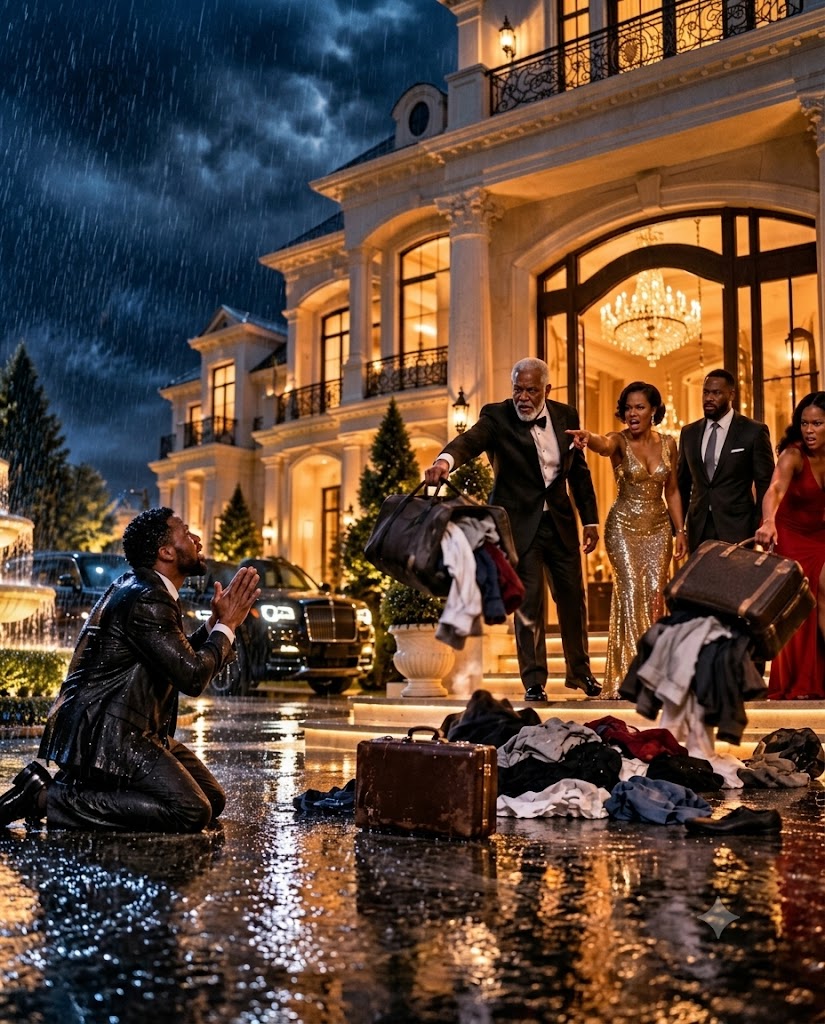
The rain came down in sheets that October night, hammering the stone steps of the house Maxwell Whitfield had helped buy. His clothes lay scattered across the wet pavement—dress shirts, a suitcase split open at the seam, a single black sock floating in a puddle near the gutter. He was on his knees in a soaked suit, hands clasped together like a man praying in church, staring up at the porch light where his wife stood dry and silent with her family behind her. That was the moment the truth finally landed on him, hard and permanent, like a door slamming shut in an empty house. The truth was simple and ugly: after nine years of funding every dream, every emergency, and every comfortable life in that family, he had become worthless the second his money ran out.
—
Maxwell had spent a long time believing money could buy loyalty.
Not in a cold, calculating way—he wasn’t that kind of man. He genuinely believed that if you took care of people, really took care of them, no strings and no scorekeeping, they would take care of you back when it mattered most. He built his whole adult life around that belief, brick by brick, check by check, year by year. And it took losing everything to find out how wrong he had been.
He met Simone Carter when he was twenty-six years old.
She was loud in the best possible way, the kind of woman who filled up a room without even trying. She had a laugh that made you feel like you had just told the funniest joke of your life, even when you hadn’t said anything funny at all. Maxwell was running a small events and hospitality company back then—banquet halls, corporate catering, a couple of boutique venues rented out for weddings and galas. It wasn’t glamorous work, but it was his, and it was growing fast enough that he could see a real future in it.
Simone’s family wasn’t poor, but they weren’t where they wanted to be either.
Her father, Franklin Carter, had spent thirty years as a mid-level manager at a shipping company, watching younger men get promoted past him year after year. Her mother, Vivian, ran a small hair salon that barely broke even most months. There was a younger brother, Terrence, who bounced between sales jobs like a pinball, and a younger sister, Renee, who was still finishing school when Maxwell came into the picture. Maxwell liked them. He liked being around a family that laughed loud at dinner and argued about football and hugged you when you walked in the door. His own family was smaller and quieter, and both his parents had passed by the time he turned thirty. The Carters felt like something he had been missing his whole life without knowing it.
So when Franklin mentioned, almost as a joke, that he wished he could get out from under his lease and buy something of his own before he retired, Maxwell didn’t think twice.
He helped with the down payment on a house.
Not because Simone asked, not because anyone pressured him, but because he could and because it felt good to be the man who made things happen for the people he loved. That was 2013. Maxwell and Simone got married a year later. And from that point on, he became something like the family’s unofficial bank.
When Terrence wanted to start a small logistics side hustle—a two-van delivery service—Maxwell put up the capital. When Renee needed help covering her final year of nursing school after her financial aid fell through, he paid it without blinking. When Vivian’s salon needed a new lease on a bigger space, he co-signed it. He never once said no. He never brought it up at dinner. He never used it as leverage or held it over anyone’s head. He told himself that was the whole point—that real generosity doesn’t come with conditions.
By 2018, Maxwell’s company had grown into something real. Four venues across the city, a catering division, a full event staff, contracts with two hotel chains. He was pulling in more money than he had ever imagined growing up, and every year some meaningful piece of it flowed toward the Carters. A car for Franklin when his transmission gave out. A down payment on a duplex for Terrence when his delivery business finally turned a profit. Vacations, tuition, emergency repairs, Christmas gifts that were less gifts and more quiet bailouts.
Simone used to tell people Maxwell was a blessing to this family. Franklin would nod along like he had always known Maxwell was good enough for his daughter. There was a comfort in that. Maxwell didn’t need the thanks, exactly. But it felt good to have it anyway. It felt like proof he belonged.
To be clear, Maxwell wasn’t naive about money. He understood business. He understood risk. He had grown a company from nothing, and he knew how quickly things could turn. What he didn’t understand—what he refused to let himself understand—was that loyalty built on money isn’t loyalty at all. It’s a transaction wearing a family’s clothes. And transactions only hold as long as both sides are getting what they came for.
There was a specific memory Maxwell kept coming back to from those early years, one that probably should have told him everything he needed to know if he had been paying closer attention.
It was Thanksgiving, maybe 2016, and he had just wired the last portion of Terrence’s van financing that morning. Franklin stood up before dinner, tapped his glass, and gave a whole toast about how a family takes care of its own. How blood runs thicker than circumstance. How grateful he was to have a son-in-law who understood that. Everyone raised their glasses. Simone squeezed his hand under the table. He remembered feeling like he had finally found the thing he had been missing his whole life—not just a wife, but a whole family that saw him, valued him, wanted him in the room.
What he didn’t notice then, because he didn’t want to, was that Franklin’s toast never once used his name.
Franklin talked about “a man who understands family” and “someone who gets it.” Language general enough that it could have applied to anyone who happened to be writing the checks. It wasn’t about Maxwell specifically. It was about what he provided. He turned that memory over more times than he could count in the years since, trying to figure out if he had been reading too much into it after the fact, coloring an innocent moment with the bitterness of everything that came later. Maybe. But he didn’t think so. Some truths just take years to become visible, and by the time you can finally see them clearly, you’re usually standing in the wreckage they were quietly building toward the whole time.
Maxwell found that out in March of 2020.
Nobody needs it explained what COVID did to the world. Everybody lived through some version of it. But here’s what it did to Maxwell specifically, because it matters for everything that came after. His entire business model was built on people gathering—weddings, galas, corporate conferences, fundraisers. Overnight, every single one of those things became illegal, then impossible, then unthinkable. In the span of about six weeks, Maxwell went from running four thriving venues with over a hundred employees to staring at a spreadsheet that made him physically sick.
He did what he could.
He applied for every relief loan available. He renegotiated leases, cut staff down to a skeleton crew, sold off catering equipment at a fraction of its value just to make payroll one more month. He dipped into savings he had built for a decade. He remembered sitting in his office—the one venue he hadn’t shut down yet—at two in the morning, going through numbers for the hundredth time, trying to find some version of the math that let him keep the doors open. There wasn’t one.
By August of 2020, he had shut down two of his four venues permanently. By the following spring, the other two followed. The company he had built from a single rented hall into a six-figure-a-month operation was gone. Not struggling—gone. He laid off employees he had known for years, people whose kids he had watched grow up at company picnics. One of his longtime managers, a woman named Dolores who had been with him since the beginning, hugged him in the parking lot after he told her the news, and both of them cried without saying much of anything.
Maxwell wouldn’t pretend the money disappearing didn’t terrify him. It did. But what scared him more, if he was honest, was the identity of it. He had spent almost a decade being the man who solved problems, the man who wrote checks and made calls and never let anyone in his orbit go without. And now he was the problem. He had nothing left to give. And for the first time in his adult life, he needed something instead.
He assumed—and this is the part that still made his chest tight when he thought about it—that the people he had spent nine years supporting would be there for him the way he had been there for them. That’s not entitlement. That’s just what he thought family meant. He was about to learn otherwise.
While Maxwell’s world was collapsing, Simone’s was doing the opposite.
She had started posting videos online a couple of years earlier, mostly cooking content and lifestyle stuff. Nothing serious—a hobby account with maybe eight or nine thousand followers, the kind of thing she would film in twenty minutes between errands. Maxwell used to watch them with her sometimes, tell her they were good, mean it. Then the world locked itself inside, and suddenly everyone had nothing to do but scroll. People were desperate for content, desperate for something to watch that wasn’t the news. Simone’s videos—funny, warm, a little chaotic, the kind of energy that made you feel like you were hanging out with a friend instead of watching a stranger—started catching.
One video about quarantine dinners for people who can’t cook did four hundred thousand views in a week. Then a million. Then she posted something else and it did three million. Within four months, Simone had gone from a hobby account to over two million followers. Brands started reaching out. Then bigger brands. Then actual money—sponsorship deals, affiliate codes, a paid partnership with a meal kit company that alone was paying her more in a month than Maxwell’s entire failing business was bringing in.
He wanted to say he was happy for her. And honestly, at first, he was. He told her so. He helped her set up better lighting in the spare room, helped her think through contract terms since he had run a business and she hadn’t, stayed up late helping her respond to emails from managers and agents who suddenly wanted a piece of her. But something shifted in Simone as the numbers climbed, and it shifted fast.
The version of her who used to ask Maxwell’s opinion on things started disappearing. She started talking about “her platform” and “her brand” like they existed in a universe separate from their marriage. She stopped asking how his business was doing—not out of malice at first, just distraction. And then later, out of something closer to disinterest.
The first time she said something that actually stung, they were at dinner with her parents. Franklin asked how the venue situation was going, and Maxwell gave him the honest, ugly truth—that they might have to close the last location. Before he could finish, Simone laughed. Not cruelly, exactly, but not kindly either. And she said, “Well, thank God somebody in this house still has income coming in.”
Everyone chuckled. Maxwell smiled, because that’s what you do at a dinner table when you don’t want to make a scene. But he remembered the specific cold feeling of that moment. It was the first time in nine years he had felt like an afterthought in a room he used to anchor.
It got worse from there, and it got worse fast.
By early 2021, Simone had crossed four million followers. She had landed a deal with a national skincare brand and another with a streaming platform to produce short cooking segments. The money coming into their joint account—the same account Maxwell had used for years to fund her family—was now almost entirely hers. And she never let him forget it.
It started small. Comments about how she was carrying the household now. Then it became pointed reminders dropped casually into arguments about how she was the one paying for groceries, for the mortgage on the house they still lived in, for the car Maxwell drove because he had sold his own to cover payroll six months earlier. She wasn’t wrong about any of it, factually. But the way she said it had changed. It wasn’t information anymore. It was a weapon, and she was learning exactly how sharp it could be.
Maxwell tried talking to her about it. One night specifically, sitting on the edge of the bed, he tried to explain that he felt like he was disappearing in his own marriage. She looked at him and said, “Maybe if you’d planned better, you wouldn’t feel that way.” Then she picked up her phone to respond to a comment on her latest post, and that was the end of the conversation.
Her family noticed the shift too, and instead of pushing back on it, they leaned into it.
At a Sunday dinner at Franklin and Vivian’s—the house Maxwell had put a down payment on eight years earlier—Franklin, halfway through a glass of wine, looked at him and said in front of everyone, “You know, Maxwell, a man’s supposed to be the one holding things down, not the other way around.” He said it like a joke. Nobody laughed like it was one.
Terrence, who was still driving a truck Maxwell had helped him finance, started making little comments about “real hustle” versus “old money that dries up.” Renee, to her credit, mostly stayed quiet, but she stopped calling to check on him the way she used to. Stopped asking about his day when they would talk. It was like watching a family recalibrate in real time, deciding who was worth their attention based on a number in a bank account—and deciding Maxwell no longer made the cut.
He kept waiting for someone—anyone—to remember the years before. The down payments, the tuition, the vans, the leases, the Christmases. Nobody did. Or if they remembered, it didn’t seem to matter anymore. Maxwell had become, in the space of about a year, the least useful person in a family he had quietly financed for nearly a decade.
There was a particular Tuesday he still thought about from that stretch, one that had nothing to do with a dramatic blowup—just a small, quiet erosion that somehow hurt more than the loud moments did. He had driven over to drop off some paperwork for Franklin, something related to the house insurance, and found him and Terrence in the garage looking at pictures on Terrence’s phone from some event Simone had been flown out to for a brand partnership. First class, a hotel suite, the whole production.
Franklin was grinning, scrolling through the photos, saying things like, “My girl’s really doing it now. This is what real success looks like.” Maxwell stood there a second before either of them noticed him. And when Franklin finally looked up, there was a flicker of something across his face. Not hostility—just mild, passing indifference, like Maxwell had wandered into a conversation that had nothing to do with him and never really would again. Franklin asked about the insurance papers, signed where he needed to sign, and went back to the photos before Maxwell had even reached his car. It wasn’t cruelty. It was worse than cruelty in a way. It was simply being forgotten in real time.
The end came in October of 2021, on a night Maxwell would never fully stop replaying in his head.
Simone had invited her whole family over—not to their old house, since they had downsized months earlier into a smaller place after Maxwell could no longer help with the mortgage, but to the house Franklin still lived in. The one Maxwell had helped him buy. It was some kind of celebration. Simone had just crossed six million followers and signed her biggest deal yet, and the family wanted to mark it properly. Everyone was dressed up. Franklin in a tux, Vivian and Renee in gowns, Terrence in a sharp suit.
Maxwell remembered feeling strange even getting dressed that night, like he was attending a party for a company he used to work for and had since been fired from.
He didn’t remember exactly what set it off. It started with a comment from Terrence about “some people not knowing when to bow out gracefully,” aimed loosely enough that Maxwell could have let it go, but pointed enough that he didn’t. He said something back—not cruel, just honest. Something about how he hoped everyone remembered who had helped build the floor they were standing on.
Simone’s face went cold in a way he had never seen before.
Franklin stood up, pointing at Maxwell, his voice loud enough that it silenced the room. He said Maxwell couldn’t take care of his daughter anymore. That a man who couldn’t provide had no business calling himself the head of anything. That maybe it was time he let her go and let her live the life she had built for herself. Vivian didn’t say a word in his defense. Renee looked at the floor. Terrence just crossed his arms like he had been waiting for this moment for a year. And Simone didn’t defend him either. She stood there, arms folded, and said quietly, “Maybe he’s right.”
It started raining outside almost the moment things turned physical in tone. Not violent—just loud, ugly, final. Someone started grabbing Maxwell’s things from the guest room where he had left a bag from earlier that week. His clothes, his suitcase. They were carried out onto the front steps in the pouring rain, tossed down onto the wet stone like garbage.
He stood in the downpour, soaked through his suit within seconds, watching his life get thrown out of a house he had once helped pay for. He dropped to his knees at some point—not out of some performance, but because his legs genuinely stopped holding him up. He was begging, hands together, asking Simone to just talk to him. Just give him a minute. Just remember nine years of his life poured into hers. She stood on the steps under the porch light with her family behind her—dry, dressed, done with him—and she didn’t move.
Franklin was the one who finally spoke. He told Maxwell the marriage was over, that he should leave before someone was called to make him leave, and that his daughter didn’t need a man who couldn’t hold his own weight anymore. Maxwell left. He didn’t have anywhere to go that night except a motel twenty minutes away, where he sat on the edge of a stiff bed in wet clothes and stared at a water stain on the ceiling until the sun came up.
The months right after that blurred together in Maxwell’s memory in a way that felt almost merciful.
He was staying in a studio apartment he could barely afford on savings that were nearly gone. He picked up consulting work where he could, helping small businesses restructure, which was a bitter kind of irony he tried not to think about too hard. He wasn’t homeless. He wasn’t destitute. But he was as low as he had been in fifteen years, and he was doing it entirely alone.
Simone filed for divorce three weeks after that night. Maxwell didn’t fight it. There wasn’t much left to fight over on paper. The properties they had co-owned had mostly been sold off or refinanced during the collapse of his business, and the things that were left, she had built with her own name attached to them by then. He signed what needed signing. He didn’t call her family. He didn’t call her—except once, about a box of his father’s old letters he had left behind, which she mailed to him without a note.
It would be a lie to say he moved through that period with grace and dignity. There were nights he sat in that studio apartment and felt like the previous decade of his life had been erased, like he had poured himself into a family that had used him up and set him down the second he stopped being useful. He thought about all the moments—Franklin’s transmission, Terrence’s vans, Renee’s tuition, every Christmas, every quiet bailout. And something curdled in him that he wasn’t proud of, but he wouldn’t pretend it wasn’t there. Anger. Not the loud kind. The kind that sits in your chest for months and slowly hardens into something else.
What kept him from completely falling apart, honestly, was something he had almost forgotten about.
Years earlier, back in 2015, a college friend named Andre Bishop had come to Maxwell with an idea. Andre was sharp—always had been—and he had left a decent corporate job to build a small logistics software startup, something meant to help small shipping and warehousing companies track inventory in real time. It was early, unproven, the kind of thing that could easily go to zero. Andre needed seed capital, and Maxwell had it, so he put in fifty thousand dollars in exchange for a small equity stake.
It wasn’t a big deal to him at the time. He barely thought about it over the years. Andre would send updates now and then—a new hire, a new client, a rough patch, a better quarter. But the shares were tied up in a vesting and lockup agreement from an early investor dispute. Some legal tangle between Andre and a co-founder who had left acrimoniously and tried to claim a bigger cut than his contract allowed. Lawyers got involved. The whole thing sat frozen in litigation for years, Maxwell’s small stake sitting somewhere in the middle of it, functionally worthless on paper and completely inaccessible. Even if it hadn’t been, he had genuinely forgotten about it by the time his own business collapsed. It felt like a minor footnote from a different life.
Then, in the middle of the pandemic, while Maxwell’s venues were closing and Simone’s account was exploding, Andre’s little logistics tracking software suddenly became essential.
Every warehouse, every shipping company, every business trying to survive a broken supply chain needed exactly what he had built years earlier as a bet on the future. His company’s revenue tripled. Then tripled again. A much larger logistics conglomerate came calling with an acquisition offer that made the news in industry circles—though not the kind of news that would have reached Simone’s family, unless they were paying very close attention, which they weren’t.
The lawsuit that had frozen everything finally settled in the summer of 2021, right around the same time Maxwell’s marriage was falling apart. As it happened—though he didn’t know it yet—Andre reached out to tell him the shares were finally unlocked. And with the acquisition on the table, Maxwell’s small, forgotten fifty-thousand-dollar bet from 2015 was suddenly worth more than four million dollars.
He found out three weeks after he had been thrown out into the rain.
The moment he got that call wasn’t triumphant the way you might expect. He was sitting in that same cramped studio apartment, still raw, still humiliated. When Andre called and told him the number, he didn’t say anything for almost ten full seconds. Andre asked if he was still there. He said yes. Then he hung up and sat on the edge of his bed and cried. Not from joy, not really—but from something more complicated. Relief, grief, and a strange, quiet fury, all tangled together.
He didn’t rush out and buy anything. He didn’t call Simone. He didn’t post about it—obviously, he had never had much of an online presence to begin with, and after watching what that world had done to his marriage, he wanted less to do with it than ever.
Instead, he did what he did best. He got quiet, got methodical, and got to work.
He paid off every debt he had accumulated during the collapse. He set aside a serious chunk into secure, long-term investments—this time diversified, boring, exactly the opposite of a single risky bet. He hired a lawyer, a good one, and started looking closely at something he hadn’t thought about in years: the paperwork behind Franklin’s house.
Here’s something he had never mentioned to anyone, including Simone—mostly because it never seemed important until it suddenly was. When Maxwell helped Franklin buy that house back in 2013, his accountant at the time had structured the purchase in a specific way, for tax and liability reasons, through a small holding LLC that Maxwell controlled, rather than a straightforward gift or a loan in Franklin’s name outright. Franklin lived there, treated it as his own, paid what he could toward informal rent that mostly went to taxes and insurance. And over the years, everyone simply assumed the house belonged to him, free and clear.
Maxwell never corrected that assumption, mostly because it never mattered. He wasn’t trying to hide anything or set some kind of trap. It was just how the deal had been built. And once the marriage was good and the family was warm, it stopped being something anyone thought to ask about.
Except it did matter now, because legally, the LLC—and the house inside it—was still his.
Maxwell sat with that fact for a long time before deciding what to do with it. Part of him wanted to let it go entirely, to just walk away with his money and never think about the Carters again. But another part of him—the part that had knelt in the rain begging for a family to remember nine years of loyalty—wanted something closer to the truth to come out into the open. Not revenge, exactly. What he did next wasn’t about hurting anyone for the sake of it. It was about finally, for the first time in almost a decade, protecting himself.
Life has a strange sense of timing sometimes, because right around when Maxwell’s situation had fully turned around—new investments settled, a modest but genuinely solid new company started with a small group of former employees who had stuck by him—Simone’s world began quietly falling apart.
He didn’t hear it from her. Obviously, they hadn’t spoken in nearly a year. He heard bits and pieces the way you do—a mutual friend, an old co-worker who still followed her online, the occasional headline in an industry newsletter he subscribed to out of professional habit more than anything else.
The short version went something like this.
Sometime in early 2022, riding the high of her platform’s growth, Simone had pivoted hard into promoting a cryptocurrency education platform. Courses, paid group chats, sponsored posts encouraging her millions of followers to invest in a specific token she had partnered with. For a while, it worked spectacularly. She was reportedly pulling in more from that single partnership than from her entire first two years of content combined.
But the token cratered later that year, part of the broader crypto collapse that took a lot of influencer-backed projects down with it. Followers who had trusted her recommendation lost real money, and the backlash was fast and brutal. Screenshots resurfaced. Old posts got dissected. A consumer watchdog account with a large following did an entire breakdown, accusing her of promoting an undisclosed paid scheme, and it went viral in exactly the way her earlier content had—except now the virality was working against her.
The platform she had built her entire income on suspended her account for terms of service violations tied to the undisclosed sponsorship issues. Not banned forever, from what Maxwell understood, but suspended long enough, at exactly the wrong moment, that her momentum died completely. Brand deals dried up overnight. The streaming platform quietly let her contract lapse. The skincare partnership issued a statement distancing itself. In the span of about two months, the income that had made Simone feel untouchable evaporated almost as fast as it had appeared.
Maxwell felt something when he heard all this, and it wasn’t pure sympathy. There was a flicker of something uglier in him, too—something he wasn’t proud of, but wouldn’t lie about either. Mostly, though, he felt a strange, hollow kind of vindication. Not happiness—just the quiet confirmation of something he had suspected the whole time. The foundation had never been as solid as it looked. It had just been a number on a screen, and numbers on screens can disappear as fast as they show up.
Maxwell found out how bad things had gotten for the family all at once.
On a Tuesday afternoon in late 2022, he was at his new office—smaller than his old venues, but his, rebuilt from the ground up with people he trusted—when his assistant told him someone was at the front desk asking for him. He assumed it was a vendor or a client. It was Vivian.
She looked older than he remembered, and not just in the ordinary way time does that to people. She looked tired in a way that had nothing to do with age and everything to do with worry. She didn’t waste time on small talk. She told him Franklin had fallen behind on the house payments—the informal payments he had been making toward taxes and insurance for years, since he had never fully understood, or perhaps never fully accepted, that there was more to the ownership structure than that. She told him Terrence’s delivery business had folded during a slow stretch. That Renee had picked up extra nursing shifts to help cover the family’s bills. And that Simone, whose money had for a while been propping up nearly everyone, no longer had much to give.
She asked—in a voice that had none of the confidence he remembered from years of Sunday dinners—if there was any way he could help. Just for a little while, she said. Just until things turned around again.
Maxwell sat with that request for a long moment, and he thought about a lot of things in that silence. Nine years of down payments and tuition and vans and Christmases. Kneeling in the rain while his clothes were thrown down a set of stone steps. Franklin’s voice telling him he couldn’t take care of his daughter anymore. Simone standing dry under a porch light, arms folded, saying nothing while he begged.
He told Vivian he needed some time to think, and asked her to have Franklin, Simone, Terrence, and Renee meet him at the house the following week. All of them. He told her it wasn’t a punishment. And at the time, he mostly meant that. He just needed to say some things in the place where they had happened, and he needed everyone there to hear it at once.
They were all there when Maxwell arrived the following Saturday, standing in the same entryway where he had once been welcomed as family.
Franklin looked smaller than Maxwell remembered, though he suspected that had less to do with his body and more to do with whatever had happened to his certainty over the past year. Vivian stood beside him. Terrence leaned against the wall, arms crossed in the same posture he had worn the night Maxwell was thrown out. Renee looked nervous, glancing between everyone like she wasn’t sure which version of this meeting she was walking into. Simone stood apart from the rest of them near the stairs, and Maxwell noticed she had lost weight, and there was a tightness around her eyes he didn’t remember from before.
Nobody said much at first. They seemed to be waiting to see which version of Maxwell had walked through that door—the man who used to write checks without asking questions, or someone else entirely.
Maxwell told them plainly what he had come to say. He told them he knew about the money troubles. He told them he understood what it felt like to lose everything you thought was permanent, because he had lived through exactly that alone less than two years earlier, with none of them beside him. Then he told them the part they didn’t know.
That the house they were standing in had never fully belonged to Franklin. That the LLC he had set up back in 2013 still held legal title. That in practical terms, he was still—and had always been—the actual owner.
The room went quiet in a way that felt total.
Franklin’s face moved through something like confusion, then disbelief, then something closer to shame. Simone looked at Maxwell like she was seeing a stranger, which in some sense she was. He told them he wasn’t there to throw anyone out onto the street the way he had been thrown out into the rain. It would have been easy, and part of him had considered it. But he also told them—without raising his voice—that the era of unconditional funding was permanently over.
He laid out the terms plainly. Franklin could stay, but he would need to formally take over the mortgage in his own name through a proper refinance, something Maxwell’s lawyer would help arrange fairly at market terms. No gifts attached. Terrence and Renee would receive no further financial support from him. Full stop. Said without cruelty—just clarity.
And Simone—Maxwell looked at her longest, because there was something he needed her to understand specifically. He told her he had spent nine years believing love and loyalty were the same thing as money, and that she and her family had taught him, in the cruelest way possible, that they aren’t. He told her he didn’t hate her, but the man who had knelt in the rain outside that house no longer existed, and he wasn’t coming back for anyone. Not even her.
Franklin tried to speak first—something that started as an apology and stumbled somewhere in the middle of itself, half explanation, half excuse. Maxwell let him finish, because Franklin seemed to need to say it more than Maxwell needed to hear it. Then he told him calmly that he appreciated the apology, but apologies don’t undo the kind of thing that happened on those front steps. Some doors, once they close a certain way, don’t reopen the same.
What happened after that meeting mattered more than the dramatic parts.
Franklin did refinance the house eventually, through a proper loan in his own name, and as far as Maxwell knew, he kept up with it since. He didn’t know much more than that, because he made a decision after that Saturday to step back from the day-to-day of the Carter family’s lives. Not out of spite, but because nine years of tangled finances had left him without a clear sense of where his own life ended and their needs began.
Maxwell rebuilt—slowly, quietly, without the noise or the applause.
He kept the new company small, deliberately so, working with people who had shown up for him when he had nothing to offer but loyalty in return. He invested conservatively. He traveled a little. He reconnected with old friends, the ones who had never asked him for anything and had never stopped calling. And he stopped measuring his worth by what he could provide to other people.
Sometimes, on quiet nights, he still thought about that rain.
Not the cold, not the humiliation—those had faded with time. What stayed with him was the sound of the front door closing. That specific, final click of a lock he had never realized was only ever open because he was paying for the key.
He had learned something in those nine years, something he wished he had understood sooner. Loyalty that has to be bought was never loyalty to begin with. It was a rental agreement, and the lease always came due eventually. The only people who truly stay are the ones who would have stayed when you had nothing.
Maxwell had found out who those people were. It had cost him almost everything to learn it. But in the end, the lesson had been worth more than the money ever was.
—
**Part 2**
—
The first few months after that Saturday meeting were strange for Maxwell in a way he hadn’t expected.
He had imagined, during all those sleepless nights in the studio apartment, that confronting the Carters would feel like some kind of release. Like a valve opening, letting out all the pressure that had been building in his chest since the night he knelt in the rain. But when he actually stood in that entryway and said the words out loud—when he watched Franklin’s face crumple and Simone’s eyes go wide and Terrence’s arms finally uncross—he didn’t feel triumphant. He just felt tired. Bone-deep, soul-level tired, the kind that comes from carrying something heavy for so long that you forget what it feels like to stand up straight.
He drove home that afternoon in silence, no radio, no podcast, just the hum of the engine and the occasional swish of windshield wipers because it had started drizzling again. He remembered thinking, absurdly, that it was raining the first time too. Like the universe had a twisted sense of humor about the whole thing.
He didn’t hear from any of them for weeks after that. Not that he expected to. He had made his terms clear, and they had listened, and now there was nothing left to say. Franklin would refinance the house or he wouldn’t. Terrence and Renee would figure out their own lives or they wouldn’t. Simone would do whatever Simone was going to do. None of it was Maxwell’s problem anymore, and that realization—that he could actually put the whole thing down—hit him harder than he anticipated.
He cried again that first night. Not because he was sad, exactly. More because he was empty. Nine years of being the guy who fixed everything, and now there was nothing left to fix. Just his own life, his own future, his own quiet apartment with his own furniture and his own plans. It was terrifying and liberating in equal measure.
The new company grew slowly, which was exactly how Maxwell wanted it.
He had learned his lesson about scaling too fast, about building something so big that a single shock could bring the whole thing down. This time, he kept things lean. A small team of people he trusted—mostly former employees from his old events business who had reached out after hearing he was starting something new. People like Dolores, the manager who had hugged him in the parking lot when he told her the venues were closing. She had retired after the layoffs, but she came back part-time to help him with operations, and her presence alone made the new office feel like home.
They focused on consulting at first, helping small businesses navigate the same kinds of challenges Maxwell had faced during the pandemic. Restructuring, renegotiating leases, finding creative ways to stay afloat. It wasn’t glamorous work, but it was meaningful, and Maxwell was good at it. He had lived through the worst-case scenario, and that experience made him uniquely qualified to help others avoid it.
By the spring of 2023, the company had grown enough to hire a few more people and lease a slightly bigger office space. Nothing flashy—just a modest suite in a mid-rise building with good natural light and a coffee shop downstairs that Maxwell visited every morning. He liked the routine of it. The predictability. The sense that he was building something again, but this time on his own terms, with no one else’s expectations weighing him down.
He started dating again, tentatively, about six months after the divorce was finalized.
It wasn’t something he had planned. He had been so focused on survival—first emotional, then financial—that romance had felt like a luxury he couldn’t afford. But a friend set him up with a woman named Elena, a graphic designer who had gone through her own messy divorce a few years earlier, and they hit it off in a way that surprised him. She was kind, funny, independent, and—most importantly—she didn’t need anything from him. She had her own career, her own apartment, her own life. She wanted to be with him because she enjoyed his company, not because he could provide something she couldn’t get on her own.
That distinction mattered more to Maxwell than he could articulate.
They took things slow. Dinners, walks in the park, long conversations about everything and nothing. Elena knew the broad strokes of what had happened with Simone and the Carters—Maxwell didn’t hide it—but she never pressed for details, never made him feel like he owed her an explanation. She just listened when he wanted to talk and held his hand when he didn’t. It was simple, and it was good, and for the first time in years, Maxwell felt like he could breathe.
Meanwhile, the Carters were adjusting to their new reality.
Maxwell didn’t go looking for updates, but information has a way of finding you whether you want it or not. A mutual acquaintance mentioned that Franklin had indeed refinanced the house, though the terms weren’t great—his credit had taken a hit during the lean months, and the interest rate reflected that. Vivian had picked up more hours at the salon, which was struggling after a nearby competitor opened a bigger, flashier location. Terrence had taken a job at a warehouse, which he complained about constantly but hadn’t quit. And Renee, to her credit, had quietly become the family’s anchor, working double shifts at the hospital and helping her parents make ends meet without ever asking for anything in return.
Simone, from what Maxwell heard, had tried to rebuild her platform but hadn’t succeeded.
The suspension had done real damage to her reputation, and the crypto scandal had made brands wary of working with her. She had posted a few apology videos—sincere ones, by all accounts—but the internet has a long memory, and forgiveness is not its strong suit. She had lost most of her sponsorship deals and was now working with much smaller brands, the kind that paid in free products rather than actual money. She had moved back in with her parents, which Maxwell assumed was as humbling for her as it would have been for anyone who had once been worth six million followers.
He didn’t feel good about any of it. He didn’t feel bad, either. It was just information, neutral and distant, like reading about a storm that had hit a city he used to live in. He hoped they would be okay. He genuinely did. But he had learned, the hard way, that their wellbeing was not his responsibility anymore. That was the lesson. That was the whole point.
The first time he saw Simone after everything was at a coffee shop in late 2023.
He was there for his usual morning ritual, standing in line and scrolling through emails on his phone, when he heard a voice he recognized. He looked up, and there she was, standing near the pickup counter, waiting for a latte. She looked different—thinner, quieter, dressed in jeans and a plain sweater instead of the styled, curated outfits she used to wear for her videos. She looked like a person who had been through something hard and was still figuring out how to stand upright.
She saw him at the same moment.
For a second, neither of them moved. Maxwell felt a complicated swirl of emotions—anger, sadness, nostalgia, curiosity—all fighting for space in his chest. He thought about turning around and walking out, about pretending he hadn’t seen her, about protecting the peace he had worked so hard to build. But something kept him rooted in place. Not love, not anymore. Something more like curiosity. A desire to see, up close, what had become of the person he had once given everything to.
Simone approached him first.
“Hey,” she said. Just that. One syllable, soft and uncertain.
“Hey,” Maxwell said back.
An awkward silence stretched between them. The barista called out a name, someone else’s drink. Simone glanced at the counter, then back at Maxwell. She looked like she was deciding something.
“I’m sorry,” she said finally. “I know that doesn’t mean much. I know I said it in the meeting, and I know you said it doesn’t undo anything. But I wanted to say it again. Outside of all of that. Just to you.”
Maxwell nodded slowly. He didn’t say anything. He had learned that silence can be its own kind of answer.
“I’m not expecting anything,” Simone continued. “I’m not asking for anything. I just—I’ve had a lot of time to think. About the way I treated you. About the way my family treated you. About the person I became when the money started coming in.” She paused, swallowing hard. “I don’t recognize that person anymore. And I’m not saying that to make you feel sorry for me. I’m saying it because it’s true.”
Maxwell looked at her for a long moment. He thought about the woman he had married—the loud, warm, funny woman who had filled up a room and made him feel like he belonged somewhere. He thought about the woman who had stood under the porch light with her arms folded while he begged on his knees. And he thought about the woman standing in front of him now, uncertain and apologetic, trying to be better without any guarantee that it would matter.
“I appreciate that,” he said finally. “I genuinely do. But I’m not the person you need to apologize to anymore. That version of me doesn’t exist. I’ve moved on. And I think—I think you should too.”
Simone nodded. Her eyes were glassy, but she didn’t cry. She just nodded, like she had expected exactly that answer and had made peace with it beforehand.
“Okay,” she said. “Okay.”
She turned and walked to the counter to get her drink. Maxwell watched her go, then got his own coffee and left. He didn’t look back. He didn’t need to. The past was the past. And for the first time in a long time, he was genuinely looking forward to the future.
That night, he told Elena about the encounter.
They were sitting on his balcony, watching the city lights flicker against the dark sky, and he told her everything—the whole sordid story, from the first down payment to the last conversation in the coffee shop. She listened without interrupting, her hand resting on his knee, her eyes soft and patient. When he finished, she didn’t offer advice or judgment. She just said, “You did the right thing. You know that, right?”
Maxwell nodded. He did know. It had taken him a long time to get there, but he did know.
The months that followed were quiet in the best possible way.
Maxwell’s company continued to grow, slowly and steadily. He hired a few more people, took on a few more clients, and started to feel like he was building something that could last. Something that wasn’t dependent on any single person or any single source of income. Something that was truly his.
He and Elena took a trip together, their first real vacation as a couple. They went to a small coastal town in Maine, where they rented a cottage and spent their days walking on the beach, reading on the porch, and cooking meals together in the tiny kitchen. It was simple and unpretentious, and Maxwell loved every minute of it. He realized, somewhere around the third day, that he hadn’t thought about the Carters in weeks. Not once. The absence of that weight felt like a kind of miracle.
He thought about the nine years he had spent funding Simone’s family—the down payments, the tuition, the vans, the leases, the Christmases. He thought about the rain, the stone steps, the front door closing. He thought about the coffee shop, and Simone’s apology, and the way he had finally, truly, let it go.
And he realized that the money had never been the point. The money was just the vehicle. What he had really been trying to buy, all those years, was the feeling of belonging. The sense that he was part of something bigger than himself. The knowledge that if he ever fell, someone would be there to catch him.
He had learned the hard way that you can’t buy those things. You can’t purchase loyalty or love or family. You can only build them, slowly and honestly, with people who show up for you when you have nothing to offer but yourself. And when you find those people—when you find the ones who stay—you hold onto them. Not with money, not with gifts, not with quiet bailouts. Just with presence. With showing up. With being there.
That was the lesson. That was the whole thing.
And in the end, it had been worth every painful moment it took to learn it.
—
Maxwell and Elena got married in a small ceremony in the fall of 2024.
It was nothing like his wedding to Simone—no big venue, no hundreds of guests, no elaborate catering. They rented a small garden space at a local park, invited a few dozen of their closest friends and family, and had a simple dinner afterward at a restaurant they both loved. It was perfect. It was exactly what Maxwell had needed without knowing it.
Dolores was there, of course, along with a handful of former employees who had become lifelong friends. Andre flew in from the East Coast, and when he gave his toast, he talked about the first time Maxwell had written him a check for fifty thousand dollars—how he had looked at the number and thought, “This guy actually believes in me.” He talked about the years of litigation, the uncertainty, the fear that it would all go to zero. And then he talked about the moment the acquisition had gone through, and how he had called Maxwell to tell him the news, and how Maxwell had gone quiet on the other end of the line.
“I thought the call had dropped,” Andre said, laughing. “But then I heard him sniff. And I realized he was crying. And I knew—I knew—that whatever was happening in his life, whatever he had been through, this was the moment he got to start over.”
Maxwell laughed and wiped his eyes. Elena squeezed his hand under the table. And for the first time in a very long time, Maxwell felt something close to pure, uncomplicated joy.
He didn’t invite any of the Carters to the wedding. That door had closed, and he had made peace with that. But he did think about them, briefly, during the ceremony. Not with anger or bitterness, but with something closer to gratitude. They had taught him a hard lesson, and it had cost him almost everything. But it had also set him free. It had shown him who he really was, stripped of all the money and the role and the expectation. And it had led him, eventually, to this garden, to this woman, to this quiet, beautiful life that was entirely his.
As the sun set over the park and the string lights came on and the small group of people who truly knew him raised their glasses in celebration, Maxwell closed his eyes for just a second and made a silent promise to himself.
He would never again mistake a transaction for a family.
He would never again measure his worth by what he could provide.
And he would never, ever kneel in the rain for anyone.
That was the promise. That was the whole thing.
And he kept it.
—
The years passed quietly after that.
Maxwell and Elena settled into a comfortable life together, filling their days with work they cared about, people they loved, and simple pleasures—long walks, good books, Sunday mornings with coffee and nowhere to be. They bought a small house in a quiet neighborhood, nothing fancy, just a place that felt like theirs. Maxwell planted a garden, which surprised everyone who had known him during his event-hall years, and he found something deeply satisfying about watching things grow from scratch.
His company continued to flourish, but he kept it deliberately small. He didn’t want to scale up or chase bigger contracts or prove anything to anyone. He just wanted to do good work with good people and go home at a reasonable hour. That was enough. That had always been enough, he realized. He had just forgotten it for a while.
He never heard from the Carters again after that coffee shop encounter with Simone. He assumed they were fine—or as fine as any family can be after that kind of implosion. Franklin would be in his late seventies by now, probably retired, probably still living in the house with the LLC finally in his own name. Terrence would be middle-aged, maybe still bouncing between jobs, maybe finally settled. Renee would be a nurse with a decade of experience, probably the only one of them who had come out of the whole thing with her integrity intact. And Simone—Maxwell didn’t know. She might have rebuilt her platform. She might have found a different career. She might have married someone else and started a family. He hoped she was okay. He genuinely did. But he didn’t need to know.
Some stories don’t have clean endings. Some people exit your life and you never find out what happens to them. You just keep living, keep growing, keep becoming whoever you’re supposed to become. And one day you realize that the people who hurt you are no longer part of your story. They’re just a chapter you read once, a long time ago, in a book you’ve since put back on the shelf.
That was where Maxwell was now. The story of the Carters had ended, for him, the night he drove away from that coffee shop. What came after was just life. His life. Quiet and imperfect and entirely his own.
And that was enough. That was everything.
—
Sometimes, on rainy nights, Maxwell would stand at the window and watch the water streak down the glass.
He didn’t do it on purpose. He didn’t seek out the rain or the memories it carried. But when it came, when the sky opened up and the sound of it filled the house, he would find himself standing there, looking out, remembering. Not the pain, not anymore. Just the fact of it. The reality that he had lived through something hard and come out the other side.
Elena would sometimes join him, wrapping her arms around his waist from behind, resting her chin on his shoulder. She never asked what he was thinking. She knew. And she knew that he didn’t need to talk about it. He just needed to stand there, in the warmth of their home, with the rain falling outside and the lights on inside, and feel the difference.
The difference between then and now. Between the cold stone steps and this warm wooden floor. Between the people who had used him and this woman who loved him for no reason he could explain.
“You okay?” she would ask sometimes, her voice soft against his ear.
“Yeah,” he would say. And he meant it. “I’m okay.”
And then he would turn away from the window, away from the rain, and back to his life.
The life he had built.
The life he deserved.
The life that no one could ever take away from him.
—
There’s a particular kind of freedom that comes from losing everything.
Maxwell had learned that the hard way, but he had learned it. When you have nothing, you have nothing to protect. No reputation to maintain, no image to uphold, no expectations to meet. You just have you—whoever you really are, stripped of all the roles you’ve been playing and all the things you’ve been providing. And if you can stand on your own two feet in that naked, unadorned state, then you know you’re going to be okay. No matter what happens next.
He had stood on his own two feet. He had rebuilt from nothing. And he had come out the other side with something more valuable than the money he had lost.
He had come out with the knowledge that he was enough.
Not because of what he could give or who he could take care of or how much he could provide. Just because of who he was. Just because he existed. Just because he showed up, every day, and kept going, even when it hurt, even when it was hard, even when the whole world seemed to be telling him he wasn’t worth anything.
That was the lesson. That was the whole thing.
And for the rest of his life, Maxwell carried it with him like a talisman. A reminder. A promise.
He would never kneel in the rain again. He would never beg for love. He would never let anyone make him feel small.
He would stand, instead. Tall and quiet and certain.
And that was enough.
That was everything.
—
*Some people learn early that loyalty can’t be bought.*
*Some learn it late, after the money is gone and the rain has washed everything else away.*
*And some, like Maxwell, learn it in the hardest way possible—by giving everything, losing everything, and somehow finding themselves at the end of it all.*
*That’s not a fairy tale. It’s just the truth.*
*And the truth, however painful, is always worth the price of learning it.*









