
He Saved a Homeless Stranger From the Cold—Then Discovered a $63 Million Hospital Secret That Powerful People Had Tried to Keep Buried
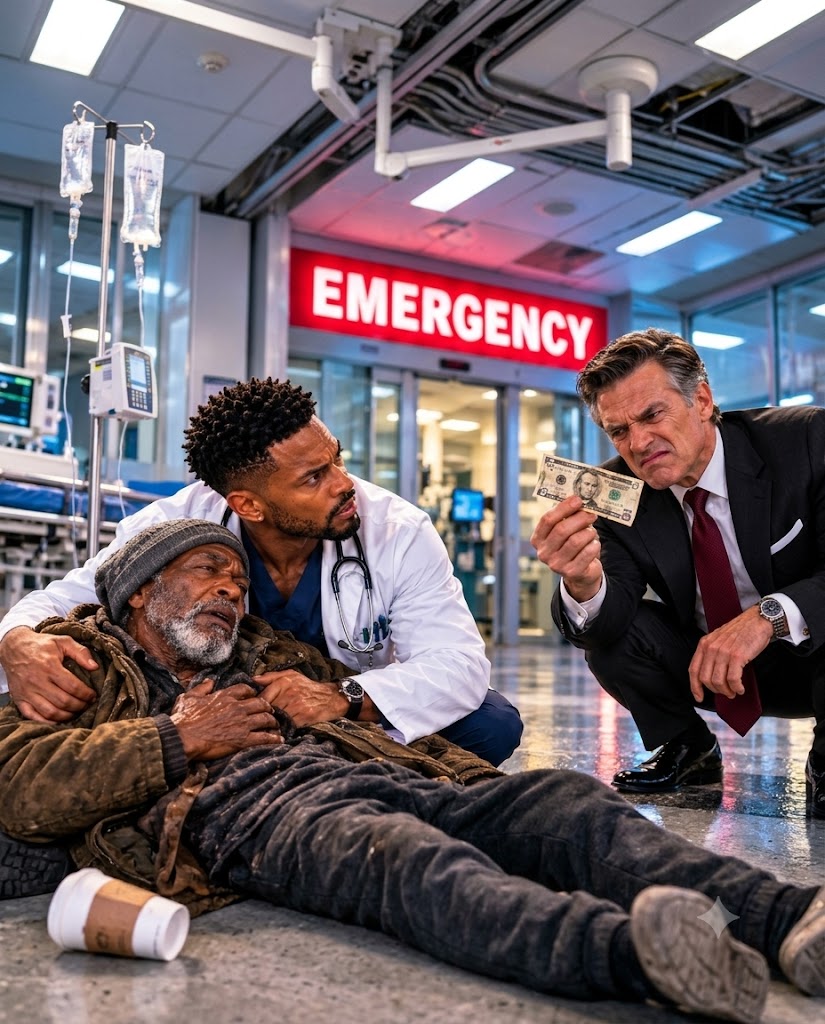
The rain came down in sheets across Tri-County that night, turning the ambulance bay into a shallow river of reflected red and blue.
Samuel Reed had walked six miles in it, clutching his chest like a man holding his own heart together with bare hands.
He pushed through the sliding doors of Whitwell Memorial at 11:47 p.m. with five dollars in his pocket and a question no one should have to ask.
“Sir, we need your insurance information,” the intake clerk said, not looking up from her screen.
“I don’t have insurance,” Samuel said. “My chest hurts.”
The clerk picked up a phone, whispered something, and hung up.
“Tri-County is six miles away,” she said. “Send him there.”
A security guard stepped forward. “Get a wheelchair now.”
“He’s uninsured,” someone called from the back. “Transfer him.”
Dr. Elena Carter was already walking toward the sound of the man’s breathing.
“He’s having chest pain,” she said. “I’m assessing him first.”
A man in a gray suit appeared at her elbow. “I’m your chief operating officer.”
“And I’m the physician responsible for this patient,” Elena said. “ECG, vitals, call the attending. His ECG needs urgent review. We’re not sending him out in the rain.”
“You’re risking your position.”
“I’m doing my job.”
Samuel looked up from the gurney, rain still dripping from his gray beard. “I only had five dollars.”
“Keep it,” Elena said. “You need care, not permission to be sick.”
That five-dollar bill was still folded in Samuel’s hand when the system marked him transferred to Tri-County forty minutes later.
It was a clean entry, timestamped, signed with a badge number that belonged to a man who had never laid eyes on the patient.
Samuel hadn’t left his bed. His ECG was still running. His chest still hurt.
“The system says transfer completed,” the night nurse said, staring at her screen.
“That’s impossible,” Elena said. “Document his actual location and care. I’ll report the discrepancy.”
The nurse’s fingers hovered over the keyboard. “Dr. Carter, if I file this, Cross can see everything I put in.”
“Then make sure there’s a record he saw it,” Elena said. “Report it. Don’t edit the record.”
By morning, the story had grown teeth.
A woman named Jordan appeared at the emergency room entrance, gasping, her lips the color of old blueberries.
“Has anyone examined her?” Elena asked.
“Cross ordered a transfer,” a resident said.
“Unfasten the chair,” Elena said. “She needs triage now.”
“Please,” Jordan whispered. “I can’t catch my breath.”
Samuel was still in bed four, still in the ER, still listed as treated at a hospital he had never reached.
Elena pulled the transfer log and found three more names like his, patients who had vanished on paper while their bodies stayed behind in Whitwell beds.
She found a badge number repeated on every phantom transfer, and the badge belonged to a man named Cross.
“He’s still in the ER,” Elena said. “How was this completed?”
“Report it,” the nurse said. “Don’t edit the record.”
“I made the transfer entry,” the nurse said later, her voice cracking. “It was my mistake.”
“You said Cross ordered it.”
“I can’t lose this job.”
They took the nurse’s badge at noon. He walked out through the ambulance bay with his head down.
Elena found the compliance officer in a windowless office stacked with folders.
“We’ve received people listed as treated at Whitwell,” Elena said. “They arrived without treatment records.”
“Will your compliance officer document it?”
“Already has,” the officer said. “Come see what we can legally share.”
She pushed a single sheet of paper across the desk. Seventeen deficiencies. Seventeen names. Seventeen patients who existed in the system as ghosts.
“Keep this,” the officer said. “We’ll need her.”
Her name was Naomi Pierce, an independent forensic auditor with a reputation for finding what institutions buried.
Elena called her from the parking lot, rain hammering the roof of her car.
“One call, Malik,” a voice said on the other end. “Your fellowship is gone.”
“Then make it,” Elena said.
“You think you’re untouchable?”
“No,” Elena said. “I think patients should be examined before they’re sent away.”
The hospital’s legal team arrived the next morning like weather.
“You can’t have the charts,” their lead attorney said.
“Neither can Whitmore’s lawyers without proper process,” Naomi said, appearing at Elena’s shoulder with a leather briefcase and a calm that felt like a weapon.
“So I leave empty-handed?”
“You leave knowing our compliance team filed seventeen deficiencies.”
Whitmer security appeared in the hallway. A man with a badge and a face like a closed door.
“Why is he here?” Naomi asked.
“He wants me to stop asking questions,” Elena said. “Because he wants proof I got the warning.”
“Why would their lawyers threaten you?”
“My family has influence there.”
“How much influence?”
“More than I’ve told you.”
“Then we’re done talking,” Naomi said.
Samuel’s clinic, a storefront operation that served the uninsured of three counties, was losing its charity funding.
“Their medicine supplier stops tomorrow,” the clinic director said.
Elena drove to Eastside at dawn and found forty people in a waiting room built for twelve.
“Am I supposed to miss tomorrow’s dose?” a woman asked.
“We’re calling every partner we have,” Elena said.
“What will keep the supplier delivering?”
“Forty-eight thousand dollars in overdue funding.”
“Let’s start an emergency county bridge funding application.”
“Will anyone pick up?”
“I’ll wait with you,” Elena said.
They waited three hours. The county approved the bridge at 4:52 p.m., and the supplier gave them thirty days.
“Enough to open tomorrow,” the director said. “Not forever.”
Samuel asked to see Elena that afternoon. He had been discharged, stabilized, and given a follow-up appointment he couldn’t afford to keep.
“Don’t write that I’m just some homeless man,” he said.
“What should they write?”
“I asked for help. They told me to leave.”
“Will you tell an independent advocate?”
“In my own words.”
“Mr. Reed, you can stop whenever you want.”
“Write this right. I asked for help. They sent me away.”
“May we record that in your statement?”
“Yes. Use my name.”
The number surfaced three weeks later, buried in a financial disclosure Naomi obtained through a public records request.
Sixty-three million dollars. That was the charity care figure Whitwell Memorial had reported to the state, the number their executives had celebrated at a gala with ice sculptures and a string quartet.
But the internal ledger told a different story. The hospital had delivered a fraction of that care, and the rest had been logged against phantom patients, paper transfers, and codes that meant nothing.
“The system says he was treated,” a billing supervisor told Naomi.
“Then somebody needs to explain what treated means,” Naomi said.
“An incentive isn’t proof,” the hospital’s attorney argued.
“The blocked incident report maybe,” Naomi said. “The financial claim is not established.”
“Then don’t decide the money tonight,” Elena said. “Decide who controls the records tomorrow.”
The board meeting was held in a room with mahogany walls and a portrait of a founder who had been dead for a century.
“The reporting total is not proof of theft,” the chair said.
“Then don’t decide who’s guilty,” Naomi said. “Decide who can touch the records tomorrow.”
“The report was filed,” the compliance officer said. “His office account placed it on hold.”
“My office paused a flawed report,” Cross said.
“One naming your own office?” Naomi asked.
The chair called for a vote. The motion passed. Interim controls were placed on record access, and every director in the room was told they owned what happened next.
“Record my objection,” Cross said. “Every director here owns what happens next.”
“And every patient deserves records no one can bury,” Elena said.
“I’ll abstain,” one director said.
“I can’t give you your job back,” the chair told Elena.
“I didn’t ask you to,” she said.
The county approved a bridge for Eastside’s clinic, and the supplier agreed to thirty more days of medicine.
“For how long?” the director asked.
“Enough to open tomorrow,” Elena said. “Not forever.”
Samuel was waiting outside the clinic when she arrived, holding a paper cup of coffee and a folded five-dollar bill.
“He asked me to bring you this,” Samuel said, handing her the bill. “I should have told you.”
“You should have,” Elena said.
“Can we start again?”
“Trust takes time,” she said. “Coffee’s inside.”
She walked through the wrong door first, into a private banking floor with imported wool carpet and a teller who looked at her like she was a stain.
“You’re dripping on imported wool,” the teller said. “Public banking is around the corner.”
Elena set her briefcase on the counter. “I have an appointment.”
“Nothing under Carter.”
“Brooks,” Elena said. “Dominic Pierce. I have an 11:30.”
A man named Dominic Pierce appeared from behind a glass door, his smile professional until it wasn’t.
“Fifteen million dollars,” Elena said. “From the Harbor Line Relief Foundation. I’m the authorized field coordinator.”
“Check the schedule,” Dominic said.
“Nothing under Carter.”
“Brooks.”
“No appointment.”
“Open that screen again.”
“You don’t tell my staff what to do.”
“The transfer must clear before noon,” Elena said.
Dominic looked at the briefcase, then at the people in the lobby, then back at Elena. “What’s all that?”
“People waiting for money to rebuild.”
“Touching. Still doesn’t make you a private banking client.”
A man in a tailored suit approached the counter. “Dominic. My credit approval?”
“Almost completed, Mr. Cole.”
“Then why are we wasting time here?”
“Minor disturbance.”
“I pay fifty thousand a year in fees so I don’t have to stand in line with people from the street.”
“Then don’t stand in line,” Elena said. “I’m ahead of you.”
“Mr. Cole has priority status.”
“My appointment was 11:30.”
“Priority clients don’t wait.”
“How do you determine priority?”
Dominic smiled. “I know my clients.”
“Apparently not,” Elena said.
She slid a credential across the counter. Dominic scanned it, frowned, and scanned it again.
“What bank issued this?”
“Crest Mutual.”
“I work for Crest Mutual. Then you should recognize your own credentials.”
“No account number. That’s what that is for.”
“No,” Dominic said. “Because I don’t put unknown devices into a secure banking terminal.”
“It’s contactless.”
“I said no.”
“Then call identification.”
“No.”
“Call your regional office.”
“No.”
“So your problem isn’t that I can’t prove who I am,” Elena said. “Your problem is that you don’t want to be proven wrong.”
Dominic turned to the security guard. “Dominic, you’re entertaining a scammer. Fifteen million. You people really dream big.”
“You people?”
“You heard me. Take it out.”
“Why?”
“Because it isn’t yours.”
“Neither is fifteen million. Those are people’s homes. And I’m supposed to believe you’re their savior?”
“No. Just process the transfer.”
“Mr. Pierce, we should verify the credential,” a young analyst said. “Compliance requires authentication before fraud classification.”
“I haven’t classified anything.”
“Potential financial fraud.”
“You just classified it.”
“Listen to your analyst,” Elena said.
“I don’t take instructions from you.”
“That’s becoming expensive.”
A man named Cole stepped forward. “Cole Construction. You’ve heard of me?”
“Unfortunately.”
“Then you know who you’re talking to.”
“I know enough,” Elena said. “How many haven’t been paid this month?”
“What did you say?”
“I inspected your Gulf Coast subcontractors yesterday. Three delayed payroll cycles.”
“Who are you?”
“A man trying to make sure workers get paid today.”
“Enough. Leave.”
“Not without completing my transfer.”
“Then you’ll be removed.”
“Sir, please come with us,” the guard said.
“Have I committed a crime?”
“Attempted fraud.”
“Established fraud,” Elena said.
“Stay out of this.”
“Before you touch me, confirm it’s recording.”
“Camera 12 is live,” the analyst said.
“Good,” Elena said.
“Why does that matter?”
“It may matter later.”
The analyst’s screen flashed red. “Harbor Light emergency delegate authenticated. Transfer limit fifteen million. Regional counter signature required. Transfer blocked. Duplicate authorization. Orange internal terminal PW1. His authority is valid, but someone submitted the same request inside this branch.”
Dominic’s face went pale. “There. The card is real. The transfer is compromised. Or he has an accomplice. Freeze every outgoing transaction. Nobody leaves.”
“Mr. Brooks, step away from the reader.”
“I told them it was fraud. My credential passed.”
“Your identity passed. The transaction did not. Do not remove him. Preserve every terminal log and camera feed.”
“Men like you—”
“There’s context—”
“Be quiet,” Elena said. “The footage resolves the conduct. It does not resolve the duplicate transfer.”
The analyst pulled the camera feed onto the main screen. There was Dominic, at 11:12 p.m., opening a hidden appointment, creating a duplicate request, and flagging the delegate as fraud before any credential had been scanned.
“You created a duplicate request before you tried to authenticate him,” the analyst said.
“Routine pre-clearance.”
“You opened his hidden appointment, created a duplicate request, then classified him as fraud without verification.”
“Counter signature approved,” Dominic said.
“Approved?”
“Check.”
The analyst checked. “We have it.”
“That’s it? He’s an employee? You could have said who you work for.”
“I did,” Elena said. “You refused to verify it.”
Dominic was terminated for cause at 12:04 p.m. His access was revoked, and compliance referred his conduct to independent counsel and banking regulators.
“Hey, Carter, please,” Dominic said as security escorted him out.
“I’m not the person deciding your future,” Elena said. “Your record is. Your conduct is also under review.”
“I was following my director.”
“So was she. Until the order became wrong. You preserved procedure under pressure.”
“I almost didn’t.”
“Remember that feeling.”
“Why?”
“Because next time someone walks through that door looking like they don’t belong, you’ll know exactly what to do.”
Elena replaced the damaged authorization but kept the old briefcase. It had belonged to her father, who had carried his lunch in it for seventeen years.
“Mr. Brooks,” the analyst said. “First payroll just cleared.”
Elena nodded. “A balance can tell a bank what you own. It can never tell them what you are worth.”
The second story began with a shove.
Elena was walking through the lobby of the Crest Mutual building when a woman stumbled into her, and a glass display case shattered.
“That ring cost two million dollars,” a man named Daniel said. “You couldn’t afford its box.”
“I didn’t touch the ring,” Elena said.
“Apologize. Leave.”
“For the collision, yes. Not for theft. Your cut calculation is wrong. Diamond is about 2.42. Your draft uses 2.31.”
“You learned optics delivering buckets?”
“At my mother’s workbench. That’s an old draft error.”
“What would it affect? The model’s light prediction.”
“Test the finished stone before you claim it performs that way.”
A woman gasped. “Sterling blue is missing. He took it. He took it!”
“I was helping her off the floor,” Elena said.
“Nobody leaves. Preserve the cameras. Search him.”
The guard found the ring in Elena’s bag. “Found it.”
“You just put that there.”
“It’s in his bag.”
“Then seal it and show every camera angle,” Elena said.
“Independent security takes the ring. Chain of custody is now.”
“A thief in a delivery jacket. Predictable. Get your hands off me.”
“Daniel has ground.”
“Or what? Or the whole room sees who started this?”
“Stop. Evelyn Carter’s son.”
Elena froze. “You knew her?”
“She brought us drawings. We declined.”
“Then why are her indexing marks on your wall?”
“Careful what you accuse people of.”
“Careful what you took.”
The footage told the truth. The main angle was blanked, but a secondary camera caught Marcus, the security chief, accessing the display before the incident and slipping the ring into Elena’s bag.
“Preserve every original file and badge log,” Elena said.
“Your security chief stole my mother’s notebook,” she told the board.
“I have footage proving he framed you.”
“Then correct the story. Publicly.”
“I will. Bring Naomi and the submission receipt to records.”
“Preserve the original archive before anyone touches it.”
The notebook was in locker 43, assigned to Marcus Cole, and it contained Evelyn Carter’s original designs, including the draft that had become Sterling Blue.
“These marks are unusually specific,” Naomi said. “It supports a copying inquiry. It doesn’t prove the finished stone is defective.”
“And the same wrong number,” Elena said.
“This is her work. Can the board rely on that tonight?”
“To preserve records and pause a launch, not to declare ownership.”
“Stop. Don’t send that.”
“Victor needs to know where they’re going.”
“You just put our independent expert at risk. You chose him over the truth? We’re done.”
The board voted to hold the launch for ten minutes while the provenance evidence was reviewed.
“Motion passes,” the chair said. “No final finding of design ownership or criminal responsibility tonight.”
“If her rights are confirmed, I want fair terms, compensation, and her name,” Elena said.
“Record my objection. You’ll answer for every loss.”
“We’ll answer for what the evidence shows. Enter a public correction. The allegation against Malik is unsupported and withdrawn. Let the record reflect it now.”
Elena reopened her mother’s workshop three months later under a name that had waited years to be spoken.
“Evelyn Carter Fine Jewelry,” she told the first customer.
“I’d like to see it,” the woman said.
“Come when I open the doors.”
The third story began with a lease and a lie.
Noah stood in the middle of his restaurant, the Harbor Table, while a woman named Melissa waved a piece of paper.
“Sign away this lease before 5:00, Noah, or your grand opening dies right here.”
“You don’t get to walk into my restaurant and decide whether I deserve a future,” Noah said. “A complaint doesn’t cancel my lease. Show me the signed order you say gives you that power.”
“You can argue about signatures while your opening dies, or you can leave before this becomes public.”
“He asked for the order,” a woman named Sophie said. “You should be able to produce it.”
“Sophie Reed? I’m his partner, and I put my savings into this place. Reed. Funny. I’ve seen your face somewhere important.”
“She worked every shift I did. If you have a claim, make it against the equipment, not the people standing here.”
“Gladly. Here’s the alleged operating violation at 4:18 on Tuesday.”
“4:18? The exhaust circuit was locked out. I was standing beside the inspector when we tagged it.”
“Your memory isn’t a certified inspection.”
“Neither is a screenshot without a signature. The final approval came at 4:42. I want the original report.”
“And the name of whoever submitted it.”
Sophie produced the service invoice and Noah’s lockout log. “The inspector emailed the certificate, but I printed the invoice, not the attachment.”
“So you can’t produce the approval you’re bluffing about?”
“We can retrieve it. What I won’t do is sign away two years of work while you hide the source of your accusation.”
“Rosa, read the lockout tag number.”
“L19, signed by Noah and the inspector. Circuit isolated from 3:55 to 4:40.”
“A handwritten log can say anything.”
“Then we’ll verify it with the inspector. You should welcome that if your report is real.”
“That review code doesn’t belong on a routine restaurant inspection.”
“How would you know?”
“I’ve seen the company’s paperwork before. I need to ask someone why this file was escalated.”
Sophie made a call. “Dad, why did your office flag the Harbor Table?”
“I requested a review when I learned you worked there. I never ordered a shutdown.”
“Your manager is pressuring Noah to surrender his lease.”
“Tell him not to sign. I’m leaving a meeting nearby. I’ll come myself.”
“You called someone at Hale Development, Dad. Tell me why.”
“Because I should have told you something months ago, and I kept finding reasons to wait.”
“You watched me put my last dollars into this room. Whatever it is, don’t make me learn it from her.”
“Ask why your partner never told you she belongs to the Hale family.”
“Reed is my legal name. I changed it years ago. Hale is the family I walked away from.”
Noah stepped back like he had been struck. “You knew the people holding my lease, and you let me believe you didn’t.”
“Yes. I was afraid of losing what we had.”
“That’s Victor Hale’s daughter,” Melissa said. “Her family controls billions in property. She could buy your whole block.”
“You told me those diner shifts paid your share. Was that even true?”
“Every shift and every dollar was real. I left their money behind, but I hid the family I came from.”
“I told you I slept in my workshop because I couldn’t afford rent. I thought you trusted me with the truth.”
“I did. I was scared you’d see my father’s money instead of me.”
“So you decided what I could handle without asking me.”
Victor Hale arrived at 4:51 p.m. with a leather portfolio and a face that had never been told no.
“I requested a property review because I learned my daughter was involved here,” he said.
“Then your review became a threat to force me off my lease,” Noah said. “Are you here to investigate that or finish the job?”
“I’m here to understand what happened. I also have an offer. Two hundred fifty thousand dollars for the business assets and a voluntary surrender of the lease, more than your documented investment.”
“You’re offering a quarter million for a restaurant your manager claims can’t safely open.”
“I prefer negotiated exits to expensive disputes.”
“Then explain why the offer was ready before anyone checked the inspection.”
“That’s the waterfront acquisition map. You told the board the plan was preliminary.”
“It is. We’re exploring several parcels including this one.”
“So my lease stands between you and a profitable redevelopment.”
“The offer is voluntary. The inspection is separate.”
“Then stop letting your manager use one to force the other.”
The inspector’s certificate arrived by email at 5:02 p.m. It confirmed the circuit had been isolated until 4:40, and the kitchen had been approved at 4:42.
“Does your report mention a motor ending in 86?” the inspector asked.
“No,” Melissa said.
“Then your draft used the wrong serial number and the wrong photograph,” Sophie said. “The housing in your picture is gray. Ours is blue. Where was that picture taken?”
“It’s from the property compliance archive.”
“The attachment says reference image, not site evidence, and this notice is marked draft.”
“A draft can still warn a tenant about a risk.”
“Not when you pass it off as a final order to make me surrender my lease.”
Melissa’s access was suspended pending an independent investigation. Victor Hale withdrew the draft hold and the surrender demand in writing.
“I used my office to test a man I hadn’t met,” Victor said. “My instructions were wrong. I’ll refer my own conduct and these records to the board’s independent audit committee.”
“You’re siding with him over your own manager?” Melissa asked.
“I’m preserving the evidence. Leave your badge and go.”
Noah opened the Harbor Table at 5:07 p.m. with a line of customers on the sidewalk and a kitchen that smelled like garlic and new beginnings.
Sophie stood beside him at the pass, her hands still shaking.
“Sophia, tomorrow may still be difficult,” Victor said. “But if we try again, there can’t be another hidden truth.”
“There won’t be. I’ll show you, not just promise.”
“Trust won’t return overnight, but I’m willing to rebuild it honestly.”
“Then I’ll earn my place beside you every day.”
Samuel Reed came to the opening, wearing a clean shirt and carrying a folded five-dollar bill.
“Remember Rosa’s broken coffee machine?” he said. “She paid us five dollars to fix it.”
“You offered me half,” Elena said. “I told you to keep the bill so we’d remember our first job together.”
“I kept our first five dollars because we earned them side by side.”
“And you still have it.”
Elena looked at the bill, soft at the edges from years of being carried in a pocket, and then at the man who had walked six miles in the rain to ask for help.
She folded it back into his hand.
“Keep it,” she said. “You need care, not permission to be sick.”
Samuel laughed, and the sound carried through the restaurant, past the new customers and the old receipts, past the fifty thousand dollars in legal fees and the sixty-three million dollars in phantom charity care, past every file that had ever tried to turn a person into a number.
Outside, the rain had stopped. The sidewalk was drying in the evening light, and the Harbor Table sign glowed like a small, stubborn sun.









