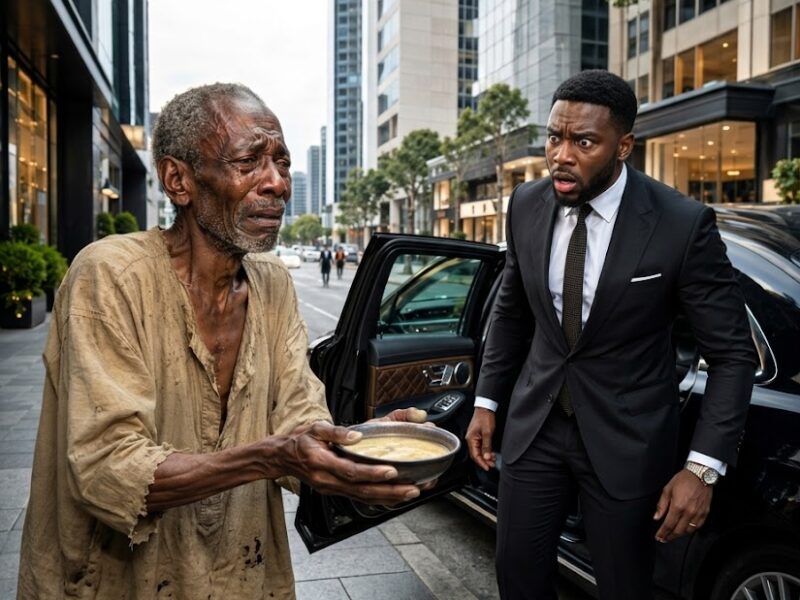
He Returned Home and Found His Father Begging for Rice—Then a Hidden Document Exposed Who Took Everything
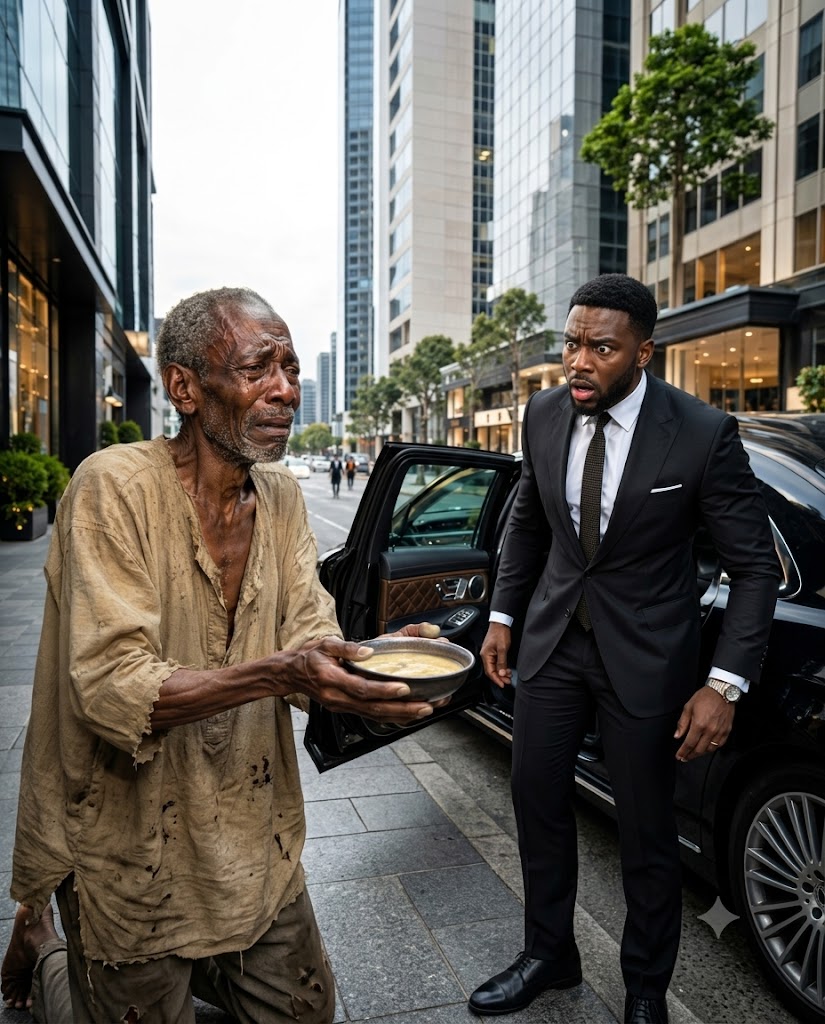
Some men beg for money. My father begged for rice. I want you to sit with that for a moment. The way I have had to sit with it every day since. A man who spent thirty-five years on job sites, who raised a son alone on a carpenter’s wages, who never once in his life asked another human being for a single thing he had not earned. That man stood at the counter of a corner store with a folded plastic bag in his shaking hands and asked a stranger for a little rice. Just a little, enough to make some porridge. He was seventy pounds lighter than the man I remembered. He was burning up with fever. And the reason he was begging was not that the money had run out. The reason was that someone in my own home had decided he did not deserve to eat. My name is Ricky Del Rosario, and this is the story of the worst thing that ever happened to my family, and the truest thing I ever learned about what a family really is. If you have ever loved someone who was too proud to tell you they were drowning, stay with me. This one is for you.
I was working overseas when it began. I had taken a contract managing construction logistics on the other side of the world. The kind of job that pays well precisely because it keeps you far from everything you love. I told myself it was worth it. I told myself I was doing it for my family, for my wife Ingred, for our daughter Luna, and above all for my father Raul, who had given me everything and asked for nothing in return. Every month, without fail, twenty-five hundred dollars left my account by automatic transfer and landed in his. I never missed a payment. Not once in three years. I would look at the confirmation on my phone and feel a small, quiet peace. The peace of a son who believes he has finally, after a lifetime, become the provider his father deserved. I believed my father was safe. I believed he was fed and warm and cared for. I believed the house I grew up in was a place of comfort. And every one of those beliefs was a lie built on sand, though I did not know it yet.
The call came on an ordinary evening. I remember I had just finished dinner alone in a rented apartment that never felt like home. My phone rang with a number I recognized. Ruth Benson, my father’s neighbor of forty years, the woman who used to hand me lemonade over the fence when I was a boy. The moment I heard her voice, I knew something had broken loose in the world. “Ricky,” she said, and her voice was trembling. “Thank God. Your father needs you.” I stood up so fast the chair fell behind me. “What happened? Is he all right?” “This afternoon,” she said, “I found him at the corner store. He was begging, Ricky. Begging for rice. He had that little plastic bag and he was sweating and shaking, burning with fever.” And he said, he said, “Just a little rice, please. I’m sick and my daughter-in-law won’t give me any.” The words did not fit together in my mind. They refused to make a sentence. “That’s not possible,” I said. “I send money every month. It’s automatic. He has more than enough.” “Son,” Ruth said gently. “Your father has been crying all day. He told me your wife took his bank card months ago. He said he’s been asking for money and she keeps telling him to be patient. He said the account isn’t his to touch anymore.” I gripped the edge of the counter so hard my knuckles went white. “Where is he now?” “He’s here in my house. I brought him inside and gave him some soup and some medicine, but the fever is high and his breathing is bad. He needs a doctor, Ricky. He needs you.”
I was on a plane before dawn. I do not remember packing. I do not remember the airport or the security line or the long gray hours suspended over the ocean. I remember only the same three sentences turning over and over in my head like stones in a river. My father was begging for rice. I sent money every month. Something is very wrong in my house. When the taxi finally pulled up in front of Ruth Benson’s home, the porch light was on, waiting. She opened the door before I could knock and she looked at me the way people look at you when they are about to hand you something heavy. “He’s sleeping,” she whispered. “Come in.” But Ricky, prepare yourself. Nothing could have prepared me. I walked into that small back bedroom. And there, under a thin blanket, lay a man I almost did not recognize. My father had always been broad through the shoulders, a working man’s frame, hands like oak roots. The man in that bed was hollow. His cheekbones stood out sharp beneath his skin. His wrists were thin as a boy’s. His breath came in shallow, rattling pulls. He looked eighty. He was sixty-eight. I knelt beside him and took his hand and his eyes opened and he smiled at me. He actually smiled as if I were the one who needed comforting. “Son,” he said. “You’re home, Dad.” My voice cracked in half. “Why didn’t you call me? Why didn’t you tell me?” He looked away, ashamed. And that shame was worse than any accusation could have been. “I didn’t want to be a burden,” he said. “I know how hard you work. I didn’t want you to worry over an old man. I thought I could manage.” “You shouldn’t have had to manage. I sent money. I sent it every single month. You should never have gone without a thing.” He was quiet for a long moment. Then he said so softly I had to lean close to hear it. “I know you did, son. I know you did. The money just never seemed to reach me.” Ruth stood in the doorway with her hands folded. “It’s been going on for months, Ricky,” she said. “I watched him getting thinner. I noticed the lights off during the day when they used to always be on, but every time I asked, he told me he was fine. You know your father. He’d sooner suffer than admit he needed help.” “I should have come home sooner,” I said. “I should have checked.” “You were working,” she said. “You were sending money. You believed he was taken care of. This is not your fault, Ricky. But now that you know, now you’re the only one who can set it right.”
That night, while my father slept and the fever finally began to break under Ruth’s careful nursing, I made a decision. I told her I was going back to the house, my father’s house, the house I had grown up in, the house I had left in the care of the woman I married. I needed to understand what had happened to the money I had been sending. I needed to see it with my own eyes. “Stay here until dawn at least,” Ruth said. “Get some rest.” “I can’t rest,” I told her. “Not yet.” I walked through the cold streets of my old neighborhood, past the houses of people who had watched me grow up, and I let myself in with the key I had carried for twenty years. The house was dark. The air inside was stale and close. The way a house smells when no one has opened a window in a long while. I found the light switch by memory. And the first thing I saw stopped me where I stood. There was a padlock on the kitchen cabinet. On the food cabinet. In my own father’s home, someone had put a chain and a lock across the doors where the rice and the flour and the canned goods were kept. As if food were a treasure to be guarded from a thief. As if the thief were the old man who lived there. I stood in that dark kitchen for a long time and something inside me went very still and very cold. I opened the refrigerator. It was nearly empty. A jar of something, a heel of bread, water. I opened the freezer. Nothing. I checked the trash and found the wrappers of expensive takeout meals, restaurant containers, the leavings of dinners that had clearly not been shared with the man in the back bedroom. I went looking for answers and I found them where the wounded always leave them. Written down in private for no one. On the nightstand in my father’s room, tucked beneath a worn Bible, was a small spiral notebook. His handwriting had always been careful, a craftsman’s hand, every letter squared and level like a good frame. I opened it and I began to read, and I have never in my life been so undone by a stack of paper. The early pages were ordinary notes about the weather, a reminder to fix the gate hinge, the name of a medicine. But as the entries went on, they changed. They grew shorter. They grew quieter, and they broke my heart clean in two. “Ingred has taken my bank card,” one entry read. “She says it’s for safekeeping. She says Ricky wants her to handle everything. I’m sure that’s true. He’s a good boy.” At first, there was still food. “Now it’s getting less and less. I asked for meat today. Ingred said I don’t need much protein at my age. She gave me rice porridge again. I didn’t argue. I never argue. I tried to call Ricky. The call didn’t go through. Maybe it’s the signal. I don’t want to bother him.” “My tools are gone. She sold them. She said we needed the money for Luna’s tuition, but Ricky pays for Luna’s tuition. I didn’t ask where the money went.” I had to set the notebook down and steady myself against the wall. My father’s tools. Thirty-five years of tools kept oiled and sharp and organized like surgical instruments. The tools he had used to build other people’s homes and to build our life. Gone. Sold. I read on, though every page cost me something. “I went to Mrs. Benson’s door today. I asked to borrow a cup of rice. She looked at me like I was a ghost. Maybe I am becoming one.” “The cabinet is locked now. My own food cabinet. Ingred put a padlock on it. She says I eat too much. I am sixty-eight years old and I weigh less than I did in high school.” “It’s my birthday today. I made porridge from yesterday’s leftover rice. It was still good. I ate alone. No birthday should have to pass without a celebration, but I suppose mine will. I hope Ricky doesn’t worry.” “I tried to call Ricky five times. Each time it said the call failed. I think Ingred changed something on the phone. I don’t understand these phones. I am afraid.” That last word sat on the page in his careful, level hand. Afraid. My father, the man who had climbed scaffolding in thunderstorms, who had faced down foremen twice his size, who had buried my mother and raised me without ever once letting me see him weep, had written the word afraid in a notebook because he had no one else in the world to say it to.
I closed the notebook. I sat alone in that dark house where I had learned to walk and to read and to be a man. And for the first time since I was a boy, I put my face in my hands. Not out of weakness. Out of the terrible clarity that comes when love and anger meet in the same heartbeat. And you understand all at once exactly what you have to do. I would not shout. I would not break things. My father had taught me that a real man does not answer a problem with noise. He answers it with the truth, gathered carefully, presented plainly, so that no one can ever again pretend it was not so. And so, before the sun came up, I made myself a promise. I would find out exactly what had been done to my father. Every dollar, every lie, every locked cabinet, and every blocked call. And I would bring all of it into the light where it could never hide again. The first thing, though, the only thing that truly mattered that first morning was my father himself. I took him to the finest doctor in the county, a quiet, thorough man who examined him for a long time and then sat me down with a grave face. “Mild pneumonia,” he said, “which we caught in time. But the larger concern is the malnutrition. Your father is severely underweight. This did not happen overnight, Mr. Del Rosario. This is the result of many months of inadequate food. I’m prescribing antibiotics, a course of vitamins, and strict orders. Rest and proper nutrition. Three real meals a day, starting now.” “He’ll have them,” I said. “Every day for the rest of his life. I promise you that.”
That afternoon, I sat with my father and took his old phone in my hands. It took me less than ten minutes to find what had been done to it. His calls to my number had been quietly diverted, blocked at the source, so that every time he dialed his own son, the phone told him the call had failed. I fixed it. Then I dialed my own number from his phone and let it ring on the table between us so he could see the screen light up with my name. So he could hear it connect. He stared at it as if it were a miracle. “It went through,” he whispered. “It works now, Dad,” I said. “I promise you it works now. And no one is ever going to block your calls again. No one.” He reached out and put his thin hand over mine and neither of us said anything for a while because some things are too large for words.
Now I want to tell you the rest plainly, the way I uncovered it, because the tangle of it matters. What had been done to my father was not the carelessness of a busy household. It was deliberate, patient, and dressed up to look like family. I went first to the bank, to a manager named Linda who had known my family for years. I asked her to pull the full transaction history on my father’s account going back two full years. She could see something was wrong in my face. “Is there a problem, Ricky?” she asked. “I think my wife has been taking money from my father,” I said. It was the first time I had said it out loud and it landed like a stone in a still pond. “I need to know how much and for how long.” “Give me ten minutes.” While the printer worked, I asked her the question that had been circling in my mind. “Has anyone else had access to his account?” “Your wife,” Linda said, checking the file. “She’s listed as a co-signer. She was added when the account was opened.” “I never authorized that.” She looked at me carefully. “The paperwork says you did. Your signature’s on it.” But it was not my signature. I knew that the way you know your own reflection. And that was the first thread of the whole web coming loose in my hands. The statements told a story so clean and so cold it took my breath. Every month my twenty-five hundred dollars arrived right on schedule. And every month, within forty-eight hours, the great majority of that money was moved out again. Transferred to another account. I asked Linda whose account. “It belongs to a Marissa Cruz,” she said. Marissa Cruz. My wife’s younger sister. Over eighteen months, more than thirty-eight thousand dollars had traveled from my father’s account, past the locked cabinet and the empty refrigerator, straight into the hands of my sister-in-law. The money I sent to keep my father fed had been buying someone else’s comfort almost before it landed. “Most of the cash withdrawals,” Linda added, “were made at the ATM outside the mall on Park Avenue. Ricky, I’ll tell you the same thing I’d tell my own brother. If you’re thinking about the law, bank records alone won’t be enough. You’ll need to prove intent, not just access.” “I know,” I said. “And I’m going to get it.”
I went to see an old friend, David Alvarez, who had gone to law school while I went to work and who had never once forgotten where he came from. I laid it out for him at his kitchen table. Off the record, one man to another. “How bad is it?” he asked. I told him the thirty-eight thousand siphoned to the sister. And there was more, because once I started pulling threads, the whole garment came apart. Three personal loans had been taken out in my father’s name. Twenty-two thousand dollars he never borrowed and never saw. Two credit cards, another eighty-four hundred in charges, again in his name, again without his knowledge. The applications listed him as the owner of a consulting business that did not exist, with a yearly income of sixty-two thousand dollars he had never earned, verified by a phone number that rang to a voicemail box no one ever answered. And the signatures on every page were forgeries. Not even close to his real hand, which I had studied for a lifetime. “She sold his tools,” I told David. “Locked up the food. Locked his phone so he couldn’t reach me. While my father was drinking water for dinner, she was buying designer handbags and planning parties.” David was quiet for a long moment. When he spoke, his voice was steady and grave. “Ricky, what you’re describing is elder abuse. It’s financial fraud. It’s identity theft and forgery. Every piece of it is a serious matter under the law. Do you have evidence?” “I’m looking at a folder full of it,” I said. “Then you have a case,” he said. “A strong one. But I have to ask you as your friend and not your lawyer. Are you sure you want to do this? She’s your wife. This will end your marriage. It could tear your family apart.” I thought about the padlock on the cabinet. I thought about my father asking a neighbor for a cup of rice. I thought about the word afraid in his careful hand. “She already tore my family apart,” I said. “I’m only going to make sure she never gets to do it to anyone else.”
Piece by piece, I gathered it. I went to the pawn shop where a man remembered a woman coming in around Christmas selling a whole set of nearly new power tools. She had told him they belonged to her father, who had passed away. My father, of course, was very much alive. The pawnbroker went pale when I told him and offered to return every piece. “Keep them for now,” I said. “But I’ll need a receipt, and I may need you to tell that story again to a judge.” I went to the electric company, where I learned that the household account had been transferred into my wife’s sole control six months earlier. The same day the service plan had been changed. The same season the lights had started going dark in the daytime. I went to the loan office where a loan officer remembered a woman who had walked in claiming to be my father’s daughter, carrying his identification, his Social Security card, and a power of attorney he had never signed. My father has no daughter. That was the only reason one of the applications had been flagged. The other three had slipped through before the system caught the pattern. Every road led back to the same place. Every road led home.
And here I have to tell you about Luna, because this is where the story turns from a matter of money into a matter of the heart, and it is the part I have carried longest. Luna was my daughter. She had been my daughter for eight years. Let me tell you how that came to be. Eight years earlier, Ingred had come to my office with a twelve-year-old girl and a story. She told me the girl was mine, the child of a relationship we had shared before we married. She said she had kept the secret out of fear. And now she was bringing the truth to me and asking me to be a father to the girl I had never known. I did not ask for proof. I did not demand a test. I looked at that quiet, frightened twelve-year-old standing in my doorway, and I made a decision that I have never once regretted. I decided that if a child needed a father, then it was my job to be one. I took Luna into my life without hesitation and without conditions. For eight years, I paid for her schooling and her clothes and her music lessons. I was there for every report card and every scraped knee and every heartbreak. When her goldfish died, I dug a grave in the backyard and stood with her through a full funeral because she asked me to. She called me dad, and I answered to it with my whole heart. And I believed with everything in me that we were bound by blood. But as I sat in that dark house reading my father’s notebook, a cold suspicion began to grow, one I could not silence. Everything Ingred had ever told me was now suspect. Every truth had a lie hidden inside it. And I had to know, for my own sake, for Luna’s, what was real.
So I did a hard thing. I arranged quietly and discreetly for a paternity test. I did not want Luna to know, because whatever the answer was, it was not her fault, and I would not put that weight on a child’s shoulders. I brought in a hair from her brush, a utensil, the ordinary things a household leaves behind. The lab told me the result would take five business days and would be accurate to a fraction of a percent. Those were five of the longest days of my life. I went to visit Luna at the restaurant where she worked after school, and I watched her carry plates and laugh with the cooks and roll her eyes about washing menus. And I felt such love for her that I could hardly breathe. And underneath it, the question sat like a stone. She brought me a plate of pasta, the dish she was always posting pictures of, and she sat it down in front of me and called me dad. And I smiled and thanked her and could not eat a bite. “So, how’s grandpa?” she asked me, sitting down across the booth. “Mom said he’s doing fine. Just getting older. Needs to rest more.” “Did she say that?” I asked. “Yeah. She doesn’t take me over there much anymore. Says he likes his privacy.” Luna frowned a little. “He seemed really thin last time I saw him. That was a couple months ago, I think.” And I understood then that my daughter had also been lied to. That the same woman had built walls between all of us. Between father and son. Between grandfather and grandchild. So that no two of us could ever compare our stories and see the truth. Isolation was the whole design. A man alone is easy to starve. A family kept apart is easy to rob.
On the fifth day, the lab called. I drove there faster than I should have. Dr. Moore, the geneticist, sat me down and slid the report across the desk, and I read the line that I already in my bones knew I would find. Probability of biological paternity: zero percent. Luna was not my daughter. She never had been. The story Ingred told me eight years ago was one more lie in a lifetime of them. A child used as an anchor. A rope tied around my heart to keep me moored to a marriage and a bank account. For eight years, I had loved a girl I believed was my own flesh. And now a piece of paper from a laboratory told me she was a stranger. I took that report to my father. Of all the people in the world, he was the only one I could bring it to. He was stronger by then, filling out again, the color back in his face, sitting up in Ruth Benson’s spare room with a book in his lap. He read my face before I said a word. “Something’s wrong, son,” he said. “You’ve been carrying something heavy. I’ve known you since before you could walk. Tell me the truth.” So I told him all of it. The money. The loans. The tools. And finally the test. When I finished, I said the thing that had been tearing at me. “Luna isn’t mine, Dad. She never was. It was all a lie. Ingred used that child to trap me for eight years.” My father set down his book and looked at me for a long, long moment. And then he asked me the only question that mattered. “And how do you feel about Luna?” “I feel angry,” I said. “I feel betrayed. I feel like everything I built my life on was sand.” “That’s about Ingred,” he said gently. “I asked you about Luna.” I was quiet, and then the truth came out of me, plain and helpless. “I still love her, Dad. I don’t know how to stop. I’ve tried these past few days to feel differently and I can’t. The love won’t obey me. It’s beyond biology. It’s beyond the test.” My father nodded slowly, and there was such peace in his tired old face. “Then that is your answer,” he said. “Not the blood, Ricky. Not the paper from the lab. The love. That’s what makes you her father. That’s the only thing that ever did. A test can tell you whose blood is in a child’s veins. It cannot tell you whose child she is. You decided that eight years ago in your office doorway. And no one, not your wife, not a laboratory, not the whole world, can undecide it for you.” “But she lied to me,” I said. “For eight years.” “Yes, she did,” he said. “And she will answer for that as she must. But Luna, son. Luna was a little girl. Whatever her mother did, the child had no part in it. Whatever you do to set this right, you remember that. Protect the child. That’s what a father does.” “I know, Dad,” I said. “I’ll protect her. I promise.” And in that moment, I understood something about my father that I had spent my whole life almost seeing. This was a man who had been starved in his own home, robbed of his money and his tools and his dignity. And the first thing on his mind was still the protection of an innocent child who was not even his own blood. That is who he was. That is who he had always been. He had spent thirty-five years putting my needs before his own. And even at the lowest point of his life, he was still doing it. Still teaching me. Still pointing me toward the light.
There was one more thing I had learned, and it shaped everything about how this story ended. Ingred was planning a party. A grand celebration for Luna’s eighteenth birthday. She had booked the finest venue in the county. She had hired a DJ, chosen the flowers, and bought Luna a designer gown that cost more than my father’s monthly pension. She had even invited the local newspaper so that a photographer would be there to capture her perfect family on its perfect night. She wanted a public stage. I decided to give her one. Understand me. I take no pride in what I am about to describe. There is no joy in exposing the mother of the child you love. But some silences are a kind of cruelty, and some truths cannot wait for a gentler time. My father had suffered in silence because he thought silence was what love required. I had learned in the hardest way that he was wrong. Love does not mean silence. Love means speaking up, even when your voice shakes. In the days before the party, I moved carefully. I made copies of everything. The bank statements. The forged loan applications. The mismatched signatures. The credit reports. The pawn shop receipt. The utility records. David helped me organize it into a single folder. A case so thoroughly documented that no one could ever call it a family misunderstanding. I visited Luna and kept our times together gentle and ordinary. Because whatever was coming, I wanted her to know always that my love for her had never wavered. She sensed something, the way children always do. On the morning of the party, she found me alone and asked me in a small voice, “Dad, are you and Mom okay? You’ve seemed different since you got back.” “We’re just tired, sweetheart,” I said, which was not a lie, but was not the whole truth either. “Don’t you worry about anything today. It’s your night. I just want you to be happy.” She said, “I want the same thing for you.” I told her, “More than you’ll ever know.” Later, as the guests were arriving, she came to me again. And what she said stopped me cold. “Dad, whatever happens tonight, I just want you to know that I’m glad you’re my father.” “Whatever happens?” I asked. “What do you mean?” “I don’t know,” she said. “I just have a feeling like something’s changing. But no matter what, you’re my dad. Okay?” “You’re my dad and you’re my daughter,” I said. “Always. Nothing in this world is going to change that.” I meant it with everything I had. And I did not yet know that she had been carrying a secret of her own.
The venue was beautiful. Ingred had spared no expense. My expense. My father’s expense. There were white flowers everywhere and soft lights and a long table of food that could have fed my father for a year. My father came dressed in his good suit, thin but upright, insisting on being there for Luna. Ingred greeted me with a bright smile and a kiss on the cheek. “You look tired, baby,” she said. “Everything okay?” “Everything’s fine,” I said. “How are the party plans, Ricky? It’s going to be perfect.” She said, “You have to see Luna’s dress. It’s Vera Wang.” “That’s expensive,” I said. “It’s her eighteenth birthday. Once in a lifetime. Don’t worry about the money. I handled everything.” “I’m sure you did,” I said quietly. “I’m sure you did.” The evening moved through its motions. There was music and laughter, and the newspaper photographer moved through the crowd. And then the host of the evening took the microphone and said the words Ingred had waited weeks to hear. “Ladies and gentlemen, the moment we’ve all been waiting for. Please welcome Luna’s father, Mr. Ricky Del Rosario, to say a few words.”
I walked to the front of that beautiful room. I could see Ingred beaming, certain that her husband was about to complete the picture she had built. I could see Luna, radiant in her gown. And off to the side in a chair I had made sure was near the front, I could see my father watching me with those steady, knowing eyes. I took a breath and I began. “Good evening. Thank you all for being here to celebrate Luna’s eighteenth birthday. On a night like this, everyone expects the father to stand up and say how proud he is of his child. And I am proud of Luna. Very proud. She is intelligent and kind and hardworking. And she is beautiful in ways that have nothing to do with any gown. Luna, I want you to hear that from me first, before anything else I say tonight.” She smiled at me and my heart ached. “But before I say anything more,” I went on, “I want to talk about what it means to be a father. I did not learn that from books or movies or advice columns. I learned it from my own dad. My father, Raul Del Rosario, is sitting right over there. He’s a retired carpenter. He worked construction for thirty-five years, six days a week, in heat and rain and cold, so that I could go to college and build a better life than the one he had. When I was growing up, we did not have much. Some nights dinner was rice and vegetables. Some nights it was just rice and soy sauce. But my father never once let me go to bed hungry. He always made sure that I had food and clothes and dignity. He taught me that being a father means putting your child’s needs before your own every single day and expecting nothing in return.” The room had gone quiet. Ingred’s smile had begun to falter. “For the past few months,” I said, “while I was working abroad and sending money home every month, believing my father was being cared for, something very different was happening in his home. And I only know how bad it was because my father kept a diary. He kept it because he had no one else to talk to.” I took the small notebook from my jacket and opened it, and I read his words into that beautiful, silent room. “No rice today. Mrs. Benson let me borrow a cup. I’ll make porridge again. I hope Ricky doesn’t worry.” I turned the page. “It’s my birthday today. I made porridge from yesterday’s leftover rice. It was still good. I ate alone.” Somewhere in the room, a woman put her hand over her mouth. “While we were planning this party,” I said, “while we were choosing flowers and gowns and lighting arrangements, my father was going without food in the very house where he raised me. I sent twenty-five hundred dollars every month by automatic transfer, and I never missed a payment. And within forty-eight hours of every deposit, most of that money was moved into another account. An account belonging to my wife’s sister. Over eighteen months, thirty-eight thousand dollars was taken from my father. And that was only the beginning. Three loans and two credit cards. More than thirty thousand dollars taken out in my father’s name using forged signatures and false income statements. While my father drank water for his supper, that money paid for handbags and dinner parties and the celebration all of you are attending tonight.” “Ricky, stop this.” Ingred was on her feet, her face white. “What are you doing?” “I’m telling the truth,” I said. “Which is something that should have been done in this family a long time ago. This is not a private quarrel. This is elder abuse. This is fraud. This is forgery. And I have documented every dollar and every lie. You took my father’s food. You took his money. You took his tools and his health. And you made him believe that no one in the world cared enough to stop you. But you were wrong. My father was never alone. He just didn’t know it until now.” I turned to my father and his eyes were shining and he was sitting up straight and tall. “Dad,” I said, “you don’t have to be afraid anymore. You don’t have to be hungry anymore. And you don’t have to be silent anymore.” The room was utterly still. And then I said the hardest thing of all. “There is one more truth that has to end tonight. Eight years ago, Ingred brought a twelve-year-old girl into my office and told me that Luna was my daughter. She said she had kept it secret out of fear. And I accepted Luna without question. Without a test. Without proof. Without a single moment of hesitation. Because I believed that if a child needed a father, it was my job to be one. For eight years, I have loved Luna as my own. I paid for her education, her clothes, her whole life. I was there for every milestone. But two weeks ago, I received the result of a paternity test. The probability that I am Luna’s biological father is zero percent.” A murmur ran through the room. And then I turned to Luna, who stood frozen in her beautiful gown, and I asked the question I had to ask. “Luna, did you know?” She was crying now. “I knew,” she whispered. “I’ve known for a long time. When I was little, I heard Mom talking to my aunt. I knew you weren’t my real dad.” “Why didn’t you ever say anything?” “Because Mom said if I told you, you’d leave us.” Her voice broke on every word. “She said you’d stop paying for my school. Stop loving me. Stop being my father. I was so scared. I’m so sorry, Dad. I’m so, so sorry.”
And that was the moment the whole evening turned on its hinge. Because I did not do what Ingred had spent eight years teaching that child to fear. I crossed that room and I took my daughter’s hands and I said the truest words I have ever spoken. “Luna, you were never a burden to me. Not for one day. Not for one hour. Not for one second. I did not love you because I thought you shared my blood. I loved you because you were my child. And nothing, not a test, not your mother’s lies, not any piece of paper in the whole world, can change that. I am still your father. Not by blood, but by choice. And I choose you. I will always choose you.” She fell into my arms and the whole room seemed to exhale, and somewhere I heard my father say softly, “That’s my boy.” Ingred was reaching for me. “Ricky, please. I did it for us. For our family. I was afraid of losing everything.” I looked at her and I felt no rage, only a great and final clarity. “You didn’t do it for our family,” I said. “You did it for yourself. You used my father as a bank account. You used this child as a leash to keep me tied to you. You used my love as a weapon against every person I care about.” “I’ll pay it all back,” she said. “I’ll do anything. Just don’t leave me.” “It’s too late for that,” I said. “Tomorrow morning, my attorney files charges. Elder abuse. Financial fraud. Identity theft. Forgery. You will answer for all of it. Not because I want revenge, but because I am never going to let you do this to anyone else ever again.” I turned back to the room full of shocked and silent guests. And I said the last of it. “I want to apologize to all of you. This is not the celebration you came here for. But some truths cannot wait for a better time. My father taught me what it means to be a man. Not by what he said, but by what he did. He worked himself to the bone for me. He went without so that I would never have to. He suffered in silence because he believed that was what love meant. But love does not mean silence. And it does not mean suffering. Love means speaking up even when your voice shakes. It means standing up even when your legs are weak. And it means protecting the people who protected you, no matter what it costs. I love you, Dad.” And my father, sitting tall in his good suit with the color back in his cheeks and tears standing in his eyes, said, “I love you too, son. And I have never been so proud of you in all my life.”
I will not pretend that everything after that night was easy. Truth does not tidy up the wreckage it exposes. It only ensures that the wreckage is honest. The evidence, David told me, was overwhelming. Ingred would very likely serve two to five years, depending on how she chose to answer the charges. I found, to my own surprise, that I did not care much about the length of the sentence. What I cared about was the record. A permanent public accounting, so that no vulnerable old man anywhere would ever be handed into her care again. My father came home. Not to the house with the locked cabinet. I could not bear for him to live another day inside those walls. But to a bright, warm place near mine, with a full refrigerator and an open pantry and a telephone that rang clear every time. He gained back the weight he had lost. The color returned to his face. He took up woodworking again once the pawnbroker returned his tools, and the smell of fresh-cut pine filled his little workshop the way it had when I was a boy. One evening, sitting on his porch with the sun going down, I told him again how sorry I was. “I should have noticed sooner, Dad. I should have come home.” “You were working,” he said. “You were building a good life. That’s all I ever wanted for you.” “But I left you behind.” He shook his head slowly. “No, son. You never left me. You just didn’t know I was in trouble. And the moment you found out, you came. You dropped everything and you came home. And you said it right. That’s what matters. Not the time we lost. The time we have.”
And Luna. Luna is the part of this story that heals the slowest and the most. For a while after that night, she stayed with her aunt Sarah, and she stopped calling me dad. The word had become tangled for her, she said, knotted up with everything her mother had done. I told her she could call me anything she liked or nothing at all, so long as she never disappeared. “I don’t want to disappear,” she said one afternoon, sitting across from me with her hands wrapped around a mug of tea. “But I don’t want to be the thing that reminds you of what she did either. Every time you look at me, do you see her lie?” “No,” I said, and I meant it with my whole heart. “When I look at you, Luna, I see the girl who waited up for me every time I came home from a trip. I see the girl who cried when her goldfish died and made me give it a proper funeral in the backyard. I see the girl who called me dad for eight years. Not because she had to, but because she wanted to. Your mother used you. That was her crime, not yours. You were a child. You were frightened. You did what you thought you had to do to keep your family together. I will never blame you for that. Not ever.” She was quiet for a long moment. And then she asked me the question I had been waiting for her to ask. “Can we still be a family?” “We are a family,” I told her. “Nothing that happened at that party changed that. Blood doesn’t make a family, Luna. Love does. And I love you. That is the only truth that matters, and it is the one truth in all of this that was never a lie.” She looked up at me, and after a moment, in a voice as small and clear as it had been when she was twelve years old in my office doorway, she said, “I love you, too, Dad.”
So that is my story. A man begged for rice in the town where he had raised a son, and that son came home, and the truth came home with him. If you take nothing else from it, take this. From an old carpenter who never went to college and never wrote a book, but who understood more about love than anyone I have ever known. Love is not silence and it is not suffering. Love is the willingness to speak up when your voice is shaking. To stand up when your legs are weak. And to protect the people who protected you. The mother who went without. The father who worked in the rain. The child who was handed to you by circumstance and became yours by choice. The bonds that hold a family together are not made in a laboratory. And they cannot be stolen by anyone, no matter how patient or how cruel. They are made of a thousand ordinary choices repeated across the years. A plate of food set down without a word. A phone call answered in the middle of the night. A promise kept when keeping it costs you everything. My father is well now. He sits on his porch in the evenings working a piece of wood smooth with his old strong hands. And sometimes Luna comes by and the two of them sit together in the fading light. The grandfather who is not her blood and the granddaughter who is not his, bound by something far older and far stronger than blood ever was. And I have learned at last the lesson he spent his whole life trying to teach me. That the measure of a man is not what he takes, but what he gives. Not what he says, but what he does. And that it is never, ever too late to come home.









