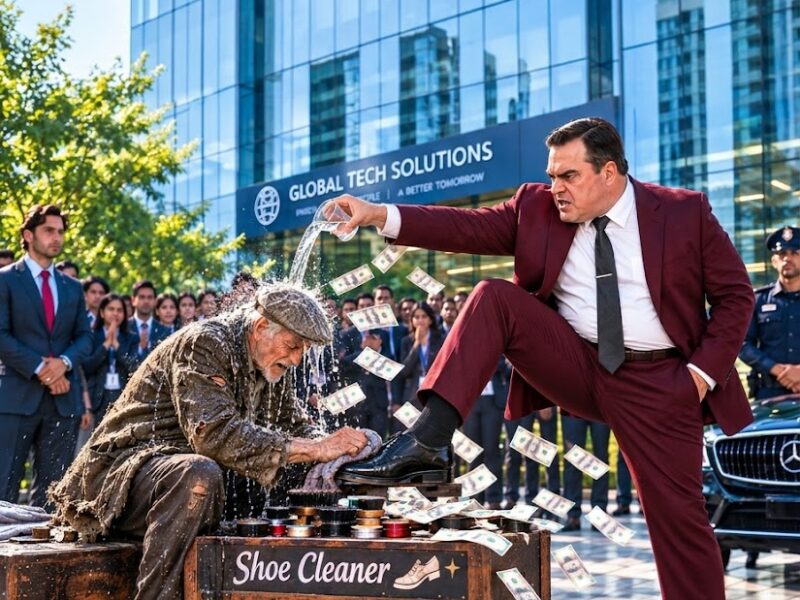
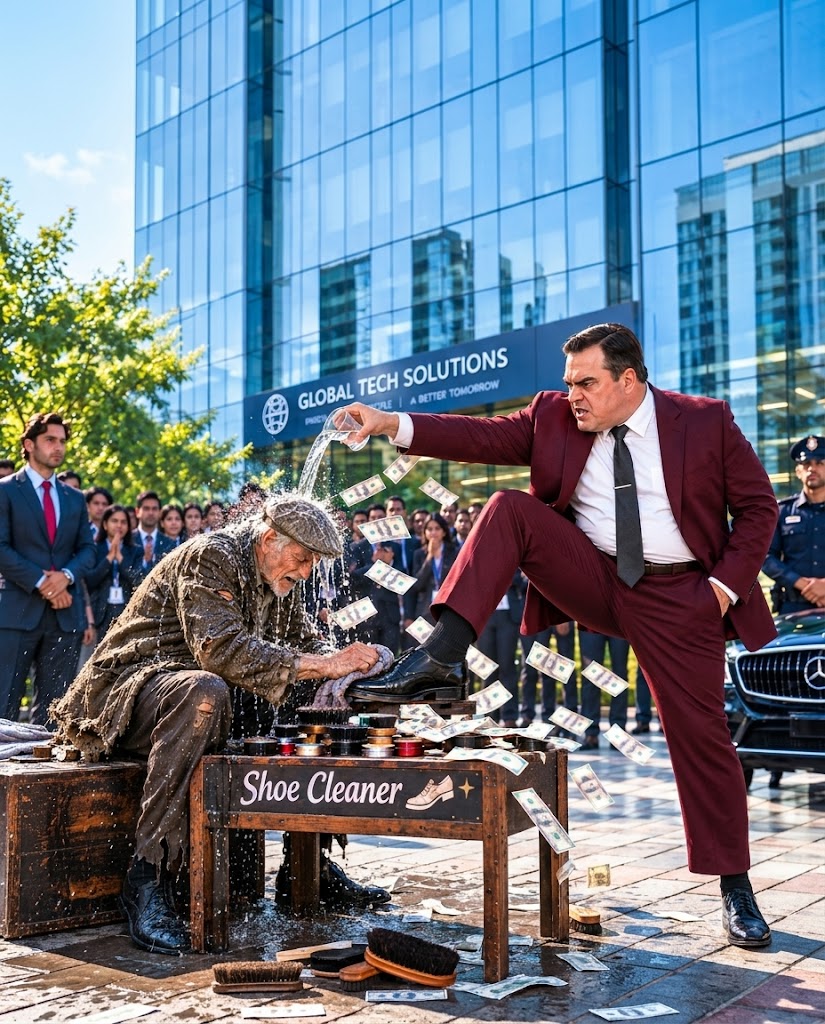
He poured water on a poor shoe shiner and laughed. He had no idea the man he just humiliated was worth more than everyone in the room combined.
The Bentley rolled to a stop at the hotel entrance, its black paint swallowing the afternoon light like a secret.
Arthur Vale watched from the back seat as the doorman scrambled, as the bellhops snapped to attention, as the whole marble facade of the Caldwell Grand seemed to hold its breath.
He was not supposed to be here.
Not like this.
His driver, a man named Owen who had worked for the Vale family for eleven years, glanced in the rearview mirror with the careful expression of someone who wanted to say something but knew better.
“Sir, we’re three minutes early.”
“Good,” Arthur said. “Early is invisible. Late is memorable.”
He adjusted his cufflinks—simple silver, nothing flashy—and stepped out onto the sidewalk.
The first thing he noticed was the shoe shiner.
An old man, bent over a wooden box, working a brush across a pair of leather oxfords with the kind of rhythm that came from decades, not training.
The second thing Arthur noticed was the young man in the tailored suit storming toward him.
“You are ruining the entrance,” the man said, his voice pitched low but sharp enough to cut. “Do you even know what a hundred looks like?”
Arthur blinked.
The man pulled a crisp bill from his pocket and dropped it on the ground.
“Then pick it up. It is yours now.”
The shoe shiner looked up, his hands still.
“A man like you should be grateful,” the young man continued. “Tomorrow you will remember this moment.”
He leaned closer, his cologne thick enough to taste.
“I doubt I will remember you at all.”
Arthur said nothing.
He simply bent down, picked up the hundred, and tucked it into his coat pocket.
The young man smirked and walked away.
Owen appeared at Arthur’s elbow. “Sir, that was—”
“Not now.”
“But he—”
“Owen.” Arthur’s voice was quiet. “Not now.”
—
The hotel lobby was a cathedral of polished brass and fresh flowers, the kind of place where the air itself seemed to cost money.
Arthur moved through it like a ghost, unnoticed, unremarkable.
He paused by the front desk, where a young woman named Nina was handing a glass of water to a guest who looked like he might faint.
“Here, please drink this,” Nina said.
“How much?” the guest asked, his voice thin.
“I am not selling water. Are you afraid of being scolded?”
“I am more afraid you will faint.”
Nina smiled, and for a moment, the lobby felt less like a museum and more like a home.
Then a manager appeared.
“Nina, inside now.”
She hesitated.
“Thank you, Nina,” Arthur said softly, and she glanced at him—just a flicker of recognition, or maybe curiosity—before disappearing through a staff door.
Arthur found a chair near the elevator bank and sat down.
He watched.
That was the whole point, after all.
—
The first hour told him everything he needed to know.
Revenue was up—he had seen the quarterly reports, the numbers climbing like a fever chart.
Complaints were almost zero.
That was what worried him.
If I arrive as chairman, they will perform for me.
He remembered saying that to his board, to the men and women who had watched him build an empire from a single hardware store in Ohio.
They had laughed, nervously.
They had assumed he was joking.
He was not joking.
—
A man in a security uniform approached him.
“Sir, you cannot sit here.”
Arthur looked up. “Is there a sign that forbids it?”
The guard—his name tag read Owen, which made Arthur’s chest tighten—shifted his weight.
“If I stepped out of that Bentley, would you call me sir?”
Owen’s eyes narrowed. “Well, Arthur, that is a very big if.”
Arthur almost smiled.
“Of course. But look at you.”
Owen said nothing.
“Which guest complained?”
“I did.”
Both men turned.
The young manager from outside stood there, arms crossed, jaw tight.
“That is enough,” he said. “Pick it up, old man.”
Arthur did not move.
“Tomorrow you will remember.”
The manager’s face flushed. “Owen, remove him from my entrance.”
Owen hesitated. “Sir, you are on the public sidewalk. Could you move a little left just to clear the luggage path?”
“I said get him out, not negotiate.”
Arthur stood slowly.
“Security is not a license to humiliate people.”
The manager stepped closer. “You have a wife and two kids, do you not?”
Owen’s face went pale. “Leave my family out of this.”
“Are you afraid?”
“Yes.” Owen’s voice cracked. “But fear does not make the wrong thing right.”
—
The manager’s name was Grant.
Arthur had read his file that morning.
Twenty-nine years old, hired two years ago as a front desk supervisor, promoted twice in fourteen months.
Hospitality turnover is naturally high, Grant had written in a memo that landed on Arthur’s desk.
Not when half the housekeeping team disappears, Arthur had thought.
Now he understood.
—
The ceremony was scheduled for three o’clock.
At two forty, a woman in a crisp suit rushed past Arthur, her heels clicking like a metronome.
“Oh no. The ceremony starts in twenty minutes.”
A man in a gray suit followed her. “Mr. Caldwell, we will handle this immediately.”
“Three minutes. I can fix it for the ceremony.”
“I would not recommend it.”
“I used to do this for a living.”
A younger man—Caldwell’s son, Arthur guessed—touched the older man’s arm. “Dad, we still have time.”
Arthur watched as the older man knelt by a display case, his hands moving with the precision of someone who had spent years doing this exact work.
“That should last the ceremony.”
“Excellent work.”
“Thank you, Miss Parker.”
—
Miss Parker was the hotel’s operations director.
She was also, according to the file Arthur had memorized on the flight from New York, the person who had falsified the incident report.
He had seen the report himself.
He entered without permission.
Mr. Caldwell invited him.
Ten days left on probation. Choose wisely.
Adapting does not mean lying.
You are fired.
For refusing to lie.
For not fitting in.
—
Arthur found Nina in the staff corridor.
She was crying.
“Did they dismiss you because of me?”
She looked up, startled. “Not entirely. He wanted me to lie.”
“Was it worth losing your job?”
“I do not know yet. Rent is due soon. I have nothing lined up.”
“Why not just sign the report?”
Nina wiped her eyes. “If I sign one lie today, the next one becomes easier.”
Arthur nodded slowly.
“Whatever you are doing,” she said, “do not make others pay for it.”
—
The boardroom was on the twenty-second floor.
Arthur took the elevator alone.
When the doors opened, Grant was waiting.
“You again. This is a private event. Please leave.”
“I have an appointment on the 22nd floor.”
Grant’s face tightened. “Owen, stop him.”
Owen stepped forward, then stopped.
“He has not broken any rule.”
“Good morning.”
The voice came from the end of the hall.
A man in a navy suit—Chairman Vale’s assistant, Arthur knew—approached with a tablet in his hand.
“I apologize. This man has been harassing the hotel.”
“Good morning, Chairman Vale.”
Grant’s face went white.
“Chairman, let us sign. The acquisition documents are ready, sir.”
Arthur walked past him.
“Mr. Veil, I did not know it was you.”
“No,” Arthur said. “You did not.”
—
The conference room was silent.
Arthur sat at the head of the table.
“I was protecting the hotel image and its margins,” Grant said, his voice shaking. “By falsifying an incident report. By taking heat and meals from your staff.”
“All to protect your half million dollar bonus.”
Grant’s hands trembled. “You cannot judge seven years by one day. If I had known who you were, I would never have done that.”
“That is exactly the problem.”
Arthur turned to the security guard standing by the door.
“Nina gave me water when she thought I had nothing. Owen stayed within his limits. He refused to misuse his authority.”
He paused.
“Terminate Mr. Mercer’s contract. No retention bonus.”
Grant’s mouth opened. “Give me one more chance.”
“Not in this chair.”
—
The man in the gray suit—Mr. Mercer, Arthur assumed—was escorted out.
“Will you drag me? There is no need.”
Arthur watched him go.
Then he turned to Miss Parker.
“Is this your signature?”
“Yes. I signed it.”
“Did you know it was false?”
“Yes. I was afraid of him and I wanted the promotion.”
Arthur nodded.
“Thirty days in housekeeping, laundry, and public areas.”
“Is this punishment?”
“It is your final chance.”
“I will do it.”
—
The next morning, Arthur stood in the lobby again.
This time, he was not invisible.
“You are Arthur Vale?”
“Yes. I asked HR to invite you back.”
Nina stared at him. “You knew I was fired. You could have stopped it.”
“I wanted to see whether it was one man or the whole system.”
“I spent last night trying to figure out my rent.”
Arthur’s jaw tightened.
“I used my power carelessly. I am sorry. Your job back, fifteen percent more, and a real voice on our culture council.”
Nina was quiet for a long moment.
“Then I will come back.”
—
Owen was waiting in the security office.
“You asked to see me, Mr. Veil.”
“You will remain head of security, and you will receive one month of pay as a performance bonus.”
Owen blinked. “For what?”
“For refusing to hurt me. For knowing the limits of your authority under pressure.”
“Thank you, sir.”
“Keep doing the right thing.”
—
The heating was fixed by noon.
Arthur walked through the staff corridors, past the laundry room, past the housekeeping closet.
“Take your time, Emily.”
“I am so sorry.”
“It is okay. Let us carry them in two trips.”
“Good morning.”
“Morning, Nina.”
“We are learning.”
“We all are.”
—
The chairman’s office was on the top floor.
Arthur sat behind the desk, staring at the shoe shine kit he had ordered from the hotel’s supply closet.
“Chairman, you really do not have to.”
“Martin, sit still.”
He knelt by the old man’s chair and began to work.
“Every pair of shoes carries a different story.”
“How long will you keep doing this, Chairman Vale?”
“At least one day every month.”
“Really?”
“So I never forget what the ground looks like.”
—
The auction house was on Fifth Avenue.
Arthur arrived at ten, dressed in a simple gray suit.
He wanted to see the appraisal department.
He wanted to see who they hired, who they promoted, who they protected.
He wanted to see if the rot went deeper than one hotel.
—
The woman at the front desk was named Lily.
She had a music box in her bag.
“This was made by hand. This mark. I have seen something like it.”
“It is an old trinket. Please give it back.”
“You are making this much harder than it needs to be.”
Arthur stepped forward.
“There is no evidence against her.”
A man in a dark suit—Tasen, according to his name tag—turned to him.
“How is Lily’s treatment going? The insurance program should cover it all.”
“Leave my sister out of this.”
“Employment has consequences. So does insubordination.”
Arthur felt the familiar tightness in his chest.
“This is wrong.”
“Go back to work.”
“No.”
—
The security guard’s name was Richard.
He had been with the auction house for nineteen years.
He stepped between Tasen and Lily.
“She is free to leave unless you have a lawful reason.”
“You are choosing this stranger over your job. Tasen, do you understand what this may cost you?”
“Yes, I understand.”
“Heroics will not pay hospital bills.”
“I see.”
—
The music box was a fake.
That was what Tasen said, anyway.
“This music box is nothing but a fake.”
“You know nothing about it.”
“Then let me authenticate it properly.”
“I do not need twenty minutes to recognize junk.”
“It was never junk.”
Arthur watched as Lily’s hands trembled.
“This worries. No provenance, no market value.”
“Age and wear are not proof of worthlessness. Richard made it before we had anything. It already did.”
“Sentiment does not raise the bid.”
“Price is not the only kind of value.”
“No, it is not.”
—
Tasen’s face hardened.
“This conversation is over. You are suspended. Effective immediately.”
“I am not moving while you mistreat her. Please give it back to me.”
“Enough.”
“No.”
“Richard, do not touch the sharp edge. I have got it.”
“Remove them from the building.”
—
The ring fell.
Arthur saw it before anyone else did.
“His ring. His ring. Here. I will not let it get lost.”
Lily looked up. “Thank you.”
“There is another compartment.”
“That cannot be real.”
“It matches the founder’s trust mark.”
“A cheap imitation.”
“You are very certain for a man who never looked. Please go through.”
“We are done here.”
—
The elevator doors closed.
Arthur pressed the button for the executive floor.
He needed to make a call.
—
The woman in the holding room was named Margaret Ashford.
She was seventy-three years old.
She was also the widow of the man who had founded the auction house.
“Mom. Mom, are you hurt?”
“I am all right. Just help me up.”
“Her son.”
“The box broke. I saved what I could.”
“Thank you for staying with her. Father’s trust seal. He made it before the group had a name.”
—
Tasen was pale.
“Mrs. Ashford, I had no idea. If I had known who you were, this never would have happened.”
“And if she were not my mother, I—” He stopped. “That is not what I meant.”
“It is exactly what you meant.”
—
Arthur stepped forward.
“Did you know who she was?”
“No.”
“Then why risk your job?”
“Because it was wrong. That answer matters.”
—
The boardroom was silent.
Arthur sat at the head of the table, the same way he had at the hotel.
“Open his management record.”
“This was an isolated mistake. There are dozens.”
“He has done this before.”
“Richard would have hated this.”
“Exclusivity is what clients pay for. We built this house to recognize stories, not wardrobes.”
“I have seen enough to know this is not new. Preserve everything. Nothing gets deleted.”
—
Tasen was suspended.
His company privileges were frozen.
He was escorted out through the service door.
“This is not over.”
—
Arthur found Lily in the lobby.
“I should probably return this. Would you like me to call a doctor?”
“I am shaken, not injured.”
“Is there anything you need?”
“No. I did not help her for a reward.”
“Even when you have so much to lose?”
“Then I would be pricing the choice I just made.”
—
The HR director was named Lucy.
She had been with the company for six years.
“The insurance approved it. Your sister gets to continue treatment.”
Lily’s eyes filled with tears. “You saw value before you knew the price.”
“I only did my job.”
“Then do that job where it can change this house. Your record already justified advancement. We want you to lead ethical appraisal and client integrity, including the people who spend the most. Especially them.”
“I accept. If the standard is the same for everyone.”
“Agreed.”
—
The restoration team arrived the next morning.
“Please do not erase every crack.”
“It does not need to be perfect.”
“No, it never did.”
“Lower the case by two centimeters.”
“Leave the scars visible.”
“This is how it should be remembered.”
—
Arthur stood in the lobby of the Caldwell Grand.
The shoe shiner was back.
“Good morning, everyone.”
“He looks lost. I will take this one.”
“Let me take a look for you. Tell me what you know about its history.”
“She still does not know we are watching.”
“This deserves a careful examination.”
Arthur smiled.
“Richard would have liked her.”
—
The shoe shine kit sat on his desk.
He had used it three times that month.
Once for Martin, the old man who had worked at the hotel for forty years.
Once for Nina, who had been promoted to guest relations manager.
Once for himself.
Every pair of shoes carries a different story.
He wanted to remember.
He wanted to remember all of it.
—
The hotel’s revenue was up twelve percent by the end of the quarter.
Complaints were up, too.
That was the point.
—
The auction house’s first ethical appraisal report was published in March.
It listed every item that had been misvalued, every client who had been overcharged, every employee who had been silenced.
There were forty-three names.
Arthur read every one.
—
The music box was restored.
It sat in a glass case in the lobby, its cracks visible, its history intact.
A plaque beneath it read:
Value is not the same as status.
—
Nina came to visit him in April.
“I wanted to thank you.”
“You do not have to.”
“I know. But I wanted to.”
She paused.
“Why did you do it? The shoe shine thing, I mean.”
Arthur thought about it.
“Because I needed to see what the ground looked like.”
“And?”
“It looks the same as it always did. I just forgot to look.”
—
The Bentley was sold in May.
Arthur bought a sedan.
Nothing fancy.
He drove himself to work.
—
The shoe shiner’s name was Harold.
He had been working at the Caldwell Grand for thirty-one years.
Arthur asked him once why he stayed.
“Because every pair of shoes carries a different story.”
“That is what I thought.”
“You want to hear one?”
“Yes.”
Harold smiled.
“These shoes belonged to a man who walked ten miles to see his daughter graduate. These belonged to a woman who buried her husband on Tuesday and came back to work on Wednesday. These belonged to a boy who shined them himself before his first job interview.”
“And mine?”
Harold looked at Arthur’s shoes.
“Yours belonged to a man who forgot what the ground looked like. But he is learning.”
—
The auction house hired a new head of security in June.
His name was Richard.
He had been fired from his last job for refusing to lie.
Arthur met him in the lobby.
“Welcome.”
“Thank you, sir.”
“You know why you are here.”
“I think so.”
“Good. Then you know what to do.”
—
The culture council met for the first time in July.
Nina was there.
Owen was there.
Lily was there.
Harold was there.
They sat around a table and talked about what had gone wrong.
And what could go right.
—
The hotel’s turnover dropped by half by the end of the year.
The auction house’s client retention was the highest it had been in a decade.
The stock price rose.
Arthur did not care about the stock price.
—
He still shined shoes once a month.
He still walked through the lobby unnoticed.
He still asked questions.
—
The old corridor was gone.
The appraisal department had been moved to the second floor.
But the music box was still there.
Still broken.
Still beautiful.
—
Arthur stood in front of it one morning.
A young woman stopped beside him.
“What is that?”
“A reminder.”
“Of what?”
“That broken things can still tell the truth.”
—
She nodded and walked away.
Arthur stayed for a long time.
—
The sun set over the city.
The lights came on.
The hotel doors opened.
And Arthur Vale, the billionaire who had poured water on a poor shoe shiner, walked out into the evening.
He had a lot of work to do.
—
He had forgotten what the ground looked like.
But he was learning.
—
The End.
—
*Author’s Note: This story is a work of fiction. Any resemblance to actual persons, living or dead, or actual events is purely coincidental. The themes of power, accountability, and ethical leadership are universal, and the characters are imagined. Thank you for reading.*









