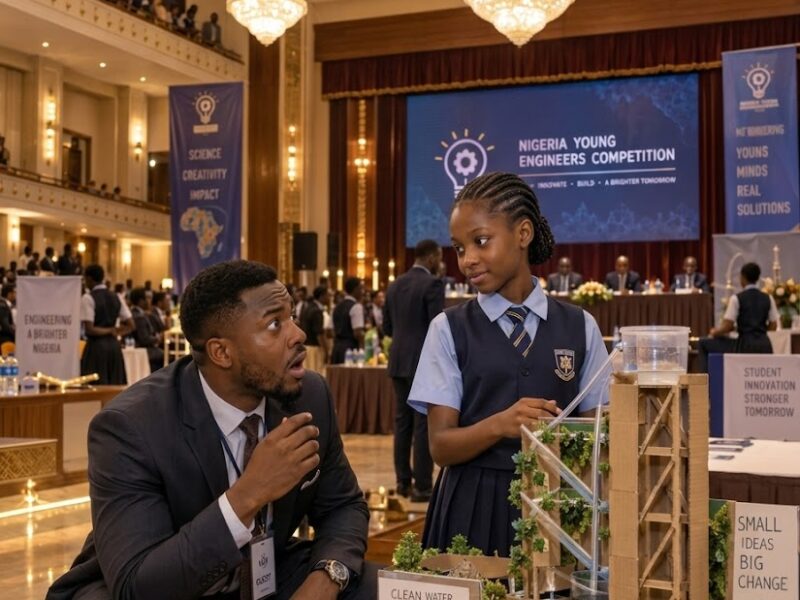
He met his daughter without knowing who she was. Then her mother walked in—and his entire world collapsed.
Part 1
The hotel ballroom in Austin smelled like lemon polish and cheap coffee, and Mr. Ibuka Okonkwo had already shaken hands with six people whose names he would forget by lunch. He was fifty-two years old, a structural engineer with a corner office in Dallas, and he had agreed to judge a children’s innovation challenge only because his company had written the check and his assistant had put it on his calendar in bold red letters. The kids were lined up behind folding tables with cardboard models and duct-taped dreams, and he was supposed to walk past each one and nod like he understood what any of it meant.
He did not expect to feel anything.
Then he reached table twelve.
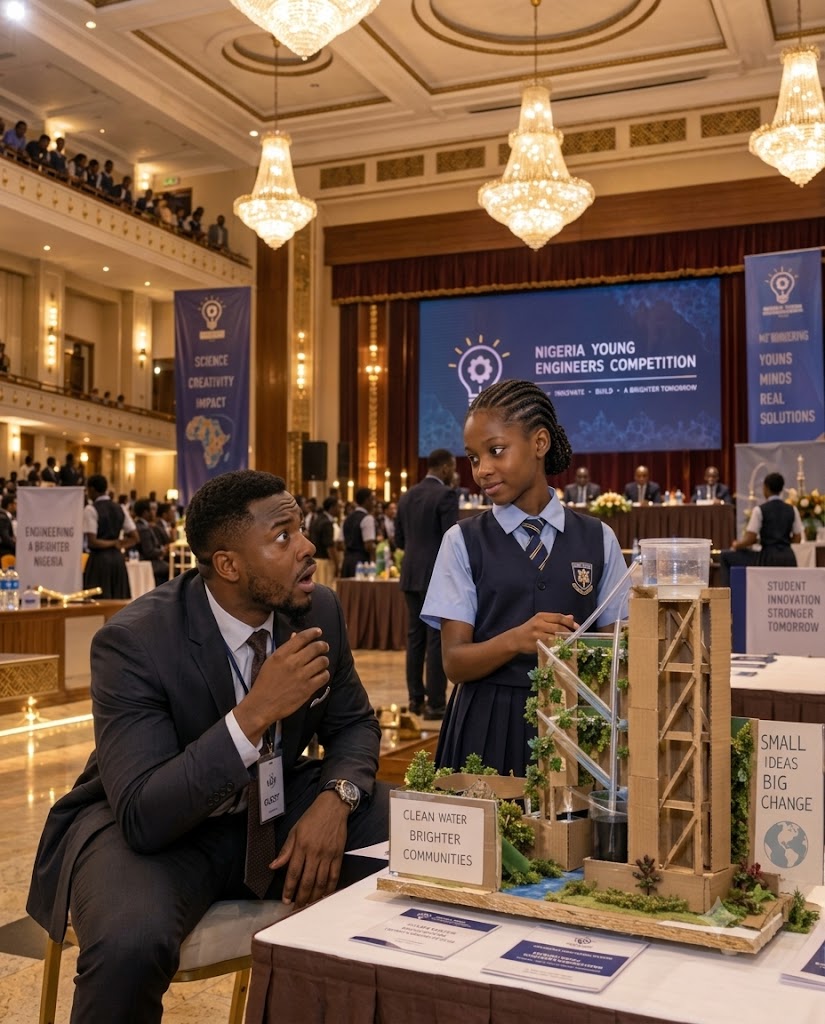
A girl with dark eyes and a gap-toothed grin was explaining how a rain barrel could water a school garden, and she spoke with her hands like an orchestra conductor. Her hair was braided tight against her scalp, and when she smiled, a dimple appeared on her left cheek.
His left cheek.
Ibuka’s pen stopped moving.
“Sir, are you listening?” the girl asked. “I said the overflow valve is the most important part.”
“I’m listening,” he said, though his voice had gone strange. “The overflow valve. Right.”
She rolled her eyes like he was the slowest person on earth.
“Adults never listen,” she said. “My mom says that’s why the world is broken.”
He laughed, but the sound caught in his throat.
Somewhere behind him, a woman’s voice cut through the room.
“Kira, we talked about the eye-rolling.”
Ibuka turned.
The woman standing at the edge of the table was wearing a navy blazer and a wedding band on a chain around her neck, and her face had not changed in twelve years. Not really. The same high cheekbones. The same habit of pressing her lips together like she was holding back a sentence she had already decided not to say.
She looked at him.
He looked at her.
The girl looked between them.
“Mommy,” Kira said, “this is the judge who doesn’t listen.”
“Go get your certificate,” the woman said, her voice steady as a table leg. “I’ll meet you by the door.”
Kira frowned but obeyed, disappearing into the crowd of parents and teachers and children clutching participation medals.
Ibuka and the woman stood three feet apart.
“Chamaka,” he said.
“Don’t,” she said.
“Is she—”
“Don’t.”
“How old is she?”
Chamaka’s jaw tightened.
“She’s eleven,” she said. “And she’s not yours. She’s mine. That’s all you need to know.”
She walked away before he could answer, and he stood there with his pen still in his hand, watching the girl with his dimple disappear through a door that led to a parking lot full of minivans and pickup trucks.
He did not sleep that night.
Part 2
The next morning, Ibuka called in sick for the first time in four years and drove to the address he had found online. It was a small house on the east side of Austin, with a chain-link fence and a pecan tree that dropped leaves all over the driveway. He parked across the street and sat there like a man waiting for a verdict.
At 7:42 a.m., Chamaka came out with a lunch bag and a travel mug.
At 7:51 a.m., Kira came out with a backpack covered in pins.
They got into a Honda Civic that had seen better days, and Ibuka followed them to a middle school three miles away. He watched Kira hug her mother, wave, and run through the front doors. He watched Chamaka sit in the car for a full minute before driving off.
He did not approach her.
He was not brave enough.
Instead, he went to his office and stared at the wall for six hours, and at 5:15 p.m. he called the one person he knew would tell him the truth.
“Vanessa,” he said. “I need a favor.”
Vanessa Okafur had been his girlfriend for almost three years. She was sharp, patient, and had a smile that could sell sand to a desert. She also knew him better than anyone, which was why she heard the tremor in his voice before he said another word.
“What happened?” she asked.
“I met someone,” he said. “A child. I think she might be mine.”
The line went quiet.
“Start from the beginning,” Vanessa said.
He told her about Chamaka. About the pregnancy. About the three weeks he had spent panicking while his father was dying in a hospital in Houston. About the messages he had sent and the calls he had made and the silence that had swallowed him whole. About Chuka, Chamaka’s brother, who had told him the baby was gone.
“You never told me any of this,” Vanessa said.
“I didn’t think it mattered.”
“It matters now.”
“I know.”
Vanessa exhaled slowly.
“What do you want me to do?”
“I need to know if Kira is mine.”
“Have you asked Chamaka?”
“She won’t talk to me.”
“Then you have a problem.”
“I know.”
Vanessa paused.
“I can make some calls,” she said. “I know a lab that does private DNA testing. It’s not cheap. About $1,800.”
“I’ll pay it.”
“That’s not the hard part.”
“What’s the hard part?”
“Getting Chamaka to agree.”
Ibuka closed his eyes.
“I’ll figure it out,” he said.
“You always say that.”
“This time I mean it.”
Part 3
Three days later, Ibuka showed up at Chamaka’s job. She worked at a dental office on Lamar Boulevard, and she was walking to her car when he stepped out of the shade of a live oak tree.
She stopped.
“You’re following me now?” she said.
“I need five minutes.”
“You had twelve years.”
“I know.”
“Then what could you possibly say that I haven’t already heard?”
Ibuka reached into his jacket and pulled out a folded piece of paper. It was a lab requisition form, blank except for the date and the address of a testing facility in Round Rock.
“I want a DNA test,” he said.
Chamaka stared at him.
“A what?”
“A DNA test. I’m not accusing you of anything. I just need certainty.”
She laughed, but there was no humor in it.
“After eleven years, suddenly you need certainty? So now I’m supposed to prove to you that the child I raised alone belongs to you?”
“That’s not what I mean.”
“It sounds exactly like that.”
“Chamaka, listen—”
“No, you listen. I don’t need a test. I know who Kira’s father is.”
“I believe you.”
“Then why are you asking?”
“Because Kira deserves certainty, too. If I enter her life and something later comes up, she’ll be the one who gets hurt. I don’t want that.”
Chamaka’s eyes filled, but she did not let a single tear fall.
“I already told her,” she said.
“Told her what?”
“The truth.”
“She knows I might be her father?”
“Yes.”
“What did she say?”
“She’s confused. And angry.”
“At me?”
“At both of us.”
Ibuka nodded slowly.
“I understand.”
“No,” Chamaka said. “You don’t.”
She opened her car door.
“Fine,” she said. “We’ll do the test. But Kira knows everything. Nobody is sneaking around her.”
“Agreed.”
“Good.”
She got in and slammed the door.
Part 4
The test took five days. Ibuka spent all five of them pacing his apartment, ignoring calls from work, and rereading the same three sentences in a book he had already forgotten the title of. Vanessa called twice. He did not answer.
On the sixth day, the results arrived in a sealed envelope.
He opened it alone, sitting on the edge of his bed, with the curtains drawn and his heart pounding like a jackhammer.
The probability of paternity was 99.9998%.
He was Kira’s father.
He sat there for a long time without moving. Then he called Chamaka.
“I know,” she said before he could speak.
“How?”
“Kira opened the copy I got. She wanted to be the one to tell me.”
“What did she say?”
“She asked if you were going to disappear again.”
Ibuka closed his eyes.
“What did you tell her?”
“I told her I didn’t know.”
Part 5
The first time Kira came to his apartment, she brought a list. It was written in purple ink on a piece of notebook paper that had been folded and unfolded so many times it was soft as cloth.
“Rules,” she said, handing it to him.
He read them out loud.
“Rule one: No showing up at my school without telling my mom first.”
“Good rule,” he said.
“Rule two: No taking me anywhere unless my mom knows.”
“Also good.”
“Rule three: No expensive gifts.”
He looked up.
“What counts as expensive?”
“If you have to ask, it’s expensive.”
He bit back a smile.
“You can’t buy eleven missing years in eleven days,” she said.
“I know.”
“Rule four: Being my father has nothing to do with my mom.”
“I wasn’t planning on—”
“If I accept you, that doesn’t mean she owes you anything.”
“I know.”
“Do you?”
“Yes.”
She studied him for a moment.
“What do you like to eat?” she asked.
“You don’t know?”
“No.”
“Your mom knows.”
“Then ask her.”
“I’d rather ask you.”
Kira crossed her arms.
“Chicken and chips,” she said. “But not spicy. And I hate papaya.”
“Noted.”
“Very important information.”
“I can see that.”
She sat down on his couch and pulled out her math homework.
“Question six,” she said. “I don’t get it.”
He sat beside her and looked at the problem.
“Okay,” he said. “Let’s start from the beginning.”
Part 6
The months that followed were not easy. Kira tested him the way children test the ground after an earthquake, with small tremors and sudden aftershocks. She cancelled plans at the last minute. She asked questions he could not answer. She called him “Ibuka” for three weeks before she finally said “Dad” by accident and then pretended she hadn’t.
Chamaka kept her distance, but she watched.
She watched him show up on time. She watched him call when he was running late. She watched him sit through a parent-teacher conference and a science fair and a Saturday afternoon soccer game in the pouring rain.
She did not forgive him.
But she stopped flinching when he walked into a room.
One evening, after Kira had gone to bed, Ibuka stood in the doorway of Chamaka’s kitchen and said the thing he had been holding in his chest for months.
“I still have feelings for you,” he said.
Chamaka did not turn around.
“I didn’t plan it,” he continued. “I’m not trying to force anything. But I’m not going to lie to you either.”
She set down the dish she was washing.
“Being a good father now doesn’t erase what happened between us,” she said.
“I know.”
“Showing up for Kira doesn’t mean I should clap for you and fall in love with you again.”
“I didn’t say that. I’m not asking for a reward.”
“Then what are you asking for?”
“Nothing.”
She turned around.
“Nothing?”
“I told you how I feel. That’s all.”
“You expect what?”
“Nothing.”
“You’re serious?”
“Yes. You don’t get a relationship with me as a reward for doing what you should have done eleven years ago.”
“You’re right.”
“If you never want anything beyond me being Kira’s father, I will respect it.”
“You won’t keep disturbing me.”
“I will probably still annoy you.”
“Good.”
“Good.”
Part 7
The truth about Chuka came out on a Tuesday.
Kira had gone to her grandmother’s house for the weekend, and Chamaka had agreed to meet Ibuka for coffee because there was paperwork to sign for the school’s emergency contact list. They sat at a small table by the window, and the conversation was careful and quiet until Ibuka mentioned the two visits he had made to Chamaka’s family home twelve years earlier.
“Two visits?” Chamaka said.
“Yes. I came back after my father died. I went to your house. Chuka told me you had lost the baby.”
Chamaka’s face went pale.
“He told me you wanted nothing to do with me,” Ibuka continued. “I believed him. I didn’t know there was a child.”
Chamaka set down her cup.
“He lied to you,” she said.
“Yes.”
“And you believed him.”
“I was twenty-two and afraid.”
“So was I.”
“I know.”
She looked out the window.
“I didn’t know he told you I lost the pregnancy,” she said. “He never told me that part. He only told me you came once and left.”
“He told you I came?”
“Yes. After you were gone. He said you showed up, asked a few questions, and then disappeared again.”
Ibuka shook his head.
“I came twice,” he said. “The first time, he told me you didn’t want to see me. The second time, he told me the pregnancy was gone.”
Chamaka pressed her hand to her mouth.
“I spent years believing you never came back,” she said.
“I did come back.”
“I know.”
“I’m sorry.”
“For what?”
“For all of it.”
She was quiet for a long time.
“There’s something else,” she said.
“What?”
“Vanessa. She’s been calling Chuka.”
Ibuka frowned.
“What?”
“She asked him questions about us. About why he didn’t trust you. She told him you were asking about your rights as Kira’s father.”
“I never said that to her.”
“I know.”
“She’s been lying to me. Using my own child as a weapon.”
“I think she wanted me angry.”
“Why?”
“I don’t know.”
Ibuka stared at the table.
“I need to talk to her,” he said.
“Do what you need to do,” Chamaka said. “But Kira comes first.”
“Always.”
Part 8
Ibuka ended things with Vanessa the next day. It was not a loud conversation. It was not even an angry one. He simply told her that he knew about the calls, and that whatever she had been trying to do had failed.
Vanessa did not deny it.
“I was trying to protect you,” she said.
“By lying to me?”
“By keeping you from getting hurt again.”
“You don’t get to decide that for me.”
“I know.”
She looked at him with something that was almost pity.
“You’re going to get hurt anyway,” she said.
“Maybe.”
“Good luck, Ibuka.”
“Goodbye, Vanessa.”
Part 9
The dinner happened six weeks later. It was not a date, or at least that was what Chamaka kept telling herself. It was a small Italian restaurant with checkered tablecloths and a waiter who kept refilling their water glasses without being asked.
“I dated two serious people,” Chamaka said. “The first one wanted me to choose between him and Kira. I chose Kira.”
“Good,” Ibuka said.
“The second one tolerated her. But every marriage conversation became about where she would fit.”
“That’s not good.”
“No. So I left.”
“I’m sorry.”
“Don’t be. It was the right decision.”
She took a sip of water.
“What about you?” she asked.
“I dated a few people. Vanessa was the longest.”
“How long?”
“Almost three years.”
“Did you love her?”
“Yes. I’m not going to lie to you.”
“So why did it end?”
“She got tired of waiting for me to decide what I wanted.”
“That must have hurt her.”
“It did.”
Chamaka nodded.
“I had a good time tonight,” she said.
“So did I.”
“That doesn’t mean anything.”
“I know.”
“I mean it, Ibuka.”
“I know.”
They walked to her car in silence.
“Good night,” she said.
“Good night, Chamaka.”
She drove home with the radio off and her hands tight on the wheel, and she did not let herself cry until she was in the driveway.
Part 10
The project came three months later. It was the biggest contract of Ibuka’s career, a fourteen-month assignment in Seattle that would require him to be on-site at least four days a week. His boss called it a once-in-a-lifetime opportunity.
Ibuka called it a problem.
He told Kira first.
“You’re leaving,” she said.
“I haven’t accepted.”
“But you want to.”
“I want the job. That doesn’t mean I want to leave you.”
“You came back. Now you’re leaving again.”
“I don’t know yet.”
“That’s what leaving is.”
He sat down beside her on the couch.
“What do you want?” he asked.
“The project. But I want my family too.”
“So what are you going to do?”
“I spoke to the company. I don’t have to relocate fully. I can travel during the week when necessary and come back.”
“Every weekend?”
“Most weekends.”
“Most.”
“Kira, sometimes something may happen.”
She reached into her backpack and pulled out a piece of paper. It was a calendar, hand-drawn, with colored boxes and arrows and small notes in the margins.
“My schedule,” she said. “Your school events go here. Your test dates, your project days, everything important.”
“And if you’re away?”
“Video call.”
“And if you’re busy?”
“I tell you.”
“And if you can’t come?”
“I tell you.”
“You promise?”
“I promise I won’t disappear.”
Part 11
The first time Ibuka took Kira to meet his mother, the old woman cried for an hour. She held Kira’s face in her hands and traced the dimple on her cheek and said, “You look exactly like your father.”
Kira did not know what to do with that, so she stood very still and let herself be hugged.
“My grandmother,” she said later, in the car. “She already loves me.”
“She hasn’t met you.”
“She’s seen your pictures.”
“Only about forty.”
“Forty?”
“Maybe fifty.”
“Daddy.”
“Your grandmother is waiting.”
Kira laughed.
Part 12
Chuka came to the house on a Sunday afternoon, seven months after the DNA test. He stood on the porch with his hands in his pockets and his eyes on the ground.
“I owe you an apology,” he said to Ibuka.
“You do.”
“I was angry. I thought I was protecting her.”
“You weren’t.”
“I know.”
Chamaka stood in the doorway with her arms crossed.
“You told him I lost the baby,” she said.
“I did.”
“You told me he never came back.”
“I did.”
“Why?”
Chuka looked up.
“Because I didn’t want him to hurt you again.”
“That wasn’t your decision to make.”
“I know.”
“You took twelve years from all of us.”
“I know.”
“Knowing isn’t enough.”
“I know.”
Chamaka sighed.
“Come inside,” she said. “Kira wants to meet her uncle.”
Part 13
The years that followed were not perfect. Ibuka missed birthdays and soccer games and one very important science fair because of a delayed flight and a thunderstorm in Denver. Kira got angry. Chamaka got quiet. Ibuka apologized and showed up the next day with donuts and a new schedule that had more arrows and more colored boxes.
But he did not disappear.
He called when he was late. He told the truth when the truth was hard. He sat in the front row of every performance and every awards ceremony and every parent-teacher conference, and when he could not be there, he sent a video message that Kira watched three times before bed.
Chamaka did not fall in love with him again overnight.
But she stopped keeping score.
One evening, after Kira had gone to sleep, she found Ibuka sitting on the back porch with a cup of coffee and a look on his face that she recognized.
“What are you thinking about?” she asked.
“Eleven years,” he said.
“That’s a long time.”
“Yes.”
“You can’t get it back.”
“I know.”
She sat down beside him.
“But you can stop carrying it,” she said.
He looked at her.
“I’m not asking you to forgive me,” he said.
“I know.”
“I’m just asking you not to carry my mistake forever.”
Chamaka was quiet for a moment.
“I’m leaving,” she said.
“I heard.”
“I’m sorry about Kira.”
“I hope one day you can believe that.”
“I believe you regret it.”
“Take care of yourself.”
“You too.”
She stood up and went inside, and Ibuka sat on the porch until the stars came out, listening to the sound of a house that was not quite his but was closer than it had ever been.
Part 14
The last time the dimple appeared, it was at Kira’s twelfth birthday party. She was blowing out candles on a cake shaped like a rocket ship, and Ibuka was standing in the corner with a paper plate and a plastic fork, watching her laugh.
Chamaka walked over.
“She’s happy,” she said.
“She is.”
“You did that.”
“No,” Ibuka said. “We did that.”
Chamaka looked at him for a long time.
“Maybe,” she said.
“Maybe is enough.”
“For now.”
“For now.”
Kira ran over with frosting on her nose.
“Dad,” she said, “did you see me? I blew out all the candles.”
“I saw you.”
“Did you make a wish?”
“I don’t need to.”
Kira rolled her eyes.
“Adults are so weird,” she said, and ran back to her friends.
Chamaka laughed.
Ibuka smiled.
And for the first time in twelve years, the dimple on his cheek did not feel like a wound.
It felt like a door.









