
He invited his poor ex-wife to his wedding just to humiliate her. Then she pulled up in a Rolls-Royce—with triplets.
The church bells in Enugu had been ringing since noon, a relentless metallic clangor that seemed to announce not a wedding but a coronation.
Chik sat in the front pew, his custom Italian suit clinging to shoulders that had been tense for months. He checked his gold Rolex—a gift from his mother—and then checked the door again.
“She’s not coming,” his mother whispered, her lace headwrap rustling like dry leaves. “Forget her. Today is about Adora.”
But Chik couldn’t forget. He had sent the invitation personally, addressed in his own hand, front row seat marked with a gold ribbon. He wanted Goazi to sit close enough to see his triumph, close enough to feel the weight of what she had lost.
The wedding planner rushed over, tablet clutched to her chest. “Sir, the bride is almost ready. We need to begin.”
“Five more minutes,” Chik said, his eyes still fixed on the massive oak doors at the back of the cathedral.
“For what?” his mother snapped. “For a barren woman who couldn’t give you a son?”
Chik didn’t answer. He had waited seven years for this moment, seven years of his mother’s daily reminders, seven years of friends’ pitying looks, seven years of believing that Goazi was the flaw in his perfect life.
Outside, a black Rolls-Royce Phantom pulled up to the curb, its engine purring like a satisfied cat.
The driver stepped out first—a tall man in a tailored navy suit, his salt-and-pepper hair immaculate. He walked around the car and opened the back door with the precision of someone who had done this a thousand times.
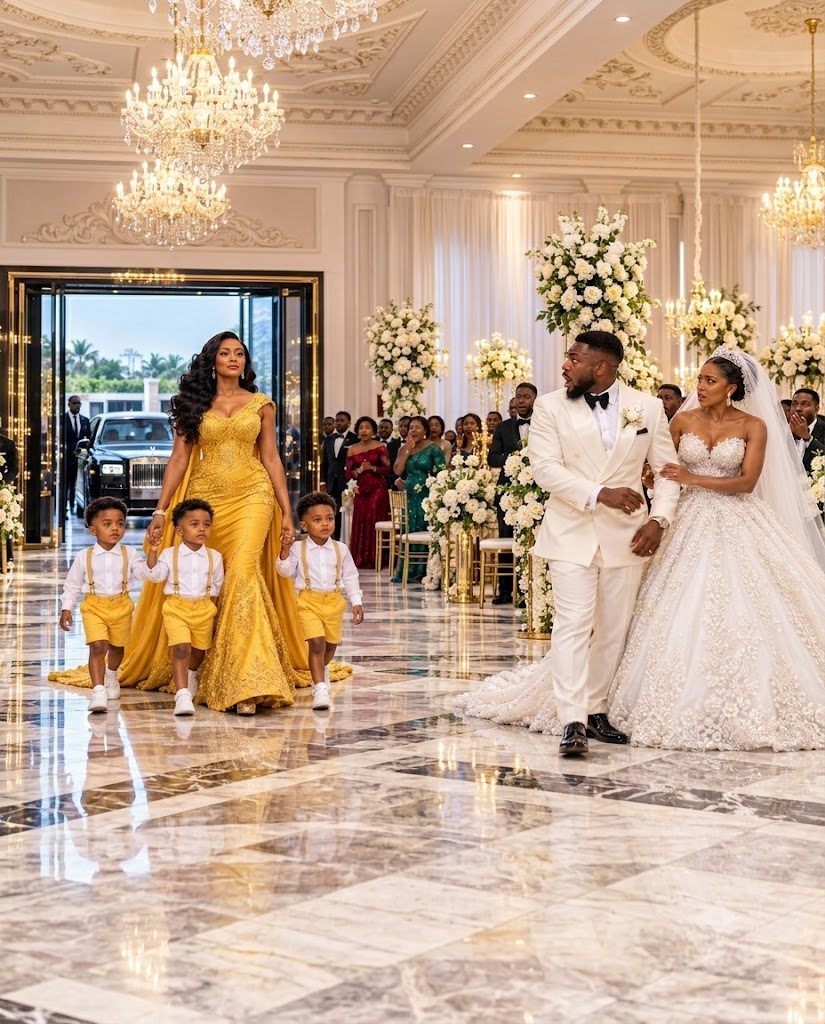
A woman stepped out, her yellow gown catching the afternoon sun like a flame. Her heels clicked against the pavement with the confidence of someone who had walked through fire and emerged polished.
Three small boys followed her, each wearing a white shirt and yellow shorts, their faces identical mirrors of each other. Their eyes were wide as they took in the cathedral, the crowd, the cameras that had started to turn.
“Mommy,” one of them whispered, tugging at her hand. “Everybody is looking.”
“Let them look, sweetheart,” Goazi said, her voice steady. “Stay close.”
The photographer at the entrance lowered his camera, his mouth falling open. A woman in the crowd gasped audibly. Someone else pulled out a phone and started recording.
Goazi kept walking.
She had spent three years preparing for this moment—not for revenge, she had told herself, but for closure. For the chance to walk through a door that had once been slammed in her face and prove that she was not the sum of someone else’s rejection.
The Rolls-Royce was parked behind her, a statement she hadn’t planned but had accepted when Emma insisted. “If we are entering,” he had said, “we are entering properly.”
She hadn’t argued. She had learned, over three years of building a business and a family, that sometimes the universe handed you a moment and you had to step into it.
The cathedral doors swung open.
Chik’s head snapped up.
For a moment, the entire church went silent—the organist’s hands froze over the keys, the guests’ whispered conversations died mid-sentence, even the priest looked up from his notes.
Goazi stood in the doorway, silhouetted against the afternoon light, her three sons clustered around her like planets orbiting a sun.
Chik’s face drained of color.
His mother’s headwrap tilted as she leaned forward, squinting. “Is that—”
“It can’t be,” Chik whispered.
But it was. And she was not alone.
The three boys stepped forward in unison, their small dress shoes tapping against the marble floor. They looked around the cathedral with the curiosity of children who had never seen so many people in one place.
One of them—the tallest by maybe half an inch—pointed at Chik. “Mommy, is that the man from the old picture?”
Goazi didn’t stop walking. “Yes, sweetheart. Keep walking. We are here as guests.”
The bride, Adora, appeared at the side of the altar, her white dress cascading around her like a waterfall. She had heard the commotion and had come to investigate.
She stopped dead when she saw Goazi.
“What is this?” Adora demanded, her voice sharp enough to cut glass. “Why is she here?”
Chik stood up, his hands trembling. “I—I invited her.”
“You invited your ex-wife to our wedding?”
“I wanted her to see—”
“To see what?” Adora’s eyes moved from Goazi to the three boys and back again. “Those children. Are they hers?”
Chik’s mouth opened and closed like a fish gasping for air.
Goazi had reached the front of the church now, her sons standing in a neat row beside her. She looked at Chik with eyes that held no anger, no bitterness—just a calm, steady certainty that was somehow more devastating than rage.
“Hello, Chik,” she said.
“Goazi.” His voice cracked. “I—I didn’t think you would come.”
“You invited me.”
“I didn’t think you would actually—”
“You invited me to the front row,” Goazi continued, her voice carrying through the silent church. “You wanted me close. Here I am.”
Adora stepped forward, her veil swishing against the floor. “What is going on? Chik, who are these children?”
Chik couldn’t answer. His eyes were fixed on the three boys—on their faces, which were so unmistakably his own that it was like looking into a mirror that reflected the past.
“These are my sons,” Goazi said. “Triplets.”
A collective gasp rippled through the congregation.
“Triplets?” Adora repeated. “But Chik said you couldn’t—”
“He said a lot of things,” Goazi interrupted. “He said I was barren. He said I was cursed. He threw me out of our home after seven years because I couldn’t give him a child.”
She paused, letting the words sink in.
“He never took a single test,” she continued. “He never questioned himself. He just decided that I was the problem and moved on.”
Chik’s mother stood up, her face contorted with anger. “How dare you come here and—”
“I dare,” Goazi said, turning to face the older woman, “because I spent seven years being told I was worthless. Seven years of daily reminders that I had failed. Seven years of praying and crying and hating my own body for something that was never proven.”
She reached into her purse and pulled out a folded piece of paper—a medical report, worn at the edges from being read and re-read a hundred times.
“This is from the clinic I went to after he threw me out,” she said. “It says I was healthy. It says there was no evidence of infertility. It says the problem—if there was one—was not mine.”
She held the paper up, and even from a distance, the congregation could see the official stamps, the doctor’s signature.
“I believed him,” Goazi said, her voice trembling for the first time. “I believed him for years. I hated myself because he told me to. But I was never the problem.”
Chik sank back into the pew, his face buried in his hands.
Adora stood frozen, her bouquet of imported roses drooping in her grip. “Chik,” she said slowly, “did you ever get tested?”
Silence.
“Did you?”
“No,” Chik admitted, his voice barely above a whisper. “I didn’t think I needed to.”
“You didn’t think—” Adora’s voice rose. “You told me she was barren. You told me it was her fault. You built our entire relationship on the foundation that she was broken and you were—what? Perfect?”
“I was wrong.”
“You were wrong?” Adora laughed bitterly. “You ruined a woman’s life because you were wrong?”
Three years earlier, in a small apartment in Enugu, Goazi had cried herself to sleep on a borrowed couch.
The apartment belonged to Amaka, a childhood friend who had taken her in without hesitation. It was small—one bedroom, a kitchen that barely fit two people, a living room dominated by a television that only worked when you hit it.
But it was safe. And after seven years of marriage, safety felt like a luxury.
“He threw me out,” Goazi had sobbed. “He called me cursed and barren and he threw me out.”
Amaka had sat beside her, her hand rubbing slow circles on Goazi’s back. “Did either of you ever complete proper fertility tests?”
Goazi had looked up, her eyes red and swollen. “No. Chik always said he was fine. His mother agreed, and I eventually believed them.”
“Tomorrow we go to Life Hope,” Amaka said firmly. “You deserve facts, not a sentence from frightened people.”
“I fear the facts may prove him right,” Goazi whispered. “But I am tired of not knowing.”
The next day, they had gone to Life Hope Clinic, where a kind-eyed doctor had run a series of tests. Blood work, ultrasounds, hormone panels—everything.
The results had come back two days later.
“Your scans, hormones, and ovulation markers are normal,” the doctor had said. “There is no evidence of infertility.”
Goazi had stared at her. “Nothing is wrong with me?”
“Nothing.”
“After seven years of blame?”
The doctor had nodded. “If there was no pregnancy, your former husband also needed evaluation.”
Goazi had walked out of that clinic feeling lighter than she had in years. The burden she had carried—the shame, the guilt, the belief that she was fundamentally broken—had been lifted.
But the anger came later. The fury at Chik, at his mother, at everyone who had stood by while she was blamed for something that was never her fault.
She had channeled that anger into work.
“You cook better than half this city,” Amaka had said one evening, watching Goazi stir a pot of stew. “Start small. My veranda is yours.”
And so, with a borrowed pot and a firewood stove, Goazi had opened a small food stand on Amaka’s veranda.
Rice, beans, stew, fried plantains—simple food, but cooked with love and desperation and the fierce determination to prove that she was worth something.
The first day, she had sold three plates.
The second day, seven.
The third day, fifteen.
By the end of the first month, there was a line stretching down the street.
Goazi had learned to cook from her mother, who had learned from her grandmother, who had learned from her great-grandmother. It was a legacy passed down through generations of women who had never had the chance to do anything with it.
Now, Goazi was doing something.
She expanded the menu—jollof rice, pepper soup, egusi, pounded yam. She hired two women to help with the cooking and one to handle the growing queue of customers.
Three weeks after she started, Amaka found her standing in the kitchen at sunrise, already stirring a pot.
“Look at you,” Amaka said. “Three weeks ago, you barely left the sofa. Now you’re running a business.”
“I still hurt sometimes,” Goazi admitted. “But work gives my hands somewhere useful to put the pain.”
She cooked, and she saved.
Every naira she earned went into a jar—the start of something bigger, something that would be entirely her own.
Emma came into her life six months later.
He was a customer first—a man in his late thirties with kind eyes and a quiet smile. He ordered jollof rice and plantains, then came back the next day, and the next.
“You have been standing since sunrise,” he said one afternoon. “Do you ever rest?”
“When the pots are empty,” Goazi replied.
“Then I should buy everything and send you home.”
She laughed. It was the first time she had laughed in months.
Emma was patient. He didn’t push, didn’t pry, didn’t ask questions she wasn’t ready to answer. He simply showed up, day after day, with his kind eyes and quiet smile, and slowly, Goazi began to trust him.
“I was married too,” he told her one evening, as they sat on a bench outside her growing restaurant. “My wife died in a car crash years ago. I stopped imagining love could return.”
“I’m sorry, Emma,” Goazi said softly.
“Grief can make a home inside you,” he said. “But recently, being around you feels peaceful.”
“I am scared of giving an answer,” Goazi admitted. “I don’t trust my judgment yet.”
“Then don’t run or leap,” Emma said. “Walk. Let me prove who I am over time.”
She gave him a chance.
They went for coffee—public place, one hour, no pressure. Then dinner, then a walk in the park, then another coffee.
Emma didn’t try to rescue her. He didn’t try to fix her. He simply walked beside her, steady and patient, while she rebuilt herself.
“Why me?” Goazi asked one night. “You could choose someone without all this history.”
“Because history did not make you cruel,” Emma said. “You carried pain and still became kind. I don’t need to rescue you. I’m asking to walk beside you.”
“Not carry you.”
“Then we can keep walking,” Goazi said.
They got married in a small ceremony—no giant cake, no noisy convoy, just family and close friends and the quiet promise of a life built on truth.
When Goazi found out she was pregnant, she didn’t believe it at first.
She had been feeling sick for weeks—nausea, fatigue, a strange sensitivity to smells. Emma had noticed before she did.
“The smell of stew is making you sick again,” he said one morning. “That has been two weeks. We are going to the clinic.”
“You think it could be malaria?” Goazi asked.
The doctor had run a test, then another, then an ultrasound.
“Your test is positive,” the doctor said. “You are pregnant.”
Goazi’s world stopped.
“Please say it again,” she whispered.
“Pregnant.”
Emma grabbed her hand. “Doctor, say it slowly. I want to hear every word.”
The doctor smiled and adjusted the ultrasound screen. “I am seeing three separate heartbeats.”
“Three?” Goazi repeated.
“Triplets.”
The room spun. Goazi gripped Emma’s hand so hard her knuckles turned white.
“Doctor, are you certain?” Emma asked.
“Very certain. Three babies.”
Goazi burst into tears—not sadness, but a release so profound it felt like her entire body was exhaling seven years of pain.
“I am not barren,” she sobbed. “I never was.”
Emma held her. “You never were.”
“I need to say it once where my heart can hear it,” Goazi said.
“Then say it until you believe it.”
The triplets were born on a Tuesday—three healthy boys, each with a full head of hair and lungs that announced their arrival to the entire hospital.
Goazi held them one by one, marveling at their tiny fingers, their perfect faces, their very existence.
“Three healthy boys,” the doctor said. “Mother is stable.”
“Goazi, you did it,” Emma said.
“No,” she corrected. “We survived it together.”
She looked down at her sons—her sons—and felt something she had never felt before. Not just love, but vindication. Proof that she had never been broken, that the problem had never been hers.
The restaurant expanded.
Goazi rented the empty shop next to her veranda stand and turned it into a proper restaurant. She hired more staff, developed a menu that drew customers from across the city, and started saving for a second location.
“You enjoy difficult projects,” Emma observed one evening, watching her review the books.
“Three babies, one expansion,” Goazi replied. “What’s a little more chaos?”
The restaurant was profitable within six months. Within a year, it was one of the most popular spots in Enugu.
Goazi hired a manager, then a second chef, then a team of delivery drivers. She opened a second kitchen, then a third. Her name became synonymous with good food and smart business.
Money can cushion consequences,” she would say later. “But it cannot erase character. It cannot buy back the years I lost. It cannot undo the damage that was done.”
Meanwhile, Chik’s life had begun to unravel.
He had married Adora six months after the wedding that never happened—a smaller ceremony, private, subdued. His mother had insisted, but the joy was gone.
Three years later, they were still childless.
Chik’s mother had started dropping hints—gentle at first, then not so gentle. “Have you considered adoption?” she asked. “Or a specialist? There are doctors in Lagos who can help.”
“We’ve tried,” Chik said through gritted teeth. “Nothing works.”
“Then perhaps the problem is—”
“Don’t,” Chik warned. “Don’t say it.”
But his mother said it anyway. “Perhaps the problem was never Goazi.”
The words hit Chik like a physical blow.
He remembered the wedding—the black Rolls-Royce, the three boys, the medical report. He remembered the look on Goazi’s face as she stood in the doorway of the church, calm and unafraid.
He remembered Adora walking out.
“You sent Goazi away,” his mother continued, “and then every woman after her left. Have you considered that we judge too quickly?”
“Don’t bring Goazi into this,” Chik snapped. “She is gone.”
His mother pulled out her phone and showed him a photo—a screenshot from social media, a picture of Goazi at her restaurant opening, three boys beside her.
“Look at this,” his mother said. “That hand looks like yours.”
Chik stared at the photo. One of the boys had raised his hand to wave at the camera, and in the gesture, Chik saw himself. The shape of the fingers, the angle of the wrist—it was like looking at a ghost.
“Call her if you want answers,” his mother said.
“No,” Chik said, though his voice lacked conviction. “I don’t care.”
But he did care. He cared so much that he couldn’t sleep, couldn’t eat, couldn’t focus on his work. The image of those three boys haunted him—their faces, their hands, their very existence.
Adora had left him by then, tired of his evasions and his mother’s interference. “You worry too much,” he had told her when she asked about children. “Adora is exactly what I need.”
“You listed everything except kind,” she had replied.
“Kindness does not build a legacy.”
“Neither does denial.”
She had walked out the door and never looked back.
Chik finally went to a doctor—not because he believed he was the problem, but because his mother had worn him down.
The results came back three weeks later.
“Your count and motility are significantly low,” the doctor said. “This could explain the years without conception.”
Chik stared at the report. “What?”
“Low count and motility. It’s treatable, but it likely contributed to the difficulty you and your former wife experienced.”
“So Goazi carried my blame for something that may have been mine?”
“It’s possible.”
Chik felt the world tilt beneath him.
He went home and called Goazi.
She answered on the third ring.
“Why are you here?” she asked, her voice flat.
“To apologize,” Chik said. “Nothing more.”
“You had seven years to be decent.”
“I know. Please let me say what I need to say.”
Goazi was silent.
“I judged you,” Chik continued. “I humiliated you. I refused every chance to question myself. I was wrong.”
“You assumed I was broken,” Goazi said. “You told everyone I was cursed. You made me doubt my own worth.”
“The clinic confirmed low count and motility,” Chik admitted. “I may have been the factor all along.”
“Then get treatment,” Goazi said. “I do not deserve forgiveness.”
“Maybe not. But I deserve freedom from carrying your shame. I forgive you.”
Chik’s voice cracked. “Thank you.”
“I am not coming back,” Goazi said. “Goodbye, Chik.”
She hung up.
The news of Chik’s failed wedding spread through Enugu like wildfire.
Social media clips of Goazi’s entrance—the yellow gown, the three boys, the black Rolls-Royce—went viral. People shared the story, debated it, argued about who was right and who was wrong.
Two investors paused their deals with Chik’s company. Staff whispered in the hallways.
“I thought money could protect me from disgrace,” Chik told his mother.
“Money can cushion consequences,” she replied. “It cannot erase character.”
Chik closed his eyes. “I know that now.”
His mother sat beside him, her age showing for the first time. “I pushed you to blame. I called her the problem without proof. I was wrong too.”
“We both helped break someone who loved this family,” Chik admitted.
“Did she speak to you?”
“She forgave me after all that. But she belongs to her own life now.”
Goazi’s restaurant—now a chain of three locations across Enugu—had become a landmark.
She had opened the second kitchen with a grand ceremony, complete with local dignitaries and press coverage. The third had opened quietly, a testament to her business acumen rather than her need for attention.
Her sons were growing fast. They had her eyes and Chik’s stubbornness, a combination that made them both exhausting and wonderful.
“Mommy, are you famous now?” one of them asked one evening, scrolling through social media on his tablet. “People on the internet know you.”
“Fame fades,” Goazi said. “Knowing your worth matters longer.”
Emma sat beside her, watching the boys play. “Your second kitchen opens next month. Not bad for a woman who started on my veranda.”
“That veranda saved me,” Goazi said.
“You saved yourself there.”
She leaned against him. “Thank you for your strength. Thank you for your forgiveness.”
“I lost a good woman,” Emma said. “I wish you peace.”
Goazi didn’t answer. She didn’t need to. The peace was there, in the laughter of her sons, in the steady rhythm of her business, in the quiet certainty that she had built something that no one could take away.
Chik visited Goazi’s restaurant once, months after the call.
He stood outside, watching through the window as she moved through the dining room, greeting customers, laughing at jokes, checking on orders. She looked happy—genuinely happy—in a way he had never seen during their marriage.
He didn’t go inside.
He went home instead and sat in the empty living room of his empty house. His mother was gone—she had moved to Lagos to live with her sister, tired of the whispers and the shame.
“What did pride gain me?” Chik asked the silence. “Nothing worth keeping.”
He thought about the three boys—his sons—and the life he might have had if he had been brave enough to question himself.
“If I build again,” he said, “it has to begin with truth.”
The house was still silent, but for the first time in years, Chik didn’t mind.
Goazi sat on her veranda—the original veranda, the one where everything had started—and watched the sunset.
Her sons played in the yard, their laughter echoing through the evening air. Emma was inside, finishing dinner, and the smell of jollof rice drifted through the open door.
“Can we have more soup?” one of the boys called.
Goazi smiled. “Peace suits this house.”
“It took a long road to get here,” Emma said, stepping onto the veranda.
“Was it worth walking?”
Goazi looked at her sons, at her husband, at the life she had built from the ashes of the one that had been destroyed.
“Every step that brought me home,” she said.
And somewhere in the distance, a church bell began to ring—not for a wedding, not for a celebration, but for the simple, quiet fact of being alive.
—
**THE END**









