
He Humiliated a Poor Housekeeper at His Engagement Party—Unaware She Was the Mother of His Own Fiancée
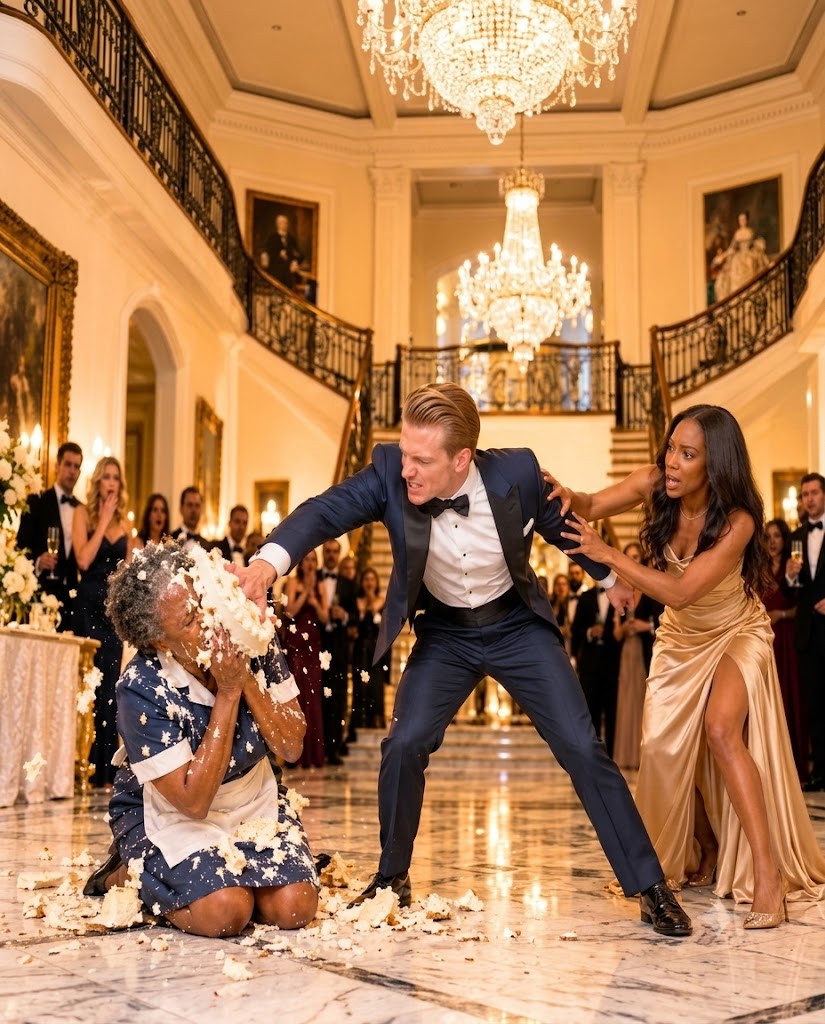
**Part 1**
The lemon cake hit the marble floor with a sound that seemed to echo through the entire kitchen. May Chen stood frozen, her hands still extended where the dessert had been moments before, watching the carefully constructed layers of sponge and frosting collapse into a yellow and white mess across the imported Italian tile. Thirty years of baking, thirty years of perfecting her mother’s recipe, and it had taken exactly three seconds to destroy everything.
“Staff used the back door,” Diane Ashford said, not even turning to look at the damage. Her voice carried the particular ice of old money speaking to new help. “Did nobody teach you that, or do you just not listen?”
The kitchen staff had gone silent. A young woman in a crisp white apron—Sophia, May would later learn—had stopped arranging silverware on a tray, her eyes wide. The sous chef had frozen mid-chop over a cutting board of vegetables. Even the industrial refrigerator seemed to hum more quietly.
“I’m sorry, ma’am,” May said, her voice steady despite the trembling in her hands. She had learned long ago that tears were a luxury she couldn’t afford. “I only came early to bring a cake for the engagement. I thought—”
“Nobody here eats cheap cake.” Diane finally turned, her gaze sweeping over May’s simple navy dress and sensible shoes with the kind of dismissal that cut deeper than any insult. “Clean that up. That’s what you’re paid for.”
The words hung in the air like smoke. May thought of the twelve hours she had spent perfecting that cake, the organic lemons she had squeezed by hand, the butter she had churned herself because store-bought simply wouldn’t do for her daughter’s engagement. She thought of the bus ride that had taken two hours instead of one because of a flooded highway, the ache in her knees from standing, the hope that had bloomed in her chest when she imagined Claire’s face lighting up at the sight of her mother’s famous dessert.
“Yes, ma’am,” she said instead. Because that was what women like her said to women like Diane Ashford.
A soft hand touched her elbow. May looked up to find an older woman—the housekeeper, she assumed, based on the silver hair pulled back in a neat bun and the kind eyes that held none of Diane’s contempt.
“Thirty years of lemon cakes and never one on the floor,” the woman murmured, kneeling beside May with a roll of paper towels. “Here, let me help you. Don’t let him see you cry.”
“Him?”
“The son. Preston. He’s worse than she is, and he’s already in a mood about the seating arrangements.” The housekeeper’s hands moved efficiently, scooping up the ruined cake with practiced ease. “You must be the extra girl from the agency. You’re late.”
Before May could explain that she wasn’t from any agency, that she was—well, she wasn’t sure what she was anymore—a young woman appeared in the kitchen doorway. She had the harried look of someone who had been running, and her apron was already stained with what looked like coffee.
“You must be the new hire,” she said, slightly out of breath. “I’m Sophia. Mrs. Diane is strict and her son is worse. Just keep your head down.”
May opened her mouth to correct her, to explain that she wasn’t the new hire, that she was Claire’s mother, that she had flown all the way from Georgia with a cake in her lap because her daughter had begged her to come early and surprise everyone—
But the words wouldn’t come. Because beneath the confusion and the humiliation, a small voice whispered that maybe this was better. Maybe she could see what her daughter was marrying into without the filter of politeness that her presence as “the bride’s mother” would command.
“Thank you,” she said instead. “I’ll remember that.”
—
Across town, in a hotel suite that cost more per night than May made in a month, Claire Ashford was pacing. Her phone was pressed to her ear, and her designer heels clicked against the polished hardwood with each anxious step.
“Sweetheart, I made it,” her mother’s voice said through the speaker. “I’m at the house.”
Claire let out a breath she hadn’t realized she was holding. “Thank God. Mom, listen to me—don’t tell them who you are. Not yet.”
A pause. “What? Claire, why would—”
“Please, Mom. I want to see who he is when he thinks nobody important is watching. You know how his mother is. You know how he can be.” Claire closed her eyes, picturing Preston’s charming smile, the way he always seemed to know exactly what to say. “I need to know if that’s real.”
Another pause, longer this time. “Okay, baby. I’ll be careful.”
“I love you. And Mom? Thank you for coming. I know the flight was—”
“Don’t you dare apologize for your own engagement party,” May said firmly. “I wouldn’t miss it for the world.”
Claire’s phone buzzed with another call—Preston, probably, wondering where she was. “I have to go. My flight landed late, I’m still hours away. Please be careful.”
“I will. I promise.”
The call ended, and Claire stood for a moment in the empty hotel room, staring at her reflection in the mirror. She was beautiful in the way that money could make someone beautiful—designer dress, professional makeup, hair styled by a man who charged more for a trim than most people paid for rent. But beneath the polish, there was still the girl who had grown up in a two-bedroom apartment, who had watched her mother work three jobs to put her through the best university in the country, who had promised herself that one day she would make her mother proud.
Claire just hadn’t expected that “making her mother proud” would involve watching her be humiliated by the family she was about to marry into.
—
Back at the Ashford estate, the party was in full swing. May had been put to work polishing silver—every piece, Diane had emphasized, and she was not to sit until the last guest left. The collection was worth more than May’s house, she estimated, studying a butter knife that probably cost as much as a semester of Claire’s tuition.
“Every piece,” Diane repeated, sweeping through the dining room in a gown that probably cost more than May’s entire wardrobe. “And she made me polish them twice last week. Then she said I breathed on them.”
The last part was directed at May, who wasn’t sure if she was supposed to respond. She decided on a neutral “Yes, ma’am” and kept polishing.
“She’s like that,” a voice said from the doorway. May looked up to see Sophia, carrying a tray of champagne flutes. “Made me polish the crystal three times for a dinner party last month. Then she dropped one and blamed me.”
“Did you tell her?”
“I didn’t have to. The security footage showed her dropping it.” Sophia set down the tray and picked up a silver spoon, examining it in the light. “Then we’ll polish them together and we’ll breathe as much as we like.”
May couldn’t help but smile. “You’re different from the other agency ladies.”
“Who says I’m from an agency?” Sophia’s eyes sparkled with mischief. “My brother goes to school with Claire—the bride. He told me she’s nothing like the rest of them. Thought I might see for myself.”
May’s heart clenched. “And what have you seen?”
“A woman who treats everyone like they matter. A woman who remembers the names of every staff member, who asks about our families, who once brought my brother a laptop when she found out he was doing homework in the library because they didn’t have one at home.” Sophia’s voice softened. “Whoever Claire is, she deserves better than this.”
“Than what?”
But before Sophia could answer, a man’s voice cut through the room like a knife.
“Relax, Marco. After the wedding, I’ll have the money. Her company is worth millions.”
May and Sophia exchanged a glance. The voice was coming from the study, its door slightly ajar.
“She thinks this is about love,” the voice continued—Preston, May realized with a cold knot in her stomach. “It never was.”
Another voice, lower, less polished: “And the ring?”
“What about it?”
“Does she know it’s fake?”
A laugh that made May’s blood run cold. “She’ll never know. I sold the real diamond to pay you. Glass looks the same in photos.”
“Hey, were you listening?” A third voice—Diane’s—sharp and suspicious.
May dropped her eyes to the silver, her hands moving automatically. “I heard nothing, ma’am. Only the sound of the silver.”
There was a pause. May could feel eyes on her, assessing.
“Eyes down and keep moving or you’re done here,” Diane said finally.
The door closed. May let out a breath, but she didn’t relax. Sophia was staring at her, her face pale.
“Are you okay?” Sophia whispered. “You look like you just saw a ghost.”
“Not a ghost,” May said slowly, her mind racing. “Just a man showing me his real face.”
She thought of the ring she had noticed on Claire’s finger at the airport, how her daughter had held up her hand with such joy. She thought of the fake diamond, the sold ring, the money that had gone to a man named Marco. She thought of the words she had just heard, words that suggested everything she had ever feared about Preston Ashford might be true.
“Tell me, Sophia,” she said, her voice barely above a whisper. “Is Mr. Preston always like this?”
“Worse when his mother’s watching.” Sophia’s eyes were wide. “And there’s a woman, Vanessa. She comes when his fiancée is away.”
May’s hands tightened on the silver. “Vanessa?”
“She’s here tonight. Over in the garden, I think, with some of the other guests.” Sophia hesitated. “I shouldn’t be telling you this. I just—I saw the way he looked at you earlier, when you spilled the cake. And I thought you should know.”
A sharp voice cut through their conversation: “Smile. Smile, but not too much. Guests don’t want to see the help’s teeth.”
Diane was back, her gaze sweeping over the two women with obvious suspicion. “There’s another tray of glasses that need polishing. And you—” she pointed at Sophia—”find something to do that doesn’t involve gossiping.”
“Yes, ma’am,” they said in unison, and Diane swept away.
May picked up another piece of silver, but her mind was elsewhere. She thought about the ring, the money, the woman named Vanessa. She thought about her daughter, driving through the rain, eager to see the man she loved.
She thought about the fact that no one in this house—no one except Sophia—seemed to know who she was.
And she decided that before the night was over, everyone would know.
—
**Part 2**
The ballroom was a vision of gold and crystal, the kind of opulence that whispered of generations of wealth. May stood by the wall as instructed, holding a tray of champagne glasses that she was not to spill, not to drop, and—most importantly—not to speak about. The instruction had come from Preston himself, delivered with a smile that didn’t reach his eyes.
“Nice party, Preston,” a man said, clapping the groom on the shoulder. “Too bad the guest of honor isn’t here yet.”
“Her flight’s late tonight.” Preston’s charm was effortless, practiced. “She’s worth the wait.”
“You’re the only woman I’m looking at,” he added to a woman beside him—Vanessa, May assumed, judging by the way she was draped over his arm like a silk scarf.
May’s jaw tightened. She thought about Claire, somewhere on a rain-slicked highway, thinking about a man who was already planning to leave her for Monaco.
“Oh, look,” Vanessa said, her gaze landing on May. “The help. Careful, honey. Don’t spill on my dress. It costs more than you.”
The words landed like a slap. May felt the familiar sting—the same sting she had felt when Diane had dismissed her cake as “cheap,” when Preston had told her to clean the floor, when every guest at this party had looked through her as if she were invisible.
But she had learned to swallow her pride a long time ago. She had learned to hold her tongue, to keep her head down, to survive.
“Hold these and stand by the wall,” Preston said, handing her a tray of drinks. “Don’t move. Don’t talk. Tonight, you’re furniture.”
The group around him laughed.
“Furniture,” Vanessa said, delighted. “Preston, you are terrible. I love it.”
May held the tray. She stood by the wall. She was furniture.
And then a hand pressed a glass of water into her palm.
“Drink this quick before Mrs. Diane sees you’ve been standing for two hours.” It was the housekeeper, the kind woman who had helped her clean up the cake.
“You’ll get in trouble for me, child.”
“My mother cleaned houses, too. Nobody ever gave her water, either.”
May drank. The water was cold and clean, and it tasted like kindness.
“How long have you worked here?” she asked.
“Twenty years. Since before Preston was old enough to be cruel.” The housekeeper’s voice was bitter. “I should have left long ago, but the pay is good and I don’t have much choice.”
“There’s always a choice.”
“Is there?” The housekeeper looked at her with eyes that had seen too much. “When you’ve got a family to feed and no other skills, you do what you have to do. You keep your head down. You don’t make waves.”
May thought about her own life—the jobs she had taken, the dignity she had swallowed, the nights she had cried herself to sleep after another day of being invisible.
“My mother used to say,” she said slowly, “that dignity is the one thing no one can take from you unless you give it away.”
The housekeeper was quiet for a moment. Then she smiled. “I like you. You’re different.”
“I’m just a woman who’s tired of being furniture.”
—
Across the room, May could see Sophia, her phone hidden behind a napkin, her eyes fixed on Preston and Vanessa. The two were still talking, their heads close together, their laughter too loud.
“Two months after the wedding,” Preston was saying, “her money is ours. Then you and I disappear to Monaco.”
“And the ring? Does she know it’s fake?”
“She’ll never know. I sold the real diamond to pay Marco. Glass looks the same in photos.”
May felt her stomach turn. Two months. That was how long Preston planned to stay married before taking everything and running. Two months, and then he and Vanessa would disappear while Claire was left with nothing—no husband, no money, no ring.
Not if May had anything to say about it.
But before she could act, a voice cut through the party: “Phones are forbidden during service. Who were you filming?”
Diane had found Sophia.
“No one, ma’am,” Sophia said, slipping her phone into her pocket. “I was only checking the time.”
“Liar. You’re fired. Leave your apron and get out of my house tonight.”
May’s heart seized. “Ma’am, she did nothing wrong. If you must punish someone, punish me.”
“Gladly. She’s fired anyway. And you will scrub the terrace stones on your knees until midnight.”
May stepped forward. “Please, Mrs. Diane. My family counts on this job.”
“Not my problem. Security will walk you out.”
Two men in dark suits appeared, escorting Sophia toward the door. But as Sophia passed May, she pressed something into her hand: her phone.
“Keep that safe,” she whispered. “And don’t go far. This night isn’t over.”
The security guards led her away. May was left holding the phone, her heart pounding.
“You,” Diane said, turning to May. “Terrace stones. Now.”
May went.
—
The terrace was cold and wet, the stones slick with rain. May knelt on the hard surface, a bucket of soapy water beside her, a scrub brush in her hand. Her knees ached, her back screamed, and her hands were raw from the cold.
But she didn’t care. She held the phone in her pocket, a small warmth against her thigh. She thought about what Sophia had seen, what she had filmed, what she had risked to get it.
She thought about her daughter, driving through the rain, and she knew she couldn’t let this go.
The phone buzzed. A text message.
“Did you hear the toast? He humiliated you in front of everyone. Said you were the housekeeper and asked how much you make.”
May’s blood ran cold. She had been outside, scrubbing the terrace, while inside, Preston had… what?
“Claire is calling. Should I answer?”
May’s fingers fumbled with the phone.
“Don’t let her see it yet. I need to be there.”
“Are you sure?”
“Yes. I need to be in the room when the truth comes out.”
Another text: “The wife is here, isn’t she? Vanessa?”
“Yes. She’s been with him all night.”
“I’m at the gate. I’ll wait for your signal.”
May let out a breath. She had been wrong about Sophia. The girl wasn’t just a temporary hire; she was something else entirely—a woman who had seen too much, who had decided that tonight was the night to do something about it.
May scrubbed the terrace with renewed energy, her knees protesting, her back aching. She thought about the woman in the garden, the woman named Vanessa who had laughed at her, who had called her dress “cheap.”
She thought about the woman who had said “Furniture” and laughed.
She thought about Claire, arriving at the party, beautiful and happy, ready to marry a man who planned to use her and discard her.
The phone buzzed again: “He’s giving the toast now. I’m sending the video to your phone. Do you want me to play it on the big screen?”
May hesitated. She thought about the consequences—the public humiliation, the scandal, the fact that her daughter was about to discover that the man she loved was a fraud.
She thought about the alternative: Claire married to a man who would take her money, humiliate her mother, and disappear to Monaco with another woman.
She typed: “Do it.”
And then she stood up, wiped her hands on her apron, and walked back into the ballroom.
—
The party was still in full swing when May entered. No one noticed her—she was invisible again, a servant in a room full of people who didn’t care to see her. She slipped along the wall, keeping in the shadows, watching as Preston took the stage.
“My fiancée is running late,” he said, his voice smooth as silk, “but the party starts now. Let’s have some fun.”
There was a ripple of laughter. May saw the housekeeper standing by the doorway, her face tight with fury. She saw Sophia’s phone clutched in her own hand, the video ready to play.
“Everyone,” Preston continued, his voice rising, “meet our new housekeeper. She brought us a homemade cake today. Isn’t that adorable?”
The spotlight swung, finding May. She stood frozen, the light blinding her.
“Come up here, sweetheart,” Preston said, his smile wide. “Tell everyone how much you make in a year.”
May didn’t move.
“Go on,” he coaxed.
She thought about running. She thought about hiding. She thought about the life she had built, the dignity she had fought for, the daughter she had raised.
And then she thought: No.
“Enough to raise a daughter alone,” she said, her voice clear and steady, “and send her to the best university in this country.”
The room went silent.
“How touching,” Diane said from the front of the room. “Now get off the stage before you embarrass us.”
“Your daughter probably cleans hotel rooms now,” a guest shouted from the back. “Like mother, like daughter.”
May felt the words hit like a punch. But she didn’t flinch.
“My daughter is many things,” she said, her voice rising, “but she would never treat anyone the way you treated me tonight.”
There was a murmur in the crowd. Someone laughed.
“Preston,” Diane said, her voice sharp, “make her dance. Housekeepers love dancing for tips.”
Preston reached into his pocket and pulled out a bill. He held it out, a smirk on his face.
“There is your tip,” he said. “Go on, entertain us.”
May looked at the bill. She looked at the crowd. She looked at the man who was about to marry her daughter.
“I don’t dance for money,” she said, her voice loud enough for everyone to hear. “And I don’t bend for men who mock the poor.”
The room erupted.
“Security!” Diane shouted. “Get this woman out of my sight!”
“No scenes in front of my guests,” Preston said, his voice tight. “Back to the kitchen and stay there until we’re done.”
May was led away. But as she passed the stage, she slipped Sophia’s phone out of her pocket and pressed play.
—
The video was grainy, shot from a low angle, but the audio was clear: “Two months after the wedding, her money is ours. Then you and I disappear to Monaco.”
The screen was huge. The silence was absolute.
“Does she know it’s fake?”
“She’ll never know. I sold the real diamond to pay Marco.”
“Glass looks the same in photos.”
The video ended. The lights came up.
May stood in the doorway, her heart pounding. She saw the faces of the guests, the shock, the confusion, the dawning realization. She saw Diane’s face go white, Preston’s face go red. She saw Vanessa slip toward the back door.
And she saw Claire, standing at the entrance to the ballroom, her face pale, her eyes wide.
“Mom?” Claire’s voice was small. “What’s going on?”
May opened her mouth to answer. But before she could, Diane spoke.
“Your mother,” she said, her voice dripping with contempt, “is a housekeeper. A servant. A nobody. And if you think you can come in here—”
“Mom, stop.” It was Preston, his face red, his voice desperate. “I can explain.”
“Explain what?” Claire stepped forward, her heels clicking on the marble floor. “Explain that you’ve been lying to me? That the ring is fake? That you plan to leave me for Monaco in two months?”
“Claire, baby, you don’t understand—”
“I understand perfectly.” Claire’s voice was ice. “I understand that you humiliated my mother. That you treated her like furniture. That you planned to use me for my money.”
She turned to face the crowd, her face pale but composed.
“Everyone,” she said, her voice clear and steady, “the engagement is off.”
The room erupted. But May wasn’t listening. She was watching her daughter, standing tall in the middle of a room full of strangers, doing what she had always taught her to do: to stand up for what was right, no matter the cost.
—
**Part 3**
The aftermath was chaos. Preston was shouting, Diane was screaming, and the guests were scrambling for their phones. May pushed through the crowd, her only thought to reach her daughter.
“Claire,” she said, grabbing her arm. “Baby, I’m so sorry.”
“Don’t be.” Claire’s voice was flat. “I should have known. I should have seen.”
“You couldn’t have known.”
“I could have.” Claire turned to face her mother, and May saw the tears streaming down her cheeks. “I ignored the red flags. The way he talked about people who worked for him. The way his mother treated the staff. I told myself it was just—just the way they were raised. Just different.”
“It’s not different. It’s wrong.”
“I know that now.” Claire wiped her eyes. “I know that now, and it’s because of you.”
May pulled her daughter into a hug. “I’m proud of you.”
“For what?”
“For being the kind of person who stands up for what’s right. For being the kind of person who sees people, not furniture.”
Claire laughed through her tears. “I learned from the best.”
They stood there for a moment, holding each other, as the party crumbled around them. May saw the housekeeper—Elizabeth, she had learned her name—watching them, her eyes bright with tears. She saw Sophia, standing by the door, her phone still in her hand.
“Thank you,” May mouthed.
Sophia nodded. “You’re welcome.”
And then May saw something else: a woman in a silver dress, slipping out the back door.
Vanessa.
—
It took twenty minutes to clear the ballroom. The guests were gone, the champagne glasses abandoned, the music silenced. Diane and Preston were in the study, their voices rising and falling in what sounded like the world’s worst argument. May, Claire, Elizabeth, and Sophia sat in the kitchen, drinking coffee and eating the last remnants of the lemon cake.
“Thirty years of lemon cakes,” Elizabeth said, looking at the ruined cake on the floor. “And it ends up on the ground at a party for a man who doesn’t deserve it.”
“It’s just cake,” May said.
“It’s not just cake.” Elizabeth shook her head. “It’s dignity. It’s pride. It’s the fact that you made something beautiful and someone tried to destroy it.”
May thought about that. She thought about the years she had spent working, raising Claire, keeping her head down. She thought about the dignity she had refused to surrender, the pride she had kept alive in her daughter.
“I almost gave up,” she said quietly. “Tonight, I almost gave up.”
“What stopped you?”
“Claire.” May looked at her daughter, who was staring into her coffee cup. “And you. And Sophia. And the fact that I knew, if I let them win, I would never forgive myself.”
“You didn’t let them win,” Sophia said. “You won.”
“Did I?” May shook her head. “Preston is still going to walk away with his reputation intact. Diane is still going to be a rich, cruel woman who can do whatever she wants. What did I actually accomplish?”
“You showed your daughter the truth,” Elizabeth said. “You saved her from a man who would have destroyed her.”
“I saved her from one man. But there are a thousand more just like him.”
“Then we save them one at a time.”
May looked at Elizabeth—at her tired eyes, her kind face, her hands that had scrubbed a thousand floors. She thought about the twenty years she had spent working for the Ashfords, the dignity she had swallowed, the dreams she had surrendered.
“Twenty years,” May said. “You gave them twenty years of your life. And they treated you like—”
“Like furniture.” Elizabeth smiled, but it didn’t reach her eyes. “I know. But what else am I supposed to do? I have no skills, no education, no—”
“That’s not true.” May leaned forward. “You know how to run a household. You know how to manage staff. You know how to solve problems, handle crises, keep things running smoothly. That’s not nothing.”
Elizabeth looked at her. “What are you saying?”
“I’m saying you have more skills than you think. And I’m saying you don’t have to spend the rest of your life working for people who don’t respect you.”
There was a pause. Then Elizabeth smiled—a real smile this time.
“You know what? You’re right.”
—
The study door opened. Diane and Preston emerged, their faces flushed.
“You,” Diane said, pointing at May. “You did this. You humiliated my son in front of his guests.”
“No,” May said, standing. “Your son humiliated himself. I just gave him the opportunity to show his true face.”
“You’ll pay for this.”
“How? By firing me? I don’t work for you.” May gestured at Elizabeth. “She does. And she quits.”
Elizabeth stood, her chin lifted. “I’ve been thinking about it for a long time. I’m done.”
Diane’s face went white. “You can’t quit. Who’s going to take care of the house?”
“That’s your problem now.”
“You’ll never work in this town again—”
“I’ve been working in this town for twenty years,” Elizabeth said quietly. “And I’ve learned one thing: there’s always more work. There’s always another house, another family, another chance to do something better.”
“I don’t understand.”
“No,” May said, stepping forward. “You don’t. You’ve never understood. You’ve never had to work for anything, never had to swallow your pride, never had to fight for your dignity. You’ve been given everything, and you’ve used it to hurt people.”
“I could sue you for this. I could—”
“Claire,” May called. “What did your lawyer say?”
Claire stepped out of the kitchen, her phone in her hand. “He said that misrepresentation of a valuable asset—like a fake engagement ring—constitutes fraud under California law. That’s a criminal offense. He also said that if we pursue it, the public humiliation will be—what was his word?—devastating.”
“It’s not fraud. It was a—a mistake.”
“A mistake worth fifty thousand dollars?” Claire raised an eyebrow. “That’s what the ring is worth. That’s what you sold it for.”
“And that,” May said, “is what you’re going to pay back.”
“I don’t have that kind of money.”
“You do,” Elizabeth said. “I’ve seen the accounts. You have three point two million dollars in liquid assets. Not to mention the equity in this house.”
“Elizabeth, you’re lying—”
“I’m not. The account number is 4782. The password is ‘Preston’s inheritance.'”
Diane’s face went pale. “How do you know that?”
“I’m a housekeeper,” Elizabeth said. “We see everything. We hear everything. We know everything.”
May smiled. “And that’s the thing about people like us. You may think we’re invisible, but we’re not. We’re always watching. We’re always listening. And we’re always—always—ready.”
She thought of the lemon cake. She thought of the floor. She thought of the word “furniture,” thrown at her like a weapon.
“We’re not furniture,” she said. “We’re people. And we deserve to be treated like people.”
Preston looked at his mother. Diane looked at the floor.
“Fine,” Diane said, her voice small. “Fine. We’ll pay the fifty thousand dollars.”
“Good. And one more thing.”
“What?”
“You’re going to apologize.”
“Apologize? To her?”
“To all of us. To every person you’ve treated like furniture. To every person you’ve humiliated. To every person you’ve hurt.”
“I won’t—”
“You will,” Claire said, stepping forward. “Or I’ll make sure every news outlet in the country knows about this. I have video evidence, witnesses, and a very good lawyer. Your choice.”
Diane looked around the room—at Claire, at May, at Elizabeth, at Sophia. She looked at the people she had dismissed, the people she had overlooked, the people she had treated as less than human.
And she saw that they were not less than human. They were human, fully and completely, with the same dignity, the same pride, the same right to respect as anyone else.
“I’m sorry,” she said, her voice barely above a whisper. “I’m sorry for… everything.”
Preston echoed the words, his face twisted with humiliation.
May looked at them—at the woman who had dismissed her, at the man who had humiliated her—and felt something strange: not anger, not satisfaction, but something else. Something that felt like hope.
“Good,” she said. “Now clean up your own damn floor.”
—
**Part 4**
It took a month to put the pieces back together. Claire broke off the engagement, returned the fake ring, and walked away from the society wedding that had been planned for a year. The gossip pages had a field day, but Claire didn’t care.
“You can’t put a price on dignity,” she told her mother over coffee in the small apartment in Georgia where May had lived for thirty years. “I learned that from you.”
“You learned it from yourself,” May said. “I just showed you the way.”
“Same thing.”
They sat in comfortable silence, watching the sun set over the oak trees. May thought about the lemon cake—about the first one she had made, the one she had learned from her own mother, the one she had carried through the doors of a mansion and watched fall to the floor.
“Mom,” Claire said. “I’ve been thinking.”
“About what?”
“About what comes next.” Claire set down her coffee cup. “I have money. I have skills. I have connections. What if I used them to help people like you? People like Elizabeth? People who work hard and get treated like furniture?”
May smiled. “What did you have in mind?”
“A training program. For domestic workers. Teaching them their rights, giving them resources, helping them stand up for themselves.”
“I thought you wanted to work in tech.”
“I did.” Claire shrugged. “But that was before. Before I saw what my money could do. Before I saw what my mother went through.”
“It wasn’t all bad,” May said. “I have you.”
“You do.” Claire reached across the table and took her mother’s hand. “But I want to do something. Something that matters.”
May thought about the housekeeper, Elizabeth. She thought about Sophia, who had risked her job to do the right thing. She thought about the thirty years of lemon cakes, all the dignity she had swallowed, all the pride she had fought for.
“Then do it,” she said. “I’ll help.”
“Really?”
“Really. I’m not going to be furniture anymore. And neither should anyone else.”
—
A year passed. Claire’s organization—Dignity First—grew from a small workshop in a community center to a national program with branches in five cities. May became the director of training, teaching workers not just how to clean and cook and manage a household, but how to stand up for themselves, how to demand respect, how to recognize when they were being treated unfairly.
Elizabeth became her assistant. Sophia, who had finished her degree, joined the board. Even the housekeeper who had given her water—Maria—came on as a counselor.
And Diane? Diane Ashford never quite recovered from the humiliation of that night. She kept the house, but she couldn’t keep the staff. No one wanted to work for a woman who had treated her own son’s bride’s mother like furniture.
Preston married Vanessa, but the marriage lasted only six months before Vanessa left him for a tech CEO in Silicon Valley. The last May heard, Preston was working for his mother, doing the kind of work he had once sneered at—answering phones, filing papers, making coffee.
“The floor’s still dirty,” May had told him once, when she had run into him at a coffee shop. “You might want to clean it.”
He hadn’t said anything. But he hadn’t ignored her, either. He had just looked at her—really looked at her—and for a moment, May had seen something like shame in his eyes.
Maybe that was enough. Maybe that was all she could ask for.
—
**Part 5**
It was a year later, on the anniversary of that night, when May found herself standing in front of a mirror in a hotel room in New York, adjusting the collar of a dress she had bought specifically for this occasion. The dress was simple—navy blue, sensible shoes, the kind of outfit that wouldn’t attract attention.
But she wasn’t invisible. Not anymore.
“You look beautiful,” Claire said from the doorway. She was holding a cake—a lemon cake, perfect and round, the same recipe May had learned from her mother, the same recipe she had carried through the doors of the Ashford mansion a year ago.
“Thank you,” May said. “Is that—”
“Your cake. The one you made this morning.”
“And the floor?”
“Clean. I checked.”
They both laughed—the kind of laughter that comes from shared history, shared pain, shared healing.
“I’m proud of you,” Claire said. “You know that, right?”
“I know.” May took the cake from her daughter’s hands. “I’m proud of you, too.”
They walked together to the ballroom, where two hundred people were waiting—domestic workers, advocates, journalists, politicians. The first-ever Dignity First gala. May had organized the whole thing, from the invitations to the menu to the seating chart.
And the keynote speaker? That was her.
“You’ve got this,” Claire whispered as May stepped toward the podium.
“I know.”
She climbed the stairs to the stage, the cake in her hands, the crowd watching. She had never spoken to so many people before. She had never felt so seen.
“Twelve months ago,” she began, “I walked into a mansion with a lemon cake in my hands. I was invisible. I was furniture. I was someone who could be humiliated, dismissed, ignored.”
She paused, looking out at the crowd.
“Tonight, I’m not invisible. Tonight, I’m not furniture. Tonight, I’m a woman who fought back, who stood up, who refused to be treated like less than human.”
The crowd applauded. May let them. Then she held up the cake.
“This is the same recipe I made that night. My mother’s recipe. Her mother’s recipe. A recipe passed down through generations of women who worked, who cleaned, who cooked, who raised families, who did the work that no one else wanted to do.”
She set the cake down on the podium.
“They told me nobody here eats cheap cake. They told me to clean the floor. They told me I was furniture.”
She paused.
“But I’m not furniture. I’m a person. And so are you. So is every person in this room. So is every person who has ever been told they don’t matter, that their work is unimportant, that their dignity is negotiable.”
She looked out at the crowd—at Elizabeth, at Sophia, at Maria, at all the faces of people who had been invisible for too long.
“Tonight, we’re not invisible. Tonight, we matter. And we always have.”
She held up her glass.
“To dignity. To respect. To the end of furniture.”
The crowd rose to their feet. The applause was thunderous.
And May Chen—who had once been invisible, who had once been furniture—stood in the center of it all, surrounded by people who saw her, who respected her, who honored her.
She thought of the lemon cake on the floor. She thought of the word “furniture.” She thought of the thirty years of dignity she had kept alive, despite everything.
And she smiled.
—
Later, after the party, after the speeches, after the last guest had gone home, May sat alone in the ballroom. The cake was gone—eaten, every last slice. The floor was clean—no lemon cake, no crumbs, no mess.
She thought about the housekeeper, Elizabeth. She thought about the house she had left behind. She thought about all the houses in all the cities, all the families, all the people who treated domestic workers like furniture.
Not anymore, she thought. Not on her watch.
She stood up, smoothed her dress, and walked to the door. Tomorrow, she would fly home to Georgia, where she would get back to work—training, advocating, organizing. Tomorrow, she would continue the fight.
But tonight? Tonight, she was going to sleep.
And in her dreams, she was not furniture.
She was a woman who had stood up.
She was a woman who had made a difference.
She was a woman who had finally been seen.
—
The lemon cake sat on the table in the corner—the last slice, saved for her by Sophia. May picked it up, took a bite, and smiled.
Thirty years of lemon cakes.
And never one on the floor.
**END**









