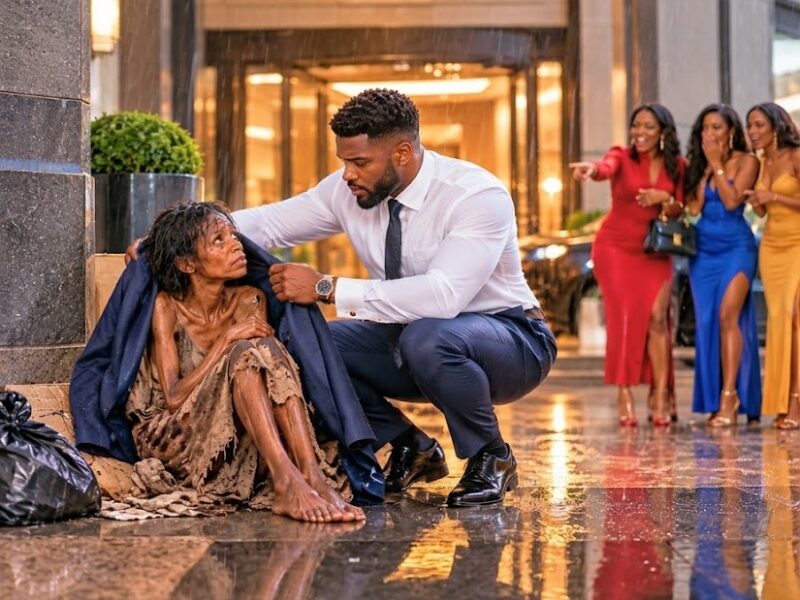
He gave his jacket to a skinny homeless woman in the rain. He had no idea she was a billionaire CEO.
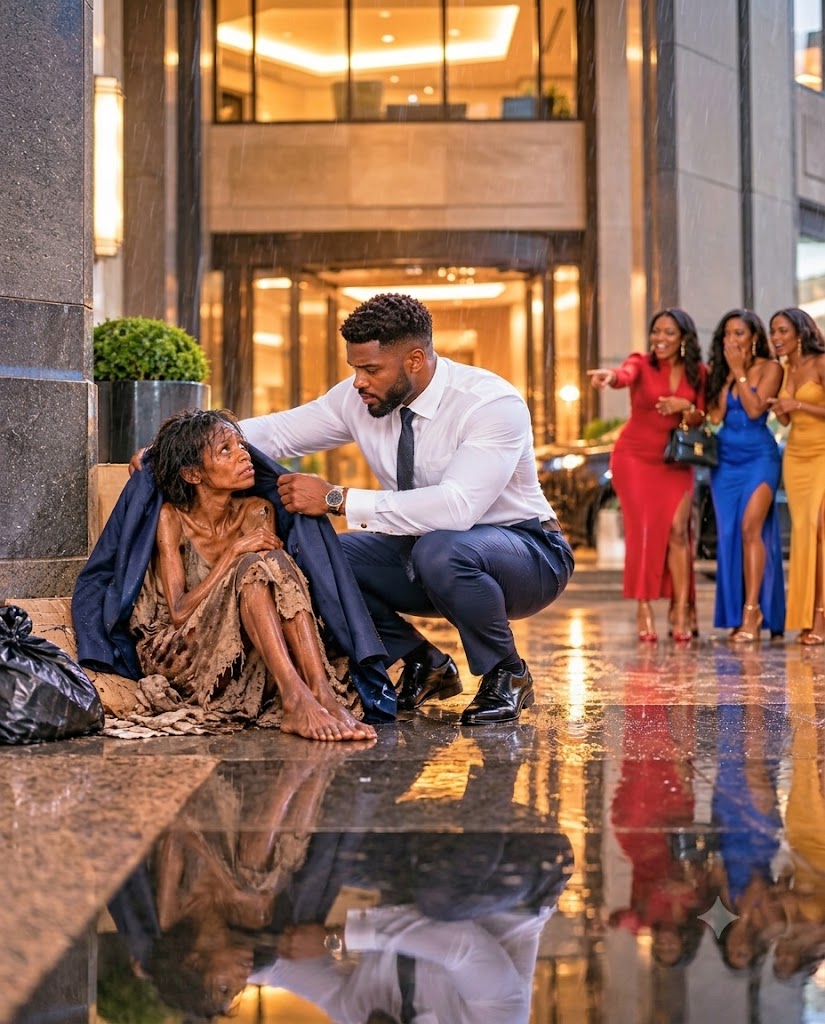
The rain came down in sheets across the city, turning the streets into rivers of reflected neon and broken promises. Tunde Bakare pulled his delivery bike under the awning of a shuttered storefront, checking his phone for the third time in ten minutes. The order was already twenty minutes late, and his customer had sent three messages, each one shorter and angrier than the last.
He was about to pull back onto the road when he saw her. A woman sitting on a bench near the bus stop, her thin frame hunched against the storm. She had no umbrella, no bag, nothing but the clothes on her back. Her lips were blue even from where he stood, and her whole body shook with a violence that had nothing to do with the cold.
Tunde looked at his phone again. Then he looked at the woman. Then he looked at his jacket hanging from the handlebar, a thin windbreaker that had seen better days but was still the only thing standing between him and the rain.
He killed the engine and walked toward her.
“Ma’am, you’re shaking and this rain won’t stop before midnight,” he said, raising his voice over the thunder.
She looked up at him with eyes that were tired but sharp, the kind of eyes that had seen too much and trusted too little. “I’m waiting for the rain to finish. Please just ride on.”
“Ride where, ma’am? It’s nine o’clock and you have no bag.”
“Ride on. Your delivery is getting cold in that big red bag.”
“The food is cold already. Your lips are blue. That’s worse.”
She stared at him, something flickering behind her gaze. “That’s your only jacket. I can see how thin it is. If I take it, you’ll be the one who’s shaking.”
“Then I’ll shake. Twelve minutes to my customer’s apartment is nothing.”
She was quiet for a long moment. Then she said, “Thank you. Nobody has stopped for me since the sun went down.”
Tunde pulled out his phone. “Let me call somebody for you. Your family or the police? Anybody. I have to deliver this food but I’ll come back.”
“Do not come back for me. Go now. Your customer will cancel. Twenty-six minutes late. And now you’re dripping water on my floor.”
He didn’t understand what she meant about the floor, but he didn’t have time to ask. He draped his jacket over her shoulders, and she pulled it tight around herself like it was made of gold instead of cheap nylon. Then he got back on his bike and rode into the storm.
The customer was waiting at the gate, arms crossed, face like a thundercloud. “Twenty-six minutes late,” he said. “And now you’re dripping water on my floor.”
“Sir, the chicken is still warm inside. Please just touch the box.”
“I don’t care. I paid for hot rice, not for excuses. I’m canceling this order and calling your office.”
“Please, sir, don’t cancel. They’ll take it from my pay.”
“Next time, deliver on time or find another job. Take your box.”
Tunde took the box. “I understand, sir. I’ll tell my supervisor exactly what happened tonight.”
“Tell him whatever you like. Close the gate downstairs when you leave.”
The ride back to the depot was a blur of rain and regret. He knew what was waiting for him. Three complaints this month. Tonight the customer had called before he even arrived. The supervisor, a man everyone called Ogre, was already standing at the desk when Tunde walked in, water pooling at his feet.
“Three complaints this month,” Ogre said. “Tonight the customer called me before you did.”
“I was twenty-six minutes late and I can explain every minute.”
“Tell me the bike had a puncture and you keep your job.”
“The bike is fine.”
“Ogre, a woman was freezing. So I stopped.”
The app says you stopped fourteen minutes. Where’s your jacket?”
“Tunde. She has it.”
“Ogre. She had nothing. And the rain was heavy.”
“Tunde. I have eleven riders who would take your bike tomorrow morning.”
“My rent is eighteen thousand naira due Friday. Please just think again.”
“The company doesn’t pay your rent. It pays for hot food.”
“I won’t lie, Ogre. I stopped and I would stop again.”
“Then give me the keys, the helmet, and the red bag tonight.”
“Everything is on the desk.”
“What about my pay for two days?”
“Two days is twelve thousand minus the canceled food. Take six thousand three hundred and go.”
“Thank you. I’ll find the rent somehow without this job.”
He walked out into the rain, jobless, bike-less, and somehow lighter than he had felt in months.
—
The woman was still on the bench when he returned, his jacket wrapped around her like a blanket. She looked up at him with surprise that quickly turned to something else—something that looked almost like guilt.
“I lost my job tonight,” he said. “Ma’am, I have plenty of time now.”
“Because of me. You have no bike and you’re walking now.”
“It was my choice. Nobody forced me and I blame nobody.”
“You don’t know me. Why walk back here in this rain?”
“Because a person shouldn’t sleep on a bench in this rain.”
She was quiet for a moment. Then she said, “Somebody is looking for me. Anyone standing near me will have trouble.”
“I have no job and no bike. What trouble can they bring?”
“I haven’t slept properly in two nights. Is your room far?”
“Machine? One bus, ten minutes walk. One room, one bed, one lock.”
Before he could say anything else, two men appeared at the end of the street. They were dressed in black, their faces half-hidden under umbrellas, and they were scanning the area with the kind of focus that made Tunde’s stomach drop.
“Have you seen this woman?” one of them asked, holding up a phone with a photo on the screen. “Thirty-four years old, thin, she has no bag.”
“I see a hundred women every hour. Which one is she?”
“She’s sick and needs her medicine. Her family is looking everywhere. If I see her, who do I call and who pays me?”
“Call this number. Whoever finds her tonight will be paid very well.”
The men moved on, and Tunde turned to the woman. “Those two work for the man who wants me. Don’t look.”
“They’re ten steps away. If they see your face, what happens?”
“They put me in a van. By Friday, I’m locked away.”
A bus pulled up, its headlights cutting through the rain. “Mushin boss is here. Two seats left. Enter before the driver moves.”
They got on the bus, and Tunde led her to his room—a single room with a single bed and a single lock. “This is it. The bed is yours. I’ll take the floor.”
“You have one bed and you’re giving it to a stranger.”
“My mat is thicker than it looks. The floor isn’t cold.”
“I can’t tell you my name tonight. Please don’t ask again.”
“I haven’t asked. I only need something to call you tomorrow.”
“Call me Madam tonight. Tomorrow I’ll decide whether to trust you.”
“Fair, Madam. I have six thousand three hundred naira. Enough for two days of food.”
“Keep your money. Friday ten o’clock in the morning is all that matters.”
“What happens on Friday at ten?”
“A court, a wedding, a funeral—a meeting. Twelve people vote, and then nothing I own is mine.”
“Then we have until Friday morning. That’s less than four days.”
“Sleep now. Helping me may cost you far more than one job.”
“You’re awake too. I can hear you breathing on the floor.”
“The mat is thin. Madam, every bus on that road wakes me.”
“It’s not the buses. I keep counting the hours until Friday.”
“How many hours is that from now until Friday at ten?”
“Eighty-one hours and forty-five minutes. I calculated it twice on that bench.”
“Then we still have time.”
—
The next morning, Tunde woke to the sound of his landlord pounding on the door. He scrambled to his feet, careful not to wake the woman who was still sleeping in his bed, and opened the door a crack.
“Tunde, I heard two voices in your room. Who’s the visitor?”
“A woman with nowhere to sleep.”
“Sir, she won’t stay long.”
“This house is not a shelter. No visitors sleep in my rooms.”
“Understood, sir. I lost my job last night, but I’ll pay.”
“You have until Friday, six p.m. After that, your things go outside.”
“I have six thousand three hundred naira today. The rest will come by Friday, sir.”
“Six thousand is nothing. Find a new job or a new room.”
“Please keep your voice low, sir. The woman inside needs to rest.”
“Since when do you care about strangers more than your own rent?”
“Since last night, sir. I can’t explain it any better than that.”
“Friday six p.m. Eighteen thousand naira. I’ll be standing at this gate.”
“I’ll be here, sir, with whatever money I have by then.”
The landlord left, and Tunde turned to find the woman sitting up in bed, watching him with an expression he couldn’t quite read.
“You’re out early,” she said. “And where’s your jacket this morning?”
“I gave it to a woman, Mama. Tea and bread, please.”
“Pay me Saturday. A man who gives his jacket away deserves credit.”
They ate breakfast in silence, the weight of the night before hanging between them. Then the radio on the counter crackled to life.
“Kestrel Freight says its chief executive has been missing since Saturday night.”
The woman’s hand froze mid-bite. Tunde looked at her, then at the radio, then back at her.
“My friend of eleven years is unwell and somewhere in this city tonight. If you see her, please bring her to us. Reward five hundred thousand naira.”
Five hundred thousand naira. The number hung in the air like a challenge.
“For that money, I’ll search every gutter in the city,” the woman behind the counter said.
“Look at the photo. She doesn’t sleep in gutters. She’ll go to Palm Grove Clinic where doctors are waiting.”
The woman beside Tunde was shaking. “You’re shaking. Is it the tea or is something wrong?”
“The board meets Friday at ten to decide who protects her company. Something is wrong, Mama, but not here. Please just pack the tea.”
“Two men in black shirts asked about her at seven this morning. What did you tell them?”
“Mama, please. I need to know exactly.”
“I told them I sell tea, not news. They left a flyer.”
“Thank you, Mama. I’ll explain everything Saturday when I pay you.”
She handed him a flyer, and Tunde read it as they walked. The photo on the front was of the woman beside him, though she looked different—polished, powerful, the kind of person who commanded boardrooms and made decisions that affected thousands of lives.
“Five hundred thousand naira for anybody who finds this woman,” he read aloud. “What did she steal from your Ogre?”
“She stole nothing. She’s sick and her family wants her home.”
“Sick people don’t wear suits like that. She looks very rich.”
“Rich or poor. If she’s in this neighborhood, we’ll find her. We’re asking at every kiosk and every mechanic until Friday morning.”
Back in the room, Tunde spread the flyer on the table. “You were gone two hours. I thought the men had taken you.”
“I was at the kiosk. I have tea, bread, and this paper.”
“That’s from our annual report. They printed hundreds of these overnight.”
“I saw you on television at the kiosk. The man was crying.”
“Then you’ve seen Bio. I trusted that man for eleven years.”
“Who are you, Madam? You’re not sick and not a beggar.”
“I am a Nkosu. I run Kestrel Freight and Bio runs finance.”
“Kestrel Freight. The green trucks on the interstate. Two thousand people work there.”
“Two thousand three hundred people. And on Friday, Bio takes all of it from me.”
“Five hundred thousand naira is twenty-seven months of my rent. I counted it already.”
“Call that number. Take the money, pay your rent, and forget me.”
“You said no police, no hospital. Sick people don’t say that.”
“If you stay near me, you may lose your room and more.”
“I’ve already lost my job. My room is only a room.”
“Why? Nobody in this city refuses that much money for a total stranger.”
“I gave you a jacket. I won’t sell you this morning. Seventy-one hours and twenty minutes left.”
“Who can stop this vote?”
“My lawyer, Barrister Ibe in the city. He drew up my father’s will.”
“Then call him. Use my phone and tell him you’re safe.”
“I know no numbers by heart. My phone is in Bio’s drawer.”
“Then we go there. The city is far and my money is short.”
“I’ll repay every naira. I promise it on my father’s grave.”
“Keep the promise for Friday, Madam. Today I’m selling my phone.”
—
The phone buyer was a thin man with quick eyes and quicker hands. He examined the phone like it was a piece of meat at the market, turning it over and over, pressing buttons, checking the screen.
“Show me the phone. I have forty buyers waiting, so be quick.”
“It’s a three-year-old phone, sir. I want fifty thousand naira for it.”
“Fifty thousand for a cracked screen? Thirty thousand naira and that’s very generous.”
“The battery is also weak, sir. It shuts down at forty percent.”
“You’re the first seller who ever told me a fault. Why?”
“You’ll find it in ten minutes. I’d rather be honest.”
“Honest people are poor in this market. Take thirty-eight thousand naira final price. You could easily have hidden the battery and earned twelve thousand more naira.”
“Twelve thousand naira isn’t worth being a liar in front of you. Do you want the thirty-eight thousand or not? People are waiting behind you.”
“Yes, sir. Count it slowly because I can’t afford a mistake today.”
“Thirty-eight thousand all in five hundred notes. Count it yourself and go well, brother.”
With the money in his pocket, Tunde led the woman—Amaka, he reminded himself, her name was Amaka—to the lawyer’s office. The building was tall and glass-fronted, the kind of place that made you check your shoes before walking in.
“Good afternoon. Do you have an appointment? Barrister Ibe is unavailable today.”
“My name is Amaka Nkosu. Tell him I’m in the lobby.”
“Miss Nkosu. Please excuse me. We were told you were away. Unwell.”
“I am Tunde Bakare, a friend of Miss Nkosu. Please call him.”
“He’s in a meeting. Please sit while I call Mr. Adeleke.”
“Please call Barrister Ibe directly. Please don’t call Mr. Adeleke first.”
“Madam, I follow firm rules. Both of you, please sit over there.”
Amaka leaned close to Tunde. “Something’s wrong. She dialed before you finished and she looked away.”
“Then we don’t wait. His office is on the third floor.”
“Then lead, Madam. I’ll walk one step behind like your driver.”
The lawyer’s office was chaos—papers everywhere, books stacked to the ceiling, a coffee cup that had been refilled so many times the stains had become part of the ceramic. Barrister Ibe was a small man with a large voice and eyes that missed nothing.
“In sixty-eight hours, the board votes to give your shares away.”
“Amaka, on what proof? I’ve signed nothing to give my shares away.”
“A pledge carrying your name dated last Thursday at three fifteen in your boardroom.”
“It looks like mine, only. Nita Bio watched me sign for years.”
“Where were you Thursday at three fifteen? Tell me someone who saw you.”
“At the port with forty of my drivers. Ask any one of them.”
“Those drivers now report to Bio. The board won’t believe them.”
“Then what will they believe? Tell me what beats a notarized signature.”
“Only a camera beats a signature. Your boardroom has one high up.”
“Then write to Kestrel and ask for that Thursday’s footage today.”
“Any letter to Kestrel lands on Bio’s desk. He would erase it.”
“Then I walk into that boardroom Friday and tell the board myself.”
“Two nurses from Palm Grove Clinic will wait in your lobby Friday morning.”
“Nurses? Why would a clinic I’ve never visited send nurses?”
“Because your uncle Godwin Nkosu signed a letter saying you are unfit.”
“Uncle Godwin? He carried my father’s coffin. He wouldn’t sign that.”
“Bio phoned our managing partner yesterday. The receptionist has already called him.”
“Then Bio knows I’m here. How long do we have, Chidi?”
“His men come within the hour. My phone rings on his desk.”
“Sir, why are you helping us when your own boss won’t?”
“Because I sat at her father’s bedside and I wrote his will.”
“Chidi, if Adele learns you helped me, you lose your practicing license.”
“Adele told me to stay away or lose it. Officially, I did.”
“What can she do, sir? The camera sits inside Bio’s own building. Find someone in Kestrel security who watches the cameras and fears nobody.”
“The gray-haired security man behind Bio on television never looked up once.”
—
The black SUV was at the corner when they left the lawyer’s office. Two men watched the gate, their eyes hidden behind dark glasses despite the rain.
“They came fast. Chidi was right. The receptionist called them at once.”
“Wait there at the gas station. We walk slowly like two workers.”
“One man is leaving the car and he’s looking at us.”
“Do not run. Walk to the bike and keep your head down.”
A motorcycle taxi—an okada—was waiting at the corner. Tunde grabbed Amaka’s arm and pulled her toward it.
“Where to?”
“That man is running toward you. Get on quickly.”
“Mushin, please. Ride fast and take the back roads. Not the main road.”
“Five thousand naira for Mushin by back roads.”
“Cash before we move here. Take it.”
“Madam, hold my shoulders and don’t look behind.”
“Tunde, that man has stopped walking. He’s talking into a phone.”
“Hold tight, both of you. I know a lane behind Obalende Market.”
“Madam, we’re clear for now. Tomorrow we find the security man.”
—
Back in the room, Amaka spread the annual report on the table. She had been staring at the first page for five minutes, her brow furrowed, her lips moving silently as she read.
“You’ve been staring at that first page for five minutes. Madam, I’m reading. I haven’t read a company paper in years.”
“Yes. You run a company and you didn’t read its papers.”
“Bio brought forty pages every Thursday. I signed under the yellow tabs.”
“Show me the numbers. What did Kestrel borrow and when is payment?”
“Six point four billion naira from Crestmark Finance due this Friday at exactly twelve noon.”
“Two hours after the board votes. That can’t be an accident.”
“No. If Kestrel can’t pay, Crestmark takes my shares and forty-one trucks.”
“So Bio needs the board to sell your shares before Friday noon.”
“Yes, he needs me on my feet, missing or silent until twelve on Friday.”
“Then we make you loud before Friday. Who else signed this paper?”
“Bio signed as borrower. Then he signed a second time as witness.”
“On paper, he stood beside you. But you were at the port.”
“Then the camera watched him do it. I need that camera.”
“The loans were in dollars and the naira fell every week. Six point four billion naira. I lost it in eleven weeks betting on the dollar.”
“Then Crestmark lent me six point four billion to cover the hole until Friday noon. They wanted her shares as security and she would never have signed.”
“She never read a page. Eleven years and she never read one.”
“I meant to put every naira back within six months. I swear.”
“Ogre Danladi still refuses to sign the wipe order for the boardroom. The server deletes last Thursday’s clip by itself Thursday at three fifteen.”
“Three fifteen is too late. Crestmark visits Thursday at one and asks questions.”
“Understood. About the rider—Fei wants a proper police letter first.”
“Who is the old woman in the photograph above your stove?”
“My mother sells pepper in Bodhija market, Ibadan six days a week.”
“Does she know you lost your job and sold your phone today?”
“She can’t know. My phone was her only way to reach me. Then she’ll call and nobody will answer.”
“Tunde, I’m sorry.”
“I’ll borrow Sadi’s phone in the morning and call her myself.”
“He began Kestrel with two trucks. He told me read every page.”
“Then you read this one tonight. That’s a good start.”
“I didn’t read them for years. Bio is right about that.”
“Right about that. Yes. He’s wrong about everything else he did.”
“Fifty-seven hours, Tunde. My hands shake when I think about that boardroom.”
“Then you won’t walk in alone. I’ll be beside you.”
“You can’t promise that. The nurses will stop anyone standing near me.”
“Then I promise less. Tomorrow I find the man behind the cameras.”
—
The next morning, Tunde found Sadi at the depot, checking his bike before the first delivery run.
“Tunde! Fei says you were fired. Where are your jacket and phone?”
“Fired? Yes. The jacket is with a woman. The phone is sold.”
“A man named Kasali asked every rider about Monday night road. Any rider who stopped near Forday on Monday night gets five hundred thousand naira.”
“Did Fei give him the GPS records from the depot app?”
“Sadi, not yet. Femi says the records need a proper police letter first.”
“Then I have until that letter arrives. Sadi, who knows Kestrel Tower?”
“Every rider does. We deliver there daily.”
“Everybody knows the security head Baba Danladi. Fifty-two years old. He buys suya every Friday. Would he ever refuse Bio? Tell me the truth about him.”
“Gray hair, always looking down. I saw him on television behind Bio. Last year he refused Bio’s order to sack drivers. Bio backed down.”
“Thank you, Sadi. Please tell Kasali nothing about me before Friday, brother.”
—
Kestrel Tower loomed over the city like a monument to ambition and betrayal. Tunde stood at the gate, his heart pounding, his palms sweating despite the cool morning air.
“Stop there. Rider, Kestrel doesn’t take parcels at this gate today.”
“I have no parcel, sir. I need to see Baba Danladi, please.”
“From Oga Bio or the board? Nineteen cameras are watching you already.”
“Nineteen? I only count six from here. Where are the others, sir?”
“Why do you care about our cameras? Who exactly sent you, rider?”
“Nobody sent me, sir. I came alone and I’ll wait here.”
“Wait across the road then. This gate is not a bus stop.”
“Thank you, sir. Is Baba Danladi inside now or is he home?”
“He’s inside. He comes out at ten fifty for tea every day.”
“Then I’ll wait under that tree until ten fifty. Thank you, sir.”
“Make trouble and that man in the black jacket will handle you.”
“I’ll make no trouble, sir. I only need one man’s time.”
—
Baba Danladi appeared at exactly ten fifty, a cup of tea in his weathered hands, his gray hair catching the morning light. He walked to the tree where Tunde waited, his eyes scanning the area with the practiced caution of a man who had spent decades watching.
“You waited thirty minutes, young man. What do you want from me?”
“Tunde Bakare. A lie is easier, but you deserve the truth, Baba.”
“The truth about what? Speak low. That man in black is watching.”
“Monday night in the rain, I gave my jacket to Amaka.”
“Amaka? Where did you see her? And where is she now?”
“She was on a bench in Yaba. Now she’s in Mushin.”
“Come into the guard room now. Don’t look at that man.”
Inside the guard room, Baba Danladi closed the door and turned to face Tunde. “This rider asked about our cameras. I told him nothing. Good. Write him in the book. Tunde Bakare, ten fifty to see me.”
“Baba, I have no parcel, no letter, and no proof of anything.”
“Then we find proof together inside before that man walks over here.”
“Yes, Baba. Please believe me because she has only forty-seven hours left.”
“Sit down. You stay here until two thirty while I check your story.”
“Baba, three hours is long. She’s alone in my locked room. Ask me anything, Baba. I’ll answer every question with the truth.”
“Three hours won’t hurt her. One wrong step with you could.”
“Chief Nkosu hired me. What did he tell his daughter about papers?”
“She said he began with two trucks. He said, ‘Read every page.'”
“Then you believe me, Baba? Please help me before Friday ten.”
“I believe you know her. I must see if she’s well.”
“Bio says she’s sick. She’s thin, but she thinks clearly.”
“Saturday, eight forty p.m. I watched two guards chase her up the ramp.”
“Then you knew, Baba. Why did you say nothing since Saturday night?”
“Bio said she was sick and the guard obeys until proof appears.”
“Then let her be the proof. Ask her anything you like, Baba.”
“We will be there at eight. Baba, I’ll bring her myself.”
“Nineteen cameras. Bio texted me to wipe the boardroom server. I refused.”
“Only Bio’s IT man has the password. My login only shows screens.”
“Refused. Then why can’t you copy the boardroom video yourself, Baba?”
“So, how long does the main server keep the boardroom video, Baba?”
“Seven days. Last Thursday’s video is erased this Thursday at three fifteen p.m.”
“Tomorrow afternoon. Then we have only one day, Baba, and no password.”
“There is a second recorder. Only Mr. Okon and I remember it.”
“What does it record, Baba? And how long does it keep video?”
“The boardroom and the lift. Poor quality. It keeps thirty days untouched.”
“Then open the door now. Baba, we can take that video today.”
“The reader reports to Bio’s man. Only Mr. Okon’s brass key works.”
“Then we fetch Mr. Okon’s key. Where is he today, Baba? Please.”
—
That evening, Tunde brought Amaka to meet Baba Danladi at the bus stop near Kestrel Tower. The old security man studied her face for a long moment, his eyes searching for something he had seen before.
“Danladi believes me. He wants to see your face tonight at eight. Then he will know your face. Pull the head tie lower.”
“Madam, what if Bio’s men are watching this bus stop right now?”
“Then act like strangers. Talk low and never turn your head around.”
“Tunde. If Danladi refuses tonight, what do we do about Thursday afternoon?”
“A forgotten recorder sits downstairs. We open it Thursday at six a.m.”
“Six a.m. to three fifteen p.m. is nine hours and fifteen minutes.”
“Enough. If the door opens, here comes the bus. One step apart.”
“One step apart. If they take me tonight, you did enough. Tunde.”
“Step into the light. Madam, I must see your face before anything.”
“Baba Danladi, it’s me. Ask me anything, I’ll answer everything.”
“Your father’s dog at the old gate. What was its name?”
“Kesh, the brown dog. You fed him suya. And my father laughed.”
“It is you. Forgive me, Madam. I watched them chase you Saturday.”
“You couldn’t have known, Baba. Bio told everyone I was sick.”
“I will open the basement recorder Thursday six a.m. with Okon’s key.”
“Baba, if Bio fires you before then, the door stays closed forever.”
“My car is across the road. I watch until you’re gone.”
—
But before they could leave, a van pulled up, its headlights cutting through the darkness. Four men in black shirts stepped out, followed by a nurse in white scrubs and two police officers.
“Miss Nkosu, Palm Grove Clinic sent us tonight. Your uncle signed the letter.”
“I will not go. You have no right and you know it.”
“The letter is signed and stamped. Police officers wait at the gate.”
“Sir, this woman has done nothing wrong. Show me that letter, please.”
“You are the writer who took her. Be quiet or face jail.”
“Madam, come with me. There is a bed, food, and a doctor.”
“Tunde, don’t fight them. Stay alive and stay free until Friday.”
“I will find you, Madam. It doesn’t matter how many men.”
“Put her in the van. Leave the rider. Ogre wants him watched.”
—
Tunde watched helplessly as they drove away, his fists clenched, his heart pounding. Baba Danladi appeared beside him, his face grim.
“I saw everything from my car. Four men, a nurse, two policemen.”
“You could do nothing against four men and police.”
“Baba, I understand. I don’t judge it. Where exactly is Palm Grove Clinic, please?”
“Leki off Admiral Way. Kestrel sends staff there. Bio signs their bills.”
“Thank you, Baba. I’ll follow that van tonight. Even on foot.”
“Do not go in front. Bio pays their guards same as ours.”
“I am a delivery rider. Baba, I know every clinic’s kitchen door.”
—
Sadi was eating when Tunde burst into his room, soaking wet and out of breath.
“Tunde, you look like you ran from Surulere. Sit down. Eat something.”
“No time. I need your bike tonight. I’ll return it tomorrow.”
“Tell me it’s your mother, Tunde, and the keys are yours.”
“It’s not my mother. It’s the woman from Monday night.”
“Kasali’s woman. Five hundred thousand naira day. And you want my bike for her?”
“Bio’s men took her to Palm Grove Clinic. She’s not sick.”
“Sadi. Then why do I not call Kasali and collect five hundred thousand for you?”
“You could and I would understand. But she has nobody else.”
“Sadi, Fei told me you refused to lie even to keep your job.”
“Yes. And I lost the job. I would choose the truth again.”
“Take the keys, have a tank, bring my bike back and yourself.”
“Sadi, if Kasali asks about me, tell him the truth after Friday.”
“After Friday, I tell him nothing. Go before I change my mind.”
“Thank you, brother. Palm Grove is in Leki. Pray that I find her.”
—
Palm Grove Clinic was a gleaming building behind high walls, its entrance guarded by men who looked like they had never smiled in their lives. Tunde parked Sadi’s bike behind a dumpster and approached the gate.
“No visitors after eight. Go away, rider. This gate is closed.”
“I came to see Amaka Nkosu. Brought here tonight. Only five minutes.”
“No patient with that name. Even if she was here, family only.”
“Her uncle signed. But he’s no doctor. Who examined her?”
“Go home, rider.”
But a nurse appeared at the gate, her face tired but kind. “You are the young man from the car park.”
“Madam, she’s not sick. She counts the hours until a vote.”
“That is not for me to judge. Her family and doctor decided.”
“Which doctor? Madam, please ask yourself that question tonight. Give her this.”
“I promise nothing, rider. Now go before the guards call the police.”
“I will be back before the morning. Madam, I will not stop.”
—
Inside the clinic, Amaka sat on a bed in a private room, her thin frame swallowed by the hospital gown. The door opened, and Bio walked in, his face a mask of false concern.
“Amaka, you are thin and dirty. Thank God Kasali found you tonight.”
“Thank God you told the whole country that I was sick. Bio.”
“I said what kept you safe. Sit, listen, and I will explain.”
“Explain the pledge. Explain my signature in a room I never entered.”
“Sign the transfer tonight. Three hundred million naira and a flight at six.”
“You forged my name. I will not sign anything else for you.”
“That is true and my fault. It does not make you innocent. Eleven years. Amaka, you never read a single page I gave you.”
“Nobody calls me innocent. I only need Friday to pass quietly.”
“Amaka, Friday will not pass quietly. I promise you that on my father, not this jacket. A rider gave it to me in the rain.”
“Your rider will lose more than a jacket, Amaka. Think about that.”
—
The nurse, Mrs. Ajay, stood outside the door, her hand hovering over the lock. She had been a nurse for twenty-two years, and in all that time, she had never signed anything she hadn’t read. The admission file for Amaka Nkosu was thin—suspiciously thin—and the doctor’s signature was from a physician who had left the clinic two years ago.
She opened the door.
“Madam, are you hurt? Did they give you injections or tablets? Anything?”
“Nothing. Mrs. Ajay refused Kasali’s order to sedate me and gave water.”
“Use the service road behind the clinic. Avoid Admiral Way before seven.”
“Mrs. Ajay, they will ask who opened it. What will you say?”
“The truth. I opened it because the paper had no doctor’s signature.”
“Mrs. Ajay, come to Kestrel’s boardroom Friday ten. Bring that certificate.”
“I will bring the original certificate and the whole admission file myself.”
“Get on, Madam. It is five forty. Danladi opens the basement at six.”
“Right now, Tunde. I will open the jacket and cover us both.”
—
The basement of Kestrel Tower was cold and dark, the kind of place that had been forgotten by everyone except the spiders and the dust. Baba Danladi led them through the maze of corridors, his flashlight cutting through the darkness.
“You called my wife twice last night. What is this about?”
“Amaka is alive and Bio forged her name. I need store four.”
“Chief Nkosu built my house. Take the brass key. I saw nothing.”
“Thank you, Mr. Okon. Go and rest. You have already done enough.”
“Baba, the green light is on. It has been recording for years. Nobody remembered it, so nobody switched it off. And Bio never knew.”
“Find last Thursday’s boardroom video, Baba. Three fifteen p.m. is what matters most.”
“Found it. This old machine copies at one quarter of normal speed.”
“Then how long will it take to copy the whole afternoon?”
“Baba, one hour and twenty-five minutes of video takes five hours and forty minutes. Six a.m. plus five hours forty is eleven forty. Well before three fifteen p.m.”
“Then press start. Baba, we wait and we watch that corridor door.”
—
At nine fifteen, the recorder had copied fifty-seven percent when Baba Danladi’s phone buzzed. He read the message, his face hardening.
“Dismissal effective today at twelve noon. Return your card, keys, and radio.”
“Twenty-eight years you served my family. Baba, I will answer for this.”
“Answer Friday. The copy finishes at eleven forty. My card dies at noon. Quiet. Do not move. Somebody is standing right outside the steel door.”
“Door four. Nobody has used this room since 2019. Try the handle.”
“Locked. Old brass lock. Nothing matters in there. Server room is next.”
“Wipe at twelve thirty after the new head signs. Crestmark arrives at one. Twelve thirty is too late for them.”
“Our copy finishes at eleven forty exactly. Eleven forty-one. The copy is finished. Saving it to two flash drives now.”
“Play it first, Baba. I must see it before I trust it.”
—
The video was grainy, the audio scratchy, but the image was unmistakable. Thursday at three fifteen and seven seconds. The boardroom was empty. Then the door opened, and Bio walked in, alone. He locked the door behind himself and sat at the table, a stack of papers in front of him.
“Count the sheets on the table, Tunde. Count them slowly and aloud.”
“Fourteen sheets. He’s writing her name on every single one.”
“Madam, by the fourteenth sheet, he is fast. The name looks like yours.”
“Look at the first sheet. The letters are crooked and too slow.”
“He practiced my name fourteen times. Then he signed away my shares.”
—
Bio was waiting in the corridor when Tunde emerged from the basement, the flash drives hidden in his sock. The CEO’s eyes were cold, calculating, the eyes of a man who had spent his life buying and selling people.
“Nineteen cameras and one has been broken since March. The service lift, the rider from the car park, from the tower gate. Yes, sir. I am Tunde Bakare. I am not hiding from you.”
“Kasali says you have been in my building since six this morning.”
“Yes, sir. Since six.”
“I will not say why or where.”
“Then listen and do not answer yet. Twenty million naira in cash today.”
“Twenty million naira is more than I will earn in my whole life.”
“Take it Friday. Say one sentence to the board and go home.”
“Which sentence, sir? Say it exactly so I know what you buy.”
“‘She was confused and dangerous when I found her.’ That is the line.”
“She was cold, thin, and very polite.”
“Twenty million naira and the kidnapping complaint disappears tonight. One sentence, Tunde. Think.”
“I gave her a jacket, sir. I will not sell her ever.”
“Then you choose a cell. Tunde. Nobody will call that choice brave.”
“I choose it, sir. On Friday, I will still tell the truth.”
—
The police station was cold and fluorescent, the kind of place that smelled of disinfectant and despair. Tunde sat in a holding cell, his hands cuffed, his mind racing. Inspector Fei had been kind enough—kind enough to listen, kind enough not to laugh.
“Bakare, I will not tell you where she is.”
“Inspector, that is honest. Ogre wanted you watched tonight. He wants you in a police cell.”
“Tell Sadi his bike is behind the hut. Please tell him tomorrow.”
“Walk. Bakare, handcuffs go on now. Say nothing more until the station.”
“I know my rights. I asked to phone Barrister Ibe in the city.”
—
But Barrister Ibe was already working. By seven fifty-two the next morning, a judge had suspended Palm Grove’s letter. By eight, bail had been paid. And by ten, Tunde and Amaka were walking into the Kestrel boardroom, the flash drives in Tunde’s pocket, the truth in his heart.
“We’re here. Take seats.”
“Thank you.”
“Six point four billion naira left Kestrel. Four point three billion can be recovered. Two point one billion is gone forever.”
“I was hunted. Mrs. Okafor, not unwell. Mr. Ibe has the order.”
“No doctor examined her. It is signed. Dr. Uch, gone two years.”
“Yes. At six with Mr. Danladi. I will not pretend otherwise.”
“Only a borrowed head tie.”
“Madam Chair, that is everything I offered.”
“Madam Chair, this drive holds boardroom video from last Thursday, three fifteen p.m. I copied it myself from the recorder. Nobody edited even one frame.”
“That is true, Bio. I have read all of them since Tuesday.”
“I gave her my jacket, Madam Chair. That is all I did.”
—
The board voted. The shares remained with Amaka. Bio was escorted out by security, his face a mask of rage and disbelief. The police were waiting for him, the kidnapping complaint already filed.
Outside, the rain had stopped. Tunde stood by the door of Amaka’s car, his hands in his pockets, his heart full.
“Here’s the rent. All right, go in. Thank you.”
“Keep it. Two policemen search your room last night. No trouble here.”
“You are shaking, Tunde. And this rain will not stop before midnight.”
“I kept my word and lost my room. A fair trade, brother.”
“Tunde.”
“Yes.”
“I am waiting for the rain to finish. Please just drive on.”
“My company can wait. Your lips are blue and that is worse. I cannot pay you. You would refuse. So I brought your jacket. It is yours. Wear it. Somebody should keep you warm now.”
He took the jacket—the same thin windbreaker he had given her that first night—and pulled it on. It smelled of rain and hope and the kind of kindness that didn’t ask for anything in return.
“Sunday,” she said.
“What?”
“My name. It’s Sunday. Amaka Sunday.”
“Tunde,” he said. “Tunde Bakare.”
“I know,” she said. “I’ve known since the moment you gave me your jacket.”
And as the sun broke through the clouds, painting the wet streets in gold and silver, they stood together, two strangers who had become something more, bound by a jacket and a promise and the simple truth that sometimes, the smallest acts of kindness are the ones that change everything.
—
**THE END**









