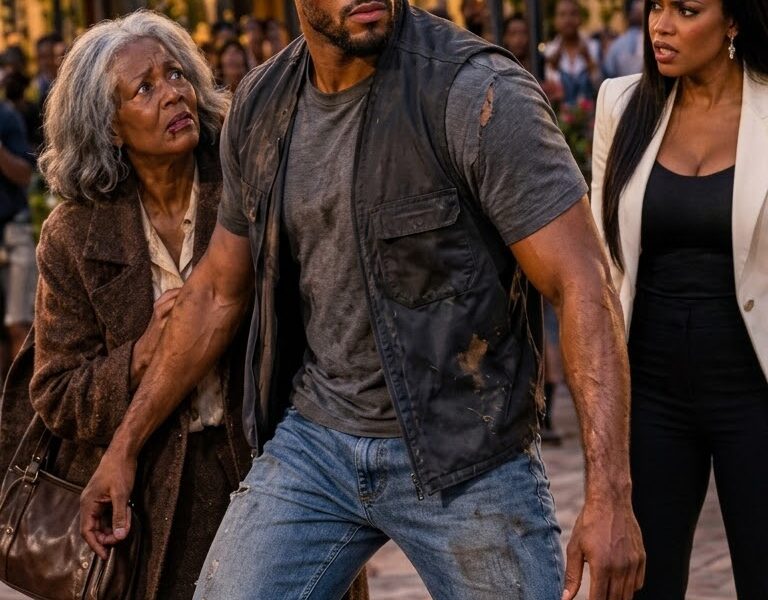
He Defended an Elderly Woman Everyone Humiliated—Unaware She Was the Billionaire Who Owned Everything
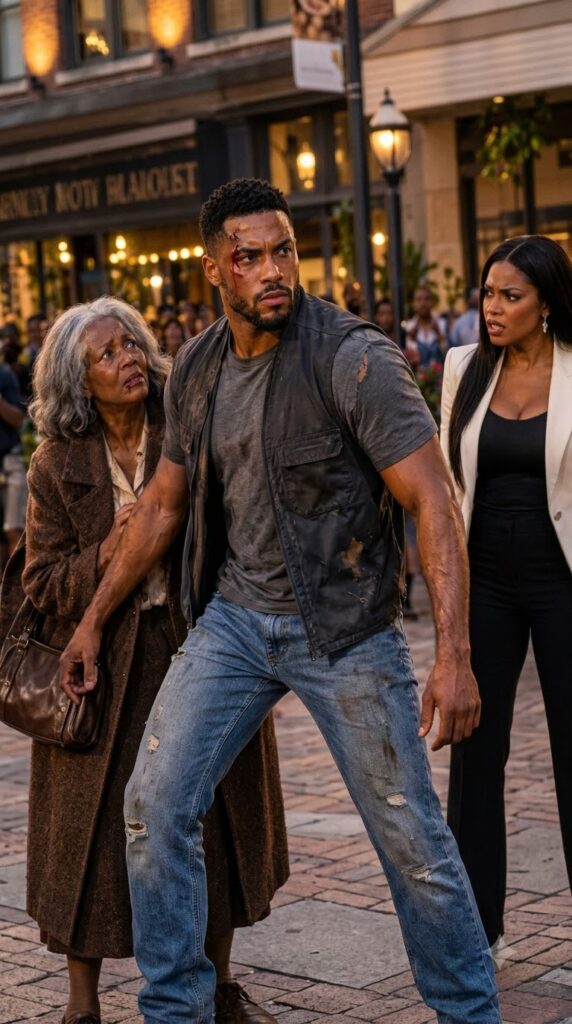
The rain had just stopped, leaving Beverly Row Market glistening under the amber streetlights like a street paved with broken glass.
Ethan Parker was twenty-six years old, wearing a denim jacket that had seen better days and carrying a bouquet of white roses he’d managed to salvage from his delivery route.
He was tired, hungry, and three hundred dollars behind on rent.
But none of that mattered when he heard the screaming.
“You filthy thing! Do you have any idea what that scarf cost?”
Ethan rounded the corner of the stone plaza and froze.
An elderly woman in a tattered gray coat was crouched on the wet ground, her hands trembling as she tried to gather what looked like scattered scraps of food.
Above her stood a woman in a cream cashmere coat, her face twisted with disgust.
“Four hundred dollars,” the woman spat. “That scarf was four hundred dollars, you worthless beggar.”
“I’m sorry,” the old woman whispered. “It was an accident. I only wanted somewhere to sit. I haven’t eaten since yesterday.”
“Then go sit in a shelter. This isn’t a charity, Grandma.”
Ethan’s jaw tightened.
He watched as a small crowd began to gather, their phones raised like weapons, recording every humiliating second.
Nobody moved to help.
Nobody said a word.
The old woman tried to stand, her knees buckling beneath her.
“Please,” she said. “I’ll leave. I only need a little help.”
“Help?” The woman laughed, cold and sharp. “Hear that, everyone? She wants help.”
A man beside her—tall, broad-shouldered, wearing a smirk that made Ethan’s blood boil—stepped forward.
“Do it again,” he said. “This is perfect.”
“Stop,” the old woman pleaded. “I’m an old woman.”
“Then you should know better.”
The man shoved her.
She fell hard, her head striking the edge of a stone bench with a sound that made Ethan’s stomach lurch.
Blood began to pool beneath her gray hair.
“Look at her bleeding,” someone shouted. “Somebody get a bucket.”
“Hit her again!”
“Please.” The old woman’s voice was barely a whisper. “Please. Somebody.”
Ethan didn’t remember deciding to move.
He only remembered the feeling of his fist connecting with the man’s jaw, the shock in the crowd’s eyes, and the way the woman in cashmere screamed as he stood between them and the bleeding grandmother on the ground.
“Get off her,” he growled.
The man swung back, but Ethan was faster, driven by something primal—something that had been building since the moment he’d heard the first cruel word.
The fight was brief and brutal.
Ethan took a punch to the ribs, another to the cheek, but he gave as good as he got, and eventually the man stumbled back, cursing.
“Anyone else?” Ethan said, breathing hard.
The crowd was silent.
The woman in cashmere grabbed her companion’s arm. “You’re pathetic,” she hissed at Ethan. “You can barely afford the shirt you’re wearing. Look at you bleeding for a beggar.”
Ethan wiped blood from his lip.
“Maybe I don’t have much money,” he said. “But I know how to treat people.”
He knelt beside the old woman, who was trembling violently, her eyes wide with shock.
“Ma’am, can you hear me?”
She blinked up at him, tears mixing with the blood on her face.
“Why did you do that?” she whispered.
Ethan frowned. “Because everybody else was enjoying watching you suffer.”
She stared at him for a long moment, something unreadable flickering in her eyes.
Then she smiled—a small, fragile thing—and let him help her to her feet.
He took her to a small diner around the corner, the kind of place with cracked vinyl booths and a neon sign that flickered every few seconds.
He ordered her soup and a sandwich, watching as she ate slowly, her hands still shaking.
“You didn’t even know me,” she said between bites.
“I didn’t need to.”
She set down her spoon. “Do you have somewhere to go?”
“No.”
“Then you’re coming with me.”
She lived in a small apartment on the east side of the city, a place that smelled like lavender and old books.
Ethan learned that her name was Margaret, that she had no family nearby, and that she spent her days volunteering at a local shelter.
He told her about his life—how he delivered flowers during the day and worked at a warehouse at night, how he was developing a small tech idea that he stayed up until two in the morning perfecting.
He didn’t expect anything in return.
He just wanted to make sure she was safe.
The next morning, Ethan woke to the smell of pancakes and the sound of a woman’s voice he didn’t recognize.
He stumbled into the kitchen to find Margaret standing by the stove, her bruises still visible but her posture straight and commanding.
Beside her stood a woman in a tailored navy suit, her dark hair pulled back, her eyes sharp and assessing.
“Ethan,” Margaret said, “this is my daughter, Victoria.”
Victoria’s gaze swept over him—his wrinkled shirt, his bandaged knuckles, the dark circles under his eyes.
“Mother,” she said coolly, “you disappeared for two days. Do you know what the board said?”
Then her eyes landed on Ethan.
“And who is this?”
“This is Ethan Parker. He saved my life.”
Victoria’s expression didn’t change. “He saved your life. He fought off four people who were beating me.”
“Mother, you should have called security, not someone off the street.”
Ethan cleared his throat. “Don’t worry. I don’t belong here either.”
Victoria’s eyes narrowed. “Excuse me?”
“You heard me.”
“Victoria,” Margaret said firmly, “don’t judge him.”
“I’m not judging. I’m being realistic. He’s not suitable for our world.”
Ethan laughed—a short, humorless sound. “And what exactly makes someone suitable?”
Victoria opened her mouth to respond, but Margaret cut her off.
“I read your business plan,” she said, looking at Ethan. “It’s good. I want you to present it to Whitmore Global.”
Ethan’s heart stopped. “You read my plan?”
“Twice. Victoria will work with you.”
“Mother, no.”
“Yes.”
The weeks that followed were a battlefield.
Victoria was brilliant, demanding, and utterly convinced that Ethan was a fraud.
“These projections are unrealistic,” she said during their first meeting, tossing his report onto the conference table.
“They’re based on current market data.”
“Fisky.”
“Your strategy is too risky.”
“High risk yields higher returns.”
She leaned forward, her eyes blazing. “You don’t have to prove anything to me.”
Ethan met her gaze without flinching. “Good. I wasn’t planning to.”
“You’re infuriating.”
“You’re welcome.”
But slowly, something shifted.
She noticed him staying late to help an assistant who was struggling with a spreadsheet.
She watched him refuse a shortcut that would have ruined a competitor.
She saw him call his mother every night, his voice soft and patient.
And one evening, when the office was empty and the city lights painted the windows in gold, she heard herself say:
“Have dinner with me.”
Ethan looked up from his laptop, surprised. “I thought you didn’t like me.”
“I didn’t like your situation.”
“That’s somehow worse.”
She laughed—a real laugh, the first he’d ever heard from her—and something inside him cracked open.
Dinner lasted four hours.
They talked about childhood, dreams, and fear.
She told him how lonely it was to be a Whitmore, how every relationship felt like a transaction, how she’d learned to build walls so high that even she couldn’t climb them anymore.
He told her how hard it was to be poor, how he’d watched his mother work three jobs and still barely keep the lights on, how he’d promised himself he would build something that mattered.
Outside the restaurant, beneath the glittering city sky, Victoria stopped.
“I judged you before I knew you.”
“You did.”
“Are you going to make me apologize all night?”
“Maybe.”
She kissed him.
It was soft at first, tentative—then fierce, desperate, like she was trying to pour years of loneliness into a single moment.
When they pulled apart, she whispered, “That was a mistake.”
“Then why are you smiling?”
Over the next weeks, the romance bloomed.
She rested her head on his shoulder in the car.
He surprised her with a simple picnic on a hilltop instead of another fancy restaurant.
They danced in her living room barefoot, no music, just the sound of their breathing.
One rainy night, they curled up together on her couch under a blanket.
“Ethan, tell me to stop.”
“Don’t you dare.”
The rest of that night belonged only to them.
Victoria’s wealthy friends found out soon enough.
One of them leaned in with champagne, her smile sharp as a blade. “Who could have anyone in Los Angeles? Why him?”
Victoria didn’t hesitate. “Because he sees me when everyone else sees my last name.”
Meanwhile, Ethan’s business grew rapidly.
Margaret offered help, but he refused.
“I want to earn it,” he said.
Months later, they landed a huge contract—a deal that would put his startup on the map and silence every doubter who had ever called him a gold digger.
Victoria’s scream of joy made the entire restaurant applaud.
“Now you understand,” Margaret said, watching them.
“I understood before he had money.”
But Camille Donovan had not forgotten.
She had lost Brent, lost her reputation, and lost every friend who had seen the video of that day—the day Ethan had defended a beggar and humiliated her in front of the world.
Her fury turned cold and careful.
She forged emails that made it look like Ethan had planned everything from the beginning—that he had been courting the Whitmore fortune since the very first day.
She sent them to Victoria anonymously.
“Tell me the truth,” Victoria said, her voice shaking.
“I’ve never wanted your money.”
“Then why didn’t you tell me about the investor meeting?”
“Because I wanted to build something that belonged to me.”
“These emails say otherwise.”
“They’re fake, Victoria. You know me.”
“I don’t know what to believe.”
Ethan’s heart shattered. “Then believe nothing. But I’d rather lose you than lie to you.”
He walked out into the rain.
He didn’t see the man waiting in the alley.
He didn’t see the pipe until it was too late.
The first blow caught him in the ribs.
The second sent him crashing to the ground.
He tried to fight back, but there were three of them, and they were relentless.
“Ethan Parker,” one of them hissed. “This is from a friend.”
He felt something crack—his arm, maybe, or his ribs—and then everything went dark.
When he woke, he was in the hospital.
Victoria was beside him, her face pale, her eyes red from crying.
“Ethan. Oh my God. Ethan.”
“I’m fine.”
“You are not fine.” Her voice broke. “I’m sorry. I’m so sorry.”
The police found the men two days later.
They confessed everything.
“The woman paid us,” one of them said. “Camille Donovan.”
Victoria’s face went white.
She confronted Camille in the lobby of Whitmore Global, surrounded by security and board members and lawyers.
“You made the very mistake I warned you about,” Margaret said, stepping forward.
“What mistake?” Camille spat.
“You judged a good man by what you thought he wanted instead of by what he had already done.”
Camille was arrested before midnight.
Ethan spent two nights in the hospital, and Victoria never left his side.
“Hey,” she said softly, holding his hand.
“Ethan. I loved you when I thought you had nothing. Then you became successful and somehow I got scared I would lose you. I let it break me.”
“You never had to compete with my ambition.”
“I know. I’m sorry.”
“I forgive you.”
Months later, Ethan took her back to Beverly Row Market—to the same stone plaza where he had once bled for a stranger.
Only the two of them stood under the evening sky, the streetlights reflecting in her eyes.
“The first time I met your mother, I thought I was helping a stranger,” he said. “I didn’t know that moment would lead me to you.”
He knelt.
“Victoria Whitmore, will you marry me?”
She laughed through her tears. “Yes. Yes. A thousand times. Yes.”
The wedding took place in a garden full of white roses.
Daniel, Ethan’s younger brother, walked Victoria down the aisle because she had insisted.
Linda, Ethan’s mother, cried so hard that Ethan had to hand her his handkerchief.
They exchanged vows and kissed, and the whole garden erupted in cheers.
“You defended me when you thought I was nobody,” Margaret said, embracing Ethan.
“And your daughter taught me that the richest thing in the world isn’t money.”
“What is it?”
“Love.”
He had defended a woman everyone else looked down on.
He never knew she was a billionaire.
And he never imagined the woman who once rejected him would one day become his wife.
But as the rose petals fell and the music swelled and Victoria’s hand tightened around his, Ethan realized something.
The scarf had cost four hundred dollars.
The meal he’d bought Margaret had cost twelve.
The kindness that started it all had cost nothing.
And yet it had bought him everything.
The day after the wedding, Victoria found Ethan in the garden, staring at the stone plaza across the street.
“What are you thinking about?” she asked.
“That night,” he said. “When I saw your mother on the ground. I keep thinking—what if I hadn’t stopped? What if I had just kept walking like everyone else?”
Victoria was quiet for a moment.
“Then you wouldn’t be you,” she said finally. “And I wouldn’t be here.”
He pulled her close.
“I love you,” he said.
“I love you too,” she replied. “Even if you do wear that denim jacket.”
He laughed. “This jacket got me through the best day of my life.”
She wrinkled her nose. “It still looks like it came from a dumpster.”
“Hey—this dumpster jacket is a symbol of hope.”
She kissed him. “You’re impossible.”
“You’re perfect.”
They stood there in the garden, wrapped in each other’s arms, while the city woke up around them.
And somewhere, in a small apartment on the east side, Margaret Whitmore smiled at the photograph on her mantel—the one of a young man in a denim jacket, standing beside her daughter, both of them laughing like they had all the time in the world.
The scarf was gone.
But the story it had started was just beginning.









