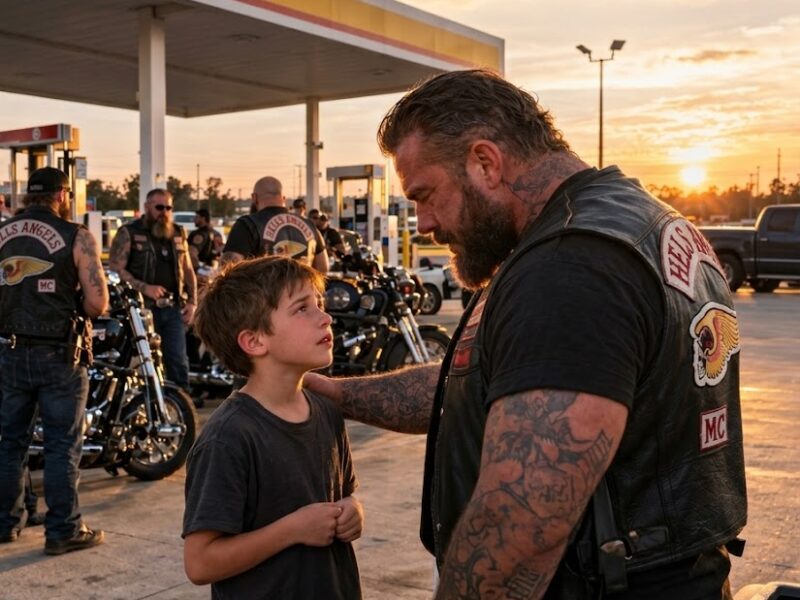
“He comes home angry every Friday,” the boy whispered to the biker on a Thursday night. What the biker did next changed everything.
The truck door slammed so hard the whole house shook.
And Kyle knew.
It was 7:00 on a Thursday night in October, and the sound traveled through the walls of the little rental house on the south side of Dayton, Ohio, the way a crack travels through ice.
He pressed his back against his bedroom wall, counted the footsteps, and listened to his mother’s voice go quiet in a way that frightened him more than any shouting ever could.
Then the footsteps stopped outside his door.
“Come out here,” his father said.
Kyle did not move.
In his pocket was a folded card with a phone number on it, creased soft from being carried around for six weeks.
And in his head was a promise he’d made to a stranger in a leather vest.
If it ever got bad, run.
The back window was open six inches.
The shop was six blocks away.
And the man at the door knew exactly who Kyle had told.
By 9:00 on a Thursday night in October, most of Wayne Avenue had gone quiet.
The bars in the Oregon District were filling up, but a few blocks south, where the brick storefronts gave way to tire shops and body shops, only one light was still burning.
It belonged to Hollis Motorworks.
Richard Hollis was lying on a creeper under a Harley Road King, a socket wrench clamped in his teeth, when he heard the side door creak.
Only one person ever used the side door.
Kyle.
He rolled out and sat up, wiping his hands on a red shop rag.
“It’s a school night, buddy.”
The boy stood just inside the doorway with both hands buried in the front pocket of a gray sweatshirt two sizes too big for him.
He was 11 years old and small for it, with brown hair that needed cutting and a kind of stillness Richard had learned to recognize over the years.
Not shyness.
Carefulness.
The stillness of a kid who had figured out that the safest way to get through a room was to take up as little of it as possible.
“I know,” Kyle said. “I’m sorry. I can go.”
“Nobody’s running you off. Get in here. It’s freezing.”
Richard was 54 years old with a gray beard that reached the second button of his flannel shirt and shoulders built by 30 years of lifting engines.
A leather vest hung on a hook by the office door, and across its back it read Gem City Riders.
Kyle Whitaker had walked straight up to him on the first Monday of September, pointed at the push broom in the corner, and asked if he could sweep the floor for a dollar.
That had been six weeks ago.
Since then, the dollar had become two, and the sweeping had become something else.
Kyle came every day after school, sorted bolts into coffee cans, and asked about everything from carburetors to the numbers on a tire.
Richard answered every question.
Somewhere around the third week, he had stopped pretending he was paying the boy for work.
Tonight, Kyle did not pick up the broom.
He sat down on an upside-down milk crate near the space heater and stared at the concrete floor.
And Richard, who had spent a lifetime reading engines by their sound, knew something was wrong.
He did not ask.
He turned the radio down to nothing, dragged a stool over, and waited.
The worst thing you could do to a person working up their nerve was fill the silence for them.
“Mr. Hollis.”
Kyle’s voice was so small it nearly disappeared into the hum of the heater.
“Yeah, bud.”
“If I tell you something, do you have to tell anybody?”
The question landed in Richard’s chest like a dropped wrench.
He knew that question.
He had asked it himself at about the same age in the equipment room of a school gym, and the coach had said, “Of course not, son.”
And nothing had ever changed.
He did not give the easy answer.
“That depends,” he said slowly. “If it’s something that means you’re safe and okay, then no. It stays right here. But if it’s something that means somebody’s hurting you or you’re scared to go home, then yes, I’d have to get you some help. I won’t lie to you about that, even if lying would make tonight easier.”
Kyle nodded as if that was exactly the answer he had expected, and let out a breath that shook on the way out.
“That’s what Mrs. Delaney said at school about having to tell. That’s why I never told her.”
He swallowed.
“But you said it first. You said it to my face. So, I think it’s okay to tell you.”
“Okay,” Richard said gently. “Take all the time you need.”
Kyle looked down at his sneakers.
“My dad comes home angry every Friday,” he said.
Richard did not move.
“He works at a warehouse out on Needmore Road. Friday’s a payday, so he goes to a bar called Murphy’s first. By the time he gets home, it’s already dark. I can hear his truck in the driveway, and the way he shuts the door tells me what kind of night it’s going to be.”
“What kind of night?” Richard asked quietly.
“Loud. Mostly loud.”
Kyle’s hands had come out of the pocket.
They were twisting the hem of his sweatshirt.
“He yells at my mom about money. He throws stuff sometimes, plates. Once the TV remote. And if I come out of my room to see if she’s okay, he—”
The boy stopped.
“He grabs my arm hard. He says I need to learn to stay out of grown-up business.”
Kyle pushed back the left sleeve.
On the soft part of his forearm, just below the elbow, four yellowing marks sat in a row, the faded ghosts of fingers.
Richard’s jaw tightened, but his voice stayed low and level.
“Is that from last Friday?”
Kyle nodded.
“Does your mom know you’re here? Does she know you’re telling me?”
“No. She thinks I’m at my friend Tyler’s house working on a science project. She’d be so scared if she knew. She says we don’t talk about things outside the house because it only makes Dad worse.”
His eyes were bright, but he was not crying.
“Tomorrow’s Friday. That’s why I came tonight. I just didn’t want to be the only person who knew anymore.”
Richard leaned forward, elbows on his knees, until his eyes were level with Kyle’s.
“Kyle, listen to me. What you just did was the bravest thing I’ve seen anybody do in a long time. And none of what happens in that house is your fault. Not one piece of it.”
The boy’s chin trembled.
“You’re going to tell somebody.”
“I am,” Richard said. “But I won’t do it behind your back. Tomorrow I’m going to talk to someone I trust, someone who knows how to handle this the right way. You’ll know every step before it happens. No surprises. Deal.”
Kyle was quiet for a long moment.
Then, barely above a whisper: “What do I do tomorrow night? He gets home at 7.”
Richard looked at the leather vest on its hook and the old black phone beside the register and thought about the 30-odd people in this city who would drop everything the moment he asked.
“Tomorrow,” he said, “you don’t go home after school. You come here.”
Neither of them knew yet how many Fridays it was going to take.
Theresa Marsh was already sitting in the back booth of the Wayne Avenue Diner when Richard walked in at 7 the next morning, and the first thing she did was slide a mug of black coffee across the table before he could sit.
“You look like you slept in a tire,” she said.
“Didn’t sleep much.”
Teresa was 63 with a silver braid down her back and reading glasses pushed up into her hair.
She rode a Honda Gold Wing older than some of the club’s newest members, and for 26 years before she retired, she had worked as a caseworker for Montgomery County Children’s Services.
She had walked into more kitchens than Richard could count.
When she folded her hands on the table, he knew she was about to be the most useful person he had ever called.
He told her everything in order the way Kyle had told it.
The truck door, the yelling, the thrown plates, the four marks on the boy’s arm.
He did not add anything.
He did not leave anything out.
When he finished, Teresa stayed quiet for a few seconds.
“Did you ask him leading questions?”
“I asked what kind of night. Whether the mark was from last Friday. That’s all.”
“Good. That’s exactly right.”
She took off her glasses.
“Here’s what I told a hundred people over 26 years. Richard, you call the county. You report precisely what you saw and what he said. Nothing more and nothing less. You do not confront the father. You do not play detective, and you do not promise that kid anything you can’t control.”
“I told him no surprises.”
“Then you tell him this afternoon and you make the call together. A kid who’s part of the plan holds up better than a kid who’s a package being delivered.”
She leaned forward.
“And hear me on this part. The system moves at the speed of paperwork. You’re going to want to do something dramatic, and you won’t be allowed to. That’s the hardest part of all this. Can you live with it?”
Richard looked down into his coffee.
“I’ll have to.”
At 3:40 that afternoon, Kyle came through the side door with his backpack on both shoulders and stopped when he saw the stranger sitting in the shop office.
Teresa did not stand up.
She did not smile too big or talk too soft the way adults did when they thought a child was breakable.
“Hi, Kyle. I’m Teresa. I used to have a job making sure kids were safe, and I’m still pretty good at it. I’m not here to make you say anything twice. Richard already told me. I’m just here to help make a plan.”
Kyle looked at Richard.
Richard nodded.
“She’s the one I told you about. And this is the part where I tell you the step before it happens. We’re going to call the county together right now, and you can listen to every word.”
The phone call took 11 minutes.
Richard held the receiver on speaker while a calm woman with a voice like warm tea asked questions and typed the answers.
She asked Kyle if he wanted to say anything himself, and he said in a small, clear voice, “My dad grabs my arm when I try to help my mom.”
The woman said, “Thank you.”
She said a caseworker would reach out to the family within a day or two, sooner if anything seemed urgent.
She said if anyone was in danger tonight, they should call 911 first and not wait.
When it was over, Kyle exhaled like a boy who had been underwater.
Teresa took an index card from her jacket and wrote on it in block letters.
“This is a safety plan,” she said. “Three things. One, if it gets scary, you leave. Go next door to Mrs. Pruitt, the one with the porch light. Two, if you can’t get there, come here. It’s six blocks, and you already know the way. Three, 911 is always okay. You will never get in trouble for calling it. Keep this in your pocket.”
Kyle read the card twice and folded it into the pocket of his jeans.
The rusted green Corolla pulled up outside at 10 after 6.
Carol Whitaker was 34, thin in the way of people who skipped meals without noticing, with her hair pulled back so tightly it made her look tired.
She wore a Kroger name tag pinned to a cardigan whose sleeves came down to her knuckles.
She came through the front door of the shop and took in the whole scene in a single sweep.
The biker, the stranger, her son.
And her face went white.
“Kyle. Car. Now.”
“Mom, I told him.”
Carol stopped.
“You told him what?”
“Mrs. Whitaker,” Richard said, keeping his hands visible and his voice low, “nobody in this room is angry at you. Kyle’s welcome here anytime. So are you.”
“You don’t know anything about my family.”
Her voice shook.
“Dale will be home in 40 minutes. If Kyle isn’t at that table when he walks in—”
She did not finish the sentence, and the unfinished part told Richard more than the rest.
He held out a card with his number written on it and Teresa’s number on the back.
“Any hour, day or night.”
Carol looked at it as if it were a live wire.
She did not take it, but Kyle did, quick and quiet, and slid it into his pocket beside the other.
Then she had his hand and was pulling him toward the door, and the boy looked back over his shoulder once, and Richard made himself stay where he was.
The Corolla’s tail lights disappeared down Wayne Avenue.
“I should have stopped her,” Richard said.
“No,” Teresa said. “She’s an adult, and he’s her son. Unless there’s imminent danger, the law is on her side tonight, and so is the fear. All we can do is keep the door open and hope she finds it.”
By 7:00, the shop had filled in a way Richard hadn’t planned.
Frank Dolan, the club’s president, 66 years old with white hair cut short, had come because Teresa called him.
Lonnie Briggs, 41 and built like a refrigerator, had come because Frank had.
Richard had told them only that a kid might need help.
That was enough.
“Where’s the house?” Lonnie asked, already reaching for his keys.
“Nobody goes near that house,” Richard said.
“Rich, if some guy’s—”
“Nobody.”
Lonnie.
Richard didn’t raise his voice.
He didn’t need to.
“That boy trusted me to do this right. Right doesn’t start with us parking outside his window.”
Lonnie’s jaw worked.
Then he sat down on a stool hard and said nothing.
The clock crawled.
7. 8. 9.
At 9:35, the old black phone beside the register rang, and Richard snatched it up on the first ring.
“Mr. Hollis.”
It was barely a whisper, muffled like a boy talking under a blanket.
“It’s me. Kyle.”
“Are you okay?”
“It was only yelling tonight. Just yelling.”
A pause.
“Dad’s in his chair. I think he fell asleep. Mom said I shouldn’t call, but I wanted you to know I’m okay.”
Richard’s whole body unclenched.
“Thank you for calling. You did good.”
“Mr. Hollis.”
The whisper dropped lower.
“A lady from the county called our house at dinner. Dad answered. He told her it was a mistake. Then he hung up, and he looked at me.”
“Kyle—”
“I think he’s waking up. I have to go.”
The line went dead.
Richard stood there with the receiver in his hand, listening to nothing while the whole room waited.
Kyle did not come on Saturday.
He did not come on Sunday either, but the shop was closed on Sundays, so Richard spent most of the day in his kitchen anyway, staring at the phone like it owed him money.
On Monday afternoon, the side door stayed shut at 3:40 and at 4 and at 5.
Richard swept the floor three times.
He rebuilt a carburetor that had nothing wrong with it.
On Tuesday, a woman named Denise Carlisle called from Montgomery County Children’s Services.
She was the caseworker assigned to the Whitaker family, she said, and she wanted to ask Richard a few follow-up questions about what he had personally seen and heard.
Richard answered carefully and truthfully.
When he finished, he asked the question he had been holding for three days.
“Is he okay?”
“I can’t share details of an open case, Mr. Hollis.”
Her voice was kind and tired.
“What I can tell you is that I’ve made contact with the family, and the case is open. And I can tell you your report mattered. Please don’t mistake the silence for inaction.”
But Richard had been listening to engines for 30 years, and he knew the sound of a motor that wasn’t running right.
Something in her careful words said the visit had not gone the way anyone hoped.
He found out how badly on Wednesday.
Kyle came at last just before 5, but he did not come in.
He stood in the alley by the side door with his backpack hanging off one shoulder and his eyes on the pavement.
And when Richard stepped outside, the boy flinched before he could stop himself.
“I can’t come anymore,” Kyle said. “Dad says I’m not allowed.”
“Okay.”
Richard crouched until they were eye to eye the way he did in the shop.
“Can you tell me what happened with the lady from the county?”
Kyle’s face crumpled.
“I told her I made it up. I said I was mad about a video game and wanted to get Dad in trouble. Mom was standing right there, and Dad had cleaned the whole house, and he was so nice. Mr. Hollis, he made coffee. He kept calling her ma’am, and the lady kept looking at me, and I just—”
He stopped.
“Dad told me in the truck that if I said it was true, they’d take me away from Mom and put me with strangers. Is that true?”
Richard felt something hot move through his chest and made himself keep it there, banked low where it couldn’t spill onto the boy.
“Kyle, I’m going to tell you the truth. Same as always. The people at the county don’t want to take kids from their moms. They try everything else first. They only do it when there’s no other way to keep a child safe. And even then, they work hard to put the family back together.”
He paused.
“I can’t promise how this ends. But I can promise you’re not in trouble. Not with me and not with that lady. You were scared. That’s all.”
“Dad said he knows it was me who told.”
Kyle’s whisper cracked.
“He said I made a mistake I’ll be sorry for.”
“Did he hurt you?”
“No. He just said it over and over.”
Kyle wiped his nose with his sleeve.
“I have to go. Mom’s waiting at the corner.”
Richard watched him run to the end of the alley where the green Corolla idled at the curb with Carol’s pale face behind the glass.
She did not look at Richard.
She looked at the dashboard as if it might save her.
That night in the clubhouse, a converted warehouse on Third Street with a pool table, a bar built from an old garage door, and 40 folding chairs, Richard laid it all out for the club.
Thirty-two people sat in the half-light.
When he finished, no one spoke until Lonnie Briggs stood up so fast his chair fell over.
“So the guy bullied a little kid into lying. And that’s it. That’s the system. We just sit here.”
Lonnie’s voice climbed.
“Give me 10 minutes with him. That’s all. Ten minutes, and he’ll never raise a hand to anybody again.”
Several heads nodded.
Richard understood the pull of it.
He felt it himself.
The old animal part of him that had been waiting 30 years for a chance like this.
He stood up slowly.
“Lonnie, I want that man to feel what that boy feels. I’d be lying if I said I didn’t. But think about what happens the minute we show up at his door. He gets exactly the story he needs. He gets to tell everyone the boy brought wolves to his house. He gets to say Kyle’s a liar and we’re thugs. Carol never leaves because now she’s more afraid of us than of him. And Kyle loses the one thing we’ve actually given him, which is proof that telling somebody works.”
The room went quiet.
“That boy walked six blocks in the dark to hand a stranger the heaviest thing he owns. If we answer that with a fist, we tell every kid in this city what telling gets you.”
Frank Dolan stood up at the back, his white head catching the light from the bar.
“Then what do we do, Rich?”
“We become the thing that house doesn’t have,” Richard said. “Someone steady, someone who’s there every day, no matter what. We keep the door open until somebody walks through it.”
Frank looked around the room.
“All in favor of doing what Richard said?”
Thirty-one hands went up.
After a moment, Lonnie’s went up too, slowly, as if it weighed 50 pounds.
Richard did not sleep that night either.
He sat on his back porch in the cold with a cup of coffee going lukewarm in his hands and thought about his own father, a machinist at the old NCR plant who had come home angry every payday of Richard’s childhood.
He thought about the coach in the equipment room.
He thought about how many grown men had looked at one scared boy and decided it was none of their business.
Over the next two days, Teresa started buying groceries at the Kroger on Salem Avenue.
She picked the checkout lane where Carol worked and bought something small each time, milk or bread or a single banana.
She never mentioned the shop.
She never mentioned Kyle.
On her second visit, she said only, “Looks like it’s been a long week.”
On the third, she left a folded paper on the counter beside the receipt.
Carol looked at it.
Her hand stopped moving over the scanner.
She slid the paper under the register tray without a word.
On Thursday night at 9:40, the side door of Hollis Motorworks banged open so hard it hit the wall.
Kyle stood there breathing like he had run all six blocks.
He wasn’t wearing his sweatshirt.
His cheeks were wet.
“Dad found the card,” he gasped. “The one in Mom’s purse with Teresa’s number. They had a fight in the kitchen. He took her phone. She’s okay, I think. But she was crying, Mr. Hollis. She was crying so hard.”
He gulped air.
“And Dad said, ‘Saturday morning. We’re driving to my uncle’s house in Kentucky, and we’re not coming back.'”
Richard was already on his feet.
“Tomorrow’s Friday,” Kyle whispered.
Friday began with three phone calls, and Richard made the first one before the sun came up.
He called Denise Carlisle at Children’s Services and told her everything Kyle had said the night before—the fight, the confiscated phone, the plan to leave for Kentucky on Saturday morning.
She listened without interrupting.
When he finished, she was quiet for a moment.
“Mr. Hollis, I’m going to be honest with you. Without a disclosure from the child or the mother, I don’t have grounds to remove anyone from that home today. I’ll document this, and I’ll push for an emergency visit. But here’s what matters most. If violence happens tonight—anyone, you, a neighbor, the boy—calls 911 immediately. Police can act in ways I can’t. Understood?”
“Understood.”
“And Mr. Hollis, thank you for not doing anything stupid.”
He almost laughed.
The second call was Teresa’s, to an old friend who worked as an advocate at the county’s domestic violence program.
The advocate, Melissa Grant, would stay by her phone all night with a van and a bed waiting at a confidential shelter.
All they needed was for somebody to walk through the door.
The third call was not a call at all.
It was a woman at a grocery checkout.
At 4:00, Teresa went through Carol’s lane one last time with a single banana.
She set it on the belt.
She did not hand over a card.
She said, quietly enough that no one in line could hear, “Tonight, if you need a door that opens, it’s at 1420 Wayne Avenue. A dozen people will be there. Nobody will ask you a single question until you’re ready to answer.”
Carol’s hands stopped on the scanner.
She stared at the banana.
“Paper or plastic,” she said, and her voice broke on the second word.
“Either one,” Teresa said. “Whatever’s easier to carry.”
At 6, the lot behind Hollis Motorworks filled with motorcycles.
Fourteen riders came quiet, with their engines already off.
Richard stood in front of them in the cold with his hands in his jacket pockets.
“Here’s how this goes,” he said. “Hands where they can be seen. Phones out and recording. Nobody touches him. Nobody threatens him. Nobody says a single word he can use. If anyone can’t do that, go home right now.”
Nobody left.
Lonnie Briggs stepped forward.
“I can do it,” he said.
Richard looked at him for a long moment.
“I know you can.”
Inside, Teresa laid out blankets, a first aid kit, and a pot of hot chocolate.
Then they waited.
7:00 came and went.
Then 7:20.
Richard watched the street until the streetlights buzzed on.
At 7:38, they heard it before they saw it.
The slap of running feet on pavement.
Kyle burst around the corner of the building in his socks, his sneakers gone, his chest heaving.
Behind him came Carol, barefoot, one hand clamped against her cheekbone, the other gripping the strap of a canvas bag.
Her cardigan was torn at the shoulder.
“He’s coming,” Kyle gasped. “Mom pushed me out the window. Mr. Hollis, he’s coming.”
Teresa and two women from the club had them through the door before Richard could answer.
He walked to the center of the lot, set his feet, and lifted his phone to his ear.
“I need to report an assault,” he told the dispatcher. “1420 Wayne Avenue. A woman and a child just ran here to get away from a man who hurt them. He’s following in a truck, and he’s been drinking. Please send officers.”
The headlights hit the fence 90 seconds later.
The truck came into the lot too fast and stopped crooked, one front tire up on the curb.
Dale Whitaker climbed out.
He was 38, six feet tall, thick through the chest, with a red face and eyes that jumped from one rider to the next to the next.
Fourteen motorcycles.
Fourteen silent people.
“Where’s my son?”
Nobody answered.
Nobody moved.
Frank Dolan stood at the edge of the line with his arms at his sides.
Lonnie Briggs stood beside him, hands open, jaw shaking.
“I said, where’s my family?”
Dale’s voice cracked off the brick walls.
He pointed at Richard.
“You. You’re the one filling his head. You think you can take a man’s family?”
“I’m not taking anybody, Dale,” Richard said. “The police are on the line right now. Every person here has a phone out. You can get back in your truck and sit down, and tonight is still just a bad night. That’s all it has to be.”
“Get out of my way.”
Dale walked up and shoved him in the chest with both hands.
Richard went back two steps, caught himself, and stood up again with his palms open at his sides.
“I’m not going to fight you, Dale.”
The punch caught Richard on the jaw.
It was a drunk man’s punch, wide and heavy, and it snapped his head around and sent a bright flare behind his eyes.
He tasted blood.
Behind him, he heard a boot scrape on gravel, and he knew without turning whose boot it was.
Lonnie.
He did not look back.
“No.”
The scraping stopped.
Richard heard Lonnie Briggs breathe in and out once, twice, a sound like a man holding a door shut with his whole body.
Dale swung again.
This time, Richard took it on the shoulder and kept his hands where they were.
His eyes stayed on the shop door, which had just opened an inch.
Sirens far away, then close.
By the time two patrol cars swung into the lot, Dale had stopped swinging and started shouting.
“They took my family. These people took my family.”
Officer Marcus Bell and Officer Danielle Crowe stepped out with their hands near their belts.
A dozen bikers stood in a half circle with their phones raised and their hands open.
A man with a split lip stood in the middle with his palms out.
A drunk, red-faced man was screaming at all of them.
“Sir, step back,” Bell said. “Right now.”
“They took my family.”
“No.”
The word was not loud.
It came from the shop doorway, where Carol Whitaker now stood with her son pressed against her side.
She had one hand on her swollen cheek.
She was shaking so hard that Richard could see it from 40 feet away, but she was standing.
“They didn’t take us,” she said. “You did.”
Dale turned.
For the first time, something went out of his face.
Carol walked into the light with Kyle’s hand in hers.
She looked at Officer Crowe.
“He hit me tonight in the kitchen. He took my phone so I couldn’t call anyone. He’s done it for years.”
She drew a ragged breath.
“And he grabs my son. Please—please look at his arm.”
Kyle pushed up his sleeve.
The old marks had faded, but tonight’s four fresh dark prints stood out against the pale skin.
Officer Crowe crouched in front of him.
“Kyle, is that right? Did your dad do that?”
The boy looked at his mother, then at Richard, then at the officer, and he said it out loud, clear and steady, in front of 14 bikers and two patrol cars and the man who had spent a year teaching him to keep quiet.
“My dad comes home angry every Friday.”
No one spoke.
Even Dale seemed to have forgotten how.
Marcus Bell turned Dale Whitaker around and put the cuffs on him while he swore and wept in the same breath.
Danielle Crowe stayed crouched in front of Kyle, and Richard, standing in the gravel with blood running into his beard, heard Carol say something so softly that only he and Teresa could hear.
“I called a hotline once,” she said. “Two months ago. He found the number in my phone. After that, I stopped believing anybody was on the other end.”
“We were,” Teresa said.
She was crying openly now.
“We just didn’t know your name yet.”
Melissa Grant arrived at 8:45 with a calm voice and a quiet van.
She spent 20 minutes with Carol in the shop office with the door closed.
And when they came out, Carol was holding a plastic bag of clothes and a cup of hot chocolate and looked like a person who had just been told the ground was solid.
“There’s a safe place for them tonight,” Melissa told Richard. “I can’t tell you where. That’s how it protects them.”
Richard’s stomach tightened.
He had wanted to follow that van to the end of the earth.
Instead, he nodded.
“That’s how it should be.”
Kyle stood at the van’s open door with a blanket around his shoulders.
A paramedic had cleaned the cut on Richard’s lip, and the boy kept glancing at it as though he owed it something.
“Mr. Hollis?”
“Yeah, bud.”
“You didn’t promise to keep it a secret.”
“No,” Richard said. “I didn’t. That’s why I could tell you.”
Kyle crossed the gravel in four quick steps and hugged him hard around the middle, the way a kid hugs when he has decided not to be embarrassed.
Then he climbed into the van, and the door slid shut, and the tail lights turned onto Wayne Avenue.
Nobody in the lot moved for a long time.
Lonnie Briggs sat down on the curb with his big hands hanging between his knees.
“I wanted to put him through that fence,” he said finally. “Every part of me wanted to.”
“I know,” Richard said, pressing a napkin to his lip. “So did I. But you stood there anyway. That boy watched 14 people who could have hurt his father choose not to, and that’s the part he’ll carry. Not the punches. The choosing.”
Frank Dolan rested a hand on Lonnie’s shoulder and said nothing, which was the kindest thing anyone could have said.
The weeks that followed were slow, the way real things are.
Eleven days later, a judge granted Carol a civil protection order.
Dale Whitaker pleaded guilty to domestic violence and assault.
He was sentenced to probation, ordered into a batterer intervention program and alcohol treatment, and barred from contact with his wife and son.
Any future time with Kyle would be supervised and only if the counselors recommended it.
Whether Dale would ever become the man he could have been was not Richard’s to decide.
That was Dale’s work with people trained to help him do it.
Kyle’s only job was to be 11.
Denise Carlisle kept the Children’s Services case open and visited every week.
She told Richard over the phone, with a smile he could hear, that she had never been so glad to write a boring report.
Six weeks after that Friday, Carol found a two-bedroom apartment above a bakery off Salem Avenue with a window that caught the morning sun.
On moving day, the whole club showed up.
Frank Dolan brought his pickup.
Lonnie Briggs carried the couch up two flights of stairs as carefully as if it were a sleeping child.
Teresa hung curtains.
The women from the club filled the empty kitchen with groceries, and one of them, without a word, lined the shelves with paper.
Carol stood in the middle of it all with her hand over her mouth.
“I’ll pay every cent back,” she said. “I swear I will.”
“Don’t pay it back,” Richard said. “Pay it forward. Someday somebody will be standing at a checkout lane with a banana and a story, looking for a door. You’ll know what to say.”
Kyle came back to the shop the following Monday.
He swept the floor without being asked, sorted bolts into coffee cans, and asked how a differential worked.
He wore a sweatshirt that fit.
His hands stayed out of his pockets.
On Thursday night, after the last customer had gone and the radio was down to a murmur, they sat by the space heater, the boy on his milk crate and the man on his stool.
“Mr. Hollis, can I ask you something?”
“Always.”
“When I asked if you had to tell anybody, you said yes. Why didn’t you just say no? I would have told you anyway.”
Richard turned his coffee cup slowly in his hands.
“My dad worked at NCR. He came home angry every payday of my life. When I was your age, I asked my coach the same question you asked me. He said, ‘Of course not, son.’ I believed him. I kept quiet for 30 years.”
He looked at Kyle.
“Somebody told me no, and it cost me more than I can explain. I decided if a kid ever asked me, I’d tell the truth, even if it meant he got up and walked out.”
“I almost did.”
“I know you did.”
Kyle was quiet for a while.
“A secret that hurts somebody isn’t worth keeping,” he said, trying out the words.
“No,” Richard said. “It isn’t.”
That winter, Hollis Motorworks started opening its doors every Thursday night.
Teresa made a sign and hung it above the side door in the same block letters she had once written on an index card.
It said: “All kids welcome. No questions. We will always tell you the truth about what we have to do.”
Some Thursdays two kids came, and some Thursdays eight.
They swept, sorted bolts, drank hot chocolate, and learned what a torque wrench was for.
Some of them talked, and some of them never did.
But every one of them left knowing which door would open.
In the new year, Denise told Richard that Dale had finished his first 90 days of treatment and had written Kyle a letter.
The counselors had read it first, and they had decided it was safe for the boy to see.
Kyle held the envelope for a week before he opened it.
When he finally did, he read it alone in the back office, then came out and swept the floor for an hour without saying a word.
Richard did not ask.
The letter was Kyle’s to carry, and his own job was only to be there when the boy was ready to set it down.
Eventually, Kyle did, one afternoon in the middle of a conversation about brake pads.
“He says he’s sorry,” he said. “I don’t know what to do with that yet.”
Richard nodded.
“You don’t have to know yet,” he said. “That’s allowed.”
On a Friday in February, snow was falling on Wayne Avenue.
At five minutes to 7, Richard stood at the front window of the shop with a cup of coffee.
Kyle stood beside him, watching the headlights slide past on the wet street.
“It’s almost 7,” Kyle said.
“I know. It used to be the worst hour of the whole week. And now—”
Kyle watched a pickup truck go by, then another, then a pizza delivery car with a glowing sign on its roof.
He thought about it for a long time.
“Now it’s just when we eat dinner,” he said.
Behind them, the club was setting out paper plates.
Carol was laughing at something Frank said.
Lonnie was arguing with Teresa about the pizza toppings and losing.
Richard looked at the boy beside him and understood that nothing about the boy’s courage had been loud.
It had been a side door, a milk crate, and 11 quiet words.
What made it matter was that someone listened, and that a room full of people had chosen to show up.
Somewhere in this city, he thought, another kid was working up the nerve.
The door would be open.









