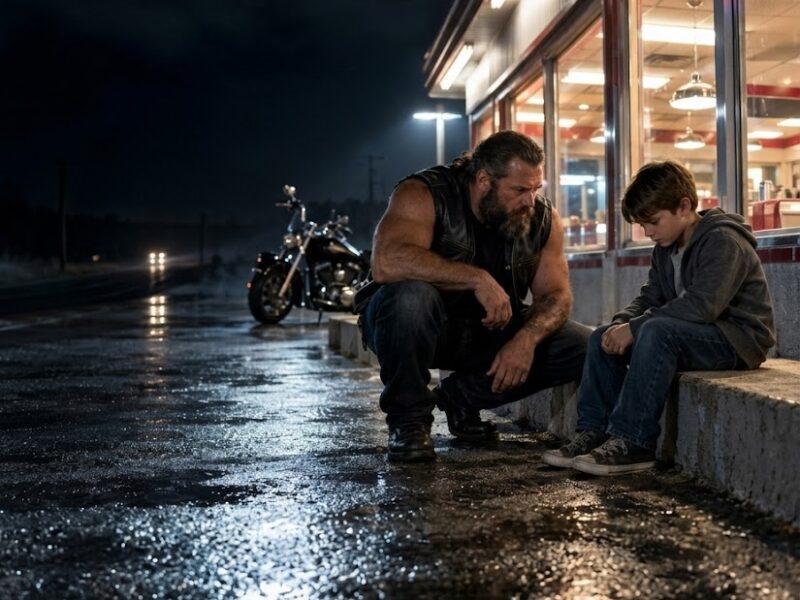
“He comes back on Thursdays,” the boy told the Hells Angel. It was Wednesday night. That meant he had less than twenty-four hours.
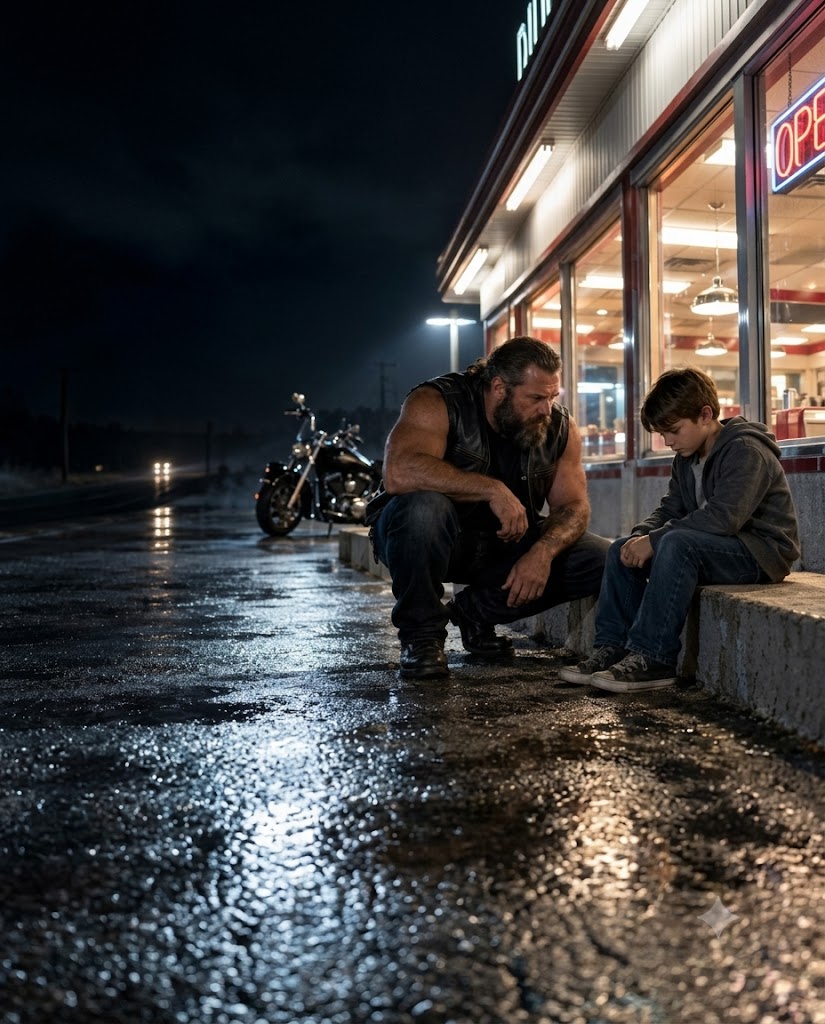
He was 9 years old, sitting alone on a flooded curb outside a diner near midnight, promising himself that a truck would come.
Nine years old, soaked through a thin gray hoodie, teeth chattering so hard he could barely form words.
Nine years old, waiting for a man who wasn’t due back for another 24 hours.
Nine years old, and not one adult standing behind that fogged glass could explain why he wouldn’t move.
Then the leather-clad giant swung off his motorcycle—6’4″, 260 pounds, ink and old scars up both forearms—and every person watching had already decided he was the danger in that parking lot, not the reason the boy might still be breathing by morning.
What happened in the next 11 minutes, none of them saw coming.
The rain over Astoria had not let up since Tuesday—a steady gray hammering that turned Marine Drive into a river of its own reflection, headlights smearing gold across the wet asphalt.
The Columbia River foghorn moaned somewhere out past the pilings every few minutes, like a held breath let go.
Nine-year-old Jack Donovan sat cross-legged on the braided rug in Beatrice Nol’s front room, listening to that foghorn and to the softer, more constant static hum of the police scanner Beatrice kept on the side table between her reading glasses and a dish of butterscotch candies.
He had memorized the sound of that scanner the way other kids memorized cartoon theme songs.
Traffic stop on Highway 101. Noise complaint on Grand Avenue. A raccoon in somebody’s chimney over on Franklin Avenue.
Most nights it was just wallpaper background noise Jack barely noticed—the kind of thing that made Beatrice’s little blue house at the top of the hill feel less lonely.
Tonight every crackle made him look up.
Nine years and two months old. He had turned 9 in July, four months after his mother died.
Jack still counted things in exact numbers, the way you do when the world has already proven to you that dates and hours matter more than anyone wants to admit.
His mother, Carol Donovan, had been gone 14 months now, killed on a rain-slick curve of Highway 30 by a driver who never even braked.
And in the 14 months since, his father Glenn had rearranged an entire life around one unbreakable rule: Thursdays.
No matter the load, no matter the weather, no matter how far up the coast his route had carried him that week, Glenn Donovan came home on Thursday nights and took his son to the Wheelhouse Diner on Marine Drive for pie.
It didn’t matter if he’d been driving since 4 that morning. Thursday was Thursday.
Jack had a booth memorized—the one by the window, red vinyl split at one corner, close enough to watch the traffic light on 12th Street blink from red to green to red again—and he and his father had sat in it every single Thursday for 14 months without missing once.
It was the only promise Jack fully believed anymore.
Beatrice, 70 years old and built like a woman who’d spent 40 winters gutting fish at the cannery before her hands gave out to arthritis, dozed in her recliner with a crocheted blanket pulled to her chin.
She took a pill every night at 8 for the pain in her knuckles, and by 8:30 she was usually somewhere between awake and gone, murmuring answers to a television she wasn’t really watching.
She loved Jack like her own and had never once in 14 months let anything happen to him—which was why what happened at 9:52 that Wednesday night didn’t feel like anyone’s fault.
Not really. It just felt like something the storm had decided on its own.
The scanner cracked through a burst of dispatch chatter that made Jack’s whole body go still.
“Multi-vehicle Highway 30, mile marker 78 near Svensen. One commercial tractor-trailer reported jackknifed, second vehicle involved, requesting additional units and life-flight standby.”
Mile marker 78.
Jack knew that stretch of road the way he knew the shape of his own hand—the long dark curve past Knappa where the trees closed in from both sides, and the guardrail was bent in three places from other people’s bad nights.
The exact road his father’s rig came down every single Thursday on the last leg home from Portland.
Except tonight wasn’t Thursday. Tonight was Wednesday, and Glenn wasn’t supposed to be anywhere near that curve at all.
Except Jack knew, because he’d heard him say it on the phone Sunday, that this week’s run had gotten rerouted early, that he might swing through a day sooner than usual, depending on how the Longview delivery went.
Jack’s hands had gone cold before his brain finished the thought.
He tried his father’s cell phone, punching the numbers into Beatrice’s landline with fingers that wouldn’t quite cooperate.
It rang twice and dropped to a robotic voicemail. He tried again. Same result.
Outside, thunder rolled low over the bay, and Beatrice slept on, unaware that the boy she was watching had already decided that Thursday’s rule was the only rule left that could save anybody.
If he went to the diner, if he sat in the booth, like always, right on schedule—somehow, in the small magical arithmetic that 9-year-olds use to keep the world from falling apart, that would pull everything else back into place, too.
His father would walk through that door tired and rain-soaked, exactly like every other Thursday, and none of what the scanner had said would turn out to be about him at all.
It didn’t need to make sense. It only needed to feel like something he could do instead of nothing.
Jack pulled on his gray hoodie over his pajama shirt, laced his sneakers with hands that shook harder than the cold alone explained, and eased Beatrice’s front door shut behind him so gently the latch barely clicked.
The porch light caught the rain in silver threads all the way down the hill.
He had walked to the Wheelhouse a hundred times with his father beside him. He had never walked it alone, and never at night, and never in weather like this.
He did it anyway.
By the time Marine Drive came into view—the diner’s red neon sign bleeding pink across the wet pavement, the windows fogged gold with light—Jack was soaked through to the skin, his teeth already starting to chatter in a rhythm he couldn’t stop.
He slowed at the edge of the parking lot when he saw them.
Four motorcycles lined up along the curb near the entrance, chrome slick with rain, engines ticking as they cooled.
Big machines, the kind that belonged to big men.
Jack had heard the stories other kids told about the Hells Angels who stopped through Astoria some weekend nights—stories that got taller and scarier every time they were repeated at school.
He should have turned around. Some small, sensible part of him knew that.
Instead, he walked to the curb near the diner’s front window, sat down on the wet concrete step with his knees pulled to his chest, and stared at the empty road leading south out of town, watching for headlights that weren’t due for another 24 hours, whispering the only thing he had left to hold on to.
“He comes back on Thursdays.”
Inside the Wheelhouse, Marlene Piltcher was working through the closing ritual she’d done for 26 years—flipping chairs onto tables, running the mop bucket along the black-and-white tile, humming along to whatever oldies station the radio behind the counter had settled on.
She’d just told her last four customers—four leather-vested men who came through most Wednesdays like clockwork, quiet, tipped well, never any trouble—that she’d have the lights off in 10 minutes.
She was reaching for the front door lock when she saw the boy.
He was just sitting there on the wet step outside, hood soaked flat against his skull, arms wrapped around his knees, not moving, not even flinching when the rain ran straight down his collar.
Marlene’s stomach dropped the way it always did when something in front of her didn’t add up.
She was reaching for the phone on the counter—thinking police, thinking parents, thinking anything—when the door chime jingled behind her and the biggest of the four bikers stepped past her out into the storm without a word.
His name was Elias Buckner, though nobody in that diner knew it yet.
Fifty-eight years old, 6’4″, built like a man who had spent three decades unloading freight by hand, a beard gone iron gray at the jaw, and a leather cut worn soft and pale at the shoulders from 20 years of highway weather.
Marlene had served him coffee—black, no sugar—every Wednesday night for the better part of a year, and in all that time she had learned exactly nothing about him beyond his order.
She watched through the fogged glass as he crossed the lot, slow and unhurried, the way you’d approach something wild you didn’t want to spook.
He didn’t crouch the way most grown men crouch near a strange kid—quick, awkward, eager to get it over with.
He lowered himself down onto the curb across from the boy the way you’d settle in for a long wait, knees popping audibly even over the rain, and just sat there at eye level instead of standing over him, close enough to talk, far enough not to crowd.
Marlene’s hand was still on the phone.
Twenty-six years of running that counter had taught her plenty about reading a room, and every instinct she owned told her this was the part of the story where she was supposed to be afraid.
She wasn’t sure, watching him sit there, patient as a fence post in the rain, that she actually was.
“Should we be worried about that?” asked one of the other riders—a broad-shouldered man in his early 60s named Milton Stalworth, the club’s chapter president, who had come to stand at the window beside her.
“I don’t know what to be worried about anymore,” Marlene admitted, and meant it about several things at once.
The other two riders had drifted a few steps closer without quite crossing into the light, the way men do when they sense something has shifted but don’t yet know what’s expected of them.
One of them, younger, kept glancing at Milton for a cue. Milton just watched Elias and the boy, arms folded, saying nothing, the same patience in his stance that was in his old friend’s.
Outside, headlights swept the lot as a Clatsop County cruiser rolled to a stop at the curb.
Deputy Alan Fitch had been three blocks over finishing paperwork on a fender bender when the sight of an unattended child outside a closed business—flanked by a parked row of motorcycles—pulled his attention like a hook.
He was out of the car before the engine fully died, flashlight already up, voice already sharp.
“Sir, step back from the kid.”
Elias didn’t move fast, which somehow made it worse in Fitch’s eyes. A big man taking his time was a big man who wasn’t afraid of a badge.
“Just talking to him, Deputy,” Elias said, hands open and visible, voice low and even. “He’s cold. He needs to be inside somewhere warm, not standing around while we all decide who’s allowed to help him.”
“That’s my call to make.”
Fitch’s light swept over Jack’s face, over the faint blue tinge starting at his lips, and something in his jaw tightened.
“Son, you know this man?”
Jack shook his head, teeth chattering too hard to answer clean. His eyes stayed fixed on the empty road.
“Then step back,” Fitch said again to Elias, harder this time.
Elias didn’t step back. He stayed exactly where he was, at the boy’s level, and asked in the same quiet voice he’d used the whole time, “What’s your name, bud?”
“J-Jack.”
“Jack. Okay. You got somewhere you’re supposed to be tonight, somebody looking for you?”
And that was when Jack finally looked up from the road, eyes glassy with cold and something closer to panic, and said the sentence that would confuse every adult standing in that parking lot for the next several minutes.
“He comes back on Thursdays.”
Marlene, now standing in the open doorway with a shawl thrown over her uniform, exchanged a look with Fitch.
“Honey, it’s Wednesday,” she said gently.
“I know,” Jack said.
And something about the flatness in his voice—not confusion, but a kind of grim, exhausted certainty—made Elias go very still.
“He knows,” Elias repeated, mostly to himself, working it over.
He’d spent enough of his life reading people who were scared past the point of making sense to recognize the shape of it.
This wasn’t a boy who’d lost track of the days. This was a boy who understood the calendar perfectly well and had come anyway, because some part of him believed that showing up on time for a promise might be the only thing holding the other half of it together somewhere out on a dark highway.
He didn’t say any of that out loud.
He simply reached up—slow, deliberate, so the deputy could see every inch of the motion—and unzipped his leather cut partway to shrug out of the flannel shirt underneath it, offering it to the boy.
For half a second, as his arm extended, the sleeve of his T-shirt rode up past his elbow, and Marlene caught a flash of old ink on his forearm—an anchor faded nearly to gray-green, wrapped through with something that might have been a caduceus, the two snakes worn thin with decades of sun and highway wind.
Elias tugged the sleeve back down before anyone could ask about it.
“Put this on,” he told Jack. “Under the hoodie, not over.”
Fitch’s radio crackled at his shoulder before he could object further.
“Units be advised, Highway 30 MVA at mile 78. One commercial vehicle confirmed jackknifed. Single occupant. Transport requested to Columbia Memorial. Second vehicle occupant status unconfirmed at this time. Additional info to follow.”
Fitch’s eyes cut toward Jack, then toward the empty southbound road. The boy hadn’t stopped watching since he’d sat down.
And for the first time since he’d stepped out of his cruiser, the deputy’s certainty about who the real problem was in this parking lot wavered just slightly at the edges.
The dispatch call kept coming in pieces, the way bad news on a scanner always does, a little more revealed every time somebody keyed the mic.
Single occupant confirmed on the jackknifed rig. Company markings partially visible. An independent hauler. Plate number requested for verification.
Second vehicle, a sedan that had spun out trying to avoid the trailer. Occupant walking and refusing transport.
No name yet on the trucker. No condition update yet either.
Jack heard every fragment of it from where he sat, and every fragment made him shake harder.
The rain hadn’t slackened at all. If anything, it had picked up, drumming so hard against the diner’s awning that the sound of it nearly swallowed the radio traffic whole.
Somewhere down Marine Drive, a set of headlights slowed, then kept going, uninterested—the way headlights do when whatever’s happening on the curb isn’t their emergency yet.
“He’s got a black flatbed,” Jack said suddenly, the words tumbling out too fast, slurring slightly at the edges in a way that had nothing to do with fear alone anymore.
“It’s a—it’s a Peterbilt. It’s got flames on the—he painted flames on it. After Mom, he—”
He stopped, blinking hard like he’d lost the thread of his own sentence halfway through it.
Marlene crouched down with a stack of dish towels from the diner, pressing them around Jack’s shoulders over the flannel shirt, and felt how cold he actually was through the fabric.
Not just wet-and-uncomfortable cold, but a deeper, wrong kind of cold that made her glance up at Elias with real alarm for the first time.
“Deputy,” Elias said, not looking away from the boy. “How far out is the ambulance?”
“Not for him,” Fitch snapped, some of his earlier hardness returning now that the scene had a name and a story attached to it—a wreck, a missing father, a distressed kid, none of which explained why a Hells Angel he’d never met was the one crouched closest to him. “I’ve got this handled. I need you to clear the area, sir. I mean it this time.”
“You’ve got a scared kid and a scanner full of half answers,” Elias said. “That’s not the same as handled.”
“That’s not your call.”
“No,” Elias agreed. “It’s his.”
He didn’t look up from Jack when he said it. Didn’t raise his voice. Didn’t give Fitch a single thing to push back against except the plain, unhelpful fact that he wasn’t moving.
“Look at his lips,” Elias said.
“I’m looking at you.”
“Look at his lips, Deputy. Then look at mine and tell me if you see a difference, because I promise you I’m not the one you need to be worried about in the next 10 minutes.”
Fitch hesitated, and in that hesitation something old and unwelcome rose up behind Elias’s own eyes, quick as a struck match.
It wasn’t the parking lot anymore for half a second. It was the deck of a ship listing at anchor in a foreign harbor. Alarms he still heard sometimes in the wrong kind of silence. Smoke where there shouldn’t have been smoke.
And his own hands, 24 years younger, no gray yet in that beard, pressed against wounds he hadn’t been able to close fast enough for two of the 17 men who never made it home from that morning.
He had been a corpsman then—good at his job, not good enough, not that day, not for everyone—and the guilt of that particular arithmetic had followed him off a battleship and out of the Navy and eventually off the tailgate of an ambulance in Warrenton, Oregon, 12 years into a paramedic career that ended the night he found himself unable to move at a routine call because the siren sounded exactly like the one from Aden.
He had told himself, driving trucks and later riding with men who never asked questions, that those hands were done being trusted with anyone’s life again.
He had built an entire second life around that decision—the long silent hauls, the club that never once asked what he used to be, the coffee he drank black and alone at the same counter every Wednesday because it didn’t require anything of him beyond showing up.
The shake in them now was so small only he would have noticed it.
But he noticed it, and for one long breath he genuinely did not know whether the hands at the end of his arms still remembered how to be trusted, or whether he was about to find that out in front of a deputy who already half believed he was the danger in this parking lot.
Then Jack’s head lulled sideways just slightly, eyes losing focus on the empty road for the first time all night, and whatever door Elias had spent 12 years trying to keep shut swung open anyway, because some things you don’t get to choose.
“Ma’am,” he said to Marlene, voice suddenly clipped and fast in a way it hadn’t been all evening, “I need every dry blanket you’ve got, and the kettle on—not boiling, just warm. Deputy, I need you to radio in an ambulance for this child. Hypothermia and shock. Tell them a 9-year-old with slurred speech and diminished responsiveness after prolonged cold exposure. And I need it now. Not after we finish deciding whether you trust me.”
“How do you know it’s hypothermia?” Fitch said, but his hand was already moving toward the radio at his shoulder.
“Because I’ve seen exactly what this looks like before, more than once, and it doesn’t wait for anybody’s permission to get worse.”
Elias peeled off his leather cut entirely and wrapped it—warm from his own body—around Jack’s shoulders over everything else, then pressed two fingers gently to the inside of the boy’s wrist, counting under his breath.
“Pulse is thready. Cap refill’s slow. Jack. Hey, Jack. Stay with me, bud. Keep your eyes on me, not the road.”
Jack’s eyes found his, unfocused but trying.
“Where’s your dad’s truck company, Jack? Can you tell me the name on the door?”
“Donovan Hauling,” Jack managed. “Just—just says Donovan.”
Fitch went still at that, one hand on his radio, the other gripping the doorframe of his cruiser, because the plate number dispatch had just repeated over the channel—requesting confirmation on an independent hauler registered under a D. Donovan—was no longer a stranger’s problem.
It was the boy sitting in front of him.
Marlene came back out with an armful of towels and the diner’s one wool lap blanket, kept folded behind the register for slow winter mornings, and pressed it into Elias’s hands without being asked.
Somewhere behind her, Milton had already pulled his phone from his cut and stepped a few feet off, voice low, working through a short list of numbers the way a man does when he’s done this kind of thing for people before. Just never quite like this.
Nobody in that parking lot was pretending anymore that this was only about a lonely kid and a day of the week that didn’t add up.
The dashboard clock in Fitch’s cruiser read 11:47 p.m. It was a Wednesday.
The wall calendar taped up behind the Wheelhouse’s register—the one Marlene never remembered to flip until she needed a receipt date—still read September, same as it had all month.
Two ordinary facts that would mean nothing to anyone except that Jack Donovan would remember them for the rest of his life as the exact hour everything either held together or didn’t.
Fitch relayed the confirmation over dispatch in a voice that had lost every trace of its earlier hardness.
Driver identified as Glenn Donovan, conscious, being transported to Columbia Memorial with a suspected broken collarbone and concussion from swerving to avoid the jackknifed trailer. Condition stable, not life-threatening.
He crouched down in front of Jack to deliver it himself, close enough that the boy could see his face clearly.
“Jack, listen to me. Your dad’s okay. Banged up. Going to the hospital, but okay. You hear me?”
For a moment, nothing in Jack’s expression moved at all, like the words needed time to travel somewhere deep enough to matter.
Then his face crumpled all at once—12 hours of held-together fear breaking apart into sobbing that shook his whole small frame—and Elias, still crouched at his level, still holding the boy’s wrist between two fingers, still counting, simply pulled him in against the flannel shirt and the borrowed cut and let him cry without saying a single word to stop it.
Milton Stalworth had already pulled out his phone, working a short chain of calls that ran through two other club members and a cousin who worked intake at Columbia Memorial, confirming everything Fitch’s dispatch had just said—and adding one more detail.
Glenn’s cell phone had been crushed in the cab during the spin, which was why no call had ever come through. Not because anyone had forgotten a promise, but because the phone itself no longer existed.
The ambulance arrived at 11:53—six minutes after the clock Jack would never forget.
Two paramedics moved fast and competent through the checks Elias had already started—pulse, pupils, skin temperature, responsiveness—and the younger one glanced up at him mid-assessment with open surprise.
“Whoever started warming him did this exactly right,” she said. “Passive rewarming, kept him talking, didn’t let him get horizontal too fast. You a medic?”
“Used to be,” Elias said, and left it at that.
Milton had stepped in close to Fitch while the paramedics worked, voice pitched low enough that only the deputy could hear it.
“Twenty-six years I’ve known that man,” he said, “and that’s more than he’s ever told most of us in one sitting. You want to know why his hands don’t shake doing what he just did? Because they’ve done it before under worse than rain.”
“Doing what, exactly?” Fitch asked, still watching Elias work.
“He was a corpsman. Navy. Aboard the USS Cole in Aden back in October of 2000, when somebody ran a boat full of explosives into her side and killed 17 sailors before anybody even knew what was happening.”
Milton’s voice didn’t rise, didn’t dramatize any of it—the way a man talks about something he respects too much to embellish.
“He spent that whole morning doing exactly what you just watched him do for a kid he’d never met. Keeping people breathing with his own two hands until real help showed up. Left the Navy after. Ran ambulances for a while in Warrenton. Doesn’t talk about either one much. Some of what he couldn’t fix that day he still carries. Doesn’t mean he forgot how to do the rest of it right.”
Fitch looked over at Elias, who was crouched beside the gurney now, murmuring something low and steady to keep Jack’s attention off the needle a paramedic was working into the back of his hand.
Fitch looked at the man he’d ordered twice to step back from a frightened child, and something in his face rearranged itself into an expression closer to shame than suspicion.
He crouched down unasked and held one corner of the blanket steady while the paramedics worked, following Elias’s directions without a single argument left in him.
“I owe you an apology,” Fitch said quietly. “I had you figured for—”
“You had me figured for exactly what you were supposed to see,” Elias said, not unkindly, rising slowly from the curb with a grunt as his knees complained about the wet concrete.
He looked down at Jack, now wrapped in a real blanket and being loaded gently onto the gurney, still holding tight to a fistful of the borrowed leather cut.
“Everybody in this parking lot decided who I was the second I pulled up on that bike. Ten years of it, longer. That boy didn’t wait around to make up his mind about me. That’s the only reason he’s still breathing right now instead of a lot worse.”
Nobody answered that for a moment.
Marlene stood in the diner doorway with both hands pressed over her mouth, blinking fast, the mop bucket forgotten behind her. Milton looked down at his boots.
Fitch simply nodded once, like a man agreeing to something he intended to remember for longer than the rest of his shift.
“Can I keep this?” Jack asked from the gurney, small and hoarse, both fists still knotted in the leather.
“Long as you bring it back,” Elias told him. “That’s the only cut I’ve got, bud, and Thursday’s coming.”
The paramedics lifted the gurney the rest of the way into the ambulance, and Marlene finally moved, hurrying out into the rain one last time to press a foam cup of warm cocoa into Jack’s free hand before the doors could shut, her other hand landing briefly, gratefully on Elias’s forearm—right over the faded anchor and caduceus, though she still didn’t know its name.
“Thank you,” she said, and for the first time all night, it wasn’t a question of who deserved to be trusted in that parking lot. It was simply true.
The ambulance pulled out onto Marine Drive with its lights turning slow, unhurried circles of red and white against the rain. No siren needed for a boy who was already stable and warming and, for the moment, quiet.
Fitch watched it go, then turned back to the three riders still standing at the curb, rain running off the brim of his hat.
“I’ll follow them over to Columbia Memorial,” he said. “Somebody’s going to need to sign for him until his father’s fit to. I figure that’s probably one of you.”
“That would be me,” Milton said.
Fitch nodded—and for just a second, standing there soaked through in the motel-sign glow of red neon with three Hells Angels who an hour earlier he’d have sworn were the reason for the trouble in that parking lot, he looked less like a man enforcing something and more like a man who’d simply been handed a piece of the night’s work and intended to see it through properly.
Nobody in that lot said anything else for a while.
The rain kept coming, steady as it had been since Tuesday, and somewhere out past the pilings, the foghorn sounded again—low and long, the same sound Jack had been listening to in Beatrice’s front room hours earlier, when none of this had started yet.
Columbia Memorial kept Jack overnight for observation, more caution than necessity, and by the following afternoon his body temperature had settled back to normal and the doctors were satisfied enough to move him down the hall to the room where his father was recovering—arms strapped across his chest in a sling, a bandage taped along one eyebrow, grinning the exact grin Jack had been waiting to see for what felt like a hundred Thursdays instead of one very long Wednesday night.
“You walked to the diner alone in that storm.” Glenn’s voice cracked somewhere between a laugh and something closer to tears as Jack climbed carefully onto the edge of the hospital bed beside him. “Kid, you scared about six years off Beatrice’s life and about ten off mine, and I wasn’t even awake for most of it.”
“You always come on Thursdays,” Jack said, like that explained everything—because to him, it did.
“I do,” Glenn agreed, pulling him in as gently as the sling allowed. “But you don’t ever have to go out and prove that by yourself again. You hear me? Not ever. There’s people who will stand with you while you wait. Turns out there’s more of them than I knew.”
Beatrice came by that evening with a shopping bag of clean clothes and a face that hadn’t fully stopped looking pale since Milton had called her the night before to explain gently where her charge had actually been.
She hugged Jack twice as long as usual and didn’t say much about the pill she’d taken or the nap she hadn’t meant to fall into, and Jack, watching her hands shake slightly around her coffee cup, decided on his own not to make her say it either.
“I should have heard you leave,” she told him quietly once Glenn had drifted off under the pain medication and it was just the two of them by the window.
“You didn’t do anything wrong,” Jack said, and meant it in the plain, forgiving way only a child can manage right after nearly losing everything and getting it back. “I was just really scared, Beatrice. I didn’t want you to have to be scared, too.”
She didn’t have an answer for that right away. She just held his hand a little tighter and looked out at the gray afternoon light over the parking lot.
And after a while, she said she thought she’d start leaving the scanner off at night from now on—at least the volume down low enough that a storm like that one couldn’t reach a 9-year-old’s ears before it reached anyone else’s.
Word of what had happened outside the Wheelhouse moved through Astoria the way any real story does in a town small enough to still trade news over a diner counter—fast, and a little different in every telling, but true at the center of it.
By the weekend, half the regulars at the counter had heard some version of how a Hells Angel had crouched in the rain for the better part of an hour to keep a trucker’s son alive.
And Marlene, who had spent a year serving Elias black coffee without learning a single thing about him beyond his order, found herself telling that story more than she told any other—usually while refilling his cup before he even asked for more.
Deputy Alan Fitch made a point the following Monday of driving out to the stretch of gravel lot behind the old cannery where the club sometimes gathered, engine idling at the edge of it, until Milton Stalworth waved him in rather than off.
He didn’t stay long. He shook Elias’s hand, told him the county owed him a debt it couldn’t exactly write a check for, and left.
It wasn’t a grand gesture. It didn’t need to be.
Two weeks later, when four motorcycles rolled slow through downtown on a Wednesday evening, Fitch was the one who lifted two fingers off his steering wheel in an easy wave instead of watching them pass with his jaw set the way he used to.
Milton brought it up once a few days after, while he and Elias sat on their bikes outside the diner, waiting out a lighter rain.
“Twenty years I’ve ridden next to you,” he said, “and I don’t think I ever once asked why a man built like you keeps his sleeves down in the middle of summer.”
“You never asked,” Elias said, “because you already knew it wasn’t your business to.”
“Fair,” Milton said, and let it go the same way he’d let a hundred other things go over two decades of quiet Wednesdays—because some men earn the right to keep their own history on their own schedule, and Elias Buckner had earned that a long time ago.
The following Thursday, right on schedule, Glenn Donovan walked into the Wheelhouse Diner with his arm still in its sling and his son’s hand in his good one, and slid into the booth by the window with the split vinyl corner, same as always.
Except this time, two tables over, four motorcycles’ worth of leather-vested men were already settled in with coffee and pie of their own.
And when Jack caught Elias’s eye across the diner, the old biker lifted his mug in a small, unhurried salute—the kind two people share when they’ve already said the important things and don’t need to say them twice.
Jack had given the leather cut back, washed and folded, the day he left the hospital. Elias had taken it without a word.
Then a week later he showed up at Beatrice’s door and handed Jack something smaller in return: a faded, carefully kept Navy pin, worn soft at the edges, the kind sailors used to keep fastened to a duffel bag.
He didn’t explain much about it—only that it had traveled a long way, and he thought it belonged, for a while, with someone who understood what it meant to wait for a promise to come true.
Jack understood, in the particular way children sometimes understand things adults spend years working out—that some promises don’t run exactly on schedule, that Wednesdays can turn sideways on you no matter how carefully you count the days, and that the people worth trusting aren’t always the ones who look safest standing in a parking lot.
Sometimes they’re the ones who kneel down in the rain anyway and stay until morning, if that’s what it takes.
He stopped sneaking out on Wednesday nights after that. He didn’t need to anymore.
He’d learned, in the space of one very bad storm, that showing up for a promise wasn’t the same thing as being the only one holding it together—that there were other hands now, steadier ones, that would catch the parts he couldn’t carry alone.
That night, long after both booths had emptied and the last coffee cup had been rinsed, Marlene Piltcher moved through her closing routine exactly as she had for 26 years—flipping chairs, running the mop along the black-and-white tile, humming along to the radio behind the counter.
Before she killed the lights, though, she paused at the register, pulled a clean mug down from the shelf, and set it out at the end of the counter, ready for the next Wednesday night—the way she now did without needing to be asked.
Then she switched off the sign, and locked the door behind her, and walked home through a town that had finally stopped raining.









