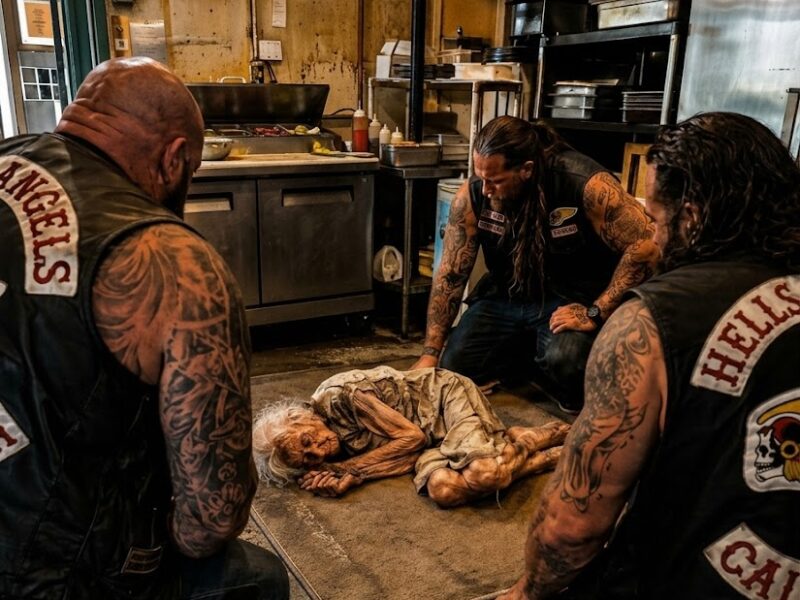
“He Charges Me Rent to Sleep Here,” the Elderly Woman Told the Bikers—Then They Found the Original Deed
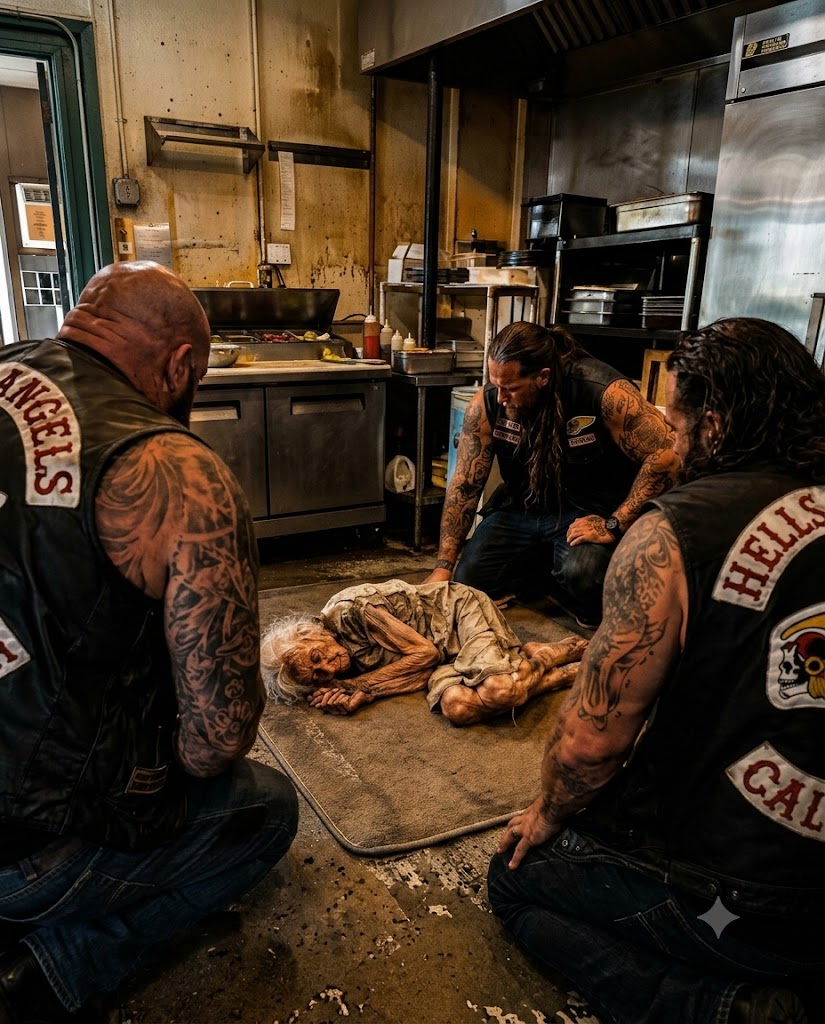
She was 78 years old, folded onto a concrete floor behind a dead diner. And nobody in that doorway knew her name.
Nobody asked how she had survived three winters paying a stranger to sleep in the cold and the dark. Nobody asked why her hands, thin as paper, still moved with a steadiness that didn’t match the rest of her. Nobody asked what she had been before this.
Then the men filled the doorway. Leather cracked pale at the shoulders, ink sleeving thick forearms, boots heavy enough to rattle the loose tile under the sink. The crowd behind them had already decided what came next, and it wasn’t kindness.
What those men found on that floor, and what they did with it after, never made it into any report anyone could find.
The Tulie fog came off the delta before the sun did, rolling down Charter Way in a gray sheet that swallowed the streetlights one by one. Margaret Hollis had learned to move through it the way a woman moves through a room she has memorized in the dark.
She knew which floor tiles in the old kitchen had come loose enough to click under her weight. She knew the exact angle to hold the flashlight so its beam would not show through the boarded front windows and draw attention from the sidewalk. She knew most of all that the fourteenth of the month meant three hundred and forty dollars in a coffee can, counted twice, ready before Dale Kesler’s truck idled at the loading dock behind the diner.
The Blue Plate had been dead for six years, ever since old man Kesler’s father died and the health inspector’s red notice went up on the door and never came down. The grill was cold iron now, furred with rust. But the back kitchen still had four walls and a roof that mostly kept out the rain.
And to Margaret, with a Social Security check that could not cover both her medication and an apartment with working locks, four walls and a roof was a kind of wealth. She told herself it was temporary. She had told herself that for three winters.
She unrolled the thin rug she kept behind the walk-in and lay down on it fully dressed in the same cardigan she had worn since October, because the diner had no heat and would never have heat again. Her hip found the two-inch foam pad she had scavenged from a dumpster behind the mattress outlet on Wilson Way. She did not sleep so much as wait, some nights, for the cold to loosen its grip enough that her body would agree to shut off.
She was still waiting when the light changed outside the boarded window, and she realized she had not eaten since the crackers the day before.
Two blocks away on El Dorado Street, the Iron Wolves Motorcycle Club was loading the last propane burner into a flatbed truck that had once hauled irrigation pipe for a Modesto almond grower. Every Thursday before dawn, for eleven years, the club had run what they called the rolling kitchen down through the underpasses and out toward the Charter Way corridor, ladling out hot food to whoever was awake enough to hold a bowl.
It was not something they advertised, and not something that showed up on any city flyer about the club. Flyers that used words like “criminal enterprise” without ever mentioning the meals the club had quietly served for over a decade.
Walter Doyle drove the flatbed himself. He was sixty-six years old, built like a man who had spent decades doing physical work and had never entirely stopped, with a gray beard trimmed close and reading glasses that lived on a cord around his neck because he had lost four pairs to his shirt pocket.
The younger members called him Preacher, not because he preached, but because the first time most of them heard him talk for more than a minute, they found themselves agreeing with things they hadn’t meant to agree with.
Beside him in the cab, Cody Sutter checked his phone for the third time in as many minutes. Cody was twenty-four, patched into the club only eight months earlier, and he had opinions about how the club spent its Thursday mornings that he was not shy about sharing.
“Sheriff’s got a task force meeting today,” Cody said. “About us, about the block on Fresno Street, and we’re out here handing out grits to people who aren’t even going to remember our names in an hour.”
“Nobody remembers a meal an hour later,” Walter said, eyes on the road. “They remember not being hungry.”
“That’s not what I mean.”
“I know what you mean.”
They turned onto Charter Way as the fog began to thin into a gray haze. And it was Hank Callahan, riding sweep on his bike behind the truck, who spotted her first. A shape near the loading dock of the shuttered diner, folded at an angle no sleeping person chooses on purpose.
He radioed ahead, and Walter had the flatbed stopped and was out of the cab before Cody had finished asking what was wrong. Margaret heard boots on gravel before she understood she was being approached, and every instinct in her told her to make herself smaller, the way she had learned to do since the shelters filled up and the nights got colder and men’s voices near where she slept had stopped meaning anything good.
She opened her eyes to a wall of black leather and ink, and a beard the color of iron, and for one long second neither of them moved.
“Ma’am,” Walter’s voice came out low, the way he’d learned to talk to spooked animals and frightened tenants, both back in a life he did not often mention. “You hurt?”
She did not answer. Her eyes went instead to Cody, standing a few feet back with his arms crossed, and to Hank, still straddling his bike at the curb. And something in her face made it clear she was doing the same math dozens of people had done looking at these men. Leather, size, ink, the particular silence of men used to being watched with suspicion, and coming up with an answer that had nothing to do with who they actually were.
It was the key that Walter noticed next, hanging from a shoelace around her neck, half tucked into her collar. Old brass, worn smooth, with two scratched letters still visible on the bow. BP. Blue Plate.
He did not ask about it yet. He crouched instead, slow, the way you’d approach a hurt dog, and held out a paper cup of coffee that was still steaming in the cold morning air.
“Name’s Walter,” he said. “We’re not here to cause you any trouble. Just food, if you want it.”
For a long moment, Margaret Hollis, who had not accepted help from a stranger in three years because help from strangers always came with a price nobody mentioned up front, looked at the steam rising off that cup like it might be a trick. Then, because her hands were shaking too hard to hide it any longer, she reached out and took it.
The rolling kitchen’s folding table went up at the end of the loading dock, and within twenty minutes Margaret Hollis was sitting on an overturned milk crate with a bowl of grits and sausage in her lap and a wool blanket someone had produced from a saddlebag draped over her shoulders. She ate slowly, the way people eat when they have taught themselves not to look hungry in front of others.
And Walter Doyle sat across from her on another crate, not too close, not asking anything yet, just letting the silence do its work the way it had for twenty-two years in a job he no longer told most people about. He watched her hands as she ate. Steady, despite the cold, despite the thinness of her wrists. Watched the careful, economical way she wiped the bowl clean with the last piece of bread. Nothing wasted, nothing left.
He had inspected enough failing households in his old life to recognize the particular discipline of someone managing scarcity as though it were a skill rather than a punishment.
“You got somewhere warm to be tonight?” he asked finally.
“I’m fine,” Margaret said, in the flat, closed voice of a woman who had said those two words so many times they had stopped meaning anything even to her.
Cody, leaning against the truck bed with his own bowl untouched, made a small sound in his throat that wasn’t quite a word. Walter caught it anyway.
“Something to say?”
“Just that we’ve got a task force sniffing around the clubhouse over a shooting three blocks from here that had nothing to do with us, and we’re spending club hours parked outside a building the county condemned six years ago.” Cody kept his voice low, but not low enough. “I get the food run. I don’t get why we’re still standing here.”
Margaret’s spoon stopped halfway to her mouth. For the first time since they’d found her, something like shame crossed her face, quick and unmistakable, and she set the bowl down on the crate beside her as though it had suddenly gotten too heavy to hold.
“He’s right,” she said. “You should go. I don’t need looking after.”
“Nobody said you did,” Walter said, and shot Cody a look that ended the conversation without a single raised voice.
It was Hank Callahan, of all people, who noticed the coffee can when Margaret shifted her blanket and it rolled a few inches across the concrete. He caught it before it tipped, saw the rubber-banded stack of bills inside through the gap where the plastic lid didn’t quite seal, and something about an old woman with a coffee can full of cash sleeping on a concrete floor made even Cody go quiet.
“Ma’am,” Hank said carefully, setting the can back beside her. “That yours?”
Margaret’s hand closed over it fast, the reflex of someone protecting the one thing standing between her and something worse than cold.
“It’s for the rent,” she said before she could stop herself.
The word landed strange in that place. Rent, spoken about a building with plywood over its windows and a red notice bolted to the door since before Cody had gotten his driver’s license.
Walter leaned forward slowly, elbows on his knees, and kept his voice as even as he could make it. “Rent to who, ma’am?”
Margaret looked at the three of them for a long moment. Men she had been raised by decades of instinct and a lifetime of headlines to cross the street from. And something in her seemed to give way. Not all at once, but like a wall finally admitting a crack it had been hiding for years.
“He charges me rent to sleep here,” she said quietly. “Dale Kesler. Three hundred and forty dollars, first of every month, or he says he’ll bring someone to clear me out and I won’t have anywhere at all.”
Nobody spoke for a moment. Somewhere down Charter Way, a truck downshifted and a dog barked twice behind a chain-link fence.
“There’s no power in that building,” Walter said. It wasn’t a question. He had already clocked the dark windows, the meter box on the side wall with its glass face shattered and its wiring pulled, the sag in the roofline over the north end that spoke of water damage nobody had addressed in years.
“There’s a candle,” Margaret said, as if that settled it.
Cody’s jaw tightened. Whatever argument he’d been building about task forces and county attention seemed, for the moment, to have lost its footing.
“How long?” Walter asked.
“Three years in March. And he’s never once fixed anything. Never turned the lights back on, never given me a lease, a receipt, anything with his name on it.”
Margaret’s silence answered for her. Walter sat back, and something moved behind his eyes that none of the younger men riding with him that morning had seen before. Not quite anger. Something colder and more patient than anger. A kind of recognition, like a man finding an old familiar tool still hanging exactly where he’d left it on a wall he thought he’d walked away from for good.
“Ma’am,” he said, “I used to do a job a long time ago where I walked through buildings just like this one for a living. I know what a red notice means. I know what it means when a man charges rent on a building the county says nobody’s allowed to live in.” He paused. “I’d like to come back and take a proper look, if you’ll let me. Not to cause you trouble. To see exactly what he’s got you sleeping inside of.”
Margaret studied him. The beard, the leather, the ink disappearing under his collar. And then, for the first time that morning, something that might have been the beginning of trust moved across her face.
“You’re not going to call anybody. Any authorities.”
“Not without asking you first,” Walter said. “Not ever, if that’s what you need.”
She nodded slow and pulled the blanket tighter around her shoulders. And behind her, unnoticed by everyone but Walter, Cody Sutter was watching the old woman’s face with an expression he did not yet have a name for.
Before they packed the rolling kitchen away for the morning, Walter pulled his phone out and typed a short message to a number he had not used in almost two years. Denise Whitfield had been a junior inspector under him back when he still carried a county badge, and she now ran code enforcement for the whole east side of the city. He didn’t say much, just that he might need a favor soon. Nothing official yet. And he watched the message send before sliding the phone back into his jacket like he wasn’t sure he’d actually done it.
Cody noticed that, too. He noticed the way Margaret’s fingers trembled less once the coffee worked through her. The careful, almost military way she folded the wool blanket before handing it back. The flicker of pride on her face when Walter thanked her for it instead of just taking it. None of it fit the picture Cody had walked up with an hour earlier, and he did not yet like how much that unsettled him.
“We’ll come back Saturday,” Walter told her before they left. “Bring some tools. Take a real look at that wiring and the roof. You don’t have to decide anything about Kesler today. Just let us look.”
Margaret hesitated, one hand still resting on the coffee can in her lap. And then she nodded again, smaller this time, like a woman conceding a point she wasn’t yet ready to admit she’d lost.
Saturday came in cold and clear. The fog finally burned off by a wind pushing down out of the Sierra foothills, and Walter arrived at the Blue Plate with a canvas bag of tools he hadn’t opened in four years. His knee complained on the loading dock steps the way it had complained every day since a warped floor joist in a Fresno Street property gave out under him and ended his career eleven months short of his pension eligibility date.
An injury the county’s insurance carrier had spent two years arguing wasn’t quite as serious as his surgeon said it was. He did not talk about that anymore. But climbing into the Blue Plate’s dead kitchen with a flashlight in his teeth, running his fingers along conduit that hadn’t seen a licensed electrician in a decade, he felt something in his chest loosen that had been tight for a long time.
What he found took less than twenty minutes to catalog and would have taken the county condemnation board about the same amount of time to act on, had anyone from the county actually walked through the door. Knob-and-tube wiring decades past its service life, spliced with electrical tape in at least six places. Black mold blooming behind the walk-in where a slow leak had been running for years. A support beam over the north storage room sistered with a two-by-four that wouldn’t have passed inspection in 1975, let alone now.
It was not a building. It was a liability wearing a building’s shape. And Dale Kesler had been quietly renting space inside it, in cash, off the books, to a woman with nowhere else to go.
“This isn’t just her,” Walter said that evening back at the clubhouse, spreading his notes across the workbench in the garage while Hank and two other members listened. “Kesler owns at least two other properties on the east side. Both flagged in county records years ago. I want to know who’s living in them.”
It took three days of quiet asking. A records request Denise Whitfield ran for him off the clock. A conversation with a tenants’ rights paralegal Hank’s sister knew from her church, to confirm what Walter had already suspected. Kesler had been doing this for the better part of a decade. Buying condemned or near-condemned properties cheap at tax auction, then finding people too poor, too old, or too afraid of shelters to say no to cash-only rent for buildings the law said no one should be sleeping inside.
Three known tenants besides Margaret. Two of them elderly, one with a wheelchair he had to carry up broken steps by hand.
Walter felt the old fire again, the one that used to get him up at five in the morning to walk properties before the heat became unbearable. And underneath it, quieter, the old fear that the county wouldn’t move without a badge behind the report, and he didn’t have one anymore. He had spent a year after his injury believing the job had been the only part of him that mattered, and losing it had left him uncertain whether the knowledge in his head still counted for anything without the authority to act on it.
It was Cody, of all people, who gave him the push he didn’t know he needed. The kid had come by the Blue Plate that Saturday to help move debris, still muttering about task forces and optics, right up until he sliced his palm open on a jagged edge of sheet metal buried in a pile of storage-room junk.
He swore loud, and Hank went for the truck’s first aid kit, but Margaret was already there before either of them. Kneeling in front of Cody with his hand turned palm up in the gray afternoon light streaming through a gap in the plywood.
“Hold still,” she said, in a voice that had not been in the diner an hour earlier. Flat, clipped, entirely without panic. She pressed a folded cloth against the wound with exactly enough pressure and not a fraction more. Checked his fingers for movement. Checked the wound’s edges with a steadiness that made Cody forget for a moment to keep complaining.
“You’ve done this before,” Cody said, staring at her hands instead of his own.
“A long time ago,” Margaret said, and did not elaborate. But her fingers moved through the makeshift bandaging with a fluency no amount of watching daytime television could have taught her, folding the cloth into a pressure dressing as clean as anything Cody had seen a paramedic produce. Hank arrived with the first aid kit a moment too late to be useful and stood there holding it while Margaret finished tying off the bandage.
“Ma’am,” Hank said slowly. “Where’d you learn to do that?”
Margaret’s hands stilled for just a second. Some old door swinging half open behind her eyes before she pushed it shut again. “Long story,” she said. “For another day.”
Cody looked down at the neat, competent bandage on his own hand, then up at the woman he had called a waste of the club’s Thursday morning three days earlier, and said nothing at all. Which, for Cody, was its own kind of confession.
That night, Walter called Denise back. “I need you to walk the Blue Plate off the record,” he told her. “And I need to know if Kesler’s got a hearing coming up on any of his other properties. Because I think it’s time somebody made him answer for all three at once.”
Denise was quiet on the line for a moment. “You know he’s not going to go quietly if he thinks you’re about to cost him four hundred a month, times four people, times years.”
“I know,” Walter said, looking through the garage window at Margaret’s silhouette in the passenger seat of his truck, wrapped in the same wool blanket, waiting for a ride to somewhere warm for the night. “That’s exactly what worries me.”
He was right to worry. Two days later, Dale Kesler showed up at the Blue Plate himself for the first time in months. His pickup idling crooked across the loading dock, and he found Margaret sweeping loose plaster from the storage-room floor where Walter’s crew had shored up the ceiling beam.
“Heard you’ve got some new friends,” Kesler said, leaning in the doorway. A heavy-set man in his mid-fifties with the soft, unbothered voice of someone who had never once had to raise it to get what he wanted. “Heard they’ve been asking the county questions about my properties.”
Margaret kept sweeping. “I don’t know anything about that.”
“See, I don’t believe you,” Kesler said. “But I’ll tell you what I do believe. I believe you like having a roof. I believe you like not sleeping in your car behind the Greyhound station like you were before. I did you a favor three years ago. And I believe that favor can end a lot faster than it started, if certain people don’t mind their own business.”
He let that sit in the cold air between them. “You tell your biker friends to enjoy their coffee and stay out of my business. Or the both of you can find out how the county deals with squatters instead of tenants.”
He was gone before she could answer. His truck’s tires spitting gravel across the loading dock, and Margaret stood alone in the ruined kitchen for a long time afterward, the broom forgotten in her hands, before she finally picked up the disposable phone Hank had given her and dialed the only number saved in it.
The digital clock over the Blue Plate’s dead grill had stopped working years earlier, frozen at some forgotten hour. But the one on Walter’s dashboard read 11:47 p.m. when Hank’s voice cracked over the radio. It was a Wednesday, the twenty-first of January, cold enough that the windows of Walter’s truck had already fogged at the edges, and Cody was riding two car lengths behind him down Charter Way when the call came through.
“Two men, a van, parked behind the diner,” Hank said. “They’re not Kesler’s usual crew. One’s got a crowbar. I think they’re going in after her.”
Margaret had gone back to the Blue Plate against Walter’s advice that morning, insisting she needed to collect the last of her medication before the shelter intake closed for the night. And Kesler, it seemed, had decided that a woman digging through code violations with a biker’s help was a liability worth removing before Denise’s hearing could be scheduled.
Walter did not remember deciding to run the red light at Wilson Way. He remembered only the sick, hollow drop in his stomach that he had not felt since the day the floor joist gave out beneath him, and the certainty that this time it would not just be his own body paying for it.
They reached the loading dock forty seconds after Hank. Red and blue shadows nowhere in sight yet. Sirens still a distant promise on the far side of the underpass. Inside, the beam of a flashlight swept wild and fast across the kitchen walls.
One man had already forced the walk-in door open, scattering Margaret’s few boxes of belongings across the concrete. The other stood over her where she’d backed herself against the stainless steel counter, crowbar loose but ready in one hand.
“You’ve got until I count three to walk out that door,” the man with the crowbar was saying, “or we start walking you out.”
“Three,” said Walter from the doorway. And the man spun to find himself facing a wall of leather and silence he had clearly not planned for.
What happened next lasted less than ninety seconds, and none of it was the kind of thing Walter was proud of afterward, even knowing it had been necessary. Hank went in low and fast, closing the distance before the second man could raise the tire iron he’d pulled from his waistband, and put him face down against the stainless counter hard enough to knock the wind out of him, but nothing worse.
Cody took the crowbar off the first man’s grip with a wrench that would have made his old wrestling coach proud, twisting until the man dropped it and swore, cradling a wrist that had bent wrong in the struggle.
It was Margaret who moved first once the room went quiet. Stepping past Walter without hesitation to kneel beside the man cradling his wrist.
“Let me see it,” she said, in the same flat, clipped voice she had used on Cody’s hand three days earlier. And when the man tried to pull away, she held his forearm with a grip that belied every assumption anyone in that room had ever made about her.
“I said let me see it. It’s not broken, but you’ll lose feeling in those fingers if you don’t stop clenching.”
“How do you—” The man started and stopped, because Margaret Hollis was already binding his wrist with a torn strip of her own cardigan, steady and unhurried. The way a person moves when a skill has been carved so deep into their hands that fear cannot touch it.
“I was an army nurse,” she said, not looking up. “Twelfth Evacuation Hospital outside Cu Chi, 1968 to 1970. I set more broken bones in a year over there than most doctors see in a career. Then I spent thirty-one years on the trauma floor at the VA hospital in Palo Alto, until I retired and outlived my pension.”
She finally looked up at Cody, at Hank, at the two men now sitting on the floor waiting for the police they could already hear approaching. “So don’t act surprised that an old woman knows how to stop bleeding. Half of you decided who I was the moment you saw where I was sleeping.”
Nobody said anything for a moment. Outside, the sirens were close enough now to bounce off the buildings along Charter Way. Red lights sweeping across the boarded windows in long, slow arcs.
Walter looked at her. Really looked, the way he hadn’t quite let himself since the morning they found her on that loading dock. And then at Cody, whose face had gone through something in the last five minutes that Walter suspected would outlast the bruise already forming on the intruder’s wrist.
“People built like her,” Walter said quietly, mostly to Cody, though he made sure it carried, “aren’t the fragile thing you feel sorry for on your way past. They’re the ones who patched up boys screaming in a country you couldn’t find on a map, and did it without flinching, and never once asked anybody to notice.” He paused. “Don’t you ever again mistake quiet for weak. It’s usually just the opposite.”
Cody didn’t answer. He didn’t need to. He crossed the kitchen, picked up the blanket that had fallen from Margaret’s shoulders in the struggle, and settled it back around her without a word. The gesture of a man who had finally run out of arguments worth making.
The police took statements for over an hour. Officers moving between the two men from the van and the small, oddly calm crowd of bikers and one elderly woman who kept insisting she was fine and didn’t need the paramedics fussing over her blood pressure.
Denise Whitfield arrived just behind the first patrol car, a folder of red emergency tags already printed under one arm, and it was clear she had been waiting for an excuse to use them longer than she’d let on to Walter. Dale Kesler arrived twenty minutes after that, drawn by a call from one of the men he’d sent, and made the mistake of walking straight up the loading dock ramp demanding to know who had given anyone the right to trespass on his property.
He stopped short when he saw the patrol cars, the paramedics, and Officer Paul Anders standing with a notepad already half full of statements naming him directly.
“Mr. Kesler,” Anders said, “we need you to come to the station and answer questions about a property you own that’s been condemned since 2020, and about three hundred and forty dollars a month you’ve been collecting from a tenant in a building with no legal occupancy permit.”
“She wanted to stay there,” Kesler said too quickly, his voice losing the soft, unbothered register it had carried on the loading dock two days earlier. “Nobody forced her.”
“Sir,” Denise said, stepping forward with the emergency tag already in hand, “the county doesn’t require force. It requires you to not knowingly collect rent on a structure you were legally informed was unfit for habitation. Three separate times going back four years, according to the letters my office has on file with your signature on the return receipts.”
Kesler looked past her toward Margaret, who stood wrapped in her blanket between Walter and Cody with a steadiness that made whatever he’d planned to say next die somewhere in his throat. Whatever he saw in her face—not triumph, not even satisfaction, just a tired, unwavering certainty that this reckoning was overdue—seemed to cost him something he did not have a way to argue with.
They led him to a second patrol car without handcuffs, for now. Though Anders made it clear that would likely change once the other two properties came up in the system.
By the time the sun came up over the delta fog the following morning, the Blue Plate diner had a new notice bolted to its door. One that named Dale Kesler, not Margaret Hollis, as the person the county wanted answers from.
Dale Kesler was arraigned five weeks later on charges of financial elder abuse, criminal code violations across three properties, and unlawful collection of rent on condemned structures. The county’s case, built largely from Denise Whitfield’s records and a paper trail Walter had helped her assemble one property at a time, named four victims in total. Margaret. A widower with a wheelchair on Fresno Street. And a retired couple who had been paying Kesler in cash for a converted garage with no plumbing since before the pandemic.
The retired couple’s daughter, reached by a reporter from the Stockton Record, said only that she hadn’t known, and that she would carry that not knowing for the rest of her life.
Margaret did not attend the arraignment. She said she had spent enough of her life standing in rooms explaining herself to people who had already decided what kind of woman she was, and she did not intend to spend one more afternoon doing it for Dale Kesler’s benefit.
Instead, she spent that Thursday morning exactly where she had spent every Thursday morning for the five weeks since the diner. At a folding table on El Dorado Street, ladling grits into bowls for the rolling kitchen, because it turned out feeding people who had nowhere warm to sleep was work she understood in her bones from a hospital ward outside Cu Chi that most of the men on that street had never heard of and never would.
A reporter from the Stockton Record tracked her down there in early February, drawn by the arraignment filing and the strange detail buried in the police report about an elderly witness who had calmly treated a suspect’s injury at the scene. Margaret agreed to fifteen minutes on the condition that the story be about the three other tenants too, not just about her.
She answered questions leaning against the same flatbed truck that had once hauled irrigation pipe, wearing a coat Hank had found for her at a surplus store. And when the reporter asked, almost as an afterthought, why she’d chosen to trust a group of bikers over the county, the shelters, or anyone else who might have helped her sooner, Margaret considered the question longer than any other that morning.
“Nobody else stopped,” she said finally. “Plenty of people saw me on that loading dock over three years. Not one of them got out of their car. These men did, and they didn’t ask what I looked like first.”
The reporter wrote that line down twice, and it ran eventually as the headline of the piece, though by then Margaret had already stopped reading her own name in the paper, having decided decades earlier in a hospital tent outside Cu Chi that she’d rather be useful than famous.
She had a home again by then. A small one-bedroom in a senior housing complex off Country Club Boulevard that Denise had helped fast-track through a county voucher program meant for exactly this kind of case. Four decades too late to help her the first time she’d needed it, but not too late to matter now.
Walter had spent two Saturdays helping her move in, along with Hank and, somewhat to his own surprise, Cody, who showed up both times without being asked.
Walter, for his part, had started spending three mornings a week at Denise’s office downtown. Unofficially at first, then on an actual consulting contract the county’s tenant protection program drew up once word of the Blue Plate case reached the city council. He walked properties again. He wrote reports again. Nobody called him Preacher in that building, but he found he didn’t mind being called Mr. Doyle by people half his age who wanted his opinion on a load-bearing wall.
And some nights he came home to the clubhouse smelling faintly of mildew and old insulation, looking for the first time in years like a man who had found the rest of the job he thought he’d lost for good.
At a city council meeting in late February, called after the Record story generated more calls to the mayor’s office than any single piece of local news had in over a year, Walter was asked to speak for three minutes about what the club had found inside three of Kesler’s properties. He kept his notes brief and his voice level, the way he’d once delivered testimony at code enforcement hearings decades earlier.
And when a council member asked whether the Iron Wolves intended to keep involving themselves in the city’s housing enforcement, Walter said only that the club would keep running the rolling kitchen every Thursday, whether the county thanked them for it or not, and that somewhere along the way, apparently, that had started counting as involvement.
A few people in the gallery laughed. More of them, Denise told him afterward, had stopped by the clerk’s office the next morning asking how to report similar situations in their own neighborhoods.
The change in Cody was smaller and took longer to notice, which was, Walter thought privately, probably the more honest kind. He stopped making comments about optics during the Thursday food runs. He started arriving early instead of on time, and started introducing himself to the people in line by name instead of nodding past them toward the food.
Hank noticed it too, though he never said anything about it directly. Only that Cody had started riding sweep on Thursdays without being assigned the position, the way a man volunteers for a job he’s quietly decided matters more than he originally let on.
And on a cold Saturday morning in early March, six weeks after the arraignment, Cody showed up at Margaret’s new apartment unannounced with a toolbox borrowed from the clubhouse, having noticed on his last visit that one leg of her kitchen table wobbled every time she set a coffee cup down.
He didn’t make a production of it. He didn’t mention Kesler, or the loading dock, or the ninety seconds in that ruined kitchen that had rearranged something in how he saw the world. He just knelt down under the table, checked the joint, found a stripped screw, and replaced it with one from a little plastic bag he’d brought along in case the first one didn’t fit.
Margaret stood at her new stove, humming something without words, making coffee in a pot that worked, in a kitchen with lights that turned on with a switch instead of a match.
“There,” Cody said, climbing back to his feet and giving the table an experimental shove that didn’t move it an inch. “That ought to hold.”
“Thank you,” Margaret said, and poured him a cup without being asked. The way she’d once counted rent money into a coffee can without being asked. Careful and exact, and entirely her own.
Cody sat down at the table that no longer wobbled, wrapped both hands around the warm cup, and looked around the small sunlit kitchen. The working stove. The lock on the door that actually turned. The framed photograph on the windowsill of a much younger Margaret in an army uniform that he hadn’t worked up the nerve to ask about yet, but would eventually, when she was ready to tell it.
For now he said nothing else at all. Because for once, in a life that had taught him to expect the worst from most rooms he walked into, there was nothing left in this one that needed fixing.
—
The coffee can sat on Margaret’s new kitchen counter now, empty of rent money, repurposed to hold loose buttons and a few stray paper clips. She had kept it not out of sentiment but because it was still a perfectly good can, and throwing away something that still worked had never made sense to her.
Walter noticed it there the first time he visited, and said nothing. He didn’t need to. Some objects carry their own history without anyone having to explain them.
The Blue Plate diner itself was demolished that spring, condemned for good after an engineering report confirmed what Walter’s flashlight had already told him. A gas station chain bought the lot and put up a sign within six months. Nobody who drove past it anymore would ever know what had happened on that loading dock, or what a woman had survived behind those boarded windows for three winters.
But every Thursday before dawn, the rolling kitchen still rolled. Down through the underpasses, out toward the Charter Way corridor, steam rising off the pots in the cold gray air. And there was always a bowl for whoever was awake enough to hold one. That had not changed. That would not change.
Margaret rode along some Thursdays now, when her hip allowed it, sitting in the passenger seat of the flatbed with a blanket over her knees and a thermos of coffee in her hands. She didn’t ladle anymore. Her hands had earned the right to rest. But she watched the line form, and she watched Cody introduce himself to each person by name, and she watched Walter pour coffee with the same care he’d once poured it for her on a concrete floor behind a dead diner.
The key on the shoelace around her neck was gone now. She had given it to Denise Whitfield as evidence, tagged and bagged and entered into the county’s file on Dale Kesler. But sometimes, in the early mornings, her fingers still went to her collar, searching for something that was no longer there. Muscle memory, the body remembering what the mind had already released.
Dale Kesler pleaded guilty that summer to reduced charges, avoiding a trial that his lawyer had advised him he would lose. He was sentenced to eighteen months of house arrest, three years of probation, and restitution to all four tenants, including every dollar of rent he had collected from Margaret Hollis over three years. Twelve thousand, two hundred and forty dollars, paid in a lump sum to a woman who had never once asked anyone for a thing.
She used part of it to buy a new coat. The rest she put in a savings account, because old habits die hard, and because somewhere in the back of her mind she still remembered what it felt like to have nothing between herself and the cold.
The Iron Wolves’ clubhouse still had a task force sniffing around it that spring, and the flyers still used words like “criminal enterprise.” But the rolling kitchen kept running every Thursday, and the people in line kept coming, and somewhere along the way, the club had become something the city couldn’t quite decide how to categorize.
Which, as Walter Doyle liked to say, was probably the most honest thing about them.
On a warm afternoon in June, Margaret sat on the small balcony of her apartment with a cup of coffee and watched the sun go down over the delta. She thought about the loading dock. She thought about the three winters. She thought about the men who had filled that doorway and what they had found on the floor and what they had done with it after.
She thought about how nobody in that doorway had known her name. And how, now, there were a dozen people who did.
She finished her coffee, went inside, and locked the door behind her. The lock turned smooth and easy, the way locks were supposed to. And for the first time in a long time, Margaret Hollis slept through the night without waking once.
—
*The key was gone. The can remained. The table no longer wobbled. And somewhere down Charter Way, the rolling kitchen kept rolling, because that was what you did when you found someone folded onto a concrete floor behind a dead diner.*
*You stopped. You asked her name. And you didn’t ask what she looked like first.*









