
He Came Home to Find His 78-Year-Old Mother Serving His Wife’s Friends—Then One Question Silenced the Room
The airport gate smelled like stale coffee and floor wax. Marcus Reed sat in a molded plastic chair, his carry-on resting against his leg, watching a family of four wrestle with a double stroller.
His phone buzzed. The client’s operations director. Something had come up. The meeting was off.
Marcus could have rebooked. He could have driven to the office and spent the afternoon catching up on emails. Instead, he picked up his bag, walked out to the parking deck, and drove home.
He didn’t call ahead. There didn’t seem to be a reason to. It was his house. He thought a surprise might be nice for once. A chance to take his wife and his mother out to dinner instead of eating leftovers alone at ten o’clock at night.
He pulled into the driveway a little after three. A few unfamiliar cars lined the curb. Tasha had friends. Tasha always had friends.
When he opened the front door, the first thing he heard was laughter from the living room. Loud and easy. The sound of women who were completely comfortable.
Then, underneath it, he heard something else. Water running in the kitchen. The steady clink of plates being set down one at a time on the counter.
Marcus stood in the entryway with his bag still on his shoulder and listened to both sounds at once. For a moment, he didn’t understand why the second one made his stomach tighten.
He set his bag down and walked toward the kitchen.
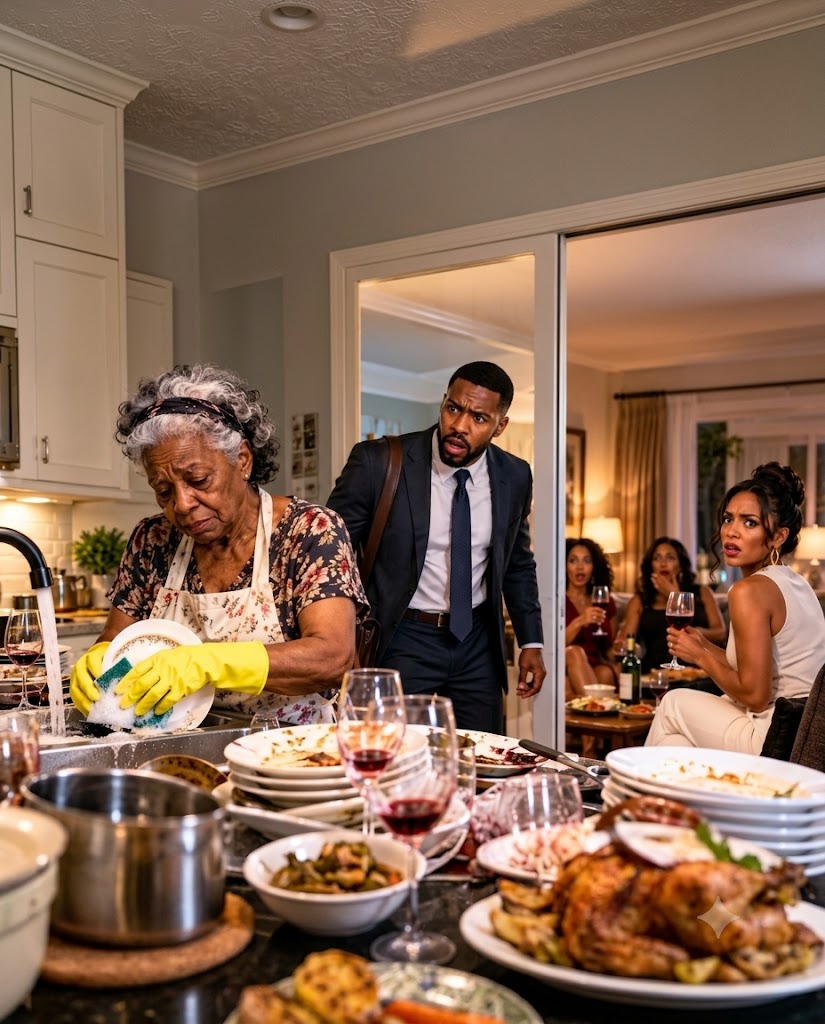
His mother was standing alone at the sink with her back to him. Yellow rubber gloves on her hands. Working through a stack of dishes that reached almost to the faucet.
The counters were covered with wine glasses, cocktail glasses with lime wedges stuck to the bottom, plates smeared with dip, and two big serving trays holding the remains of wings and cut vegetables.
None of it was hers. Gloria didn’t drink. She didn’t eat wings. All of it had come from the party still going on in the next room.
“Mom, what are you doing?” Marcus asked.
She startled a little. She hadn’t heard him come in over the water and the music. When she turned and saw him, something crossed her face. Surprise first. Then something closer to worry.
“It’s fine,” she said, much too quickly. “I offered.”
She smiled at him. The same smile she used to give him when he was twelve and asked whether they had enough money for the electric bill. Then she turned back to the sink as if that settled it.
Before her hands went back into the water, Marcus watched her rub her right wrist with her left thumb. Slowly and hard. The way you rub a joint that has been aching all day. She did it without thinking. She didn’t know he was watching.
It lasted maybe two seconds. It was the only honest thing in that kitchen, and it told him more than anything she could have said out loud.
He looked through the doorway into the living room. Tasha was on the sofa with her legs tucked under her, a glass of wine in her hand. Denise sat beside her. The other two women were in the armchairs across from them.
There was music coming from the speaker on the shelf. Someone was in the middle of a story that had everyone laughing. Not one of them was looking toward the kitchen. Not one of them seemed to think there was anything strange about a seventy-eight-year-old woman washing up after them twenty feet away.
Marcus walked into the living room. He didn’t raise his voice. He didn’t need to.
He stood at the edge of the rug where all four of them could see him clearly, and he asked the only question that mattered.
“Why is my seventy-eight-year-old mother washing your dishes while you’re sitting here?”
The laughter stopped as if someone had pulled a plug. The woman telling the story closed her mouth. One of the friends in the armchairs looked down at her glass like she wasn’t sure whether to set it down or keep holding it and pretend she hadn’t heard a thing.
Tasha’s face went red from her neck all the way up to her forehead. She set her wine glass on the coffee table and stood, smoothing the front of her blouse. She looked not at her husband, but at her friends. One after another. Like she was measuring how bad this looked from where they sat.
Then she stepped closer to him and lowered her voice to almost nothing.
“Marcus, not in front of my friends.”
That sentence stopped him harder than anything else could have. Marcus had come into that room angry. But he had come in expecting something from her. An explanation. An apology. Maybe even surprise, as if she honestly hadn’t realized.
What he got instead told him exactly where her mind was. She didn’t say his mother shouldn’t be doing that. She didn’t say she’d go and help her right now. She said, “Don’t talk about this in front of my friends.”
The problem to her wasn’t what was happening in the kitchen. The problem was that someone had finally noticed.
He looked at the three women sitting in his living room. He didn’t know two of them well at all. They were polite people who had eaten at his table and waved at him from their cars. He wondered how many afternoons they had sat in those exact seats while his mother moved around them with trays and glasses.
He wondered whether any of them had ever thought it was odd. And standing there, he understood that none of it had happened in secret. It had happened in plain sight. It had just happened while he wasn’t looking.
Tasha recovered quickly. She always could. She put on the softer voice she used with difficult neighbors and customer service lines, and she explained that Gloria had volunteered.
She said she had told Gloria to leave the dishes. That she’d get to them later. But that Gloria had insisted.
“You know how your mother is,” she said. “She won’t sit still. I can’t stop her from helping. Believe me, I’ve tried.”
Marcus turned around. His mother had come to stand in the kitchen doorway. The yellow gloves were still on her hands. Water dripped from the fingertips onto the tile.
He asked her if what Tasha said was true. She looked at him. Then at Tasha. Then back at him. And he watched her decide.
“I told her I’d take care of it,” Gloria said. “It’s just a few dishes, Marcus. Don’t turn this into something it isn’t.”
She was protecting her daughter-in-law. Even then. Even standing there with her wrist aching. For a moment, Marcus didn’t know what to do with that. His mother was telling him he was wrong, and his wife was standing in front of him waiting for him to back down.
The easy thing would have been to take his mother’s word. Apologize to the room. Carry his anger quietly into the kitchen. He could feel every person in that house waiting for him to do exactly that.
And he might have. Then Denise leaned forward and set her glass down on the coffee table.
Denise had been Tasha’s friend longer than Marcus had been Tasha’s husband. She was a quiet woman. The kind who listened far more than she talked. In all those years, he had never once heard her contradict Tasha about anything.
She didn’t look at Marcus when she spoke. She looked down at her own hands folded in her lap.
“Tasha, that’s not completely true.”
Tasha turned toward her so fast her earrings swung. “Excuse me?”
Denise took a slow breath and kept going. Still quietly. Still not raising her eyes. She said this wasn’t the first time. She said that at the last few get-togethers, she had heard Tasha call toward the back of the house for Gloria to bring more ice, or to clear off the table, or to carry out the next tray of food. She said it had made her uncomfortable every time, and she was sorry she had never said anything.
Every word Denise said seemed to land on the room like something heavy being set down. The other two women found places to look that weren’t Tasha’s face. Gloria stayed in the doorway, completely still.
Marcus thought about all those Saturdays he’d spent at the office or at an airport, telling himself his family was fine at home. All that time his mother had been getting called from another room like hired staff at somebody else’s party.
Tasha’s voice finally rose. “She never complained. Not once. If it was such a problem, she could have said something. She’s a grown woman, Marcus. Nobody forced her to do anything.”
She looked over at Gloria as though waiting for her to confirm it. Gloria didn’t say a word.
Marcus looked at his wife and gave her the only answer he had. “She shouldn’t have to complain.”
He could feel the next words forming before he even opened his mouth. He wanted an apology. And he wanted it right there, in front of the same friends she had been so worried about. He wanted her to walk into that kitchen, take the gloves off his mother’s hands, and finish those dishes herself while everyone watched.
He took a step toward her to say exactly that. And that was when Gloria spoke from the doorway.
“Marcus, stop.”
She said it quietly. It was the voice she’d used when he was fourteen and about to say something to a teacher that he could never take back. She walked out of the doorway and into the living room. She peeled off the yellow rubber gloves one finger at a time and laid them over the back of a dining chair.
Her hands underneath were red and swollen at the knuckles. Every person in the room looked at them.
Then, for the first time since she had come to live with them, Gloria told the truth.
“Yes,” she said. “She was tired.”
She was tired in a way she hadn’t been since she’d retired. Her back hurt at night. Her wrist hurt every morning when she woke up. And yes, there were days when she felt less like the mother of the man who owned this house and more like the help.
She said it plainly. Without looking at Tasha. Without any drama. The way she might have read off a grocery list.
Tasha’s lips parted. One of the friends quietly set her glass on the floor beside her chair.
Something in Marcus’s chest settled into place when he heard it. There it was. He had been right all along. He turned back toward Tasha, ready to finish what he had started.
But his mother wasn’t done.
“And you,” she said. And when he looked at her again, she was looking directly at him. “I blame you, too, son.”
The room went quiet in a way it hadn’t been even after his question. Nobody moved. Even the music from the speaker suddenly seemed too loud for the space.
Marcus didn’t understand her. He actually let out a small, disbelieving sound. “Me? Mama, I wasn’t even here.”
Gloria nodded slowly. “That’s what I mean.”
She said he had gotten so busy earning money and so busy protecting this family from everything out there that he had nearly stopped seeing what was going on in here. Inside his own home. She said it wasn’t a crime. And that plenty of good men did it. But it had consequences. And one of them was standing right in front of him.
“You saw my hands,” Gloria said. “You held one of them at the dinner table and turned it over and looked right at it. You saw me asleep in that chair before eight o’clock at night. You saw it, Marcus. And all it took was one easy answer for you to stop asking. Old hands. She likes to keep busy. That was enough for you. You wanted it to be enough.”
Marcus remembered her hands from when he was a boy. After her second job, she’d come home and soak them in a bowl of warm water at the kitchen table, flexing her fingers slowly while she asked him about his day. He used to sit across from her and watch the steam rise. He had promised himself back then that when he grew up, those hands would never have to work that hard again.
And now here they were. Red and swollen. In his house. Because of dishes from a party he wasn’t even at. While he was busy keeping promises to clients instead.
He stood in his own living room with his bag still sitting by the front door, and he realized the argument he thought he had walked into wasn’t the one he was really having. He had come in to confront his wife. He had been sure about who was wrong and who was right. Now his mother was holding up a mirror, and his face was in it, too.
Every question he hadn’t asked came back to him all at once. Not because he didn’t love her. Because asking would have taken time he kept telling himself he didn’t have.
Tasha started crying then. It wasn’t the quiet kind of crying that asks for forgiveness. It was hot and angry. She wiped at her face with the back of her hand while she talked. She said she was exhausted, too. And that nobody in this room seemed to care about that.
She said that for months, long before Gloria ever moved in, she had been holding this house together by herself because Marcus was almost never in it.
“You leave before the sun comes up,” she said, looking straight at him through her tears. “You come home after dinner. You eat standing at the counter and disappear into your laptop. When you’re not at the office, you’re on a plane or you’re on the phone with a client. I stopped asking you to be home for things, Marcus, because you never were. So don’t stand there and act like I’m the only one who let this happen.”
Her friends didn’t move. Denise kept her eyes on the floor. Marcus couldn’t argue with any of it. And that was the worst part.
Every example she gave was true. He had missed dinners with her family. He had canceled weekends she’d planned for them and promised to make them up, then never did. He had told himself she understood. That she knew what the job demanded. That everything he did was for the two of them.
Standing there, he had to face the possibility that she hadn’t understood at all. She had simply stopped expecting anything from him.
Tasha kept going. She said that when Gloria arrived and started helping, it felt like relief. There was someone else in the house. Someone else noticed when the laundry piled up or the sink filled. At first, she had been grateful. Truly grateful. And she had said thank you every single time.
But after a while, the thank yous got shorter. Then they stopped altogether. And then Gloria doing those things simply became the way the house worked.
She didn’t say the last part out loud. But Marcus heard it anyway. Gratitude had turned into habit. And habit had turned into something worse. A quiet assumption that Gloria would do these things because she always had. That she was just the kind of woman who did them. That it didn’t cost her anything because she never once said that it did.
Marcus looked at his wife. At the mascara running beneath her eyes. And he asked her the question he had been circling since the moment he walked into that kitchen.
“Did you ever ask yourself whether she was helping because she wanted to? Or because she was afraid saying no would hurt us?”
Tasha opened her mouth. But nothing came out. She looked at Gloria. Then at the floor. Then at her friends. And none of them could give her an answer, either. She sat back down on the sofa and put her face in her hands.
Her friends left a few minutes later. They did it quietly. Picking up purses and car keys. Murmuring goodbyes that nobody really answered.
Denise stopped beside Gloria on her way out and touched her arm for just a second. “I’m sorry,” she said.
Gloria patted her hand.
Then the front door closed. The cars pulled away from the curb one by one. And the three of them were alone in a house that suddenly felt much too big.
Marcus went to his mother’s room and pulled her suitcase out of the closet. He told her they were going to a hotel for the night. Maybe for a few nights. Until he could figure out what came next.
Then he walked back into the living room and told Tasha that while they were gone, she needed to think hard about this marriage and what kind of home she wanted to live in. He said it calmly. And he meant every word. He thought it was the right thing to do. The protective thing. The thing a good son does.
Gloria followed him into the living room and stood between them.
“No,” she said. “I’m not going to any hotel.”
Marcus started to argue. She raised one of those red hands to stop him. She said that if he turned this into a war with one person to blame and one person to punish, he would win the fight and miss the whole point.
“You want to find the bad guy,” she said. “I understand that. But if you make this about finding the bad guy, you’re going to miss the only lesson that matters here.”
Marcus felt almost insulted by that. He had just stood up for her in front of a room full of people. He had taken her side against his own wife. And now she was telling him he was doing it wrong.
But he also knew that look on her face. It was the same look she used to give him before she explained something he didn’t want to hear. Something that would turn out to be true whether he liked it or not.
So he set the suitcase down on the floor. And he let her talk.
Gloria turned to Tasha, who was still on the sofa with her knees pulled up to her chest. Her voice wasn’t angry. It was steady. The way it got when she had already made up her mind about something.
“You didn’t become cruel in one day,” she said. “You just got comfortable with someone else carrying your weight.”
Tasha flinched as if she’d been touched somewhere sore. But she didn’t look away. For the first time all afternoon, she didn’t look away from Gloria.
Then Gloria turned to her son. And she took her time. He was her boy. The one she had raised on two jobs and very little sleep. And Marcus could see on her face that this part cost her more than anything she had said to Tasha.
“And you got comfortable believing everything was fine,” she said. “Because asking harder questions took time.”
Neither Tasha nor Marcus said a word. There was nothing either of them could have said that wouldn’t have sounded like an excuse. And they both knew it.
Marcus carried the suitcase back into her room and set it in the closet where it had been. Tasha stayed on the sofa.
Gloria walked into the kitchen, looked at the dishes still stacked along the counter, and then walked right past them to her room and closed the door.
It was a small thing. But Marcus had never in his life seen his mother walk away from a dirty dish. And he stood in the hallway for a long time after her door clicked shut.
He barely slept that night. He lay next to his wife in the dark. Both of them awake. Both of them pretending not to be.
Around six in the morning, he gave up and went downstairs to make coffee. When he passed his mother’s room, the door was open and the bed was already made. The sheets tucked tight the way she had made every bed of his childhood.
Her suitcase was standing upright at the foot of it. Zipped and ready. Her purse sitting on top. His stomach dropped. He thought she was leaving because of him. Because of what he’d said and everything he had failed to see. Because she was angrier than she had let herself show the day before.
He found her at the kitchen table with a cup of tea. Fully dressed. Her coat folded over the chair beside her. The counters behind her were clear. Someone had washed every dish during the night. And it hadn’t been his mother.
He asked her where she thought she was going. He told her she didn’t have to leave like this. Not angry. Not in the middle of everything.
Gloria shook her head and told him she wasn’t leaving angry. She said the landlord had called her three days ago. The pipe was fixed. The walls were closed back up. Her apartment had been ready since Thursday.
She could have gone home three days ago.
Marcus stared at her across the table. Three days of dishes and laundry and trays of food. Three days she hadn’t needed to be in this house at all.
“Then why?” he asked her. “Why would you stay?”
Gloria wrapped both hands around her cup. By then, Tasha had come down the stairs and was standing at the edge of the kitchen in her robe, listening. Gloria knew she was there. And she answered anyway.
She said she had stayed because she wanted to see whether Tasha would notice on her own. Whether one day, without anyone saying a word, she would look up and see what she’d been letting happen. And put down her glass and come help.
“She didn’t,” Gloria said simply.
Then she looked at Marcus. And her eyes filled. She said that wasn’t what hurt her most. What hurt her most was that her own son hadn’t noticed either. That he had laid a blanket over her while she slept in a chair and gone upstairs to answer emails.
“I raised you to see people,” she told him. “I just never thought I’d be the one you’d miss.”
Marcus had no answer. At least none that would have meant anything.
Tasha stepped into the kitchen then and stood across the table from Gloria. Her arms folded tightly over her robe. Marcus expected an explanation. He expected her to talk again about how exhausted she had been. About him never being home. About everything she’d said the day before.
Everything he knew about his wife told him that was coming.
Instead, she said, “Gloria, I’m sorry.”
And she stopped there. She didn’t add a but. She didn’t explain what she had been going through or list the things Marcus hadn’t done. She just stood there with the apology hanging in the air between them. Unprotected. And let Gloria decide whether to accept it.
In all the years Marcus had known his wife, he had never heard her apologize without a reason attached to it.
Gloria looked at her for a long moment. Then she nodded once.
It would be nice to say that everything was fixed after that. But it wasn’t. Marcus didn’t forgive Tasha on the spot. And he didn’t pretend the day before had never happened. Forgiveness that comes too fast is just another way of not looking at something.
What they did instead, the three of them, was sit at that kitchen table while Gloria’s tea went cold and talk honestly about the things that should have been said weeks earlier.
They laid some things out plainly. Gloria was a guest in their home. And she was Marcus’s mother. Full stop. She was not free help. And she never should have been treated like it. If she chose to help with something, it would be because she wanted to. And she would be the one deciding. Not the one being asked until saying no felt rude.
Tasha agreed to all of it. Gloria made both of them say it out loud. And Marcus understood later that saying it out loud was the whole point.
Marcus drove his mother home that same Sunday afternoon. Her apartment smelled like fresh paint. The patched section of the bathroom wall was a slightly different shade than the rest.
She walked through every room slowly. Touching the backs of chairs and the edges of picture frames. The way you do when you’ve been gone long enough to miss your own things.
Before he left, she held his face in both hands like she used to when he was small. And told him she was proud of him for listening. He didn’t feel like he had earned that yet.
Then there was his part. That Monday, Marcus went into the office and started handing off the travel he didn’t truly need to take. He moved his early meetings later. He told his team he’d be leaving at six unless something was really on fire.
And he discovered that most things weren’t.
He had spent years telling himself that providing for his family was the same as being there for them. It wasn’t. A paycheck can keep the lights on in a house. But it can’t see who’s standing at the sink.
Tasha changed, too. Slowly. And without making speeches about it. She started doing her own laundry again. When her friends came over on Saturdays, she was the one refilling the ice, carrying out the trays, and loading the dishwasher after everyone left.
Some weekends Marcus helped her. And some weekends Denise stayed late to dry glasses beside her. Tasha was picking back up the things she had set on Gloria’s shoulders without ever quite deciding to put them there.
A few weeks later, Gloria came back to their house for dinner. Tasha cooked. And Marcus set the table. Gloria sat where they put her and let them serve her. And Marcus could tell that was harder for her than washing any dish had ever been.
They talked about her church. About her neighbor’s new puppy. About nothing important at all. It felt like a family eating together instead of a house being run by whoever happened to be standing closest to the sink.
When they finished, out of a lifetime of habit, Gloria stood and reached for the plate in front of her. She had it halfway off the table before she even realized what she was doing.
Tasha got there first. She put her hand on the edge of the plate and gently took it out of Gloria’s fingers.
“No, Mom,” Tasha said. “Sit down. I’ve got it.”
Marcus didn’t say anything. There was nothing he needed to say. He just stood up, walked around the table, and pulled his mother’s chair back out for her.
Gloria looked at him. Then over at Tasha standing at the sink with her sleeves pushed up. And then she sat down.
That evening, she wasn’t the woman expected to serve the people she loved. She was a mother visiting her family. And for once, she let herself be treated like one.
What happened in that house was never really about a sink full of dishes. It took Marcus a long time to understand that. Disrespect doesn’t always arrive with an insult or a slammed door. Sometimes it starts much more quietly. When one person’s kindness gets repeated so often that the people around them stop seeing it as kindness at all. And start treating it as their job.
Gratitude isn’t only saying thank you. Marcus had said thank you to his mother his whole life. Real gratitude is noticing. It’s seeing when someone you love is caring too much. Even when they’re smiling. Even when they tell you they’re fine. Even when they hold out their red hands and call them old.
Gloria told her son the truth that Saturday afternoon. Marcus only wished he had asked her for it sooner.
The weeks that followed were not a straight line. There were good days and there were days when the silence in the house felt like a third person sitting at the dinner table. Marcus kept his promise about leaving the office at six. Most days. But there were still nights when a crisis in Atlanta or a delayed shipment in Savannah pulled him back to his laptop after dinner. The difference was that now he looked up. He saw Tasha’s face when he did it. He saw her decide not to say anything. And he closed the laptop.
Tasha started leaving her phone in the kitchen at night. A small thing. But Marcus noticed. She also started asking Gloria to come over for Sunday dinners. Not to help. Just to come. The first time she asked, Gloria hesitated on the phone. Marcus could hear it from across the room. A pause that lasted a beat too long. Tasha heard it, too. Her jaw tightened, but she didn’t take the invitation back. She just waited. And Gloria said yes.
Denise came back, too. Not with the other friends at first. Just her. She showed up on a Wednesday afternoon with a box of pastries and sat at the kitchen table with Tasha for two hours. Marcus was at work, but Tasha told him about it that night. She said Denise had asked her how she was doing. Really asked. And Tasha had told her the truth. That some days she felt like she was learning to walk in her own house again.
Denise didn’t say much. She just listened. And when she left, she hugged Tasha at the door and told her she was proud of her. Tasha cried after she left. Not because she was sad. Because she hadn’t realized how much she needed someone to say that.
Marcus started having lunch with his mother once a week. Every Tuesday. He would drive across town to her apartment, and they would sit at her small kitchen table and eat sandwiches. She would ask about work. He would ask about her church friends. And then, slowly, they started talking about the things that mattered.
She told him about the years after his father left. The way she used to lie awake at night doing math in her head. Rent. Electricity. The cost of his school shoes. She told him about the time she cried in the parking lot of the grocery store because she had fifteen dollars and a list that added up to twenty-two.
Marcus had never known that. He had been nine years old. He remembered that week only because she had made pancakes for dinner three nights in a row. He had thought it was a treat.
She told him about the jobs where supervisors figured out she wouldn’t say no. The extra shifts she picked up because saying no felt like risking everything. The way she learned to smile through it. The way it became a habit so deep she didn’t know how to stop.
Marcus listened. And he started to understand something he had never let himself see. His mother hadn’t just worked hard for him. She had trained herself to disappear into the needs of other people. To make herself small. To be agreeable. It was how she survived. And he had benefited from it his whole life. Every meal she made. Every shirt she ironed. Every night she stayed up late so he could sleep.
He had taken it as love. And it was love. But it was also something else. Something he was only now beginning to name.
One Tuesday in October, Marcus brought his mother a gift. A small box wrapped in plain brown paper. Gloria opened it slowly. Inside was a pair of gloves. Not rubber ones. Soft leather gloves, lined with cashmere. Red. The color of the hands she had held out in his living room that afternoon.
She looked at them for a long time. Then she looked at him.
“What are these for?” she asked.
Marcus shrugged. “For your hands,” he said. “So they don’t have to work so hard.”
Gloria’s eyes filled. She didn’t say anything. She just put the gloves on. They fit perfectly.
She wore them every Sunday after that. To church. To the grocery store. To dinner at Marcus and Tasha’s house. And every time Marcus saw them, he remembered.
He remembered the yellow rubber gloves. He remembered the water dripping onto the tile. He remembered the way his mother had rubbed her wrist when she thought no one was looking.
And he remembered the question he had asked. The one that had started all of it. The one he should have asked months earlier.
Why is my seventy-eight-year-old mother washing your dishes while you’re sitting here?
He had asked it in anger. But it had turned into something else. A question he kept asking himself. Every day. Not about the dishes. About everything.
Who was carrying the weight he wasn’t seeing? Who was smiling through something they shouldn’t have to smile through? Who was disappearing so that he could stay comfortable?
The answers weren’t always easy. Sometimes they were about Tasha. Sometimes they were about his team at work. Sometimes they were about his mother, still, even now. She still said yes too often. She still made herself small. But now he noticed. And when he noticed, he said something.
That was the other thing he learned. Noticing wasn’t enough. You had to act on it. You had to say the thing that might make someone uncomfortable. You had to ask the harder question. The one that took time.
He had spent years telling himself he didn’t have time. But the truth was, he had made time for the wrong things. For clients. For contracts. For the kind of success that looked good on paper but felt hollow in his chest.
He had made time for everything except the people who were actually in the room with him.
That Saturday afternoon had been a mirror. And he had seen himself in it. The busy man. The good provider. The son who called from the office and asked how things were going and hung up before he had to hear the real answer.
He didn’t want to be that man anymore.
So he started small. He started by leaving the office at six. He started by putting his phone in the other room during dinner. He started by asking Tasha how she was doing and then waiting for the real answer. Not the easy one. The one that came after the pause.
Some nights she said she was tired. Some nights she said she was still angry. Some nights she said she didn’t know if she trusted him yet. And he listened to all of it. Without defending himself. Without explaining why he had been the way he had been.
Because the truth was, there was no explanation. There was only the choice he had made. Over and over. To be somewhere else. To let someone else carry the weight.
He was making a different choice now. And some days it felt like learning to walk again. Some days it felt like the easiest thing in the world.
The holidays came. Thanksgiving at their house. Gloria arrived with a sweet potato pie. Tasha had spent the morning cooking. Marcus had set the table with the good china that had been sitting in the cabinet for three years, still wrapped in tissue paper.
Denise came, too. And two of Tasha’s other friends. The same ones who had been there that Saturday. The room was quieter than it had been that day. Not tense. Just aware.
When it came time to eat, Tasha brought out the dishes and set them on the table. Gloria started to stand. To help. To carry something.
Marcus put his hand on her arm. “Sit down, Mom,” he said. “You’re a guest.”
Gloria looked at him. Then at Tasha. Then at the table full of people who were waiting for her to sit back down.
She sat.
And Marcus watched her face as she let herself be served. The way she watched Tasha bring her a plate. The way she said thank you and didn’t reach for anything else. The way she kept her hands in her lap.
It was harder for her than any dish had ever been. He could see that. But she did it. And after a while, she relaxed. She started talking about her neighbor’s new puppy. She laughed at something Denise said. She ate her dinner like everyone else at the table.
Marcus looked around the room. At his wife. At his mother. At the friends who had stayed and the ones who had come back. At the dishes on the table that nobody had rushed to clear.
This was what he had been missing. Not the big moments. The small ones. The ones that happened while he was somewhere else. The ones that made a house into a home. The ones that required him to be present. To notice. To stay.
He thought about the mirror his mother had held up. And he thought about the man he had seen in it. He was still that man in some ways. Still busy. Still ambitious. Still trying to build something that would last.
But he was different, too. He was learning to see. And that, he realized, was the only thing that really mattered.
The dinner ended. People said goodbye. Denise hugged Gloria at the door. Tasha stood at the sink with her sleeves pushed up, loading plates into the dishwasher. Marcus came up behind her and put his hands on her waist.
“I can do that,” he said.
Tasha turned her head and looked at him. “I know you can,” she said. “But I’m already here.”
He didn’t argue. He just picked up a towel and started drying.
They worked together in silence. The way they used to. Before the contracts. Before the travel. Before everything got so busy.
When they finished, they walked into the living room. Gloria was sitting on the sofa, her red gloves on the cushion beside her. She was looking out the window. The street was quiet. The lights from the neighbor’s house glowed through the trees.
Marcus sat down next to her. Tasha sat on the other side.
For a long time, nobody said anything. There was nothing that needed to be said. They were just three people, sitting together in a house that felt like a home again.
Gloria picked up her gloves and put them on. She flexed her fingers. Then she reached over and took Marcus’s hand. And Tasha’s hand. She held them both.
“I’m proud of you,” she said. To both of them.
Marcus didn’t feel like he had earned it. But he didn’t argue. He just held on.
The snow started falling outside. Soft and quiet. The kind that covers everything and makes the world look new.
They sat there for a while longer. Watching the snow. Holding hands. Being together.
It wasn’t a grand gesture. It wasn’t a big moment. It was just a Tuesday. Or a Wednesday. Or a Saturday.
But it was theirs. And that was enough.









