
He Came Home Early and Heard His Mother Threatening His Wife—Then One Hidden Recording Exposed Everything
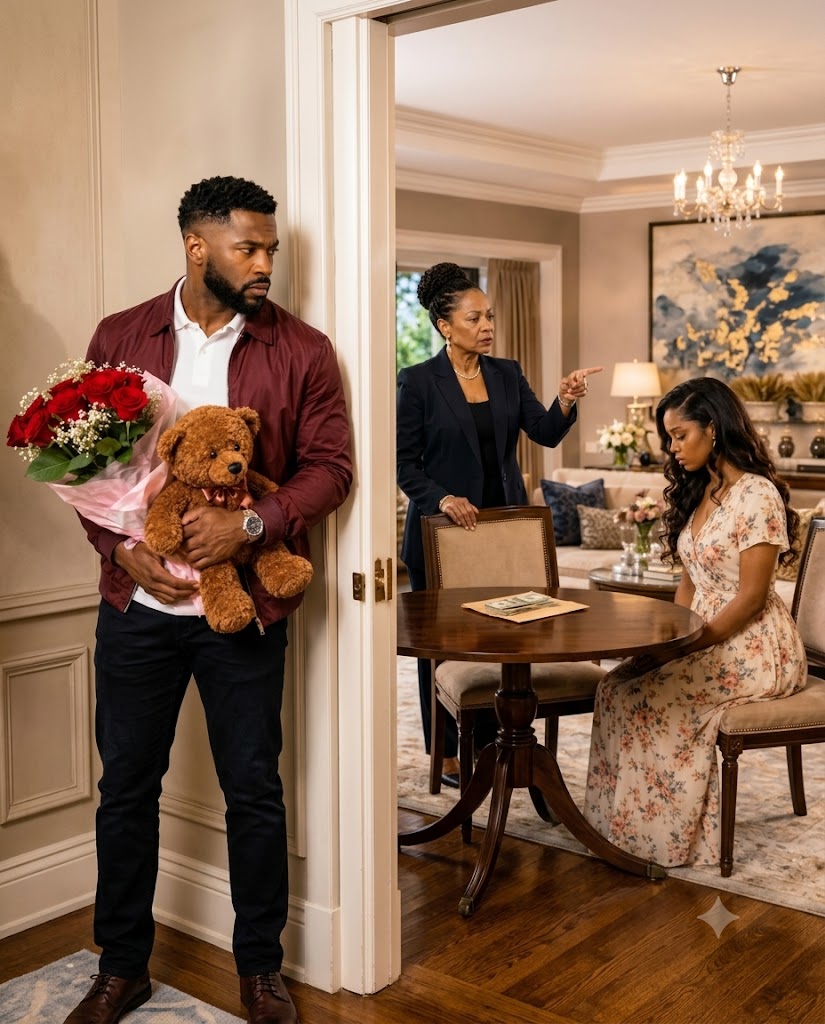
## Part 1
The envelope was the first thing Raymond Banks noticed when he pushed the front door open, and it was the last thing he expected to see waiting for him at the end of an ordinary Tuesday.
He had left the office three hours early, a decision so unlike him that his assistant had asked twice if everything was all right.
Everything was more than all right.
In his left arm he carried a bouquet of red roses wrapped in pink tissue paper, and tucked against his chest, its little bow slightly crushed from the drive, was a brown teddy bear he had bought on impulse from a shop near his office because it reminded him of the one Leila kept on their bed from her childhood.
He wanted to surprise her.
He wanted for once to be the one who walked through the door with something in his hands instead of just his tie loosened and his mind still tangled in spreadsheets.
He never made it to the living room.
His mother’s voice reached him first, sharp and low, cutting through the hallway like something sharpened for exactly this purpose.
“Take the money and leave my son.”
Raymond froze with his hand still on the door.
He knew that voice.
He had known it his entire life, had been soothed by it as a boy, and steadied by it after his father’s funeral, had trusted it more than almost any other voice in the world.
But he had never heard it sound like this, cold, deliberate, aimed like a blade.
Then quieter came Leila’s answer.
“I won’t leave Raymond because of a lie.”
His grip tightened around the teddy bear until the seams strained.
He could feel his own pulse in his ears now, loud enough to nearly drown out what came next.
For a moment there was only silence, the kind that presses against the eardrums and makes a person hyper-aware of every small sound in a house, the hum of the refrigerator down the hall, the tick of the grandfather clock his father had left behind, his own breath catching somewhere in his throat.
Then his mother spoke again, and this time her words landed somewhere deep in his chest and stayed there.
“If Raymond discovers what you’ve been hiding, he will never forgive you.”
He didn’t remember crossing the hallway.
He only remembered his hand on the frame of the living room doorway, and what he saw when he looked inside.
Ruth Carpenter stood beside the dining table in her dark navy suit, pearls resting against her collarbone, one finger extended and pointed at Layla like a verdict already decided.
Her hair, as always, was pulled into its neat, controlled bun, not a strand loose, as though even in the middle of an accusation she refused to let anything about her appear unraveled.
On the polished wood between them sat a thick manila envelope, its flap open just enough to reveal the edge of stacked hundred-dollar bills.
Layla stood with her head bowed, her hands clasped so tightly in front of her that her knuckles had paled.
She was wearing the cream floral dress Raymond loved, the one that always made her look like she’d stepped out of a warmer, gentler season.
Tears sat heavy and unshed along her lashes, and she did not look up, did not defend herself, did not do anything but stand and absorb whatever was being thrown at her, the way a person absorbs something they have absorbed too many times before.
For several seconds nobody spoke.
The roses in Raymond’s hands suddenly felt absurd, a small foolish thing brought into a room that clearly did not belong to happy surprises.
He became aware distantly that he was still holding them, that the teddy bear was still pressed against his ribs, and that neither woman in front of him had yet noticed he was standing there at all.
Then Raymond asked the question neither woman expected to hear.
“What secret are you talking about?”
Ruth’s head snapped toward him first, her expression sliding in the span of half a second from fury to something far more practiced.
Composure, concern, the face of a woman caught mid-sentence in an argument she would rather he hadn’t witnessed.
Leila’s head lifted more slowly, and when her eyes finally met his, Raymond saw something in them he had never seen in three years of marriage.
Not guilt.
Fear.
—
Raymond and Leila had been married three years by then, three years that had looked from the outside like the kind of marriage people quietly envied.
Raymond was successful, the kind of hard-working man who had built his career instead of inheriting it entirely, deeply devoted to the family that raised him.
Leila was gentle in a way that never asked for attention, intelligent in a way that never needed to prove itself, and restrained in a way Raymond had always mistaken for contentment.
There had always been one shadow across their happiness, though, one Raymond had spent three years explaining away.
His mother had never fully accepted Leila.
He told himself it was simply Ruth being protective, the natural instinct of a woman who had raised her only son alone after his father’s death, and wasn’t ready to hand him over to anyone.
He told himself it would soften with time, that Ruth’s sharper comments were just the residue of grief she’d never fully processed.
He had never imagined it looked like this.
“What have you been hiding from me?” Raymond asked, turning to his wife, his voice quieter now, almost pleading, the roses lowering slightly at his side as if he’d forgotten how to hold them properly.
Layla lifted her eyes to his, and in them was something Raymond had never seen before.
Not guilt, but exhaustion.
The specific exhaustion of someone who has been holding something heavy for far too long by herself.
Someone who had rehearsed this exact confession a hundred times in the shower, in the car, in the quiet moments before sleep, and had never once found the courage to say it out loud.
Before she could answer, Ruth’s voice cut between them, sharp enough to make Layla flinch.
“Don’t listen to her, Raymond. She’s been manipulating you from the beginning.”
Raymond turned toward his mother slowly.
He looked at her face, the same face that had comforted him through every hard year of his life, the face that had told him bedtime stories and sat beside hospital beds and clapped louder than anyone at his college graduation.
And for the first time in that life, standing in his own living room with flowers wilting slightly in his hand, he did not immediately believe her.
—
To understand the money on the table and the fear in his wife’s eyes, Raymond would eventually have to go back three years, to the beginning, to the ordinary Tuesday when he had first met Layla at a friend’s dinner and realized, within twenty minutes of conversation, that he had never felt so unguarded with another person in his life.
Layla had come from nothing extraordinary.
Her father had spent thirty years repairing machinery at a textile plant, his hands permanently stained with grease no soap could fully lift.
Her mother had taught elementary school until her knees gave out, then took up mending clothes for neighbors to fill the quiet hours.
Layla had grown up believing that character mattered more than money, that kindness mattered more than status, and she carried that belief into every room she entered, including the grand chandeliered rooms of the Banks family, where it had never once impressed Ruth Carpenter.
Raymond loved that about her immediately.
She never asked about his company’s revenue in their early conversations.
She never glanced at his watch or his car with the calculating look he had grown used to from other women.
She had asked him on their second date what made him happiest as a child, and he had talked for twenty minutes about a wooden tree house his father built before Raymond even realized how much he’d said, how easily the words had come out of him with her sitting across the table, chin in her hand, actually listening.
Ruth saw it differently from the start.
She had imagined a different wife for her son, someone from a family with a name, someone polished enough to command a room the way Ruth herself had learned to after her husband’s death, someone who understood, as Ruth put it once at a dinner Raymond wasn’t meant to overhear, how families like ours are supposed to be built.
At first, the comments were small enough to laugh off.
Ruth remarking that Layla’s dress was sweet for what she could afford.
Ruth asking in front of guests where exactly Layla had gone to school, and letting the silence stretch a beat too long after the answer, as though the school itself required an apology.
Ruth suggesting, with a small approving nod that somehow still managed to sting, that Layla’s cooking was surprisingly good considering.
Raymond laughed these off every time, kissing his mother’s cheek and telling her she was being dramatic.
Layla never laughed, though she never said so out loud.
She simply folded each comment away somewhere quiet inside herself and kept smiling.
At family dinners, Ruth found new and quieter ways to make her feel small.
A comment about posture, a comment about her family’s modest home in a town Ruth pretended she couldn’t quite place on a map, a comment disguised as concern about whether Layla was adjusting well to a life so different from what she was used to.
Raymond would sometimes notice Layla go quiet afterward, staring at her plate a half second too long, and he would ask, gently reaching for her hand under the table, “Are you okay?”
Layla would smile.
“I’m fine.”
It became a pattern so familiar that Raymond stopped hearing the words as anything but reassurance.
He believed her every time because believing her was easier than confronting the possibility that his mother, the woman who had sacrificed so much to raise him alone, could be capable of quiet cruelty.
The first real warning came eight months into the marriage when Ruth cornered Layla alone in the kitchen after a family gathering, drying her hands on a towel with unnerving calm, the kind of calm that felt far more dangerous than shouting ever could.
“You may have Raymond now,” Ruth had told her, voice low enough that no one else could hear, “but that doesn’t mean you’ll have him forever.”
Layla had been too stunned to respond at first, the dish towel still in her hands, water dripping unnoticed onto the tile.
When she finally found her voice, she said simply that she loved Raymond, that nothing would change that.
Ruth had only smiled, the kind of smile that carried no warmth at all, the kind that reached only her mouth and left her eyes untouched.
“Love won’t protect you.”
Layla never repeated those words to Raymond.
She told herself it was one bad moment, a mother’s grief still tangled with her love, nothing more.
She folded the memory away and kept smiling, kept saying she was fine, kept believing that time would soften what she had heard in that kitchen.
It was nearly a year later, while helping organize the family’s financial documents for Raymond during a hectic quarter at his company, that Layla found the first bank statement that didn’t make sense.
A large withdrawal from an account she recognized as belonging to Raymond’s late father, a fund Raymond had always believed remained untouched, reserved quietly for his future.
She assumed at first that it had to be legitimate.
Families managed money in complicated ways she didn’t fully understand.
She set the statement aside and kept working, sorting receipts into neat labeled folders the way she always did.
Then she found a second withdrawal.
And a third.
The name on the receiving account meant nothing to her.
But something about the pattern, the frequency, the round and careful amounts, the way each transfer seemed timed to avoid drawing attention, made the back of Layla’s neck go cold.
For the first time since she had married into the Banks family, Layla found herself looking at Ruth Carpenter not with hurt, but with suspicion.
—
That night, Layla lay awake long after Raymond had drifted off beside her, staring at the ceiling and replaying every strange interaction of the past year.
The way Ruth sometimes left the house without explanation and returned hours later smelling faintly of a downtown coffee shop Layla had never known her to frequent.
The way certain phone calls made Ruth step outside onto the balcony and lower her voice to something barely above a whisper.
At the time, Layla had noticed these things only in passing, filing them away as the ordinary eccentricities of an older woman who valued her privacy.
Now, with the bank statement folded carefully inside her nightstand drawer, those small oddities began arranging themselves into a shape she didn’t like.
She thought too about the comment Ruth had made in the kitchen all those months ago.
“Love won’t protect you.”
And wondered for the first time whether it had been less a threat about Raymond’s affection and more a warning about something else entirely, something Ruth herself was afraid of losing.
Layla did not go to Raymond right away.
She told herself she needed proof first, something more solid than a bad feeling and a stack of confusing bank statements.
She began, quietly and carefully, to look deeper into the family’s financial records whenever she had the house to herself, usually late at night after Raymond had fallen asleep.
The desk lamp casting a small circle of light over the papers as she cross-referenced dates and amounts with a patience she didn’t know she possessed.
What she found unsettled her more each time.
Over roughly eighteen months, significant sums of money had been transferred out of the account tied to Raymond’s father.
Money that had no connection to any of the family’s known investments, no connection to Raymond’s company, no connection to anything Leila could identify no matter how many hours she spent staring at spreadsheets.
The receiving account belonged to someone whose name she had never once heard mentioned at a single family dinner.
A name that felt oddly out of place among the familiar names of aunts, cousins, and business associates she’d learned over three years.
She wanted, more than once, to simply bring the papers to Raymond and lay them on the table between them, to end the secrecy in one honest conversation.
But every time she nearly did, she thought of how he spoke about his mother.
The reverence in his voice when he described how Ruth had worked two jobs after his father’s death, how she had refused to remarry so she could focus entirely on raising him, how she had sacrificed her own comfort so that Raymond could have every opportunity she never had.
To Raymond, Ruth wasn’t simply his mother.
She was the architect of everything good in his life, the foundation he had built his entire understanding of family upon.
If Leila walked in with accusations and no proof, she feared exactly what Ruth had once warned her of in that kitchen, that she would become, in Raymond’s eyes, the wife who tried to turn him against the woman who raised him.
So she kept investigating, quietly, carefully, telling herself that once she had real answers, she would tell him everything, that she owed him the whole truth and not just fragments of suspicion.
Ruth found out sooner than Leila expected.
It happened on an afternoon when Leila thought she was alone in the study, spreading three months of statements across the desk, cross-referencing dates with a highlighter clutched in one hand.
She didn’t hear Ruth’s footsteps in the hallway until the older woman’s shadow fell across the papers, blocking the light from the window.
“What exactly do you think you’re doing?”
Layla startled, gathering the papers instinctively, though there was nothing left to hide.
Ruth’s eyes had already found what mattered, scanning the desk with the speed of someone who had clearly expected this moment to come eventually.
“I want to know who this account belongs to,” Layla said, steadier than she felt, forcing her chin to stay level.
Ruth’s expression shifted from surprise to something colder, more controlled, the composure sliding back into place like a mask.
“This is not something that concerns you. It’s Raymond’s father’s money.”
“It was,” Ruth said. “Now forget you ever saw it.”
Layla refused.
She told Ruth plainly that she couldn’t simply forget something that looked, by every measure she understood, deeply wrong, that pretending not to see it would make her complicit in whatever this was.
Ruth’s voice dropped low, threatening in a way Layla had never heard from her before, each word deliberate and controlled.
“If Raymond finds out about this, it will destroy this family. Do you understand me? Everything he believes about his father, about me, about the life we built, gone. Is that truly what you want? To be the woman who tore this family apart over a misunderstanding?”
“Who are you sending this money to?” Layla asked.
Ruth said nothing at first, her jaw tightening, her hands curling slightly at her sides.
“Then finally, you don’t know what you’re getting yourself into.”
—
That evening, alone in the study before Ruth returned to lock the drawer, Layla made a decision that would change everything.
She took out her phone and quietly photographed one of the statements, capturing the account number and beside one transfer a name scrolled in handwriting she didn’t recognize, hurried and slanted as though written in secrecy.
The name meant nothing to her.
But when Ruth stepped back into the room moments later and saw the phone still in Layla’s hand, her face changed in a way Layla had never seen before.
For the first time since Layla had known her, Ruth Carpenter looked genuinely, unmistakably afraid.
Layla’s own heart pounded as she watched the fear move across Ruth’s face, a fear so raw it momentarily eclipsed whatever anger Layla had carried into that room.
She had expected fury, another round of cold warnings and thinly veiled threats.
She had not expected this, a woman visibly terrified, her carefully composed authority stripped away in an instant, leaving something almost pitiable in its place.
“Delete it,” Ruth said, her voice no longer commanding but pleading, a tone Layla had never once heard from her in three years.
“Please, Layla. You don’t understand what you’re holding in your hand.”
“Then help me understand,” Layla said. “Tell me the truth and I’ll listen. I’m not trying to destroy anything. I just want to know why money keeps disappearing from a dead man’s account.”
For a moment something flickered across Ruth’s face, the beginning perhaps of a confession, the shape of words gathering behind her tightly pressed lips.
But whatever door had cracked open closed again just as quickly, and Ruth’s composure snapped back into place like a rubber band pulled too far and released.
“You’ll ruin everything,” Ruth said instead, backing toward the doorway. “You have no idea what you’re about to unravel.”
She left the room without another word, and Layla sat alone at the desk for a long time afterward, the photograph still saved on her phone, her hands cold, wondering for the first time whether she had just made herself a target in her own home.
She thought about calling Raymond right then, about driving to his office and laying everything out on his desk before she lost her nerve.
She got as far as picking up her phone before setting it back down again, her thumb hovering uselessly over his name.
What would she even say?
That his mother was hiding something involving money from his dead father’s account sent to a stranger neither of them could explain?
Without more, it would sound like exactly what Ruth had warned it would sound like: jealousy, suspicion, an attempt to drive a wedge between mother and son.
So she put the phone away and told herself once again that she needed more before she could risk everything on an accusation she couldn’t yet prove.
Weeks passed like that, Layla caught between the mounting weight of what she knew and the fear of what saying it aloud might cost her, until an ordinary Tuesday arrived without warning, and Raymond came home three hours early carrying roses and a small brown teddy bear, and everything Layla had spent so long trying to carefully manage collided at once in the one room she had never expected it to happen.
—
Back in the present, in the living room where the roses still sat forgotten in Raymond’s arm, the confrontation was only beginning to unravel.
“I want an answer,” Raymond said, looking between the two women, his voice carrying an authority Layla had rarely heard from him inside these walls.
“Both of you. Now.”
Ruth recovered first, straightening her shoulders, folding her hands with the composure of a woman who had spent decades controlling every room she entered.
“I was protecting you,” she said. “This woman has been going through private family finances behind your back, digging through things that don’t belong to her, Raymond. What kind of wife does that to her own husband’s family?”
“She’s my wife.”
“She’s a woman who married into money she didn’t earn,” Ruth said sharply, “and now she thinks she has the right to interrogate a family she barely understands.”
Leila finally spoke, her voice trembling but clear, cutting through the room with more strength than she felt.
“Your mother has been threatening me for months, Raymond.”
The room went silent.
Raymond turned to her slowly, the roses finally slipping from his hand entirely, landing forgotten on the arm of the sofa.
“Months?”
Leila nodded, tears finally breaking free and sliding down her cheeks, her carefully held composure cracking at last.
“She told me if I said anything to you about the money, she would destroy this family. She told me I should take whatever she offered and disappear before you found out what I supposedly did.”
“Why didn’t you tell me?”
Raymond’s voice cracked with something between hurt and disbelief.
“Because I knew you would choose your mother first,” Leila said. “You always have. And I didn’t want you to hate her because of me.”
“I would never abandon you,” Raymond said, wounded, stepping closer to her. “Never. Do you hear me?”
“I never wanted you to hate her,” Leila repeated, quieter now, wiping uselessly at her cheek. “I just wanted this to stop.”
Ruth seized the pause.
“She’s lying, Raymond. This is manipulation. She wants control of your money and she’s willing to say anything to get it.”
She gestured toward the envelope on the table, her hand steady even now.
“I offered her that money because I wanted to make this situation easier for everyone. That’s all this ever was.”
But Raymond was no longer looking at his mother’s face.
He was looking at the envelope and something about the thickness of it, the particular weight of it, snagged at a memory of numbers he had seen once in passing on a statement Leila had shown him weeks ago, numbers he hadn’t thought much of at the time, dismissed as an accounting question for another day.
“Where did you get this money?”
He asked.
Ruth’s silence answered before her mouth could, the pause stretching a beat too long, her eyes flicking briefly toward the door as though calculating distance.
“Mom, where did this money come from?”
Ruth’s eyes darted briefly to Leila as if searching for some silent agreement to keep this buried a while longer, but Leila only held her gaze steady and unflinching, offering no such rescue this time.
Raymond noticed the exchange between them, brief as it was, and something in his chest tightened further.
Whatever this was, it had clearly been building between the two women for longer than a single afternoon, a silent negotiation he had never been invited into.
She said nothing.
Raymond crossed to the side table where the household folder of financial records sat, the one Leila had been quietly organizing for months, and began flipping through statements with hands that were no longer steady.
He found the page.
He compared the number scrolled across the top of the bank slip in the envelope to the missing withdrawal Leila had flagged weeks earlier, his eyes moving back and forth between the two documents with mounting dread.
They matched.
“This is from Dad’s account,” Raymond said, his voice barely above a whisper, the papers trembling slightly in his grip.
He looked up at his mother and for the first time in his adult life, he searched her face not for comfort but for the truth.
“Mom, did you take this money from Dad’s account?”
Ruth said nothing.
Her silence in that moment became the loudest answer Raymond had ever heard from her, louder than anything she could have shouted, louder than every reassurance she had ever given him about their family’s honesty.
He set the papers down on the table with a care that felt strange given how badly his hands were shaking, as though handling them roughly might make the truth inside them even worse than it already was.
He looked between the two women who mattered most to him in the world, his mother, whose face had gone the color of ash, and his wife, whose eyes were fixed on him with a mixture of relief and dread, as though she had spent a year bracing for this exact moment and still wasn’t ready for it now that it had arrived.
“Somebody needs to start talking,” Raymond said, his voice low, “and it needs to be right now.”
The chandelier above them flickered faintly as the evening settled outside the windows, and for a long moment none of them moved.
The three of them frozen in a tableau that had been years in the making, finally forced into the light.
It was Leila who finally broke the stillness, crossing the room to sit beside Raymond, close enough that their shoulders touched, a small gesture of solidarity that seemed to steady them both.
Ruth watched the two of them together, and something in her expression shifted.
Not quite acceptance, not yet, but the first flicker of a woman realizing that the battle she had been fighting alone for years had already been lost long before this evening, whether she admitted it tonight or not.
The silence stretched until it broke something in Ruth herself.
She sank slowly into the dining chair beside her, the composure she had worn like armor for years finally slipping from her shoulders, her hands trembling now in a way Raymond had never once witnessed in twenty-nine years of life.
“I moved the money,” she admitted quietly, “but I didn’t steal it, Raymond. You have to understand that. I never stole from you. Not once in my life have I taken something that wasn’t already threatening to be lost.”
“Then explain it to me,” Raymond said, pulling a chair to sit across from her, his voice gentler now, though the hurt beneath it hadn’t faded.
“Please, because right now none of this makes sense.”
Ruth’s hands trembled in her lap as she began haltingly to speak.
After his father’s death, she explained, she had discovered a problem buried in the paperwork of his business, a financial irregularity that if it ever became public would have unraveled the bank’s family name and everything Raymond’s father had built over three decades.
A former business partner had proof of it, evidence that could ruin the family’s reputation overnight, could turn Raymond’s father’s legacy into a scandal instead of the inheritance she wanted to leave him.
Terrified and grieving and utterly alone with a young son to raise in a house suddenly too quiet, Ruth had made a decision she now called the worst of her life.
Instead of confronting the problem directly, the way her husband would have wanted, she tried to bury it.
She reached out to the man who held the evidence and offered him money to stay silent, telling herself it would be a single payment, a closed chapter.
It worked for a while.
Then the demands grew.
What began as one quiet payment became a pattern she couldn’t stop, each transfer larger than the last, each one pulling more from the account meant to secure Raymond’s future.
Each one a small betrayal she promised herself would be the final one.
“Why target Layla?” Raymond asked, his voice hollow, his eyes fixed on his mother.
“Why threaten my wife over your mistake?”
Ruth’s eyes filled, her composure gone entirely now.
“Because she found the statements. I panicked. I thought if she disappeared from your life, I could still control the situation before it reached you. I thought I could still fix it quietly, the way I’d been fixing it for years.”
“You thought making my wife disappear was fixing something?”
“I thought I was protecting you,” Ruth said, her voice breaking, a tear finally sliding down and catching in the fine lines of her face.
“I was your mother. That was my job. It has always been my job since the day your father died and left me with all of it.”
“You weren’t protecting me,” Raymond said, each word landing like a stone dropped into still water.
“You were protecting yourself.”
He said it quietly without cruelty, but the words seemed to cost him something all the same, a small piece of the certainty he’d always carried about who his mother was, a certainty he understood now he would never quite get back in the same shape it had once been.
Ruth flinched as though he’d struck her, and for a long moment she said nothing, staring down at her own hands as though she no longer recognized them.
The clock on the mantel ticked steadily through the silence, marking a stretch of time that felt to all three of them far longer than the seconds it actually was.
Finally, in a voice smaller than Raymond had ever heard from her, Ruth spoke again.
“I know,” she said. “I know that now, and I wish I had known it years ago before any of this ever started.”
She looked up at her son, her eyes searching his face for some sign of the boy she had raised, some remnant of the unconditional trust he had always given her without question.
It was still there, she realized, buried somewhere beneath the hurt, but it no longer came freely.
It would have to be earned back now, piece by piece, the way anything worth having usually had to be.
Leila, who had been silent through most of this, standing near the window with her arms wrapped around herself, finally spoke, her voice steadier now than it had been all afternoon.
“There’s still something she hasn’t told you, Raymond.”
Both Raymond and Ruth turned to her, Ruth’s face draining of what little color remained in it.
“The person receiving this money,” Leila said, “he isn’t just some old business partner your mother is trying to keep quiet.”
She hesitated, glancing at Ruth, whose face had already gone pale, as though she knew exactly what was coming, as though she had been dreading this exact sentence for years.
“I know who he is, and he’s been watching this family for a long time.”
Raymond felt the floor of his understanding shift again, some new and unwelcome weight settling over the room.
“Watching us. What does that mean?”
“It means this was never a one-time payment she could quietly make and forget,” Layla said. “It means someone has had leverage over your mother for years, and every time she paid him, it only proved to him that she would keep paying. People like that don’t stop asking. They only ask for more.”
Ruth pressed her palms flat against the table as if to steady herself, her breathing shallow.
“I told myself I could manage him,” she said quietly, almost to herself. “I told myself I understood exactly how far it would go.”
“And did you?” Raymond asked.
Ruth didn’t answer.
She didn’t need to.
The envelope of cash sitting untouched on the table between them was answer enough.
Proof that whatever line she’d once believed she could hold had long since been crossed, again and again, until she could no longer remember where it had originally been drawn.
Raymond turned fully toward his wife, his chest tight with a dread he couldn’t yet name, the room suddenly feeling smaller than it had a moment ago.
“Who is he?”
Layla took a slow breath, steadying herself before she spoke.
“His name is on the account. Marcus Whitfield. He was your father’s business partner years ago, before you were even old enough to understand what the company did. After your father died, he disappeared from this family’s life completely. I didn’t recognize the name at first, either. It took me weeks of quiet digging to understand who he actually was, cross-referencing old company records I found tucked away in a box in the study.”
Ruth’s hands had gone white where they gripped the edge of the table, her knuckles bloodless.
“He has documents,” Layla continued, “proving that your mother concealed something serious about the company’s finances after your father passed. That’s what he’s been holding over her. That’s what all of this money has been paying for, month after month, for years.”
Raymond looked at his mother, searching her face for a denial that never came.
“Is that true?”
Ruth nodded slowly, tears finally slipping down a face that had rarely allowed itself to show weakness in front of her son.
“Your father discovered irregularities in the business before he died. He was planning to confront Marcus directly, to fix it the right way before his heart gave out that night. I found the paperwork after the funeral, buried in his desk drawer, and I didn’t know what to do with it. I was drowning in grief, Raymond, and terrified of what exposure would do to your father’s name, to your inheritance, to everything he built. So, instead of exposing it, I buried it alongside him. I thought I could make it disappear.”
“And instead,” Raymond said quietly, “you built a secret that could never stop growing.”
Ruth didn’t argue.
“Every payment required another payment. Every lie required another lie. I told myself each time would be the last. It never was. Marcus kept coming back, kept finding new reasons the amount needed to increase, and I kept paying because the alternative felt unthinkable.”
Raymond wanted desperately to hate her in that moment.
But looking at her now, smaller somehow than the woman who had raised him, undone by years of fear she had carried entirely alone in a house that had once been full and was now, since his father’s death, only ever half full, he found only a tangled ache where his anger should have been.
He remembered his childhood, the countless sacrifices she had made, the nights she worked two jobs so he would never feel his father’s absence as a lack, the way she had never once complained in front of him.
It made this harder, not easier.
Ruth pressed her fingers to her temples, as though the confession had cost her physically, as though naming Marcus’s name out loud had finally made the years of secrecy real in a way the quiet payments never had.
“I told myself he would eventually stop,” she added softly. “I told myself that lie every single month for two years, and every single month he proved me wrong again.”
Raymond exhaled slowly, running a hand over his face.
“Two years,” he repeated, as though saying the number aloud might make it easier to absorb.
“Two years of this happening under my own roof, and I never noticed a single thing.”
Leila reached for his hand without a word, and he let her take it, grateful in that moment for the one steady thing left in the room.
Outside, the streetlights had begun to flicker on, ordinary and indifferent to everything unraveling inside the house.
And for a strange moment, Raymond envied their simplicity.
He turned to Leila.
“Why did you keep protecting her? After everything she said to you, after everything she threatened, why didn’t you just tell me the moment you found out?”
Leila’s eyes were steady even as they filled again.
“Because she is still your mother, Raymond. I never wanted to be the reason you lost her. I know what she means to you even when she’s cruel to me. I never wanted to take that away from you.”
Raymond realized in that moment that even while Ruth had been hurting his wife, Leila had been quietly protecting his heart, carrying a secret specifically so that he wouldn’t have to.
He turned back to the desk, needing something solid to hold on to, and began sorting through the remaining papers Leila had gathered.
Near the bottom of the folder, his hand stopped on a document he hadn’t seen before.
Old, slightly yellowed, bearing his father’s signature at the base in the familiar looping handwriting Raymond hadn’t seen in years.
He read it once.
Then again, slower this time, his eyes catching on details that made his stomach drop.
What it said contradicted almost everything his mother had just told him.
He set the letter down between them, his father’s familiar signature staring back up at all three of them from the aged paper.
It felt in that moment as though his father himself had somehow entered the room, a silent fourth presence bearing witness to a truth he had tried to set in motion years before his death and never gotten the chance to see through.
“He knew,” Raymond said quietly, more to himself than to either woman. “He knew there was a problem and he had a plan to fix it the honest way. He wasn’t hiding from it. He was walking toward it.”
He thought of his father then, not the version softened by years of grief and careful remembering, but a fuller version, a man who had apparently trusted his son enough, even at thirty, to hand him control of something important, who had believed the truth was worth the risk of scandal.
It was a version of his father Raymond had never been allowed to know, buried along with the letter in a drawer for over a decade.
The document was a letter dated just weeks before his father’s death, addressed to a lawyer Raymond didn’t recognize.
In it, his father laid out plans to expose the very irregularity Ruth had spent years trying to bury, and more than that, laid out instructions to transfer full control of a specific portion of the family’s assets directly to Raymond the moment he turned thirty, regardless of what happened with the business dispute, regardless of any scandal that might follow.
Raymond had turned thirty two years ago.
He had never once heard of this letter.
“Mom,” he said slowly, holding the paper toward her, his hand shaking slightly. “Did you know about this?”
Ruth’s silence once again told him everything before her mouth could, her eyes dropping to her lap.
“You knew Dad wanted to expose it himself,” Raymond said, his voice rising now with a hurt he could no longer contain. “You knew he’d already arranged for me to inherit control of this, and you buried both. You buried his plan and my inheritance in the same drawer.”
Ruth’s composure finally shattered completely.
She pressed a hand to her mouth, her shoulders shaking, and when she finally spoke, her voice was barely recognizable, thin and cracked.
“I was afraid, Raymond. I was afraid of what the truth would do to his memory, to you, to everything I’d built to keep you safe after he was gone. I told myself I was preserving your future. I convinced myself of it for years, told myself the story so many times I nearly believed it. But somewhere along the way, the fear turned me into someone I don’t recognize when I look in the mirror anymore.”
Raymond sat down heavily, the letter still in his hand, feeling something inside his chest give way.
Not from the money, though the money mattered, but from something deeper, something that felt like the ground shifting under a house he’d assumed was built on solid foundation.
Two women he loved had been carrying an enormous weight around him for years, and he had noticed none of it, had walked through his own life believing everyone around him was simply fine.
He turned to Leila.
“How long have you actually known? All of it, not just the withdrawals.”
“About the full picture, three weeks,” Leila said quietly. “About the fear, about her threats, almost a year.”
A year.
Raymond closed his eyes, the number settling over him like a weight.
He thought of every ordinary evening across that year.
Dinners where Leila had laughed at his jokes, weekends where she had planned small trips to surprise him, mornings where she had kissed him goodbye with no trace of what she carried visible on her face.
She had built an entire life beside him while holding this alone, and he had never once suspected it, had gone about his days believing their marriage was exactly as simple and steady as it appeared on the surface.
It humbled him, this realization.
How much strength it must have taken to smile so convincingly, so consistently, while quietly carrying a weight heavy enough to break most people entirely.
Layla’s composure finally cracked completely, months of held breath releasing all at once, her shoulders shaking with the force of tears she’d been suppressing since long before this afternoon.
“I was so tired, Raymond. I was afraid of Ruth, afraid of losing you, afraid of what exposing this would do to your family’s name, and afraid more than anything that if I finally told you everything, you wouldn’t believe me over her. I didn’t know how to carry all of that and still smile every time you asked if I was okay.”
“You told me you were fine,” Raymond said softly, the words feeling heavier now than they ever had. “Every single time.”
“I know,” Layla whispered. “I’m sorry.”
“Don’t apologize,” Raymond said, crossing the room and taking her hand for the first time since he’d walked through the door. “Don’t you dare apologize for surviving something I should have noticed.”
He stood, walked slowly toward his mother, and placed the letter on the table in front of her alongside the envelope of cash.
The two objects sitting side by side like evidence in a trial only now beginning.
“Mom,” he said, his voice quiet but unwavering. “Was there anything else you lied about?”
Ruth looked away, unable to meet his eyes, her jaw tight.
That silence told Raymond there was still one final secret left to uncover.
He didn’t press her yet.
He simply sat there for a moment, looking at the woman who had raised him single-handedly, who had shown up to every school recital and every hospital visit and every hard night of his life, and who had also somewhere along the way buried enough secrets to fill a decade.
He felt all at once both the love he had carried for her his entire life and the anger that love did nothing to soften.
Both feelings were true.
Both feelings would have to be carried together whether he liked it or not.
“Take a minute,” he said finally, standing and walking to the window, needing distance more than answers for just a moment. “Then we finish this, all of it, tonight.”
Behind him, he heard his mother’s breath catch, and Layla’s hand find his shoulder, steady and warm, grounding him in the one certainty he had left standing in a house suddenly full of collapsed ones.
The minute stretched into several, none of them speaking, the only sound the faint hum of the refrigerator down the hall, and somewhere outside, a car passing on the quiet street.
When Raymond finally turned back around, his mother had wiped her face and straightened in her chair, gathering whatever remained of her composure for what she seemed to understand would be the last confession she’d be allowed to delay.
“I need all of it,” Raymond said, his voice low but absolute, leaving no room for negotiation.
“Not pieces. Not the parts that make you look less guilty. All of it, right now, or I walk out of this room and let Marcus Whitfield tell me himself.”
The threat worked where nothing else had.
Ruth’s shoulders sagged, and something in her finally gave way completely, the last of her composure dissolving like sugar in water.
She looked in that moment less like the commanding woman who had once pointed an accusing finger across this very table, and more like someone finally setting down a bag she had carried for far too many miles.
The room seemed to hold its breath along with her, waiting.
She admitted everything.
She admitted she had threatened Layla for months, warning her again and again to stay silent or lose everything, cornering her in kitchens and hallways whenever Raymond wasn’t home to witness it.
She admitted she had tried repeatedly to convince Layla to leave Raymond entirely, believing that if Layla simply disappeared, the danger of exposure would disappear with her.
She admitted the money in the envelope had been intended as a final push, a bribe dressed up as generosity, the last card she thought she had left to play.
She admitted concealing the financial scandal for years, lying to Raymond about his father’s final wishes, and letting fear dictate every decision she had made since the funeral, one compromise stacking onto the next until she could no longer see where the lies ended and the truth began.
Ruth’s hands twisted the fabric of her skirt as she spoke, her eyes fixed somewhere past Raymond’s shoulder as though it were easier to confess to the wall behind him than to his face.
“I thought if I pushed her away,” Ruth said, her voice raw, tears streaming freely now, “I would get my son back. I thought Layla had become the most important person in your life, and somewhere in my grief, I convinced myself that meant I was losing you. That there wasn’t room in your heart for both of us.”
“You were never losing me,” Raymond said. “Layla was never taking me away from you. The distance between us, that was something you built yourself, one secret at a time, one lie stacked on top of another until there was nothing honest left standing between us.”
Ruth said nothing.
There was nothing left to say.
Raymond turned toward Layla, and something in his expression softened even as it remained heavy with everything he now understood.
“I’m sorry,” he said. “Not because I caused any of this, but because I failed to notice it. Every time you told me you were fine, I let myself believe it because it was easier than asking what was underneath it. I was comfortable in my own ignorance, and you paid the price for that comfort.”
Layla’s tears finally came freely, the kind of crying that comes only after months of holding still, her whole body finally allowed to release what it had been carrying.
Raymond crossed the room and took her hands in his, steady this time, certain, his thumbs brushing gently over her knuckles.
“You should never have had to suffer in silence just to protect my relationship with my mother,” he told her. “Never again. Do you understand me?”
Leila nodded, unable to speak, pressing her forehead briefly against his shoulder.
Ruth watched them from the dining chair, smaller now than Raymond had ever seen her, the weight of years finally visible on her face, every line and shadow suddenly more pronounced.
When she finally spoke again, her voice had lost all its former sharpness.
“I’ll cooperate,” she said quietly, “with whatever investigation needs to happen. I’ll surrender control of the accounts. I won’t fight you on any of it. I’ve fought long enough, Raymond. I’m tired, too.”
She said it plainly, without theatrics, and somehow that plainness landed harder than any of her earlier tears had.
Raymond nodded once, unable to summon forgiveness yet, but grateful at least for honesty.
It was, he realized, the first entirely honest thing his mother had said to him all evening, and he understood, somehow, that this small honesty would have to be the beginning of everything that came after.
Ruth rose slowly, gathered her coat, and walked to the door without another word, her steps heavier than Raymond had ever seen them, as though the weight she had carried in secret for years had only now become visible enough to actually feel.
She left the envelope of money behind on the table, untouched, like something too heavy to carry out with her.
Raymond and Leila stood together in the sudden quiet of the house, neither speaking for a long moment.
Near the doorway, forgotten in the chaos of the last hour, the bouquet of roses and the small brown teddy bear still sat exactly where Raymond had set them down.
Raymond finally crossed the room and picked them both up, cradling the flowers and the small bear as though they were fragile in a way they hadn’t been that morning.
He set the roses gently in a glass of water on the kitchen counter, unwilling even now to let them wilt forgotten on the floor.
Some part of him understood, even in the wreckage of the afternoon, that the gesture behind them still mattered.
That wanting to surprise his wife with something soft and thoughtful hadn’t been foolish, only interrupted by a truth that had needed to surface eventually, one way or another.
Leila watched him from the doorway, her eyes still red, her arms wrapped around herself.
When he turned back to her, she managed for the first time in hours something close to a real smile.
“You still came home early to surprise me,” she said softly.
“I did,” Raymond said. “I just didn’t expect the day to go quite like this.”
—
The weeks that followed were not easy ones.
Raymond hired an independent accountant to trace every transfer that had ever left his father’s account, and slowly, painstakingly, the full shape of the deception came into focus.
Years of quiet payments, years of fear disguised as protection, an entire secondary history of the Banks family that had unfolded in the shadows while Raymond lived his life unaware.
Marcus Whitfield was confronted directly, the blackmail exposed and dismantled through legal channels Raymond’s lawyers handled with quiet efficiency.
The threat that had loomed over his mother for years finally, formally ended.
It was not a clean process.
It was not a fast one.
There were meetings with attorneys, uncomfortable conversations with the family’s accountant, long nights where Raymond sat alone in his father’s old study trying to reconcile the man he remembered with the story that had unraveled around him.
But piece by piece, the truth stopped being a weapon and became simply a fact the family had to live with.
Ruth moved out of the family estate temporarily into a smaller apartment across town, giving everyone, herself included, the space to breathe, the space to sit with what had happened without the pressure of shared walls and shared meals forcing conversations no one was ready for.
For Raymond and Layla, the real work happened in smaller, quieter moments.
Layla stopped saying she was fine when she wasn’t.
It didn’t come easily at first.
The habit of swallowing her pain had been built over years and didn’t unravel in a single conversation.
And there were still evenings when Raymond had to gently ask a second and third time before she found the words.
But slowly, she began telling Raymond when something hurt, when something worried her, when silence felt safer but honesty felt necessary anyway.
And Raymond, for his part, learned to stop accepting easy answers.
He asked deeper questions.
He watched for the things she didn’t say, the pauses that lasted a beat too long, the smile that didn’t quite reach her eyes.
Their marriage did not simply survive what had happened.
It became something sturdier than it had been before, built now on a foundation of honesty instead of assumption.
Months later, Ruth returned to the house.
She didn’t come with money this time.
She didn’t come with excuses or explanations or the practiced composure she had always worn like armor.
She came only with an apology, plain and unadorned, delivered standing in the same living room where everything had unraveled, in the same spot where she had once pointed an accusing finger at the woman now watching her with cautious, careful eyes.
“I confused controlling my son with loving him,” she told Layla. “I let fear convince me that love and control were the same thing. I was wrong. I’m sorry for every part of what I put you through, and I know an apology doesn’t undo any of it.”
Layla listened to all of it, her arms loosely crossed, her expression unreadable but not unkind.
She didn’t offer instant forgiveness.
She had learned by then that forgiveness rushed too quickly rarely meant anything at all, that it needed time the way a wound needed time, not a rush to close it over before it had properly healed.
“I want to forgive you,” she said honestly, “but trust has to be rebuilt. It won’t happen in one conversation, Ruth. It’s going to take time and actions, not just words.”
Ruth nodded, and for the first time she accepted an answer without arguing against it, without trying to negotiate a faster path back to comfort.
Raymond watched his mother and his wife begin the slow, uncertain process of finding their way back toward each other, one honest conversation at a time, one small gesture of trust extended and gradually returned.
He understood now that the real hidden secret in his family had never simply been the missing money.
It had been the quiet, invisible weight Leila had carried behind two small words for far too long.
“I’m fine.”
That evening, after Ruth had gone, Raymond and Leila sat together on the couch as the last light faded from the windows, the house settling into its familiar evening quiet.
The roses he brought home that fateful afternoon now stood in a vase on the side table, a little wilted but still holding their color, refusing to be thrown out even weeks later.
The teddy bear sat propped beside it, exactly where Leila had placed it weeks ago, refusing to let either be discarded, small reminders of the ordinary happiness he had walked in expecting to find that day.
Raymond looked at his wife for a long moment, studying the familiar lines of her face in the fading light.
“I came home early that day because I wanted to surprise you,” he said quietly. “Instead, I discovered how much you had been carrying without me.”
Leila smiled through eyes still bright with unshed tears and took his hand, her fingers lacing through his in the way they always had, the way that had somehow, through everything, never once changed.
Sometimes the greatest secrets aren’t hidden in locked rooms or bank accounts.
Sometimes they’re hidden behind a person’s smile, behind the words “I’m fine,” and behind the silence of someone who is afraid that telling the truth will destroy the people they love.
Raymond finally understood, sitting there in the quiet with his wife’s hand in his, that a marriage isn’t protected by avoiding difficult truths.
It is protected by having the courage to face them together.
—
## Part 2
The months that followed Ruth’s departure from the family estate were not measured in grand gestures or dramatic confrontations.
They were measured in small, quiet moments that accumulated like snowflakes on a windowsill, each one insignificant on its own but together forming something that could no longer be ignored.
Raymond started coming home earlier.
Not every day, because the demands of his company hadn’t magically disappeared, but more often than before, and always without the ulterior motive of a surprise that might detonate in his hands.
He learned to read the house differently.
The way Layla’s shoulders relaxed when he walked through the door instead of tensing, the way she started humming again while she cooked, small signs that the weight she had carried for so long was finally, incrementally, being lifted.
The accountant Raymond hired, a meticulous woman named Patricia Okonkwo who had spent fifteen years untangling financial fraud for the district attorney’s office, delivered her preliminary findings three weeks after the confrontation.
Raymond sat in his father’s old study, now cleared of the boxes Leila had been secretly organizing, and listened as Patricia walked him through the numbers.
“Over forty-seven months,” she said, her voice calm and professional, “approximately two hundred and thirty-eight thousand dollars were transferred from the account tied to your father’s estate. The transfers were structured in amounts between four thousand and six thousand dollars, always just under the threshold that would trigger automatic reporting to the IRS.”
Raymond felt his stomach drop.
“Two hundred and thirty-eight thousand,” he repeated, the number settling over him like a physical weight.
“Yes. The first transfer occurred fourteen months after your father’s death. The most recent was three weeks ago, just before your mother surrendered control of the accounts.”
Patricia continued, explaining how the receiving account had been opened under a shell company registered in Delaware, how the funds had been disbursed almost immediately upon receipt, making them nearly impossible to trace once they left the original account.
But she had traced them, at least partially.
To Marcus Whitfield.
A man Raymond had never met, never heard of, whose name had been carefully erased from every family document, every conversation, every memory Raymond had of his father’s business.
Now that name sat on the desk between them, printed in black and white, accompanied by a photograph Patricia had obtained from public records.
Marcus Whitfield was seventy-three years old, silver-haired, with the kind of face that had once been handsome and had settled into something harder over the years.
He lived in a gated community in Scottsdale, Arizona, in a house valued at just under a million dollars.
He had no known employment.
His lifestyle, Patricia noted dryly, appeared to be funded entirely by “consulting fees” from a shell company registered in Delaware.
Raymond stared at the photograph for a long time.
This was the man who had been bleeding his family dry for nearly four years.
This was the man who had turned his mother into someone Raymond no longer fully recognized.
This was the man who had made his wife afraid to speak in her own home.
“What happens now?” Raymond asked.
Patricia closed her folder.
“Now we document everything, build a case for extortion, and hand it to the authorities. The FBI handles cases like this, interstate extortion with financial fraud components. Your mother’s cooperation will be essential, but even without it, the evidence we’ve gathered is substantial.”
Raymond nodded slowly.
“Will she face charges? My mother, I mean. For the concealment, the obstruction.”
Patricia hesitated, choosing her words carefully.
“That depends on the prosecutor. Your mother was a victim of extortion, but she also concealed evidence of a financial irregularity in your father’s business and obstructed the proper handling of his estate. There’s a range of possible outcomes. Cooperation helps. Full transparency helps more.”
Raymond thanked her and walked her to the door, then stood alone in the hallway for a long moment, listening to the quiet of the house.
Layla was upstairs, taking a shower, the sound of the water a faint murmur through the ceiling.
He thought about his father, about the letter buried in the desk drawer, about the plan his father had made to expose the truth and protect his son’s inheritance.
His father had been willing to face scandal, to risk everything, because he believed the truth mattered more than the family’s reputation.
And Ruth, in her grief and fear, had done the opposite.
She had buried the truth so deep that it had nearly destroyed the family she was trying to protect.
Raymond understood, for the first time, that protecting the people you loved sometimes meant refusing to protect them from the truth.
—
That night, after Layla had fallen asleep, Raymond sat in the living room with the letter from his father spread out on the coffee table.
He had read it so many times now that he had memorized most of it, but he kept returning to one paragraph, the one that felt most like his father was speaking directly to him across the years.
“I have made mistakes in my business, and I will not compound them by hiding from the consequences. If something happens to me before this matter is resolved, I trust my son to do what I could not. I trust him to choose integrity over reputation, honesty over comfort. I trust him to understand that a man’s legacy is not measured in what he accumulates, but in what he is willing to sacrifice for what is right.”
Raymond read those words again and again, feeling the weight of his father’s trust settling over him.
He had spent so much of his life trying to live up to the version of his father that Ruth had presented to him, the flawless provider, the man who had built everything from nothing, the father whose absence had shaped Raymond’s entire understanding of family and duty.
But the real man, the one who had written this letter, was more complicated.
He had made mistakes.
He had been willing to admit them.
And he had trusted Raymond to finish what he had started, even if it meant exposing the family to scandal and shame.
Raymond folded the letter carefully and placed it back in the folder where he kept all the documents Patricia had gathered.
He understood now that honoring his father didn’t mean preserving the myth Ruth had constructed.
It meant finishing what his father had started, facing the truth no matter how uncomfortable, and building something honest on the foundation of what remained.
—
The call from the FBI came six weeks later.
Raymond was at his office when his phone rang, the caller ID showing a Virginia area code he didn’t recognize.
“Mr. Banks? This is Special Agent Daniel Reyes with the FBI’s financial crimes division. We’ve been reviewing the evidence your attorney submitted regarding Marcus Whitfield. Do you have a few minutes to speak?”
Raymond closed his office door and sat down.
“I have as long as you need.”
Special Agent Reyes explained that the Bureau had been building a case against Whitfield for nearly a year, based on similar complaints from other families, other victims who had been extorted after the deaths of their loved ones.
Raymond’s evidence, combined with Ruth’s cooperation and testimony, had provided the final piece they needed.
“Mr. Whitfield was arrested this morning at his home in Scottsdale. He’s being charged with multiple counts of extortion, wire fraud, and money laundering. Given the amount involved and the pattern of behavior, he’s looking at significant federal prison time.”
Raymond exhaled slowly, feeling something loosen in his chest that had been tight for months.
“Thank you for letting me know.”
“There’s one more thing, Mr. Banks. During the search of Whitfield’s home, we recovered a significant number of documents related to your father’s business. Some of them may be relevant to your family’s estate. I can have copies sent to your attorney if you’d like.”
“Yes,” Raymond said. “Please do.”
He hung up the phone and sat in the quiet of his office for a long moment, staring out the window at the city skyline.
It was over.
The man who had haunted his family for years, who had turned his mother into a stranger, who had made his wife live in fear, was finally going to face consequences.
But the relief Raymond felt was complicated, tangled up with grief and anger and a strange, unexpected sadness for his mother, who had spent years trapped in a prison of her own making.
He called Layla.
“Marcus Whitfield was arrested this morning.”
There was a long pause on the other end of the line.
“Are you okay?” Layla asked finally.
“I think I will be. I think we all will be, eventually.”
—
Ruth was in her apartment when the news broke, watching the local evening news in the small living room that had become her quiet retreat from the world she had spent decades trying to control.
She saw Marcus Whitfield’s face on the screen, handcuffed and led into a police car, and she felt something she hadn’t expected to feel.
Not relief, exactly.
Not vindication.
Just a strange, hollow emptiness, the realization that the man she had feared for so long, the man who had held her future in his hands, was just a man after all, fallible and finally, mercifully, contained.
She called Raymond that night.
“I saw the news.”
“I know. I was going to call you tomorrow.”
“I don’t know what to say,” Ruth admitted, her voice quiet, stripped of its usual control. “I spent so many years afraid of him. And now he’s just… gone. It doesn’t feel the way I thought it would.”
Raymond was silent for a moment.
“I think that’s because you spent so long carrying it that you forgot what it felt like to put it down. It’s going to take time to adjust.”
“I know. I’m trying.”
“I know you are, Mom.”
They didn’t say much more than that, but something in the conversation felt different to Raymond, something lighter.
His mother wasn’t asking for forgiveness.
She wasn’t trying to explain herself or justify her choices.
She was just calling to share a moment, to let him know she was thinking about him, to be present in his life without demanding anything in return.
It was small, but it was a beginning.
—
The following weekend, Raymond and Layla drove out to the family estate, the house where Raymond had grown up, where his father had built a life and a business, where Ruth had raised him alone after her husband’s death.
They hadn’t been back since Ruth moved out, and the house felt different now, quieter, emptier, but also somehow lighter, as though the secrets that had been pressed into its walls were finally dissipating.
Raymond walked through the rooms slowly, touching the furniture, remembering.
The grandfather clock his father had left behind still ticked in the hallway, steady and indifferent to everything that had happened.
In the study, Raymond sat at his father’s old desk and opened the bottom drawer, the one where Layla had found the letter, the one where Ruth had buried so many secrets.
It was empty now, cleared out during the investigation, but Raymond could still feel the weight of what had been hidden there.
He thought about his father, about the letter, about the trust his father had placed in him.
He thought about his mother, about the fear that had driven her to make choices that had nearly destroyed everything.
He thought about Layla, about the strength it had taken for her to carry a secret she hadn’t asked for, to protect a family that had never fully accepted her.
He closed the drawer and stood, walking to the window that looked out over the garden his mother had once tended with such care.
The roses were overgrown now, tangled and wild, but still blooming, still stubbornly alive.
Layla found him there a few minutes later, standing at the window with his hands in his pockets.
“What are you thinking about?” she asked, slipping her arm through his.
“I’m thinking about what we do with this house. Whether we keep it, sell it, or just let it sit empty for a while. I don’t know what feels right.”
Layla leaned her head against his shoulder.
“We don’t have to decide today. We don’t have to decide anything today.”
Raymond nodded, grateful for her steadiness, her patience, the way she had always known how to give him space without leaving him alone.
“I think my father would have liked you,” he said quietly. “I think he would have seen the same thing I saw the first time I met you. Someone who tells the truth even when it’s hard. Someone who doesn’t need to control everything to feel safe.”
Layla smiled, a little sadly.
“I wish I could have met him.”
“Me too. But I think he’s still here, in a way. In the letter he wrote, in the trust he placed in me, in the belief that I would do the right thing even if it was difficult. I want to honor that. I want to be the kind of man he believed I could be.”
Layla squeezed his arm.
“You already are.”
—
The legal proceedings against Marcus Whitfield moved forward over the following months, a slow, methodical process that Raymond followed with the same attention he gave to his company’s quarterly reports.
Whitfield’s defense team attempted to paint him as a legitimate business consultant who had simply been compensated for his expertise, but the evidence Patricia had gathered, combined with the testimony of other victims and Ruth’s own account of the extortion, made that narrative impossible to sustain.
Whitfield pleaded guilty to three counts of extortion and one count of money laundering, avoiding a trial that would have exposed more of his victims to public scrutiny.
He was sentenced to eleven years in federal prison and ordered to pay restitution to the families he had defrauded.
The restitution would be partial, Patricia warned Raymond, because Whitfield had spent most of the money on his own lifestyle, but it was something.
Raymond didn’t care about the money.
What mattered was that it was over.
What mattered was that the man who had terrorized his family for years would never have the chance to do it again.
What mattered was that Ruth could finally sleep through the night without listening for the phone.
—
Ruth returned to the family estate six months after she had left it, not to move back in, but to help Raymond and Layla decide what to do with the house.
She walked through the rooms slowly, the way Raymond had done, touching the furniture, remembering.
In the study, she stood at the window for a long time, looking out at the overgrown garden.
“I let this place go,” she said quietly. “I let everything go, while I was so busy trying to hold everything together. I stopped tending the garden. I stopped having people over. I stopped living, really. I was just surviving, one payment at a time, one secret at a time.”
Raymond stood beside her, not speaking, letting her find her words.
“I thought I was protecting you,” Ruth continued. “I thought if I could just keep the truth from you, keep the past buried, you would be safe. But I was wrong. The truth doesn’t stay buried. It always finds a way to surface, and when it does, it takes everything with it.”
She turned to look at him, her eyes steady for the first time in months.
“I’m sorry, Raymond. For everything. For the lies, for the secrets, for the way I treated Layla. I know an apology doesn’t undo any of it, but I want you to know that I understand now. I understand what I did wrong, and I’m going to spend the rest of my life trying to do better.”
Raymond looked at his mother, really looked at her, the way he hadn’t allowed himself to in months.
She was thinner than she had been, older, the lines on her face deeper.
But there was something in her eyes that hadn’t been there before, something that looked like peace, or at least the beginning of it.
“I believe you,” Raymond said. “And I’m not going to pretend that everything is fine, because it’s not. There’s a lot of damage to repair, and it’s going to take time. But I believe you, and I’m willing to try.”
Ruth nodded, tears slipping down her cheeks, but she was smiling too, a small, fragile smile that Raymond hadn’t seen in years.
“Thank you,” she whispered. “That’s more than I deserve.”
—
Layla was in the garden when Raymond found her, kneeling beside the overgrown rose bushes, pulling weeds from around the roots.
“Your mother wanted to know if she could help with the garden. I told her I’d think about it.”
Raymond crouched beside her, pulling a weed himself.
“What do you think?”
Layla was quiet for a moment, considering.
“I think she’s trying. I think she’s genuinely trying, and that matters. But I also think trust isn’t something you can rush. It’s something you build, slowly, over time, through actions and consistency. I’m not ready to be her friend, but I’m willing to let her work alongside me, to see if she follows through on her promises.”
Raymond nodded.
“That sounds fair.”
“I’m not doing it for her, though. I’m doing it for you. Because I know how much your family means to you, and I don’t want you to lose your mother. I want you to have a relationship with her that’s honest and real, even if it takes a long time to get there.”
Raymond reached for her hand, squeezing it gently.
“You’re a better person than I deserve.”
Layla smiled, leaning over to kiss his cheek.
“You deserve someone who tells you the truth. That’s all I’ve ever tried to be.”
—
The garden became a project, something Ruth and Layla worked on together over the following months, first tentatively, then more comfortably.
They didn’t talk about the past, not at first.
They talked about the roses, about which ones needed pruning, which ones needed more sun, which ones had been neglected for too long and needed extra care.
They talked about the weather, about the local farmers market, about recipes Ruth had learned from her mother and Layla had learned from hers.
They built something together, slowly, patiently, one afternoon at a time.
And eventually, without either of them realizing it, they began to heal.
Raymond watched from the window sometimes, watching his mother and his wife kneeling side by side in the dirt, their hands busy with the same task, their voices low and easy.
He thought about the secrets that had once divided them, the fear that had made Ruth desperate, the silence that had nearly suffocated Layla.
He thought about how far they had come, how much had changed, how much still remained to be rebuilt.
He understood now that family wasn’t about perfection.
It was about showing up, again and again, even when it was hard, even when you weren’t sure you could forgive or be forgiven.
It was about choosing to stay, to work, to try.
It was about believing that the truth, however painful, was always worth fighting for.
—
## Part 3
One year after the afternoon Raymond came home to roses and secrets, he and Layla celebrated their fourth wedding anniversary in the garden, surrounded by the roses Ruth had helped bring back to life.
Ruth was there, sitting quietly at the edge of the gathering, watching her son and his wife laugh with friends and neighbors who had come to celebrate.
She didn’t try to insert herself into conversations the way she once had.
She didn’t offer unsolicited opinions or corrections.
She simply sat, present but not demanding, grateful for the invitation, grateful to be included at all.
Layla noticed, and something in her softened.
She crossed the garden and sat down beside Ruth, two glasses of lemonade in her hands.
“You’ve been quiet tonight.”
Ruth smiled, a little ruefully.
“I’m trying to learn the difference between being present and being in control. It’s harder than I thought it would be.”
Layla handed her a glass of lemonade, then sat back in her chair.
“You’re doing fine. Everyone’s just glad you’re here.”
Ruth looked at her, surprised, then looked away, blinking quickly.
“I didn’t expect you to be kind to me. After everything, I didn’t expect you to want me here at all.”
Layla was quiet for a moment, choosing her words carefully.
“I didn’t think I would either. But I’ve learned that forgiveness isn’t about pretending the past didn’t happen. It’s about deciding that the past doesn’t get to control the future. I’m choosing to give you a chance. That doesn’t mean I’ve forgotten, and it doesn’t mean I trust you completely. But it means I’m willing to let you earn my trust, slowly, over time.”
Ruth nodded, her eyes glistening.
“That’s more than I deserve. And I promise you, Layla, I’m not going to waste it.”
They sat together in silence, watching the sunset paint the garden in shades of gold and pink, two women who had once been enemies, now something closer to friends.
It wasn’t perfect.
It wasn’t easy.
But it was real, built on honesty and patience and the willingness to start again.
—
That night, after the guests had gone and the house was quiet, Raymond and Layla sat together on the couch, the same couch where they had faced the truth a year earlier.
The roses were in bloom outside, the garden transformed from a tangled mess into something beautiful, something alive.
Raymond reached for Layla’s hand, lacing his fingers through hers.
“I’ve been thinking about what I want our life to look like,” he said quietly. “Not just for us, but for what we leave behind. The way we handle things when they’re hard. The way we tell the truth, even when it costs us something.”
Layla turned to look at him, curious.
“What have you decided?”
Raymond took a breath, steadying himself.
“I want to build something honest. Not perfect, because nothing is perfect. But honest. I want to face the hard things together, instead of letting them fester in the dark. I want to believe the best about each other, but also to tell the truth when the best isn’t what’s happening. I want to be the kind of family that doesn’t need secrets to survive.”
Layla leaned into him, resting her head on his shoulder.
“That’s what I want too. And I think we’re already doing it. We’re not perfect, but we’re honest. We’re learning to trust each other again, to tell the truth even when it’s hard. That’s more than a lot of families have.”
Raymond kissed the top of her head.
“I love you. Not just for what you’ve carried, but for how you’ve carried it. For the strength you have that I didn’t even know was there. For the way you protected my family even when they didn’t deserve it. For the way you’re still here, still choosing me, even after everything.”
Layla smiled, her eyes bright.
“I love you too. And I’m not going anywhere. We’re building something here, Raymond. Something that’s going to last.”
—
The years that followed were not without challenges.
Raymond’s company faced a difficult quarter, and he had to make hard decisions about layoffs and restructuring.
He came home stressed and uncertain, but instead of burying it, he talked to Layla.
He told her about his fears, his doubts, the pressure he felt to live up to his father’s legacy.
She listened, the way she had always listened, and then she said the thing he needed to hear.
“You’re not your father. You’re you. And you’re allowed to make mistakes, to struggle, to not have all the answers. That doesn’t make you less. It makes you human.”
Raymond exhaled, feeling something loosen in his chest.
“I forget that sometimes. I forget that I don’t have to be perfect.”
Layla smiled.
“None of us have to be perfect. We just have to be honest.”
—
Ruth, too, found her footing.
She moved out of her apartment and into a smaller house closer to Raymond and Layla, not to be closer to them in the way she once had been, but to have a place of her own, a life of her own, independent and quiet.
She took up gardening again, not just the roses but vegetables too, and she started volunteering at a local community center, teaching budgeting and financial literacy to women who had been through hard times.
She didn’t talk about her past with them, not directly, but she understood them in a way she hadn’t before.
She understood what it was like to be trapped by fear, to make choices you couldn’t undo, to wonder if you would ever be able to move forward.
And she found, in helping them, something she hadn’t realized she was looking for.
A sense of purpose that wasn’t tied to controlling anyone else.
A sense of peace that came from being useful without being in charge.
—
Raymond noticed the change in his mother when he visited her, the way she seemed lighter, more present.
“You seem different,” he said one afternoon, sitting at her kitchen table while she made tea.
“Different how?”
“Calmer. Happier. Like you’re not carrying something heavy anymore.”
Ruth considered this, pouring the tea into two cups.
“I think I am. For the first time in years, I feel like I’m not running from something. I’m just… living. It’s strange how unfamiliar that feels. Like I have to learn how to do it all over again.”
Raymond nodded, understanding.
“I think we all do. We spent so long in survival mode that we forgot what it felt like to just be. To be together without secrets, without fear, without waiting for the other shoe to drop.”
Ruth looked at him, her eyes steady.
“I’m proud of you, Raymond. Not just for what you’ve accomplished, but for who you’ve become. You’re a better man than I was a parent. You’re a better man than your father was, in some ways. You learned from our mistakes in a way we never could have taught you.”
Raymond felt his throat tighten.
“I had good examples. Both of you. The good and the bad. I think that’s what shaped me. Not just the good parts, but the hard parts too.”
Ruth nodded, a tear slipping down her cheek.
“I hope you know how much I love you. Even when I couldn’t show it the way I should have. Even when I made mistakes that hurt the people you love most. I never stopped loving you.”
Raymond reached across the table and took his mother’s hand.
“I know. I’ve always known. And I love you too. That’s never been the question. The question was whether we could learn to love each other in a way that was healthy, that didn’t hurt. And I think we’re finally figuring out the answer.”
—
Layla, meanwhile, found her own transformation.
She started writing, first in a journal, then in a blog that she kept anonymous, about what it was like to marry into a family that didn’t accept her, to carry secrets she hadn’t asked for, to finally find the courage to speak the truth.
She didn’t name names, didn’t expose the family’s private business, but she wrote with honesty and vulnerability about the experience of being silenced, of finding her voice, of learning to trust again.
The response was overwhelming.
Women from all over the country wrote to her, sharing their own stories of families that had made them feel small, secrets they had been forced to keep, truths they were finally finding the courage to tell.
Layla read every letter, every message, and she realized that her story wasn’t just hers.
It was the story of anyone who had ever been told to stay quiet, to accept things as they were, to sacrifice their own truth for the comfort of others.
And she realized that her willingness to speak, to tell the truth even when it was hard, had made a difference.
Not just for her, but for everyone who had ever felt alone in their silence.
—
One evening, a year and a half after that fateful Tuesday, Raymond and Layla sat in the garden, watching the sun set over the roses.
The teddy bear that Raymond had bought that day sat propped on a small table between them, a reminder of the surprise that had turned into something so much more.
“I’ve been thinking about that day,” Raymond said quietly. “The day I came home early. The day I heard everything.”
Layla nodded, her expression soft.
“What about it?”
“I’ve been thinking about how different things could have been. If I had come home at the usual time. If you had taken the money. If I had believed my mother instead of you. How many ways this could have gone wrong.”
Layla reached for his hand.
“But it didn’t go wrong. It went exactly the way it needed to. The truth came out. We faced it together. And we’re still here.”
Raymond squeezed her hand.
“I know. But I think about it anyway. I think about how close we came to losing everything. And I think about what saved us.”
“What saved us?”
“The truth. Your willingness to tell it, even when it cost you something. My willingness to hear it, even when it hurt. We didn’t let the silence win.”
Layla leaned into him, resting her head on his shoulder.
“I think that’s the secret, isn’t it? Not avoiding the hard things, but facing them together. Not pretending everything is fine when it’s not, but telling the truth and trusting each other enough to handle it.”
Raymond nodded.
“I think that’s it. And I think it’s what my father was trying to tell me in that letter. That a man’s legacy isn’t measured in what he accumulates, but in what he’s willing to sacrifice for what’s right. I think he was telling me that the truth matters more than the appearance of perfection. And I think he was telling me that the people who love you will stay, even when the truth is hard.”
Layla lifted her head, looking at him with steady eyes.
“I’m staying. I’m not going anywhere. And I’m never going to stop telling you the truth, even when it’s hard. That’s my promise to you.”
Raymond smiled, a real smile, the kind that came from somewhere deep.
“And that’s my promise to you. To listen, to believe you, to face whatever comes together. No more secrets. No more silence. Just the truth, and the two of us, figuring it out one day at a time.”
—
The roses bloomed every spring after that, a reminder of what had been resurrected from the ruins.
The teddy bear stayed on the table in the garden, weathered by sun and rain, but still there, still holding its shape.
And the grandfather clock in the hallway still ticked, steady and indifferent, marking the passage of time in a house that had finally learned to be honest.
Sometimes the greatest secrets aren’t hidden in locked rooms or bank accounts.
Sometimes they’re hidden behind a person’s smile, behind the words “I’m fine,” and behind the silence of someone who is afraid that telling the truth will destroy the people they love.
But sometimes, if you’re lucky, and if you’re brave, the truth comes out.
And when it does, it doesn’t destroy.
It heals.
It rebuilds.
It sets you free.
—
Raymond and Layla celebrated their fifth anniversary in the garden, surrounded by roses and friends and the quiet hum of a house that had finally, after so many years, learned to be a home.
Ruth was there, sitting with a group of neighbors, laughing at a story one of them was telling.
She caught Layla’s eye across the garden and smiled, a real smile, the kind that reached her eyes.
Layla smiled back, and something passed between them, something that didn’t need words.
They had come so far from that afternoon in the living room, the envelope of cash on the table, the accusations, the fear.
They had built something new, something honest, something that could survive the truth.
Raymond walked over to Layla and took her hand, pulling her gently to her feet.
“Dance with me.”
There was no music, just the quiet sounds of the garden and the voices of the people they loved.
But Raymond held her close, and they swayed together in the fading light, husband and wife, partners, survivors.
“I love you,” Raymond whispered.
“I love you too,” Layla whispered back.
And in that moment, surrounded by the roses his mother had helped bring back to life, holding the woman who had taught him what it meant to be brave, Raymond understood that the truth was never something to be feared.
It was something to be faced, together, with the people you loved.
And that, in the end, was the only secret that ever really mattered.
—
**THE END**









