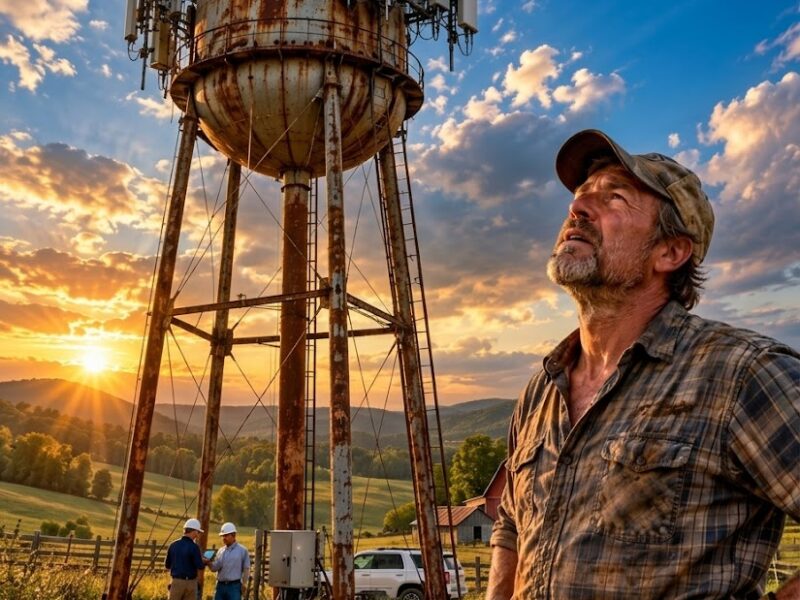
He Bought a Farm With a Rusted Water Tower—Then a Wireless Company Asked to Mount Equipment on It
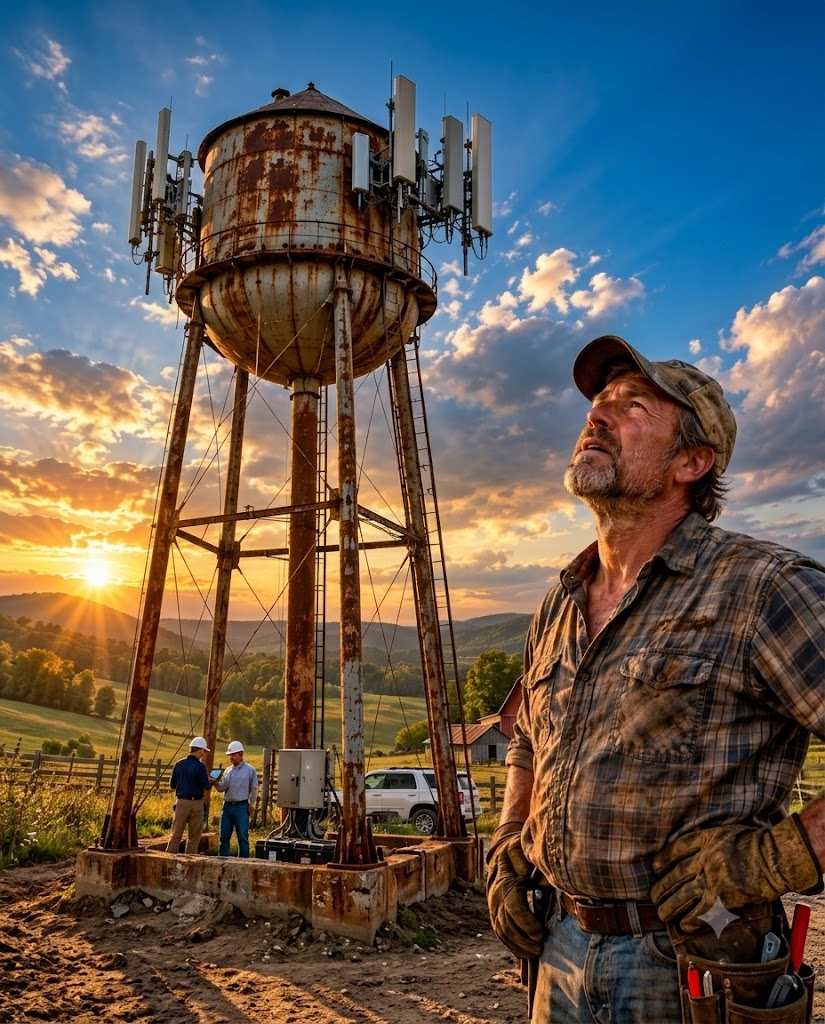
Three weeks after Ethan Cole bought the farm nobody else wanted, a stranger stopped at his gate and asked about the one thing Ethan had already decided was worthless.
The rusted water tower.
The man had stepped from a white SUV carrying a tablet and a hard equipment case.
He barely looked at the sagging barn, the patched fences, or the pasture disappearing beneath weeds.
His eyes went straight to the hill.
Is that tower yours?
Ethan glanced over his shoulder.
Until that moment, everyone who noticed the tower had asked the opposite question.
When are you going to get rid of it?
Yeah, Ethan said slowly.
It’s mine.
The man introduced himself as Daniel Reeves.
Then he opened the equipment case and pulled out a rangefinder.
We’ve been looking for elevation out here.
Ethan stared at him.
You came all this way for that?
Daniel looked past him toward the tower, toward the location underneath it.
For the first time since buying the farm, Ethan looked at the old steel without thinking about demolition.
Nothing had changed.
The tower was still rusted, still empty, still ugly.
But somebody had driven miles down a county road because it was standing there.
And Ethan suddenly wondered if everyone, including him, had been asking the wrong question.
Forty-three acres sat at the end of a narrow county road in western Missouri, where the land rolled just enough to matter and the soil held just enough clay to frustrate.
The barn roof leaked along its eastern side.
Half the fence posts leaned toward the ground like tired old men.
The well pump coughed brown water the first time Ethan switched it on, then spat out a rust-colored stream that took ten minutes to run clear.
And above all of it stood four rusted steel legs supporting an empty tank.
The real estate agent had called it a demolition problem.
Ethan had called it something he couldn’t afford to deal with.
At forty-six, he’d spent most of his adult life repairing equipment other people had given up on.
Tractors with seized engines.
Balers with cracked housings.
Irrigation pumps farmers swore were finished.
Machines made sense.
You found what had failed.
You figured out what hadn’t.
Then you decided whether the difference was worth saving.
His own life had been harder to diagnose.
After years of working for other people, Ethan had put nearly everything he had left into this farm.
There wasn’t enough money for another mistake.
So he’d patched fences, cleared brush, repaired the pump.
When rain came through the barn roof, he moved his tools to the dry side and placed buckets beneath the leaks.
But he left the tower alone.
A scrap dealer had looked at it once.
By the time they discussed cranes, labor, dismantling, and hauling, the small value of the steel disappeared beneath the cost of removing it.
So the tower stayed.
Every morning its shadow stretched across the pasture like a hand on a clock measuring money Ethan didn’t have.
Now a stranger was asking who owned it.
Yeah, Ethan said slowly.
It’s mine.
The man introduced himself as Daniel Reeves.
Then he opened the equipment case and pulled out a rangefinder.
We’ve been looking for elevation out here.
Ethan stared at him.
You came all this way for that?
Daniel looked past him toward the tower, toward the location underneath it.
For the first time since buying the farm, Ethan looked at the old steel without thinking about demolition.
Nothing had changed.
The tower was still rusted, still empty, still ugly.
But somebody had driven miles down a county road because it was standing there.
And Ethan suddenly wondered if everyone, including him, had been asking the wrong question.
Daniel asked permission to walk the hill.
Ethan opened the gate.
As they crossed the pasture, Daniel didn’t ask when the tower had last held water, or whether Ethan planned to repair it.
He checked coordinates, measured the road, studied the utility poles along the county line.
At the top, he photographed the concrete footings and slowly circled the tower before pointing the rangefinder toward the horizon.
Ethan finally asked, You planning to put water back in it?
Daniel lowered the instrument.
No.
Then what are you looking at?
Height.
The answer seemed almost ridiculous.
One section of ladder was badly corroded.
Orange streaks ran down the legs.
A faded warning plate hung crooked near the base.
Everything Ethan noticed reduced the tower’s value.
Daniel appeared interested in something the rust couldn’t remove.
He asked whether the property had an access easement, whether power could be extended toward the hill, whether a service truck could use the gravel lane after heavy rain.
Then he asked, Has anyone else contacted you about the structure?
Ethan laughed.
Only people telling me to tear it down?
Daniel didn’t laugh.
He explained that his company surveyed rural locations for wireless infrastructure.
Existing tall structures sometimes made useful mounting sites, but height alone meant nothing.
Engineers would have to inspect the steel, check loading capacity, study access, power, terrain, and network requirements.
There are plenty of reasons this might not work, Daniel said.
Ethan nodded.
He appreciated that more than a sales pitch.
Daniel packed his equipment and handed Ethan a business card.
If the first review looks promising, we’ll ask to inspect the structure.
No offer?
We’re nowhere near an offer.
The SUV disappeared down the road ten minutes later.
Ethan stayed by the gate until the dust settled.
Then he walked back uphill alone.
For months, he’d looked at the tower and seen demolition costs.
Now he stood beneath it and followed its legs toward the empty tank.
The steel hadn’t changed.
Neither had the rust.
But the question had.
What if the tower’s value had nothing to do with holding water?
Three days later, Ethan’s phone rang.
A woman from Daniel’s company asked whether a structural engineering crew could visit.
Ethan agreed.
Before ending the call, she added one more sentence.
If the site qualifies, we’d also like to discuss a possible lease.
Ethan was standing beside his kitchen counter.
He slowly sat down.
On the table beside him was an overdue invoice for roofing materials.
He looked through the window toward the hill.
Three weeks earlier, he would have paid someone to make the tower disappear.
Now someone was talking about paying him to keep it.
The word lease stayed with Ethan all evening.
He didn’t celebrate.
He didn’t know whether the company would offer fifty dollars or five thousand dollars a month, or whether the engineers would arrive and end the idea in ten minutes.
But that night, the barn door remained unrepaired.
Ethan sat at his kitchen table with his laptop.
He searched for abandoned water towers being reused for communications equipment.
The answer was simpler than he’d expected.
The tower didn’t matter because it had once held water.
It mattered because someone decades earlier had already paid to place a tall structure on high ground.
That distinction changed everything.
Two days later, three engineers arrived.
Ethan expected them to glance at the rust and shake their heads.
Instead, they spent hours measuring.
They photographed welds, inspected bolts, checked the concrete bases, used instruments against sections of steel Ethan would have judged simply by looking at them.
How bad is it? Ethan finally asked.
The lead engineer looked at one of the orange-streaked legs.
Don’t know yet.
It looks bad.
Looking bad and being structurally unusable aren’t the same thing.
Ethan understood that sentence immediately.
It was how he’d approached broken machinery his entire life.
A tractor coated in oil might need one seal.
A clean-looking gearbox could be destroyed inside.
Appearance was evidence.
It wasn’t diagnosis.
The crew continued working.
Near one footing, Ethan noticed a metal plate buried beneath dirt and weeds.
He cleared it with his boot.
A manufacturer’s name.
A year.
A sequence of numbers.
That evening, he searched the markings and found old engineering references showing that towers of this type had originally been designed around substantial loads.
That didn’t mean his tower could support modern equipment.
Age mattered.
Corrosion mattered.
Connections mattered.
But the tower wasn’t random scrap.
Somebody had calculated it, fabricated it, anchored it into the hill for a reason.
Five days later, Daniel called.
We received the preliminary review.
Ethan straightened in his chair.
And the location is strong.
Ethan waited.
Daniel didn’t sound relieved.
But the structure is going to be the harder part.
Ethan looked through the window.
The tower stood black against the evening sky.
Only a week earlier, hearing that it might be unusable wouldn’t have bothered him.
Now it did.
Because for the first time, the rusted thing on his hill had become something he could lose.
Daniel returned the following Tuesday with Rachel Monroe, who handled property agreements for the infrastructure company.
The leather folder in her hand told Ethan this visit was different.
They sat at his kitchen table beneath a ceiling stained by an old roof leak.
Rachel placed a draft agreement in front of him.
We’re interested in securing the site while engineering continues.
Ethan looked at Daniel.
I thought the tower was the problem.
It may be, Daniel said.
But the location is good enough that we want to keep working on it.
Rachel showed Ethan the proposed monthly payment.
He read the number twice.
It wasn’t life-changing.
But Ethan immediately saw what it could do.
Roofing panels.
Fence wire.
Pump parts.
Feed.
Taxes.
For months, every problem on the farm had been fighting for the same shrinking pile of money.
This payment wouldn’t solve everything.
It might stop everything from becoming urgent at once.
Rachel slid a pen toward him.
This authorizes the next phase.
Ethan reached for it, then stopped.
He read the agreement again.
How long is the term?
Rachel showed him.
Renewals.
Another section.
Access.
She turned the page.
The more Ethan read, the less the deal looked like someone renting a few feet of tower.
Technicians would need access.
Vehicles would need a defined path.
Ground equipment might occupy part of the hill.
Electrical service could cross the property.
Future equipment might change what the company needed.
The payment hadn’t become bad.
It had become incomplete.
Ethan looked through the window.
He desperately needed the money.
That was exactly why he didn’t trust himself to sign quickly.
What happens if a service truck damages the lane during harvest?
Rachel began explaining the general damage clause.
I don’t want general.
She paused.
Ethan pointed toward the pasture.
That lane is how I reach half this property.
For the first time, Rachel stopped moving through the contract from memory.
That may require more specific language.
There it was.
Not a trick.
Not a conspiracy.
Just a contract written before anyone understood exactly how Ethan used the farm.
He pushed the pen back.
I need time.
Daniel looked surprised.
A lot of owners signed the first version.
Three weeks ago, I would have paid somebody to haul that tower away.
Ethan looked toward the hill.
I don’t think that version of me should decide what it’s worth.
Rachel left him a copy.
That night, Ethan paid for one hour with a property attorney in town and spent the rest of the evening studying access rights, renewal language, damage responsibility, and equipment expansion.
Then he opened a county topographic map.
His farm sat on one of the stronger pieces of elevation in the immediate area.
Ethan stared at the map.
The tower mattered.
But the hill underneath it might matter even more.
Once Ethan understood the hill, Daniel’s first visit made sense.
The gravel lane already reached relatively close to the tower.
Utility lines followed the county road.
The structure stood away from the barn and livestock areas.
And from that point on the property, the surrounding land dropped away in several directions.
None of those advantages guaranteed anything.
Together, they explained why the company kept returning.
A longtime store owner in town confirmed something Ethan hadn’t known.
That hill has always been high ground, Frank told him.
You could see three roads from up there after the big outage in ’94.
It wasn’t technical evidence.
But it reminded Ethan that the tower’s location had been useful long before Daniel arrived.
Four days later, the detailed structural crew came back.
This time they carried climbing gear, ultrasonic thickness equipment, cameras, and old dimensional drawings.
Ethan watched them for most of the morning.
The first inspection had made him curious.
This one made him nervous.
Near noon, the lead engineer crouched beside one tower leg.
He measured the same section twice, then called another engineer over.
They spoke quietly.
Ethan felt his stomach tighten.
When the inspection ended, he approached them.
Well?
The engineer removed his gloves.
The site works well.
Ethan heard the wording.
The site.
The man nodded toward the tower.
We’re seeing material loss in several places.
Some connections concern us.
Can it carry the equipment?
Not the way it stands today.
The answer hit harder than Ethan expected.
For days, he’d been studying maps, access roads, power lines, and terrain.
Every new fact had made the site seem more valuable.
Now the old steel itself threatened to end the deal.
Is it done?
Not necessarily.
The engineer looked back up.
We need calculations.
Reinforcement may be practical.
May.
Ethan had learned to pay attention to words like that.
That evening he walked the pasture after sunset.
The tower’s shadow stretched toward the barn.
Months earlier he had wanted the structure gone.
Then he had learned why someone else wanted it.
That discovery had felt almost like finding money buried on his property.
Now reality had arrived.
There was no hidden fortune.
There was a potentially valuable asset with potentially expensive problems.
And Ethan knew enough about broken machinery to understand the worst kind of repair.
The kind worth making only if what came afterward justified the risk.
The structural report arrived Monday morning.
Thirty-eight pages.
Ethan understood maybe half.
But the conclusion required no translation.
The structure cannot support the proposed installation in its current condition.
He read it three times.
For two weeks, he’d allowed himself to imagine the lease money changing the farm.
A finished barn roof before winter.
A reliable well.
Fence posts that didn’t wait another year.
Now those plans seemed to vanish behind engineering calculations.
Daniel called that afternoon.
So that’s it? Ethan asked.
Not necessarily.
Daniel explained that several members could potentially be reinforced.
Certain connections could be repaired or replaced.
The access system would need work.
Then came the part Ethan didn’t want to hear.
The company wasn’t prepared to fund every structural repair before making a final site commitment.
They had alternative locations.
Maybe less attractive ones.
But alternatives.
How much would reinforcement cost?
Daniel gave him a preliminary range.
Ethan closed his eyes.
It was almost exactly what he’d reserved for the worst section of barn roof and the well system.
You’re asking me to repair your tower?
No, Daniel said carefully.
It’s still your tower.
Ethan hated the answer because it was true.
After the call, he walked into the barn.
Rain stains spread across the rafters.
A blue tarp covered his welding equipment.
The pump assembly he’d planned to rebuild sat in one corner.
Everything on the farm already wanted money.
Now the structure he’d ignored for months wanted more.
That evening, Ethan read the engineering report again.
This time he stopped focusing on the red marks.
One word appeared repeatedly.
Reinforcement.
Not replacement.
Not demolition.
Reinforcement.
The next morning, he called the engineer.
Forget the thirty-eight pages.
Tell me what actually has to change.
They spent forty minutes separating the work into categories.
Certified structural work.
Fabricated steel.
Access improvements.
Ground preparation.
Ethan could safely handle himself.
The number still hurt.
But now it had shape.
That night, rain struck the barn roof.
Drops fell into the buckets.
One.
Then another.
Then another.
Through the open doorway, Ethan could see the dark outline of the tower.
If he spent the money on the barn, he would solve a problem he already understood.
If he spent part of it on the tower, he might create income that could solve several problems later.
Or he might end up with a stronger empty tower and a leaking barn.
The next morning, Ethan called Daniel.
I’ll take responsibility for part of the reinforcement.
Daniel was silent.
But I’m not doing it on a handshake.
What do you want?
A written agreement.
If I bring the tower to the structural standard your engineers require and it passes review, we reopen the lease terms before installation.
Daniel didn’t answer immediately.
Finally, he said, I’ll take it upstairs.
Ethan hung up.
For the first time since buying the farm, he was preparing to spend money not on what was broken today, but on what might make tomorrow less fragile.
Daniel called two days later.
The company would not guarantee installation.
Network plans could change.
Permits could fail.
The final equipment configuration still required approval.
But they agreed in writing that if Ethan completed the specified reinforcement, and the tower passed structural review, the lease terms would be renegotiated before equipment was mounted.
It wasn’t certainty.
It was enough for Ethan to make a decision with his eyes open.
He signed Thursday.
Friday morning, he began clearing the hill.
Brush disappeared from the tower legs.
Old fencing came down.
Ethan widened the rough service path so contractors could reach the structure without driving through his main pasture.
The critical steel work was different.
Ethan knew how to weld.
He also knew that knowing how to weld did not make him a structural engineer.
The reinforcement plan came from the engineering firm.
Fabricated members arrived to specification.
Qualified contractors handled the structural connections.
Ethan did the groundwork and watched the invoices grow.
Every morning he passed the barn on his way uphill.
The roof still leaked.
After another storm, he moved his tools again.
That was the real price of the gamble.
Not an abstract number.
Something he needed remained broken because he’d chosen to spend the money somewhere else.
During the second week, contractors exposed several sections of steel beneath old coating and corrosion.
Some areas were better than they looked.
Others were worse.
Ethan stopped trying to predict which was which.
Measurements had replaced assumptions.
When the repair work was nearly finished, a contractor suggested coating the remaining exposed sections.
Ethan pointed toward a harmless rectangular patch low on one leg.
Can you leave that?
The contractor frowned.
The rust?
It’s not structural.
No.
Just ugly.
Leave it.
The man shrugged.
Three weeks after work began, the engineers returned.
They measured, photographed, compared the repaired members against the drawings.
Then they sat inside their truck with laptops for nearly an hour.
Ethan waited on the tailgate of his pickup.
Thousands of dollars were gone.
The barn roof was still unfinished.
If the answer was no, nobody had forced him into it.
Finally, the engineer stepped from the truck.
The reinforcement performed as designed.
Ethan stood.
Meaning?
Subject to the final equipment configuration, the tower can support the proposed installation.
Ethan released a breath that seemed to come from somewhere deeper than his lungs.
His phone rang before the engineers left.
Rachel.
I understand the tower passed.
That’s what they tell me.
Then we’d like to finalize the lease.
Ethan looked downhill at the patched barn roof, then back at the tower.
Not the old lease.
Silence.
I took my side of the risk, Ethan said.
Now we finish the deal knowing what this site actually requires.
Rachel paused.
All right.
Send me your changes.
Months earlier, Ethan had been terrified the company might withdraw its offer.
Now he understood what he owned well enough to stop negotiating like he owned nothing.
The second negotiation lasted longer than the first.
This time, Ethan didn’t arrive hoping merely to keep the company interested.
He arrived knowing exactly what could go wrong if the agreement stayed vague.
The monthly payment still mattered.
But so did everything surrounding it.
The service route was placed on a map and attached to the agreement.
The equipment area was defined.
Responsibility for damage caused by maintenance vehicles was clarified.
Access during planting and livestock movement was addressed.
Future expansion beyond the agreed installation would require another review under the terms they negotiated.
Rachel pushed back.
So did Ethan.
Neither side got everything.
That reassured him.
A real agreement wasn’t one side winning every paragraph.
It was both sides knowing what happened when reality became inconvenient.
The monthly payment increased as well.
Not dramatically.
Enough to recognize that Ethan had assumed part of the structural risk himself.
When Rachel placed the final agreement in front of him, Ethan read every page.
Then he signed.
There was no dramatic celebration.
Just a pen resting on a scratched kitchen table.
But Ethan knew the contract mattered because of what would happen on an ordinary bad day.
A service truck in mud.
A damaged gate.
A future equipment request.
A technician arriving when cattle occupied the lane.
The check was easy to notice.
The boundaries were what protected the farm.
Several weeks later, installation crews arrived.
A small fenced equipment area took shape near the hill.
Conduit went underground.
Power was extended.
Cables climbed the reinforced structure.
Then one morning, a crane rolled through Ethan’s gate.
He stood beside his pickup as an antenna assembly rose slowly above the pasture, higher than the barn, higher than the tank.
Toward the exact point in the sky Daniel had studied during his first visit.
Ethan remembered the real estate agent calling the tower a demolition problem.
He remembered the scrap dealer pricing it by weight.
He remembered nearly signing the first agreement because he feared the opportunity might disappear.
Now technicians were fastening new equipment to the same steel.
What surprised Ethan was how little the moment felt like winning money.
What moved him was seeing the tower useful again.
Not restored to its old purpose.
Adapted to a new one.
The first lease payment arrived the following month.
Ethan stared at the deposit on his banking screen.
Then he closed the laptop.
Outside, the barn still needed work.
The pump still worried him.
The western fence still leaned.
Nothing had magically changed.
But for the first time since buying the farm, Ethan knew another payment was scheduled to arrive.
And that changed what he could fix next.
The first lease payment didn’t change Ethan’s life.
It changed the well.
For months, the old pump had worked only when it felt like cooperating.
Ethan had rebuilt pieces, replaced fittings, and kept enough spare parts nearby to make failure feel almost routine.
This time, he stopped patching it.
He replaced what needed replacing.
When water finally moved through the line without coughing or losing pressure, Ethan stood beside the trough and listened.
A small victory.
But small victories were exactly what the farm had been missing.
The next payments went toward the worst section of barn roof, then the western fence.
One problem at a time.
The farm didn’t become prosperous.
It became less fragile.
That difference mattered more.
By spring, Ethan could spend money before small problems became emergencies.
He repaired pasture water access.
Rested sections of ground he’d been overusing.
Replaced broken fence instead of wiring it back together for another month.
Nothing turned green overnight.
The tower didn’t heal soil.
It didn’t make weather predictable.
It simply gave Ethan enough margin to make better decisions.
One evening, his daughter Clare drove out to visit.
She stood beside the barn looking up at the new roofing panels.
You actually finished it.
Most of it.
Clare smiled.
That might be the most optimistic sentence you’ve said since buying this place.
Ethan laughed.
Clare had never understood the farm.
To her, it had looked like forty-three acres of repairs wrapped around a house that needed more repairs.
They walked toward the hill.
New fence posts followed the western boundary.
Water filled the trough.
The blue tarps were gone from the barn.
Clare looked at the antennas mounted beside the old tank.
So that ugly thing paid for all this?
Helped.
How much?
Enough.
She rolled her eyes.
You always say that.
Ethan looked across the pasture.
Enough means something different when every month used to end with nothing left over.
Clare didn’t joke after that.
They stood quietly beneath the tower.
Then she pulled out her phone.
Huh.
What?
I’ve got full signal.
You’re standing under the antennas.
No.
At the house, too.
It used to drop constantly.
Ethan remembered his neighbor Tom mentioning the same thing about his south field.
He didn’t pretend to understand the entire network.
One tower couldn’t fix every dead zone.
But as his daughter walked back toward the house, Ethan looked once more at the structure.
For months, he’d measured its value by what it could do for his farm.
He was beginning to see that its second life didn’t stop at his fence.
Over the next few months, Ethan heard the tower mentioned around town.
A farmer said calls stopped dropping along one stretch of road.
Another noticed no difference at all.
Ethan learned to answer carefully.
It’s one piece of the network.
That was all he knew.
Terrain still blocked signals.
Distance still mattered.
But the tower was clearly doing something beyond producing rent.
One Saturday, Clare returned to help Ethan paint the repaired western gate.
For years, she’d talked about the farm as if it were something he needed to escape before it swallowed the rest of his savings.
Now she kept glancing toward the hill.
You know what’s strange? she said.
What?
When you bought this place, I thought everything old here needed to be replaced.
Most of it did.
You know what I mean?
Ethan did.
Clare looked toward the tower.
You didn’t really save it.
Ethan stopped brushing paint.
No.
You changed what it was for.
He looked up at the old tank and the equipment attached beside it.
That was closer to the truth than anything he’d said himself.
He hadn’t restored a water system.
He hadn’t recreated some ideal version of the farm’s past.
He had allowed an old structure to meet a new need.
Later, Ethan took Clare to the base of the tower and showed her the rectangular patch of rust he’d asked the contractors to leave.
You paid all that money to reinforce this thing and deliberately kept the ugly part?
Yep.
Why?
Because that’s the part everyone understood.
Clare frowned.
The rust?
The conclusion we made from it.
He told her how close he’d come to signing the first offer, how the structural report nearly ended the project, how he had delayed the barn roof to fund reinforcement without knowing whether installation would ever happen.
Clare stared at him.
You never told me that.
There wasn’t much point until I knew whether I’d made a very expensive mistake.
She laughed.
Ethan didn’t.
The possibility had been real.
That afternoon, a vehicle Ethan recognized came up the gravel drive.
Mark Willis stepped out.
The real estate agent who had sold him the farm.
Mark looked at the repaired barn, then the new fencing.
Finally, his eyes reached the hill.
He stared at the antennas.
I’ll be damned.
Ethan waited.
Mark pointed toward the tower.
I told you that thing was going to cost you money.
Ethan smiled.
It did.
Mark looked confused.
Ethan started walking uphill.
After a moment, Mark followed.
Mark stopped beneath the tower.
The last time he’d stood there, weeds surrounded the concrete footings, and rust dominated everything above them.
Now reinforcement plates marked several members.
A fenced equipment area sat nearby.
Cables climbed toward the antennas.
But it was unmistakably the same tower.
So they actually leased it.
They did.
And they’re paying you every month?
Ethan nodded.
Mark looked upward.
I really thought this thing was a liability.
It was.
Mark turned.
What?
It cost money.
Needed engineering.
Needed repairs.
Could have failed inspection.
Ethan pointed downhill.
I delayed that roof because of it.
Mark’s expression changed.
The story sounded less magical when told that way.
Ethan preferred it.
He didn’t want the tower remembered as a lottery ticket attached to his land.
You knew this could happen when you bought the farm? Mark asked.
Ethan laughed.
Not even close.
Then you got lucky.
Ethan considered the word.
Daniel stopping at his gate had been luck.
The hill being useful to the network had been luck.
Ethan hadn’t created either one.
But luck hadn’t read the structural report.
Luck hadn’t funded reinforcement.
Luck hadn’t stopped him from signing a contract he didn’t understand.
I got an opportunity, Ethan said.
He looked upward.
What happened after that cost me plenty.
Mark nodded slowly.
Then he noticed the small rectangular patch of rust.
You missed a spot.
No.
Ethan placed his hand beside it.
I kept it.
Why?
Because that’s what we saw first.
Wind moved through the grass.
We saw rust and thought we knew the whole thing.
Mark looked downhill.
What do you think the farm is worth now?
Months earlier, Ethan would have cared desperately about the answer.
A larger number might have proved he hadn’t made a mistake.
Now he looked at the straight fence line, the finished barn roof, the water trough, the pasture he’d finally begun managing instead of merely rescuing.
I don’t know.
Want me to find out?
No.
The answer came so fast that both men laughed.
Ethan hadn’t bought the farm to flip it.
And somewhere during the repairs, negotiations, and months of uncertainty, he’d stopped needing another person to tell him whether buying it had been a mistake.
Mark left shortly before sunset.
Ethan remained on the hill.
Below him, Clare’s car turned onto the gravel road for dinner.
The tower’s shadow stretched across the pasture toward the house.
Once Ethan had watched that shadow like a clock, measuring how long his savings might last.
Now it crossed land he intended to keep.
That was the reversal Ethan hadn’t expected.
The tower hadn’t simply changed value.
So had the farm.
And so had the way Ethan saw his place on it.
Three years later, the water tower was still the tallest thing on Ethan Cole’s farm.
People driving the county road noticed the antennas.
Ethan noticed everything underneath them.
The western fence ran straight.
Water moved reliably to the troughs.
The barn roof was finished from one end to the other.
Pasture that had once looked exhausted now carried healthier grass through much of the season.
None of it had happened quickly.
The lease hadn’t made Ethan rich.
It had given the farm margin.
A broken tractor was still expensive.
But it no longer automatically meant another bill went unpaid.
Dry weather was still dangerous.
Markets still moved against him.
Ethan still repaired equipment whenever repair made sense.
The farm wasn’t easy.
It was simply harder to knock down.
One September evening, Clare came for dinner with her young son, Ben.
The boy ran through the grass ahead of them.
Grandpa!
Ethan turned.
Ben pointed toward the tower.
Can we see the big thing?
Clare laughed.
The big thing has a name.
They followed him uphill.
At the base, Ben immediately noticed the small rectangular patch of old rust.
Most surrounding steel had long since been repaired and protected.
The patch remained.
Ben touched it.
Why didn’t you fix this part?
Clare looked at Ethan.
She knew the story.
Ethan crouched beside the boy.
Because I wanted to remember something.
What?
Ethan thought about Daniel’s white SUV, the first offer, the engineering report, rain striking buckets in the barn while he tried to decide where to spend the money.
He could have explained elevation, structural loading, contracts, wireless networks.
Instead, he pointed toward the rust.
When I bought this place, that’s what everybody noticed first.
Ben stared at it.
Because it looks bad.
Yeah.
Was it bad?
Some of it was.
Ben waited.
Ethan smiled.
But seeing what’s wrong with something isn’t always the same as knowing what it’s still capable of.
Clare looked away toward the fields.
Above them, the antennas stood against the evening sky.
Below, cattle moved toward the water.
Ethan remembered how close he’d come to treating the tower as scrap.
He also remembered that the story could easily have ended differently.
The engineers could have rejected the structure.
The company could have chosen another location.
The repairs might have cost more than they were worth.
That mattered.
The lesson wasn’t that old things always contained hidden fortunes.
It was that Ethan had almost made a permanent decision before he understood what he owned.
The sun dropped behind the ridge.
The tower’s shadow stretched across the pasture.
Years earlier, Ethan had watched that shadow crawl toward his house like a clock, counting down the money he had left.
Now Ben ran straight through it.
Clare called after him.
Ethan stayed beside the tower.
The steel overhead carried something it had never been designed to carry when it was built.
Below it stood a farm that had survived by adapting in much the same way.
Ethan placed one hand against the remaining patch of rust.
Once the tower had stored water.
Now it carried signals.
He no longer needed to hide what it had been.
The rust reminded him how close he’d come to confusing an old purpose with a finished life.
And as Ben disappeared down the hill toward the house, Ethan looked across the farm and understood the difference.
Obsolete was not always the same thing as finished.
The first winter after the lease began, Ethan learned what margin actually meant.
Not wealth.
Not comfort.
Just the ability to choose which problem to solve first.
The well pump had been first because water touched everything.
The barn roof had been second because rain touched everything else.
The western fence had been third because cattle respected neither weather nor deadlines.
By the time spring arrived, Ethan had repaired more of the farm in six months than he had in the two years before Daniel Reeves stopped at his gate.
He didn’t forget that.
Every time he walked past the tower, he remembered.
Not with gratitude exactly.
With awareness.
The tower hadn’t saved the farm.
It had bought the farm time.
That distinction kept Ethan honest.
One afternoon in late April, a young man in a company truck arrived to check the equipment.
Ethan met him at the gate.
Name’s Derek, the technician said.
I’m here for the quarterly inspection.
Ethan walked him up the hill.
Derek was maybe twenty-eight, with a clipboard and a tablet and the kind of quiet efficiency that reminded Ethan of himself at that age.
They didn’t talk much on the way up.
At the base of the tower, Derek stopped and looked at the small rectangular patch of rust.
Most of it’s been treated, he said.
Yeah.
You left this section.
On purpose.
Derek looked at him.
Why?
Ethan shrugged.
Story.
Derek didn’t ask for more.
He climbed the tower with practiced movements, checked connections, photographed equipment, recorded readings.
Ethan waited below.
When Derek came down, he wiped his hands on his jeans.
Everything looks good.
Same as last time.
Good.
Derek hesitated.
Can I ask you something?
Sure.
How long did it take before the company approached you?
Ethan thought about it.
Three weeks after I bought the place.
Derek laughed.
That’s fast.
Yeah.
Most people wait years.
Ethan looked up at the tower.
I wasn’t waiting.
I was ignoring it.
Derek nodded like that made sense.
They walked back down the hill together.
At the gate, Derek paused.
You know, he said, a lot of these old towers never get reused.
They just sit there until somebody pays to tear them down.
Ethan nodded.
I know.
You got lucky.
Ethan smiled.
I got a lot of things.
Derek drove away.
Ethan stood by the gate until the dust settled.
Then he walked back uphill alone.
That evening, Clare called.
Dad, I’ve been thinking.
About what?
The farm.
What about it?
I want to bring some friends out next month.
Show them the place.
Ethan paused.
You want to show people the farm?
Yeah.
Why?
Because it’s yours.
And?
And I used to think it was just a money pit.
Ethan waited.
But it’s not.
It’s actually kind of beautiful.
Ethan looked through the kitchen window toward the hill.
The tower stood black against the fading sky.
Antennas caught the last light.
Alright, he said.
Bring them out.
Clare laughed.
You sound surprised.
I am.
The visit happened three weeks later.
Clare arrived with four friends from the city.
They stepped out of a rented SUV and looked around like they’d landed on another planet.
One of them, a woman named Priya, immediately pointed at the tower.
What is that?
Clare grinned.
That’s the reason my dad can afford to fix things.
They walked the property.
Ethan showed them the barn, the pasture, the water troughs.
He didn’t show them the tower first.
He saved it for last.
At the base, Priya looked up.
So this used to hold water?
Yeah.
And now it holds antennas?
Yeah.
That’s kind of amazing.
Ethan shrugged.
It’s practical.
No, Priya said.
It’s amazing.
Old things finding new purposes.
That’s not practical.
That’s hopeful.
Ethan didn’t know what to say to that.
Clare caught his eye and smiled.
Later, after the friends had gone, Clare stayed behind.
You liked her, she said.
She’s smart.
She’s right, too.
About what?
About it being hopeful.
Ethan looked at the tower.
I never thought of it that way.
That’s because you’re too close to it.
Ethan laughed.
Probably.
Clare hugged him.
Thanks for not selling, she said.
Ethan hugged her back.
Thanks for coming back.
The second year of the lease brought a different kind of change.
Ethan started noticing things he’d missed before.
The way the pasture recovered when he rotated the cattle properly.
The way water moved through the soil after a good rain.
The way the barn felt when the roof wasn’t leaking.
Small things.
But small things added up.
One morning, Ethan woke before sunrise and walked to the hill.
He did this sometimes now.
Not because he had to.
Because he wanted to.
The tower stood silent in the gray light.
Antennas pointed toward the horizon.
Ethan sat on a concrete footing and watched the sun come up.
He thought about his father, who had worked machines his whole life and never owned a farm.
He thought about his mother, who had worried about money until the day she died.
He thought about the version of himself who had bought this place three years ago.
That man had been desperate.
Not for money.
For proof.
Proof that he could build something that lasted.
Proof that his life wasn’t just a series of repairs.
Ethan looked up at the tower.
The rust patch was still there.
Small.
Ugly.
Important.
He touched it.
Still capable, he said out loud.
The words sounded strange in the morning quiet.
But they felt true.
A few weeks later, Ethan got a call from Daniel Reeves.
We’re planning an upgrade, Daniel said.
Additional equipment.
Ethan tensed.
What kind of upgrade?
More antennas.
Maybe a small equipment shelter.
Nothing major.
But we wanted to talk to you first.
Ethan remembered the first negotiation.
The vague language.
The access clauses.
The damage responsibility.
Okay, he said.
Send me the details.
Daniel laughed.
You’ve changed.
How?
Three years ago, you would have said yes before I finished the sentence.
Ethan smiled.
Three years ago, I didn’t know what I had.
The upgrade negotiation took two weeks.
Ethan hired the same attorney.
He read every page.
He pushed back on access routes that crossed his main pasture.
He insisted on a defined construction window that didn’t conflict with calving season.
He asked for a higher monthly payment.
Rachel Monroe negotiated with him again.
She didn’t seem surprised.
You’ve gotten good at this, she said.
I’ve gotten good at knowing what I need.
That’s the same thing.
No, Ethan said.
It’s not.
The upgrade was approved.
Construction took three weeks.
When it was finished, Ethan stood at the base of the tower with Daniel.
The equipment looked new.
Shiny.
Modern.
It didn’t match the rust.
It didn’t need to.
So, Daniel said.
What do you think?
Ethan looked up.
It’s still ugly.
Daniel laughed.
Yeah.
But it works.
That’s what matters.
Daniel nodded.
You know, he said, we use this site as an example now.
For what?
For how to work with landowners.
Ethan raised an eyebrow.
Really?
You asked the right questions.
You took the right risks.
You didn’t sign anything you didn’t understand.
Ethan shrugged.
I just didn’t want to get burned.
That’s the same thing.
Ethan looked at him.
Maybe.
Daniel shook his hand.
Thanks for working with us.
Thanks for stopping at my gate.
Daniel drove away.
Ethan stayed on the hill.
The tower’s shadow stretched toward the barn.
He watched it for a long time.
The third year brought a drought.
Not the kind that made national news.
Just the kind that made farmers nervous.
Ethan watched the pasture dry out.
He watched the water level in the troughs drop.
He watched the sky for clouds that never came.
But he didn’t panic.
He had margin now.
He could buy hay when he needed it.
He could cull the herd without losing the farm.
He could wait.
That was new.
Waiting had always felt like losing.
Now it felt like strategy.
One evening, his neighbor Tom stopped by.
Tom had been farming in the area for thirty years.
He knew every road, every creek, every stubborn patch of clay.
He stood at Ethan’s gate and looked at the hill.
Your tower’s been busy, he said.
Ethan nodded.
Seems like it.
I heard they upgraded it.
Yeah.
Tom shook his head.
I remember when that thing was just rust.
Ethan laughed.
So do I.
You ever think about tearing it down?
Ethan looked at the tower.
For about three weeks.
Then what?
Then I found out it was worth something.
Tom nodded slowly.
Lucky.
Ethan thought about that word again.
Lucky.
He’d heard it a lot in the past three years.
From Mark Willis.
From Derek the technician.
From Tom.
Maybe they were right.
Maybe luck had played a role.
But luck hadn’t read the structural report.
Luck hadn’t negotiated the lease.
Luck hadn’t spent three years learning how to manage a farm instead of just rescuing one.
I got an opportunity, Ethan said.
What happened after that was work.
Tom looked at him.
You sound like a farmer.
Ethan smiled.
I am one.
Tom laughed.
Took you long enough to figure that out.
They stood in silence for a while.
The sun was setting behind the ridge.
The tower cast a long shadow across the pasture.
You know what I think? Tom said.
What?
I think that tower was waiting for you.
Ethan looked at him.
What do you mean?
I mean, nobody else wanted this place.
Nobody else saw what it could be.
Tom shrugged.
Maybe the tower was the same.
Ethan thought about that.
The tower had been rusted.
Empty.
Useless.
Until someone asked the right question.
Maybe he had been the same.
Rusted.
Empty.
Useless.
Until someone asked the right question.
Maybe they had saved each other.
Tom left as the last light faded.
Ethan walked up the hill.
He stood beneath the tower and looked up.
The antennas pointed toward the stars.
The rust patch was still there.
Small.
Ugly.
Important.
He placed his hand on it.
Still capable, he said.
The words felt different now.
Not just true.
Not just hopeful.
Grateful.
The fourth year brought Ben.
Not the tower.
The grandson.
Clare had married a man named James, who worked in software and didn’t understand farms at all.
But he loved Clare, and he tried.
Ben was born in March.
Ethan drove to the hospital in Springfield and held the baby in the hallway while Clare rested.
You’re a grandpa now, James said.
Ethan looked at the tiny face.
Yeah.
How does it feel?
Ethan thought about the farm.
The tower.
The years of repairs and negotiations and uncertainty.
It feels like the beginning, he said.
James looked confused.
Of what?
Ethan smiled.
Everything.
Ben grew up visiting the farm.
He learned to walk in the pasture.
He learned to run beneath the tower.
He learned to ask questions.
What’s that?
A water tower.
What’s it for?
It used to hold water.
What does it hold now?
Signals.
What are signals?
Ethan laughed.
Things that connect people.
Ben frowned.
Like phones?
Yeah.
Like phones.
Ben looked up at the tower.
That’s cool.
Ethan looked up too.
Yeah.
It is.
When Ben was five, he noticed the rust patch.
Grandpa, why didn’t you fix this part?
Ethan crouched beside him.
Because I wanted to remember something.
What?
Ethan thought about all the years.
The desperate ones.
The uncertain ones.
The ones where he’d watched the tower’s shadow like a clock, measuring money he didn’t have.
He thought about Daniel Reeves.
The white SUV.
The rangefinder.
The question that had changed everything.
When I bought this place, Ethan said, that’s what everybody noticed first.
Ben touched the rust.
Because it looks bad?
Yeah.
Was it bad?
Some of it was.
Ben waited.
Ethan smiled.
But seeing what’s wrong with something isn’t always the same as knowing what it’s still capable of.
Ben nodded like he understood.
Maybe he did.
Maybe he would.
That was the point.
The story would continue.
Not just in the tower.
In Ben.
In Clare.
In the farm.
In everyone who learned to ask the right question.
Ethan stood up.
The sun was setting behind the ridge.
The tower’s shadow stretched across the pasture.
Ben ran toward the house.
Ethan watched him go.
Then he looked up at the tower one more time.
Still capable, he said.
And he meant it.
The years passed.
The tower stayed.
The antennas multiplied.
The lease renewed.
The farm survived.
Not because of luck.
Not because of magic.
Because Ethan had learned to see what others missed.
Because he had asked the right questions.
Because he had been willing to risk.
Because he had been willing to wait.
Because he had been willing to work.
The rust patch remained.
Small.
Ugly.
Important.
A reminder.
A lesson.
A symbol.
Not of what had been lost.
But of what had been found.
Ethan Cole bought a farm nobody else wanted.
He found a tower nobody else valued.
He asked a question nobody else asked.
And in doing so, he found a life nobody else could have imagined.
That was the story.
The whole story.
The only story that mattered.
And as the sun set behind the ridge, Ethan walked down the hill toward his grandson, toward his daughter, toward his farm.
Toward everything that had come from a single question.
Is that tower yours?
Yeah.
It’s mine.
And it always would be.









