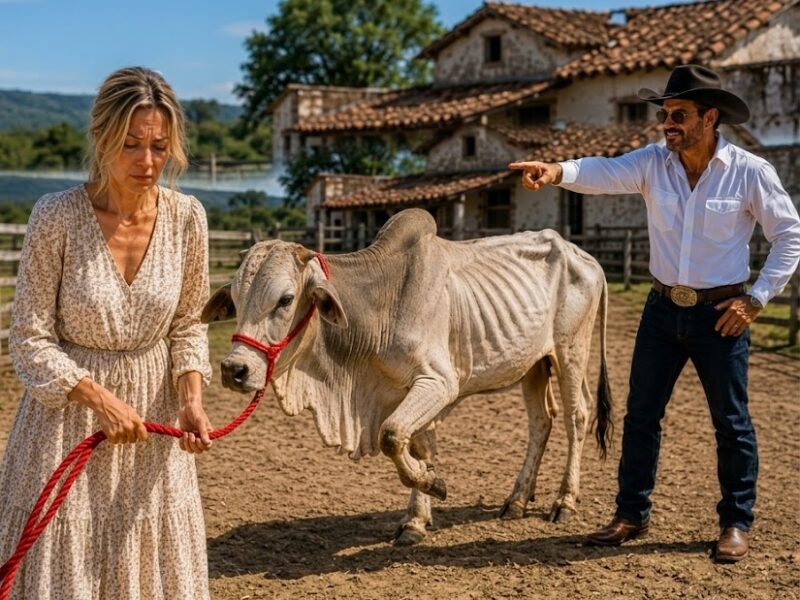
He became a millionaire overnight. And the first thing he did was abandon the wife who stood by him in poverty. His only “goodbye gift”? A lame ox. Years later, fate demanded a price he never saw coming.
The last thing Afonso Bragança put in the truck bed was a toolbox that belonged to his father.
Rosália Duarte was leaning against the door frame, arms crossed over her chest and eyes dry, because she had already cried all she could the night before, alone in the bathroom with the shower running to muffle the sound.
It had been almost twenty years.
Twenty years sharing a bed, a table, work, and silence on that small property on the outskirts of São José do Rio Preto.
When they married, Rosália was young, hardworking, and had a huge desire to make life work.
Afonso was thin, had calloused hands, and was always making plans to get rich.
Together they cleared pastures, fixed fences, sold milk in town, and spent more than one Christmas counting coins to buy meat.
Everything changed when Afonso inherited land from his father and managed to sell a portion to a developer setting up in the region.
There were negotiations that took months, and Rosália was by his side for every meeting, every signed paper, every night he came home nervous, saying the deal might not work out.
But it did.
The money came in, and with it came a version of Afonso that Rosália had never known.
He started by buying a new truck.
Then he changed his clothes.
Then he changed his friends.
He began attending barbecues at large farms, talking to people who spoke of millions, and he started looking at his own house with an expression Rosália knew well, because it was the same one he made when looking at something he intended to discard.
“I’m tired of counting coins and living in a tight spot, Rosália.”
He said that on a Tuesday night while they were having dinner.
She was serving rice and stopped with the spoon in the air.
“What do you mean by that?”
Afonso wiped his mouth with the back of his hand.
“Now that the real money is here, I’m not going to stay tied to an old farm.”
In the following weeks, he hardly ever slept at home.
When he did show up, he brought the scent of different perfume and an impatience that made Rosália feel like she was in the way just by existing.
The separation was cold.
Afonso simply hired a lawyer and sent the papers for her to sign.
He kept the money, the investments, and the properties that were worth something.
For Rosália, only the oldest piece of land remained.
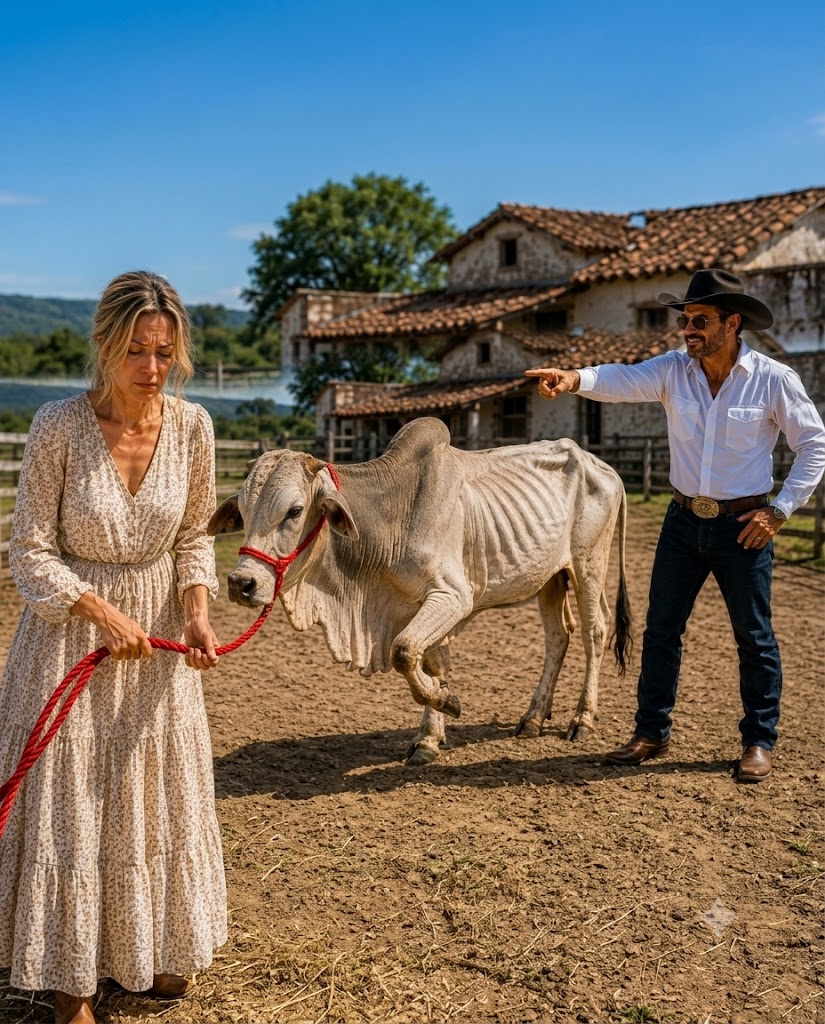
The house with the broken roof and Bento, an ox that limped on his right hind leg and that Afonso didn’t even want to take to slaughter.
On that morning of departure, with the truck already loaded, Afonso looked at the corral where Bento was lying, ruminating, and let out a short laugh.
“You can keep this falling-apart house and this lame ox. They both suit you well.”
Rosália didn’t answer.
Her throat had tightened in a way that wouldn’t even let air pass through properly.
He got into the truck, started the engine, and rolled down the window to say one last thing.
“If you manage to get anything out of that, let me know.”
The truck pulled away, kicking up dust on the dirt road.
Rosália stood still in the yard until the engine noise vanished completely.
Then she looked at the house.
The broken tiles, the crooked porch, the peeling paint.
She looked at the corral.
Bento was still lying down, chewing with his injured leg tucked under his body.
What hurt the most was the certainty Afonso carried that she wouldn’t be able to survive alone.
The way he looked at her before leaving, with that half-smile of someone leaving behind something not worth carrying.
Rosália uncrossed her arms, stepped down from the porch, and walked to the water trough.
It was almost empty.
She grabbed the bucket, filled it at the well, and poured it in while Bento raised his head toward her.
The ox looked at her with that calmness only a farm animal has.
Rosália wiped her sweaty forehead and whispered softly:
“Are we going to make it, Bento?”
But make what exactly, she still had no idea.
The first three days alone were the worst.
Rosália woke up before the sun out of habit, but now the house’s silence had a different weight.
The empty house seemed bigger in the morning.
She took stock of what she had.
Little food in the cupboard, a few bills inside an envelope kept at the back of the drawer.
Overdue electricity and water bills and a property that needed repairs on almost everything.
The roof was letting water in two of the rooms.
The back fence was down.
The water pump motor was making a strange noise that could mean it might stop working at any moment.
And then there was Bento.
The ox ate, drank, and chewed its cud in the same corner of the corral every day, always with that limp in his hind leg that made him walk awkwardly.
Rosália had never paid much attention to him during the years Afonso took care of the cattle, because Bento was considered a useless animal.
Afonso repeated this frequently.
“This creature isn’t even worth the grass he eats.”
On the fourth morning, Toninho, a neighbor who lived two properties over, appeared leaning against the fence with his hat in his hand.
“Rosália, I heard that Afonso left. Do you need anything?”
She thanked him and said she was getting by.
Toninho looked toward the corral and shook his head.
“Look, I know a fellow who buys cattle for slaughter. That one won’t bring you any profit while he’s alive. If you sell him, it will at least pay for some roof tiles.”
Rosália thought for a moment.
The proposal made sense in a way that was practical and cruel at the same time.
She needed money and Bento really seemed to serve no purpose.
Other than taking up space.
“You can send the man to take a look,” she replied without much conviction.
The buyer showed up two days later, a short man with a mustache who examined Bento, walked around the ox, looked at his leg, made a face, and spat on the ground before speaking.
“Ma’am, this animal is not in good condition. I can offer two hundred dollars and that’s pushing it. His meat won’t yield much at all.”
Two hundred dollars.
Rosália felt her face grow hot.
It was the humiliation of hearing once again that what was left for her had no value.
“Thank you, but I’m not going to sell.”
The buyer shrugged and left.
Toninho, who had been watching from afar, approached.
“Rosália, not meaning to interfere, but two hundred dollars buys roof tiles. And that ox there isn’t going to get any better.”
“I know, Toninho, but for two hundred dollars I’d rather keep him.”
That night, after washing the dinner dishes, which were just rice and eggs, Rosália grabbed the flashlight and went to the corral.
Bento was standing, which was rare at that hour.
The flashlight beam hit his body and Rosália noticed something she had never observed carefully before.
Despite the bad leg, Bento had a large body, a broad chest, firm muscles, and a solid frame.
His eyes were gentle, and when she got closer, the ox didn’t pull away.
He stood still, letting her stroke his neck.
“You’re handsome, you know? Aside from that leg, you’re a beautiful animal.”
She stood there longer than she intended, leaning against the fence, thinking.
Afonso had never bothered to look into what was really wrong with that ox.
Once he started limping, he just stopped caring.
But what if the leg could get better?
And what if Bento was more than he seemed?
The next morning, Rosália made a decision.
She knew of a retired breeder who lived on a property nearby, Mr. Geraldo Menezes.
Everyone in the region knew Geraldo had spent his whole life working with breeding cattle and understood bloodlines like few others.
He had been retired for a few years, but still kept up with what was happening in the breeding world.
Rosália put on a clean dress, tied back her hair, and walked to Geraldo’s property.
She found the old man sitting in a plastic chair under a mango tree, reading an old newspaper.
He looked up when she approached.
“Mr. Geraldo, please excuse me for showing up like this. I’m Rosália from Afonso’s property. I mean, from my property now.”
Geraldo folded the newspaper.
“I know who you are, dear, and I heard what happened. Sit down here.”
Rosália sat on a wooden stool and went straight to the point.
“I have an ox that limps. Everyone says he’s no good, but I wanted you to take a look at him before I decide anything. Just take a look.”
Geraldo studied her face for a moment, then agreed.
“I’ll stop by early tomorrow.”
Rosália went home with a glimmer of hope and a great fear that Geraldo would say the same thing as everyone else.
Geraldo arrived the next morning, punctual, wearing worn-out cotton pants, a plaid shirt, and a straw hat that looked as old as he was.
Rosália was already at the corral.
She had woken up before five to clean the trough and leave fresh water for Bento.
“Good morning, Mr. Geraldo.”
“Good morning.”
He wasn’t much of a talker.
He leaned against the fence, crossed his arms, and watched Bento for a long time.
Rosália respected that time.
She knew that country folk examine things at their own pace and that rushed decisions usually go wrong.
After a few minutes, Geraldo entered the corral.
Bento lifted his head but did not move.
The old breeder ran his hand over the animal’s back, felt the muscles, examined the hooves one by one, and lingered especially on the right hind leg.
He flexed the joint carefully while Bento stood still, just swishing his tail to shoo away a fly.
“This ox trusts people,” Geraldo said, almost to himself.
“He’s always been this tame,” Rosália confirmed.
Geraldo straightened up, wiped his hands on his pants, and walked back out of the corral.
His expression had changed.
It was attention.
The kind of attention someone gives to something they recognize.
“Rosália. That leg of his isn’t a birth defect. This looks like an old injury, probably a sprain that got inflamed and was never properly treated. With treatment, he can improve a lot. He might never walk perfectly, but he can improve.”
Rosália felt her shoulders relax.
At least it wasn’t permanent.
But Geraldo wasn’t finished.
He returned his gaze to Bento with that same focus.
“Tell me something, do you know where this ox came from? Who sold him to you?”
“Afonso bought him in a lot about seven years ago with a bunch of other calves. I don’t know from where.”
“Do you have any paperwork from that purchase? An invoice, a form, anything. Can I look?”
Afonso left a cupboard full of old papers he didn’t even bother to take.
“Why?”
Geraldo took off his hat, ran a hand through his hair, and put it back on.
“Because this ox has some characteristics I’ve seen before. I’m not saying it’s certain, because I need to confirm. But if it is what I’m thinking, you might be sitting on a gold mine without knowing it.”
Rosália squeezed her hands together, controlling her anxiety.
She had already learned not to get her hopes up too easily.
“I will look.”
She spent the whole afternoon stuffed in the old cupboard in the back room, which Afonso used as storage for everything he didn’t want to throw away but also didn’t want to organize.
Cardboard boxes, bags, yellowed invoices, feed receipts, vaccination records, loose papers without dates.
Rosália sorted everything on the living room floor, pile by pile, until she found a thin transparent plastic folder with a handful of animal purchase records.
She ran her finger over each one.
Goats, pigs, two cows, and a card with the name Bento, a registration number, and on the supplier line, the name of a breeding farm.
Estância Santa Fé.
Rosália took the record to Geraldo the next day.
The old breeder was on the porch and, as soon as he read the name of the farm, he sat in his chair and stared at the paper in silence.
“Estância Santa Fé.”
He repeated softly.
“I knew the owner. I worked with him for almost fifteen years. The man had one of the best breeding lineages in the state of São Paulo. Genetics that people paid a fortune to access. The breeding farm closed when he passed away, and the animals were sold in lots. Some to those who understood, others to those who had no idea what they were buying.”
Rosália stood before him, her hands clasped in front of her.
“Mr. Geraldo, what does this mean?”
He looked up.
“It means this bull might be the son of one of the best sires that ever passed through this region. But hold on, Rosália, it might be. I need to check records, run tests, and confirm fertility. Having good blood isn’t enough on its own. What matters is what he passes on to his offspring.”
Rosália took the record back and carefully tucked it into her purse.
When she left Geraldo’s house, she walked down the dirt road with the hot sun on her back.
Inside that simple bag was a possibility that didn’t exist twenty-four hours earlier.
That night, leaning against the corral fence, Rosália looked at Bento and said softly:
“If Mr. Geraldo is right, we have a real chance, Bento.”
The bull kept chewing without lifting his head.
But there was still a problem Rosália couldn’t ignore.
To treat Bento, run tests, and start anything, she needed money.
And the glass jar on top of the fridge was empty.
The next morning, Rosália sat on the edge of the bed, looked at the nearly empty room, and began to think calmly.
She had little, but she still had something.
She started with the house.
Afonso had left behind furniture he considered too old for his new life.
A wooden china cabinet that belonged to his mother-in-law, a table with six chairs still in good condition, and a large wardrobe from the master bedroom.
Rosália cleaned every piece, took photos with Toninho’s borrowed cell phone, and posted them in town.
In ten days, she sold everything.
The money wasn’t much, but it covered good feed for Bento for two months and a veterinary visit.
At the same time, she offered her services to the neighbors.
She knew how to sew, make sweets, clean yards, and tend to vegetable gardens.
For every job done, she put the payment in a glass jar that stayed on top of the fridge.
She called it the Bento fund, and every night she counted the bills before going to sleep.
Geraldo guided her without charging a cent.
He explained that the treatment for Bento’s hoof needed anti-inflammatories, proper rest, and follow-ups, and he referred a local vet who agreed to make the first visits for an amount that Rosália could pay in installments.
“The doctor will look at the hoof, and we’ll take the opportunity to perform a fertility test,” Geraldo said one afternoon, sitting on the porch of Rosália’s house.
“And if it turns out he can’t breed, then you’ll know you tried and we can move on.”
The vet came the following week, examined Bento’s leg, confirmed it was an old injury that had partially calcified, and prescribed a sixty-day treatment with medication and specific care.
He also collected samples for a fertility test and warned that the results would take a few weeks.
“The animal is docile and has a good frame. If his fertility is good, he can work as a breeder without any issues, even with the limp,” the vet explained while washing his hands in a bucket.
Rosália paid the first installment with money from the glass jar.
The treatment was slow.
Bento improved, but he still limped slightly, and Rosália learned to accept that it would probably never go away completely.
Geraldo explained that this didn’t diminish his value as a breeder, because what mattered was in his genetics.
The exam results arrived in a brown envelope that the vet brought in person.
Rosália opened it with trembling hands and read it without understanding half the terms.
“Explain this to me, Mr. Geraldo.”
Geraldo adjusted his glasses and looked over the numbers.
He took off his glasses, cleaned them with the hem of his shirt, and put them back on.
“Very good fertility. This bull can breed with no worries.”
Rosália leaned her back against the wall and closed her eyes.
When she opened them, she was smiling.
The first test came soon after.
Geraldo knew a small local breeder named Osvaldo, who had a few beef cows and needed to improve his herd.
Geraldo explained the situation.
Rosália had a breeder of good lineage.
She was just starting out, and the service would be at a below-market price.
“It’s an experiment for both sides,” Geraldo told Osvaldo.
“If it works, everyone wins.”
Osvaldo accepted, though skeptical.
He brought three cows to the property and Bento did his job with his usual calm.
Months passed.
Rosália kept doing odd jobs, paying bills tightly, and looking after Bento every day.
When the first calf was born, Osvaldo called Geraldo.
“Mr. Geraldo, you need to see this. This calf was born with a structure I’ve never seen in my animals.”
Geraldo went to see, returned, and told Rosália, who was in the kitchen peeling cassava.
“It was born strong, large, and healthy. Osvaldo is impressed.”
The other two calves were born in the following weeks, all with the same quality.
A second breeder found out and looked for Rosália.
Then a third.
The money was still scarce, but every cent went back into the property.
A fence fixed here, a piece of roof patched there.
One afternoon, one of the breeders asked what the place was called.
Rosália looked at the corral where Bento was eating peacefully, looked at the house that already had two fewer leaks, and answered almost without thinking:
“Boa Esperança Farm.”
The name came out so naturally that it seemed to have been waiting to be said for a long time.
But Rosália didn’t yet know that the path between that beautiful name and a real farm would have a turn that would almost take everything from her again.
The problem came at the worst possible moment.
Rosália had already closed an agreement with two other breeders in the region to use Bento as a stud.
Payment would come after the calves were born and evaluated, because no one would pay upfront for a bull that limped and still had no name in the market.
She depended on that future money to keep the property running.
But along the way, the water pump that supplied the corral and the house stopped working.
The motor burned out on a Tuesday morning, and the technician who came to examine it shook his head before even opening his mouth.
“Ms. Rosália, there’s no fixing it. You need a new motor.”
“How much does it cost?”
The man quoted a price that was almost everything Rosália had saved in her glass jar.
And without water, nothing worked.
Neither the house, nor the corral, nor the animals.
Without water, Bento couldn’t stay there.
Rosália turned the motor off.
She had no choice.
But when the technician left and she counted what was left in the jar, she realized it was barely enough to buy feed until the end of the month.
The veterinarian’s installment was overdue.
The electric bill was due in ten days, and the calves that guaranteed the next payment hadn’t been born yet.
It was that same week that one of the breeders who had made the deal with her appeared at the gate with a stern expression.
“Rosália, I came to tell you something.”
“What is it?”
“Nenê Figueira from the co-op is saying around town that you’re selling stud services without official registration. He says this bull has no recognized lineage documentation and that the breeders who use him will have trouble selling the calves later.”
Rosália felt her stomach tighten.
Bento had the Santa Fé Ranch records, but the breeding farm had closed years before and the formal lineage registration had never been transferred.
Geraldo had already warned her that regularizing the documentation would take time and cost money she didn’t have.
“So, are you going to keep the agreement?” Rosália asked, trying to keep her voice steady.
The breeder looked at the ground and then back at her.
“I’ll wait for the calves to be born. If they’re good, I’ll stay. If they aren’t, I’m taking my cows.”
The second breeder sent word saying the same thing.
Rosália now had a sire with no official documentation.
Money running out, overdue payments, and breeders ready to quit at the first sign of trouble.
That night, sitting in the kitchen under the dim light of a flickering bulb, Rosália rested her forehead in her hands and stayed there for a long time.
She swallowed the lump in her throat.
She knew that wallowing wouldn’t pay the electric bill, nor fix the pump.
But the question hammering in her head was clear.
Was Afonso right?
Was she insisting on something that wasn’t going to work?
The next morning, she went to find Geraldo.
She told him everything.
The burnt-out pump, the money running out, Nenê Figueira’s gossip, the breeders threatening to leave.
Geraldo listened in silence, drinking coffee from an aluminum mug.
When she finished, he set the mug on the table and said:
“Rosália, Nenê Figueira says that because he wants to sell his own sire. Gossip in the country is like weeds. It grows fast and dies out. When the results show, though, the documentation is a real problem. Without registration, you will hit the same wall every time you try to grow.”
“And how do I solve this without money?”
“The Regional Breeders Association has a registration program for small producers. The cost is lower and I can help you with the process, but it takes about three months and until then you will need to endure the pressure.”
“Three months is a long time, Mr. Geraldo.”
“Yes, but what alternative do you have?”
Rosália went back home and did the math one more time.
If she cut everything she could, sold the last valuable thing she still had in the house, an old wood stove a neighbor had already offered to buy, and kept working odd jobs every day, maybe she could hold on until the calves were born.
That is what she did.
She sold the stove and bought a simple two-burner camp stove.
She started cooking as little as possible and eating rice and beans, with no meat on most days.
In the morning, she took care of Bento and the property.
In the afternoon, she went out to work at the neighbors’ houses and farms.
At night, she returned to check on the animals, noted everything in a notebook, and slept with her alarm set for four thirty.
Two months later, the first calves from that second batch were born.
Rosália called the two suspicious breeders to see them.
The animals had the same quality that Bento’s offspring always showed.
Strong frame, good weight, and vitality.
The breeder who had threatened to leave examined the calves, examined them again, and looked at Rosália.
“Nenê Figueira can go tend to his own cattle. I’m sticking with the deal.”
The second breeder confirmed it the following day.
The gossip lost steam because the result was right there, alive and healthy for anyone to see.
Geraldo started the registration process at the association, and in three months, Bento’s paperwork was regularized.
Rosália kept the registration certificate in the same folder where the original Estância Santa Fé file was.
She placed the folder on the shelf in the room that was starting to become an office and went out to give water to Bento.
That period had almost destroyed everything, but once it passed, Rosália knew no one could ever say what she built came easy.
Boa Esperança Farm took shape month by month, at the same speed Rosália learned to be the owner of her own business.
In two years, what started with three borrowed dams spread across the entire region by word of mouth.
Bento’s calves grew strong, gained weight quickly, and had a vitality that drew attention.
Osvaldo, the first breeder who accepted the experiment, returned twice, wanting to repeat the cross, and started recommending Rosália to acquaintances.
“There’s a woman near São José do Rio Preto who has a very good sire. The bull limps, but his offspring are extraordinary.”
Rosália learned that in the countryside, the strongest advertising is the result.
And Bento delivered results to spare.
The old house was restored without losing its original structure.
Rosália replaced the broken tiles, painted the exterior a light color, fixed the kitchen floor, and bought new curtains.
The corrals were expanded with organized partitions, better troughs, and waterers with automatic floats.
She bought her first own dams with the income accumulated from over a year of work.
Geraldo stepped back from the day-to-day as he realized Rosália was already walking on her own.
“You learned the ropes quickly, Rosália,” he said one morning while they were checking birth records at the small table Rosália had placed in a corner of the room.
“If I faltered, Mr. Geraldo, the numbers wouldn’t add up.”
“Yes, but you had care for detail. That cannot be taught in a book.”
At a regional fair in São José do Rio Preto, two young animals descended from Bento were exhibited.
An experienced breeder, a tall man with a white beard, stopped in front of them and examined them carefully.
“Whose are these? Boa Esperança Farm? You have good stock. If you continue along this line, you will stand out.”
Rosália thanked him and kept that compliment close to her heart.
Meanwhile, Afonso Bragança was living a different story.
He bought the new farm even before his separation was finalized.
A large, beautiful, and expensive property, the kind he always pointed out in agricultural magazines.
The main house had a wide porch, tile floors, and a kitchen that looked like it came straight out of a television show.
In the first few months, he spent without a second thought.
He bought expensive cattle, hired staff, and renovated everything with top-tier materials.
He liked to hear people say:
“You’ve grown, Afonso.”
And he would flash a wide smile every time.
But Afonso understood money much better than he understood cattle.
During his years with Rosália, she was the one who followed the animals closely, who noticed when a calf wasn’t nursing properly, who knew the right time to call the vet.
Afonso handled the accounts and the contacts.
It worked well when the two worked together.
On his own, he bought based on appearance.
The expensive animals came with nice pedigrees and high price tags, but didn’t always deliver results.
Some breeding cows struggled to reproduce.
A stud bull, for which he paid a fortune, didn’t cover half the cows he should have.
Calves were born smaller than expected, and Afonso, instead of looking for the cause, would buy more.
“You need to look at the lineage more carefully, Afonso,” warned the consultant he hired after the second year of losses.
“You’re investing too much in names and too little in proven genetics.”
“I know what I’m doing,” Afonso replied with his usual impatience.
When an acquaintance mentioned during lunch that his ex-wife still lived on that old property, Afonso shrugged.
“Poor thing, she must be struggling on that small patch of land.”
The farm’s numbers started to get really tight in the third year.
The herd didn’t provide enough return to cover the high costs.
Staff members were expensive.
The beautiful main house required constant maintenance, and the expensive animals kept disappointing.
Afonso sold some cattle at a loss and, for the first time, looked at the accounts with real concern.
The consultant returned with a different suggestion.
“Afonso, there are some smaller breeders in the interior of São Paulo that are showing very good results. Solid genetics. Affordable prices. I did some research and have a few names.”
One of the names on the list was Boa Esperança Farm.
Afonso read it and felt nothing.
When he left Rosália’s property, the place had no name, no sign, and no future.
“This one here, Boa Esperança, what’s so special about it?”
“They have a stud bull called Bento,” the consultant replied.
“His descendants are appearing at fairs with excellent ratings. It’s worth checking out.”
“Bento.”
The name passed through Afonso without leaving any mark at all.
“Schedule a visit,” Afonso told the administrator.
On the other side of the road, at Boa Esperança Farm, Rosália received the call from Afonso’s administrator and recognized the name instantly.
She hung up the phone and sat in the chair, digesting the news.
Geraldo, who was having coffee on the porch, noticed the change in her face.
“What is it?”
“Afonso scheduled a visit. He wants to meet Bento.”
Geraldo raised an eyebrow.
“And he knows it’s here, doesn’t he?”
On the day of the visit, Afonso left early, wearing a light dress shirt, dark jeans, and leather boots that cost more than Rosália earned in a month back in those difficult early days.
He started the truck, put on his sunglasses, and hit the road with the manager in the passenger seat.
“It’s far, near São José do Rio Preto, about two hours from here.”
Afonso turned on the radio and didn’t think about the matter anymore during the trip.
He was focused on solving the herd problem.
And that visit was just another attempt.
He had already left other breeders disappointed in previous weeks.
When the truck left the highway and entered the dirt road, Afonso’s body reacted before his mind.
His shoulders adjusted in the seat, his hands tightened on the steering wheel, and his eyes began searching for landmarks in the landscape.
The road had been leveled and the vegetation on the sides was taller, but the layout was the same.
The curves, the slope of the terrain, the way the hill appeared after a straight stretch.
When the truck rounded the last curve, Afonso saw the gate, new, well-painted, with a large wooden sign where it read in clear letters:
Boa Esperança Farm.
He slowed down, looked at the sign, and parked.
It was upon crossing the entrance and following the internal path that the details began to fall into place.
The layout of the pastures, the angle of the house in relation to the road, and a tree, an old mango tree with a thick trunk and wide branches that stood about thirty meters from the house.
That mango tree he recognized instantly, because under it he and Rosália had eaten lunch hundreds of times during the hot summers.
The truck stopped.
Afonso kept his hands on the steering wheel.
The house he remembered with a broken roof and peeling walls was now painted with a new roof, a renovated porch, and curtains on the windows.
Where there used to be a fallen fence, there were organized corrals.
A shed that didn’t exist before occupied the land next door and two buyer trucks were parked near it.
The manager, who knew nothing, commented:
“Nice place, isn’t it?”
Afonso did not answer.
In the yard, the same patch of packed dirt where he had loaded his things into the truck and told Rosália to keep the old house and the lame ox, there were three people talking.
Two were men in hats, breeders by the looks of them.
The third was a woman in jeans, a light-colored shirt, and hair in a ponytail.
Rosália.
She was speaking to the two men as an equal.
She pointed toward the corral, explained something with her hands, and the breeders nodded.
She looked exactly like what she was: the owner of that place.
Afonso got out of the pickup truck, his legs stiff.
Rosália looked in his direction and recognized him before he got close.
Her face showed no surprise.
She had known he would come since the manager’s phone call.
“Afonso.”
“Rosália.”
The breeders with her sensed the shift in the atmosphere and politely moved away.
Afonso looked around at the shed, the corrals, the trucks, and the restored house.
“Is this farm yours?”
“Mine. No one else’s.”
He tried to regain his composure, adjusted his sunglasses on his head, and spoke with the voice he used for negotiations.
“I came to see the bull Bento, if I’m not mistaken.”
Rosália gestured with her head toward the corrals.
“Come with me.”
She walked ahead, with Afonso a few steps behind.
In a separate corral, waiting with his usual calm, there was Bento.
Older, his coat a bit duller, but with a solid body, firm muscle, and gentle eyes.
The limp in his right hind leg still visible, that slight imbalance in his stride that never went away.
Afonso approached the fence and stopped.
That mark on his ear, the dark coloring on his back, the limp.
It was the same bull.
“It’s him,” Afonso said quietly.
Rosália looked at the bull and then at her ex-husband.
“The same one you said wasn’t worth the grass he ate.”
Afonso leaned on the corral fence, staring at Bento for a time that felt too long for someone who had come to do business.
The bull had laid down and was chewing calmly.
The limp, the gentle eyes, the calm demeanor, everything was the same, exactly as Afonso had left it, except for the corral, which was now renovated, clean, and organized.
Rosália waited at his side, not rushing anything.
He tried to resume his professional tone.
“Does he still breed?”
“He does. He’s on reduced activity because of his age, but his children and grandchildren are spread across breeding farms in three states.”
Geraldo appeared at the side of the corral, carrying a thick folder of documents.
He greeted Afonso with a firm, cold handshake.
“Did you come to see the records? I’ll show them to you.”
He opened the folder on a wooden table set up under a shelter.
There were years of documented work.
Crossbreeding sheets, results from every batch of calves, fair evaluations, lineage records, photographs of the animals at different stages.
Afonso flipped through the papers.
With every page, his expression grew heavier.
He was looking at serious, consistent work built upon the animal he had discarded.
“Are those animals that appeared at the Ribeirão Preto fair in May his descendants?” he asked, pointing to a photo.
“Grandchildren,” Rosália replied.
“Offspring of a bull born here three years ago that’s currently on loan to a breeder in Minas.”
Afonso closed the folder, looked at Bento again, then at Rosália.
“Rosália, I had no idea it was you.”
“I know.”
“When a place has no name, it’s easy to forget it exists.”
Rosália stepped toward him and said, without raising her voice:
“You came to buy the sons of the bull you left for me because he was useless.”
“At that time, he seemed useless, Rosália. Limping like that, with no registration. Anyone would have thought the same.”
“You only looked at his limp and wanted to discard him immediately.”
“I went to find out what was wrong with the animal.”
Geraldo picked up the folder.
Before walking away, he said to Afonso:
“You can travel the whole state, Mr. Afonso. A calf with this build and health, you won’t find at just any gate.”
Afonso waited for Geraldo to disappear and tried to resume the negotiation.
“Rosália, I need high-quality animals. I want to make a deal to use Bento’s genetics in my herd, to buy calves from his lineage. I’ll pay well.”
“The calves from this batch are already sold, and the breeders on the waiting list have already reserved the next ones.”
“Then put me on the list.”
“The list is first-come, first-served, Afonso.”
He swallowed his pride and lowered his voice.
“I’m willing to pay above market price, well above. I need these genetics to save my herd.”
“Save it?”
The word slipped out before he could hold it back.
Rosália caught on immediately.
Afonso wasn’t just there to improve his stock.
He was there because his herd was suffering serious losses and he needed results fast.
The yard was empty now.
The afternoon sun hit the sign for Boa Esperança Farm.
Afonso looked at that sign, at the full corrals, at the restored house, and for the first time since he arrived, the businessman posture he tried to maintain began to crack.
“Rosália, let’s talk properly. Under the mango tree, just like in the old days.”
They sat on the same little wooden stools, under the same mango tree, where they had eaten lunch hundreds of times when their whole life fit within that property.
The thick roots emerged from the earth and spread across the ground.
Afonso clasped his hands between his knees and spoke with an honesty that Rosália hadn’t heard from him in years.
“I was wrong, Rosália. I bought expensive cattle from big names, but the stock didn’t hold its weight and the cows are failing. If I don’t put a good breeder in that pasture, I’ll go broke soon. I came here because Bento’s calves are the only ones getting results in the region.”
Rosália listened without interrupting.
“I want to propose a partnership to you. I’ll provide the capital, the contacts, and the structure. You provide the breeding stock and the expertise. Boa Esperança Farm could triple in size in two years.”
“And whose name would it be in?”
Afonso hesitated.
“We can work out the details.”
“The details are exactly what matters, Afonso. I don’t need a partner.”
“You’re refusing without thinking.”
“I’m refusing because I have thought. Everything here was built with my own work. Not a single cent came out of your pocket.”
Afonso leaned forward.
His voice dropped.
“Rosália, I’m begging you. If I don’t improve the herd in the next few months, I’ll have to sell at a loss again. I’m bleeding money.”
“You’re begging me.”
“I am.”
Rosália looked at him.
The man who left laughing, who pointed at Bento and said he was worthless, who looked at her with that smirk of superiority.
Now sitting in the same yard, hands gripped between his knees, asking for access to the genetics of the bull he abandoned.
“I can pay you whatever you want, Rosália, any amount.”
“It’s not a question of price, Afonso.”
“Then sell me the entire property. Tell me the price.”
Rosália stood up and stood before him.
“You haven’t changed at all, Afonso. You think everything has a price and that you just have to throw money on the table for things to work out. When you left, this place was worth nothing to you. Bento was worth nothing, and I was worth even less. Now that I’ve built everything up alone by the sweat of my brow, you want to be a partner here. You won’t lay a finger on anything else.”
Afonso lowered his head.
“The farm is not for sale. Bento is not for sale, and neither is my work.”
Afonso stood up from the stool, stood there for a moment, and looked around one last time.
At the corrals, the house, the pasture, where Bento’s descendants grazed peacefully.
There were no more offers to put on the table.
“Rosália.”
“Go, Afonso. You’ve already seen what you needed to see.”
He walked to the truck without looking back, started the engine, shifted gears, and drove down the dirt road.
Rosália stood in the yard, watching the dust rise, exactly as she had stood years before.
That night, Rosália went to Bento’s corral.
The bull was lying in his usual corner.
She leaned against the fence and stood there listening to the crickets and the sound of the wind in the grass.
Geraldo appeared with two mugs of coffee and handed one to her.
“Are you okay?”
Rosália took a sip before answering.
“Seeing him like that brings me no joy, Geraldo. I just want to keep tending to my cattle in peace.”
Geraldo nodded and said nothing more.
The two of them stood there drinking coffee in silence, looking out at the dark pasture as the farm settled down for the night.
Bento grew old the way a field bull ages when he is well treated.
He calmly reduced his reproductive activity until one quiet afternoon when Rosália and Geraldo decided together it was time to let the old guy rest.
He got a pasture all to himself near the house, with good shade and soft grass.
He kept limping, kept chewing his cud, and kept lifting his head whenever Rosália approached the fence.
Bento’s children and grandchildren had taken over the operation.
Boa Esperança Farm received demand from Minas Gerais, Goiás, and Mato Grosso do Sul.
Rosália employed three families from the region, and the old house was still standing, restored but recognizable.
She kept the old structure of the house, only replacing the woodwork and patching the plaster.
That house was proof of where she had started.
On a Thursday afternoon, Geraldo was sitting on the porch drinking coffee when he saw Rosália come out of the house with an open envelope in her hand.
It was an invitation from a breeders’ association to tell her story at a state fair in Ribeirão Preto.
“I accepted,” she said.
Geraldo raised his mug toward her.
Rosália sat down next to him and kept looking at Bento’s pasture.
The bull was standing under a tree, chewing.
“You know, Geraldo, the day he left, he said that this bull and I were a match because we were useless. I know what he meant. Today, I see Bento grazing there and I think that all we needed was a little patience and respect. A simple woman and a lame bull. He didn’t bother to look any further.”
Geraldo set his mug on the table.
“The one who looked the most was you, Rosália.”
Bento lifted his head toward the porch, flicked his ears, and went back to chewing.
The slight limp was still there, but his stride remained steady across the pasture.
The sun dipped behind the hill, bathing Boa Esperança Farm in that orange glow unique to late afternoons in the São Paulo countryside.
The restored house, the full corrals, the green pastures, and in the middle of it all, an old ox walking with his familiar limp across the very land they once tried to take from him.
Rosália finished her last sip of coffee, stood up from her chair, and walked down the porch steps to tend to the chores.
The farm didn’t wait, and she no longer needed to wait for anyone either.
He said the lame ox and the old house suited her, and deep down, unintentionally, he was right, because Afonso looked at both and only saw what was on the surface.
A woman who was too simple and an ox that limped.
He couldn’t imagine what still existed there.
Rosália didn’t need to shout, didn’t need revenge, didn’t need to prove anything to the man who left.
She only needed to look with care at what he had discarded.
The End.









