He Abandoned His Wife in a Wheelchair for Her Best Friend—One Year Later, She Walked Into His Boardroom as the New Owner
Part 1
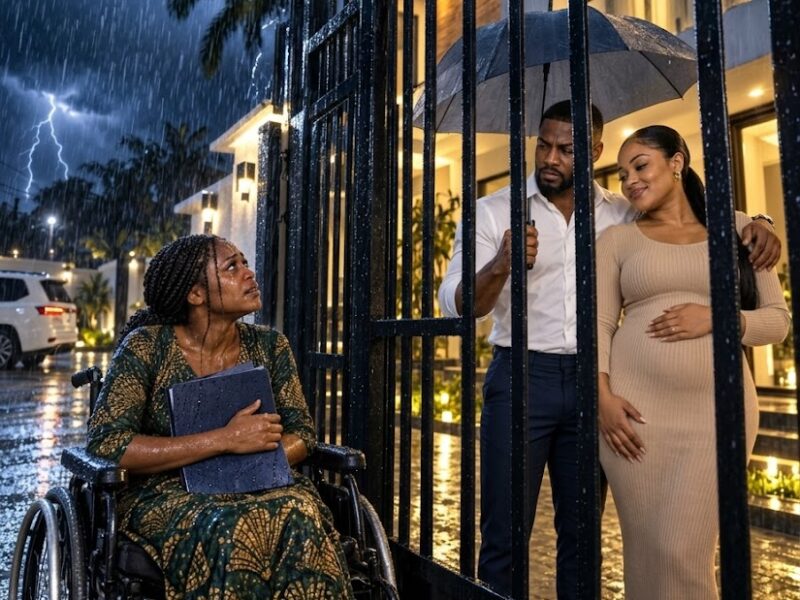
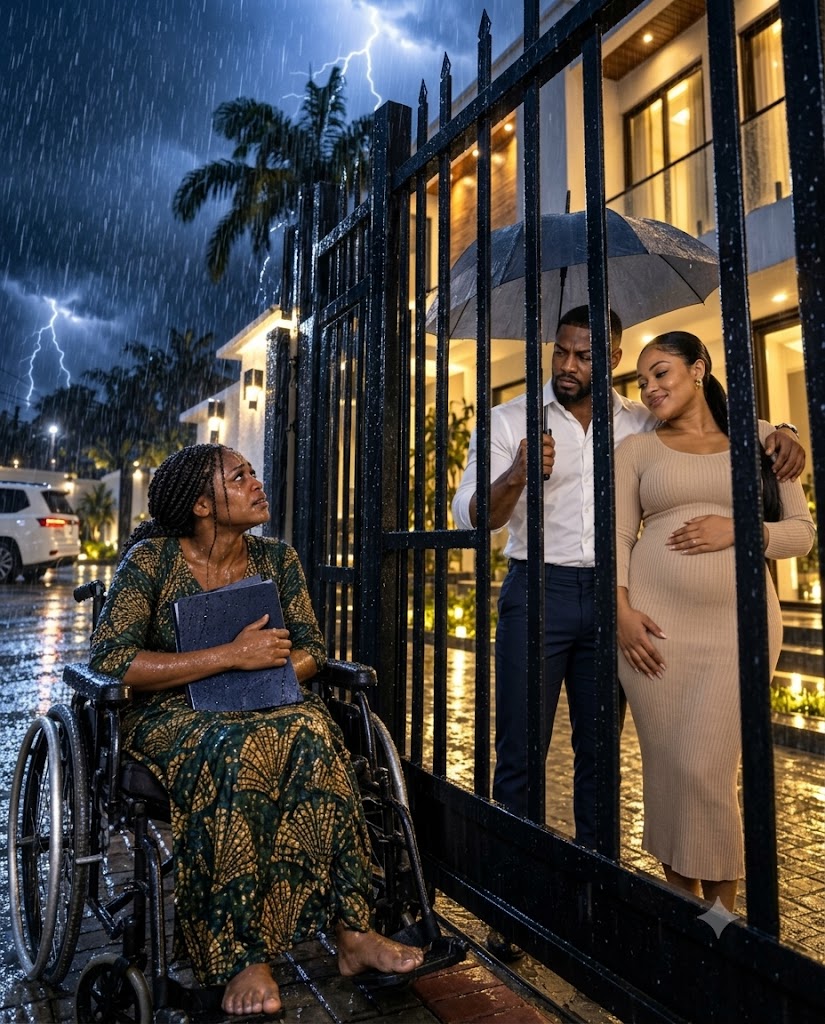
The rain came down in sheets that Saturday evening, hammering against the roof of the Ogedengbe estate like judgment itself.
Inside the grand mansion, a different storm was brewing.
Sign it, Dayo said, sliding the divorce papers across the mahogany table. Kofo moves in on Saturday.
Ore sat in her wheelchair by the window, her hands folded in her lap, watching the water stream down the glass. She had not moved in twenty minutes. She had not spoken in ten.
A wife who cannot stand cannot keep a house, his mother added from her throne-like chair by the fireplace. Her name was Madam Ogedengbe, and she wore her wealth like armor. The doctors say you will never walk again. What use is a wife who cannot even greet her husband at the door?
Ore’s fingers tightened around the armrests of her chair.
You slept beside my hospital bed for weeks, she said quietly. Her voice was steady, but there was something underneath it, something brittle. I thought that meant something.
Someone had to take care of him, Dayo said, not looking at her. He was a handsome man of thirty-five, with the kind of face that had learned to smile its way out of consequences. And Kofo is carrying my son’s heir.
The words landed like stones in still water.
I built your company beside you for six years, Ore said. Her voice cracked now. I drew every building. Every tower. Every blueprint that made Ogedengbe Structures what it is. I sat at that dining table with my sketchbook while you slept, and I gave you everything.
You only drew pictures for me, Dayo said coldly.
Pictures cannot walk into a boardroom, his mother added.
Ore turned her chair to face them fully now. Her eyes were dry, but her hands trembled.
That accident was not my fault, Dayo.
The truck swerved into us, he said with a shrug. Nobody’s fault. That is what the police report says.
Give me a pen.
The room went silent.
What?
Give me a pen, Ore repeated. Her voice was flat now, emptied of something. Keep the house. Keep your name. Keep everything.
Dayo hesitated for just a moment, then pulled a gold pen from his jacket pocket and placed it in her hand.
She signed.
The scratch of the pen against paper was the only sound in the room.
Baba Idogan, Madam Ogedengbe called toward the door. Come and take her out.
An older man appeared in the doorway, his face creased with something that looked like shame. He was the estate’s longtime groundskeeper, a man who had watched Ore design her first tower at the dining table, who had brought her tea on nights when she worked until dawn.
Madam, he said softly, it is raining heavily outside.
Then she will learn how to swim, Madam Ogedengbe said.
It’s all right, Baba, Ore said. Push me out.
Madam, you paid my daughter’s university fees, Baba Idogan whispered. I cannot—
Get her out now, Baba, Madam Ogedengbe snapped.
Ore looked back at Dayo one last time. He was already looking at his phone.
My sketchbook is still in the study, she said. The one with all my original designs. Everything in this house belongs to Dayo now, so I suppose that does too.
SHE MUST LEAVE NOW, Madam Ogedengbe shouted.
A young woman appeared in the hallway. Abigail, the housekeeper, had been Ore’s closest friend in this house. She had braided Ore’s hair on Sunday mornings and listened to her talk about design theories and color palettes.
PAPA, please go inside, Abigail said, stepping forward. Don’t worry about me. I am staying with you.
Abigail, lock that gate or leave with her, Dayo said without looking up.
Madam, at least hold this, Abigail whispered, pressing an umbrella into Ore’s hands. It was a small thing, black and collapsible, the kind you buy at a gas station for fifteen dollars.
Call your village people, Madam Ogedengbe muttered.
She has none, Dayo said.
Baba Idogan pushed Ore’s wheelchair through the front door and down the long driveway. The rain hit her face like needles. By the time they reached the gate, she was soaked through, her thin blouse clinging to her skin, her hair plastered to her cheeks.
Please pick up, Daddy, she whispered, pulling her phone from the waterproof pouch on her wheelchair. Please pick up.
The line rang once. Twice.
So, your private line is ringing, a voice said on the other end. It was warm, familiar, laced with concern.
Daddy, can I come home?
Where are you, my daughter?
Outside this gate. In the rain.
There was a pause. Then: Bring every car we have. Now.
The line went dead.
Ore sat in the rain, the umbrella Abigail had given her still folded in her lap. She did not open it. She let the water wash over her, mixing with the tears she had refused to shed inside that house.
Let the rain wash away her bad luck, Madam Ogedengbe said from the doorway, watching.
Maybe her ghost family is coming for her, Kofo added, appearing beside Dayo with a silk robe wrapped around her shoulders. She was beautiful in the way expensive things are beautiful—polished, deliberate, cold.
Who is that? Dayo asked, squinting through the rain at the convoy of black SUVs now turning onto their street.
Which big man would come for her? Kofo laughed.
The first SUV stopped at the gate. A man stepped out—tall, silver-haired, wearing a suit that cost more than most people’s cars. He was flanked by two security guards.
He walked directly to Ore’s wheelchair and knelt in the mud.
I should have come for you six years ago, he said, his voice breaking. I should have called you, Daddy.
You’re here now, she whispered.
Behind them, Dayo’s face had gone pale.
So, SHE HAD AN OLD SUGAR DADDY ALL ALONG, Kofo said loudly. I always knew she was hiding something.
Asukonto, Dayo said to his assistant, who had appeared at his elbow. Find out everything about that man’s company.
Everything, sir?
Every naira. Every dollar. Every cent.
The man helped Ore into the back of the SUV. Her wheelchair was folded and placed in the trunk. Baba Idogan stood in the rain, watching, his cap held over his heart.
As the convoy pulled away, Ore looked back one last time. The mansion glowed warm and golden through the rain. She could see Dayo and Kofo standing in the doorway, already turning away.
The rain woman is gone, she heard Kofo say. Good riddance.
Ore closed her eyes.
You never told him whose daughter you are, her father said quietly.
I wanted to be loved without your money.
And were you?
I thought so. Until tonight.
She opened her eyes and looked at him. Chief Ayotunde Durusimi. Founder of Aromi Holdings. One of the wealthiest men in the country.
I’m sorry, Daddy, she said. I’m sorry I stayed away.
You’re here now, he said, taking her hand. That’s all that matters.
The convoy drove through the rain, past the gates of the estate, past the neighborhood where Ore had spent six years of her life building a company that would never bear her name.
Mommy’s portrait is still here, she said, looking around the mansion she had grown up in. It had been years since she’d been inside. Everything looked the same—the marble floors, the chandeliers, the sweeping staircase.
Every morning, I apologize to her, her father said. For letting you go. For not fighting harder.
What did they do to you tonight?
Divorce papers. His mother and my best friend.
Her father’s jaw tightened.
I’ll destroy them.
No, Daddy. Not yet.
Ore looked down at her legs. Useless. Dead weight. The doctors had said maybe never. Two words that had haunted her for nine months.
I need to walk first, she said. Then I’ll destroy them myself.
—
## Part 2
The rehabilitation gym smelled like sweat and determination.
Ore sat in her wheelchair, watching the other patients—stroke victims, accident survivors, people whose bodies had betrayed them. They moved slowly, painfully, celebrating small victories.
I can’t do this, she whispered.
You can, her father said from beside her.
The physical therapist was a woman named Kochebi, a former Paralympic gold medalist who had lost her left leg in a car accident at nineteen. She moved through the gym on a prosthetic that she wore like a badge of honor.
Orefi, meet Kochebi, the best in Lagos, Chief Durusimi said.
Second best, sir, Kochebi said with a grin. My old coach was the best.
She looked at Ore, her eyes sharp and assessing.
Your nerves are sleeping, madam, not dead.
The doctor said maybe never.
Doctor say maybe. But I say walk.
Why should I believe you?
Kochebi pulled up her pant leg, revealing the prosthetic.
I never walked again, and I still won gold. Walking is not the prize. Living is.
Ore stared at her.
Again? she asked, trying to lift her legs. They won’t answer me.
Then your arms will teach them.
The first session was agony.
Kochebi had Ore gripping parallel bars, trying to pull herself upright. Her arms shook. Sweat poured down her face. She made it two seconds before collapsing back into her chair.
Again, Kochebi said.
I can’t.
Again.
Three seconds. Four. Five.
By the end of the first week, Ore could stand for ten seconds.
By the end of the second week, she could take one step.
It hurts so much, she gasped one afternoon, tears streaming down her face.
Pain means the road is open, Kochebi said.
—
Meanwhile, in the boardroom of Ogedengbe Structures, Dayo was learning what it meant to lose.
Sir, we lost the Ikoyi hospital bid, Garba said. Garba was Dayo’s chief architect, a man who had worked for the company for fifteen years. He had watched Ore design every major project from her wheelchair, had watched Dayo take credit for all of it.
Our designs always win, Dayo said, frowning at the papers in front of him.
Madam Olaye used to finish the designs, sir.
The room went quiet.
Kofo will do the designs now.
Sir, Kofo decorates rooms. She doesn’t design towers.
THEN FIND ALL OF OLAYE’S OLD FILES.
Garba nodded and left the room.
At home that evening, Kofo stood in Ore’s old study, staring at the sketchbooks and design portfolios that filled the shelves.
MUMMY, LOOK at the rubbish she left behind, Kofo called out.
Madam Ogedengbe appeared in the doorway.
Throw it away. Her bad luck is inside.
Take her rubbish out, Baba, Madam Ogedengbe called. Baba Adegan, are you sleeping out there?
No, madam. I’m coming.
The old groundskeeper appeared. His name was Baba Adekunle, and he had worked for the family for over a decade. He gathered the sketchbooks into a cardboard box, his hands trembling.
Madam Olaye, I will find you, he whispered to himself.
He carried the box to the trash bin outside, but he did not throw it away. Instead, he hid it in his quarters, beneath his bed.
—
In her father’s mansion, Ore was learning to stand.
Hold it. Five seconds, Kochebi said.
Ore gripped the parallel bars. Her legs screamed. Her arms shook.
Can’t hold it.
Four.
Three.
She collapsed into her wheelchair, gasping.
You’re standing, Orefa, her father said, tears in his eyes. You’re standing.
I prayed for this, he said. Since the night you called.
Don’t cry, Daddy. People will talk.
Let them talk while we lift.
She looked at him.
I want five hundred guests at our wedding, she said.
Whose wedding?
Mine. I’m going to find someone who deserves me.
Her father laughed.
First, you walk. Then, you conquer.
—
Dayo’s world was crumbling.
Kofo, the bank is calling my loans, he said one evening, staring at his phone.
Then win that tower contract, my son, his mother said.
Without Ore’s drawings, we have nothing to pitch.
I copied her files from her old laptop, Dayo said. Now they carry my name.
He pulled up the designs on his computer. The Lagoon Tower. A masterpiece of modern architecture, designed to curve nine degrees at the fourteenth floor to catch the lagoon breeze. It had been Ore’s passion project, the one she had worked on for years.
Now it was his.
—
In the gym, Ore was making progress.
Month three, Madam. Show me ten steps, Kochebi said.
Ore gripped the bars. She had graduated from the parallel bars to a walker, and now she was attempting steps without either.
Seven, she gasped.
Eight.
Look where you’re going, not at your feet.
Nine.
Ten.
She stood, trembling, sweat pouring down her face.
Good. Now, twenty.
You are a wicked woman, coach.
Wicked women win medals.
—
In the Ogedengbe household, Baba Adekunle had been fired.
They sacked me yesterday, sir, he said, standing in the doorway of the Durusimi mansion.
Ore looked at him from her wheelchair. She had just finished a session with Kochebi and was exhausted, but she recognized him immediately.
Baba Adekunle. You worked at the estate.
Yes, madam. I asked every gateman in the neighborhood about your convoy. They threw your book into the rubbish, madam. I saved it.
He held out the box of sketchbooks.
You saved my tower, Baba.
You saved my daughter’s future first, madam. The university fees. I never forgot.
Ore smiled.
Do you still have a job?
They sacked me yesterday, sir.
Then you guard my gate from tomorrow.
—
The boardroom of Aromi Holdings was buzzing.
Sir, Ogedengbe Structures just applied to Aromi, an assistant said.
For how much?
Five billion dollars for the Lagoon Tower. The designer is listed as Kofo.
Ore’s father looked at her.
He is selling my tower under Kofo’s name.
Then Aromi will say no.
No, Daddy. Say yes and invite him.
Why invite a snake to dinner?
Because I want to see his face. When I walk into his boardroom.
The tender closes in ten months.
Then I have ten months to walk.
Your mother said you were stubborn.
Some people need ten years, not ten months. Then train me like I have ten months.
—
## Part 3
The months passed in a blur of pain and progress.
Ore moved from the walker to a cane, then from the cane to nothing. Her legs were weak, her gait unsteady, but she was walking.
At night, she studied the Lagoon Tower designs, redrawing them from memory, adding new details, new innovations. If Dayo was going to sell her tower, she would make sure it was unmistakably hers.
In the Ogedengbe household, cracks were beginning to show.
Kofo, look. The rain woman is still crawling, Madam Ogedengbe said one afternoon, pointing at a social media post. Someone had snapped a photo of Ore at the rehabilitation gym.
Mama’s knee doctor is here, Kofo said. But who pays yours, Orefa? Her sugar daddy must be very old and blind.
They laughed.
But Dayo was not laughing.
He had seen the photo too. Ore was standing. Not walking, but standing. He had not seen her stand since the accident.
That night, he dreamed of her. Of the way she used to smile at him across the dining table. Of the way she had looked at him when he signed the divorce papers. Of the umbrella she had left at the gate.
He woke up in a cold sweat.
—
The rehabilitation gym was hosting a fundraising event.
Madam, this is a rehabilitation gym, not a market, Kochebi said, blocking the entrance. Two women stood in the doorway—Madam Ogedengbe and Kofo.
Dayo and I marry next month, Kofo said with a smirk. You can come in your chair.
Congratulations, Ore said from behind Kochebi. And I hope he drives carefully.
What are you trying to say?
Security, please escort these ladies out.
Do you know who my son is?
Why didn’t you shout at them? Kochebi asked after they were gone.
Shouting is for people who have already lost.
Then, madam, you are winning.
—
The wedding was a grand affair.
To my son and my real daughter-in-law, Madam Ogedengbe toasted.
And to our tower, Kofo added. And to Aromi’s money.
The guests applauded.
But Dayo was distracted. His phone buzzed with a text from Garba.
Sir, the bank made the house collateral.
Not today, Garba. Today I am king.
He looked around the banquet hall, at the smiling faces, at Kofo in her designer gown. He should have been happy. He had everything he wanted.
So why did he feel like he was drowning?
—
In the Durusimi mansion, Ore was practicing walking without her cane.
Tomorrow, the board makes you executive chair, her father said.
Are you sure, Daddy?
I built Aromi and named it for you. Aromi means the firstborn. My first, my only, my heir. Now walk into your name.
Ore took a deep breath. She had been training for this moment for months. She had walked the length of the hallway a hundred times. She had climbed stairs, practiced standing for hours, strengthened her legs until they could carry her weight.
She took a step. Then another.
Forty meters, no rest. Go.
She walked. Her legs ached, her muscles screamed, but she walked.
Hold my mother’s cane, coach, she said when she reached the end.
Without the cane, Ore Fe? You walked without anything.
Don’t cry, coach. People will talk.
Let them talk while we walk.
—
The final meeting was set for June 10th.
Aromi set the final meeting, her father said. Their new chairwoman will attend in person.
I’ll charm that woman in five minutes, Dayo said when he heard the news.
Nobody has ever seen this chairwoman’s face, Kofo said.
Rich women all want the same thing—flattery.
Then flatter her. Because we need this money.
The bank will take this house.
Only if Aromi says no, mama.
Then make them say yes, OR WE SLEEP OUTSIDE.
—
The boardroom of Aromi Holdings was the most impressive Dayo had ever seen.
Floor-to-ceiling windows overlooked the city. The table was polished mahogany, the chairs leather. On the wall hung a portrait of the founder, Chief Ayotunde Durusimi.
Dayo straightened his tie.
The Lagoon Tower, designed by my wife, Kofo, he said, presenting the blueprints.
Impressive work, Mrs. Ogedengbe, a voice said from the doorway.
Dayo turned.
Sir, Aromi’s chairwoman is outside the door, Garba whispered.
Everybody stand and smile. This is our future. Let me greet her first.
Please hold my mother’s cane, someone said.
Madam, are you sure?
I didn’t come here to lean.
The door opened.
She’s here, everybody smile.
Dayo’s smile froze on his face.
Let me walk with me.
Aromi Hastings walks with you, madam.
No, that’s not possible. Ore?
The executive chair of Aromi Holdings.
You invited me, so I walked.
You can walk?
Sit down, Dayo. We have business.
Somebody call security right now, Madam Ogedengbe shouted.
Madam, she is the investor.
Where did you get this kind of money?
From that old sugar daddy, obviously.
That old man is my father.
The room went silent.
Chief Ayotunde Durusimi, founder of Aromi Holdings. The Aromi Durusimi.
Your father is Aromi’s Durusimi?
You never once asked about my family. You only asked what I could do for you.
Ore walked to the head of the table. Her steps were slow, deliberate, but she walked.
Ore, we can start afresh.
Why does it twist nine degrees at floor fourteen?
What?
For beauty? For the lagoon breeze my mother loved?
Anyone can memorize a design.
Then explain these originals dated four years ago.
She pulled out her sketchbook and placed it on the table.
Sir, I cannot lie anymore, Garba said suddenly.
WAKA, SIT DOWN.
Madam Olaye designed everything. AND KOFO FORGED THE DATES.
You forged documents for an investor?
It was Kofo’s idea.
You told me to do it.
Aromi will not invest in stolen work.
Aromi, the bank WILL TAKE MY HOUSE.
THE HOUSE YOU PUSHED ME OUT OF?
Please, six years must mean something.
It meant everything to me. To you, it meant a signature. Aromi withdraws, and the forgery goes to the tender board.
And the Lagoon Tower?
Aromi will build it with its real designer.
I am not staying for this.
Kofo, where are you going?
Somewhere with money. Your mother said pictures cannot walk into boardrooms.
Ore, please.
Tell her I walked.
Madam, it is an honor to finally say your name.
Come and see me on Monday, Mr. Garba.
—
## Part 4
The fallout was swift.
Madam, we are fraud investigators, two men in suits said, appearing at the Ogedengbe mansion the next morning.
Those drawings were Dayo’s idea, Kofo said.
Then you will both explain, madam.
Baba, I didn’t know you worked here now, Dayo said, spotting Baba Adekunle at the gate.
I gave her my umbrella that night, sir.
Please tell Madam Ore that we must see her.
She’s coming, Mama. She saw you from upstairs.
Ore appeared at the top of the driveway. She was walking. Slowly, with a cane, but walking.
You came to my gate in the rain, she said. We have nowhere to sleep tonight.
Ore, we have nowhere to go.
Mama. Ore, I must tell you something first.
Mama, no.
My son was texting Kofo. That’s when the terrible event happened.
I knew he ran the red light, not why.
Forgive me, my daughter.
Baba, give Mama the umbrella.
Mama will have a small flat for one year.
And me?
You will learn to stand on your own.
—
The Lagoon Tower rose from the waterfront like a promise fulfilled.
Ten floors of this tower are for wheelchair users, Ore said at the ribbon-cutting ceremony. Wide doors, gentle ramps, and dignity on every floor. Now, that is a tower.
Your mother would be proud of you.
For Mommy. For you, my Aremu.
God bless this ground.
—
Where did you work today? Ore asked Baba Adekunle.
Carrying blocks by the lagoon, next to her tower.
Her tower?
Her tower.
We laughed at her in the rain.
And she still gave you an umbrella.
Gold for glass myself. I don’t need it anymore, Mommy.
Keep it close anyway. Strength remembers its roots.
Always, Daddy.
Are you still angry at him?
No, Daddy. Anger would keep me in that rain.
Then you are truly free.
They thought my worth left with my legs. It never did.
—
## Part 5
One year later, Ore stood at the window of her office on the forty-fifth floor of the Lagoon Tower.
The city stretched out below her, a glittering tapestry of lights and life. Somewhere down there, Dayo and Kofo were learning what it meant to start over. The fraud charges had been dropped, but the reputation damage was permanent. Ogedengbe Structures had filed for bankruptcy six months ago.
The bank had taken the house.
Madam Ogedengbe had moved in with her sister in the countryside, her social standing reduced to gossip and regret.
Kofo had left Dayo three months after the wedding, taking what was left of his money and fleeing to another city.
Dayo was working at a construction site now, carrying blocks by the lagoon, just like Baba Adekunle had done.
Ore had seen him once, from a distance. He had looked up at the tower, at the building his wife had designed, and she had watched his face crumble.
She had not felt satisfaction. She had not felt pity. She had felt nothing.
That was the truest freedom.
Madam Chair, your father is here, her assistant said.
Ore turned from the window.
Her father stood in the doorway, leaning on a cane of his own. Age had caught up with him, but his eyes were still sharp, still proud.
You did it, he said.
We did it.
She walked to him, her steps steady now, her gait almost normal. The doctors had said maybe never. They had been wrong.
I have something for you, her father said, pulling a small box from his pocket.
Ore opened it. Inside was her mother’s cane, the one she had used after her surgery, the one Ore had held during her first steps.
It still smells of her perfume, she said softly.
Now it walks with you.
Ore held the cane, feeling its weight, its history.
The cane is a friend, not a master, she said.
Six months ago, I couldn’t feel my feet. In six months, they will carry you anywhere.
Daddy, I have something to tell you.
What is it?
I’m going to build more towers. Not just for Aromi. For everyone. For the people who were told they would never walk again. For the people who were pushed out into the rain.
Her father smiled.
Your mother would be proud.
I know.
—
That evening, Ore visited the rehabilitation gym.
Kochebi was training a new patient, a young man who had lost his leg in a motorcycle accident. He was struggling, sweating, crying.
I can’t do this, he gasped.
You can, Ore said, stepping forward.
The young man looked up at her, at the woman who had walked into her own boardroom after being told she would never walk again.
How do you know?
Because I was where you are. Six months ago, I couldn’t feel my feet. Now they carry me anywhere.
She knelt beside him, her knees protesting, and took his hand.
Walking is not the prize, she said. Living is.
The young man stared at her.
Who are you?
My name is Ore. And I’m here to tell you that you can do this.
She stood, her legs steady beneath her.
One step at a time.
—
Later that night, Ore sat on the balcony of her mansion, looking out at the city.
Her sketchbook was open in her lap. She was designing again, not for Dayo, not for anyone else, but for herself. A new tower, one that would curve ten degrees at the fifteenth floor, catching the moonlight.
Her father appeared beside her.
You’re thinking about her.
Every day.
She would be proud of you.
Ore looked up at the stars.
I know.
She thought about the night she had been pushed out into the rain. The night she had lost everything. The night she had thought her life was over.
She thought about the umbrella Abigail had given her, the one she still kept in her closet.
She thought about the sketchbook Baba Adekunle had saved from the trash.
She thought about the cane her mother had used, the one that now leaned against her desk.
These were the things that had carried her through. Not money. Not status. Not revenge.
Love. Kindness. The small acts of grace that reminded her she was still human.
She picked up her pencil and began to draw.
The rain had stopped.
The sun was rising.
And Ore was walking into her future, one step at a time.
—
THE END









