Green Beret Doubted the Quiet Nurse — Until Her Military K9 Skills Exposed a Buried Secret
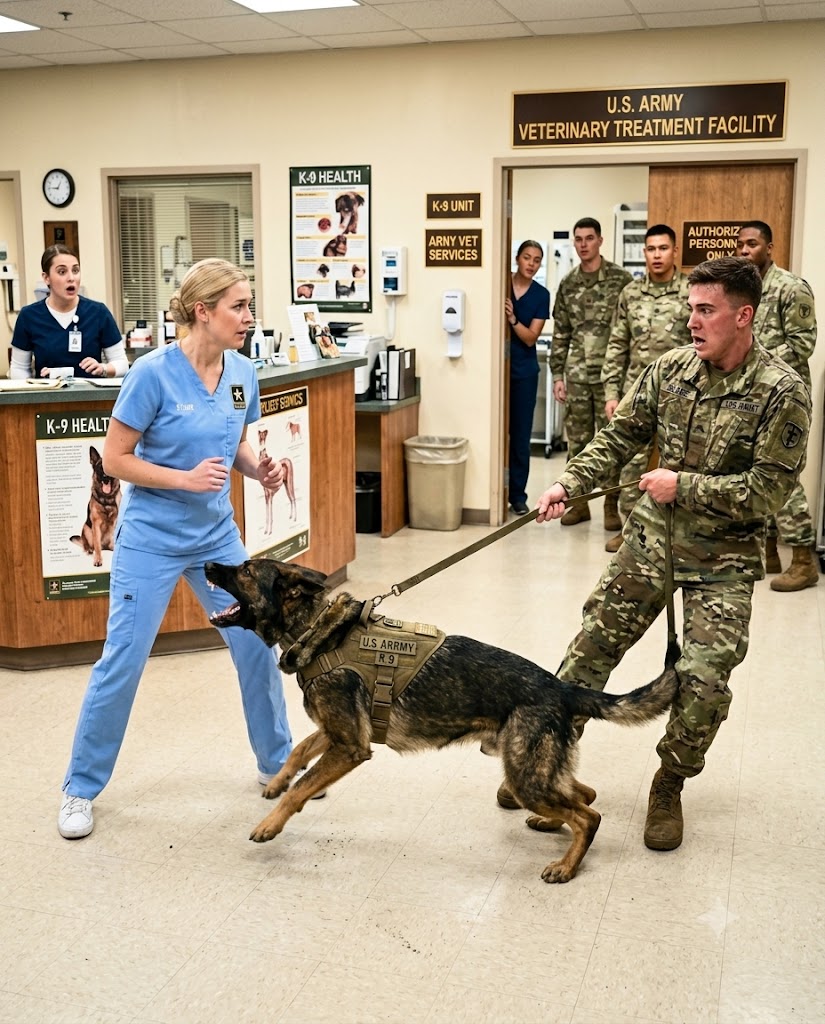
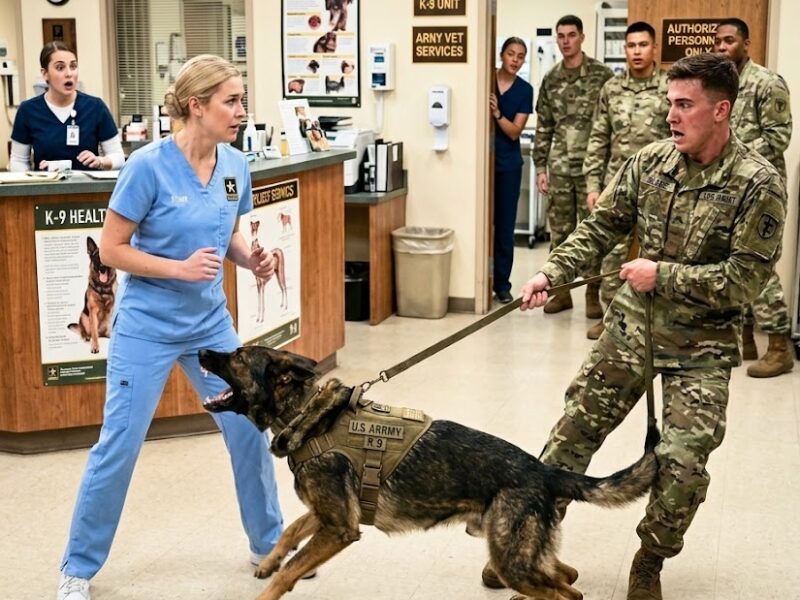
The Belgian Malinois hit the floor like a grenade had gone off.
A hundred pounds of muscle and teeth dragged a decorated Green Beret across the linoleum while staff scattered behind counters and pressed themselves against walls.
The handler, combat ribbons on his chest, hands wrapped in the leash, couldn’t hold him.
Nobody could.
The dog was screaming in a language no one in that building understood except one person.
The nurse everyone forgot was in the room.
She stepped out from behind the intake desk.
No gloves, no protective gear, no hesitation.
And the dog stopped.
Not slowly.
Instantly.
Like she’d spoken a word only he could hear.
—
The morning shift at Ridgeline Animal Trauma Hospital started the way it always did, with Dr. Harlon Voss telling someone they were wrong.
He wasn’t related to Elena.
The shared last name was the kind of coincidence that made people do a double take the first week and then forget about entirely.
But Dr. Harlon Voss, chief of veterinary surgery, had a talent for making sure everyone knew exactly who mattered in that building.
And Elena Marsh had never been on that list.
She’d been at Ridgeline for three years, long enough to know every procedure by heart, every doctor’s preference, every supply closet code, every patient file before the attending even pulled it up.
She worked intake, post-op monitoring, wound management, pre-surgical prep, and when it got busy, which it always did because Ridgeline was the only Level II animal trauma center within a hundred-mile radius of Dunore, Nevada, she worked all of it simultaneously, quietly, without asking for credit.
She was thirty-eight, medium height, dark hair she kept pinned back, and the kind of face that people consistently underestimated as tired.
She didn’t correct them.
She’d stopped correcting people about a lot of things a long time ago.
“Marsh.”
Dr. Voss didn’t look up from the chart he was reviewing when he called her name.
He did that.
Summoned people the way you’d call a cab, expecting arrival without acknowledgement.
“Pre-op on bay three needs to be redone. Whoever prepped it left the instrument tray uncovered.”
“That was Dr. Prenn’s tech,” Elena said from the supply station where she was restocking suture kits.
“And you’re telling me this because?”
She paused for half a second.
“Because I prepped bay three myself this morning and covered the tray before I left it. If it’s uncovered now, someone went in after me.”
Dr. Voss finally looked up.
His expression was the one he reserved for minor annoyances.
Parking tickets.
Equipment delays.
Nurses who pushed back.
“Just fix it, Marsh.”
She fixed it.
—
That was a Tuesday in early March, and it was completely ordinary.
The extraordinary part came at 11:47 that same morning when the front doors blew open.
The man came through first, tall, maybe forty, with the kind of build that didn’t come from a gym.
Combat boots on the wrong side of broken.
Civilian clothes that sat on him like a costume.
His left hand was wrapped in a leather leash, and the leash was attached to a Belgian Malinois who was in the process of destroying the entryway.
The dog was enormous for his breed.
Ninety, maybe a hundred pounds.
And he moved like something detonating in slow motion.
Not erratic.
Not chaotic.
Purposeful and explosive.
And the distinction mattered because it meant the aggression wasn’t random.
He wasn’t scared.
He was in pain and he was done tolerating it.
“Somebody help me.”
The man’s voice was rough, cracked at the edges, not from fear, but from three days without sleep, which Elena could read in his face the moment she came around the front desk.
“His name’s Titan. He’s a retired MWD. He’s… I don’t know what’s happening. He won’t let me touch him.”
The receptionist, a twenty-two-year-old named Bria, had retreated to the wall behind the printer.
The intake tech, Marcus, was behind the counter with both hands on the edge of the desk like he was considering climbing it.
Two technicians who’d been walking through the lobby with a transport carrier had simply stopped moving because Titan had turned in their direction when they moved.
And something in his eyes told them that was enough.
The handler, the man, the Green Beret, though Elena didn’t know that yet, had wrapped both hands in the leash now and was pulling from the shoulder, not the wrists, which meant he knew what he was doing, which meant this dog had broken his control for a reason that was bigger than training.
Elena walked toward them.
“Marsh.”
Dr. Voss’s voice came from somewhere behind her.
“Don’t.”
She held up one hand without looking back.
Not at him.
To the dog.
She stopped about eight feet out.
She didn’t crouch.
Didn’t make herself small.
Didn’t extend her hand or talk in the high soothing voice people used with animals they didn’t understand.
She just stood there, her weight even, her breathing slow.
And she made eye contact with the Malinois for exactly two seconds, then looked away.
Titan went still.
Not calm.
Still.
Which was different.
The difference between a storm ending and a storm waiting.
She took one step forward, held position, took another.
The dog’s ears shifted toward her, then back.
His breathing changed, still ragged, but the pace dropped.
His handler had gone statue still, too, like he understood that moving right now would undo whatever this was.
Elena stopped four feet away.
She looked at Titan again, a real look, the kind that cataloged.
She saw the muscle tension in his left hind quarter before she saw anything else.
The way he held the left leg slightly off true, barely perceptible unless you were looking for it.
The way he’d been redistributing his weight forward, which explained the aggression, because the aggression wasn’t behavioral.
It was a pain response that had been mislabeled for however long this had been going on.
She pulled a small piece of dried chicken from the pocket of her scrubs.
She always had it.
The attending vets thought it was excessive.
She kept it anyway.
She placed it on the floor, slid it with her foot three feet in Titan’s direction.
He looked at it, looked at her, looked at it again.
Then he walked to it, picked it up, and stood there chewing with the slow, deliberate movements of an animal that had just made a significant decision about a person.
The room exhaled.
“What the—” Marcus from behind the counter.
“Get Dr. Prenn,” Elena said to no one in particular and everyone at once.
“Tell him I need imaging on a Malinois, possible orthopedic injury, left hind quarter.”
She finally looked at the handler.
“What’s his name? His full designation.”
The man blinked.
“Titan. Military working dog. Contract number—”
“How did you know it was orthopedic?”
“How long has he been holding that leg?”
A beat.
“I thought it was behavioral. The handlers at Fort Dunlap said—”
“How long?”
He pressed his mouth flat.
“Three months. Maybe four.”
Elena looked back at the dog.
“What’s your name?”
“Mercer. Sergeant First Class Caleb Mercer. Retired.”
He said it with the muscle memory of someone who’d introduced himself that way ten thousand times and hadn’t fully broken the habit.
“He’s… Titan’s been with me for six years. Since before I got out. I’ve never seen him like this. Not once.”
“He’s in pain,” Elena said.
Not gently.
Just directly, which was its own form of respect.
“He has been for a while. The aggression is secondary. Did the handlers at Fort Dunlap do imaging?”
“X-ray two months ago. They said it was clear.”
She said nothing to that, but her jaw tightened and she turned away before Mercer could read what crossed her face.
—
Dr. Prenn arrived nine minutes later and immediately wanted to sedate Titan, which Elena expected.
The dog was still standing, not calm, but contained, and the moment a new person entered the room, the tension ratcheted back up two degrees.
“Get the sedation kit,” Prenn said to Marcus.
“No,” Elena said.
Prenn turned toward her with the expression of a man who had never been told no by a nurse and found the experience genuinely confusing.
“Excuse me?”
“Sedation before exam in an animal this size, this stressed, in this much pain. The dosage calculation needs to be based on current weight, not file weight. We don’t have current weight. And sedating him before we know what we’re dealing with structurally means we risk him coming out of it fighting, which is going to be harder to manage than this.”
She kept her voice level.
Not challenging.
Just stating.
“Let me do a manual assessment first. If he won’t tolerate it, then we sedate. But let me try.”
Prenn stared at her.
Behind him, Dr. Voss had materialized in the doorway, arms crossed, watching with the flat expression he used when something was happening outside his control.
“She’s the intake nurse,” Voss said to Prenn, like Elena wasn’t in the room.
“I know what I am,” she said, still level.
“And right now, I’m the only person that dog is letting near him. So either let me do the assessment or send me out and sedate him and hope for the best.”
She paused.
“Your call.”
Prenn looked at Voss.
Voss looked at Titan, who had turned slightly toward Prenn the moment his voice changed pitch.
“Do the assessment,” Prenn said.
“Marsh—”
She was already moving.
—
It took eighteen minutes.
Titan let her work.
Not easily.
There were two moments where his lip pulled back and his body went rigid.
And both times Elena stopped, waited, and the moment passed.
Mercer stood at the edge of the room watching with his arms down at his sides, which Elena noticed because most people folded their arms when they were anxious, and the fact that he didn’t meant he’d learned to keep his hands ready.
When she found it, she didn’t say anything immediately.
She worked her fingers carefully over the left hip joint, felt the crepitus that shouldn’t have been there, watched Titan’s response.
He didn’t pull away.
He braced.
Which was worse.
And she ran the location twice in her head before she spoke.
“I need the imaging from Fort Dunlap,” she said.
Mercer pulled his phone out.
“I can request the digital transfer.”
“We need our own imaging, too, but I want the comparison.”
She looked up at Prenn, who was leaning against the wall with his arms now crossed in the same way Voss’s were.
“There’s crepitus in the left hip. Significant. He braces against pressure at the acetabular joint, not the muscle body. This isn’t soft tissue.”
“The X-ray was clear,” Mercer said.
“The X-ray was read as clear,” Elena said.
The distinction was quiet, but it sat in the room like a stone dropped in still water.
Prenn pushed off the wall.
“Run the imaging. I’ll look at it myself.”
Elena nodded.
She stood and Titan, without any instruction from Mercer, stayed next to her left leg as she moved to get the transport lead.
The handler watched that happen with an expression that wasn’t quite surprise.
More like recognition.
“Where did you train?” Mercer asked her as she clipped the lead.
“I didn’t train anywhere,” she said.
“Come on. I’ll walk him to imaging.”
—
The X-rays came back two hours later.
Dr. Prenn stood at the lightboard with his reading glasses on, which he only used when he wanted to look certain, and he stared at the images for longer than was comfortable.
The Fort Dunlap films, transferred in by digital request, were on the left side of the board.
Ridgeline’s films were on the right.
The fracture was visible in Ridgeline’s imaging the way a crack in a wall becomes visible once the light hits it right.
Left femoral head, partial fracture tracking through the acetabular margin.
Stress patterning consistent with weight-bearing on an untreated injury.
It was not new.
It was not borderline.
It was the kind of finding that, once you saw it, made you wonder how the Fort Dunlap images had come back clean.
“That’s been there for at least eight to twelve weeks,” Prenn said, almost to himself.
“More,” Elena said.
He looked at her.
“The stress patterning,” she said.
“Secondary callous formation along the inferior margin. That’s not eight weeks. That’s four to six months minimum.”
She hesitated, then added, “Which means it was present when the Fort Dunlap images were taken.”
Silence.
“That’s a significant accusation,” Voss said.
He’d been standing in the back, and Elena had half forgotten he was there.
“That’s a finding,” she said.
“Whether it’s an accusation depends on what the Fort Dunlap films show when someone competent reads them.”
Voss’s jaw moved.
“Watch yourself, Marsh.”
“I’m watching the imaging, Dr. Voss.”
She held his gaze.
“Someone should.”
—
That was the moment, she knew it as it happened, that Harlon Voss decided she’d become a problem.
Not the first time she’d become a problem for someone, but she’d hoped to get a little further down the road before it started again.
Mercer had been standing by the imaging suite door with his arms at his sides again.
He’d heard all of it.
“Who reads the Fort Dunlap imaging?” he said.
His voice was quiet.
Very quiet, which Elena understood was what happened to people like him when they got very, very close to angry.
“The military vet staff there,” Prenn said.
“Dr. Trell oversees the MWD medical program.”
“And if the fracture was there when the images were taken, then someone missed it,” Voss said sharply.
“Happens in medicine.”
“It’s not—” Elena started.
“Or someone didn’t look,” she said.
Nobody filled the silence that followed that.
—
Titan went into pre-surgical evaluation that afternoon.
He let Elena lead him, let her place the IV line, let her take his vitals with the measured patience of an animal that had made a decision about someone and was sticking to it.
Mercer stayed in the waiting room because Elena had looked at him when Titan was being taken back and said quietly, “He’ll be okay.”
And something about the way she said it, not performatively reassuring, just certain, had made him sit down.
Dr. Prenn scheduled surgery for the following morning.
Hip repair, possible total hip replacement, depending on what they found once they were in.
Ridgeline had a board-certified orthopedic surgeon on contract, Dr. Yuan, who drove up from Las Vegas on a three-week rotation.
By five o’clock, Elena was in the break room eating crackers and leftover soup she’d microwaved from her lunch bag.
And Bria, the receptionist, had come in twice to tell her there was someone asking for her at the front desk.
And both times, Elena had said, “I’ll be there in a minute,” because she was reading the Fort Dunlap imaging transfer on her phone and she hadn’t gotten to the part she was looking for yet.
The third time Bria came in, she didn’t sit down.
“Elena, he’s… it’s not a client. He asked for you by name. Not the nurse. By name.”
Elena looked up.
“He’s got a badge,” Bria added.
“Federal.”
—
His name was Agent Doyle and he was with the DoD Inspector General’s office, which wasn’t an agency Elena had expected to walk through the doors of a veterinary trauma hospital in Dunore, Nevada, on a Tuesday in March.
He was in his mid-fifties, gray at the temples, with the particular kind of tiredness that comes from working large cases for a long time.
He also had a partner, younger, a woman named Agent Rusk, who stayed near the door with a tablet while Doyle sat across from Elena in the small conference room off the main hallway.
“Elena Marsh,” he said.
“Formerly Sergeant Elena Marsh, Combat Veterinary Support Unit, Operational Detachment 14. Classified deployment, 2007 to 2010.”
She kept her face neutral.
It took effort, not because he’d surprised her.
She’d known at some level that Fort Dunlap and the imaging and the fracture were going to pull something old toward the surface.
Things like this had a gravity.
But hearing her own name said that way, the rank and the unit number that she’d spent fourteen years not saying out loud, was something she hadn’t fully prepared for.
“You’ve reopened something,” she said.
“We’ve been running a joint investigation with the Army Criminal Investigation Division for eight months,” Doyle said.
“Military working dogs, medical clearance documentation, specifically. We have evidence suggesting that animals have been certified as medically fit for active deployment when their own veterinary records indicated otherwise.”
He put a folder on the table.
“Your name came up because of Titan. Because of Titan and because of a complaint filed in 2010 by Sergeant Elena Marsh to the commanding officer of Operational Detachment 14 regarding falsified veterinary clearance documents for three working dogs assigned to her care.”
He opened the folder.
“A complaint that was reviewed, classified, and subsequently closed with no action taken.”
Elena looked at the paper, her own handwriting reduced to a photocopy fourteen years old.
She’d written it by hand because the unit computers had been flagged for security review and she hadn’t trusted them.
She’d filed it in triplicate and kept one copy herself.
She hadn’t looked at any copy since 2011.
“The complaint was buried,” she said.
“Yes.”
“I was reassigned to a support role three weeks after I filed it. Six months later, I was pushed out on a medical administrative separation.”
She paused.
“There was nothing medical.”
“We know,” Doyle said.
“Then what are you doing here fourteen years later?”
The question came out harder than she intended.
She didn’t apologize for it.
Doyle looked at her steadily.
“We’re here because Titan’s imaging found something that matches a pattern we’ve been building for two years. Seven dogs in the last four years, all with documented joint injuries that cleared military veterinary review. Two of them died in the field. One was put down for behavioral issues that were later, once somebody actually looked, attributed to chronic pain.”
He pushed a second document across the table.
“And we’re here because the contractor managing the MWD medical clearance program for the past nine years has a name you might recognize.”
Elena looked at the document.
She recognized the name.
Marcus Vale.
She’d known him when he was a procurement officer attached to Operational Detachment 14.
She’d known him when he’d told her three days before her complaint was filed that she should think very carefully about what she was putting on paper.
She’d known him when he’d smiled at her across a base in a country she wasn’t supposed to name and said, “Nobody’s going to listen to you, Marsh.”
He’d been right then.
“He’s running the clearance program,” she said.
“Has been for nine years. Federal contract, renewable. The certification process for MWD medical readiness runs through his company.”
Doyle’s voice stayed even.
“We believe the falsified clearances generating the contract renewals have been going on for most of that time.”
Elena set the paper down.
She was very still.
“What do you need from me?”
“We need to know if you kept anything from 2010,” Doyle said.
“Documentation, records, copies.”
She looked at him for a long moment.
Then she looked at Agent Rusk by the door, who was watching her with the particular expression of someone who has been running a long case and is standing close to a door that might open.
“I need to think about how I answer that question,” Elena said.
Doyle nodded.
He didn’t push.
He gave her his card, stood, and extended his hand, which she shook.
“We’ll be in Dunore through Friday,” he said.
“If you remember anything.”
—
After they left, Elena sat in the conference room for eleven minutes.
She was counting, though she couldn’t have said why.
Then she got up, went back to the break room, finished her crackers, and washed her bowl in the sink.
Bria appeared in the doorway again.
“Is everything okay? Those were federal agents, weren’t they? Did something happen with—”
“Everything’s fine,” Elena said.
“Who’s on overnight?”
“Marcus and Yolanda.”
“Tell Marcus Titan’s vitals need checks every two hours, not three. He’s post-assessment stressed and I don’t want his pressure dropping overnight without someone catching it.”
“Okay,” Bria said.
“Elena…”
“It’s fine,” she said again.
“Go on.”
—
She drove home at 6:15.
She lived thirty minutes out of Dunore in a small rented house on a flat piece of land where the nearest neighbor was a quarter mile away.
She’d chosen it for that reason.
She drove the thirty minutes, parked, went inside.
In the back of the bedroom closet, behind a fireproof lock box that held her lease and her car title, was a second box, smaller, older, with a combination lock she hadn’t opened since she’d moved to Nevada four years ago.
She stood in front of it for a moment.
Then she went to the kitchen and made coffee because some decisions you didn’t make in thirty seconds, no matter how long they’d been waiting.
She sat with the coffee.
She thought about Titan, who had walked into Ridgeline that morning like a system failing and had stood still when she got close to him.
She thought about what it meant that he’d done that, what he’d recognized in her or remembered or found.
She thought about the fracture in his hip that someone at Fort Dunlap had either missed or chosen not to see.
She thought about two dogs that had died in the field and one that had been put down for pain that nobody had labeled correctly.
She thought about Marcus Vale telling her nobody was going to listen.
She finished the coffee.
She washed the cup.
She went back to the closet, opened the box, and looked at what was inside.
She hadn’t destroyed it.
She’d known, without ever saying it clearly to herself, that destroying it would mean accepting that it had never mattered.
She wasn’t built that way, so she’d carried it through four duty stations and two civilian jobs and one cross-country move in a reinvention so complete that the people she worked with every day would not have recognized the woman in the unit photographs.
The box held printed records, field logs, veterinary assessment forms with her handwriting alongside correction marks in a different hand, a USB drive, three photographs, and a copy of the complaint she’d filed in 2010 marked received and then closed in red ink with a signature she’d memorized and never forgotten.
She put everything back, closed the box, set it on the bed where she could see it.
Her phone buzzed.
A text from an unknown number.
“Dr. Prenn bumped Titan’s surgery to 7:00 a.m. Just thought you should know. —Mercer.”
She hadn’t given Mercer her number.
He’d gotten it from somewhere, which told her something about him that she filed away.
She typed back.
“He’ll be ready.”
She set the phone down, looked at the box.
Fourteen years was a long time to carry something.
It was also a long time for people to assume you’d put it down.
She turned off the light and sat in the dark with the box on the bed beside her.
And outside, the Nevada desert was so quiet she could hear herself think all the way down to the bottom of it, which was exactly as uncomfortable as it had always been, and she sat with it anyway.
Tomorrow, Titan would go into surgery.
Tomorrow, the federal agents would be in Dunore waiting for an answer.
Tomorrow, Dr. Voss would come in and call her name the way he called a cab and expect her to show up without acknowledgement.
She’d show up.
She always showed up.
But she reached over in the dark and put one hand on top of the box and she left it there.
She left her hand there until it went numb.
And then she moved it and went to sleep.
—
She was at Ridgeline by 6:15 the next morning, forty-five minutes before Titan’s surgery, which gave her enough time to run his pre-op checks herself rather than trust the overnight notes.
Marcus had logged the two-hour vitals the way she’d asked, but his notation on the third check was vague in a way that bothered her.
“Stable, no concerns,” without numbers attached, which wasn’t a notation.
It was an opinion, and opinions weren’t what she needed.
At 6:00 in the morning before a hip replacement on a hundred-pound working dog, Titan was in the pre-surgical kennel, awake, lying on his sternum with his head up.
He tracked her when she came in, not the alert, coiled tracking of the day before.
This was something quieter, more considered, like he’d spent the night making peace with something and had arrived at a decision about it.
“Hey,” she said.
Just that.
He lowered his head slightly.
Not all the way.
Just enough.
She ran the vitals herself.
BP slightly elevated, which was expected.
Temperature normal.
Respiration steady.
She checked the IV line Marcus had placed for the overnight fluids, found it seated correctly, and noted in the chart that she’d confirmed placement at 0622.
She wrote the time with the colon and everything because she’d learned a long time ago that if something later became important, the difference between a note that held up and one that didn’t was often the level of detail you’d put in when you thought nothing was going to matter.
—
Dr. Yuan arrived at 6:40, pulling a rolling case behind her, jacket still on.
She was somewhere around fifty, compact and precise, with reading glasses pushed up on her head and the particular economy of movement that came from spending thirty years doing intricate work in small spaces.
She’d met Elena twice on previous rotations.
She didn’t remember her by name, which Elena expected.
“Pre-op ready?” Yuan asked, looking at the chart board.
“Ready,” Elena said.
“Who’s assisting?”
“I am. Unless Dr. Voss reassigns.”
Yuan glanced at her.
“You do surgical assist?”
“When they need it.”
She kept it neutral.
“I’ve assisted on orthopedic before.”
“Where?”
A pause that lasted exactly one beat too long.
“Field setting. Not civilian.”
Yuan looked at her for a moment with the careful attention of someone recalibrating.
Then she looked back at the chart.
“Fine. Get the O.R. prepped. I want to be in by 7:15.”
—
The surgery ran three hours and twenty minutes, which was longer than projected because what Dr. Yuan found once she was in was worse than the imaging had suggested.
The femoral head wasn’t just fractured.
It had been fractured and then compressed by continued weight-bearing, which had altered the joint geometry enough that a standard repair wasn’t viable.
They went to total hip replacement.
Elena handed instruments, monitored anesthesia readings, tracked Titan’s vitals on the secondary screen, and did not speak unless spoken to, which was how she’d learned to operate in rooms where her presence was provisional.
Yuan asked her twice for instruments by name.
Not by gesture.
By name.
And both times, Elena had them in her hand before the sentence finished.
The second time, Yuan looked at her over her surgical mask with an expression that wasn’t quite readable and then looked back at the field.
At the two-hour mark, there was a moment where Titan’s blood pressure dropped faster than the anesthesia load accounted for, and Elena called it before the monitor alarmed.
“Pressure dropping.”
And Yuan was already reaching for the adjustment by the time the alarm sounded, which meant they’d caught it with enough lead time that the correction was smooth rather than reactive.
Yuan said nothing about it, but she nodded once, and Elena filed that away, too.
The surgery closed at 10:40.
Titan came out of anesthesia and recovery with Elena sitting on the floor beside the mat, her back against the kennel wall because he’d started cycling up when the tech tried to leave and had gone still again when Elena sat down.
Mercer was in the waiting room.
He’d been there since 6:30, which Elena knew because Bria had come to find her at 8:00 with that information, delivered with the particular tone of someone who wanted to discuss it further and had read the room correctly enough not to.
When Elena came out to the waiting room at 11:20, Mercer stood up immediately.
He’d changed his shirt from the day before.
That was the only difference in him.
Same boots, same posture, same arms-at-sides readiness.
His eyes went to her face the way people’s eyes went to faces when they were reading for information they already half knew.
“He’s out,” she said.
“Surgery’s done. Dr. Yuan will come talk to you, but it went well. He’s in recovery.”
The breath Mercer let out was slow and controlled, which meant he’d been holding it for hours without letting it show.
“The hip, total replacement. Better long-term outcome than a repair would have been given the damage.”
She sat down across from him because she’d been on her feet for five hours and her lower back was making a point.
“He’s going to need twelve to sixteen weeks of rehabilitation. Strict. The first four are critical.”
“I can do that.”
“It’s not a small commitment.”
He did four combat deployments.
Mercer’s voice was flat, not cold, just certain.
“Twelve weeks is nothing.”
She believed him.
“He’ll be sedated until this afternoon. You can see him at two.”
Mercer sat back down.
He looked at his hands for a moment.
“The agents who came yesterday. Doyle and Rusk. They found you.”
Not a question.
Elena kept her face even.
“They did.”
“I know what they’re looking for,” he said.
“I’ve been talking to them for six weeks. That’s how Titan ended up here. They pulled the Fort Dunlap records and flagged the imaging, and someone in their office found Ridgeline and found your name on the intake.”
He paused.
“I didn’t know you’d be here. I didn’t know any of this.”
“But now you do.”
“Now I do.”
He looked up at her.
“And I need to know if you’re going to help them.”
Elena studied him.
He had the particular stillness of someone who’d spent years in situations where reading the person across from you accurately was the difference between two very different outcomes.
She’d known people like that.
She’d been trained by people like that.
“I need to know something first,” she said.
“The handlers at Fort Dunlap who said Titan’s aggression was behavioral. Did they push for behavioral euthanasia?”
Mercer’s jaw tightened.
“One did. Trell overruled it. Said they’d give him thirty days.”
“Thirty days to do what?”
“Settle down. Stop being a problem.”
Elena said nothing for a moment.
Then, “I’m going to help them.”
—
She called Doyle at noon from the parking lot because she didn’t want to have the conversation inside where voices carried through walls.
She’d stopped trusting walls a long time ago.
“I kept records,” she said when he answered.
“From 2010. Documentation of the clearances that were falsified, the chain of authorization and communications between the contracting office and the unit command.”
She paused.
“I also have something you probably don’t. Three days before I filed the complaint, I was approached by the contracting officer who was managing the program at the time. He advised me informally not to file. I recorded that conversation.”
Silence on the line.
Then, “You have an audio recording of Marcus Vale advising you not to file the complaint.”
“I have an audio recording of Marcus Vale telling me that filing a complaint about falsified military veterinary clearances would end my career and that nobody would listen to me.”
She kept her voice neutral.
“He was right about one of those things.”
Doyle exhaled.
It was a small sound, but it carried the weight of eight months of investigative work behind it.
“Ms. Marsh, can you meet with us this afternoon? Three o’clock. There’s a diner on Route 9 called Pallister’s. I’ll be in the back.”
She hung up and went back inside because Titan’s two o’clock was coming up and she had three hours of charting to finish first.
—
Dr. Voss caught her in the hallway at 1:15, which she suspected was not accidental.
“Marsh.”
He fell into step beside her in a way that wasn’t quite walking with and wasn’t quite blocking.
“I heard Yuan’s surgery went long.”
“Three-twenty. Damage was more extensive than imaging showed.”
“She asked for you on the assist.”
“She did.”
He was quiet for a few steps.
“You told Prenn yesterday that the Fort Dunlap imaging was misread.”
“I said the fracture was present when the images were taken. Whether it was misread or read correctly and documented otherwise, that’s a different question.”
“It’s the kind of question,” Voss said, and his voice had shifted to something careful, something measured, “that creates problems for institutions. For professional relationships. For people trying to do their jobs without getting pulled into someone else’s legal situation.”
Elena stopped walking.
He stopped because she did.
“Are you telling me to drop this?” she asked.
“I’m telling you to think carefully about what role you want to play in a federal investigation when you’re an intake nurse at a regional animal trauma center.”
He said it evenly, without heat, which was somehow more corrosive than anger would have been.
“I’m telling you that people who make noise about things outside their job description have a habit of finding their job description gets very narrow very fast.”
She looked at him for a moment.
She thought about fourteen years, about a box with a combination lock, about an audio file she’d transferred from a recorder to a USB drive in 2010 because she’d understood even then that physical media outlasted institutional memory.
“Dr. Voss,” she said, “I’ve had that conversation before with someone who had a lot more leverage than you do.”
She held his gaze.
“Go run your hospital.”
She walked away.
He didn’t follow.
Her hands were steady.
She noticed that and was quietly grateful for it.
—
Pallister’s Diner was half empty at three, which was what she’d counted on.
She got to the back booth first, ordered coffee she didn’t need, and spread nothing on the table because she hadn’t brought anything yet.
That was intentional.
She wanted to talk before she showed them anything.
Doyle and Rusk arrived four minutes after three, which suggested they’d been close by and had waited to avoid seeming eager.
Elena noted the tactic without judgment.
She’d have done the same.
Doyle sat across from her.
Rusk slid in beside him, tablet on the table but closed.
“I’ll tell you what I have,” Elena said before either of them could open with something structured, “and then I want to understand exactly what your case looks like before I hand over anything. Because I’ve given documents to the wrong people once and I won’t do it again.”
“That’s fair,” Doyle said.
She outlined it.
The field logs from 2010, which documented three dogs—Kira, Bolt, and Ranger—that she had assessed as having musculoskeletal injuries inconsistent with the clearances in their files.
The veterinary assessment forms with dual notations, hers and the correction marks that had been made afterward, changing her findings to fit the clearance.
The email chains she’d printed before her reassignment, two of which included Marcus Vale’s name alongside a Colonel Leland Fitch, who had since retired.
The audio recording.
She described each item without overstating it.
Rusk had the tablet open now, typing.
Doyle listened without interrupting, which was the mark of someone who understood that interrupting people who were saying important things was how you got incomplete information.
When she finished, Doyle said, “Colonel Fitch. He signed off on closing your complaint.”
“He was also CCD on two of the email chains regarding the clearance documentation.”
“Fitch died in 2019,” Rusk said.
Not gently.
Just factually.
“Then he can’t explain himself,” Elena said.
“But the emails exist.”
Doyle was quiet for a moment.
“Ms. Marsh, the documentation you’re describing, if it says what you’re telling me it says, substantially expands the scope of what we’ve been building. We’ve been working forward from current contracts. What you have goes back to the origin.”
“I know that’s going to put you in a complicated position.”
“I’ve been in complicated positions.”
She picked up her coffee.
“What does your case look like right now?”
Doyle and Rusk exchanged a look, brief, practiced.
The kind of look that contained a full conversation in under two seconds.
“We have financial records showing systematic overbilling and contract manipulation over a nine-year period,” Doyle said.
“We have three current military veterinarians who’ve agreed to provide statements that clearance decisions were pressured from the contracting level. And we have Titan’s imaging, which gives us a current documented example of an animal deployed with a known injury.”
He paused.
“What we don’t have is the connective tissue between the current scheme and its origins. We can prove Vale’s been doing this. We can’t yet prove he’s been doing it since the beginning, or that the system was designed to silence people who noticed.”
“I can give you that,” Elena said.
“Yes,” he said.
“You can.”
She set her coffee down.
She looked at the window, at Route 9 outside, at the flat Nevada afternoon going about its business.
“I need until tomorrow morning,” she said.
“I need to make copies of everything before it leaves my possession. And I need something in writing confirming that my 2010 complaint is being officially reopened as part of this investigation.”
“I can have that to you by tonight,” Doyle said.
“Then we have a deal.”
—
She drove home the long way, through the part of Route 9 that ran along the edge of the desert where the scrub grass grew low and the light came in flat and orange in the late afternoon.
She had the window down.
She wasn’t listening to anything.
She was thinking about Kira, Bolt, and Ranger.
Names she hadn’t said out loud in fourteen years.
Names she’d written on intake forms with the same pen she’d written her complaint with.
Names attached to animals that had trusted the system that was supposed to protect them and had been let down by it the way she’d been let down by it, except that for two of them, the letting down had been permanent.
She pulled into her driveway, went inside, got the box.
She sat at the kitchen table with the contents spread in front of her and her phone propped against the sugar bowl, recording a video log of every item before she handled it.
Date, description, condition, her voice narrating over the footage.
She’d learned that from a JAG officer she’d known briefly, who told her once that the most common reason evidence stopped mattering was improper documentation of the chain of custody.
She was meticulous.
She’d always been meticulous.
She was on the fourth item, the email printouts, still crisp because she’d stored them in a sealed archival sleeve inside the lock box, and the Nevada climate was dry enough that paper held.
When her phone buzzed with a text from a number she didn’t recognize, she picked it up.
“You should think very carefully about what you’re doing, Elena. Some things are better left in boxes. —A friend.”
She read it twice, set the phone face down on the table, picked it up again, and screenshotted the text, then forwarded the screenshot to Doyle’s number with a single line.
“Someone knows I’m talking to you.”
The reply came in under two minutes.
“Don’t go anywhere tonight. We’re sending someone to your address.”
She looked around the kitchen at the spread of documents on the table, at the box sitting open on the chair beside her.
She got up and checked the locks on the front door, the back door, and the two windows in the main room.
Then she sat back down at the table, picked up the next document, and kept working because the alternative was to stop.
And stopping was what they’d always counted on her doing.
—
Her phone buzzed again.
Not a text this time.
A call.
Unknown number, same prefix as the text.
She let it ring.
It rang six times and went to voicemail.
Thirty seconds later, a voicemail notification appeared.
She opened it and held the phone to her ear.
The voice was male, middle-aged, with the specific flatness of someone who’d rehearsed what they were going to say until the emotion had been sanded out of it.
She’d heard that voice once before, fourteen years ago, in a base building in a country she wasn’t supposed to name.
“This is a courtesy call,” Marcus Vale said.
“Professional to professional. Whatever you think you have, it won’t be enough. And the people you’re talking to have a very limited window before this investigation gets buried the same way the last one did. So before you do something you can’t undo, think about what you’re protecting. Because it isn’t going to protect you back.”
The recording ended.
Elena held the phone for a long moment.
Then she opened her voicemail app, saved the recording, and forwarded it to Doyle.
She typed: “He just called me directly. Recording attached. He identified himself by implication. Same voice, same phrasing I documented in the 2010 audio.”
She set the phone down and looked at the documents in front of her.
The field logs, the assessment forms, the emails, the USB drive with its fourteen-year-old audio file sitting next to the sugar bowl.
Whatever you think you have, it won’t be enough.
She picked up the next document.
She kept working.
—
She kept working until 10:47, when headlights swept across the kitchen window and she heard a car pull onto the gravel drive.
She didn’t move from the table.
She’d already decided that if whoever was outside wasn’t Doyle’s people, she had enough time between the front door and the back to make a decision about what to do next.
Old habits.
They didn’t leave clean.
They just went quiet until they were needed.
A knock.
Three spaced.
Then, “Ms. Marsh, it’s Agent Rusk.”
She got up, confirmed through the side window, and opened the door.
Rusk came in with a second agent she introduced as Baxter, younger, quiet, the kind of quiet that was professional rather than social.
He did a perimeter check without being asked, which told Elena he’d done it before and expected to keep doing it for the foreseeable future.
Rusk looked at the kitchen table, at the documents laid out in organized rows, the video log still running on Elena’s propped phone, the archival sleeves stacked neatly to one side.
“You’ve been working this whole time,” Rusk said.
“I told Doyle I needed until morning. I didn’t say I’d stop.”
Rusk sat down across from her.
She looked at the voicemail transcript on her own tablet.
She’d already pulled it up, which meant Doyle had briefed her in the car.
“Vale called you directly.”
“He did. He used my first name. He knew I’d been in contact with your office and he knew roughly how far the conversation had gone.”
Elena capped a pen and set it on the table.
“That means someone told him, or he has access to communications that he shouldn’t.”
Rusk’s expression didn’t shift, but her eyes moved in the way eyes moved when someone was recalculating.
“We’re aware of the possibility of a leak. We’ve been running compartmentalized since last month.”
“Then the compartment isn’t sealed.”
“We’re working on it.”
Elena looked at her.
“That’s not reassuring.”
“No,” Rusk said.
“It isn’t.”
—
They worked for another two hours.
Rusk photographing each document with a forensic imaging setup from her kit.
Elena narrating provenance and context for each item while Baxter logged it.
The audio recording from the USB drive was transferred, verified, and cross-referenced against the voicemail Vale had left that evening.
Rusk listened to both files twice with her eyes closed, which Elena recognized as the technique of someone checking for voice pattern consistency without visual distraction.
At one o’clock in the morning, Rusk looked up from the tablet.
“The 2010 recording is going to require chain of custody documentation from the original capture device.”
“I have the recorder,” Elena said.
“It’s in the box. I kept the batteries out so it wouldn’t corrode.”
She paused.
“I also have the receipt from when I bought it, dated two weeks before the conversation. I wasn’t planning anything when I bought it. I just developed a habit after my third year in the unit of recording anything that felt off.”
Rusk set the tablet down.
“What made that particular conversation feel off?”
“He smiled when he told me my career was over.”
Elena said it flat.
No performance to it.
“People who are delivering professional warnings don’t usually smile. People who already know the outcome do.”
Rusk wrote something down.
Not on the tablet.
In a small notebook with a pen, the old-fashioned kind of notation that didn’t sink to any cloud.
Elena noticed that, too.
—
She slept three hours on the couch because it felt wrong to sleep in the bedroom with Baxter stationed outside, though she couldn’t have explained why the distinction mattered.
She woke at 4:30 with the specific alertness of someone who’d been sleeping lightly and had a reason to.
Made coffee for herself and Baxter, was showered and in her car by 5:40.
Titan’s morning vitals were her first obligation.
Then whatever came next.
The hospital was quiet at 6:00.
She did Titan’s checks.
He was alert, trying to stand already, which was exactly what she’d expected from an animal bred for drive and frustrated by confinement.
She adjusted his pain management protocol in the chart, flagged it for Yuan’s morning review, and spent ten minutes sitting with him on the floor of the recovery kennel, letting him rest his head on her knee while she read yesterday’s case notes on her tablet.
Mercer arrived at 7:15.
He looked like he’d slept in his truck, which she suspected was literally true.
“He tried to stand,” she told him.
“That’s actually good. Means his pain is managed well enough that his brain is outrunning his body. We need to keep it that way for the first week. Managed comfort, strictly limited movement. If he’s too comfortable too fast, he’ll try to do too much.”
Mercer nodded.
He was looking at Titan through the kennel window with an expression Elena had seen on people who’d spent enough time in situations where caring about something was a liability and then found themselves caring about something anyway.
It was a particular kind of helplessness, and he wore it badly, which meant he’d never learned to wear it comfortably, which meant the carrying was real.
“You look like you slept outside,” she said.
“I was parked down the street from here. From your house.”
He said it without inflection.
“The agents were there. I wasn’t going to interfere, but I wanted to be close if something went sideways.”
Elena looked at him.
“I didn’t ask you to do that.”
“No.”
He held her gaze.
“I know what Vale’s capable of. You apparently do, too.”
She let it sit for a moment.
Then, “Go get some coffee. Real breakfast if you can. Titan’s not going anywhere, and neither are the next twelve weeks.”
—
The escalation came at 9:47, which was forty minutes after Dr. Voss arrived and twenty minutes after he had had a conversation behind his closed office door that Elena hadn’t been present for but had noted on her way past by the fact that the blinds were pulled, which Voss never did before noon.
He came out and went directly to the front desk.
“Marsh.”
She was doing discharge paperwork on a cat that had come through two days ago.
She finished the line she was writing before she looked up.
“Yes?”
“My office.”
She followed him in.
He closed the door but didn’t pull the blinds again, which she read as a decision to let the staff see that a conversation was happening rather than hide it.
The opposite of whatever the earlier call had been.
He sat behind his desk.
She didn’t sit.
“I’ve been contacted,” he said, “by an attorney representing a federal contracting firm regarding an investigation into practices at Fort Dunlap’s MWD medical program.”
“Okay.”
“They want Titan’s imaging and surgical records released to them for independent review.”
She kept her face still.
“That request goes through Yuan. She’s the surgeon of record.”
“I’m the hospital director.”
He put both hands flat on his desk.
“I have the authority to authorize release of records in the context of a legal proceeding.”
“It’s not a legal proceeding. It’s a request from an attorney representing a party that may be under investigation.”
She held his gaze.
“There’s a difference. And releasing those records to Vale’s legal team before the federal investigation formally subpoenas them would compromise the chain of evidence.”
A beat.
“How do you know it’s Vale’s team?”
“Because nobody else involved in Titan’s case has a reason to want independent imaging review right now.”
She paused.
“Does the attorney’s letter mention the DoD Inspector General’s office?”
Voss looked at the letter on his desk.
“It mentions an active investigation. It doesn’t specify which agency.”
“Don’t release the records. Not until you’ve spoken to a hospital attorney and confirmed the request is legally obligated rather than requested.”
She kept her voice level, the same way she kept it level when she was telling someone news they didn’t want to hear about an animal they loved.
“If I’m wrong, the delay costs you a day. If I’m right, releasing them now costs this hospital its role in a federal investigation.”
Voss stared at her.
The expression on his face was complicated in a way she hadn’t seen from him before.
Less the flat authority of someone certain of their position, and more the look of someone who’d been moving through a situation thinking they understood it and had just been handed a piece that didn’t fit.
“Why are you the one telling me this?” he said.
“You’re an intake nurse.”
“Because I’m the one who knows what’s in those records and what they mean.”
She met his eyes.
“And because apparently I’m the only person in this building who’s read the letter closely enough to notice who it’s actually protecting.”
She left his office before he could respond.
—
She texted Doyle at 10:00.
“Vale’s legal team contacted Ridgeline this morning requesting Titan’s records. Hospital director received the letter. I’ve advised him to hold pending legal counsel. You need to move faster.”
His reply came in six minutes.
“Subpoena for Ridgeline records filed this morning. Our side should arrive by noon. Vale’s attorney is named Garrett Soul. We know him. This confirms Vale is running scared.”
She read it twice and slipped the phone into her pocket.
Running scared was not the same as stopped.
She’d learned that distinction the hard way.
—
Doyle called at 11:15 and asked her to come to the field office they’d set up in a rented space above a real estate office on Commerce Street, which was the kind of location federal investigators used when they didn’t want to use the local police facility and didn’t want to be visible in a hotel.
She told him she could come at lunch and went back to charting.
At 11:40, she was in the supply room pulling dressing materials for a post-op check when the door opened and Marcus—the overnight tech, not Vale, a coincidence of first names she’d stopped finding unsettling after the first month—came in with the expression of someone delivering news they’d rather not be carrying.
“There’s someone at the front. Not a client. He asked for you specifically. Said his name was—”
He checked the slip of paper in his hand.
“Garrett Soul.”
She stood very still for a moment.
“Did he say what he wanted?”
“Said he needed five minutes. Professional matter.”
Marcus held out the paper.
“He left a card.”
She took it.
Garrett Soul, attorney at law, with a firm address in Las Vegas and a direct number.
She turned it over.
On the back, in handwritten ink: “This doesn’t have to be difficult for you. Call me.”
She folded the card and put it in her pocket.
“Tell him I’m unavailable,” she said.
“If he asks when I’ll be available, tell him to contact the hospital’s legal department.”
Marcus looked relieved to have a script and left.
Elena finished pulling the dressing materials.
Her hands were steady.
She was starting to think that was something she could count on now.
Not calm exactly, but a kind of operational stillness that came from having been in situations where falling apart wasn’t a viable option, and having learned to move past the impulse.
She photographed Soul’s card, front and back, and sent it to Doyle with the text: “He came here in person.”
The reply was immediate.
“Do not engage. We’re accelerating the timeline. Meeting at noon, not lunch. Can you get away?”
She looked at her charting queue, at the clock, at the stack of dressing materials in her hands.
“Give me until 12:15,” she sent back.
—
The field office smelled like cheap coffee and dry erase marker.
There were four people in the main room when she arrived.
Doyle, Rusk, Baxter, and a fourth she hadn’t met, a woman in her forties named Hollis, who Doyle introduced as the lead investigator from the Army Criminal Investigation Division side of the joint operation.
Hollis had the particular brisk manner of someone who’d been building a case for longer than anyone in the room and didn’t have patience for backtracking.
“We’re filing for arrest warrants today,” Doyle said before Elena had fully sat down.
“Vale and two others. Former Colonel Damen Puit, Fitch’s subordinate who took over the clearance oversight after Fitch retired, and a contracting administrator named Sylvia Bard, who’s been processing the falsified certifications since 2017.”
He had photographs on the table.
“The evidence package includes your 2010 documentation, plus what we’ve built over the past eight months. The U.S. Attorney’s Office has reviewed and approved.”
Elena looked at the photographs.
Vale was older than she remembered, mid-fifties now, with the softness of someone who’d spent the decade since she’d known him behind a desk rather than in the field.
She’d expected to feel something sharper seeing his face.
Instead, she felt something precise and functional, like a calibration completing.
“When?” she said.
“End of business today or first thing tomorrow, depending on how fast the warrants clear.”
Hollis leaned forward.
“We need you to stay accessible and stay put. No travel, nothing that disrupts contact.”
“I’m not going anywhere,” Elena said.
“The fact that Soul showed up at your workplace is concerning,” Rusk said.
“That’s pressure tactics. They’re trying to find out what you’ve handed over and whether there’s any chance of walking it back.”
“There isn’t.”
“We know that. Vale doesn’t yet.”
Doyle looked at her.
“One more thing. The U.S. attorney wants to know if you’re prepared to testify. Grand jury and potentially trial if this goes to indictment.”
She’d known it was coming.
Had known it since she’d opened the combination lock on that box.
Had known it, if she was honest, since she’d walked toward a dog in pain in a lobby full of people who’d backed away from him.
“Yes,” she said.
Hollis nodded once and made a note.
Doyle looked like he wanted to say something that wasn’t procedural and had decided against it, which Elena appreciated more than whatever the something was would have been.
—
She drove back to Ridgeline with fourteen minutes to spare on her lunch hour and walked in through the back entrance to avoid the front desk because there was a nonzero chance Soul or someone connected to him was still in the area and she had no interest in another business card.
She checked Titan’s midday vitals herself.
He was more alert than the morning, tracking movement, eating a small portion of the post-surgical diet on his own.
The tech had logged everything correctly this time.
Small mercies.
Mercer was in the recovery room when she came in, sitting on the floor beside the kennel door with his back against the wall.
Not unusual.
She’d cleared him for supervised visits at midday.
What was unusual was the expression on his face when she walked in, which was the expression of a man who had been sitting with a thought long enough that it had turned into something he was going to say whether or not it was the right time.
“Doyle called me this morning,” Mercer said.
“Told me about the warrants.”
“Then you know more than most people right now.”
He told me about 2010.
He paused.
“About what happened to you after you filed the complaint.”
She ran Titan’s chart without looking at him.
“It’s in the past.”
“You lost your career over it.”
“I built a different one.”
“That’s not the same thing.”
She closed the chart.
She looked at him because he’d earned a look, and the look was the most honest response she had.
“No, it isn’t.”
She held it steady.
“But here we are anyway.”
Titan turned his head toward her and made a low sound that wasn’t a whine and wasn’t a growl.
Something between the two.
Conversational.
She put her hand on the kennel door and he pressed his nose against it.
“He’s going to be okay,” Mercer said.
Not asking.
“He’s going to be better than okay,” Elena said.
“Six months from now, you won’t be able to tell anything happened. He’ll just be slower on cold mornings. So will you, probably.”
Mercer almost smiled.
Not quite, but the shape of it moved across his face.
“Yeah.”
She was almost out the door when he said her name.
She turned.
“The people who did this. Vale, the others.”
His voice was quiet and absolutely even.
“Are they going to face anything real? Or is this going to be like last time? Paperwork, investigations, and then nothing.”
She held the door.
She thought about Doyle saying arrest warrants today.
She thought about Hollis making the note about testimony.
She thought about Kira and Bolt and Ranger and the two dogs in the field that hadn’t made it.
“This time,” she said, “I kept better records.”
—
She was at the front desk at 3:15 when Dr. Voss came out of his office for the second time that day with the particular energy of someone who’d been on the phone since morning and had arrived at the end of a decision.
He walked to the front desk and stood there until she looked up.
“The hospital attorney confirmed we’re not releasing records without a subpoena,” he said.
“Good.”
A pause.
“The federal subpoena arrived at noon.”
“I know.”
He looked at her for a moment with that same complicated expression from earlier.
Only now it had resolved into something more specific, something that wasn’t quite an apology and wasn’t quite an acknowledgement, but sat in between them like a marker of where things stood.
“You knew what those records meant when you looked at the imaging?”
“Yes.”
“And you knew about the federal investigation before the agents came here?”
“I knew there was a history that might connect,” she said carefully.
“I didn’t know the investigation existed until they walked in.”
He stood there another moment.
Then, “Is there anything you need from this facility to support what’s happening?”
The question sat her back on her heels.
Not visibly, but she felt it.
The unexpected pivot.
The first time in three years he’d directed anything at her that functioned as an offer.
“Titan’s records stay intact and fully documented,” she said.
“Every vital, every chart entry, every notation on the imaging. Nothing gets amended. Nothing gets summarized. The raw record stays raw.”
“Done.”
He walked back to his office.
She turned back to the desk.
Her phone was in her pocket and she felt it vibrate with a text at 3:22.
She pulled it out.
Doyle.
Two words: “Warrants issued.”
She set the phone face down on the desk and finished the chart she’d been working on because there was a cat in bay two that needed its discharge summary completed by 4:00 regardless of what was happening in the federal court system.
And the cat had not consented to its medical care being deprioritized because of a fourteen-year-old conspiracy.
And that was a form of fairness she’d always been able to maintain.
—
She was halfway through the discharge summary when the front door opened.
She didn’t look up immediately.
Clients came in all afternoon.
That was normal.
But she heard Bria make a small sound, the kind of sound that wasn’t a greeting.
And she looked up.
Marcus Vale was standing at the front desk.
He was alone.
No Soul, no intermediary, just him in a suit that cost more than Elena’s monthly rent, with his hands in his jacket pockets and the expression of a man who had decided that direct was the only option left.
He was older, heavier.
The smile she remembered, the one he’d worn when he’d told her career was over, wasn’t there.
What was there instead was something she recognized as calculation wearing the mask of calm.
His eyes found her immediately, which meant he’d known exactly where to look.
“Elena,” he said, like they were colleagues at a conference.
Like fourteen years was a weekend.
She set her pen down.
She did not stand up.
“Mr. Vale,” she said.
“I’m going to need you to wait right there.”
She reached under the desk and pressed the silent alert button that she and Bria had agreed on six months ago for situations involving difficult clients.
It sent a notification to both their phones and to the staff-only channel in the building’s internal system.
She’d installed it herself.
She’d told Bria it was for aggressive pet owners.
She picked up her phone and typed to Doyle: “He’s here in person. Ridgeline front desk.”
Then she looked at Vale.
“You drove a long way,” she said.
“From Las Vegas.”
“I wanted to talk to you directly.”
He took one step toward the desk.
“Without intermediaries, without—”
He gestured, a small movement.
“All the noise.”
“There’s nothing to talk about.”
“There’s everything to talk about, Elena.”
His voice stayed level, practiced.
“Whatever Doyle has told you about this investigation, whatever he’s convinced you is going to happen, I want you to understand that federal investigations of this scope don’t move the way they’re promising you they will. They stall. They get complicated. People who cooperate early think they’re protected and then find themselves in the middle of something that doesn’t end cleanly for anyone.”
He let that sit.
“I’ve seen it happen to better-positioned people than you.”
She looked at him.
She thought about the box, about the recorder, about an audio file she’d made fourteen years ago because his smile had told her she was going to need it.
“I know,” she said, “that you have about ninety seconds before this conversation becomes something you’re going to regret having started in person.”
He tilted his head, still calculating.
“Is that a threat?”
“It’s a timeline,” she said.
“You called me last night. You texted me. You sent your attorney to my workplace. And now you’re here yourself.”
She held his gaze without blinking.
“Every single one of those decisions is going to be part of a federal record, Marcus. And you just walked into a building with security cameras at the entrance and witnesses at the front desk.”
She paused.
“So I’ll ask you again to wait right there.”
Something shifted in his face.
Not much.
Just enough.
The front door opened behind him, and Agent Rusk walked in with Baxter two steps behind her.
And the expression on Vale’s face in the moment between seeing them and reassembling himself into something composed was the first honest thing Elena had seen from him in fourteen years.
Rusk reached into her jacket.
“Marcus Vale,” she said.
“I have a warrant for your arrest.”
—
Vale didn’t move for two full seconds after Rusk said the words.
Elena watched it happen.
The calculation running behind his eyes, the brief inventory of exits, the assessment of Baxter’s position relative to the door.
Old habits in a man who’d spent his career thinking three moves ahead.
Then he settled, and the settling looked almost like dignity, which she supposed was the last thing a certain kind of person held on to.
“I’d like to call my attorney,” he said.
“You’ll have that opportunity,” Rusk said.
She was already moving around the desk with the practiced economy of someone who’d done this enough times that it no longer felt significant.
“Hands out of your pockets, please.”
He complied slowly, deliberately, with the careful compliance of a man making sure every movement was documented as cooperative.
Elena had seen that, too.
The late-stage performance of someone who’d decided the optics of arrest mattered more than the arrest itself.
Bria had backed against the wall behind the reception desk.
Two technicians had stopped in the hallway.
Mercer had come out of the recovery wing and was standing at the far end of the corridor.
And when Vale was turned and cuffed and walked toward the door, Mercer watched with his arms at his sides and said nothing, which was more controlled than most people would have managed.
Vale passed the reception desk on his way out.
He didn’t look at Elena.
That was a choice, and she understood it.
Looking at her would have conceded something, and he wasn’t ready to concede it yet.
Maybe never would be.
Some people didn’t.
The door closed behind Rusk and Baxter and Marcus Vale, and the lobby of Ridgeline Animal Trauma Hospital went very quiet.
Bria said, carefully, “Was that—did they just arrest someone?”
“Yes,” Elena said.
She picked up her pen.
“I need to finish this discharge summary.”
—
The next four hours were the functional kind of chaos that Elena had learned to move through by treating it as a series of separate problems rather than one large one.
Doyle called at four to confirm Vale was in federal custody and that Puit had been taken in simultaneously at his home in Henderson.
Sylvia Bard had been arrested at her office in Arlington, Virginia, by a separate team coordinated by Hollis.
Three arrests, three locations, within a forty-minute window.
The kind of operational precision that told Elena this had been staged for days and the warrants had been the last piece.
She finished the discharge summary.
She ran Titan’s four o’clock vitals.
She answered three questions from Prenn about a separate case involving a German Shepherd that had come in that afternoon with internal injuries from a car impact, and she answered them correctly and completely because the German Shepherd’s situation had nothing to do with any of this and deserved its own attention.
At 6:15, Dr. Harlon Voss found her in the break room.
He sat down across from her without being invited, which he’d always done, but the quality of it was different now.
Less ownership.
More something he couldn’t quite name yet.
She let him find it on his own.
“They arrested someone in my lobby,” he said.
“They did.”
“A federal contractor connected to the investigation into Titan’s case.”
“Connected to a nine-year scheme to falsify military working dog medical clearances, resulting in at least two animal deaths and the systematic suppression of a complaint filed in 2010.”
She kept it factual.
“Yes.”
Voss was quiet for a moment.
Outside the break room window, the Nevada evening was coming in flat and orange-pink, the same colors as the afternoon she’d driven home to open the box.
“How long have you been carrying this?” he said.
Not in the way he usually asked her things.
Without the hierarchy in it.
“Fourteen years.”
He absorbed that.
“The complaint you filed in 2010.”
“It was buried. I was pushed out. I rebuilt.”
She looked at her coffee.
“That’s the short version.”
“And the imaging yesterday morning. You knew immediately.”
“I suspected. The confirmation took imaging. But you knew what it meant. What it was connected to?”
“Yes.”
He looked at his hands on the table.
He had the expression of a man revising something, not dramatically, but carefully, the way you’d revise a calculation after finding you’d been working from a wrong initial value.
“I told you to watch yourself,” he said.
“You did.”
“And I told Prenn you were the intake nurse.”
“Also true.”
A longer pause.
“I underestimated what you knew.”
“Most people did,” she said.
“It was useful for a while. Less useful now.”
He looked up at her.
“What happens next with the investigation?”
“Grand jury proceedings, testimony. If the U.S. attorney moves to indictment, trial.”
She paused.
“The clearance program Vale was running will be suspended pending review. The MWD medical certification process will likely be restructured under new oversight.”
She’d talked this through with Doyle that afternoon.
She knew the shape of it.
“It’ll take months, probably longer.”
“And you’ll be testifying.”
“Yes.”
He nodded once.
Then he stood, and he did something she hadn’t expected.
He picked up her empty coffee cup without asking and walked it to the sink and rinsed it, the same way you do for someone in your house.
A small thing, but he’d never done anything like it before.
And they both knew it.
He didn’t say anything else.
He didn’t need to.
He left the break room, and Elena sat for another minute looking at the clean cup drying by the sink, and then she went back to work.
—
The first story broke at nine the following morning.
She found out from Bria, who came to find her with her phone in her hand and the expression of someone who’d stumbled into something larger than expected.
“It’s on the news. Federal contractor arrested, something about military dogs. Elena, they’re saying there’s a witness, a veterinary professional in Nevada.”
“I see it,” Elena said.
She’d already gotten a text from Doyle.
“Media has the arrest information. Your name isn’t in anything we released. Stay aware.”
The story, as it ran on three national outlets by noon, was this.
A federal investigation into falsified military working dog medical clearances had resulted in the arrest of Marcus Vale, fifty-four, founder and CEO of Vantage Contract Services, along with former military official Damen Puit and contracting administrator Sylvia Bard.
The investigation had been running for eight months under a joint DoD Inspector General and Army Criminal Investigation Division operation.
A Malinois named Titan, retired MWD, had been the triggering case.
Imaging at a regional veterinary trauma center had revealed a hip fracture inconsistent with the clean clearances in his military record.
Fracture dating back at minimum four to six months and present during his last official evaluation at Fort Dunlap.
The stories mentioned a whistleblower complaint from 2010 that had been suppressed.
They did not name Elena.
—
She got through the morning by moving faster than the noise.
Intake on two new cases and assist on a minor procedure for Prenn.
A full chart review on Titan’s overnight numbers.
Mercer came in at 10:30 and sat with Titan for two hours without saying much to anyone.
At noon, he found Elena at the supply station.
“They’re calling him a trigger case,” Mercer said.
“On the news.”
“He is one.”
“That feels like a small word for what he is.”
She stopped what she was doing and looked at him directly.
“He’s the reason the timeline moved. Doyle told me last night they’d been building the financial side of the case for months, but they needed a current documented medical example to take to the U.S. attorney. Without Titan’s imaging, they were still six months away from being ready to file.”
She held his gaze.
“He mattered. He’s going to keep mattering.”
Mercer absorbed that the way he absorbed most things.
Slowly, without visible reaction, letting it settle somewhere below the surface.
“What happened to the others?” he said.
“The ones from 2010.”
“Kira died in the field in 2011. Bolt was retired in 2012, joint deterioration, severe. He died in 2014. Natural causes, but he was five.”
She paused.
“Ranger made it to eight. Lived with a handler in Georgia.”
Mercer said nothing for a moment.
“You remembered their names.”
“I filed their paperwork,” she said simply.
“You remember the paperwork?”
It wasn’t quite a question.
“Some things you don’t forget,” she said.
—
The second escalation came from a direction she hadn’t fully anticipated.
At two in the afternoon, Doyle called her with a different quality in his voice.
Less controlled.
More energized, which in a federal investigator of his experience meant something had broken open.
“Soul is cooperating,” he said.
“Vale’s attorney. Former attorney. He terminated representation this morning and contacted our office voluntarily. He says Vale told him three days ago that he’d ‘handled the Nevada situation.’ Soul took that to mean intimidation, possibly more, and decided his exposure level wasn’t worth the client.”
Doyle paused.
“He also gave us something we didn’t have. Vale has been maintaining a secondary set of clearance records. A shadow documentation system, separate from the official federal submissions, that shows exactly which animals were cleared despite known injury flags. He’s had it as protection against his own subcontractors in case anyone downstream ever tried to flip on him.”
Elena sat down on a supply crate.
“He kept records of his own scheme as leverage over the people involved.”
“Thirteen years of it. Every falsified clearance, the name of the vet who signed it, the flag that was overridden, the date.”
Doyle’s voice had the careful flatness of someone not allowing themselves to get ahead of the evidence.
“We seized the servers this morning under a supplementary warrant. Forensic accounting is working through it now.”
“How many animals?”
A pause.
“Current count is forty-seven. Over thirteen years.”
She didn’t say anything.
“Elena.” Doyle’s voice shifted slightly.
“I need you to know this is substantially larger than what we presented to the U.S. attorney on the initial warrants. The scope of what we’re looking at now is going to require a superseding indictment. Vale, Puit, and Bard are looking at charges that go well beyond what was filed yesterday.”
“Good,” she said.
She meant it without heat.
Just clearly.
“Your 2010 documentation is now the foundational anchor of a thirteen-year criminal timeline. The U.S. Attorney’s Office will need your testimony to establish the origin point of the scheme. The fact that Vale knew the clearances were falsified, moved to silence a complaint about them, and then continued operating for over a decade.”
He paused.
“I want you to understand what that means in terms of exposure.”
“I’ll be a named witness in a high-profile federal prosecution.”
“Yes.”
“Vale’s defense when he gets new counsel will likely attempt to discredit you. Your separation from the military, the circumstances, the gap in your record. They’ll say you had a grievance. They’ll say you had a motivation beyond the evidence.”
She thought about that.
“I did have a grievance. I also kept thirteen years of records that have nothing to do with grievance and everything to do with documentation.”
She kept her voice even.
“Let them try.”
—
She was driving home at 6:40 when the call came from a number she didn’t recognize.
She almost let it go.
Then something in the timing made her answer.
The voice on the other end was a woman’s.
Older, slightly hoarse, like someone who’d been on the phone for most of the day.
“Is this Elena Marsh?”
“It is.”
“My name is Barbara Wall. I don’t know if that name means anything to you.”
A pause.
“My son was Corporal Daniel Wall. He was a military working dog handler. His dog was Kira.”
Elena pulled to the shoulder of the road.
She hadn’t cried about any of this yet.
She’d moved through it the way she moved through most things.
Efficiently, with the next task in front of her keeping the larger weight behind.
But something about hearing Barbara Wall’s voice, saying Kira, with the particular steadiness of someone who’d been carrying that name for a long time and had decided today was the day to carry it somewhere, moved through Elena’s carefully maintained operational calm in a way she didn’t have a defense against.
She pressed her mouth flat for a moment.
“Yes,” she said.
“That name means something to me.”
“Daniel didn’t make it home.”
Barbara said that evenly.
“That was 2012. We were told it was enemy contact. And I believe that because there wasn’t anything else to believe.”
A breath.
“The news today. The story about the dogs and the woman who filed a complaint in 2010 that they buried.”
Another breath.
“I’ve been making calls all afternoon. I think—I think you knew Kira.”
“I did,” Elena said.
“I assessed her. I documented what I found. I filed a complaint because what I found wasn’t in her official record.”
Silence on the line.
Then, “Was she in pain when she was deployed?”
Elena closed her eyes for one second.
“I believe she was. Yes.”
The sound Barbara Wall made was small and controlled and devastating.
The sound of a grief that had been sitting in a specific shape for thirteen years and had just been told it was allowed to be a different shape now.
“Thank you,” Barbara said finally.
“For not letting it go.”
Elena sat on the shoulder of Route 9 with the Nevada dark coming in around her and the desert going quiet in every direction, and she held the phone until Barbara Wall said goodbye.
And after she hung up, she sat for another four minutes before she trusted herself to drive.
—
Doyle called the next morning at 7:45 with the update she’d been expecting.
The forensic accounting team had completed a preliminary pass on Vale’s shadow records, and the picture that had emerged was worse than the initial scope, and also, in the specific legal sense, better.
Cleaner.
More documented.
Harder to argue against.
She was at Ridgeline by the time he called, already at Titan’s kennel for morning vitals, and she put the phone on speaker and listened while she worked.
Forty-seven animals over thirteen years.
Clearances signed by eight different military veterinarians, all of them under pressure from Puit, who had taken over from Fitch and continued the practice with the same template.
Override the clinical flags, process the clearance, pass the animal to deployment.
The financial mechanism was straightforward.
Each certified clearance triggered a contract payment, and Vantage’s contract renewal was tied directly to throughput numbers.
More certifications meant more money.
Injured animals held for treatment meant delays, reduced numbers, reduced payment.
“The eight vets who signed the clearances,” Elena said.
“Three have already retained attorneys. Two are cooperating. The other three—”
Doyle paused.
“One of them died last year. Natural causes. The other two are Fort Dunlap staff.”
“Trell,” she said.
“Dr. Nathaniel Trell and a junior staff vet named Okafor. Trell’s the one who told Mercer’s team that Titan’s aggression was behavioral.”
He paused.
“Trell signed Titan’s last clearance. Eight months ago.”
She worked through the implication.
“He certified Titan as medically fit eight months ago with a hip fracture that was already developing.”
“The shadow records show Titan flagged in Trell’s internal notes as ‘possible joint irregularity, monitor.’ That note never made it to the official certification because the certification had to be clean for the contract payment to process.”
“Correct.”
She was quiet for a moment, looking at Titan through the kennel door.
He was standing.
Actually standing, weight distributed, not fully even, but better than yesterday.
Better than the day before.
The first morning he’d put full weight on the repaired hip.
She made a note in the chart.
“Trell knew Titan was injured,” she said, “and certified him anyway, and told Mercer he was behaviorally compromised when the pain got bad enough that he became unmanageable.”
“Yes.”
She thought about Mercer in the waiting room on Tuesday morning.
The three days without sleep in his face.
The six years he’d spent with a dog who’d been quietly failing and been told by people with credentials and authority that it was a training problem.
“Is Trell being charged?”
“Warrants are being prepared. He’ll be taken in today.”
A pause.
“Elena, I also want to tell you the U.S. Attorney’s Office filed a formal motion this morning to officially recognize your 2010 complaint as a valid substantiated whistleblower report that was improperly suppressed. It’s a procedural step in building the timeline, but it also means, officially, in the federal record, that you were right. That what happened to you in 2010 was retaliatory.”
She finished her notation in Titan’s chart.
She put the pen in her pocket.
“Fourteen years late,” she said.
“Yes,” Doyle said.
“It is.”
She accepted that without trying to make it feel like more than it was.
It was something.
It wasn’t everything.
It was never going to be exactly right in the way that would make the fourteen years feel like they’d happened to someone else, but it was in the record now, and the record was what lasted.
—
When Titan took his first assisted steps outside that afternoon, Mercer was with him, and a rehabilitation technician named Darra who’d driven up from Las Vegas that morning, and Elena, who had absolutely no medical reason to be there and was there anyway, standing at the edge of the small exterior courtyard with her arms folded against the afternoon wind.
He moved slowly.
Four steps.
Five.
His back leg tracked imperfectly, the repaired hip still finding its new geometry.
But he moved, and he moved under his own direction.
And when he stopped and turned and looked back at Mercer, the look between them was the kind of thing that didn’t need language because language was the wrong tool for it.
Mercer crouched down.
Titan came the last two steps to him, and Mercer put both hands on the dog’s face, and neither of them moved for a moment.
Elena looked at the sky.
The Nevada afternoon was clear and very blue and going nowhere.
Her phone vibrated.
A text from Doyle.
“Trell taken into custody. 2:17 p.m. Press conference scheduled 4:00 p.m. in Washington. DOD and DOJ. Joint statement. Your name will be mentioned as the whistleblower whose 2010 complaint anchored the investigation. We wanted to give you advanced notice.”
She read it twice.
Her name in a DOD and DOJ joint statement.
The same name that had been attached to a classified complaint that was reviewed, buried, and closed in red ink fourteen years ago.
She thought about how to feel about that and didn’t reach a clean conclusion, which was probably honest.
She thought about Barbara Wall on the phone last night, about Kira, about forty-seven animals in a shadow record kept by the man who’d built his career on the assumption that nobody would look hard enough or long enough or carefully enough to find it.
She texted back.
“Understood. Thank you.”
She put her phone in her pocket and watched Titan take three more steps across the courtyard, slow and imperfect and entirely his own.
—
The press conference ran at four, and she didn’t watch it live.
She found out what was said from Rusk, who texted her the key points in bullet form at 5:15, and from Bria, who had watched it on her phone in the break room and came to find Elena with the particular energy of someone who just understood something much larger than they’d been standing next to.
“They said your name,” Bria said.
“On the news. A DOD spokesperson said a whistleblower complaint filed in 2010 by a military veterinary specialist had been improperly suppressed and that the complaint formed the evidentiary foundation of the current prosecution.”
“I heard.”
“Elena, that’s—”
She stopped, started again.
“You’ve been here three years. You’re the intake nurse. You—”
She made a gesture that was trying to contain something too large for it.
“Why didn’t you say anything?”
“It wasn’t the right time,” Elena said.
“And then it was.”
She went back to her charting.
Bria stood in the doorway for another moment, then left.
At 5:40, Prenn appeared at the nursing station.
He’d been avoiding her since the arrest, not visibly, just the small avoidances of a man trying to recalibrate without showing his work.
He stopped at the station and said, without preamble, “The imaging call you made on Tuesday. On the hip.”
“Yes.”
“I’ve been in veterinary medicine for twenty-two years.”
He said it to the counter, not to her, which was its own kind of honesty.
“I wouldn’t have caught that.”
“You would have with the right imaging,” she said.
“The clinical signs were subtle.”
“You caught the clinical signs before we had imaging.”
She didn’t answer that.
He nodded once, in the way people nodded when they were acknowledging something they weren’t going to put more words around.
And he went back to his office.
—
She was almost at the door at 6:30, coat on, keys in hand, when Dr. Voss came out of his office and said her name.
She stopped.
He walked toward her through the empty lobby, which was quiet the way institutional spaces went quiet at the end of a working day.
Not peaceful, just uninhabited.
The hum of equipment doing what it did without audience.
“There’s a position,” he said when he got close enough, “that I’ve been trying to fill for seven months. Clinical specialist. Trauma and orthopedic support. It’s not a nursing position. It’s a practitioner-level role. Case consultation, surgical assist, patient management, protocol development.”
He stopped.
“I’ve been reviewing credentials for it since September. Nobody’s been right.”
Elena looked at him.
“I’d like you to apply,” he said.
“Formally. Tomorrow if you want. Or whenever.”
He paused.
“The salary is substantially different from your current position.”
She studied him for a long moment.
The offer, the timing, what it meant that he was making it now, whether it was genuine recalibration or a version of management by damage control.
She didn’t know.
Probably both.
People were usually both.
“I’ll think about it,” she said.
“That’s all I’m asking.”
—
She pushed through the door into the Nevada evening.
The air was cold and very still, the way desert air went still when the temperature dropped fast.
And she stood in the parking lot for a moment, just breathing it.
The stars were beginning to show, faint, then less faint, the way they always did in Nevada, where the light pollution was low enough that the sky could do what it was actually capable of doing.
Her phone rang.
Unknown number.
Different prefix than Vale’s calls.
Different from Soul’s.
She answered it anyway because she’d been answering unknown numbers all week and at this point the known risks were less frightening than the unknown ones.
“Elena Marsh.”
The voice was a woman’s.
Clipped, official, with the specific cadence of someone who introduced themselves by title as a matter of professional habit.
“This is Deputy Inspector General Harmon, DOD, Office of the Inspector General. I’m calling because we’ve encountered a development in the evidence review that we need to discuss with you directly.”
A pause.
“Specifically, the shadow records Vale maintained.”
“I know about the shadow records,” Elena said.
“Doyle briefed me this morning.”
“He briefed you on the forty-seven animals,” Harmon said.
“He didn’t brief you on page 847 of the document index.”
Elena went still.
“What’s on page 847?”
“A personnel file,” Harmon said, “maintained by Vale in the same shadow system. With your name on it.”
Another pause, and in it was the particular weight of someone delivering something they’ve been sitting with all day.
“He’s been tracking you, Ms. Marsh, for eleven years. Your addresses, your employment history, your professional licenses. This isn’t recent. The first entry is dated 2013. Three years after your separation.”
Her voice was steady, but something in it had tightened.
“There are also internal memos between Vale and two individuals we haven’t yet identified, redacted in the original. We’re working on reversing the redaction.”
A breath.
“One of those memos, dated eight months ago, discusses the possibility that you would eventually become a problem.”
Elena stood in the parking lot with the stars coming in overhead and the Nevada cold pressing through her coat.
“Eight months ago,” she said.
“Yes.”
“That’s before Titan. Before Mercer brought him to Ridgeline.”
“Yes,” Harmon said.
“Which raises a question we need to answer before the prosecution moves forward.”
A pause.
“Ms. Marsh, is it possible that Titan being brought to your specific facility was not a coincidence?”
—
Elena stood in the parking lot long enough that the cold stopped feeling like cold and became just the air she was breathing.
“Tell me what you know,” she said.
Harmon’s voice was measured.
Not cold.
Careful.
“Eight months ago, Vale’s internal memos began referencing a potential exposure risk tied to a specific geographic region. Nevada. The language is indirect, but the context makes the reference clear. The memo discusses the possibility that, quote, ‘legacy documentation from the 2010 incident remains in private possession and could surface under the right conditions.'”
A pause.
“Two weeks later, there’s a follow-up memo. It discusses a plan to, quote, ‘create conditions that would draw the asset into the open before it became a liability.'”
Elena kept her breathing even.
“The asset.”
“We believe that refers to you.”
She thought about Mercer, about the specific chain of events that had brought him to Ridgeline.
The Fort Dunlap staff recommending behavioral euthanasia.
Trell overruling it with a thirty-day window.
And somehow, through whatever sequence of referrals and recommendations, a retired Green Beret in Dunore, Nevada, ending up at the one animal trauma facility in the region staffed by a woman Vale had been tracking for eleven years.
“How did Mercer find Ridgeline?” she asked.
“He says a referral from a veterinary network contact who told him Ridgeline had specialists in working dog care.”
Harmon paused.
“We’re tracing the referral now. It may have originated from someone connected to Vantage’s contractor network.”
“So Vale’s theory was, draw me out. Get me to surface the documentation voluntarily so he could assess what I had and move to neutralize it before it reached anyone official.”
“That’s our current read.”
“Yes.”
She let that sit for a moment.
The sky above her was fully dark now.
Nevada dark, which was darker than most places.
She could see more stars than she usually let herself notice.
“He miscalculated,” she said.
“Significantly,” Harmon said.
“Whatever he expected you to do when Titan came through your door, whatever version of you he’d built from eleven years of surveillance files, it wasn’t what happened.”
A brief pause that had something in it that might have been dry appreciation.
“You didn’t surface the documentation to assess your options. You called the federal investigators and handed them everything.”
“I kept better records than he expected,” Elena said.
“You kept better records than anyone expected.”
She stood in the cold for another moment.
Then, “The two unidentified individuals in the memos. The ones with the redacted names.”
“We’re working on it. The redaction appears to have been applied after the fact. Vale protected his co-conspirators more carefully than himself, which is consistent with someone who expected to need leverage over them later.”
Harmon’s voice tightened slightly.
“We’ll have identifications within forty-eight hours. I’m telling you this now because you need to know the full scope of what you’re walking into when you testify, and because—”
She stopped, started again.
“Because you’ve been operating with incomplete information about how long this has been pointed at you. And I thought you deserved to have the complete picture.”
“Thank you,” Elena said.
She meant it without performance.
“I’ll be available when you need me.”
—
She hung up and stood there another minute, and then she drove home.
She didn’t sleep well, but she slept.
That was something.
By morning, she’d worked through most of what Harmon had told her and arrived at a place she recognized.
Not acceptance exactly, but the functional version of it.
The version where you understood that being angry about a thing and being operational about the same thing were not mutually exclusive and didn’t have to be resolved before you could get out of bed.
Vale had been tracking her for eleven years.
He’d built a file on her.
He’d watched her rebuild and relocate and redirect and had sat with that information like a man holding a card he might need to play.
And when he decided she might surface on her own, he’d tried to engineer the conditions to bring her out in a way he could control, assess, and shut down.
He’d been right that she would surface.
He’d been wrong about everything else.
She made coffee.
She fed the two chickens she kept in a small coop out back, which nobody at Ridgeline knew about because it had never come up, and she’d never volunteered it.
She stood in the early morning cold with the chickens moving around her feet and thought about what it meant that a man had spent eleven years afraid of her.
It meant he’d known all along that what she had was enough.
—
The redaction reversals came back in thirty-one hours, not forty-eight.
Harmon called her on a Thursday afternoon to deliver the names.
A retired Army general named Wallace Sutter, who had served on the DOD contracting oversight board from 2014 to 2020, and a current civilian official in the Pentagon’s logistics division named Roy Abrams.
Both names were in Vale’s memos in the context of, respectively, protecting the contract renewal process from internal audit flags and suppressing a 2018 whistleblower inquiry from a Fort Bragg veterinarian who’d independently noticed the same clearance irregularities Elena had documented in 2010.
There had been a second complaint, eight years after hers, filed by a different person who’d seen the same thing.
That one had also been buried.
“The Bragg vet,” Elena said.
“What happened to her?”
“Reassigned to an administrative post in 2019. Separated from service in 2020.”
Harmon’s voice was steady.
“Her name is Dr. Priya Sandival. She’s been contacted by our office. She’s cooperating.”
Elena sat with that for a moment.
Two women, eight years apart, who’d noticed the same wrong thing and filed the same complaint and been handled the same way.
The system had been so practiced at the motion of suppression that it had performed it twice without variation.
“I’d like to speak with her,” Elena said.
“Dr. Sandival. If she’s willing.”
“I’ll pass that along.”
—
Sutter and Abrams were taken into federal custody on a Friday, six days after Vale’s arrest, which brought the total charged in the conspiracy to five.
The superseding indictment that the U.S. attorney filed the following Monday ran to forty-three pages and included charges of conspiracy to defraud the United States, obstruction of justice, wire fraud, and, in Vale’s case specifically, witness intimidation for the calls and texts to Elena in the days before his arrest.
The forty-three-page indictment named forty-seven animals.
Each one was listed with a case number, a clearance date, and the name of the military veterinarian who had signed the certification.
It was the kind of document that was dry to read and devastating to understand.
And Elena read every page of it, sitting at her kitchen table on a Tuesday morning before her shift.
When she got to Kira’s entry, case number 0004, clearance date March 2010, certifying veterinarian listed as a Captain T. Reyes, who had since cooperated with the investigation, she put the document down and sat for a moment with her hands flat on the table.
Then she picked it back up and kept reading.
—
The Ridgeline staff found out the full scope of things the way most people found out most things.
Incrementally, from multiple directions, some accurate and some not, all of it eventually resolving into something closer to the truth.
Bria had told Marcus, the overnight tech, who told Yolanda on the next shift, who told Prenn, and by the end of the second week after the arrest, everyone in the building knew at least the outline.
Their intake nurse had been a military veterinary specialist who’d filed a suppressed whistleblower complaint in 2010, and that complaint was now the foundation of a federal prosecution involving five defendants and forty-seven documented cases of fraud.
Nobody knew quite how to behave around Elena, which she found mostly manageable.
Some people overcorrected into a kind of deference that made ordinary conversations strange.
Some went quiet in ways that were more about their own feelings than hers.
Prenn had gone back to treating her the same way he always had, which was the most comfortable of the available options, and she thought better of him for it.
Dr. Voss said nothing more about the clinical specialist position for two weeks.
Then he left the formal job description on her desk with a salary figure written in the margin in pen.
She read it once and put it in her bag.
—
The person who surprised her was Darra, the rehabilitation technician who’d driven up from Las Vegas for Titan’s recovery program and had been making the three-hour drive twice a week since.
Darra was twenty-nine and direct in the way of someone who’d decided early that indirectness costs more time than it saved.
And on a Thursday afternoon, three weeks after the arrest, she stopped Elena in the hallway and said, “Can I ask you something?”
“Go ahead.”
“Did you know? When you walked toward that dog on the first day, did you know what was going to happen? Like, did you see the whole thing?”
Elena thought about it honestly.
“I saw a dog in pain being misread as dangerous. That’s all I saw. But everything that came after wasn’t something I planned.”
She paused.
“I just didn’t look away from what I saw.”
Darra considered that.
“Most people would have.”
“Most people did,” Elena said.
“That’s how it gets to forty-seven.”
—
She called Barbara Wall back in the fourth week.
She’d been thinking about it since their first conversation and had been waiting until she had more to offer than acknowledgement.
“The indictment,” Elena said when Barbara answered.
“Kira is case number four. She’s named. Her clearance documentation, the flag that was overridden, the date. It’s all in the federal record now. It’s official. It’s not going away.”
Silence on the line.
Then, “She’s in the official record.”
“Yes.”
“By name.”
“By name.”
Barbara was quiet for a long moment.
“Daniel would have—”
She stopped.
“He knew something was wrong. He said that before the deployment. He said she wasn’t right. They told him she was fine.”
Her voice stayed even, with the particular effort of someone who’d had years to build the container for this grief and was testing its walls again.
“Now he trusted them.”
“I know,” Elena said.
“I know he did.”
“And they—”
Another stop.
“All of this for contract payments.”
“Yes.”
Elena didn’t soften it.
It didn’t deserve softening.
“Are they going to prison?”
“The U.S. Attorney’s Office is pursuing the maximum on all counts. Vale’s looking at twenty years on the combined charges. Puit and Sutter are likely similar. The others will depend on their cooperation and what the judge decides.”
She paused.
“But yes. They’re going to prison.”
Barbara exhaled slowly.
“Good,” she said.
The word was quiet and absolute, the kind of good that doesn’t require anything around it.
They talked for another twenty minutes, not about the case mostly, about Daniel, about who he’d been before deployment and what he’d wanted afterward and the small specific ways a person’s absence rearranges everything around the space they left.
Elena listened more than she talked, which was what was needed.
Before she hung up, Barbara said, “Thank you for keeping the records.”
“I kept them because I couldn’t put them down,” Elena said honestly.
“It wasn’t noble. I just couldn’t do it.”
“Sometimes that’s what it takes,” Barbara said.
“Not nobility. Just not being able to put it down.”
—
Titan’s twelve-week rehabilitation mark fell on a Wednesday in early June, desert warm, with the afternoon light coming in low and gold across the courtyard where Darra had been running his mobility sessions.
He moved well.
Not perfectly.
The cold morning stiffness Elena had predicted was real, and he’d learned to compensate for it in the first two weeks, the way working dogs learned everything, which was methodically and without complaint.
But his range of motion was ninety percent of what it should be.
His gait was even at walking pace, and when Mercer threw a training bumper across the courtyard that afternoon as part of the drive stimulation exercises Darra had designed, Titan went after it at a controlled trot that was not the movement of an animal in pain.
Mercer caught it when he came back.
He stood there holding the bumper and looking at the dog, and his face did something complicated that resolved into something simple.
Elena was leaning against the courtyard wall with her arms folded.
She’d come out for the twelve-week assessment and stayed because staying had seemed right.
“He’s good,” Mercer said.
Not a question.
“He’s good,” she confirmed.
Mercer looked at her.
Six weeks of twice-daily visits had moved them past the careful distance of the first days into something more like the functional trust of people who’d been through a thing together.
Not friendship exactly.
Something more specific than that.
“What about you?” he said.
“What about me?”
“Grand jury’s done. Indictments filed. You’ve given four rounds of testimony in six weeks.”
He held her gaze.
“What happens now for you?”
She considered the question.
“I applied for the clinical specialist position. Voss offered it. The money’s different. The work is more—”
She searched for the word.
“Accurate to what I know how to do.”
“You took it.”
“I’m going to take it.”
She paused.
“There’s also a thing with the DOD. A working group on MWD medical oversight protocols. They want someone with field experience and civilian practice background to consult on the new framework. Harmon asked if I’d be willing.”
“Are you?”
“I think so.”
She looked at the courtyard wall.
“It’s not the same as what I filed in 2010. It doesn’t undo it. But it’s something that comes after it. And I think that matters.”
Mercer nodded.
He put the bumper in Titan’s direction and the dog took it and settled on the ground with it, working it with his teeth with the focused satisfaction of an animal who had figured out how to feel comfortable again.
“He trusts you,” Mercer said.
“He has since day one.”
“He recognized something,” Elena said.
“I don’t know if it was me specifically. I think it was just—”
She thought about how to say it accurately.
“I think he knew I wasn’t going to pretend he was fine when he wasn’t.”
Mercer was quiet for a moment.
“That’s rarer than it should be.”
“Yes,” she said.
“It is.”
—
The sentencing proceedings ran across eight months, the way federal cases did, with continuances and motions and the slow machinery of a system that moved at its own pace regardless of how long people had been waiting.
Elena testified three times in front of the grand jury and twice in evidentiary hearings.
And each time she walked into the federal building in Las Vegas, she wore the same thing.
Dark slacks, a plain jacket, her hair pinned back, because she’d decided early that the version of herself she brought into those rooms was going to be the same version every time.
And that version wasn’t performing anything.
Marcus Vale pleaded guilty in month five.
His attorney, the third one he’d retained after Soul’s departure, told the court that his client accepted responsibility, which was the language of legal strategy rather than human acknowledgement.
And Elena sat in the gallery and listened to it and felt what she felt, which was not satisfaction exactly, but something adjacent to it.
The feeling of a weight that has been balanced a long time finding its resolution.
He received nineteen years.
The judge cited the systematic nature of the scheme, the deliberate suppression of two separate whistleblower complaints, the direct harm to forty-seven animals, the indirect harm to the handlers and families connected to them, and the witness intimidation charges against Elena specifically, which added two years to the baseline.
Puit received sixteen.
Sutter received fourteen.
Bard received seven after substantial cooperation that had provided most of the financial paper trail.
Abrams received nine.
Trell, Dr. Nathaniel Trell, who had signed Titan’s fraudulent clearance and told Caleb Mercer that his dog’s pain was a training failure, lost his veterinary license thirty days before his sentencing and received four years, reduced from eight for cooperation.
Elena thought four years was not enough.
She’d made her peace with the fact that what she thought and what the system produced were not always the same, and that the system producing anything at all after fourteen years was something she hadn’t been certain she’d lived to see.
She sat in the courtroom on the day of Vale’s sentencing with her hands folded in her lap and her back straight, and she looked at him when the number was read.
He didn’t look at her.
Same choice as the day he’d been arrested in Ridgeline’s lobby.
She understood it.
He’d spent eleven years building a file on her and had never once managed to predict what she’d actually do.
And looking at her now would have required him to understand why, and she didn’t think he was capable of that.
Outside the courthouse afterward, Doyle found her on the steps.
“How do you feel?” he asked.
She thought about it honestly.
“Like it’s done and not done at the same time.”
“That’s about right,” he said.
“The forty-seven cases, the families, the ones like Barbara Wall, there are civil proceedings being filed. The families have representation. It’s not going to give them back what they lost.”
“No,” she said.
“It isn’t.”
She looked at the Las Vegas street below the courthouse steps, the ordinary afternoon traffic of a city going about its business.
“It’s still right that it happened. It just doesn’t fix the thing that can’t be fixed.”
Doyle nodded.
He understood that she wasn’t asking him to argue with her.
—
Six months later, on a cold morning in December, Elena Marsh walked into Ridgeline Animal Trauma Hospital at 6:15 a.m. the way she had for almost four years, except now she walked past the intake desk instead of stopping behind it.
She was the clinical specialist now.
The title was still new enough that she sometimes forgot to answer to it.
She had an office with a window that looked out at the courtyard where Titan had taken his first steps, and a caseload that included the kind of complex orthopedic and trauma cases she’d spent fourteen years preparing for without knowing she was preparing.
Darra still drove up from Las Vegas twice a week.
Mercer still came in every Friday with Titan, who had become something of a fixture at the hospital, a living reminder of why the place mattered.
And Dr. Voss still called people the way he called cabs, but he called Elena by her title now, and he’d stopped pretending she was someone who’d just arrived.
She kept a photograph on her desk, one of the three from the box.
Kira, Bolt, and Ranger, in a field somewhere, with a young sergeant kneeling beside them, not knowing what was coming.
She’d brought the box out of the closet and put the photograph in a frame and the rest of the documents in a filing cabinet in her office, where they could be accessed if needed and remembered if not.
The USB drive was in a sealed evidence bag with a chain of custody tag attached, filed with the federal court, and also in her memory, where it would stay until she didn’t need it anymore.
Which she suspected would be never.
And that was fine.
Some things you carried because putting them down meant forgetting, and forgetting meant the same thing would happen again.
She wasn’t built that way.
She’d never been built that way.
And on that cold December morning, with the desert light coming in low and gold through the window, and Titan sleeping on a bed in the recovery wing, and the phone on her desk ringing with a new case that needed her attention, she picked it up.
“Clinical specialist Marsh.”
And she got to work.









