
Girl Pulled a Loose Wire From a Hells Angel’s Bike Seconds Before He Turned the Key—600 Riders Went
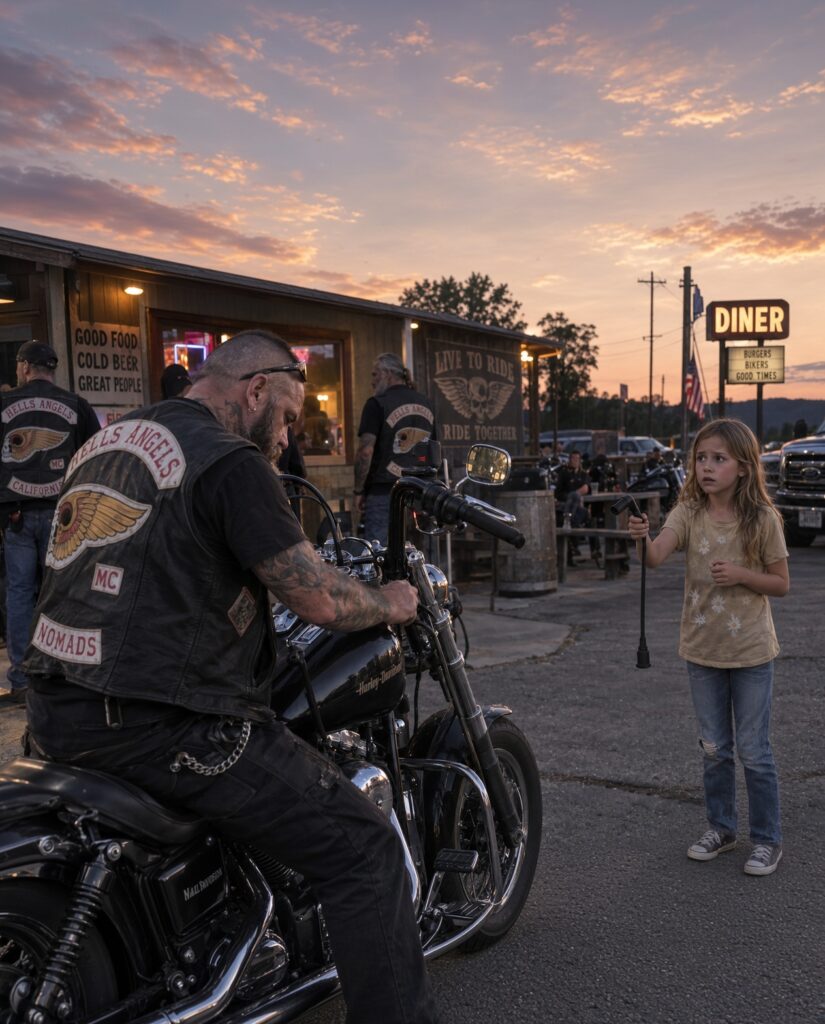
She was seven years old, standing alone in a parking lot at dusk, holding a wire she’d pulled from beneath a 600-pound machine.
Every face around her had already decided what kind of man owned that bike.
Every person at that diner had reached the verdict before he even turned around, before the tattoos filled the frame, before the size of him blocked out the last of the light, before the full weight of that leather vest rose from the seat.
They had 22 years of assumptions.
They had 600 stories already written.
They had zero seconds before he turned the key.
What that child pulled out of that machine in those zero seconds is the reason 600 riders spent the next 14 hours crossing four counties.
And why something no one saw coming changed everything.
The last light of a California August evening was turning the hills above Hollister into something almost golden when Rex Callaway guided his Harley-Davidson Fat Bob off Highway 25 and into the gravel lot of Rolling Thunder Diner.
It was 7:42 p.m. on a Thursday, the kind of evening that made the Central Valley heat almost worth tolerating.
The sky going deep orange and purple toward the west, the smell of sage and exhaust mixing in the cooling air.
He killed the engine.
The big V-twin shuddered and went quiet, and for a moment there was just the sound of the lot—40 other motorcycles ticking as their engines cooled, voices from the picnic tables outside, the neon buzz of the sign at the edge of the property.
Rex swung off the bike, stretched his shoulders back, and heard something in his spine pop in a way that confirmed he’d been riding since before noon.
He was 44 years old and built like a man who’d spent most of those years doing physical work.
Broad across the back, thick through the arms, the kind of size that made him difficult to miss in a room and nearly impossible to look past.
His head was shaved clean, dark aviator glasses, both forearms covered in ink that ran up under the sleeves of a black t-shirt and over everything.
The vest black leather worn soft from thousands of miles.
The patch across the back: California below the wing, Nomads across the bottom rocker, a chain hung from his belt loop to his wallet.
He stood next to his bike for a moment, looking over the lot.
Friday night would bring half of Northern California through this place, but Thursday evenings were still manageable.
He could see Frank Boone at one of the picnic tables, a beer in his hand, talking to a pair of riders from the Bay Area chapter.
A few other Nomads were inside through the diner window, visible under the fluorescent lights.
Everything looked right.
He was about to walk toward Frank when movement at the edge of his vision made him stop.
A girl was standing near his motorcycle, seven years old, maybe.
Blonde hair past her shoulders, worn loose, a t-shirt with small daisies printed across it, jeans with a tear at the left knee.
She was small enough that the Harley seemed enormous next to her, a dark wall of chrome and steel.
She was holding something—a wire, thin black, hanging from her fingers.
Rex did not move immediately.
He read the situation the way he’d learned to read it years ago, slowly, without jumping.
The girl wasn’t running.
She wasn’t hiding it.
She was just standing there with the wire in her hand, watching him.
Her expression somewhere between curious and uncertain, the way kids looked when they’d done something they weren’t sure counted as wrong.
He walked toward her, not fast.
He crouched down when he got close, bringing himself to somewhere near her eye level, and he looked at the wire and then at her.
“Where did you find that?” he said.
She pointed toward the left side of the frame, near where the ignition harness ran alongside the fuel line.
“It was making a scraping sound,” she said.
“I thought it would get caught in something.”
Rex took the wire from her gently.
He held it up between two fingers and looked at it in the fading light.
His first thought was that she was right.
It was loose.
No problem.
Just needs to be reconnected.
His second thought arrived about two seconds later as he looked more carefully at the end of the wire.
Something was wrong.
The end was not frayed.
It was not worn.
It was not the kind of damage that happened gradually over miles and road vibration.
The insulation had a cut in it.
Precise.
Not random.
Not a break.
A cut.
He looked at it for another moment, then looked at the girl.
“What’s your name?” he said.
“Lily.”
“You here with someone, Lily?”
She pointed at the diner window.
“My mom. She works here.”
At the counter inside, a woman in a diner uniform was watching through the glass.
Dark hair, early thirties, eyes locked on her daughter and the large tattooed man crouching next to her.
Rex straightened up slowly and raised one hand in her direction, palm open.
Not a wave exactly.
Just: I see you. Your daughter’s okay.
Then he looked down at Lily again.
“Did you see anyone near this motorcycle before I got here?”
At the picnic tables nearest the lot entrance, a heavyset man in his mid-fifties had stopped talking to the person next to him and was watching the scene.
Wade Prescott—Rex didn’t know his name yet—had the expression of a man running calculations he hadn’t expected to run tonight.
He had a gray mustache, a John Deere cap pushed back on his head, and a coffee mug in his hand.
His eyes moved from Rex to Lily and back again, and Rex could read exactly what was in them.
The presumption of a story that wasn’t happening.
Lily thought about his question.
“There was a man,” she said.
“He was looking at the motorcycles. He had a patch on his arm, but it wasn’t like yours.”
She gestured vaguely at the lot.
“He had a white truck. He stood there for a while. Then he went inside.”
“What did he look like?”
“Old,” she said.
“Gray hair. Gray shirt.”
Rex looked at the wire in his hand.
“Lily,” he said, and something in the way he said her name made her look at him fully.
“I’m going to go find your mom. Can you stay right here for just a second?”
She nodded.
Rex stood and walked toward the diner door.
He passed Wade Prescott’s table without looking at him, his face unreadable, the wire held carefully in his right hand.
Donna Hartwell was already coming out through the diner door when Rex reached it, moving fast in the way of a mother who’d spent 30 seconds watching her daughter interact with a stranger and had finally run out of patience with standing still.
“I’m sorry,” she started.
“She knows better than to—”
“She didn’t do anything wrong,” Rex said.
He said it flat and direct, not unkind.
He held up the wire.
“This came off my bike. I need you to know your daughter pulled it loose before I left.”
Donna stopped.
Her eyes went from his face to the wire.
“Before you left,” she repeated.
“I was about to ride out.”
She looked at him for a moment, reading him the same way he’d read the wire.
Slowly, trying to understand what she was actually looking at.
Frank Boone had seen Rex walking toward the diner and had followed.
He was 50 years old, leaner than Rex, with a salt-and-pepper beard and a way of standing that suggested he’d been in a lot of situations that required him to move fast if necessary.
He came up behind Rex now, and Rex turned and handed him the wire without a word.
Frank looked at it.
He turned it over.
He looked at the cut.
“Tell me that’s road damage,” Frank said.
“I can’t,” Rex said.
Frank’s jaw tightened.
He said nothing.
Rex turned back to Donna.
“I need to ask Lily a few more questions if that’s okay with you.”
Donna nodded.
She called to Lily, who had stayed exactly where Rex told her to stay, and Lily walked over and stood next to her mother.
Rex crouched again.
He asked Lily to describe the man she’d seen in more detail—his height, his build, anything else about the patch on his arm, whether he’d been alone, whether he’d touched anything else, whether he’d looked at the other motorcycles too.
Lily was thoughtful and precise in the way that children sometimes are about things adults dismiss.
She said the man was shorter than Rex, had a belly, walked with his weight forward on his toes a little.
The patch on his arm was round, she said, with writing on it, but she couldn’t read what it said.
He’d only been near Rex’s motorcycle.
The white pickup truck had a dent on the passenger side door.
She’d noticed that because she’d been sitting on the concrete barrier nearby, bored, looking at the parking lot.
Rex listened to all of it.
Wade Prescott had moved from his table to the edge of the diner porch in what he probably believed was a subtle way.
He was close enough to hear the conversation.
Rex registered this without reacting to it.
Frank had stepped away to make a call.
Rex could hear his voice, low, controlled, as he reached out to other chapter members.
“What happens now?” Donna asked quietly.
“We figure out who was near my bike,” Rex said.
And then he didn’t answer that.
He looked at Lily instead.
“You ride on motorcycles ever?”
“No,” she said.
“My mom says they’re dangerous.”
Rex almost smiled.
“Smart woman.”
“She says a lot of things are dangerous.”
“She’s right about most of them, I’d guess.”
Marcus Webb came out through the kitchen door at the side of the building, a dish towel over his shoulder.
He was 48, built for the long haul, with close-cropped gray at his temples.
He’d worked this diner for 14 years and had seen enough of both the regulars and the bikers to have a fairly calibrated view of people.
Rex walked over and described the man Lily had seen.
Marcus thought about it and said, “Gray shirt, belly, walked funny. Yeah, I saw him. He was in and out before your crew pulled up. Left through the back.”
He paused.
“He wasn’t anyone I’d seen before.”
“Did he pay in cash?”
“Didn’t even order anything,” Marcus said.
“Came in, went to the bathroom, left. Took maybe 10 minutes.”
Rex went back to Frank.
They talked in low voices for a moment.
Rex described what he was thinking, and Frank said the name Rex was thinking of before Rex finished the sentence.
Dell Marorrow.
59 years old.
Former owner of Marorrow’s Automotive and Cycle Shop off Monterey Road in South San Jose.
The chapter had used him for three years starting in 2017.
Routine mechanical work, part sourcing, storage.
In 2020, a chapter member had discovered that Marorrow had been billing for OEM parts and supplying aftermarket.
Small money, but it was the principle.
When it came out, Marorrow’s contract with the chapter ended.
The shop was audited and eventually folded.
Marorrow had blamed the audit on the chapter’s complaint, which wasn’t entirely inaccurate, and had said things when he left that were the kind of things you didn’t forget.
But that had been three years ago.
People said things when they were angry.
This wire was not something people did when they were angry.
This was something people did when they’d had three years to move from angry into something quieter and more deliberate.
Rex looked at the wire one more time.
He thought about Highway 156 in the dark, doing 70, the junction at Tres Pinos, where the road curved without warning.
He put the wire in his pocket.
“I need to know where he went,” he said.
“And I’m not going to find that by standing in this parking lot.”
Frank had already sent the description to six contacts in the region, other chapter officers who had eyes across a wide territory.
By 9:01 p.m., those six had become 30.
By 9:30, the word was moving through four counties.
But it was at 9:55 p.m. when Rex made a direct call to the president of the Fresno chapter and explained exactly what had happened and exactly what was at stake that everything changed in scale.
The man on the other end of the call said, “How many you need?”
Rex said, “Everyone available.”
By 10:15 p.m., the number was past 400.
By 10:40, it was 600.
There was a particular kind of quiet that happened when a large group of people organized around a single purpose.
Rex had seen it before in different contexts, times when a chapter responded to something that required the full weight of its membership.
It was not chaotic.
It was the opposite.
It was the kind of quiet that came from everyone knowing exactly what they were doing and why.
By 11 p.m. on that Thursday in late August, 600 motorcycles were moving across San Benito, Santa Clara, Merced, and Fresno counties, coordinated through a radio network and a chain of chapter officers who tracked grid sectors the way a search and rescue operation tracked terrain.
Gas stations, motels, truck stops, late-night diners, auto salvage yards—any place that might shelter a man with a white pickup who needed to disappear for the night.
It was not aggressive.
There were no threats.
There were no confrontations.
There were riders stopping at a Flying J on Highway 99 and asking a young attendant with polite directness whether he’d seen a gray-shirted man in a white pickup.
There were riders checking the far rows of motel parking lots on Pacheco Pass Road, noting plates, moving on.
Wade Prescott drove home at 9:45.
He took County Road J1 and passed three parked motorcycles at a Chevron near the edge of town, their riders in conversation with the overnight cashier.
Wade slowed down, watched for a moment, kept driving.
He got home.
He ate a leftover sandwich.
He turned on the news and found he couldn’t pay attention to it.
His nephew Bobby called at 11:15.
Bobby worked overnight at the Flying J off Route 33 in Dos Palos, and he sounded nervous in the particular way of a 23-year-old confronted with something he didn’t have a framework for.
“There are bikers here,” Bobby said.
“Like 15 of them. They’re asking about some guy. I don’t know what to do.”
“Answer their questions,” Wade said.
“You sure?”
Wade thought about what he’d seen in the Rolling Thunder parking lot.
A man crouching down to a child’s eye level, asking her a question, taking the time to understand what she’d seen.
The wire in the man’s hand, the precision of the question.
“Yeah,” he said.
“Just answer them.”
He hung up and thought for a long time.
Back at Rolling Thunder, Rex had stayed.
He was at one of the outside tables with Frank, working the radio and his phone, coordinating the search in the way he was most useful—as a hub.
He knew the contacts, knew which chapters to reach, knew how to structure the information that was coming in and route it back out.
Donna had stayed too, past the end of her shift.
She’d called the neighbor who usually watched Lily in the evenings and said she’d be late.
Lily was asleep on a booth seat inside the diner, her backpack under her head, a diner jacket draped over her by Marcus at some point in the last hour.
Rex didn’t register the fact of this until Marcus pointed it out sometime around 11:30.
He went inside and stood at the edge of the booth, looking at the girl who had pulled a wire from his motorcycle and saved his life without knowing it.
She was sleeping with one hand curled near her face, her hair fallen across her cheek.
The daisy t-shirt was slightly twisted from the way she’d settled into the booth.
He stood there for a moment.
Then he went back outside.
“She’s going to want to know how it ends,” Frank said when Rex came back to the table.
Rex didn’t answer.
Frank said, “Kids always want to know how it ends.”
“Then we make sure it ends right,” Rex said.
At 11:47 p.m., Wade Prescott called the San Benito County Sheriff’s non-emergency line.
He gave his name and address and explained that there was a large organized group of motorcyclists conducting what appeared to be a search operation across multiple counties.
He said he thought it might bear watching.
The deputy who took the call was courteous and systematic.
He asked if anyone had been threatened.
Wade said no.
The deputy asked if any property had been damaged.
Wade said no.
The deputy asked if there was reason to believe the search was connected to a specific crime.
Wade paused.
He thought about the wire.
He hadn’t actually seen the wire.
He’d only seen a big man with a patch crouching next to a little girl in a parking lot, and the little girl had not been crying.
“I don’t know,” he said.
The deputy thanked him and said he’d pass the information along.
Wade sat with the phone in his hand after he hung up and couldn’t fully explain to himself why the call felt less satisfying than he’d expected it to.
Carter Sloan had been riding with the Fresno chapter for nine years.
He was 38, quiet, reliable, the kind of rider you wanted on a long haul because he didn’t manufacture drama where there wasn’t any.
He’d taken a sector that included a stretch of Olive Avenue east of downtown Fresno and was working it methodically, row by row, through motel parking lots, noting plates and descriptions against the one he’d been given.
At 12:23 a.m. on Friday morning, he found a white pickup with the right color and a dented passenger door in the far corner of the lot behind the Roadside Inn on Olive Avenue.
He did not approach.
He did not touch the vehicle.
He pulled out his phone.
The call went to Frank, and Frank’s voice changed when he heard the plate prefix matched what Rex had circulated.
Frank put Carter on hold for 11 seconds and came back.
“Stay back. Stay visible. We’re coming.”
Rex was already moving before Frank finished the sentence.
It was 74 miles from Hollister to Fresno by the fastest route, Highway 156 east to 99 south through the flat dark of the Central Valley.
Rex rode it in just under an hour, Frank and two other Nomads tight behind him, the speed of the road pushing everything else out of thought for a while.
The night was warm and starless, the agriculture stretching away on both sides into the dark, and Rex rode without music and without thinking much, just the engine and the road and the hum of everything that had led to this moment.
Hank Sturgis had arrived at Rolling Thunder just after 10 p.m., having come down from Sacramento when Frank put out the word.
He was 68 years old, one of the longest-serving members of the California chapter, a man who had seen so much of what the road and the organization could be at its worst and its best that most of what happened anymore landed on him with the steady weight of something expected.
He didn’t excite easily.
He didn’t alarm easily either.
But when Frank explained what had been found on Rex’s bike, Hank had gotten on his own motorcycle without comment and ridden 90 miles south.
He was in the Fresno motel parking lot when Rex arrived.
He’d driven down separately, faster, and was leaning against a car at the far end of the lot with a cup of coffee from the gas station down the block, watching Carter Sloan watch the white pickup.
Rex pulled in at 1:37 a.m.
He stopped his bike at the lot entrance and looked at the pickup.
The lights in room 14 were off.
“He’s been quiet,” Carter said.
“No movement since I called.”
Rex looked at Hank.
Hank said, “Your call.”
Rex walked to room 14.
He knocked three times, not hard.
The sound of someone who expected the door to open, not the sound of someone trying to break anything down.
There was a long pause, the kind of pause that meant someone inside was deciding.
Then the door opened.
Dell Marorrow was shorter than Rex by eight inches and looked smaller than that.
He was wearing the gray shirt.
His hair was uncombed, and his face had the hollow, used quality of a man who hadn’t slept well in some time—not just tonight, but many nights.
He looked at Rex with an expression that had passed through fear and come out the other side into something more tired than anything else.
He didn’t try to close the door.
Rex said, “I’m not here to hurt you.”
Dell Marorrow said nothing.
Rex said, “I need you to talk to me.”
He stepped inside when Dell moved aside.
The room was a standard motel room—single bed, nightstand, ancient AC unit clicking under the window, a duffel bag on the chair, Dell’s tools, a mechanic’s roll, small, the kind a man carried on long drives, on the table.
Rex looked at the tools and then looked at Dell.
“Sit down,” Rex said.
“I’m going to stand.”
Dell sat on the edge of the bed.
What followed was not what Dell had been prepared for, either from expectation or from whatever scenarios he’d run through in his head during the hours he’d been in this room.
He had expected rage.
He had expected the kind of encounter that ends with someone getting hurt.
He’d lived with that expectation since the moment he’d walked away from Rolling Thunder Diner and gotten back into his truck and driven south, and the weight of it had done something to him during those hours that was visible in his posture and his eyes.
Rex was not raging.
Rex stood in the middle of the room and asked him to talk.
So Dell talked.
He talked for 27 minutes.
He talked about his shop, the way he’d built it from one bay to four over 14 years, the way it had felt to have his name on the sign out front, the particular pride of a man who made things work when other people couldn’t figure them out.
He talked about the audit and what it felt like to watch the doors close and how the anger had come on slowly at first and then over two years had gotten very loud in a place inside him that he didn’t know how to quiet.
He talked about his daughter in Sacramento who didn’t call anymore and his body, which was not doing what he needed it to do.
A cardiac diagnosis, two years old now, and the medication made him tired in a way that somehow made the anger louder by contrast.
He didn’t say he was sorry.
He didn’t try to justify what he’d done.
He just talked in the voice of a man who had been alone with something for so long that getting it out of his body was its own kind of relief, regardless of what came next.
Rex listened to all of it without moving, without interrupting.
When Dell was done, Rex was quiet for a moment.
Then he said, “A seven-year-old girl pulled that wire off my bike before I left the lot. She had no idea what she was doing. She thought it was caught on something. She thought she was helping a stranger’s motorcycle.”
Dell looked at his hands.
Rex said, “I need you to understand what could have happened on that road if she hadn’t.”
Dell’s hands tightened together.
Rex said, “I would have been at speed on 156 by Tres Pinos. You know what that junction does in the dark.”
Dell didn’t answer.
His jaw moved.
Rex let the silence sit for a moment.
Then he said, “I’m going to contact law enforcement in the morning and report the tampering. I’m not going to tell you what that means for you because I’m not a lawyer and I don’t know, but I’m going to do it.”
Dell nodded once, very small.
Hank Sturgis had come in behind Rex quietly at some point during the conversation.
He was standing near the door.
Dell hadn’t noticed him until now.
He looked at Hank with the careful expression of a man trying to read a situation.
Hank was just looking at him, not with anger, with the particular attention of a man who had lived 68 years and learned something about what desperation looked like in other people.
He said, “The leather and the road don’t make a man what he is. What he does when nobody’s watching does.”
Dell Marorrow looked at him for a moment.
Then he looked at the floor.
Rex turned and walked back out of the room, past Hank, into the parking lot where Frank and Carter and two others were waiting.
The night air was still warm.
The lot was lit by a single sodium lamp that buzzed slightly.
Somewhere on Olive Avenue, a car passed and its sound faded north.
Rex stood next to his motorcycle.
He put his hands on the handlebars, not to ride, just to feel the familiar weight of them.
Frank said after a moment, “You all right?”
Rex said, “Yeah.”
He didn’t say anything else.
Frank didn’t ask.
The all-clear went out at 2:15 a.m.
Frank handled it—a series of calls down the chain of chapter officers who passed it along to their riders who passed it to the next until 600 people across four counties heard the same two words in the quiet of the California night.
Stand down.
It took a while for that to move all the way through the network.
Some riders were 30 miles from the nearest highway and had to wait for the message to reach them.
Some were already heading back on their own.
By 3:30 a.m., most of the lot at Rolling Thunder was empty.
The bikers dispersed back toward Sacramento, the Bay Area, Fresno, Los Banos, all the places they’d come from when Frank made the calls.
Rex spent the night at a motel on Union Road in Hollister.
He didn’t sleep much.
He lay in the dark and listened to the highway sounds and thought about the wire in his pocket, which he’d kept as evidence, and about the road between Hollister and Tres Pinos, and about the girl asleep in the diner booth with a jacket over her.
At 7 a.m. on Friday, he drove to the San Benito County Sheriff’s Office on West Street and asked to speak with the deputy.
He had the wire.
He had photographs Frank had taken of the ignition harness on the motorcycle, showing the location of the damage.
He had Dell Marorrow’s name, his former address of record, the motel where he was currently staying, and his plate number.
He provided all of it in a single organized statement that took 40 minutes to deliver and which he’d largely composed in his head during the night.
The deputy, a woman named Castillo who’d been on the force for 11 years, listened without interrupting and took thorough notes.
She asked three clarifying questions at the end.
She said they would move on it.
Rex walked out into the morning sun and stood on the sidewalk for a moment, looking at nothing in particular.
Then he got on his motorcycle and rode to Rolling Thunder.
Donna Hartwell was working the morning shift.
She’d stayed late the night before and come back early the way you did when there was no one else available.
She was moving between tables when Rex came in, and she saw him right away and stopped.
Rex sat down in a booth.
He said, “It’s handled.”
He said it quietly, just to her, and she understood from the way he said it what that meant.
She put a coffee cup down in front of him without being asked.
Lily was at a table near the window, doing something with a pen and a paper napkin.
She was there because school didn’t start until the following week, and there was no one to leave her with on short notice, and Donna had simply brought her in.
Lily looked up when Rex came in and held eye contact with him for a moment with the directness that children sometimes had—not rude, just honest—and then went back to whatever she was drawing.
A few minutes later, she picked up the napkin and walked over to Rex’s booth and sat down across from him, uninvited, with the complete comfort of someone who had decided that the social conventions requiring an invitation didn’t apply to her.
“Is your bike okay?” she asked.
“Better than ever,” Rex said.
She considered this answer, then she said, “Can I have one of your hash browns?”
He hadn’t ordered yet.
He looked at her.
“I’ll order some,” he said.
“You should get the ones with the onions,” she said.
“Marcus makes them the best.”
He ordered the hash browns with onions.
When they came, she ate most of them without asking again because the first question had apparently been both the request and the permission.
Rex drank his coffee and let her eat and didn’t find this strange.
Wade Prescott came in at 8 o’clock, which Donna could have told Rex was a certainty.
Wade had been coming to Rolling Thunder at 8 a.m. six days a week for the better part of 11 years, and a late night’s events had not changed that.
He took his usual stool at the counter, and Marcus poured his coffee without being asked.
Wade looked at the booth, at the large tattooed man in the leather vest, at the seven-year-old girl eating his hash browns.
He looked away.
He drank his coffee.
Marcus came to refill Wade’s cup and leaned on the counter for a moment.
Marcus said, “600 of them out all night. Nobody got hurt. They found the guy.”
Wade said nothing.
Marcus said, “She’s got something, that kid.”
Wade looked at the booth again.
Lily had finished the hash browns and was showing Rex the napkin.
He couldn’t see it clearly from the counter, but Rex had taken it from her and was looking at it with the focused attention of someone examining something worth examining.
Wade said, not quite to Marcus, “Both of them do.”
Marcus refilled his coffee and moved on.
Hank Sturgis came in at 8:30.
He’d stayed in Hollister.
There was no urgency now, and at 68, driving back to Sacramento before a good night’s sleep and a proper breakfast was not a trade-off that made sense.
He found a table by the window, ordered eggs over medium and wheat toast and coffee, and sat looking out at the parking lot.
Forty motorcycles were still in the lot.
The morning light came through clean and direct the way it did in the Central Valley in late August before the heat had time to build its haze, and it hit the chrome of the bikes in a way that was genuinely beautiful if you were the kind of person who noticed that sort of thing.
At some point Rex came over and sat down across from him.
He set his coffee on the table and didn’t say anything for a while.
Then he said, “22 years on the road. 340,000 miles. I never thought a seven-year-old girl would be the reason I’m sitting here this morning.”
Hank looked at him.
Rex said, “I’ve been thinking about that.”
“What have you been thinking?” Hank said.
Rex said, “That I don’t know what it means.”
Hank picked up his coffee.
He thought for a moment in the particular way of someone who has thought about something many times before and arrived at a place of some peace with the answer.
He said, “People see the vest and they see a threat. That’s what they’ve been told to see. That little girl out there, she saw a motorcycle with a problem. That’s all. Just a problem that needed fixing.”
He set his cup down.
“She didn’t read the patch. She read the machine.”
Rex looked out the window.
“The leather doesn’t make a man dangerous,” Hank said.
“And it doesn’t make him safe either. What he does in the quiet moments does. What he does when no one’s watching or when the only person watching is a child who doesn’t know enough to be afraid. People spend their whole lives reading the surface of things and missing what’s underneath. That girl didn’t have that habit yet. She just saw what was in front of her, and she fixed it.”
Rex nodded slowly.
He went back to the booth where Lily was waiting.
She’d made a second drawing on a fresh napkin—a motorcycle, more detailed this time, with what appeared to be the handlebars and a headlight rendered with careful concentration.
She handed it to him.
Rex looked at it for a long moment.
He folded it once, carefully, and tucked it into the inside pocket of his vest next to where he kept the things that mattered.
Outside in the lot, Frank Boone was at the Harley.
He went over it the way he always went over it before a long ride, methodically, his hands moving from point to point along the frame and engine and wiring harness, checking what needed checking, confirming what he already knew but needed to know again anyway.
Every chapter member whose bike stood in that lot was doing some version of the same thing.
Not because anyone had said to, just because it was the thing you did.
Frank finished.
He straightened up.
He put both palms flat on the seat of Rex’s Harley-Davidson and pressed down once, firmly, feeling the solidity of it.
Good to go.
—
The story didn’t end in that parking lot.
It never does.
Three days later, on a Monday morning, Donna Hartwell got a call from the San Benito County Sheriff’s Office.
Deputy Castillo wanted to confirm a few details from the statement Rex Callaway had given.
Donna answered the questions she could and asked the ones she needed to ask.
Dell Marorrow had been arrested on Friday afternoon at the motel on Olive Avenue.
He had not resisted.
He had, according to Castillo, seemed almost relieved.
The charge was attempted murder, which sounded like a bigger word than what had actually happened until you thought about it for more than a few seconds.
A cut wire on a motorcycle that was about to get on a highway at night was not vandalism.
It was not a prank.
It was not revenge in any proportionate sense.
It was a decision that a man had made, alone in a parking lot, with a pair of wire cutters and three years of anger, and the only reason it hadn’t ended with Rex Callaway dead on Highway 156 was a seven-year-old girl who thought a wire looked like it might get caught in something.
Donna hung up the phone and sat at her kitchen table for a long time.
Lily was in the other room, watching cartoons.
Donna could hear the theme song through the wall.
She thought about the way her daughter had described the man in the parking lot—old, gray hair, gray shirt—and how Lily had noticed the dent on the passenger side door because she’d been bored and looking at the parking lot.
She thought about how close she had come to something she would never have been able to explain to herself.
She got up and went into the living room and sat down on the couch next to Lily and pulled her close without saying anything.
Lily, who was seven and therefore understood that sometimes adults needed to hug you for reasons they didn’t explain, let herself be hugged and kept watching her cartoons.
—
The news of what had happened moved through the chapters the way news always moved through the chapters—quickly, quietly, and with a certain amount of embellishment.
By Monday afternoon, the story had been told in at least 40 different versions across four counties.
In some versions, Rex had tracked Dell Marorrow himself, alone, through the night.
In others, the 600 riders had been 1,000.
In others, the little girl had been the one to identify Dell from a lineup, pointing a small finger at a man in a gray shirt.
None of these were true, exactly, but they were true enough in the way that stories become true when a community needs them to be.
Frank Boone told the story the most accurately, because Frank had been there for most of it.
He told it at the Bay Area chapter’s monthly meeting, standing in front of a room of men and women who had known Rex for years and had known of Dell Marorrow for years and had never expected the two names to end up in the same sentence.
He told it without drama, because the drama was already in the facts.
A man had tried to kill another man.
A child had stopped him without knowing it.
Six hundred riders had spent a night looking for someone who had done something unforgivable, and when they found him, they had not hurt him.
That last part was the part that people had trouble with.
Frank understood why.
The vest and the patch and the 600 bikes and the 14 hours and the four counties—all of that was the part that people saw.
The part that people didn’t see was the part where Rex Callaway stood in a motel room and listened to a broken man talk for 27 minutes and then walked away without touching him.
The part that people didn’t see was the part where Hank Sturgis, who had every reason to be angry, said the thing about the leather not making a man dangerous and then just stood there by the door.
The part that people didn’t see was the part where 600 riders, any one of whom could have found Dell Marorrow first and done something that couldn’t be undone, had instead passed the information up the chain and waited for orders and then stood down when the orders came.
That was the part that mattered.
That was the part that had always mattered, Frank thought, even if most people never saw it.
—
Wade Prescott went back to Rolling Thunder the next morning, and the morning after that, and the morning after that.
He sat on his usual stool and drank his coffee and read the paper and didn’t say much.
But something had shifted in him, and he knew it, and he didn’t quite know what to do with it.
He had spent 11 years coming to this diner and watching the bikers come and go and never once talking to them.
He had assumed things about them the way everyone assumed things about them.
He had assumed they were dangerous, or at least that they were the kind of people who were comfortable with danger, which was not quite the same thing but close enough for the purposes of assumption.
He had assumed that the leather and the patches and the bikes meant something simple and legible.
He had assumed that a man who looked like Rex Callaway was a man you kept your distance from.
And then he had watched that man crouch down to a child’s eye level and ask her a question and listen to the answer.
He had watched that man walk into a diner and tell a mother that her daughter hadn’t done anything wrong before he told her anything else.
He had watched that man stay up all night coordinating a search and then walk away when he found what he was looking for.
Wade didn’t have the language for what he was feeling, exactly.
He was 56 years old and had spent most of his life in a small town in Central California, and he had not spent a lot of time examining his own assumptions.
But he knew that something had changed in him, and he knew that it had changed because of a seven-year-old girl and a wire and a man on a motorcycle.
Marcus came by to refill his coffee.
Wade said, “That guy. The one with the bike. He still around?”
Marcus said, “Rex? He’s been coming in for breakfast most mornings. He’s got some kind of business in town this week.”
Wade nodded.
He didn’t say anything else, and Marcus didn’t ask.
But the next morning, when Rex came in and sat down at a booth, Wade picked up his coffee and walked over and sat down across from him.
Rex looked up.
Wade said, “Name’s Wade. I was here Thursday night.”
Rex said, “I know.”
Wade said, “I called the sheriff.”
Rex said, “I know that too.”
Wade said, “I wasn’t sure what I was seeing.”
Rex said, “Neither was anyone else.”
Wade looked at his coffee.
He said, “I’ve been coming here for 11 years. I’ve seen a lot of bikes in that lot. I never once thought about the people on them.”
Rex said, “Most people don’t.”
Wade said, “I’m sorry about that.”
Rex said, “You didn’t do anything wrong.”
Wade said, “I called the cops on you.”
Rex almost smiled.
“You called the cops because you saw 600 motorcycles and didn’t know what was happening. That’s not wrong. That’s just not knowing.”
Wade said, “I should have asked.”
Rex said, “You’re asking now.”
They sat there for a while.
Marcus brought Rex his coffee and Wade his refill, and neither of them said anything for a few minutes.
Then Wade said, “That little girl. She’s something.”
Rex said, “She is.”
Wade said, “You think she knows what she did?”
Rex said, “No. And I think that’s the point.”
Wade nodded slowly.
He finished his coffee and stood up and went back to his stool at the counter.
But something had shifted between them, and both of them knew it.
—
The story made the local news by Wednesday.
A small item in the Hollister Free Lance, a couple of paragraphs on the San Jose Mercury News website, a brief mention on a Fresno radio station.
“Motorcyclist’s Life Saved by 7-Year-Old Girl Who Found Cut Wire,” the headline said, or something close to it.
The story didn’t mention the 600 riders, because the reporter who wrote it didn’t know about the 600 riders.
The story didn’t mention Dell Marorrow’s name, because he hadn’t been arraigned yet.
The story didn’t mention the 14 hours or the four counties or the motel on Olive Avenue or the 27-minute conversation in room 14.
It just said that a man had found a cut wire on his motorcycle, and a little girl had found it first, and the man had called the police, and the police had made an arrest.
It was accurate, as far as it went.
But it wasn’t the whole story, and everyone who knew the whole story understood that.
—
Donna Hartwell read the news item on her phone while she was on her break at the diner.
She read it twice and then put her phone down and looked out the window at the parking lot.
There was a Harley parked in the far corner, and a man in a leather vest was standing next to it, checking something on the handlebars.
She didn’t know his name.
She didn’t need to.
She went back to work.
—
Lily went back to school the following week.
She was in second grade, and her teacher was a woman named Mrs. Alvarez, who had been teaching at Hollister Elementary for 22 years and had seen just about everything.
Lily didn’t tell Mrs. Alvarez about the wire, or the man on the motorcycle, or the hash browns with onions.
She didn’t tell anyone at school.
It wasn’t that she was keeping a secret.
It was just that she didn’t think it was a story.
She had seen something that looked like it might cause a problem, and she had fixed it, and that was what you did.
Her mother had taught her that.
You see something that might cause a problem, you fix it if you can.
You don’t make a big deal about it.
You just do it.
So Lily went to school and learned about vowels and subtraction and the life cycle of a butterfly, and she didn’t think about the wire at all.
Until one day in October, when a man came to her classroom.
He was a big man with a shaved head and dark glasses, and he was wearing a black leather vest with patches on it, and he stood in the doorway of the classroom and looked around until he saw her.
Mrs. Alvarez looked up from her desk.
“Can I help you?” she said.
The man said, “I’m here to see Lily Hartwell. I talked to the principal.”
Mrs. Alvarez looked at Lily, who was sitting at her desk, looking at the man with a calm, curious expression.
“Do you know this man?” Mrs. Alvarez asked.
Lily said, “He’s the one with the motorcycle.”
The man smiled.
He walked over to Lily’s desk and crouched down to her eye level, the same way he had in the parking lot three months earlier.
He said, “I wanted to say thank you.”
Lily said, “For what?”
He said, “For the wire.”
Lily thought about it.
She said, “Did it get caught in something?”
He said, “Something like that.”
She said, “You’re welcome.”
He stood up and looked at her for a moment.
Then he reached into the pocket of his vest and pulled out a folded napkin.
He handed it to her.
She unfolded it.
It was a drawing of a motorcycle—not the one she had drawn, but a different one, more detailed, with a rider on it and a road stretching out behind.
He said, “I kept yours. I thought you might want this one.”
Lily looked at the drawing for a long time.
Then she looked up at him.
She said, “Do you have hash browns with onions at your house?”
He laughed.
He said, “No. But I know a place that does.”
She said, “Okay.”
He said, “Okay.”
He turned and walked out of the classroom.
Mrs. Alvarez watched him go.
She said, “Lily, who was that?”
Lily said, “A friend.”
Mrs. Alvarez said, “He looks like a very interesting friend.”
Lily said, “He is.”
She folded the napkin carefully and put it in her backpack.
She didn’t show it to anyone.
It wasn’t that she was keeping a secret.
It was just that some things were hers.
—
The story didn’t end there either.
It never does.
Dell Marorrow pleaded guilty to attempted murder in December and was sentenced to 12 years in state prison.
He didn’t speak at his sentencing.
His lawyer read a statement that Dell had written, in which he said he was sorry and that he had been in a dark place for a long time and that he didn’t expect forgiveness but wanted to say it anyway.
Rex Callaway didn’t attend the sentencing.
He didn’t need to.
He had already heard everything he needed to hear in room 14 of the Roadside Inn on Olive Avenue.
—
Hank Sturgis died two years later, at 70, of a heart attack, while riding his motorcycle on Highway 1 south of Monterey.
He was doing what he loved, which was the only thing anyone could say about it that made any sense.
At his funeral, 300 riders showed up, and Rex Callaway spoke.
He said that Hank had taught him something important, something he had carried with him since the night at the motel.
He said that Hank had told him that the leather and the road don’t make a man what he is, and that what a man does when nobody’s watching does.
He said that he had tried to live by that, and that he had Hank to thank for it.
He didn’t mention the wire, or the girl, or the 600 riders.
He didn’t need to.
Everyone there already knew.
—
Lily Hartwell grew up.
She went to college at Cal Poly in San Luis Obispo, studied mechanical engineering, and graduated with honors.
She never rode a motorcycle—her mother’s warnings had stuck—but she spent a lot of time around people who did, and she never once looked at a leather vest and assumed she knew what kind of person was wearing it.
She kept the napkin drawing in a frame on her desk all through college and all through her twenties.
She never told anyone where it came from, exactly, but sometimes, when people asked, she would say that a friend had given it to her when she was seven, and that it reminded her that you should always look at what’s actually in front of you, not what you think is there.
When she was 28, she got a job at a motorcycle company in Southern California, designing engine components.
She was good at it.
She had an eye for the way things worked, and a feel for the way things fit together, and a patience for the details that other engineers sometimes missed.
Her colleagues didn’t know about the wire, or the parking lot, or the man with the shaved head and the dark glasses.
They just knew that Lily was the kind of engineer who noticed things.
The kind of engineer who saw a problem and fixed it.
The kind of person who didn’t make a big deal about it.
—
Rex Callaway kept riding.
He rode for another 15 years, through California and Oregon and Washington and Nevada and Arizona and New Mexico and Texas and Louisiana and Florida.
He rode through sun and rain and wind and heat and cold.
He rode through the best days of his life and the worst days of his life.
He never forgot the girl, or the wire, or the 600 riders, or the 27 minutes in room 14.
He kept the napkin she had drawn on, the one with the motorcycle and the handlebars and the headlight, folded carefully in the inside pocket of his vest next to where he kept the things that mattered.
He kept it through 15 years of riding, through 200,000 more miles, through more sunsets and sunrises than he could count.
When he finally hung up his helmet and sold his bike—at 62, when his hands had started to shake a little and he didn’t trust himself on the road the way he used to—he took the napkin out of his vest and unfolded it and looked at it one more time.
It was faded now, and creased from being folded for so long, but he could still see the lines she had drawn—the handlebars, the headlight, the careful concentration of a seven-year-old girl who had seen something that looked like a problem and had decided to fix it.
He put it in a frame and hung it on the wall of his house in Hollister, where he lived alone with a dog named Buddy and a garden he didn’t spend nearly enough time in.
People who visited sometimes asked about the napkin.
He told them it was from a friend.
He didn’t tell them the whole story.
He didn’t need to.
—
The Rolling Thunder Diner closed in 2031, after 40 years of serving coffee and hash browns and pie to bikers and truckers and locals and anyone else who needed a place to sit for a while.
Donna Hartwell had retired by then, and Marcus Webb had passed away, and the building was sold to a developer who turned it into a Starbucks.
But for a long time, there was a plaque on the wall near where the booth used to be, and the plaque said:
“On August 21, 2003, a seven-year-old girl named Lily Hartwell pulled a wire from a motorcycle in this parking lot. She didn’t know what she was doing. She just saw something that looked like a problem and fixed it. The man who owned that motorcycle is alive today because of her. So are the 600 riders who spent the night looking for the person who cut that wire, and the community that learned something about assumptions, and the people who heard this story and thought about what it means to see what’s actually in front of you. This plaque is for all of them.”
It wasn’t there for very long.
Starbucks didn’t keep it.
But for the years it was there, people read it and asked questions and heard the story, and the story spread the way stories do, from person to person, from chapter to chapter, from town to town.
And somewhere, in a classroom in Hollister, a little girl learned that you should always look at what’s actually in front of you, not what you think is there.
And somewhere, on a highway in California, a man on a motorcycle learned that the leather and the road don’t make a man what he is.
And somewhere, in a parking lot at dusk, a wire lay on the ground, waiting to be found.
The end.









