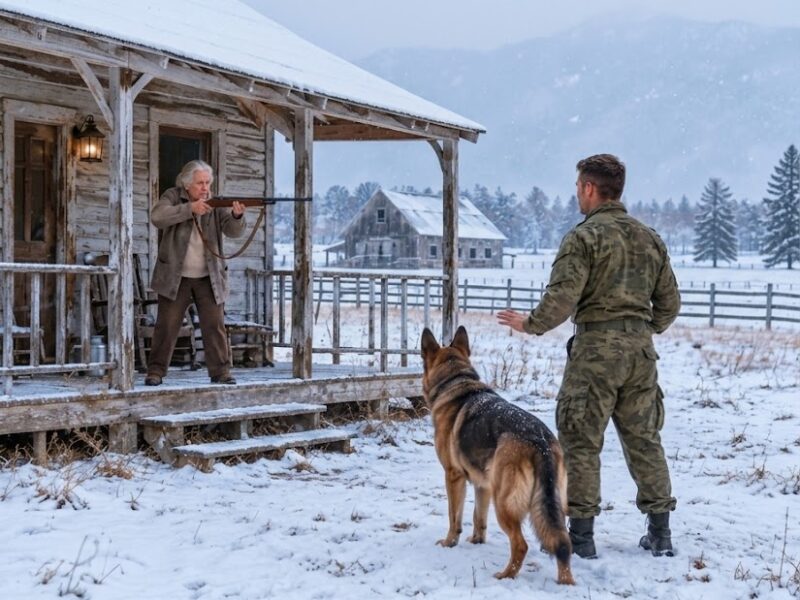
“Get Out of Here!” the Elderly Woman Shouted at a Navy SEAL—Then His K9 Revealed Who She Was Protecting
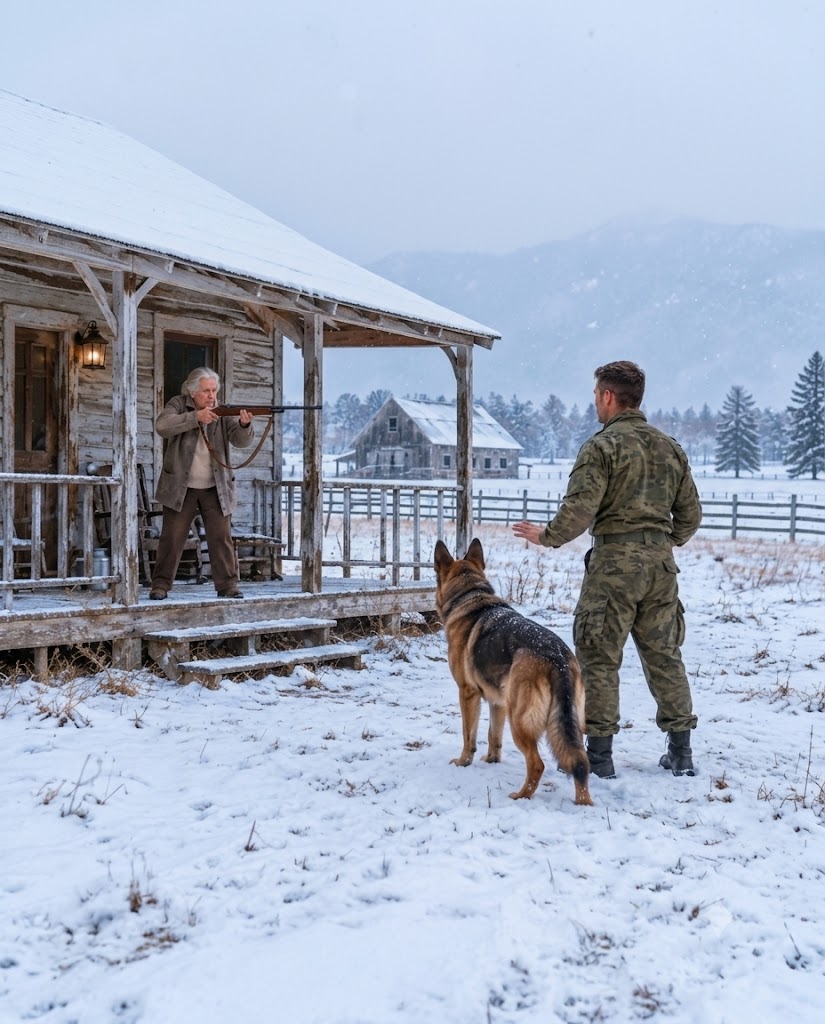
After 20 years away, former Navy SEAL Cade Hollister finally returned home with his German Shepherd, Bracken, to face the mother he believed had abandoned him.
But at the front door, his elderly mother greeted him with a shotgun, convinced another stranger had come to take her land.
The moment she realized the man before her was the son she had missed for decades, the strength in her face finally broke.
Cade soon discovered she had spent years fighting powerful men who wanted her property, refusing every offer because she had always hoped to leave the house and land to him.
Then Bracken began uncovering strange tracks, unfamiliar scents, and disturbed patches of earth that everyone else had overlooked.
With old wounds finally healing, Cade had to choose between revenge and becoming the protector of the family he had once left behind.
By the last week of February, winter had begun loosening its grip on Michigan’s Upper Peninsula, though no one in Brightwater Junction would have been foolish enough to call it spring.
Snow still covered the shoulders of the highway in clean white banks.
Tall pines stood dark against a sky so blue it almost hurt to look at, and beyond them, Lake Superior stretched toward the horizon like a sheet of cold steel catching the afternoon sun.
Cade Hollister had remembered all of it.
He simply had not expected remembering to hurt.
At 40, Cade looked like a man who had spent most of his adult life learning how not to waste movement.
He stood six-foot-one, broad through the shoulders, solid without carrying the exaggerated bulk of a bodybuilder.
Years after leaving the Navy SEALs, he still trained every morning, though his build now belonged more to a disciplined civilian than a man preparing for deployment.
His face was clean-shaven and sharply masculine, with a strong square chin, defined cheekbones, and gray-blue eyes that seemed darker whenever he was tired.
His dark brown hair was cut in a neat undercut, silver beginning to show clearly at the temples and through the front.
A thin scar near his left temple disappeared partly into the hairline.
People sometimes mistook his quietness for confidence.
It was not always confidence.
Sometimes it was simply the habit of keeping things where no one else could see them.
Cade drove an aging dark pickup west toward Brightwater Junction with both hands resting lightly on the wheel.
He wore the same practical clothing he preferred whenever he was away from cities, a fitted long-sleeved green camouflage shirt, matching trousers, a black utility belt, and clean black boots.
Beside him sat Bracken.
The six-year-old German Shepherd was large without being oversized, his body lean and powerful beneath a rich honey-gold coat marked by a deep black saddle across his back.
His muzzle was black, his amber brown eyes alert without being restless, and the outer edge of his right ear carried a small V-shaped notch that made him easy to recognize.
A tiny golden patch, shaped almost like a falling drop, marked the dark fur at the center of his chest.
Bracken had once been trained for search and detection work.
These days, his greatest occupation was apparently judging Cade’s driving.
Cade glanced over.
“You’ve been staring at me for 20 miles.”
Bracken blinked.
Very supportive.
The dog turned toward the window.
Cade almost smiled.
Almost.
Brightwater Junction appeared slowly between the trees.
A gas station with a faded red awning, a church whose narrow white steeple Cade remembered from childhood, a diner with a newer sign but the same broad front windows, low wooden houses gathered along plowed streets where dirty snow had been pushed into piles.
Twenty-one years.
That was how long it had been since Cade had considered this town home.
His father had died when Cade was 16.
There had been no dramatic final conversation, no carefully prepared goodbye.
One ordinary man had gone into the hospital after a sudden cardiac event and a frightened 16-year-old had discovered that ordinary days could split a life cleanly into before and after.
His mother, Eleanor, had survived the next year by working, paying bills, fixing what she could, and crying mostly where Cade would not hear her.
Then Walter Fenwick entered her life.
Walter had been a steady, soft-spoken man in his late 40s back then, tall and broad-handed from years of practical work.
He had thick hair that was already turning silver and a short beard he kept carefully trimmed.
Cade remembered him as painfully patient, which had somehow made hating him easier.
Walter never raised his voice, never ordered Cade around, never asked to be called Dad.
At 18, Cade had interpreted every one of those qualities as strategy.
When Eleanor married Walter, Cade saw only betrayal.
A year later, he joined the Navy.
At first, he still called home.
He sent money when he could.
Christmas cards sometimes found their way back and forth.
Eleanor always said she was fine.
Cade always said he was busy.
Both statements eventually became walls.
Eleven years ago, during one of their last real arguments, Eleanor asked him to come home for a family anniversary.
Cade refused.
She accused him of punishing her for surviving.
He accused her of replacing his father.
The silence afterward lasted longer than either intended.
By the time pride softened, shame had hardened.
Every year Cade stayed away made returning the next year more difficult.
Eight months ago, Walter died after a long illness.
Cade heard about it late.
He still did not return.
That fact sat inside him like a stone.
Only two weeks earlier, an old school acquaintance had finally reached him and said something Cade had not been able to ignore.
“Your mother’s alone out there, Cade, and that house isn’t doing well.”
So, Cade had driven north, just for a few days, he told himself, a visit, an inspection, maybe some repairs, then he would leave again.
Bracken suddenly raised his head.
Cade looked at the dog.
They had turned off the county road onto the narrow lane leading toward the Hollister property.
The pine trees opened and Cade forgot to breathe for a second.
The house was still there, but only barely.
The two-story timber home his father had once kept so carefully maintained now leaned beneath 20 winters of exhaustion.
Blue tarp covered part of the western roof.
One section of gutter hung away from the eaves.
The porch railing had lost two boards, and a downstairs window was patched with a square of weathered plywood.
The woodshed held less than half a winter’s supply.
The fence sagged toward the road, and beside the entrance stood a hand-painted wooden sign, “Not For Sale.”
Someone had dragged a thick line of red paint across the words.
Cade stopped the truck.
For several seconds, neither man nor dog moved.
Then Bracken’s ears shifted forward.
The shepherd looked not at the house, but toward the far edge of the driveway.
Fresh tire tracks crossed the packed snow there.
They did not belong to Cade’s truck.
He opened the door.
“Stay close.”
Bracken stepped down beside him.
The cold air smelled of pine, wood smoke, and the faint mineral scent of old snow beginning to soften under sunlight.
Cade walked toward the porch.
Each step uncovered another memory.
His father carrying lumber, his mother shaking a rug over the railing.
Cade at nine years old jumping the last three steps because walking down them normally had apparently been beneath him.
Now, one porch board groaned beneath his boot.
He knocked.
Nothing.
“Mom?”
No answer.
He knocked again.
Bracken stopped behind him.
The dog’s body became still, not frightened, listening.
The door opened three inches, then six.
A shotgun appeared first.
Cade froze.
The barrel was angled downward, but the hands holding it were tight enough that the knuckles had gone pale.
Behind it stood a small elderly woman.
Eleanor Hollister was 72 now, though the woman in Cade’s memory had somehow stopped aging around 50.
She was barely five-foot-four, thin enough that her cream sweater and ash gray cardigan seemed to hang from narrower shoulders than they should.
Her skin was fair and marked gently by age, her face long and fine-boned with deep lines around the mouth and pale blue eyes.
Her once brown hair had turned completely silver and was gathered into a loose knot at the nape of her neck.
She looked fragile.
Then Cade saw the steadiness in her eyes.
No, not fragile.
Worn.
There was a difference.
“Get off my property.”
Her voice was lower than he remembered.
Cade slowly lifted both hands.
For perhaps three seconds, Eleanor looked at him as though he were nothing more than another strange man who had come up her road.
Then Cade said one word.
“Mom.”
Something changed.
Not dramatically.
Her eyes narrowed first, then widened.
Her attention moved across his face, the scar at his temple, the silver in his hair, his jaw, his eyes.
The shotgun lowered.
“Cade?”
He swallowed.
“Yes.”
Twenty-one years vanished nowhere.
They remained exactly where they had always been, between them.
Eleanor did not throw down the shotgun and run into his arms.
Cade did not step forward and pretend he had earned such a welcome.
They simply stared at one another.
Then Bracken moved.
The German Shepherd walked slowly past Cade.
“Bracken.”
The dog stopped immediately.
Eleanor looked down at him.
Bracken studied the old woman for a moment, then lowered his head and sat.
Cade loosened his hand.
“Okay.”
Bracken advanced two quiet steps.
Eleanor hesitated before lowering one hand from the shotgun.
Bracken leaned forward.
His black muzzle touched her palm.
Her fingers trembled against the fur.
The old woman’s face collapsed.
Not loudly.
Not theatrically.
One breath caught and suddenly tears were moving down her cheeks.
“Oh, Lord,” she whispered.
Cade looked away.
Bracken stayed where he was.
For once the dog seemed wiser than everyone present.
Half an hour later, Cade was inside the house where he had once believed nothing could ever change.
Almost everything had.
The kitchen cupboards had faded.
A thin crack climbed one corner of the ceiling.
The old table remained, though one chair had been replaced.
A black iron wood stove provided most of the warmth.
Eleanor had put the shotgun away.
Neither mentioned it.
She made coffee because apparently 21 years of estrangement did not exempt a son from being offered coffee in his mother’s kitchen.
Bracken lay near the stove.
Then, without warning, his head lifted.
His ears came forward.
Cade noticed.
“What is it?”
Bracken rose and walked toward the east-facing window.
He stared into the darkening yard.
Cade joined him.
Nothing moved.
Then he saw them.
The same tire marks he had noticed near the drive continued along the outer edge of the property before disappearing behind the woodshed.
“Who was here?”
Eleanor’s hand stopped around her mug.
That silence told him more than an answer.
Bracken gave one low breath against the glass.
Not a growl.
Recognition.
Eleanor looked at the dog, then at the tracks.
For the first time since Cade had arrived, fear, not surprise, not grief, passed openly across her face.
“They come after dark sometimes.”
Cade turned.
“Who?”
Eleanor stared into her coffee, and suddenly the shotgun behind the door made sense.
The story came slowly.
A local property developer named Benton Harrow, 53, had spent years buying parcels around Brightwater Junction.
Eleanor described him as a polished man with a broad frame, steel-gray hair combed carefully back, and the irritating habit of speaking so calmly that even pressure sounded like courtesy.
He wanted her land.
Her property sat close to the highway and near a proposed expansion of an Interlake Road.
Harrow had approached Walter first.
Walter refused.
After Walter died, Harrow approached Eleanor.
She refused, too.
Then came the smaller things.
The mailbox knocked down, fence wire cut, marks around the shed lock, vehicles stopping along the road after midnight, a cheap outdoor camera disappearing.
Cade’s jaw tightened.
“You called the police?”
“Several times.”
Eleanor told him about Deputy Mara Ellison, 38, a local deputy with chestnut-brown hair usually tied low at the neck, an athletic build, and gray-green eyes that missed very little.
Mara had always treated Eleanor respectfully and never dismissed her fears, but there had never been enough evidence linking Harrow or anyone working for him to the damage.
Cade stared toward the window.
“Then why stay?”
Eleanor looked at him.
“What?”
“Why not sell? Mom, look at this place. The roof is failing. You’re keeping a shotgun beside the door.”
Her expression changed.
Cade knew immediately he had stepped somewhere dangerous, not physically, somewhere older.
Eleanor turned toward the wood stove.
“Your father bought this land before you were born.”
Cade said nothing.
“He built most of this house himself. After he died, it passed to me.”
“And Walter?”
“Walter never asked to be put on the deed.”
That surprised Cade.
Eleanor watched the fire.
“I kept it because it was yours before you knew how to lose it.”
Cade frowned.
“I don’t understand.”
Now she looked at him.
“Your father built this place believing that one day you’d bring your own family through that door.”
The room became painfully quiet.
Cade looked around.
The damaged ceiling, the faded cabinets, the same window where his father once stood drinking coffee before work.
“You kept all this?”
“For you.”
He could not answer.
For more than 20 years, Cade had carried the belief that his mother had moved on from his father, then moved on from him.
Yet she had remained here.
Winter after winter, repair after repair, holding onto a house her son had refused even to visit.
That night Cade did not sleep in his childhood bedroom.
He sat alone at the kitchen table long after Eleanor went to bed.
Bracken stretched across the floor between the hallway leading to Cade’s old room and the chair Eleanor had occupied.
As though the dog had chosen the exact center of two lives that had forgotten how to meet.
Cade had come to Brightwater Junction intending to stay a few days.
He looked toward the dark window, then toward the cracked ceiling.
Finally, he stood.
Without making any announcement, Cade walked outside to the pickup.
Bracken watched from the doorway.
A minute later, Cade returned carrying his toolbox.
He set it beside the kitchen wall.
Nothing had been forgiven yet.
Nothing had been repaired.
But for the first time in 21 years, Cade Hollister had brought something into that house without already thinking about how soon he would carry it back out.
Morning came bright enough to make the snow outside the Hollister house shine almost blue.
Cade was awake before 6:00.
Old habits had survived retirement better than most relationships had.
He dressed in his fitted long-sleeved green camouflage shirt and matching trousers, pulled on his black boots, and stepped quietly into the kitchen.
The wood stove had burned down to red coals.
The house smelled faintly of pine smoke and yesterday’s coffee.
Bracken was already awake.
The six-year-old German Shepherd rose from the floor with one long stretch, black saddle rippling across his honey-gold back.
His amber eyes followed Cade toward the toolbox.
“No speeches,” Cade whispered.
Bracken tilted his head.
“Exactly.”
By sunrise, Cade had a ladder against the porch roof.
The first problem was obvious.
One section of flashing had pulled loose, allowing meltwater to work beneath the shingles.
The damage was not catastrophic yet, but another season would make it expensive.
Cade started removing the worst pieces.
He did not ask permission.
That mistake took less than 20 minutes to find him.
The front door opened.
Eleanor stepped onto the porch wearing her cream sweater beneath the same ash-gray cardigan, brown trousers tucked into worn boots.
In daylight, she looked even smaller than Cade remembered, but there was nothing small about the way she planted both hands on her hips.
“What are you doing?”
“Fixing the roof.”
“I can see that.”
Cade looked down from the ladder.
“Then why ask?”
“To see whether you knew.”
He stared at her.
For the first time that morning, Bracken’s tail moved.
Cade pointed at the dog.
“Don’t encourage her.”
Eleanor disappeared inside without answering.
By noon, Cade had repaired the loose flashing, secured part of the gutter, and replaced the temporary plywood over the downstairs window with a properly fitted panel until new glass could be ordered.
Then he inspected the heating system.
The furnace was old but functional.
Several vents needed cleaning and one section of insulation around a pipe had deteriorated enough to worry him.
He made a list.
Roof, window, pipe insulation, porch rail, woodshed, fence.
The list irritated him.
Not because any one job was impossible, because each one represented a month when someone should have been here.
By late afternoon, irritation had found a target.
His mother.
Eleanor was at the kitchen table peeling potatoes when Cade came inside.
“You can’t stay here like this.”
The knife stopped.
Cade continued before judgment could catch up with him.
“The house needs more work than you can manage alone. You could sell the property, buy something smaller in town, somewhere closer to people.”
Eleanor put the potato down.
Her pale blue eyes lifted to him.
“You’ve been home two days.”
Cade knew the tone.
He had heard it when he was 17 and had brought a motorcycle home without telling her.
“That doesn’t change what I’m looking at.”
“No,” she said. “Apparently, it qualifies you to decide what I should do about it.”
“That isn’t what I’m doing.”
“It sounds remarkably similar.”
Cade folded his arms.
“Mom, this is about safety.”
Eleanor gave a short, humorless laugh.
“That’s what they said.”
Cade went still.
“Who?”
“The men who wanted me to sell.”
Her voice remained calm, which somehow made the words cut more deeply.
“They told me I was too old to maintain the property. Winter was too dangerous. Repairs were too expensive. A woman alone shouldn’t be stubborn about land she couldn’t manage.”
Cade’s arms dropped slowly.
Eleanor picked up the potato again.
“They called it being practical.”
He had spent years learning how to identify a threat before it reached him.
He had not recognized himself standing on the wrong side of one.
Cade left the kitchen without answering.
Outside the afternoon sun had fallen behind the trees, turning the snow pale gold.
Bracken followed him as far as the porch and sat.
Cade looked down.
“Nothing?”
The dog blinked.
“You had plenty to say with your tail this morning.”
Bracken looked toward the yard.
Cade exhaled.
“Fine.”
That evening he found Eleanor beside the stove.
“I was wrong.”
She looked up.
Cade did not add anything, no explanation, no claim that his intentions were good, just the sentence.
Eleanor studied him for several seconds.
Finally, Cade asked, “What do you want?”
She looked toward the dark windows.
“I want to live in my house without wondering who’s coming up the road.”
Cade nodded once.
“Then we’ll start there.”
Something subtle shifted between them.
Not forgiveness, permission.
The next morning Cade stood beside the shed door with a replacement hinge in one hand.
“Can I fix this?”
Eleanor inspected the door.
“Yes.”
“That sounded painful.”
“It was manageable.”
He repaired it.
Then Eleanor walked over, narrowed her eyes, and said, “It’s crooked.”
Cade stared at her.
“It is not crooked.”
She folded her arms.
Cade took out a level.
The bubble betrayed him immediately.
Bracken lay several yards away and thumped his tail once against the snow.
Cade looked at him.
“You’re retired. Stay out of management.”
Eleanor laughed.
It was brief, a single surprised sound, but Cade stopped what he was doing.
He could not remember the last time he had heard that laugh without a telephone line between them.
For an instant, the 21 missing years seemed less like a wall and more like a distance that could perhaps be crossed one ordinary step at a time.
He straightened the hinge.
The door closed perfectly.
Eleanor tested it twice.
“Better?”
“That’s almost praise. Don’t get ambitious.”
That night Bracken did something Cade had not seen him do since their working years.
At 1:57 a.m. the shepherd rose without sound.
Cade was asleep on the old living room couch when the movement woke him.
Bracken crossed to the east side of the house and stood perfectly still.
No barking, no scratching.
His ears pointed forward.
Cade watched him for several seconds.
“Bracken.”
One ear turned toward him.
The rest of the dog remained focused elsewhere.
By the third night it happened again at almost the same hour.
This time Cade did not dismiss it.
He put on his boots and followed Bracken outside.
The German shepherd moved only as far as the porch then stopped.
Cade continued alone.
Near the outer fence he found several footprints pressed into crusted snow.
Someone had been close enough to the property to leave a trail but not close enough to have entered the yard.
Cade crouched.
He did not follow them.
He photographed them.
Then he photographed the surrounding area and marked the time.
Old Cade might have gone looking.
The man standing in the snow at 40 knew better.
By breakfast he had begun a written incident log.
Three days later he installed additional motion lights and two simple exterior cameras positioning them toward entry points rather than neighboring property.
He did not build traps.
He did not wait outside at night.
He documented.
That distinction mattered.
Later that afternoon a county SUV pulled into the yard.
The woman who stepped out wore a dark brown winter deputy’s jacket over a matching uniform, duty trousers, and black boots.
Deputy Mara Ellison was 38, tall enough to carry herself with quiet authority, athletic without looking imposing.
Her chestnut brown hair was pulled into a low ponytail and her gray-green eyes had the unnerving habit of settling on a detail before anyone else noticed it.
Cade remembered her vaguely as a younger girl at school.
Mara remembered him better.
“You got older.”
She said.
“So did you.”
Strong start.
She shook Eleanor’s hand before acknowledging Bracken who sat beside the porch studying her.
“Beautiful dog.”
“He knows.”
Cade said.
Mara walked the property with him.
Cade showed her his photographs and notes, then frustration got the better of him.
“How many times did my mother call before somebody decided this mattered?”
Mara stopped.
Her expression did not harden.
It simply became professional.
“I came every time she called.”
“That isn’t what I asked.”
“No.”
“What you’re asking is why nobody arrested the person you’ve already decided did it.”
Cade said nothing.
Mara looked directly at him.
“Suspicion isn’t evidence, Cade. You know that better than most.”
The sentence landed cleanly.
Mara explained that Benton Harrow’s offers to purchase the property had been legal.
No recorded threat connected him to vandalism.
No witness had identified his employees damaging anything.
Previous camera footage had shown only headlights and indistinct vehicles.
“I believe your mother,” Mara said, “but belief is not probable cause.”
Cade looked toward the house.
“I understand.”
Mara’s eyebrow lifted slightly.
“That was easier than I expected.”
“Don’t get ambitious.”
From the porch, Eleanor smiled.
A second vehicle arrived before Mara left.
It was an old blue station wagon with enough salt stains along the doors to qualify as camouflage.
June Bellamy, 67, climbed out carrying two grocery bags.
She was short and pleasantly round with a warm round face, honey brown eyes, and silver brown hair cut just below her ears in soft natural waves.
Small dark red rectangular glasses sat low on her nose.
She wore a navy and white plaid shirt beneath a wine-colored cardigan and carried herself with the unstoppable certainty of a woman who had spent 30 years running a diner and therefore considered most emergencies manageable after coffee.
She looked at Cade, then looked at Eleanor, then back at Cade.
“Well,” June said, “the prodigal son got taller.”
Cade took one grocery bag from her.
“You tried calling me?”
“Several times.”
“I changed numbers.”
“Yes, very inconsiderate of you.”
June walked inside as if the house belonged partly to anyone carrying groceries.
Over coffee, she told Cade that Eleanor had lost noticeable weight since Walter died.
“She won’t tell you that.”
“I’m sitting right here,” Eleanor said.
“I know, saves time.”
June also told Cade something he had not expected.
Walter had fought every effort to buy the property.
He met lawyers, survey people, asked questions all over town.
Cade frowned.
“Why?”
June looked genuinely puzzled.
“Because this was his home, too.”
“He didn’t own it.”
“No,” June said quietly, “but people can protect things without owning them.”
Cade looked away.
June studied him over the rim of her glasses.
“Maybe you didn’t know him as well as you thought.”
He disliked the sentence immediately.
That was probably why it stayed.
Late that afternoon, Cade walked behind the house with Bracken.
The dog wandered toward a weathered workshop near the tree line, Walter’s workshop.
Its door was secured with an old padlock.
Bracken approached, lowered his nose, and began smelling along the bottom edge.
Then he stopped.
He returned to the same spot, again.
Cade watched him.
“What is it?”
Bracken pressed his nose close to the gap beneath the door.
Cade looked toward the house.
Eleanor had stepped onto the porch.
He pointed toward the building.
“What’s in there?”
For a moment, her face changed.
Not fear, something sadder.
“Twenty years of things neither of you ever finished talking about.”
Cade looked back at the locked door.
Behind him, Bracken remained perfectly still.
And for the first time since coming home, Cade wondered whether fixing the house might be the easy part.
The workshop smelled exactly the way Cade remembered it.
Cold wood, machine oil, dust, old pine boards that had absorbed decades of winters and summers.
Eleanor unlocked the door shortly after breakfast and stepped aside.
Cade did not enter immediately.
For 21 years, that building had occupied a strange place in his memory.
His father had spent evenings there repairing chairs, sharpening tools, tying fishing leaders, and turning pieces of rough lumber into things the family somehow always needed.
After Walter married Eleanor, Cade had imagined the workshop changing.
His father’s tools gone, his bench replaced, his memories packed into boxes so another man could make room for himself.
Cade had never come back to check.
Now he stood at the threshold with Bracken beside him and realized how confidently a person could resent something he had never actually seen.
Eleanor pushed the door wider.
“You coming in?”
Cade stepped over the threshold.
He stopped again.
The old workbench was still there, not something similar, the same one.
A long maple surface scarred by saw blades, hammer strikes, burn marks, and one deep groove Cade remembered making at 12 when his father had trusted him with a chisel too early.
The iron vice remained fixed to the left corner.
A row of hand planes hung beneath the pegboard.
His father’s wooden mallet sat in a shallow drawer.
Cade reached toward it, then stopped before touching.
Behind him, Eleanor said softly, “Walter never moved that bench.”
Cade glanced around.
An old fishing rod rested against the far wall, its cork handle darkened by age.
A narrow wooden boat frame sat on sawhorses beneath a canvas sheet.
Cade pulled the cover back.
The little 12-foot skiff his father had once promised they would finish together was still unfinished.
One side had been repaired, the rest remained exactly where time had abandoned it.
“Walter worked on this?”
“A little.”
“Why didn’t he finish it?”
Eleanor looked at the boat.
“He said it wasn’t his to finish.”
Cade stared at her.
Bracken moved quietly through the workshop, nose low, investigating the accumulated scent of mouse trails, old leather, wood dust, and rust.
His honey-gold shoulders passed through bars of pale morning light falling between the wall boards.
Cade noticed another thing, the door frame.
Along the inner edge were pencil marks.
Cade, eight.
Cade, 10.
Cade, 12.
Cade, 15.
The last line at 16 was almost level with Eleanor’s forehead.
Fresh paint covered the rest of the frame, but not that narrow strip.
Cade ran his thumb over his own name.
“How many times was this place repainted?”
“Three, I think.”
“And he left this?”
“Every time.”
Something tightened behind Cade’s ribs.
It would have been easier if Walter had been careless.
Easier if he had thrown things away, painted over names, replaced photographs, claimed space.
Then Cade’s old anger would have somewhere solid to stand.
Instead, every preserved object removed another excuse.
Eleanor opened a cabinet and took out a cardboard box.
“This is yours.”
Cade frowned.
“What is it?”
“You should look.”
Inside were envelopes, dozens of them.
Some yellowed, some still white.
Military addresses, forwarding labels, return to sender stamps.
Cade sat on an old stool.
He picked up the first letter.
His name was written in Eleanor’s handwriting.
The date was 19 years earlier.
Another had been sent to a Virginia address, another to California.
Another had several postal markings from being forwarded between locations.
On the back of each returned envelope, someone had written a date in small careful handwriting, not Eleanor.
Cade knew before he asked.
“Walter?”
Eleanor nodded.
“Why?”
“He kept track of which ones came back.”
Cade lifted another envelope.
“Why would he do that?”
“Because I kept thinking maybe you stopped reading.”
Her voice stayed steady.
“He wanted me to know that some of them never reached you.”
Cade looked down.
There were letters he remembered receiving.
There were far more he did not.
For years he had told himself the silence had become mutual.
That his mother had stopped trying, too.
The box suggested otherwise.
Eleanor sat on an overturned crate opposite him.
“Walter said that if you ever came home, you deserved to know I kept writing.”
Cade rubbed one thumb against the edge of an envelope.
“And if I never came home?”
Eleanor looked toward the workbench.
“He said then it wouldn’t matter.”
Cade almost laughed, though there was nothing funny in it.
“That sounds like him.”
“Yes.”
For the first time in years, Cade did not say Walter’s name in his mind like an accusation.
A loose photograph slipped from between two envelopes and landed face down on the floor.
Bracken reached it first.
He sniffed the paper once, then sat beside it stepping away.
Cade picked it up.
The image showed three men standing beside the unfinished skiff.
His father, a much younger Walter, and Cade himself at perhaps 13 years old.
Cade stared.
“I don’t remember this.”
Eleanor leaned closer.
“It was taken at the county fishing day.”
Cade looked again.
Walter was not standing where Cade expected.
He was at the edge of the photograph, several feet from Cade and his father, holding a toolbox.
Not family, not yet.
Just a man helping with a boat.
On the back his father had written, “Walter saved the trailer again. Cade caught nothing and blamed the lake.”
Cade let out one short breath.
“Dad knew him for years. You never told me.”
“You never asked.”
The truth was small, almost harmless, and yet it altered something Cade had believed for most of his adult life.
Walter had not arrived after his father’s death like a stranger entering an empty place.
He had already existed at the edge of their lives.
Cade looked at Bracken.
The shepherd rested his chin on Cade’s knee.
For reasons Cade could not explain, that simple weight kept him from standing up and leaving the room.
Later that morning, Eleanor drove with Cade into town.
Their destination was a narrow brick office beside the post office.
Martin Hale, 64, had practiced law in Brightwater Junction for nearly four decades.
He was a slender man of average height with slightly rounded shoulders, silver hair combed neatly to the right, and narrow brown-gray eyes behind round tortoiseshell glasses.
He dressed more like a professor than a small-town attorney.
White shirt, brown sweater vest, charcoal trousers, and a navy wool coat.
Martin had represented farmers, widows, store owners, divorcing couples, and more families arguing over land than he cared to remember.
Years of watching people destroy relationships over property had made him slow to speak and suspicious of easy certainty.
He shook Cade’s hand.
“You look like your father around the eyes.”
Cade was not prepared for that.
Martin did not seem interested in making him comfortable.
They sat.
Eleanor explained why they had come.
Martin pulled an old property file from a locked cabinet.
“The house and acreage were titled to your parents originally,” he said.
“After your father died, the ownership transferred entirely to your mother according to the estate documents.”
Cade glanced at Eleanor.
“And Walter?”
“Never added.”
“By choice?”
“Very much by choice.”
Martin opened another folder.
“About 12 years ago, Walter asked me to prepare documents clarifying that neither he nor his relatives should have any claim inconsistent with Eleanor’s estate wishes.”
Cade frowned.
“He was worried his family would contest it?”
“I wouldn’t say worried, prepared.”
Martin folded his hands.
“Walter understood that marrying someone doesn’t give you moral ownership over everything they carried into the marriage.”
Cade sat back.
Every answer made the younger version of himself look smaller.
Martin seemed to notice.
He did not rescue Cade from the discomfort.
Good lawyers, Cade thought, probably knew when silence was doing useful work.
They returned to the property afternoon.
Cade spent the afternoon sorting the workshop.
He did not throw anything away.
That decision surprised him.
Bracken occupied himself by investigating corners.
Twice the dog returned to the same steel cabinet against the back wall.
The first time Cade ignored him.
The second time Bracken pushed his nose into the narrow gap beneath it, sneezed from the dust, backed away, then returned.
Cade crouched.
“Mouse?”
Bracken’s ears tipped forward.
“Strong argument.”
Cade emptied the cabinet enough to move it.
The legs scraped across the floor.
Behind it, one board looked different.
Not newer, exactly, just disturbed more recently than the surrounding planks.
Cade lifted it.
Below the floor sat a small waterproof steel box.
Eleanor came closer.
“I’ve never seen that.”
Cade opened it.
Inside were papers.
No dramatic confession, no single document explaining everything, just pieces.
A photocopy of the deed, an old plat map, photographs of a gray pickup near the edge of the property, receipts from survey work, a pocket notebook.
Cade opened it carefully.
Walter’s handwriting filled the first half.
Dates, measurements, vehicle descriptions, names.
One appeared repeatedly, Miles Danner.
Cade had never met him.
Eleanor had.
“He works for Harrow.”
“Doing what?”
“Whatever Harrow doesn’t want to explain himself.”
Cade looked at the notes.
Walter had written that a survey marker near the northern boundary appeared to be in a different location than an older reference suggested.
He had not written who moved it.
He had not even stated that someone definitely had.
Only, “North marker does not match old measurements. Verify independently.”
Cade appreciated that.
Even sick, Walter had separated suspicion from fact.
Then he found another note.
Only one line.
“They don’t need the house. They need the access.”
Cade read it twice.
That evening they returned to Martin’s office with the box.
Martin spread the maps across a conference table.
He pointed to the highway, then Eleanor’s frontage, then the parcels Harrow had already acquired.
“The proposed commercial development sits here.”
Cade leaned over the map.
Martin continued.
“If Harrow controls this frontage, his access becomes shorter, cleaner, and cheaper.”
“And without it?”
“He has alternatives. None as convenient.”
Martin showed Cade an older easement reference.
The language was vague.
The mapped location had changed slightly over decades of copied records.
Cade looked at him.
“So someone moves a survey marker and takes the land?”
“No.”
Martin’s response was immediate.
“Property law is not a treasure map. Moving metal in the ground does not magically change ownership.”
That answer almost relieved Cade.
“Then what’s the point?”
“Dispute.”
Martin tapped the file.
“Delay, surveys, attorneys, hearings, more surveys, more attorneys.”
Eleanor’s face tightened.
Martin looked at Cade.
“They may not need to win.”
He paused.
“They may only need to make keeping the property expensive.”
Cade finally understood.
This was not about stealing a house in the night.
It was about exhaustion.
Make Eleanor spend money.
Make her worry.
Make her question herself.
Make the land feel like a burden until a generous purchase offer began to look like mercy.
Cade looked at his mother.
She had been resisting that pressure alone.
Then he opened Walter’s notebook again.
Near the final written page, the handwriting had become less steady.
The letters slanted downward.
Illness, Cade guessed.
Fatigue.
The final entry contained four words.
“Don’t let fear decide.”
Cade sat without speaking.
For two decades, he had believed Walter Fenwick had taken something from his family.
Now he was holding evidence that Walter had spent his final years trying to protect it.
Not replace Cade’s father.
Not erase him.
Protect what he had left behind.
Cade closed the notebook carefully.
For the first time since coming home, anger was no longer the strongest thing he felt toward Walter.
Shame was.
And beneath it, quieter but growing, something Cade had never expected to feel.
Gratitude.
Bracken and Harrow arrived just after 10:00 on a morning so clear that sunlight turned every ridge of snow around the Hollister property into white fire.
Cade saw the vehicles before Eleanor did.
One dark SUV, one gray pickup, both slowed at the entrance rather than coming straight up the drive.
Cade was outside repairing a section of porch railing when Bracken lifted his head from beside the steps.
The six-year-old German Shepherd did not bark.
His amber eyes followed the vehicles while his ears angled forward.
His honey gold body remaining loose beneath the black saddle across his back.
Cade set down the drill.
“Easy.”
Bracken glanced at him once.
He was already easy.
That was the thing people often misunderstood about a well-trained dog.
Silence did not mean inattention.
The SUV stopped near the house.
Benton Harrow stepped out.
At 53, Harrow was a broad, well-kept man of about six feet with a heavy square face, a strong jaw, and steel gray hair brushed neatly away from a receding hairline.
He was clean-shaven, his skin carrying the healthy color of someone who spent enough time outdoors to appear practical, but not enough to earn calluses from it.
He wore a charcoal wool coat over a pale blue shirt and gray V-neck sweater, dark trousers, and polished brown boots that were immediately dusted with snow.
Nothing about him looked threatening.
That, Cade suspected, was intentional.
Harrow moved like a man who had spent years discovering that doors opened more easily when he never seemed impatient.
The driver of the gray pickup joined him.
Cade recognized the name before Eleanor supplied it.
Miles Danner.
Miles was 47, several inches shorter than Cade, but built densely through the chest and neck.
The shape of a man who had once done physical labor every day and had never entirely lost it.
His brown-gray hair was cut in a short crew cut.
Two or three days of rough stubble darkened his jaw.
His nose bent slightly to the right, suggesting an old break, and his pale brown eyes rarely rested on anyone for long.
He wore a brown canvas work coat, gray thermal shirt, dark work trousers, and heavy boots.
Unlike Harrow, Miles looked entirely comfortable getting dirty.
He also looked like a man accustomed to letting someone else do the talking.
Eleanor opened the front door before Cade reached it.
Her silver hair was tied into its usual loose knot and her small frame seemed almost swallowed by her gray cardigan.
She did not look surprised.
“Mr. Harrow?”
“Mrs. Hollister.”
Harrow smiled pleasantly.
“I hope this isn’t a bad time.”
“It depends on what you came for.”
Cade almost smiled.
Harrow noticed him.
His attention paused on Cade’s clean-shaven face, the silver beginning at his temples, the fitted green camouflage clothing, then moved to Bracken.
“You must be Cade.”
Cade said nothing for half a beat.
“Must be.”
Harrow’s smile remained.
“I heard you’d come home.”
Brightwater Junction, Cade remembered, had always treated information as a naturally renewable resource.
Eleanor stepped onto the porch.
“If this is another offer, Benton, you already know my answer.”
“It is another offer.”
Harrow lifted a leather document folder, but not the same one.
Eleanor hesitated.
Cade could feel the immediate urge to tell Harrow to turn around.
He did not.
That urge belonged to him.
The property belonged to Eleanor.
She looked at Harrow and said, “Five minutes.”
They sat at the kitchen table.
Bracken settled near the wood stove, though his eyes remained open.
Miles stayed standing near the mudroom rather than joining them.
Harrow opened the folder.
The offer was high.
Even Cade, who knew little about local land values, understood that immediately.
Enough to purchase a comfortable house in town, enough to repair nothing ever again, enough money left afterward that Eleanor could live quietly without worrying about a leaking roof, winter fuel, or property taxes for a long time.
Harrow presented it without pressure.
He spoke about maintenance, safety, medical access, the difficulty of managing acreage alone.
“I know this year has been hard,” he said.
“Walter’s illness, then losing him. No one should have to make decisions while carrying that much.”
Eleanor’s fingers tightened slightly around her coffee cup.
Cade noticed.
Harrow continued, “This gives you choices.”
Eleanor closed the folder.
“No.”
Harrow waited.
“You haven’t read the second page.”
“I read the number.”
“There are relocation provisions?”
“No.”
The pleasantness in Harrow’s expression did not disappear.
It simply became thinner.
His gaze shifted toward Cade.
“I suppose having family back changes the calculation.”
Cade met his eyes.
Harrow leaned back.
“After so many years away, I imagine there’s a lot to catch up on.”
There it was, not an accusation, something cleaner, a sentence designed to place doubt in the room and let everyone else do the work.
Cade felt heat move up the back of his neck.
Harrow continued, “And naturally, whatever happens to the property eventually becomes relevant to the next generation.”
Miles glanced toward the floor.
Cade knew exactly what Harrow was implying, that Cade had returned for inheritance, that Eleanor’s refusal might no longer be entirely her own.
A week earlier, Cade would have answered for her.
He might even have enjoyed it.
Instead, he looked at his mother.
Eleanor’s pale blue eyes met his, then she turned to Harrow.
“My son doesn’t decide whether I sell.”
Harrow said nothing.
Eleanor added, “Neither do you.”
The room went quiet.
Cade lowered his gaze for a moment, not submission, respect.
He realized with a strange satisfaction that saying nothing had required more discipline than confronting Harrow would have.
Harrow closed the folder.
“I appreciate clarity.”
“So do I.”
Eleanor said.
He stood.
Miles opened the mudroom door.
Bracken rose but remained beside the stove, as Harrow stepped outside he paused.
“Walter understood the economics even when we disagreed.”
Eleanor’s expression hardened.
“He understood more than you gave him credit for.”
For the first time that morning, Harrow’s smile disappeared completely.
Only for a second.
Then it returned.
“Good day, Mrs. Hollister.”
The two men left.
Cade watched the vehicles turn toward the road.
He had expected relief.
Instead, Bracken walked away from the porch.
“Bracken.”
The shepherd stopped.
Cade stepped down.
“Okay, show me.”
Bracken moved toward the patch of packed snow where Miles’ pickup had been parked.
He lowered his black muzzle, sniffed once, moved three feet, returned, then followed a faint path toward the rear of the house.
Cade did not immediately follow.
He studied the snow first.
There were boot impressions, fresh, one set.
They angled around the side of the house toward the utility area.
Cade took out his phone.
Photographs first, questions second.
Bracken stopped beside a dark stain in the snow.
The dog sniffed it, recoiled slightly, then looked directly at Cade.
Not frightened, waiting.
Cade crouched without touching the residue.
A few feet away, one boot print turned sharply toward the exterior utility enclosure.
Someone had walked there while Harrow and Eleanor were inside.
Cade looked back toward the road.
The vehicles were already gone.
What unsettled him was not that Bracken had found something strange.
It was that whoever had left it had done so while everyone believed the visit was polite.
The danger had not arrived shouting.
It had shaken hands at the kitchen table.
Cade called Mara before inspecting anything further.
She arrived 25 minutes later and walked directly to the rear of the house.
“You touched it?”
“No.”
“Good.”
“That sounds almost like approval.”
“Don’t ruin it.”
Mara photographed the area herself.
The dark residue could have come from equipment, a vehicle, or something carried on a boot.
She made no assumption.
At the backup heating enclosure, however, her expression changed.
The exterior access panel was not seated properly.
One fastener was partly displaced, and a protective cover inside appeared disturbed.
Cade’s jaw tightened.
“Could weather do that?”
Mara looked at him.
“Could.”
“Do you think it did?”
“That’s a different question.”
She called for the county maintenance technician to inspect the system before anyone used it.
The technician later confirmed that something had been disturbed, but he could not say when or by whom.
No dramatic sabotage, no obvious fingerprints, no single piece of proof.
But Mara added the event to the existing case file.
“This changes the seriousness,” she told Eleanor.
“Not the evidence?”
“Not enough yet.”
Eleanor nodded.
She seemed disappointed, but not surprised.
Cade was beginning to understand what months of that kind of answer could do to a person.
Later that day, Cade called Martin Hale.
“I need somebody to look at the north boundary.”
Martin was quiet for a moment.
“I know someone.”
Two mornings later, a white field truck came slowly up the driveway carrying equipment racks on both sides.
The man who stepped out was Ethan Cole, 58, a licensed land surveyor who had worked across the upper peninsula for more than 30 years.
Ethan stood about five-foot-nine and had the lean durable build of someone who had spent half his life walking uneven ground in bad weather.
His face was long and weathered, deeply lined around the eyes from wind and sun.
Short silver-gray hair had thinned across the crown, and a neatly trimmed gray mustache sat above a narrow mouth that seemed naturally skeptical.
Wire-framed glasses rested on his nose.
He wore an olive field jacket over a gray flannel shirt, brown canvas trousers, and waterproof boots marked with old mud.
Ethan had known Cade’s father.
He did not use that fact to manufacture intimacy.
“Martin says you have concerns about a boundary monument.”
Cade handed him copies of Walter’s notes.
Ethan read them, then read them again.
Finally, he said, “Walter suspected something.”
“Yes.”
“That’s not the same as proving it.”
“I know.”
Ethan glanced at him.
“Good. Saves us 15 minutes.”
Cade decided he liked him.
Surveying took hours, not minutes.
Ethan established reference points, compared recorded measurements, checked older documentation, and repeatedly told Cade to stop asking what things meant before all the measurements were finished.
Bracken accompanied Cade but remained well clear of Ethan’s work.
Around midday, they stopped near a large pine along the northern boundary.
Cade poured water into Bracken’s collapsible bowl.
The shepherd drank, then wandered several yards on his lead.
He stopped beneath the pine, sniffed, moved away, returned.
His front paw scraped once across a patch where the snow looked slightly different from the undisturbed crust around it.
Cade frowned.
“Leave it.”
Bracken stopped.
Ethan looked over.
“What’s he got?”
“Probably a squirrel with poor judgment.”
Then sunlight struck something beneath the disturbed snow, a small edge of metal.
Ethan’s expression changed immediately.
“Don’t touch that.”
Cade stepped back.
Ethan did, too.
Mara was called again.
Only after the location had been photographed and documented did Ethan examine what had been exposed.
The object appeared consistent with an older type of survey monument.
That did not make it legally decisive, but its position mattered.
Ethan returned the next morning with historical records, then again that afternoon.
By sunset he spread several maps across Eleanor’s kitchen table.
“The older monument aligns more closely with historic references than the marker currently being relied on farther east.”
Cade looked down.
“So the recent survey is wrong?”
“I said the measurements don’t match.”
Ethan tapped the papers.
“Let’s not improve my sentences.”
Eleanor almost smiled.
Ethan continued, “There needs to be more verification, but yes, there’s enough inconsistency here that I would challenge the newer interpretation.”
Cade looked toward Bracken.
The shepherd was stretched beside the stove, asleep.
No victory, no heroic pose.
Bracken did not know that a piece of old metal might matter to deeds, access rights, surveys, or lawsuits.
He had simply smelled disturbed earth and something foreign beneath it.
That was what Cade trusted most about him.
Bracken never needed the world to fit a theory.
He noticed what was there.
Humans, Cade thought, were the ones who kept getting into trouble by noticing only what they had already decided to believe.
By the second week of March, Brightwater Junction had been fooled twice into believing winter was nearly finished.
The third time, winter seemed offended.
A wall of cold moved down across Lake Superior overnight, bringing hard northwest wind, thick snow, and temperatures low enough to make exposed metal burn bare skin within seconds.
By dawn, white drifts pressed against the north side of the Hollister house, and the road beyond the pines had almost disappeared beneath blowing powder.
Cade had spent most of the morning clearing the porch and checking the house.
Eleanor pretended not to notice.
She sat at the kitchen table in her cream sweater and gray cardigan, sorting a collection of old receipts with the determined concentration of someone who believed paperwork could be intimidated into order.
“You have enough medicine for the weekend?”
Cade asked.
“Yes.”
He opened the cabinet.
“No.”
Eleanor looked over.
“You asked whether I had enough.”
“You have enough until tomorrow morning.”
“That still qualifies as enough today.”
Cade closed his eyes briefly.
Bracken lay near the wood stove, amber eyes moving between them.
Cade pointed at the dog.
“Do not take her side.”
Bracken rested his chin on his paws.
Eleanor said, “He has judgment.”
Cade looked out the window.
Snow was still falling, but the county plow had passed the highway less than an hour earlier.
If he went now, he could make it to town and back before the heavier band arrived.
June Bellamy called almost immediately after he decided.
“I need supplies for the diner anyway.”
She said.
“You’re driving.”
That sounded less like a request.
“I’m 67. I’ve earned efficient sentences.”
Twenty minutes later, Cade’s pickup moved slowly toward Brightwater Junction.
June sat in the passenger seat, bundled in her wine-colored cardigan beneath a winter coat, small dark red glasses fogging each time she leaned too close to the heater vent.
Bracken occupied the rear seat, large body curled tightly enough to leave room for bags.
The town looked smaller in the storm.
Storefronts glowed warm behind snow-streaked windows.
The church bell tower appeared and disappeared through gusts.
The diner’s red sign swung faintly above the street.
Cade stopped at the pharmacy, then a hardware store for pipe insulation, furnace filters, and several other things Eleanor had insisted were unnecessary.
June bought enough groceries to suggest she expected Brightwater Junction to lose contact with civilization until May.
“Do you always shop like a siege is coming?”
Cade asked.
“I own a diner.”
“That wasn’t an answer.”
“It was if you’ve ever met truckers during a snowstorm.”
They were halfway back when Bracken sat up sharply.
Cade saw the movement in the rearview mirror.
The Shepherd’s ears rose, his body shifted forward.
“Easy.”
Bracken did not settle.
His nose lifted toward the front of the cab as if he were listening for something Cade could not hear.
June turned.
“What’s wrong with him?”
“Don’t know.”
Bracken had never been a nervous dog.
He responded to changes, sounds, smells, patterns.
Sometimes a familiar machine stopping was more noticeable to him than a loud unfamiliar one starting.
Cade’s phone vibrated in the cup holder.
He glanced down only long enough to see the alert.
Rear camera offline.
His hand tightened on the steering wheel.
Another notification followed.
Exterior power connection lost.
June saw his face change.
“What?”
“Camera at the house.”
“Storm?”
“Maybe.”
But Cade was already slowing for the next turn.
He did not tell himself Bracken had sensed something impossible from miles away.
The dog could have reacted to Cade’s change in breathing, an alarm tone too faint for June to notice, or the difference in the truck’s speed.
It did not matter.
Something at home had changed.
Cade turned around.
The drive back took 15 minutes.
It felt longer.
When the Hollister house appeared between the pines, Cade knew something was wrong before he reached the porch.
No exterior light, no smoke from the furnace vent.
The windows looked dark.
He parked hard but controlled.
“Stay in the truck, June.”
“Absolutely not.”
“June.”
“I’ll stay near the porch.”
That was apparently the most obedience he was going to get.
Cade opened the rear door.
“Bracken.”
The German Shepherd jumped down and immediately moved toward the house.
The front door was unlocked.
Inside, the air was noticeably colder.
“Mom?”
No answer.
Cade crossed the kitchen.
“Eleanor!”
Bracken moved ahead of him then stopped near the hallway leading toward the basement stairs.
The basement door stood open.
That was wrong.
Eleanor hated leaving it open because cold air climbed into the kitchen.
Bracken barked once, sharp, direct.
Cade reached the stairs.
“Mom!”
A voice answered from below, weak but conscious.
“Stop yelling.”
Relief hit so hard it almost made him dizzy.
He descended quickly.
Eleanor lay on the concrete floor near the electrical panel, one leg bent awkwardly beneath her skirted cardigan.
Her silver hair had partly come loose from its knot.
Cade dropped beside her.
“Don’t move.”
“I wasn’t planning to.”
“Did you hit your head?”
“No.”
“Neck?”
“No.”
“Back?”
“No.”
“Leg?”
“That one has opinions.”
Cade almost laughed, but his hands were shaking.
He checked her carefully before helping reposition her.
Her skin felt cold, too cold.
“What happened?”
“The heat stopped, then the lights. I came down to check the breaker.”
“You should have called me.”
“I did.”
Cade looked at his phone, no missed call.
“No signal.”
Eleanor said.
He glanced toward the small basement window.
The storm had thickened.
June appeared at the top of the stairs.
“I’ve called 911. They’re coming.”
Cade nodded.
He wrapped Eleanor in a blanket and kept her still.
Bracken came down only when Cade called him.
The shepherd approached Eleanor slowly, sniffed her hand, then sat close enough that his shoulder touched her arm.
Eleanor looked at him.
“I’m fine.”
Cade said.
“Nobody asked you.”
Bracken leaned closer.
Eleanor sighed.
“Apparently, nobody listens to me anymore.”
Cade looked at her.
“Welcome to family.”
For one second, despite everything, she smiled.
The paramedics arrived nearly 30 minutes later.
Eleanor had a sprained ankle, mild hypothermia, and bruising along her hip, but no fracture and no head injury.
Cade rode with her to the small county hospital.
June followed in Cade’s pickup with Bracken.
By late afternoon, Mara was at the property with a county technician.
The backup heating system had not simply failed from age.
Something had been disturbed inside the exterior service area.
Not destroyed, not obviously sabotaged in a way that identified a person.
But altered enough that Mara no longer treated the incident as ordinary mechanical failure.
Near the rear access, she also found a single partial boot print preserved beneath an overhang where the wind had not erased it.
Then came the detail that changed the investigation.
A cabin owner farther down the service road had a weather camera pointed toward his driveway.
The image was not clear enough to show a face, but it recorded a gray pickup traveling past during the window when the power system likely stopped functioning.
Mara recognized the vehicle type.
It was consistent with Miles Danner’s truck.
Consistent was not the same as proof, but it was more than they had before.
For the first time, Mara had a reason to start pulling together movements, times, ownership records, and witness statements instead of treating each incident separately.
At the hospital, Cade sat beside Eleanor’s bed while snow scratched softly against the window.
The room smelled of antiseptic and warm plastic.
Eleanor wore a hospital blanket over her shoulders.
Her silver hair was untidy, and the bruised fatigue around her eyes made her look older than 72.
Cade hated that.
He hated the room, the storm, the house, the people who had frightened her.
Mostly, he hated the helplessness.
“Mara thinks Miles was on the service road.”
Eleanor watched him carefully.
Cade stood.
“I’m going to find him.”
“No.”
He looked at her.
“Mom.”
“No.”
“He was there.”
“You don’t know why.”
“The heating system was touched.”
“You still don’t know who touched it.”
Cade’s jaw tightened.
Eleanor’s voice sharpened.
“Sit down.”
For reasons he would never admit, the command worked.
He sat.
Eleanor looked at him for a long moment, then said quietly, “This is what I was afraid of when you came home.”
Cade stared at her.
“Me?”
“Not you.”
She shook her head.
“The part of you that still thinks anger is proof you care.”
The words landed harder than any accusation.
Cade looked toward the window.
Eleanor continued, “If you turn this into a fight, they get to choose who you become.”
Silence filled the room.
Cade had spent years believing control meant being the strongest person in a dangerous situation.
Now his 72-year-old mother was asking him for a different kind of control, the kind that required staying in the chair.
After a while, Eleanor said, “There’s something else Walter knew.”
Cade turned back.
She explained that several months before Walter became seriously ill, he had noticed Benton Harrow asking about parcels near the proposed access corridor before the planning alternatives had been publicly discussed.
“At first, Walter assumed Harrow simply had better business instincts than everyone else. Then Harrow began approaching specific property owners too early, too accurately. Walter suspected someone connected to the planning process had shared information privately.”
“Who?”
Cade asked.
“I don’t know.”
“Did Walter?”
“No.”
That mattered.
Cade did not want another suspicion turned into certainty.
Eleanor said Walter had intended to raise the issue formally, but his health declined quickly.
“Hospital visits replaced meetings. Treatments replaced paperwork. He thought he had more time.”
Cade looked at his hands.
“Why didn’t you tell me this when I came back?”
Eleanor gave him an exhausted look.
“You had been home less than a day and nearly turned a real estate dispute into a personal war.”
“That’s unfair.”
“It’s extremely fair.”
Cade almost argued, then stopped.
“You still think I’m the 19-year-old who left?”
Eleanor considered him.
“Sometimes.”
Cade frowned.
She added, “And sometimes you make a very convincing argument.”
A laugh escaped him before he could stop it.
Eleanor stared, then she laughed, too.
Not politely, not cautiously.
For several seconds, they were simply mother and son again, sharing the kind of laughter that required familiarity older than resentment.
When it faded, Eleanor looked down at her hands.
“There’s one more thing.”
Cade waited.
“Before Walter died, he told me something about you.”
His chest tightened.
“What?”
“He said if you ever came home, I wasn’t allowed to make you apologize before I let you through the door.”
Cade stopped breathing for a moment.
Eleanor’s voice became softer.
“He said if I demanded payment for every year you were gone before I let myself love you again, then I’d waste whatever years we had left.”
Cade looked away.
The hospital room blurred.
He stood, walked into the hallway, and made it as far as an empty window before the tears came.
No dramatic collapse, no sound, just a 40-year-old man pressing one hand against the cold glass while 20 years of certainty quietly gave way.
Walter had protected the house, then the land, and somehow, even near death, he had tried to protect a doorway Cade had not yet walked through.
Eleanor was released that evening with instructions to rest, keep weight off the injured ankle, and return if symptoms worsened.
June drove them home.
Bracken had remained with her for most of the day.
The moment the front door opened, the German Shepherd moved past Cade straight to Eleanor.
He approached carefully, sniffed the brace around her ankle, then rested his black muzzle against her hand.
Eleanor smiled and stroked the fur between his ears, careful around the small notch in the right one.
“He forgives faster than we do.”
Cade stood behind her carrying the hospital bag.
“Probably smarter.”
Bracken looked at him.
Eleanor left quietly.
Outside the cold still pressed against the windows.
The storm had not ended.
The investigation had not ended.
Nothing had been solved.
But that night, Cade stopped seeing restraint as standing still.
Sometimes restraint was action.
Sometimes love was not chasing the person you blamed.
Sometimes it was simply staying close enough to the person who needed you.
And for once, Cade stayed.
By the end of that week, Brightwater Junction had returned to the kind of winter silence that came after a storm had spent itself.
Roads were open again.
Snow banks stood shoulder high at the edges of the county lanes, and sunlight broke across Lake Superior in long silver bands.
From a distance, the town looked clean, calm, almost untouched.
Up close, things were beginning to move.
Not dramatically.
No sirens.
No sudden arrests.
Just paper, measurements, phone calls, people checking details that had once seemed too small to matter.
Cade discovered that truth in civilian life was rarely a door kicked open.
More often, it was a file cabinet opened at the right time.
Ethan Cole finished his independent survey first.
He arrived at the Hollister house with two rolled map sheets tucked under one arm and a folder thick enough to suggest he had enjoyed proving someone wrong more than he intended to admit.
His silver-gray hair had been flattened by a wool cap, and the lines around his pale eyes seemed deeper after several long days outdoors.
Eleanor was at the kitchen table with her injured ankle elevated on a chair.
Bracken lay near her feet.
Ethan spread the maps across the table.
“I’m going to say this carefully.”
He began.
Cade leaned against the counter.
“That sounds ominous.”
“It sounds professional.”
Ethan pointed to several reference points.
“The older monument we documented aligns with historical measurements better than the monument being used in the more recent interpretation.”
Eleanor frowned.
“So, the newer survey is wrong?”
Ethan lifted one finger.
“I didn’t say that.”
Cade looked at his mother.
“He does this.”
“I’ve noticed.”
Ethan ignored them.
“The newer interpretation is inconsistent with the older records. That gives Martin something worth pursuing.”
That something became larger two days later.
Martin Hale called Cade into his office.
The attorney had found a copy of a more recent survey recorded through the county system that did not match one earlier working version stored in a related property file.
The difference was not enormous.
That made it more troubling.
Big changes invited questions.
Small changes often passed unnoticed.
Martin adjusted his round tortoiseshell glasses and tapped the paperwork.
“One line shifts. One reference changes. Enough to improve an argument about access.”
“Who filed it?”
Cade asked.
“A subcontracting survey firm.”
“Connected to Harrow?”
“Not directly.”
Cade looked at him.
Martin gave a tired smile.
“That word matters.”
“The firm had worked repeatedly for companies associated with Harrow’s commercial projects. Not Harrow himself. Not always on paper. But often enough to attract Mara’s attention.”
The person who finally complicated things further was Gavin Mercer, 44, a former field technician for that subcontractor.
Gavin was a narrow-shouldered man with a tall, slightly stooped frame, a weather-beaten face, thinning sandy hair, and a short reddish-brown beard gone gray along the chin.
He had pale skin roughened by years of outdoor work, and the uneasy habit of rubbing his left thumb across the knuckle of his right hand whenever he was nervous.
He no longer worked in surveying.
A back injury three years earlier had pushed him into warehouse work, and the change had left him with a bitterness he tried hard not to show.
Mara interviewed him at the sheriff’s office.
Cade was not present.
He learned about it later.
Gavin remembered Miles Danner, not because Miles had openly ordered anything illegal, because Miles had been unusually interested in one boundary line.
According to Gavin, Miles had asked the crew to verify measurements more than once and kept pressing them to use one particular reference point.
Gavin had thought it strange, but strange was not the same as criminal.
At the time, he had been trying to keep his job.
He had not asked many questions.
Now, he regretted that.
Mara told Cade, “He gave us enough to justify looking harder, not enough to charge anyone.”
Correct.
Cade hated how often that sentence appeared.
Still, he was learning to respect it.
Truth did not become stronger because he was impatient.
It became stronger because people resisted the temptation to say more than they could prove.
Mara then began building a timeline.
She compared vehicle sightings, county records, service schedules, and employment logs.
One small piece came from a fuel station outside Brightwater Junction.
The station used automatic license plate records for fleet billing.
Miles’s company truck had been logged there on the same afternoon it later appeared on a service road camera.
Again, not proof of sabotage, but it contradicted Miles’s initial statement that he had been working nearly 40 miles away all day.
That contradiction brought him into the sheriff’s office.
This time, he could no longer remain simply a name in Walter’s notebook.
For several hours, Miles denied involvement in anything beyond property negotiations.
He said he had driven roads near the Hollister land because Harrow owned or considered purchasing nearby parcels.
Reasonable.
He said he had spoken to subcontractors because coordinating land development was part of his job.
Also reasonable.
Mara kept asking questions.
Not louder ones, better ones.
By the time Miles left the room for a break, something in him had changed.
Cade saw him outside the sheriff’s office afterward.
Miles stood beside the gray pickup with both hands in the pockets of his brown canvas jacket.
His crew cut hair looked almost silver beneath the hard afternoon light.
The rough stubble along his jaw had grown darker, and for the first time, Cade noticed how tired he looked.
Not frightened of Cade, frightened of being left alone with the consequences.
Miles looked toward him.
Cade walked no closer.
That surprised both of them.
Miles gave a humorless laugh.
“You know what’s funny?”
Cade said nothing.
“Harrow never writes anything down.”
His pale brown eyes finally held Cade’s.
“Not the things that matter.”
Then Miles looked toward the sheriff’s office door.
For a moment, Cade understood something before Miles said it.
The man was not protecting Harrow anymore.
“I was calculating how much Harrow had ever protected him.”
And that was the first crack that did not appear in wood, glass, or land.
It appeared in loyalty.
Miles returned inside.
The next round of questioning lasted longer.
He did not confess to everything.
He did not suddenly become noble.
He began negotiating with reality.
Miles admitted that he had monitored activity around Eleanor’s property and coordinated several pressure tactics intended to make the land feel difficult to keep.
He admitted arranging for someone to interfere with the boundary marker.
He admitted sending people to create minor disturbances and to observe when Eleanor was home.
He denied instructing anyone to physically harm her.
He also denied intending for the heating failure to put her in danger.
Whether that denial was true remained unresolved.
His cooperation did not erase responsibility.
Mara made that clear.
But his statements gave investigators something they had not previously possessed, direction.
Payment records were subpoenaed.
Contracting chains were examined.
Phones were reviewed through proper process.
The pattern widened.
Harrow rarely appeared in the middle of anything.
Instead, instructions moved through layers.
A project manager, a consultant, a subcontractor, then someone like Miles.
The most interesting new name was Calvin Reddick, 51, a planning consultant who had worked on transportation and commercial access studies across several Northern Michigan counties.
Calvin was a polished, compact man with an oval face, smooth olive-toned skin, closely cropped salt and pepper hair, and a carefully shaped goatee.
He dressed in fitted navy jackets and spoke with the measured confidence of someone accustomed to explaining complicated decisions to people who had already lost patience.
Former colleagues described him as ambitious rather than corrupt.
He liked being the person who knew what was happening before everyone else.
That trait had built his career.
It may also have created problems.
Records showed Calvin and Harrow had communicated repeatedly during a period when some access alternatives were still being evaluated internally.
The communications did not immediately prove illegal disclosure.
Some could have been ordinary consulting, but their timing was difficult to ignore.
Mara told Cade the same thing she always did.
“We follow what we can prove.”
He nodded, this time without argument.
That evening, Cade sat with Eleanor at the kitchen table.
Bracken lay nearby, his head resting across Cade’s boot.
Cade stared at a copy of the timeline Mara had allowed them to review.
“So, Harrow keeps himself clean.”
Eleanor folded a dishtowel.
“Clean and innocent aren’t the same thing.”
“No.”
Cade looked toward the window.
“I still want to talk to him.”
Eleanor stopped folding.
“That means you still want him to feel something.”
Cade did not deny it.
She looked at him carefully.
“Your father protected this place by building it.”
Cade lowered his eyes.
“Walter protected it by staying.”
She paused.
“Maybe your job is to know when not to turn everything into a battlefield.”
Cade leaned back.
For years, he had believed action meant movement, advance, interrupt, control.
Now, he understood another form: hold position, protect the vulnerable, let someone else do the job they were trained to do.
His role was not to punish Harrow.
His role was to make sure Eleanor had time, safety, and enough support for the truth to survive the people trying to exhaust it.
Bracken shifted beneath the table.
Cade looked down at him.
The dog had attacked no one, caught no criminal, solved no mystery.
He had simply noticed things: a sound, a scent, a patch of disturbed earth, a person who did not belong where he stood.
Maybe that was enough.
Maybe people failed not because truth was invisible, but because fear and anger made them look past it.
Two mornings later, Cade drove alone toward the cemetery above the lake.
Bracken rode beside him.
Snow lay thin between the headstones, and wind moved through the bare branches with a soft, steady whistle.
Cade found Walter’s grave near the eastern slope.
The marker was simple: Walter James Fenwick, dates, a small line beneath, steady hands, open door.
Cade stood there for a long time.
Bracken sat beside him.
No one else was present.
Cade put both hands in his pockets.
“I spent a long time blaming you for something you never did.”
The words disappeared into the wind.
He looked down at the stone.
“I thought you took his place.”
Cade swallowed.
“You didn’t.”
Bracken leaned lightly against his leg.
Cade closed his eyes, then said the words he should have said years earlier.
“Thank you for staying when I didn’t.”
Nothing answered.
No sign.
No sudden warmth.
No miracle.
Only wind off Lake Superior.
Only a German Shepherd sitting close enough to touch.
And somehow, that was better.
Cade had spent most of his life believing closure would feel like an answer.
Instead, it felt like finally asking the right question without demanding one back.
When he returned home, Eleanor was standing at the kitchen window.
She did not ask where he had gone.
She looked at his face once, then put another cup of coffee on the table.
Cade sat down.
Bracken lay between them.
Outside, sunlight moved slowly across the snow.
The investigation was still unfinished.
But for the first time, Cade no longer needed to be the one who finished everything.
Spring did not arrive in Brightwater Junction all at once.
It came in pieces.
A strip of dark earth appeared beneath the south fence.
Then the snow along the roadside softened into gray ridges.
Then one afternoon, water began running beneath the ice at the edge of the drainage ditch, carrying pine needles and last autumn’s leaves toward Lake Superior.
By then, the legal pressure around the Hollister property had changed shape.
Miles Danner faced charges connected to trespassing, property damage, and other actions uncovered through the investigation.
The survey issues moved into formal review, where records, monuments, filings, and contractor conduct were examined by people whose job was to separate mistakes from misconduct.
Benton Harrow remained free.
He still owned land, still had money, still had attorneys.
There was no dramatic public downfall, no crowd outside the courthouse, no scene where the town watched him lose everything.
Cade came to understand that this was probably more realistic.
Harrow’s greatest loss was quieter.
He could no longer make Eleanor believe that she had no choice.
That power was gone.
Ethan Cole completed the final independent survey and filed the necessary documentation through the proper channels.
The older historical references supported Eleanor’s established boundary more strongly than the interpretation that had favored Harrow’s preferred access.
Martin Hale handled the paperwork that followed.
The property remained Eleanor’s.
The access Harrow wanted would have to be routed farther south across land already available through another arrangement.
It would cost him more.
It would take longer.
But it could be done legally.
When Martin explained the outcome at Eleanor’s kitchen table, she listened without celebrating.
Cade had expected relief.
Instead, his mother simply leaned back, closed her eyes for several seconds, and said, “Good.”
That was all.
After months of defending the right to stay, victory did not feel like winning.
It felt like finally being allowed to stop defending.
Life returned to ordinary problems.
The porch still needed reinforcement.
The west roofline needed final work.
The workshop had accumulated three decades of objects that apparently possessed legal immunity from being thrown away.
And the unfinished wooden skiff still sat on its sawhorses.
Cade began with that.
He stripped away rotted material, replaced damaged fasteners, and repaired the hull a little at a time.
He refused to erase every scar in the wood.
Some belonged to his father.
Some belonged to Walter.
One gouge near the stern had no known origin.
Eleanor stood in the workshop doorway one morning and studied the boat.
“You missed a rough spot.”
“I know.”
“It’s visible.”
“I also know.”
“You’re leaving it?”
“Yes.”
She frowned.
“Why?”
Cade ran his hand along the old timber.
“Because not everything has to look new to be worth keeping.”
Eleanor stared at him, then nodded toward another section.
“That part still looks terrible.”
Cade looked over.
“That’s convenient.”
She laughed and walked back toward the house.
Their relationship did not become perfect.
That might have frightened both of them.
Eleanor still moved things in the kitchen after Cade organized them.
Cade still put items on shelves too high for her to reach.
One morning he discovered her standing on the second step of a small ladder he had deliberately moved into the workshop.
He stopped in the doorway.
“Where did you get that?”
Eleanor glanced down.
“Found it.”
“I hid it.”
“Poorly.”
“You’re 72 and still taller on a ladder.”
Cade took the paint can from her hand.
“You’re impossible.”
“So I’ve been told.”
Bracken sat near the door watching the exchange.
His amber eyes moved from Eleanor to Cade.
His tail struck the floor once.
Cade pointed at him.
“Management stays neutral.”
Eleanor said, “Management has already ruled.”
The dog lay down.
Cade lost the argument.
Again.
The house changed in other ways, too.
June Bellamy began appearing every few days with pie.
She always claimed she was only passing through.
Nobody questioned why a woman who owned a diner six miles away apparently passed through a dead end country road with remarkable frequency.
Mara stopped by occasionally after her shift.
She drank coffee at the kitchen table and never spoke about active case details she was not supposed to share.
Ethan visited twice to inspect drainage near the north boundary and spent 15 minutes criticizing the way Cade measured a replacement fence brace.
“You’re off by half an inch.”
“It’s a fence.”
“That’s how civilization ends.”
Cade stared at him.
Ethan adjusted his glasses half an inch at a time.
Even Eleanor laughed.
The Hollister property no longer felt like an isolated house being watched from the road.
Cars came because people were welcome.
Doors opened without fear.
The change was small enough that Cade only noticed it after it had already happened.
Then April became May.
The last snow retreated into shadows beneath the pines.
Cade finished the workshop.
He had always told himself that would be the point when he left.
First he delayed because the skiff needed sealing, then because the porch rail was not finished, then because Eleanor’s ankle still bothered her on cold mornings.
A week became two.
Two became four.
One morning, Eleanor found him drinking coffee on the porch while Bracken lay across his boots.
She sat beside him.
“When are you leaving?”
Cade looked at the truck.
“Truck’s running fine.”
“That wasn’t my question.”
He took another sip.
Eleanor waited.
Cade did not answer.
Later that afternoon, Bracken carried something out of the workshop.
Not a tool, not a glove, a small block of pine.
Cade recognized it immediately.
It was one of the scrap pieces his father had once used to teach him how to sand wood properly.
A crooked letter C had been carved into one side.
Bracken dropped it at Cade’s feet.
Cade picked it up.
He had no idea where the dog had found it.
Maybe beneath the old bench, maybe behind a cabinet.
It did not matter.
Eleanor saw the block from the doorway.
“Oh.”
Cade turned it over.
“You remember this?”
“You ruined three good pieces before making that one.”
“I was nine.”
“You were stubborn at nine.”
“Glad I grew out of it.”
Eleanor looked at him.
Neither of them smiled.
Then she said softly, “You always finished what you finally decided mattered.”
Cade looked at the little piece of wood again.
The sentence stayed with him longer than it should have.
Not because it told him what to do, because it forced him to admit that somewhere along the way staying had stopped being an accident.
A week later, Cade cleared the east side of the workshop.
He installed a second workbench, shelving, a place to store common parts.
He did not create a foundation, did not file paperwork for a grand organization, did not hang a plaque about service.
He simply began telling people that if an older neighbor had a broken heater cover, sticking barn door, damaged porch step, or small generator problem, they could bring it by on Saturday.
At first, three people came, then seven.
June took over coffee without permission.
She brought a large silver urn from the diner and declared the corner beside the window hers.
“No one assigned you that job.”
Cade said.
“No one assigned you yours, either.”
“That’s different.”
“It usually is when men explain things.”
Cade looked at Bracken.
The shepherd was stretched near the workshop entrance, honey gold chest rising slowly in the warm spring air.
“Security?”
Eleanor said from behind him.
“Management.”
Bracken opened one eye.
Cade gave up.
The work stayed small.
That mattered to him.
An elderly farmer brought a broken gate latch.
A widow needed help replacing a damaged step.
A retired teacher brought a portable heater that was not working properly.
Cade fixed what he safely could and told people when something needed a licensed professional.
No speeches, no stories about the SEALs, no photographs on the wall, just work, useful work.
One morning in late May, Cade walked down to the road with a hammer and pry bar.
The old not for sale sign still stood by the entrance.
Its paint had faded.
The red slash across the words remained.
Cade pulled the nails.
Eleanor had followed him halfway down the drive.
She stopped several yards away.
“Changed your mind?”
“No.”
“Then why take it down?”
Cade looked toward the highway.
A truck passed, then another.
Neither slowed.
“Because we’re not arguing with strangers anymore.”
Eleanor studied the sign in his hands, then nodded.
They carried it to the workshop.
Cade did not burn it.
He leaned it against the back wall.
Some battles deserve to be remembered.
They simply did not deserve to keep standing at the gate.
The last afternoon of May was warm enough for Eleanor to sit on the porch beneath a thin blanket.
Lake Superior shone blue through breaks in the trees.
Cade worked on a section of fence his father had built long ago.
The posts were weathered.
The wire was still good.
Bracken lay in the grass midway between the porch and Cade, black and gold body stretched in the sunlight.
Cade drove the final nail into a brace.
“Eleanor.”
His mother did not answer.
He looked up.
She was watching him.
“Cade.”
That was all she said.
No question.
No request.
He understood anyway.
Cade looked at the house.
For more than 20 years he had believed he lost home the day his mother remarried.
He had been wrong.
His father built the place.
Walter protected it.
Eleanor kept it.
And Bracken, in the strange uncomplicated wisdom of dogs, had accepted it before Cade ever did.
Cade walked back toward the porch.
Eleanor handed him a cup of coffee.
He sat.
No apology was demanded.
No promise was made.
Bracken stood, circled once, then settled across both their feet.
Cade looked toward the road.
When he had returned to Brightwater Junction, he thought he had come to rescue his mother, but Eleanor had never needed a hero.
She needed her son to stay long enough for both of them to remember how to be family.
Maybe destiny was rarely the thunder people expected.
Maybe sometimes it was quieter.
A dog waiting at the doorway.
A toolbox that never went back into the truck.
A chair pulled closer to another chair.
A house that had spent 21 years holding its breath.
And at last, no reason left to wait.
Sometimes the miracle we pray for does not arrive with thunder, signs in the sky, or a sudden answer to every question.
Sometimes it comes quietly.
It looks like an old house still standing after years of winter.
It looks like a mother who kept a door in her heart open long after she had every reason to close it.
It looks like a man finally returning to the place he spent half his life avoiding.
And sometimes it looks like a faithful dog lying between two people who have forgotten how to speak to each other, waiting patiently until love finds its way back into the room.
Cade believed he had come home to protect his mother, but in the end, Eleanor gave him something he did not know he still needed.
The chance to be forgiven without being humiliated, to remember his father without resentment, and to understand that Walter had never tried to take anyone’s place.
He had simply chosen to protect what love had already built.
That may be one of the quiet ways God works in our lives.
He does not always remove the storm.
Sometimes he places the right people beside us while the storm is still there.
A mother who refuses to give up.
A stranger who tells us the truth.
A neighbor who keeps showing up.
A good dog who notices what everyone else misses.
A second chance that arrives years later than we expected, but not one day too late.
In everyday life, we often carry old anger because it feels easier than admitting we were hurt.
We avoid a phone call because too much time has passed.
We tell ourselves a relationship is finished because apologizing feels too difficult or because we are afraid the other person will not open the door.
But this story reminds us that time does not always destroy love.
Sometimes love waits.
Sometimes forgiveness waits.
Sometimes home waits.
And when the moment finally comes, the greatest act of courage may not be fighting harder.
It may be walking back through the door.
If there is someone in your life you have been meaning to call, forgive, thank, or simply sit beside, perhaps today is the day to take one small step.
You may not be able to repair everything at once.
Cade could not repair 21 years in one conversation.
He repaired one board, then another.
One misunderstanding, then another.
And eventually, those small acts became a life again.
That is often how healing works.
Not through one perfect moment, but through ordinary kindness repeated until the heart begins to trust again.
If this story reminded you of someone you love, share your memory in the comments.
Tell us about the person, the animal, or the unexpected second chance that helped bring light back into your life.
And if stories about faith, loyalty, family, and the quiet bond between people and animals mean something to you, please subscribe to the channel and share this story with someone who may need to hear it today.
May God bless your home.
May he protect the people and animals you love.
May he give strength to those carrying burdens no one else can see.
Peace to those waiting for someone to return.
And courage to anyone standing outside a door they have been afraid to open.
And may we never be too proud to recognize a miracle simply because it arrived quietly.









