Freezing German Shepherd Guarded a Woman in Deep Snow—What Navy SEAL Travis Found Left Him Stunned
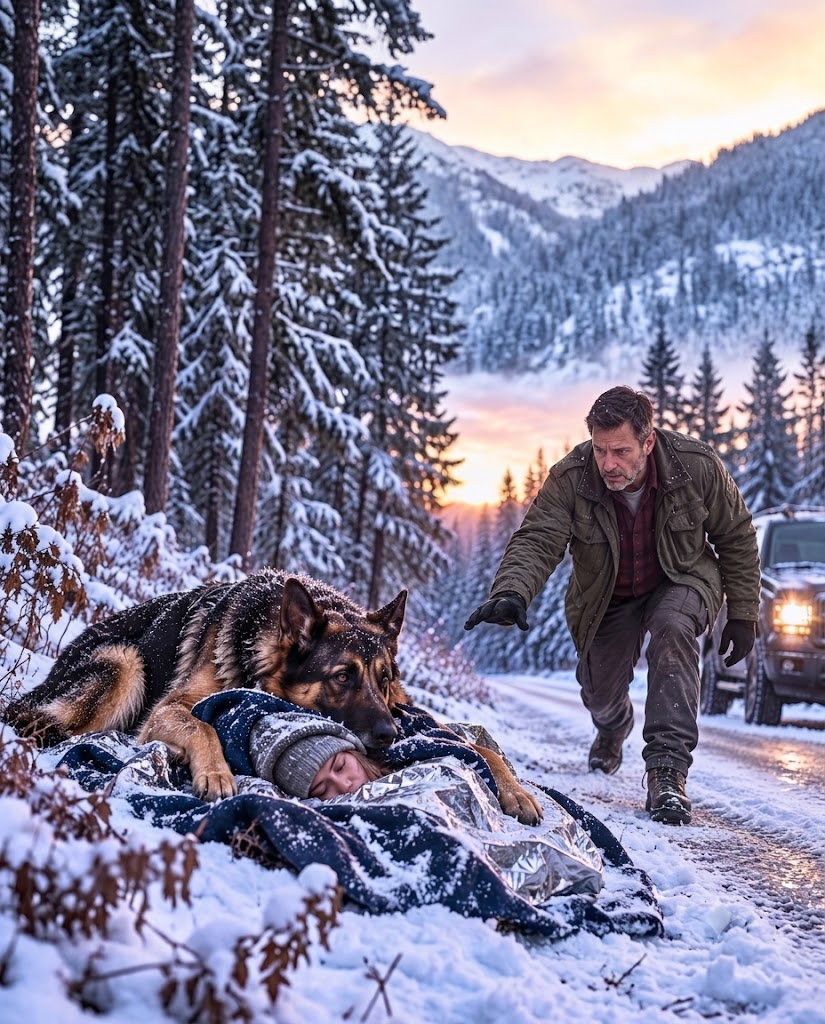
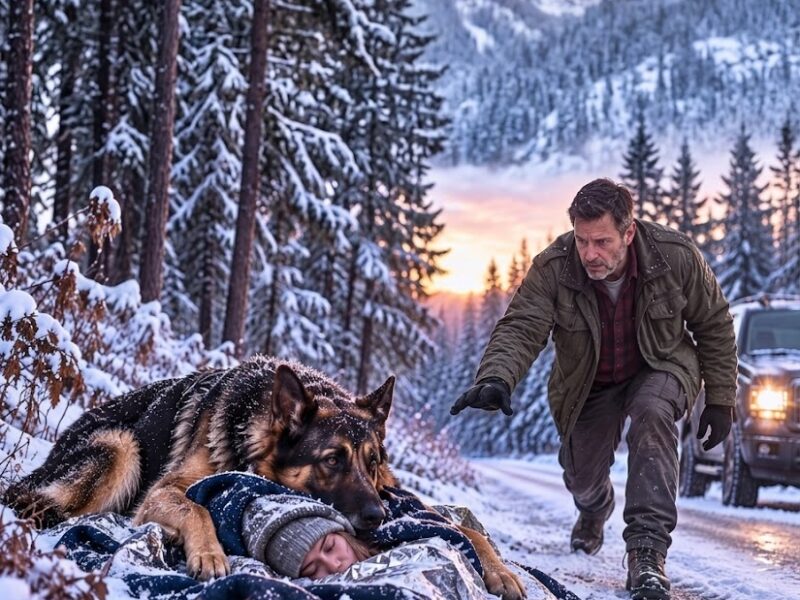
At dawn on a snowbound Oregon road, retired Navy SEAL Travis Keen found a German Shepherd standing over a hidden bundle beside the pines.
The dog would not move until Travis saw the young woman beneath the blankets, barely alive.
But the shepherd was not finished.
Someone else was still lost in the forest.
Snow moved sideways before sunrise along Cascade Lakes Highway, hard and fine against the windshield.
West of Bend, Oregon, retired Navy SEAL Travis Keen drove through the Blue Hour with one hand on the wheel and the other near the radio clipped to his coat.
He was returning from a search and rescue repeaters station where ice had bent an antenna out of line.
He was 40, broad-shouldered, dark-haired with gray beginning at the temples, and weathered in the quiet way of men who had learned to keep fear useful.
These days he repaired radios, trained volunteers, and tried to call that peace.
His mind knew better, especially in winter.
Empty roads became old roads.
Old roads became a training storm years earlier, when a teammate’s voice had faded under static before help could reach him.
Travis named what was real in front of him.
Pine. Snow. Dashboard light. Cold coffee. Bend, 30 minutes east.
Then the headlights caught a pair of amber eyes near the shoulder.
Travis slowed.
A German Shepherd stood half in the ditch, half on packed snow, facing the truck as if he had been waiting for one particular human and was unimpressed by the delay.
He was large, black and tan, with a dark saddle and a small cream mark on his chest like a fallen leaf.
Snow dusted his coat, but he stood balanced and alert.
Behind him lay a low bundle wrapped in a blue tarp and silver rescue blankets.
When Travis eased onto the shoulder and stepped out, the dog shifted sideways to block him.
No charge. No panic.
A low, controlled growl—just enough to say the bundle mattered.
Travis called 911, gave his location, and crouched several yards away with his hands low.
“Easy. I see you.”
He had worked beside military dogs and rescue dogs enough to know this was not a stray defending trash or territory.
This dog was guarding a person—or believed he was.
Travis offered the back of one gloved hand and waited while the shepherd measured him.
The cold bit through Travis’s sleeves.
Beneath the tarp, something breathed softly, unevenly.
Everything inside him sharpened.
“Dispatch, I may have a living person in the bundle. Send medical. Possible exposure.”
The dog glanced back at the tarp, then stepped aside two inches.
Two inches was a door.
Travis peeled back only the upper corner.
A young woman lay on a folded rescue sled beneath layered blankets, her face pale, lips bluish, dark blonde hair damp around a wool cap.
She was not a child—early 20s, maybe—old enough that the rules of rescue and dignity both mattered.
One hand had slipped free, fingers curled around a cloth embroidered with a single capital A.
Beside her were glucose gel packets, a small medical kit, and a steel bottle that had gone cold.
Travis checked her breathing and pulse, found both weak but present, and saw no obvious bleeding.
“Can you hear me?” he asked.
Her eyelids flickered. Her mouth moved.
The word came thin as thread.
“Mom.”
The shepherd pressed close to the sled, no longer blocking, only watching.
Travis added his own thermal blanket, activated warming packs around the outside layers, and kept the woman’s face clear.
He did not try to give oral glucose while she drifted at the edge of consciousness.
When dispatch reported the nearest ambulance delayed by a jackknifed truck, Travis confirmed that St. Charles Bend was closer than waiting in the ditch.
He loaded the sled carefully into the rear of his truck, secured it, and stepped back for the dog.
The shepherd climbed in without being invited and settled beside the woman’s shoulder with the precision of a trained guardian.
The drive toward Bend felt stretched thin.
Travis kept the heater high, the truck steady, and the radio open.
In the rearview mirror, the shepherd never relaxed.
Once the young woman made a faint sound, and the dog lowered his muzzle to the edge of the blanket until she quieted.
Travis had seen courage in uniforms, scrubs, helmets, and shaking hands.
Now it sat in the back of his truck with amber eyes, refusing to look away.
At the hospital, two nurses and Dr. Paige Hollis waited beneath the emergency bay lights.
Travis parked close, opened the rear door, and placed one hand lightly on the dog’s collar.
“Their help,” he said.
The dog disliked the idea but accepted it.
As the team lifted the young woman out, Travis’s fingers struck metal beneath the dog’s damp collar.
He rotated the tag toward the light.
The engraved family name was worn but clear.
Whitlock.
Below it, in smaller letters, was the dog’s name.
Thain.
Travis looked from the tag to the young woman disappearing through the sliding doors, then back toward the white road beyond town.
This had not begun beside the highway.
It had begun somewhere deeper, in a place cold and quiet enough to hide another life.
He photographed the tag for dispatch before the door closed, then noticed something else tucked under the collar.
A narrow strip of blue reflective tape, cracked with age and hand-stitched into place.
Not store-bought.
Someone had prepared this dog for dark roads and bad weather.
Someone had trusted him to be visible when visibility mattered.
Travis felt the small hairs rise along his neck as the emergency doors slid shut behind Avery.
Thain stood beside him, staring toward the west-facing glass, and the name Whitlock stopped being an answer.
It became the first breadcrumb.
Morning opened gray over St. Charles Bend, snow sliding from the hospital roof in soft, sudden sheets.
Inside the emergency department, warm air smelled of antiseptic, wet wool, burnt coffee, and the metallic edge that always seemed to wait near fear.
Dr. Paige Hollis took charge before Travis finished the full story.
She was 44, compact and quick-moving, with dark hair tied back and brown eyes that separated panic from useful information in a breath.
She asked for exposure time, responsiveness, the glucose found in the bundle, medical signs, and whether Travis had seen trauma.
He answered in order, his voice flattened by old training.
The young woman was moved behind a curtain, then into treatment.
Warm blankets replaced the roadside layers.
Monitors began their steady work.
Thain planted himself outside the treatment room door.
A nurse brought water and food, and the shepherd drank only when Travis placed the pan close enough that he did not have to turn away.
He ate three precise bites, then returned his full attention to the room.
“He doesn’t waste much,” Travis said.
The nurse, Kevin, glanced down.
“Neither do most charge nurses.”
Travis nearly smiled.
After 20 minutes, Paige stepped out.
The young woman’s name was Avery Whitlock, 24, hypothermic with dangerously low blood sugar and dehydration, but alive.
No signs of assault. No major injury.
Her record confirmed type 1 diabetes and ongoing mobility issues after a climbing accident the year before.
Paige looked at Thain.
“He may have saved her life.”
Travis watched the dog lift one ear at Avery’s faint movement inside.
“He knows enough.”
Dispatch traced the tag to Evan and Marin Whitlock, residents of West Bend.
Evan was listed as a Navy civil engineer on assignment overseas.
Marin was Avery’s mother and emergency contact.
Travis asked if Thain could remain near Avery.
Paige allowed it, provided he stayed calm and outside active treatment.
Thain lay down parallel to the door, head on paws, one ear raised.
Travis left him there and drove to the Whitlock address while daylight spread across snow-packed streets.
The house stood on a quiet road beneath ponderosa trees.
Pale siding, green trim, a small porch, an empty driveway.
No one answered.
Mail crowded the box.
A grocery bag had frozen near the porch.
Curtains stayed closed in every front window.
The house did not look abandoned.
It looked paused too long.
A door opened across the street.
A woman in a red wine-colored coat stepped onto her porch, silver hair tucked behind brown-framed glasses.
“Are you here about Marin?” she asked.
Her name was June Carver, 67, a church secretary and neighbor.
When Travis told her Avery was alive at St. Charles, June closed her eyes around a prayer she did not say out loud.
Then worry returned.
She had not seen Marin properly in nearly a week.
Marin had answered through the door twice, saying Avery was resting and everything was fine.
June had noticed porch lights burning all night, mail stacking up, and a tiredness in Marin’s voice that did not sound like ordinary caregiving.
“I thought knocking harder would embarrass her,” June said, her gloved hands twisted together.
“Now I wish I had.”
June remembered seeing Marin load the silver Subaru Outback three days earlier, before the storm.
Avery sat in the passenger seat, bundled carefully, and Thain jumped into the back.
June assumed they were going to a doctor’s appointment or the old family cabin Evan sometimes mentioned.
When Travis asked which way they went, she pointed west toward the forest roads.
The detail changed the weight of the morning.
Avery and Thain had not simply appeared on a highway.
They had left home with Marin and vanished into winter before the dog brought one of them back into view.
Travis documented the exterior of the house with a deputy, circulated the Subaru information, and returned to St. Charles.
He expected Thain to be sleeping after warmth and water.
Instead, the shepherd lifted his head the instant Travis entered the corridor.
He rose, walked toward the glass entrance doors, stopped, and looked back.
“Not now,” Travis said quietly.
Thain returned, touched his nose to Travis’s hand, then went back to the doors.
Paige watched from the nurse’s station.
“That looks less like a bathroom request.”
Travis felt the old road open inside his ribs.
“It is.”
Thain stood facing the snow, patient and certain, as if Avery’s rescue had only completed the first half of the order.
Paige did not stop him, but she did make him say the plan out loud.
He would not take the dog alone.
He would notify dispatch, bring law enforcement, carry winter gear, mark their route, and turn back if the road became unsafe.
Travis almost told her he knew procedure, then saw her expression and chose wisdom.
“Yes, ma’am,” he said.
Paige’s mouth twitched.
“Good. I dislike rescuing rescuers.”
Thain gave one impatient huff at the doors, and Travis understood the shepherd had no interest in hospital policy, human pride, or careful timing.
Somewhere beyond the glass, the rest of the story was waiting.
In the treatment room behind them, Avery’s monitor kept a steady rhythm.
It sounded like permission to leave—and a warning not to be late.
Travis clipped the temporary lead to Thain’s collar, and the dog stepped forward before the command was even spoken.
Late morning cleared hard and bright over Bend, leaving the streets glazed and the mountains hidden behind torn white cloud.
At the hospital entrance, Thain waited beside Travis Keen’s truck with the grave patience of a dog who had already explained the plan and found the human slow.
Travis did not simply follow him into the mountains.
The younger version of himself might have, back when urgency could still disguise itself as courage.
Search work had taught him that a rescue could be ruined by one man who treated instinct like permission.
He called dispatch, requested Deputy Riley Benton, and told Paige Hollis where he intended to go.
Riley arrived in a marked county SUV 15 minutes later, sandy-haired and practical, with the squint of someone used to reading winter ground for one track that mattered.
He listened to the full sequence: Avery, the tag, June Carver’s account, the Subaru, and Thain’s behavior.
“You trust the dog?” Riley asked.
Travis looked through the window at Thain in the back seat, eyes fixed west.
“I trust that he knows something we do not.”
They drove west, Riley following, past the last neighborhoods and into forest.
For several miles, Thain stayed still—at a fork where one route continued toward a maintained recreation area, and the other climbed toward older service roads.
He stood so suddenly the harness creaked.
Travis slowed there.
Thain gave one low sound, not a bark—more correction than plea.
Travis turned uphill, and the dog settled.
Twice more, where the road allowed, Travis tested a wrong direction.
Each time, Thain stiffened within seconds, nose pointing toward the opposite way.
When Travis corrected, the shepherd quieted.
It was not courtroom evidence, but it was enough to stop wasting daylight.
The road narrowed under heavy ponderosa branches.
Snow banks rose along both sides, clean on top and gray where blades had cut earlier layers.
Travis scanned for what the storm had failed to hide.
Broken brush. Compressed snow. A mound too square. Tire marks under drift.
Thain barked once.
Travis braked.
A narrow service road disappeared between trees on the right, almost invisible beneath overhanging limbs.
Two ruts entered it, softened by snowfall, but still showing where tires had packed the first layer before the second came down.
Riley pulled alongside.
“Seasonal road. Mostly ignored by people with sense.”
Travis looked at the ruts.
“The Subaru did not get that memo.”
They reported the turnoff and proceeded carefully, Riley in front for clearance.
Branches scratched the vehicles, and the road dipped through silent timber.
Nearly two miles in, the silver Subaru Outback appeared crooked near a bend, right wheels buried deep in a drift, rear bumper resting against frozen brush.
Snow covered the hood and windshield.
It looked like a vehicle that had argued with winter and lost by inches.
There was no major damage, no shattered glass, no sign of another car.
The driver’s door was unlocked.
Inside were medical supplies packed with care.
Glucose gel. Insulin pens in a cooler pouch. Water bottles. Protein shakes. Hand warmers. Spare socks. A pill organizer. Blankets. A tub of fire starters.
The fuel gauge sat empty.
“This is not dumping someone,” Riley said.
Travis said nothing, because the Subaru was already saying it louder.
Outside, under the shelter of nearby pines, he found what wind had spared.
Boot impressions. Sled grooves. Dog tracks leading away from the vehicle.
Some bootprints were deep and uneven, as if the walker had been pulling weight.
A broken branch held a thread from a green parka.
Marin had come this way—alive, then exhausted, maybe frightened, but moving with purpose.
Riley photographed everything, logged the location, and requested a search team to stage at the service road, while Travis tied bright survey tape to a branch.
Thain led, but did not rush.
Every 30 or 40 yards, he stopped and looked back until the men caught up.
The forest swallowed road noise and left only breath, boot crunch, and the small sound of the lead sliding through Travis’s glove.
After nearly a mile, the trees opened enough to reveal a low roofline through the white.
A cabin sat ahead among tall pines.
From its chimney rose a thread of smoke, so thin it nearly vanished against the pale sky.
Thain saw it and leaned forward, body turning certain.
Travis loosened his grip, and the shepherd pulled toward the cabin as if every minute since the highway had been pointing there.
Travis raised a fist for Riley to hold position a moment.
Smoke meant warmth, but it also meant someone had been conscious enough to start a fire—or unconscious long enough for the fire to die.
Both possibilities pressed against his ribs.
He checked the time, the radio signal, the wind, the distance back to the Subaru.
Then he looked at Thain.
The dog was not staring at the chimney.
He was staring at the front door, ears high, body still.
Travis had followed signs through deserts and harbor alleys and mountain storms.
Few had ever looked back at him with such unbearable certainty.
Riley’s radio clicked once with static, then went quiet.
Travis stepped into the clearing, knowing the next sound from that cabin might decide everything.
Thain moved with him, careful and silent, no longer leading them through snow, but bringing them to a door that needed opening.
The clearing around the cabin held the muffled silence that follows heavy snow.
Pale noon light pressed through the pines, while a faint thread of smoke lifted from the chimney and disappeared before it rose above the roof.
Travis Keen stopped at the edge of the trees and let his eyes work before his feet did.
The cabin sat low beneath a steep roof built of weathered logs darkened by years of mountain weather.
One shutter hung slightly crooked.
A stack of firewood rested under a lean-to.
The porch showed disturbed snow, then fresh powder over the top.
No broken window. No fresh tire tracks. No obvious sign of another person.
Deputy Riley Benton moved to circle the outside while Travis kept Thain on a short lead.
The German Shepherd’s body leaned toward the door with disciplined urgency.
At the first step, he stopped and looked back—not asking permission, only reporting.
Travis knocked hard and called out.
“Marin Whitlock. Travis Keen with search and rescue. Deputy Benton is with me. Avery is alive. If you can hear me, call out.”
No answer came.
Thain pressed his nose to the gap beneath the door and went still.
That stillness changed everything.
A bark could have meant confusion or impatience.
This was recognition.
Riley returned from the side wall.
“Back door locked. Windows frosted. Curtains drawn.”
Travis called again, louder, and this time a sound answered from somewhere inside—so faint it might have been old wood shifting.
Thain’s ears snapped forward.
Riley nodded.
“Legal enough for entry.”
They chose a warped side window, photographed it, and forced it open without shattering the glass.
Travis climbed in feet first and low, then crossed the dim room to unlock the front door.
Cold air breathed out, carrying ash, cedar, medicine, wool, and fear held too long in a closed space.
When Riley entered with Thain, the dog went straight to the center of the room and stopped.
The cabin did not look like violence.
It looked like effort.
A cot had been pulled near the wood stove.
Blankets lay folded.
Protein drinks, water bottles, glucose wrappers, a thermometer, and medication sat in careful rows on the table.
Beside them were papers covered in handwriting that began neat and grew uneven.
“Avery—food 6:10. Check sugar 6:35. Drink water, Marin. Call Evan if signal. You only have to get through the next hour.”
Travis stood over that last line longer than he meant to.
It sounded like a woman building a bridge from one minute to the next with whatever boards remained.
Thain moved toward the back of the room and gave a low sound.
Not triumph. Not alarm.
Relief too large for words.
Travis followed him around an old couch and found Marin Whitlock on the floor near the wall, partly wrapped in a gray blanket.
She was 52, slender beneath a green parka, auburn-brown hair streaked with silver and tangled around her cheeks.
Her lips were dry.
One hand lay near an overturned cup.
Her eyes opened when Thain touched his nose to her wrist.
“Thain,” she whispered.
Travis knelt several feet away, giving her room.
“Marin, my name is Travis. Avery is alive. She is at St. Charles Bend.”
The words reached her slowly.
Her eyes closed, and the tension left her face so suddenly Travis checked that she was still conscious.
Riley called in the find, requesting medical transport for exposure, dehydration, and severe exhaustion.
Travis covered Marin with a dry blanket and gave controlled sips of water only after medical command approved it.
She tried to rise once, and he lifted one hand in the air, stopping the idea without touching her.
“Stay down. Help is coming.”
Her gaze found Thain again.
“I told him.”
Travis leaned closer.
“Told him what?”
Her mouth trembled.
“Stay with her.”
The rescue team needed nearly 40 minutes to reach the cabin by snowmobile and tracked litter.
During that time, Marin answered simple questions when she could.
Name. Pain. Medication. Allergies.
Other answers slipped away from her.
The notes, the washed bottles, the lined-up supplies, and the sled tracks outside answered what she could not yet explain.
This was not a room where someone had stopped caring.
It was the remains of a system built by a woman losing strength one hour at a time.
When the paramedics finally lifted her onto the stretcher, Thain rose but did not interfere.
He walked beside her until Travis held the lead gently.
At the doorway, Marin turned her head toward Travis.
“Thain stayed with Avery.”
Travis looked at the shepherd, then at the white forest waiting outside.
“Yes,” he said. “He held the road until help came.”
Marin’s eyes closed around the answer, but one hand moved weakly from beneath the blanket.
Thain stepped close enough for her fingers to brush the fur at his neck.
The gesture lasted less than a second.
It was enough.
Outside, the paramedics called for clear footing on the steps.
Riley warned that the wind was building again, and Travis felt the cabin shift in his mind from mystery to testimony.
Whatever anyone might assume later, the room had spoken.
Now the forest had to let them leave with the truth alive.
Behind them, the note on the table fluttered in the draft, still saying, “One more hour.”
This time, the hour had brought help.
Wind thickened again over the Deschutes forest, shaking powder from the pines while the rescue team worked inside the cabin.
The light outside turned flat and white, the kind that made distance lie and familiar trees look like strangers.
Marin Whitlock drifted in and out as the paramedics prepared the collapsible stretcher.
Travis stayed near her shoulder because she kept searching for one steady face whenever the room filled with movement.
Thain remained close—calm but watchful, shifting only when someone needed space.
No one asked the dog to leave.
He had earned his place without understanding the word.
The lead paramedic, Dana Morales, checked Marin’s pulse and said they were going to move her soon.
Marin’s eyes opened.
“Avery?”
Travis answered at once.
“Still safe.”
That seemed to open a small door in her, and the truth came through in pieces.
The cabin, Marin said, had once been one of the happiest places the Whitlocks knew.
Evan fixed things there. Avery read on the porch. Thain slept where he could watch every doorway.
After Avery’s climbing accident the year before, life narrowed.
Her leg and nerve pain improved slowly, and her type 1 diabetes became harder to manage under stress.
Marin had been an emergency nurse for years.
She knew what low blood sugar could do.
That knowledge did not comfort her.
It turned every night into a test she believed she might fail by sleeping.
She checked numbers, wrote them down, then checked the notes because she no longer trusted her own memory.
Evan called from Guam when he could, tired and far away.
Marin told him they were fine because explaining the truth felt impossible.
“I thought quiet would help,” she whispered.
The house had too many sounds, so she packed carefully.
Insulin. Glucose. Protein drinks. Blankets. Medication. Water. Fire starters. Thermos food. A folding sled. An old emergency radio she did not know had a bad battery.
The Subaru trapped itself before they reached the cabin.
One wheel sunk deep, fuel nearly gone from running the heater, while Marin tried to think.
The phone showed one bar, then none.
Avery told her they could wait, using the dry humor she used when frightened.
Marin looked at the darkening sky and knew waiting in a dead vehicle was not a plan.
She loaded supplies onto the sled, helped Avery move as far as she could, and let Thain guide them along the old marked route.
At the cabin, Marin got the stove lit.
She melted snow, tracked medicine, checked glucose, fed, and wrote notes because paper seemed more reliable than her exhausted mind.
For a while, the cabin reduced the world to fire, food, numbers, and the next hour.
Then the storm closed harder.
Firewood ran low.
Avery’s blood sugar dipped twice.
Marin found one of her own notes that said “Drink water” and realized she had not done it.
“I knew we had to get her where someone could see her,” she said.
She wrapped Avery in layers, tied a reflective strip to the sled, placed glucose and water within reach, and pulled her back through the trees while Thain circled between them.
The road felt farther than it had any right to be.
No vehicle came.
Marin understood she could not keep Avery warm beside the highway for long, and she could not drag her back and out again.
Thain stood beside Avery and would not move.
Marin put one hand on his collar.
“Stay with her,” she told him. “Stay close.”
She meant to return to the cabin for the flare kit and the brighter flashlight, then try for higher ground or signal.
She reached the cabin.
Then her body stopped.
“I woke up on the floor,” she said. “I thought he would leave her to find me.”
Travis looked at Thain, who lay with his head near Marin’s hand.
“He waited until Avery was safe.”
Marin closed her eyes.
“Good boy.”
Thain’s tail tapped once against the floor.
The rescue team carried Marin toward the door as new snow began to fall, fine and fast.
Travis walked beside the stretcher with Thain on a loose lead, and Riley went last, checking the stove and securing the scene.
Outside, the forest was already softening their tracks.
Riley’s radio crackled with a weather update.
Another snow band would reach the ridge within the hour.
Travis tightened his glove on the lead, and Thain leaned forward into the path, steady as a compass.
They had found Marin.
Now they had to get her home before winter changed its mind.
Halfway down the trail, Marin stirred when the stretcher tilted over a buried root.
Travis stepped closer, ready to steady the side.
Her eyes opened only a slit.
“Tell Evan,” she whispered.
Travis thought she would ask him to explain, to defend her, to make the story clean enough for a husband hearing it from across the world.
Instead, she said, “Tell him I tried.”
The words hit harder than apology.
Travis looked at the men and women carrying her through the snow, at Thain walking with his ears fixed forward, and answered the only way he could.
“You will tell him yourself.”
The radio hissed, the wind rose, and the trail behind them began disappearing.
Ahead, the rescue lights blinked through the trees like small red stars.
Behind them, the cabin vanished, but Marin’s words kept walking with Travis.
By the following afternoon, Bend sat beneath a washed gray sky.
The storm finally tired enough to let thin sunlight reach the hospital windows.
At St. Charles Bend, the urgent noise had softened into the quieter rhythm of recovery, which was less dramatic and often harder to trust.
Avery Whitlock was awake for longer stretches.
Her blood sugar had stabilized, warmth had returned to her hands, and the frightening blue tint Travis remembered from the roadside had disappeared.
She remained weak, sore, and embarrassed by the number of strangers who had seen her wrapped in her words like a misplaced camping burrito.
Paige Hollis laughed, then reminded her that humor was welcome but discharge instructions were not optional.
Marin was two rooms away, receiving fluids and rest, her body stronger than when they carried her from the cabin, but her face still marked by shame.
She had asked to see Avery as soon as she could sit upright.
Paige allowed a brief visit only after making it clear that reunion was not treatment.
In the corridor, Thain lay between the two rooms with his head on his paws and one ear raised.
Paige joined Travis near the window.
“People will want a simple version,” she said. “Mother abandons daughter. Hero dog saves her. Former SEAL finds everyone. Easy story. Wrong enough to hurt people.”
Travis looked through the glass toward Marin’s door.
“The cabin did not look like abandonment.”
Paige nodded.
“It looked like a health crisis inside a care crisis. Dangerous choices were made.”
“Yes. But every object you described shows she was trying to protect Avery. Notes, food, medicine, heat, the sled, choosing the road. She needed help long before the cabin.”
The words landed where Travis did not want them.
Competent people he knew could turn silence into armor and call it discipline.
Finally, a call pushed through military channels.
Travis stepped into an empty consultation room and heard a man’s voice cross half the world, controlled so tightly it almost broke.
“This is Evan Whitlock.”
Travis identified himself and did not make him wait.
“Your wife Marin and your daughter Avery are alive. They are both at St. Charles Bend.”
Silence filled the line.
“Say that again,” Evan whispered.
Travis did.
Evan asked about Avery. Then Marin. Then Thain.
Travis told him the dog was safe and had stayed with Avery until help arrived, then led the search back to Marin.
The sound Evan made was part prayer, part grief, part a man’s heart dropping its pack after carrying it too long.
The questions came next, organized because Evan was a Navy engineer and fear needed a framework if it was going to stand.
Travis explained the Subaru, the service road, the cabin, the notebook pages, the sled, and the highway.
He did not judge Marin.
He did not soften the danger.
Evan listened, then said, “She told me they were fine.”
Travis answered carefully.
“She may have wanted that to be true.”
Evan went quiet.
“I should have known.”
Travis looked through the consultation room window at Thain watching Avery’s door.
Everyone had one piece.
Nobody had the whole picture until the storm put it together.
Evan said he was coming home, and Travis promised to tell Marin.
That evening, June Carver came to the sheriff’s office before anyone asked for her.
She wore her red coat and twisted her gloves between both hands.
“I remembered more,” she said, though her face made clear she had remembered all along and only now found the courage to speak.
The porch light had burned three nights straight.
Mail had stacked up.
Once she had heard Avery calling for Marin—not in terror, just needing help—and June had nearly knocked.
“I told myself new caregivers need privacy. I did not want to be intrusive.”
Travis sat across from her with Riley by the wall.
“You did not know they were in the woods,” he said.
June’s eyes shone.
“But I knew something was wrong.”
He would not lie to comfort her.
Lies had already done enough.
“Maybe,” he said. “And maybe if you had knocked, Marin would have said fine through the door again.”
June looked down at her gloves.
“Then what do I do with that?”
Travis thought of Paige’s words, Evan’s silence, and Marin’s note.
You only have to get through the next hour.
“Next time,” he said. “Knock one more time.”
June pressed both gloves to her mouth.
The sentence did not absolve her.
It gave her somewhere to put her hands.
Outside the station windows, snow began to fall again—lighter now, almost gentle—and Travis understood that he had given advice he had not yet learned to take.
When June left, Riley remained in the doorway with two paper cups of coffee from a machine that believed bitterness was a civic duty.
“You all right?” he asked.
Travis accepted the cup.
“Fine.”
Riley’s eyebrows rose.
The word had done too much work in the last 24 hours to pass unnoticed.
Travis looked away first, which annoyed him.
Down the hall, a dispatcher laughed softly at something ordinary, and the sound felt like it belonged to another county.
Travis took one swallow of terrible coffee and heard himself add, “Tired.”
Riley nodded as if that small correction mattered.
“It did.”
Some truths entered a room that quietly.
Others waited outside hospital doors with amber eyes and snow still caught in memory.
The next morning broke clean and cold over Bend, with sunlight flashing off the hospital parking lot and turning the roof edges white.
Inside St. Charles, the halls smelled of disinfectant and breakfast trays, and Thain regarded both as matters deserving inspection.
Because the shepherd had spent hours in winter conditions and then refused to abandon his post, Paige arranged for a veterinarian to examine him in a quiet consultation room.
Dr. Russell Grant was 50, with a close gray beard, soft flannel under his clinic coat, and the patient knees of a man used to sitting on floors with animals who trusted linoleum more than tables.
He introduced himself by sitting sideways and ignoring Thain for a full minute.
“Best conversation I have had today,” Travis said from the wall.
Russell glanced up.
“He is deciding whether I am worth paperwork.”
Thain sniffed the man’s sleeve, then sat where he could still see Avery’s door.
“Permission granted, apparently on probation.”
The exam was slow and respectful.
Russell checked Thain’s paws, gums, hydration, heart, lungs, eyes, joints, and collar fit.
The shepherd tolerated every touch with grave dignity except the thermometer, which earned Travis a look so personally betrayed that Kevin the nurse laughed into a chart.
Russell’s verdict was reassuring.
Thain was safe, not injured, not frostbitten, and not in distress beyond fatigue and a deep suspicion that humans still needed supervision.
“Rest, normal meals, water, and quiet,” Russell said. “Do not turn him into a mascot. He can be admired from a respectful distance.”
Paige folded her arms.
“What if he refuses rest?”
Russell looked at the dog.
“Then we negotiate with a professional.”
The professional rejected two blankets and one expensive foam dog bed donated by a volunteer.
He sniffed the bed, stepped on it, considered its softness, and returned to the hard floor beside Avery’s door.
Kevin stared.
“That bed costs more than my first car.”
Travis looked at Thain.
“Maybe your first car had worse positioning.”
Laughter moved through the hallway—small but real.
For the first time since the roadside rescue, the story held a sound that did not brace for another emergency.
If Avery heard the laughter and demanded to know whether Thain was charming people without authorization, Paige allowed Travis and Thain inside for a short visit.
Avery sat partly upright, hair brushed into a loose knot, cheeks pale but eyes clearer.
At 24, she had the sharp, tired humor of someone who disliked being treated like glass, even when her body had made a fair argument for careful packaging.
Thain approached her bed without jumping or crowding and rested his chin near her hand.
Her fingers moved into the fur between his ears.
“Hey, you stubborn old sergeant.”
The dog’s tail moved once.
Travis said, “He is five.”
Avery replied, “Emotionally, he outranks everyone.”
She asked about Marin and listened while Travis answered.
Then she looked toward the window, where snow on the roof reflected harsh morning light.
“I remember pieces,” she said. “Mom pulling the sled. She kept telling me not to sleep, which was unfair because she has spent a year telling me I need rest.”
A weak smile came and went.
“At the road, she couldn’t stand straight. I told her to stay with me. She put her hand on Thain’s collar and said, ‘Stay with her.’ I thought he might follow her because he loves Mom, but he lay down beside me. Every time a car didn’t come, I got more scared. Then I got too cold to manage scared. I could hear him breathing. I thought if he was still there, maybe the world hadn’t left.”
No one spoke for a moment.
Travis felt an old winter memory rise—a teammate’s voice fading in a whiteout, static where rescue should have been.
The old accusation that he had been close enough to hear and not close enough to save.
Thain nudged Avery’s hand, and the room returned.
“You stopped,” Avery said. “People drive past strange things when they are tired.”
“You stopped.”
Travis shifted in the chair.
“Thain was persuasive.”
Later, when Avery slept, Travis visited Marin.
She was awake, wrapped in a hospital blanket, more present but still drawn.
He mentioned Avery’s memory of a green notebook.
Marin’s face changed.
“It’s at the cabin,” she said. “I wrote things when my head wouldn’t hold them. Some of it will not sound like me.”
Travis answered, “Maybe it will sound exactly like you trying to survive.”
In the hall, Thain lifted his head as if the cabin had called again.
Marin looked toward the door, where she could just see the shadow of Thain’s ears against the glass.
“I used to be the person people called when everything fell apart,” she said. “I thought if I admitted I was the one falling apart, something in me would stop being true.”
Travis understood that sentence so well he disliked it.
“Maybe the true part is that you kept looking for a way to keep Avery alive.”
Marin closed her eyes—not healed by the words, but no longer entirely alone with the opposite ones.
Outside, Thain stood, and Travis knew the green notebook was no longer only a clue.
It was a voice waiting in the cabin.
By morning, he would have to listen to what it had been trying to say.
Thain lowered himself back beside Avery’s door, waiting as if he already knew.
The forest was quieter after the storm passed, with sunlight resting on the snow as if the mountain had been covered in white glass.
Travis Keen and Deputy Riley Benton returned to the Whitlock cabin under a pale afternoon sky, carrying evidence bags, fresh batteries, and the uneasy respect men bring to a place where disaster nearly became permanent.
They did not bring Thain.
Russell Grant had ordered rest, and Paige had supported the order with the calm menace of a doctor who could make a clipboard feel like a court summons.
Kevin reported by text that Thain had eaten breakfast, ignored the expensive bed again, and dragged one clean towel closer to Avery’s room for reasons of interior design.
At the cabin, the air felt different without Marin on the floor and Thain at the door.
It looked less like an emergency and more like a room that had tried to hold too much human fear without complaint.
Travis found the green notebook beneath a folded thermal blanket.
The vinyl cover was bent at the corners.
The early handwriting was crisp.
“Avery—glucose 118. Soup, half bottle protein drink. Thain fed. Fire good. Call Evan from road if signal.”
The entries continued across pages.
Measurements. Food. Medication. Weather notes. Battery checks.
Then prayers, not polished ones.
“Lord, keep my hands steady. Help me remember the next thing. Forgive me for being angry at the phone. Keep Avery warm. Please let Evan sleep tonight.”
Travis read only enough to understand the nature of it.
He photographed relevant timeline and medical entries for Paige and the social worker, then closed the notebook gently.
Riley looked around the table.
“My mother cared for my father after his stroke. She had lists like this on the fridge.”
Travis asked if they helped—until they became proof she was the only one doing everything.
Riley packed Marin’s dead phone, the unopened flare kit, and the old emergency radio whose battery had corroded months earlier.
Travis turned the radio over in his hands longer than necessary.
Evan must have packed it years ago and assumed it remained useful.
Marin had brought it because hope sometimes looked like equipment no one had tested.
Back at the hospital, the notebook changed the conversation.
Paige read the timeline entries with Carla Freeman, a social worker with silver braids, purple reading glasses, and the habit of letting silence finish itself.
They did not read every prayer aloud.
The record showed enough.
Marin had been tracking care past exhaustion, compensating for memory lapses, and slowly losing the ability to judge risk without backup.
“We build rails,” Carla said. “Not cages. Rails.”
Marin cried when Paige returned the notebook.
She held it against her chest with both hands.
“This is not proof you failed,” Paige said. “It is proof you were carrying too much alone.”
Marin whispered, “Avery could have died.”
Paige did not flinch.
“Yes. And she did not. Now we treat the reasons she came so close.”
While the hospital built rails, June Carver built a different kind across the street from the Whitlock house.
She began with the walkway.
A retired contractor from church cleared the packed snow and salted the steps.
A neighbor checked the furnace and replaced a failing igniter.
Another stocked the pantry with easy meals, low-sugar snacks for Avery, tea Aaron liked, and more paper towels than seemed strictly theological.
June washed sheets, folded towels, and taped a list of numbers beside the kitchen phone in letters large enough to read while crying.
She did not write “We are here for you” in curling script.
She wrote, “Call before it gets bad.”
Then she added her own name twice.
Her phone rang while she labeled freezer meals.
The number came through a military liaison.
“Mrs. Carver, this is Evan Whitlock.”
June sat hard in a kitchen chair.
Evan thanked her for helping at the house.
“A few ordinary things,” she said.
“Ordinary sounds pretty good from here,” he answered.
He was at an airfield routing through Seattle, trying to reach Bend by the next day if weather and the Navy showed mercy at the same time.
June looked around at the cleared path, the warm rooms, the note by the phone, and Thain’s rubber ring waiting near the door.
“Your girls are alive,” she said, because someone who loved them needed to hear it.
Evan was quiet.
“Say it again.”
June did, and the house seemed to breathe around her.
After the call ended, June stood alone in the kitchen and noticed how different silence could feel when people were expected to return to it.
Before, the closed curtains had made the house seem secretive.
Now, the folded towels, the stocked fridge, and the note by the phone made it feel like a place holding its breath in hope.
She placed Thain’s rubber ring on the mat inside the door, then moved it two inches because he was particular about thresholds.
The small adjustment made her laugh and cry at the same time.
Outside, headlights passed slowly on the snowy street, and June thought of Evan crossing the country toward a home prepared by people who had almost waited too long.
On the kitchen counter, the radio instructions waited, blank and unfinished.
Travis would have to make that hope work.
June left a pen beside the page because this time no one would trust memory alone.
Three days later, the sky over Bend had the pale silver color of old tin, and the mountains wore a veil of cloud behind the hospital roofline.
Evan Whitlock arrived at St. Charles with a duffel over one shoulder, salt from two airports on his boots, and the stunned exhaustion of a man who had crossed an ocean while imagining too many endings.
He was 55, tall and lean, with close-cut salt-and-pepper hair and the careful posture of someone used to standing straight when orders, weather, or fear tried to bend him.
His travel uniform was clean but rumpled from the journey.
He paused inside the entrance, scanning doors, exits, faces, corridors.
Travis recognized the habit and did not comment.
“Mr. Whitlock.”
Evan turned.
“Travis Keen?”
They shook hands.
Evan gripped too hard, noticed, and let go.
“I am sorry.”
Travis shook his head.
“No need.”
Evan looked at his empty hands.
“There is every need. I do not know what to do with these.”
They walked toward the recovery floor without filling the hall with explanations already given by phone.
Evan asked only what mattered.
“Was Avery awake?”
“Yes.”
“Could Marin talk?”
“Yes.”
“Was Thain with them?”
“Very much yes.”
Outside Marin’s room, Evan stopped.
Through the narrow window, he saw his wife sitting upright in bed, thinner than when he had left, her hair brushed back, a blanket around her shoulders.
Avery sat in a reclining chair beside her, legs covered, one arm carefully around Marin.
The two women were not speaking.
They were simply touching, as if touch had become a language more trustworthy than updates.
Evan put one hand against the wall.
Travis stepped back.
“Take your time.”
Evan swallowed.
“If I take too much, I may not go in.”
Travis said, “Then don’t take too much.”
Evan opened the door and crossed the room without asking whether Marin intended to welcome him or apologize.
He set the duffel down and gathered her carefully, as if she were both fragile and not fragile at all.
Marin made a small sound against his shoulder.
Avery turned away, then gave up and cried, too.
Travis stayed in the hall.
Privacy was not always distance.
Sometimes it was a guard posted outside a door.
Through the glass, Travis saw Evan kneel beside Avery next, taking both her hands.
She said something that made him laugh once, and the laugh broke halfway through.
Marin reached for him.
He sat between them, one hand holding his wife, the other his daughter.
Nobody in the room looked repaired.
They looked found.
Paige Hollis joined Travis with a chart.
“He seems steady.”
Travis watched Evan bow his head.
“Steady can be a costume.”
Paige said, “So can quiet.”
She did not look at him when she said it.
That made the sentence worse.
Inside, Evan listened while Marin spoke.
She told him about the sleepless weeks.
The numbers she checked and checked again.
The way saying fine on video calls became easier than explaining something she could not understand.
She told him the cabin had seemed like a place to rest, not disappear.
She told him about the Subaru, the dead signal, the sled, the road, and the command she had given Thain.
Evan did not interrupt.
When Marin stopped, he moved her hands away from her face and said something too low for Travis to hear.
Later, Paige would hear the sentence from Marin.
“We do not call silence strength anymore.”
Thain discovered Evan when Kevin returned from a supervised walk.
The shepherd stopped at the corridor corner, ears forward, body lowering under the weight of recognition.
Evan stepped into the hall and dropped to one knee.
“Thain.”
The dog came to him—not wildly, but with urgency that made every person nearby understand the reunion was not theirs to manage.
He pressed his head into Evan’s chest, then leaned harder as Evan wrapped both arms around his neck.
“Good boy,” Evan said, voice wrecked. “You impossible, perfect boy.”
Kevin wiped his eyes and pretended to check the leash clip.
Later, Evan stepped into the hall with Travis.
His face looked older than it had an hour earlier and less brittle.
“I need to know where they were,” he said. “Not for a report. For when Marin wakes up believing Avery is still beside that road. For when Avery asks why her mother left. For when I need to remember how close we came and not turn that into blame.”
Travis understood.
“I can show you on a map.”
Evan nodded.
“Show me exactly where Thain held the road.”
Travis expected the request to feel like procedure, but it did not.
It felt like a man asking for the geography of mercy before fear could redraw it into accusation.
Down the hall, Thain settled again outside Avery’s door, head on paws, eyes open.
Marin and Avery spoke softly inside the room, their voices too low to separate.
Evan listened for a moment with his hand still on the doorframe.
“I spent months asking if everything was all right,” he said. “I never asked what all right was costing them.”
Travis folded the map packet under his arm.
The answer was waiting in lines of road, snow, and forest.
Before nightfall, those lines would become a family map, and every mile on it would ask them what kind of home they meant to rebuild.
A clear morning followed Evan Whitlock’s return—cold enough to silver the hospital lawn and bright enough to make the mountains look closer than they were.
In a family consultation room at St. Charles Bend, Travis spread a county map across the table while three paper cups of coffee cooled untouched.
Evan stood with both hands braced on a chair back, studying the lines like a damaged bridge plan.
Marin sat wrapped in a hospital cardigan, pale but present, with Avery beside her in a wheelchair she had called offensively beige.
Paige Hollis stood with Carla Freeman, the social worker, and Deputy Riley Benton, joined by phone for the official timeline.
Thain lay under the table with his head on Evan’s boot, making it clear that any map of the incident lacking him was incomplete.
Travis pointed to the highway shoulder.
“This is where I saw Thain. Avery was here on the folded sled, wrapped in blankets. The reflective strip made the tarp visible.”
Marin’s fingers tightened on her sleeve.
Travis continued gently, giving distances, weather, road conditions, and what had been found.
He did not dramatize.
He did not hide danger.
He marked the service road, the Subaru, the path, the cabin, the notes, the stove, and the place where Marin had fallen.
He explained that Thain had positioned himself close enough to guard Avery, but far enough into view to be seen.
Avery looked down at the dog.
“You chose the spot.”
Thain exhaled.
Evan nodded solemnly.
“He does that when he is smug.”
Marin laughed once, so softly it startled her.
The sound entered the room like a candle.
When Travis finished, Carla opened her folder.
“This map tells us what happened. Now we discuss what changes before anyone goes home—not punishment. Rails.”
The plan took shape in practical language.
Avery’s glucose monitoring would sync to her own phone first, with backup alerts to Marin and Evan under terms Avery approved, because support could not become surveillance.
Marin would meet with a counselor and follow a medical plan for exhaustion, anxiety, and sleep disruption.
Evan would remain on emergency leave long enough to rebuild routines.
June Carver would coordinate meals and check-ins, but only with Marin’s consent.
Travis would repair the emergency radio and teach all three of them how to test it.
“Four of them,” Avery said.
Everyone looked at her.
She pointed at Thain.
“He should know whether the radio works, too.”
The dog’s ears lifted.
Evan said, “He has strong views on communications readiness.”
Marin wiped her eyes.
“He always did. Evan trained him to bring the phone when my mother was sick. I thought it was excessive.”
Evan replied, “It was excellent.”
Marin gave him a tired look.
“It was excessive and excellent.”
The room breathed easier after that.
Not fixed. Easier.
There was a difference.
After the meeting, Travis drove to the Whitlock house with Evan and June to install the repaired radio.
June had labeled cabinets with painter’s tape, then apologized for labeling too much, then labeled the apology note by mistake.
Evan found it on the refrigerator and laughed until he had to sit down.
The sound made June cry, which annoyed her enough to make tea.
Travis mounted the radio near the kitchen phone, checked the battery, antenna, weather band, and emergency frequency, then printed a one-page instruction sheet in large type.
When the SAR base answered the radio check cleanly, Evan’s shoulders lowered.
Marin was not home yet, but part of her future had a working battery.
Outside, June handed Travis a container of soup.
He tried to refuse.
She looked at him over her glasses.
“Mr. Keen, I am a church secretary. I have outlasted four pastors, two copy machines, and one choir director who believed tambourines belonged in Advent. Take the soup.”
He took it.
That night, in his small house on the east side of Bend, Travis set the container in his refrigerator and stood in the quiet kitchen.
No notes on the counter. No one asking if he had eaten.
His radio gear sat in exact rows.
Everything worked. Everything was in place.
His phone buzzed with a message from Evan.
“Marin is asleep. Avery says Thain snores like a chainsaw with moral authority.”
Travis smiled before he could stop himself.
He typed a joke, erased it, and tried again.
“Glad they are resting. Call if tonight gets hard.”
He stared at the words after sending them.
They looked like advice he might someday need to take.
In the stillness, he wondered whether telling people he was fine had become just another locked door.
The soup warmed on the stove with a low, homely smell that did not match the room’s hard neatness.
Travis took down one bowl, then hesitated and took down a second for no reason at all.
Old habits made him correct the mistake, but his hand paused before putting it away.
He thought of Marin’s notebook, June’s labels, Evan’s map.
Avery’s voice saying, “People drive past strange things when they are tired.”
His own quiet suddenly looked less like discipline and more like a porch light no one had been close enough to question.
The phone stayed on the table, face up, as if daring him to use it first.
For once, he did not turn it over.
If it rang, he wanted to see the name before fear answered for him.
Spring returned to Bend slowly, melting snow banks into gray seams along the roads and lifting the smell of wet pine from the forest floor.
Several months had passed since Travis Keen found Thain standing beside Avery Whitlock on the highway, but some mornings still carried the old cold.
Travis placed a printed copy of the rescue map inside the SAR training room—not for visitors, but in a binder used for winter response review.
The map taught more than a dramatic retelling could.
It showed where visibility mattered, where a seasonal road could hide a vehicle, where a dog’s indication could guide but not replace procedure, and where an untested radio became hope with a dead battery.
New volunteers studied it.
Travis made them practice radio checks until their eyes pleaded for mercy.
“If you are bored, you are learning,” he told them.
One volunteer asked if that was a SEAL saying.
“No, it is a Travis saying, which means it is less marketable.”
The Whitlocks changed in quieter ways.
Marin continued counseling and medical follow-ups, learning to say “overwhelmed” before the word became emergency.
Some mornings, she still woke convinced she had forgotten Avery’s medication, even after the shared system confirmed otherwise.
On those mornings, Evan did not say, “You already checked.”
He sat with her, opened the app, read the numbers, and made coffee.
Avery returned to graduate classes part-time at Oregon State University–Cascades, using a cane on uneven days and making jokes sharp enough to worry professors.
Her health alerts went to her own phone first, then to Marin and Evan only under the plan she had approved.
Support was not ownership.
Avery said Thain understood this, though he still believed all humans benefited from supervision.
Thain was healthy, glossy, and unimpressed by his fame.
His black-and-tan coat shone again under spring light, and the cream mark on his chest seemed brighter after a bath he considered legally questionable.
He slept near Avery’s chair while she studied, walked with Evan before breakfast, and visited Marin’s counseling office once a week because the therapist claimed his presence improved honesty.
Thain’s own honesty remained blunt.
He yawned when sessions ran long.
June Carver became neighbor, aunt, logistics officer, and benevolent weather system.
She stopped asking, “Are you fine?” and started asking, “Did you eat? Is laundry too much? Do you want company for 20 minutes or quiet with someone nearby?”
At the end of April, Evan invited Travis to the house on a Saturday afternoon.
Travis arrived off duty in jeans, boots, and a jacket that had survived more winters than style experts would forgive.
The Whitlock house looked different from the day he first stood on the porch.
A window stood open.
Early flowers sat on the railing.
The walkway was clear because people expected tomorrow.
Marin sat on the porch with tea and a paperback.
Avery worked at a small table, laptop open, one foot resting against Thain’s side.
Evan knelt by the fence, replacing a loose board, offended by its lack of discipline.
They greeted Travis at the gate.
Thain pressed his head into Travis’s hand, then returned to Avery without apology.
They spent an hour on the porch.
Marin talked about treatment without making it sound magical or shameful.
Evan explained a new family rule.
No one could answer “fine” without one supporting detail.
Avery had taught him to ask, “What is the hard part today?” and then survive the answer without immediately bringing tools.
June arrived with muffins and a casserole schedule for someone Travis had never met.
She handed him a copy because he had apparently been added to her emergency driver list.
He pointed out that he had not volunteered.
June patted his arm.
“You stopped on a highway for a shepherd with an opinion. Do not pretend your standards are strict.”
Before Travis left, Evan handed him a wrapped frame.
Inside was a photograph taken that morning: Avery in spring sunlight, smiling down at Thain with his head across her shoe. Marin in the doorway. Evan behind her. June at the edge of the frame, carrying muffins like an official state symbol.
Beneath the photograph, Evan had written, “He held the road until help came.”
Travis looked at it for a long moment.
“Thank you,” Evan said. “You held it, too.”
Travis shook his head.
“I stopped because he made it impossible not to.”
Evan answered, “That still counts.”
The following Monday, Travis placed the frame on a shelf in the SAR radio room near the equipment sign-out log.
That afternoon, the radio crackled with a call that sounded small.
A welfare check request near an older ranch road.
Medication not picked up. No confirmed emergency. Maybe nothing.
Travis reached for his jacket before the dispatcher finished.
A volunteer looked surprised.
“You think it is serious?”
Travis glanced at the photograph of Thain beside Avery.
“I think small calls deserve a knock.”
He clipped the radio to his coat and took fresh batteries from the shelf below the frame.
The duplicate map binder sat nearby, its clear plastic cover catching the light.
For one second, Travis saw the highway again—the blue tarp, Thain’s amber eyes refusing to let him pass.
Then the present returned.
Spring wind. A waiting truck. A quiet address that might hold nothing or might hold everything.
Travis keyed the mic.
“Keen on route.”
This time, he did not wait for the call to sound dramatic before moving.
Warm light lay over Bend in late afternoon, turning wet grass gold and leaving the last snow on the peaks like a memory the mountains had chosen to keep.
The small call from the SAR radio room had not become a headline.
It became an older man with a fever, a dead phone, and medication waiting at a pharmacy counter while his neighbor wondered whether she was being nosy.
She had knocked anyway.
Then she called.
Travis arrived with a deputy and an ambulance, and the man recovered after two days in the hospital.
No camera crew came.
No one used the word “miracle” except the man’s sister, who said it while bringing banana bread to every person remotely involved.
Travis accepted one loaf and did not argue.
He was learning.
Two weeks later, he returned to the Whitlock house with radio batteries, a replacement antenna cap, and the banana bread June had ordered him to share because his freezer, in her opinion, was becoming a museum of uneaten gratitude.
The porch window stood open.
Wind carried the smell of coffee, cut grass, and melting snow somewhere higher in the forest.
Marin sat in the rocking chair with a yellow notebook in her lap—not the green crisis notebook, but a new one filled with appointments, meal plans, prayers, and ordinary complaints about insurance forms.
She seemed proud of the complaints.
Travis thought she should be.
Avery sat at the porch table with textbooks open and a mug too close to her laptop.
Her cane leaned against the chair, painted with tiny pine trees.
She called it either art or procrastination.
Evan repaired the gate latch at the side fence and announced it had been installed by a man who feared right angles.
“You installed it,” Marin called.
“I was younger then.”
“It was last summer.”
“Youth is relative.”
Thain lay under Avery’s chair, positioned to see the yard, the door, Travis, and at least two sandwich opportunities.
When Avery shifted, he noticed.
When Marin stood, he tracked her.
When Evan dropped a screw, Thain chose not to assist, proving excellent judgment.
June came through the side gate with a clipboard, a basket, and the expression of a woman managing mercy and inventory.
“Mr. Keen, I have your name for next Thursday.”
“For what?”
“Driving Mr. Lel to physical therapy.”
“Do I get consulted?”
“You may file an appeal with Thain.”
Thain yawned.
Avery said, “Denied.”
Laughter moved across the porch easily.
Travis heard it and felt something loosen—not because the past had softened, but because the present had gained enough ordinary noise to stand beside it.
They ate as the sun lowered.
Marin spoke about her support group without disguising hard days.
Avery described returning to campus and discovering three classmates had taken notes for her in competing systems.
Evan talked about learning to listen before bringing solutions.
Travis mostly listened, which no longer felt like failure.
He had started meeting Paige for coffee on Fridays and attending a veterans group in Redmond twice a month.
At the third meeting, he had said Ben Mallalerie’s name aloud and stayed in the room afterward.
Progress, he had learned, was not always impressive to watch.
Inside, it could feel like crossing a winter river near sunset.
Evan handed him a duplicate tag made of brushed steel.
One side read “Thain Whitlock.”
The other said, “Stay close—for the SAR room.”
Evan said, “To remind people the simplest instruction may save someone.”
Travis turned it over in his palm.
Behind him, Marin rested her hand on Thain’s head.
“I used to think needing people meant failing Avery. Now I think Avery needed to see me let people come close.”
Avery looked at her mother.
“I did.”
No one rushed to fill the silence.
It did not need repair.
When Travis walked to the gate, Thain followed halfway, then looked back toward Avery.
The old posture returned for a breath—body angled between loved ones and the uncertain world, ears raised, eyes bright.
Travis crouched.
“You know the mission ended, right?”
Thain looked at him.
“That is what I thought.”
Avery called, and the dog returned to her immediately.
Months earlier, Travis believed he was stopping for a dog beside a road.
He had found a family at the edge of breaking.
A mother whose strength had become a locked room.
A daughter who needed help without losing adulthood.
A father learning that distance could hide more than miles.
And a community learning to knock before silence became danger.
On the porch, Thain settled beneath Avery’s chair and closed his eyes slowly.
His mission had changed shape, but no one had convinced him it was over.
The lesson in this story is simple and close to home.
Strength is not proven by carrying every burden alone.
Sometimes real strength is letting another person knock, answer, drive, cook, listen, pray, or sit beside you when the next hour feels too heavy.
God often sends help quietly—through a loyal dog who stays, a neighbor who notices, a doctor who understands, or a stranger who stops on a snowy road.
Marin’s struggle reminds us that loving people can become overwhelming, and compassion heals more than judgment.
Travis learned that rescue is not only for mountains and storms.
It is also for locked doors inside the heart.
If this story touched you, comment “Amen” below.
Share it with someone who needs hope today.
And subscribe for more stories about courage, loyalty, faith, and second chances.
May God give you peace when you are tired, wisdom when something feels wrong, and courage to knock one more time.









