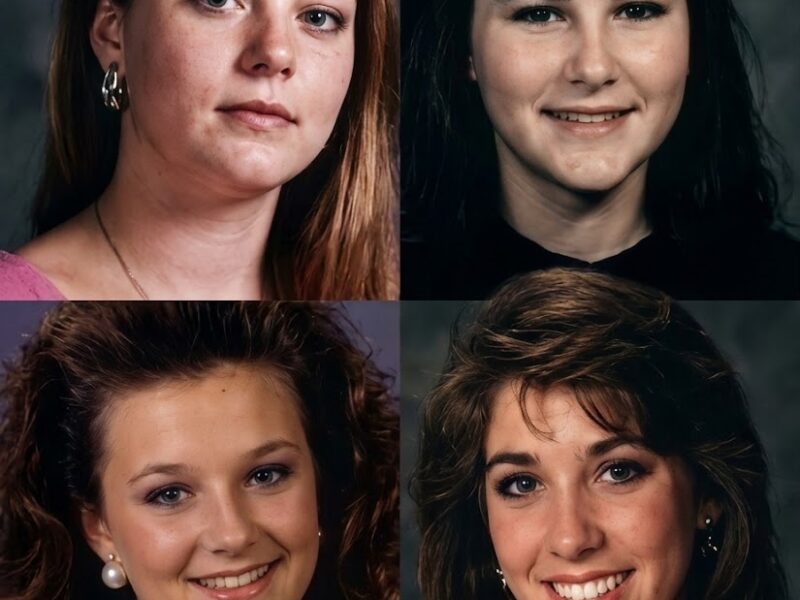
Four teenage girls were bound, gagged, and shot inside a Texas yogurt shop. The building was set on fire. For 34 years, the question was: who did it? Then a single tissue sample—taken from under the fingernail of 13-year-old Amy Ayers—finally gave the answer.
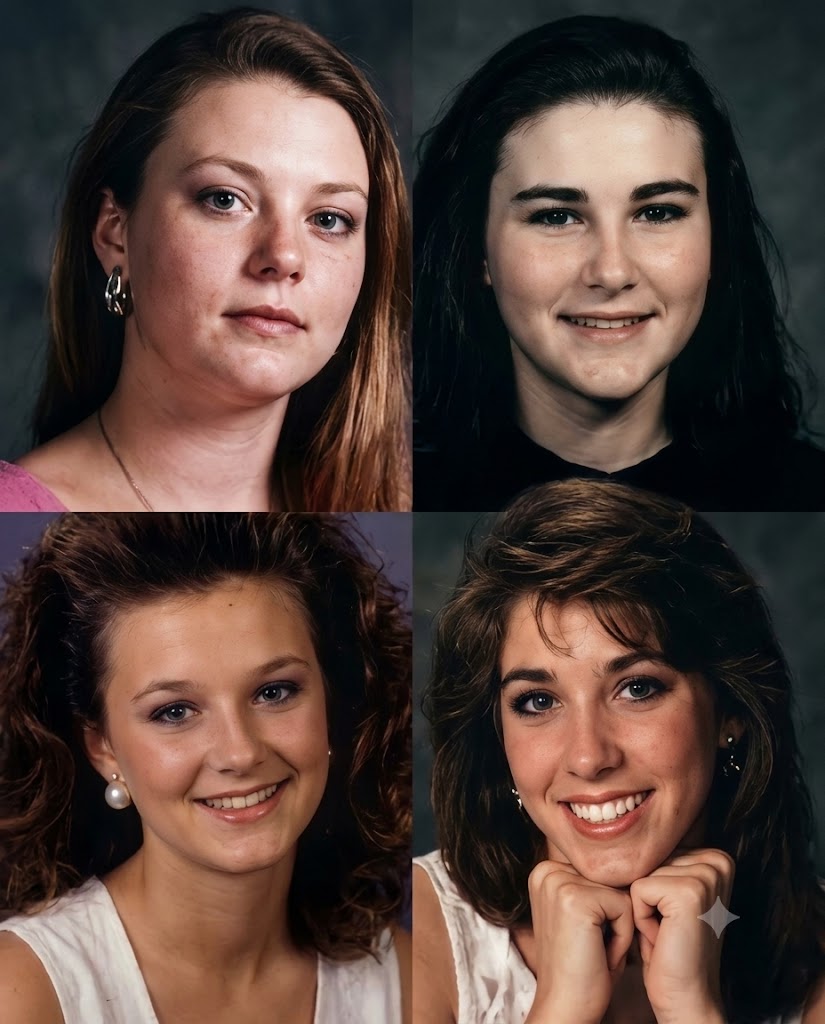
**PART 1**
The fire was the first thing that lied.
It climbed through the front windows of a frozen yogurt shop in a strip mall off West Anderson Lane, orange and hungry, and it told everyone who saw it that the story began there—with flames.
But flames are just a cleanup crew.
They cover what came before.
The patrol officer rolling down West Anderson Lane that Friday night in December 1991 saw the glow and called it in, and by the time fire crews knocked the blaze down and pushed through to the back storage room, the smoke was still thick and the floor was black with water.
Four teenage girls lay on that floor.
All four had been bound with their own clothing.
All four had been shot in the head.
At least three had been sexually assaulted.
The shop had been doused with lighter fluid and set on fire—not as an afterthought, not as panic, but as a deliberate act to burn away every piece of evidence in that room.
It mostly worked.
Then the sprinkler system kicked in and soaked what the flames hadn’t reached, and between the fire and the water, the crime scene was gutted.
Fingerprints, fibers, trace evidence—gone before a single investigator could process the room.
But one thing survived.
From beneath the fingernails of the youngest girl, a thirteen-year-old, the medical examiner recovered skin cells that did not belong to her.
She had fought her attacker hard enough to scratch him and trap his DNA under her nails.
In 1991, the technology to read that DNA did not exist.
It was sealed, logged, and placed into evidence storage.
It stayed there for thirty-four years.
Her name was Amy Ayers.
She was thirteen years old.
She had gone to the shop that Friday night for one reason—to wait for a ride home with her friend’s older sister when the closing shift ended.
That detail matters.
Hold onto it.
Because everything that happened inside that building started with an ordinary Friday night in Austin, Texas, the kind of night where four girls were supposed to end up in a car with the radio on, arguing about what song to play next.
Instead, a killer walked in.
And one of those girls, the youngest one, did something that would matter more than anything else in the entire investigation.
She scratched him.
She trapped his DNA under her nails and held onto it.
She couldn’t have known it would take thirty-four years.
She couldn’t have known that the technology to read her evidence wouldn’t exist until long after her family had aged out of grief and into something harder—a permanent ache.
She just fought.
And that fight became the thread that finally pulled a name out of the dark.
But before we get to the name, we have to understand how many times the answer was almost found, how many innocent men were sent away instead, and why it took a single detective pulling a dusty file off a shelf in 2022 to finish what a thirteen-year-old girl started with her hands.
This is the story of the Austin yogurt shop murders.
And it is a story about how the truth can be buried—not just by fire and water, but by a system that convinced itself it already knew the answer.
—
Jennifer Harbison and Eliza Thomas were both seventeen.
They worked together at I Can’t Believe It’s Yogurt, a frozen yogurt shop in a strip mall off West Anderson Lane on the north side of Austin.
Jennifer ran the closing shift on Friday nights.
Eliza worked it with her.
It was a part-time job, the kind high schoolers in Austin picked up in 1991 to make some money on the weekend—gas money, maybe, or cash for a movie and a burger.
Jennifer’s younger sister Sarah, fifteen, and Sarah’s friend Amy Ayers, thirteen, had come to the shop that evening.
They were not working.
They were waiting for the shift to end so Jennifer could drive them home.
On the evening of Friday, December 6th, 1991, the shop ran its normal hours.
Customers came and went.
The shop closed at 11:00 p.m.
Jennifer locked the front door and started the closing routine—wiping down counters, cleaning the machines, the same checklist she ran every Friday night.
Eliza worked alongside her.
Sarah and Amy sat in the shop waiting for the ride home.
None of them made it out.
By midnight, the building was on fire.
A patrol officer driving down West Anderson Lane saw the flames through the front windows and called it in.
When fire crews knocked the blaze down and pushed through to the back room, they found all four girls on the floor.
John Jones caught the call.
He was a veteran of Austin homicide, years on the unit, and nothing in his career had prepared him for what was in the back of that building.
Four teenage girls on the floor of a storage room, smoke still in the air, everything black and wet.
He would later describe the scene in two words: wholesale carnage.
All four had been taken from the front of the shop to the back.
They had been made to undress.
Their own clothing was used to bind and gag them.
Each one had been shot in the head with a .22 caliber handgun.
Amy had also been shot with a .380 caliber pistol, struck with a cash register, and strangled before the gunshots.
At least three of the four had been sexually assaulted.
The medical examiner documented everything.
After the killings, the shop was set on fire.
Lighter fluid was poured over paper plates, cardboard cups, the surrounding area, and the bodies.
It was not accidental.
It was not an afterthought.
The fire was set to destroy every trace of what had happened in that room.
It nearly did.
The sprinkler system kicked in during the blaze and soaked what the flames had not already consumed.
Between the fire and the water, the crime scene was gutted.
Fingerprints, fibers, trace evidence—nearly all of it was gone before a single investigator could process the room.
Jones’s partner, Mike Huckabay, made a call that night that would matter thirty-four years later.
In 1991, homicide detectives typically processed their own crime scenes.
Huckabay pushed to bring in the DPS crime lab instead.
It slowed things down.
Not everyone agreed with it.
But the lab technicians worked through what was left methodically, cataloging every piece of evidence the fire and the water had not reached.
Two things came out of that room.
A single spent .380 shell casing found inside a floor drain where it had rolled before the flames could reach it.
And skin cells recovered from beneath Amy Ayers’ fingernails during the autopsy.
She had clawed at her attacker hard enough to pull his DNA from his body and trap it under her nails.
Her right hand held the evidence the fire had tried to erase.
A back door to the building was found unlocked.
Every other entrance was secure.
The killer had walked out through the rear of the building and into the dark.
He left no weapon behind.
He left no prints the fire had not already destroyed.
He left nothing except what a thirteen-year-old girl had taken from him with her hands.
That shell casing went into evidence storage.
Those skin cells went into a lab file.
And Austin, Texas, spent the next three decades trying to figure out who had walked through that back door.
The answer, when it finally came, would not be a name anyone in that city had ever spoken in connection with the case.
But we’re getting ahead of ourselves.
—
In 1991, Austin was still a small city, under half a million people.
A state capital built around a university.
The kind of place where a Friday night closing shift at a yogurt shop was not something a parent would think twice about.
Four teenagers murdered in a strip mall changed that overnight.
The mayor would say years later that it haunted Austin’s soul.
The murders dominated the news for months.
Thousands of tips hit the department in the first weeks.
A task force was pulled together.
Detectives fanned out across the north side of Austin and worked every lead that came in.
None of it produced a suspect.
In the months and years that followed, the confessions started.
More than fifty of them over the course of the investigation.
Some were inmates trying to trade a story for a lighter sentence.
Some were people who wanted the attention.
Some were people who had no business being in an interrogation room at all.
Every single one was checked.
Every single one fell apart.
Jones was the wall they hit.
Every time a detective brought him a confession, his response was the same.
“Show me the evidence. Show me the weapon. Show me the DNA match.”
He would not close this case on someone’s word alone.
If the physical evidence from that back room did not connect to the person sitting across the table, the confession meant nothing to him.
That position put him on the wrong side of the department.
He was pulled off homicide because of it.
But none of the confessions he rejected ever held up.
Not one could be linked to anything recovered from the scene.
The investigation chased leads in every direction.
Mexican authorities arrested two men on a confession that crumbled within weeks.
Kenneth McDuff, a serial killer active in Central Texas at the time who was known for going after young women, was looked at closely and ruled out.
When McDuff was executed in 1998, he claimed the yogurt shop killings were his.
They were not.
Year after year, the same pattern.
A name emerges, resources pour in, the trail leads nowhere.
The city kept thinking the answer was close.
It never was.
Within a week of the murders, Maurice Pierce, fifteen years old, had been picked up at Northcross Mall with a .22 caliber revolver.
Same caliber as one of the weapons from the crime scene.
Under questioning, he gave detectives a name—Forest Wellborn—and said Wellborn had used the gun in the yogurt shop.
From Wellborn, the thread led to Robert Springsteen and Michael Scott.
All four were teenagers in 1991, all part of the same circle.
Jones talked to Pierce the following day and saw that what he described did not match the physical reality of the crime scene.
The ballistics on the .22 were inconclusive.
Jones set it aside.
The rest of the department did not.
By the end of the 1990s, the investigation had stalled completely.
The evidence was boxed up.
The DNA profile from Amy’s fingernails was locked in a lab file, useless without technology that had not been built yet.
Jones was no longer working homicide.
The file collected dust.
In 1999, a new task force was assembled and went back to the beginning.
They landed on the same four names Jones had already walked away from: Pierce, Wellborn, Springsteen, Scott.
All were in their mid-twenties by now.
Springsteen and Scott were brought in and questioned over multiple days.
Scott sat in an interrogation room for more than twelve hours.
Significant portions of those sessions were not recorded.
There is no record of what was said to either man during those windows.
Their accounts did not line up.
They disagreed on who was where, who held what weapon, what happened in what order.
But under enough pressure and enough hours, both eventually gave statements that pointed at each other and at themselves.
The DNA from the crime scene did not belong to any of the four.
The prosecution told the jury that fact openly and then told them to disregard it.
The biological material came from an unrelated source, they argued.
It had nothing to do with the murders.
The jury believed them.
Springsteen was convicted of capital murder.
He was twenty-five when a jury decided he should be executed.
Scott was convicted and sentenced to spend the rest of his life in prison.
He had a three-year-old daughter at home.
Pierce was held in county lockup for three years waiting for his case to move forward.
Three years in a cell without ever being convicted of anything.
Wellborn was charged, but two separate grand juries reviewed the evidence and would not indict.
Austin exhaled.
The case was closed, except it was not.
Not a single piece of physical evidence placed any of the four men inside that yogurt shop on the night of December 6th, 1991.
No prints, no weapon, no witness.
The convictions rested entirely on statements extracted in rooms where the cameras were off.
And the DNA—the one biological trace that had outlasted the fire and the water—belonged to someone who was not in any of those rooms.
Barbara Wilson, Jennifer and Sarah’s mother, had lost both of her daughters that night.
She said afterward that she only ever wanted one thing from this case: the truth.
When more advanced testing was conducted years later, the results confirmed what the earlier analysis had already indicated.
Every piece of biological evidence from the crime scene traced back to one male.
He was not Springsteen.
He was not Scott.
He was not Pierce.
He was not Wellborn.
His genetic profile did not exist in any law enforcement database in the United States.
The Court of Criminal Appeals in Texas reversed both convictions.
Springsteen and Scott were released in 2009.
They had spent close to a decade locked up, but being released did not mean being cleared.
The charges were dropped without any public declaration that these men had done nothing wrong.
The accusation was still attached to their names.
Wellborn could not find steady work.
He lost people close to him.
There was a period where he had nowhere to live.
Scott’s family broke apart.
His daughter spent her childhood with her father behind bars.
Springsteen lived on death row before his release.
He said that even on the outside, he woke up every morning being seen as something he was not.
Pierce was never given the chance to rebuild.
On December 23rd, 2010, he was stopped for a traffic violation in Austin.
He ran.
When an officer caught him, Pierce pulled the officer’s own knife from his belt and stabbed him in the neck.
The officer survived.
Pierce was shot and killed.
He was thirty years old.
After the convictions were thrown out, the case went cold for a second time.
The DNA profile from Amy’s fingernails was now complete.
A full genetic fingerprint of the man who had been in that room.
But it sat in a database that could only return matches against people who had been arrested or convicted.
This man had never entered any system anywhere.
He was invisible to every tool investigators had.
The original detectives retired or transferred.
New investigators inherited the file, read through the reports, and reached the same conclusion every time.
Every actionable lead had been exhausted years ago.
The families wore buttons that read, “We will not forget.”
They had been made by the victims’ parents in the weeks after the murders.
They were still wearing them decades later.
Shawn Ayers, Amy’s brother, was nineteen the night she was killed.
He said there was a stretch where he lost his faith completely.
His wife Angie had known about the yogurt shop case since she was a teenager, years before she ever knew Shawn.
They kept pushing.
In 2022, Dan Jackson was assigned to Austin PD’s cold case unit.
On his first day, his supervisor pulled him aside and gave him the file.
The yogurt shop murders.
No one had put active work into the case since the convictions had collapsed.
Jackson read the file cover to cover.
Then he read it again.
He pulled the evidence log and started making calls.
The shell casing was still there.
The DNA was still there.
Everything was still there, waiting.
It had been waiting for thirty-one years by then.
It would have to wait a little longer.
—
**PART 2**
Dan Jackson was not a man who believed in miracles.
He believed in evidence logs, chain of custody, and the stubborn refusal of physical objects to lie.
So when he pulled the .380 shell casing from evidence storage in June 2025—the one that had landed in the floor drain, the one the fire never touched—he was not expecting a miracle.
He was expecting a clean result or no result.
The casing had been run before, more than once, and had come back clean every time.
He submitted it to a federal ballistics database anyway.
This time the system flagged a match.
A casing from an unsolved 1998 killing in Lexington, Kentucky.
The same gun had been fired at both scenes.
Two crimes, two states, seven years apart.
Jackson stared at the screen for a long moment.
Then he picked up the phone.
He pursued the DNA at the same time.
He sent the male genetic profile from the Austin scene to forensic laboratories across the country and asked each one to manually compare it against their holdings.
Lab after lab came back empty.
The South Carolina state lab did not.
It returned a complete match.
The Austin profile aligned with DNA from a 1990 sexual assault and homicide in Greenville.
A case that had been closed years earlier.
Two lines of evidence, developed independently through different systems, from different parts of the country, had arrived at the same individual.
The Greenville case had been closed in 2018.
Genevieve Zutricky, twenty-eight, sexually assaulted and strangled with a pair of pantyhose inside her own apartment in 1990.
Her killer had moved her body into the bathtub and left a message scrawled on the bathroom mirror.
The case had gone nowhere for almost three decades until genetic genealogist Cici Moore, working with Parabon NanoLabs, traced the DNA to one man.
His body was exhumed from a cemetery in Arkansas.
The bones were a match.
His name was Robert Eugene Brashers.
Born March 13th, 1958, in Virginia.
Raised in Alabama.
He had spent most of his adult life drifting through the South and Midwest, picking up construction jobs and day labor, never staying anywhere long.
His first known violent crime was in Florida in 1985.
He broke into a woman’s home and shot her in the neck during an attempted sexual assault.
She was twenty-four.
She survived and got away from him.
He was convicted and sentenced to twelve years.
He was out in just over three.
By May 1989, he was paroled.
Within a year, Zutricky was dead in Greenville.
Brashers had been living less than a mile from her apartment on Pelham Road.
Once investigators started pulling the thread, the trail extended across state lines and the better part of a decade.
A fourteen-year-old girl sexually assaulted in Memphis in 1997 after a man carrying a revolver forced his way into her home and restrained four people.
In March 1998, a mother and daughter in Portageville, Missouri—Sherry Sherer, thirty-eight, and Megan Sherer, twelve—both restrained.
The girl sexually assaulted.
Both shot to death with a .22.
Barely two hours later, the same night, the man crossed into Dyersburg, Tennessee, and broke into another home.
That woman fought back.
He put a bullet in her arm and fled.
Later that year, a forty-three-year-old woman was found dead inside a business in Lexington, Kentucky.
The building had been set on fire after she was killed.
Eight murders minimum.
Four states.
The pattern never changed.
Forced entry, restraints made from whatever he could find, sexual assault, a gun.
He never returned to the same area.
Every crime sat in a separate jurisdiction under a separate set of detectives working a separate file.
Not one of them was linked to another while he was still alive.
Investigators searching his belongings found police scanners, lock picking equipment, and false IDs.
He had built a system for doing what he did and disappearing before the pieces came together.
Then Jackson found one more entry in the file.
December 8th, 1991.
Two days after the yogurt shop murders.
Brashers was driving a pickup truck stolen out of Marietta, Georgia, westbound through the desert on Interstate 10.
He was stopped at a border patrol checkpoint in West Texas.
On him was a .380 caliber AMT backup pistol.
Same make and model as the weapon used to shoot Amy Ayers.
He was booked on the stolen vehicle charge.
The pistol was seized by federal authorities.
Nobody ran the ballistics against any open case.
No system existed in 1991 that would have connected a drifter in the West Texas desert to four dead girls in a strip mall five hundred miles behind him.
The gun was eventually released to Brashers’ father.
Jackson closed the file and sat back in his chair.
He had a name.
He had a weapon.
He had a timeline that put Brashers two days and five hundred miles from the crime scene with the same caliber gun on him.
What he did not have was a living suspect.
Robert Eugene Brashers had been dead for twenty-six years.
—
On January 13th, 1999, police responded to a stolen vehicle report at a Super 8 Motel in Kennett, Missouri.
They found Brashers underneath a bed with a loaded firearm.
He fired at the officers.
Then he took his wife and three children and sealed the room.
Negotiators talked to him for four hours.
Eventually, he released his family, placed the gun against his own head, and fired.
He died six days later in a hospital.
He was forty years old.
The weapon was traced by serial number.
It was the same .380 that had been taken from him at the checkpoint two days after the Austin murders and given back to his father.
He had been carrying it the entire time.
Nobody at that motel had any idea they were dealing with a man connected to at least eight killings across four states.
He died looking like a man at the end of a bad road.
Nothing more.
Nine months after Brashers was buried, the Austin Task Force charged Maurice Pierce, Robert Springsteen, Michael Scott, and Forrest Wellborn with capital murder.
The man who had actually done it was already underground.
Jackson ordered the final test.
The DNA preserved from beneath Amy Ayers’ fingernails—the same sample the medical examiner had recovered in December 1991—was compared directly against Brashers’ known profile.
The result came back at a likelihood ratio of 2.5 million to 1.
It was him.
What a thirteen-year-old girl had clawed from her attacker’s body and held under her nails in the last minutes of her life had been waiting in a lab for thirty-four years to say his name.
Jackson read the report three times.
Then he called the families.
—
On September 29th, 2025, the Austin Police Department held a press conference at City Hall.
Jackson addressed the families directly.
He told them the identification of Brashers could not have happened any earlier.
The technology and the cross-jurisdictional connections simply did not exist until now.
Then he said what the evidence had proven.
“Amy’s final moments on this earth were to solve this case for us. It is because of her fighting back.”
Jones was in the room.
The detective who had refused to accept confessions without evidence.
The one who had been removed from homicide for holding that line.
He had been right for thirty-four years.
Amy’s father, Bob, stepped forward and pinned something onto Jackson’s lapel.
One of the original “We will not forget” buttons.
The victims’ families had made them in the weeks after the murders.
Thirty-four years later, they were still carrying them.
Bob Ayers didn’t say anything.
He didn’t have to.
The button said it for him.
—
**PART 3**
The exoneration hearing was held on February 19th, 2026, at the Blackwell Thurman Criminal Justice Center in Travis County.
Every seat in the courtroom was taken.
Assistant District Attorney Trudy Strasburger addressed the judge first.
She said the science and the confessions could not both be true.
That Robert Eugene Brashers alone was responsible for the yogurt shop murders.
That the wrongful prosecutions had left the defendants screaming into the wind for decades.
She said it was now the state’s turn to accept responsibility.
DA Jose Garza faced the men and their families directly.
He told them they were innocent.
He apologized for everything the system had done to them.
Judge Dana Blazy issued the ruling.
She declared all four men actually innocent.
She said the decision was not generosity.
It was an obligation to the truth, to the rule of law, and to the dignity of the individual.
Scott and Wellborn were in the courtroom.
Scott stood and addressed the judge.
He said he had carried the weight of a wrongful conviction every day of his life.
That no ruling could return what had been taken from him.
But it could acknowledge what was true.
He is not guilty.
Springsteen was not there.
He could not go back inside a courtroom.
His attorney spoke for him and said it was a miracle they were standing in that room at all.
A miracle that had come too late for Maurice Pierce.
Pierce was gone.
He had been dead for sixteen years.
His daughter Maurice was in the courtroom in his place.
His wife Kim sat beside her.
Maurice told the court that her father had never been heard.
That nobody had believed him.
That the tunnel vision of police and prosecutors had taken his dignity from him when he was still a boy.
Then she spoke to him directly.
“Daddy, you have your name back. The world finally hears what you were trying to say all along.”
The courtroom was silent.
Then it wasn’t.
—
In May 2026, the city of Austin agreed to pay a thirty-five million dollar settlement to Springsteen, Scott, Wellborn, and Pierce’s family.
The city manager called it the closing of the final chapter.
But chapters don’t close just because someone says they do.
The families of the four girls had waited thirty-four years for an answer.
They got one.
It came in the form of a name they had never heard, attached to a man who had been dead for more than half of that time.
It came because a thirteen-year-old girl fought back.
It came because a detective in 1991 refused to close a case on a confession without evidence, and because another detective in 2022 pulled a dusty file off a shelf and decided to try again.
It came because the truth, once it is written into the fabric of a thing—into skin cells under a fingernail, into a shell casing in a floor drain—does not go away.
It waits.
On the night of December 6th, 1991, four girls were inside a frozen yogurt shop on West Anderson Lane.
Two were finishing a closing shift.
Two were waiting for a ride home.
The youngest was thirteen.
Her family always said she was a fighter.
When a man came into that building and tried to take everything, she fought hard enough to leave his DNA under her fingernails.
That evidence outlasted the fire.
It outlasted the water.
It outlasted thirty-four years of wrong answers and wasted time and innocent men sent to prison for something they did not do.
It was the last thing she did.
And it is the reason they know his name.
—
The “We will not forget” buttons are still out there.
Some are in drawers now.
Some are pinned to bulletin boards in family homes.
Some were worn to courtrooms and press conferences and graveside services.
Bob Ayers gave one to Dan Jackson on the day the case was finally solved.
Jackson wears it sometimes.
Not because he needs to remember.
Because he wants to.
There is a difference.
Amy Ayers fought for her life in a storage room behind a frozen yogurt shop in 1991.
She lost that fight.
But she won something else.
She won the long game.
She won the one that took thirty-four years and a technology that didn’t exist yet and a detective who wouldn’t let go.
She won because she scratched him.
And because someone, eventually, looked.
The fire tried to erase her.
The water tried to wash her away.
The system tried to replace her truth with a convenient lie.
None of it worked.
She was thirteen years old.
She was a fighter.
And she is the reason the world finally knows the name Robert Eugene Brashers.
He died thinking he had gotten away with it.
He was wrong.
He was wrong for thirty-four years.
And then a girl with long nails and a stubborn heart proved it.









