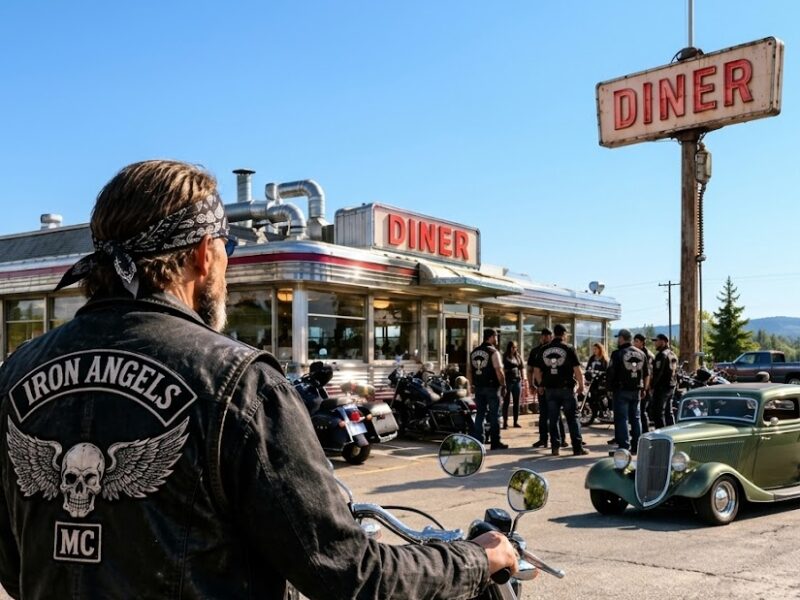
For years, one small diner welcomed bikers when no one else would. Then one night, everything changed — and what happened next left an entire brotherhood in tears.
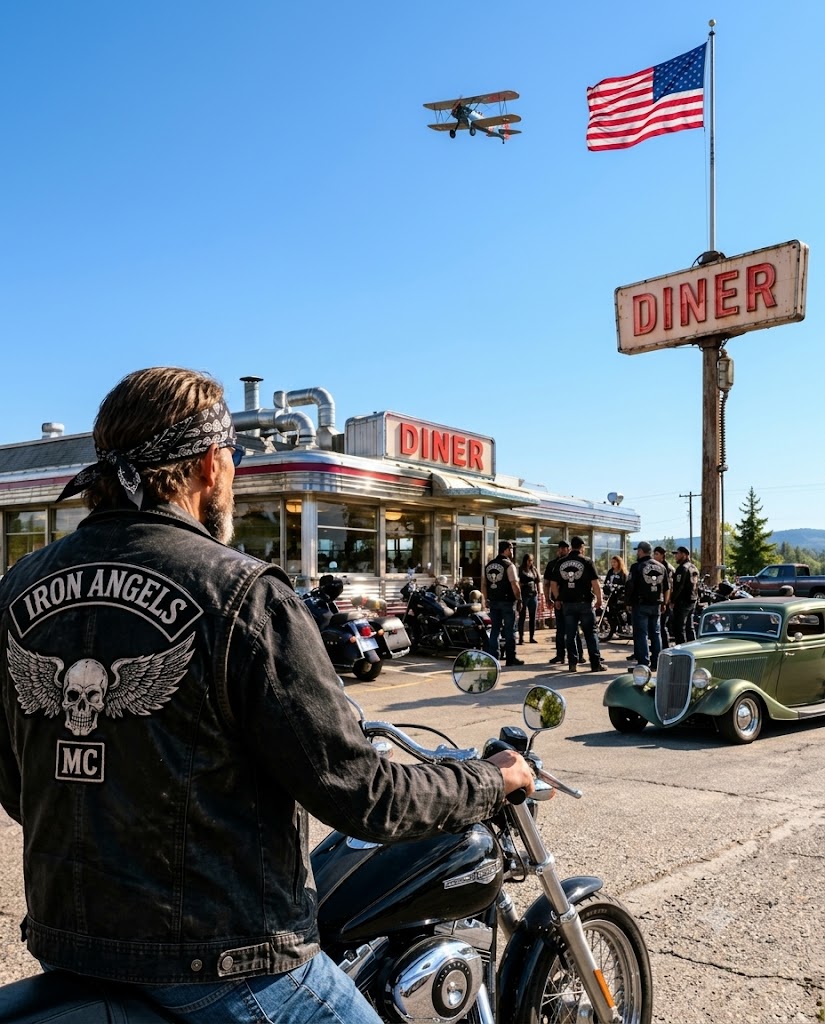
For 20 years, the Iron Creek riders assumed they knew why the Silver Spur closed.
Ellie had wanted them gone.
That was the story they carried.
Forty men on motorcycles, and not one of them ever went back to ask if it was true.
Then Doc got a letter and an old cash box turned up under a floorboard in the storage room.
And the story they’d been telling themselves for two decades turned out to be wrong in almost every detail, including the part about who was actually to blame.
The highway outside Mil Haven, Missouri, looks different in the early morning.
The sky is still purple at the edges, that soft Missouri dawn that makes everything look like it’s been rinsed clean overnight.
The old two-lane road runs straight through town the way it always has.
Past the closed movie theater with its marquee still advertising a film from 2003, past the hardware store with the faded awning that Maya Reed had been meaning to replace for six years, past the volunteer fire station where somebody has already turned the lights on inside.
And then at the far end of town, just before the road bends south toward the bypass that eventually killed most of what used to matter out here, there it is.
The Silver Spur.
Low and wide, turquoise paint gone pale like old denim, chrome trim around the windows that caught the morning light and threw it back in soft flashes, a long parking lot with weeds growing through the cracks in the asphalt, a neon sign that hadn’t worked in 20 years.
The demolition machine sitting in the lot is not small.
It came in overnight on a flatbed truck, yellow and angular and patient, the kind of machine that doesn’t care about memories or history or the way a place used to feel on a Friday night.
By the afternoon, the schedule says most of this building will be rubble.
That was the schedule.
Then the sound starts.
Not loud at first, more like a vibration underneath the quiet, something you feel in your chest before your ears catch up.
Then it grows.
Then it turns into something you can feel before you can properly hear it, a low rumble that rolls down Main Street like thunder that forgot to bring the storm.
One motorcycle rolls past the old theater.
Then three more behind it, then a dozen, then so many that the sound fills the whole street and doesn’t stop.
Forty motorcycles turn into the Silver Spur parking lot at 6:45 in the morning and roll to a stop in a long quiet line.
The riders don’t immediately get off.
They sit there, engines cooling, ticking as the metal contracts, looking at the building.
The man at the front removes his helmet slowly.
Sixty-seven years old, gray at the temples, a face that looks like it has made a lot of decisions and regretted approximately half of them.
His name is Jack Hollis, though everyone who has known him for more than 10 minutes calls him Hawk.
He stares at the Silver Spur for a long moment.
Then he says quietly to nobody in particular, “Twenty years is a long time to stay away.”
Behind him, an older man climbs off a black motorcycle with some difficulty.
Seventy-one, white beard moving like his knees gave him a firm opinion this morning and he ignored it.
Frank Mercer, though everyone who knows him just calls him Doc.
He looks at the diner the way you look at a place you spent years trying not to think about.
He says almost to himself, “We shouldn’t have waited this long.”
Before we talk about why they came back, you have to understand what this place was.
The Silver Spur opened in 1968.
Eleanor Dawson and her husband Raymond ran it together for nearly 30 years through gas shortages and factory layoffs and three different highway projects and every kind of winter Missouri could produce.
Ellie knew every regular by name.
She knew what they took in their coffee before they sat down.
She remembered birthdays and anniversaries and the names of people’s kids, even the ones who only came in twice a year.
Raymond handled the kitchen.
Ellie handled everything else, which was most of it.
On Friday nights, the back corner of the Silver Spur belonged to the Iron Creek riders.
They weren’t famous.
They weren’t dangerous.
They were mechanics and truck drivers and factory workers and a couple of retired postal workers who had bought motorcycles because somebody told them it would be liberating.
And it turned out that was mostly true.
They filled the back booths.
They were loud and they ordered a lot of coffee and they stayed late.
And Ellie never once asked them to keep it down or leave earlier.
Raymond would come out from the kitchen sometimes and sit with them for 20 minutes, wiping his hands on his apron, talking about nothing in particular.
Doc used to say that the Silver Spur was the only place in Mil Haven where it didn’t matter what you looked like when you walked in.
You were getting coffee and you were getting treated like a regular human being.
And that was the whole policy.
Bear Tommy Wilks, the largest of the Iron Creek riders and also somehow the most easily embarrassed, once knocked over an entire display of pie slices reaching across the counter for the sugar.
Ellie never charged him for the pie.
She just handed him a mop and watched him go red.
It was that kind of place.
The good Friday nights, Hawk used to say, you’d look around the diner at 10:00 and think, this is what a town is supposed to feel like.
Then one winter evening, the Silver Spur closed.
No announcement, no final night special, no sign in the window.
Ellie simply didn’t open the door the next morning.
The town waited a week, then two, then a month.
People called, nobody answered.
Eventually, the word spread that it was over.
And for 20 years, nobody knew why.
The morning the bikers returned, a woman named Maya Reed was already at the hardware store across the street with the lights on.
Maya had grown up in Mil Haven.
Her father had been a Silver Spur regular.
She remembered sitting in the booth near the jukebox as a child doing her homework while her dad and his friends talked about whatever it was men in their 40s talked about in the mid-’90s.
She didn’t care what they were saying.
She just liked the noise of it, the sound of people being comfortable somewhere.
She was standing at her front window when 40 motorcycles pulled into the old diner parking lot and didn’t leave.
She watched for about three minutes.
Then she locked the store and walked across the street.
Hawk was standing near the entrance when she arrived.
Maya Reed is not a person who approaches a conversation from the side.
She looked at the motorcycles and she looked at Hawk and she said, “Forty men don’t ride into an empty parking lot at 6:00 in the morning without a reason.”
Hawk said, “No, they don’t.”
“So what’s the reason?”
Hawk considered her for a moment.
“Somebody asked us to come back.”
“Who?”
He didn’t answer that.
Maya looked at the demolition machine, then at the diner, then back at Hawk.
“The property was sold eight months ago,” she said.
“The owner filed for demolition permits in the spring.”
“This building comes down today unless something changes.”
Hawk nodded like this was information he already had.
“Then we better get inside,” he said.
Inside, the diner smelled like 20 years of closed windows.
Dust on everything.
A crack in the ceiling where water had come in during some old storm.
The red vinyl booths were still there, cracked and faded now.
The long counter still ran the length of the room.
The jukebox sat in the far corner, covered in a layer of grime that made it look like something archaeologists would catalog.
The bikers spread through the old space quietly, which is strange if you’ve never seen 40 motorcycle riders do something quietly, but they did.
Bear sat down in the back corner booth and didn’t say a word.
Patch Ray Dalton, 62, mustache like a country singer from 1979, ran one finger along the counter and looked at the dust on his fingertip like it meant something.
Eddie Morrison found the old pie case and stood in front of it for a while.
Doc walked slowly toward the booth that had been his booth for 15 years.
He sat down.
He reached under the table.
His expression changed.
Hawk noticed.
“Doc, I told you I’d explain when we got here.”
“Explain what? We’re here.”
Doc looked up at him.
“Not quite.”
He stood and moved toward the kitchen.
Hawk followed him.
The storage room was behind the kitchen, past the walk-in that hadn’t been cold in two decades, past a metal shelf still holding a stack of old menus.
Doc moved through the dark like he knew exactly where he was going.
He did know exactly where he was going.
He stopped at a section of floor near the far wall.
Boxes stacked on top.
Christmas decorations from what appeared to be multiple separate decades.
A rusted coffee machine that must have died in service.
Doc moved the boxes aside.
He found a loose floorboard.
He pulled it up.
Underneath was an old blue metal cash box.
Hawk stared at it.
He said, “How did you know that was there?”
Doc picked up the cash box.
He didn’t answer.
He carried it out to the counter and set it down.
He opened it.
Inside was a photograph of the Iron Creek riders.
Old photograph, back when the diner was open.
Back when everyone’s hair was a different color, everyone grinning.
The usual booth.
The usual mess of coffee cups.
At the edge of the photograph, barely in the frame, was a teenage boy.
There was also a diner receipt, a brass key, a handwritten note.
Hawk picked up the note.
One sentence in handwriting he recognized.
If you boys ever come back, you’ll finally understand why I had to close the doors.
He read it twice.
Then he looked at Doc.
“She left this here for us.”
“She left it for me,” Doc said.
“She knew I’d know where to look.”
Hawk picked up the photograph again.
He looked at the boy at the edge of the frame.
Seventeen or so, dark hair, uncomfortable smile like someone had just told him to stop moving right before the shutter.
“That’s Ellie’s nephew,” Hawk said.
Doc said, “Yeah.”
“What happened, Doc?”
Doc pulled up a counter stool.
He sat down heavily and looked at the cash box for a long time.
He said, “Caleb took something that wasn’t his.”
To understand what happened, you have to go back to a particular night in early winter.
The Silver Spur had been closed for three hours.
Ellie and Raymond had gone home.
The kitchen was dark.
Caleb Dawson was 17 years old and he was making the worst decision of his life.
His mother was three months behind on the mortgage.
The factory where his uncle worked had cut 40% of the floor workers the previous spring and the ripple from that one decision had been moving through the neighborhood ever since.
Invisible but steady, like a crack spreading through pavement.
Caleb didn’t know how to fix any of that.
He was 17.
He knew the register code because he’d helped close up twice before.
He knew where Ellie kept the day’s take before it went to the bank.
He wasn’t a bad kid.
That’s the thing Doc always came back to afterward.
He wasn’t a bad kid at all.
He had a key.
He let himself in.
He went to the register and Doc was already in the parking lot.
Doc had forgotten his jacket.
He was halfway home when he realized.
He came back, unlocked the side door, walked through the kitchen.
He found Caleb standing at the register with his hand in it.
The silence in that room, Doc said later, was the loudest silence of his life.
Caleb didn’t run.
He didn’t make an excuse.
He just looked at Doc like a person who had already accepted whatever was coming.
Doc asked him what he was doing.
Caleb told him.
Not a practiced story, not an excuse, just the truth.
His mother, the house, the number he had been looking at on the kitchen table every night for two months.
Doc stood there for a very long time.
He made a decision that he would spend 20 years trying to evaluate.
He told Caleb to put the money back.
Caleb put the money back.
Doc told him to go home.
Caleb went home.
Doc locked the diner behind him and drove away and said nothing to anyone.
The problem was that Ellie already knew something was wrong with the register count.
She had noticed a discrepancy earlier that evening.
She had chalked it up to a calculation error, but something in her didn’t sit right with it.
She came back the next morning and went through the numbers again.
Then she called someone who knew Caleb’s family.
Then she made a few careful inquiries.
Then she understood exactly what had happened.
She didn’t call the police.
She didn’t call Caleb’s mother.
She called Caleb.
She asked him to come to the diner.
He came in looking like he hadn’t slept.
She poured him coffee and sat across from him and said, “I know what happened.”
He didn’t deny it.
She looked at him for a while.
Then she said, “I’m not letting one stupid night decide who you become.”
Caleb began crying at the counter of the Silver Spur, and Ellie sat there and let him.
Then she told him to go home.
She locked the diner.
She didn’t open it the next morning.
She didn’t open it ever again.
The town assumed the business had failed.
The Silver Spur had been struggling since the bypass took the highway traffic.
Raymond had died the previous spring after a long illness that had drained more than just his energy.
It was easy to look at the closed doors and conclude the math had simply caught up.
The Iron Creek riders assumed something else.
They assumed Ellie blamed them.
They had no evidence for this, but they were a loud group of men who occupied the back of a diner and sometimes stayed past last call and occasionally had friends who made bad impressions.
When a place closes suddenly and the owner doesn’t explain, people fill in the space with guilt.
Hawk spent months turning it over.
Bear asked around town and got nothing.
Doc said nothing.
For 20 years, Doc said nothing.
Outside the Silver Spur, the demolition foreman was checking his schedule.
He had a different job after this one, and the timing mattered.
Maya crossed the parking lot and intercepted him.
She wasn’t asking him to cancel.
She was buying time.
She had made a phone call the previous week about the property’s legal transfer status, and she had some thoughts about whether the paperwork was fully complete.
She wasn’t certain, but she was willing to make that uncertainty very apparent to the right people.
The foreman told her he had a schedule.
She said she had a lawyer’s phone number and a question about the chain of title.
They looked at each other.
The foreman said he’d give her until noon.
Inside, Hawk was on the phone.
He had a number he’d tracked down through three separate people over the previous two weeks.
He’d called it twice before and gotten no answer.
He tried it again.
This time, someone picked up.
A quiet voice. Male. Careful.
Hawk said, “Is this Caleb Dawson?”
A pause.
“Yeah.”
“My name’s Jack Hollis. I rode with the Iron Creek riders. I spent about 15 years eating dinner in your aunt’s diner.”
Another pause. Longer this time.
“I know who you are,” Caleb said.
“Then you probably know why I’m calling.”
The sound of a window or a door somewhere on Caleb’s end.
Then nothing.
Caleb said, “I can’t come back there.”
Hawk said, “Why not?”
“Because it’s not something I can fix.”
“Caleb,” Hawk said, “nobody’s asking you to fix it.”
He waited.
“Ellie’s coming today,” Hawk said.
“She asked for us to be here. I think she needs you to be here too.”
The line was quiet for a long time.
Then Caleb said, “She doesn’t want to see me.”
“Did she tell you that?”
Silence.
“Did she ever say that to you, Caleb?”
More silence.
“When did you last talk to her?”
Caleb said, “The day I left.”
“That was 20 years ago.”
“I know.”
Hawk said, “Then how do you know what she wants?”
Sam Carter, Wrench, the riders’ unofficial mechanic and the man most likely to say the thing nobody else is willing to say, came and found Hawk after the call.
Wrench said, “So Doc knew the whole time.”
Hawk said, “That’s what it looks like.”
“And he didn’t tell you.”
“No.”
Wrench considered this.
“I’m trying to think of the most polite way to describe that.”
“Don’t.”
“He let you spend 20 years thinking Ellie was mad at us.”
Hawk didn’t say anything.
“That seems like information a president of a motorcycle club might want to have.”
“Yeah, I’m just noting that.”
“I noticed you noting it.”
Wrench looked at the old counter.
“What are you going to do?”
Hawk said, “I’m going to wait for Doc to explain himself.”
Doc was sitting in his old booth.
He looked like a man waiting for something he’d been waiting for a long time.
Hawk sat down across from him.
Doc looked at the table.
He said, “I made a decision when that kid was 17 years old, and I have been living inside that decision ever since.”
Hawk said, “Walk me through it.”
Doc did.
All of it.
The jacket, the parking lot, the register, the drive home, the 20 years of saying nothing.
Hawk listened without interrupting.
When Doc finished, he said, “He was 17, Hawk. His family was losing their house. I made a bad call. I just didn’t know I’d still be carrying it 20 years later.”
Hawk looked at him for a long moment.
“You let Ellie carry it instead.”
Doc nodded.
“And you let all of us believe she blamed us.”
“I didn’t know that’s what you believed. I thought you knew she had personal reasons.”
“Nobody told us what the reasons were, Doc.”
Silence.
Hawk leaned back.
He looked at the diner around them, the cracked tile, the old booths, the jukebox nobody had played in 20 years.
He thought about something.
He thought about how many different people had been trying to protect someone in this story.
Ellie had tried to protect Caleb.
Doc had tried to protect Caleb.
Caleb had tried to protect Ellie in his own quiet way from a distance for years.
And the Iron Creek riders had spent 20 years protecting the memory of a place while not understanding why they’d lost it.
Everyone protecting something.
Nobody protecting the truth.
He said finally, “When Ellie gets here, you’re going to tell her yourself.”
Doc said, “Yeah. Everything.”
“Everything,” Doc said. “I know.”
Ellie Dawson arrived at 11:15.
She drove herself, a practical blue sedan that had been through its share of winters.
She parked at the edge of the lot away from the motorcycles and sat in the car for a minute before getting out.
She’s 78, slower than she was, still sharp, moves with the economy of someone who spent 30 years on her feet in a diner and learned not to waste a single step.
She stood outside the Silver Spur and looked at it.
Then she looked at the 40 motorcycles.
Something in her expression changed.
Not surprise exactly, more like recognition, like something she had imagined for a long time was finally in front of her.
She opened the door and walked in.
The bikers stopped what they were doing.
Bear stood up without quite meaning to.
Patch took off his bandana.
Even Wrench, who claimed to be unsentimental about most things, got unusually interested in the floor.
Ellie looked around the room.
She looked at the booths, at the counter, at the jukebox.
She said, “Still smells the same.”
Nobody was sure if that was good or bad.
Then Doc stood up.
They looked at each other.
Neither said anything for a moment.
Ellie said, “Frank.”
Doc said, “Ellie, I owe you something long overdue.”
She nodded slowly.
“Let’s sit down first.”
They sat at the counter.
Doc told her.
He told her everything he had already told Hawk.
She listened the way she had always listened to people, completely, without looking away.
When he finished, she was quiet for a while.
Then she said, “I already knew most of that.”
Doc blinked.
“I knew you’d caught him. Caleb told me eventually.”
She looked down at the counter.
“I never blamed you for what you decided. You were trying to give a kid a chance. I should have talked to you.”
“Yes,” she said. “You should have.”
Simple as that.
Hawk was standing near the kitchen door.
He said, “Ellie, what really happened? Why did you close?”
She looked at him.
She was quiet for a moment.
“Raymond died that spring,” she said.
“You know that.”
“We know that.”
“What you don’t know is that I almost closed after that. I kept going because the diner was the only thing keeping me going. And then Caleb—”
She shook her head.
“I wasn’t angry at him. I was just tired. I had nothing left. And I thought if I call the police, that boy’s life goes a certain direction. If I stay open, people find out anyway because people always find out. So I closed. I went to stay with my sister in Iowa. I thought I’d come back. I didn’t.”
Hawk said, “We thought you wanted us gone.”
Ellie looked at him.
“Why would I want you gone?”
“Because of Caleb. We thought maybe you—we thought the whole situation—”
She shook her head.
“You boys were half the reason I kept the lights on. You think I wanted to lose you, too?”
The room was very quiet.
Hawk said, “You never reached out.”
“Neither did you.”
That landed the way truths sometimes land.
Not like a blow exactly, more like something clicking into a position it should have been in years ago.
“I thought you were ashamed of me,” Ellie said, “for closing without explaining.”
Hawk looked at her.
“We were waiting for you to be ready.”
“I thought the silence meant you understood.”
“We didn’t understand anything.”
She nodded.
“I know that now.”
The demolition foreman knocked on the door at noon.
He came in, saw 41 bikers and one elderly woman sitting at an old counter, and looked like he genuinely did not know what to do with this situation.
Maya came in behind him.
She had been on the phone all morning.
She had also at some point in the past three hours gotten the hardware store’s community sign out and propped it in the Silver Spur parking lot facing the street.
Word travels fast in a town of 5,000 people.
Cars had been slowing down since 10:00.
By the time the foreman arrived, Maya had 19 people waiting in the parking lot with him, including four members of the town council, a pastor, two families who used to come to the Silver Spur for Sunday breakfast, and a retired school principal named Howard, who had been eating at the counter since 1974.
Maya walked to the center of the diner.
She said, “I want to make a proposal.”
Nobody stopped her.
“The property transfer isn’t finalized. The paperwork has issues. I’ve spoken to the owner’s representative and they are willing to discuss an alternative if we can demonstrate this building serves the community.”
Hawk said, “What alternative?”
“A community lease. The town takes responsibility for the building. We open three evenings a week. Simple menu. No debt. No speculation. No promises we can’t keep.”
Hawk looked at Ellie.
Ellie said, “I’m 78 years old. I can’t run a diner.”
“We’re not asking you to run it,” Maya said.
“We’re asking you to sit at the counter. The rest of us will figure out the running.”
Ellie looked at the counter.
She looked at the cracked tile, the old booths, the jukebox.
She looked at Hawk.
She said, “Does that jukebox still work?”
Wrench said, “It will.”
And that was more or less that.
What happened next was not organized.
Nobody gave instructions.
People simply started doing things.
Doc got behind the counter and found cleaning supplies in a closet.
Bear and two other riders moved boxes out of the storage room.
Patch discovered that the main lights still worked if you reset the breaker.
Wrench took the back panel off the jukebox and spent 45 minutes with his head inside it.
Three families from the parking lot came inside.
The retired principal organized people into cleaning teams.
The pastor’s wife, who turned out to have worked in commercial kitchens for 30 years, went into the back and assessed what could be salvaged.
Hawk found a toolbox and went to work on the neon sign.
The demolition foreman eventually went back to his truck.
He made some calls.
He drank the coffee that somebody gave him.
He looked out his windshield at a whole town cleaning an old diner.
He delayed the crew.
It was late afternoon when the door opened and Caleb Dawson walked in.
He had driven most of the night.
He looked it.
He stood in the doorway and looked at the diner, at the people cleaning it, at the bikers, at the old counter that somehow looked almost like itself again.
Then he saw Ellie.
She was sitting on a stool at the end of the counter, watching the activity, drinking something warm from a paper cup somebody had brought from the gas station up the road.
Caleb walked toward her.
He stopped a few feet away.
He said, “I’m sorry.”
She looked at him for a long moment.
She said, “I know.”
He looked like he might be 17 again for just a second.
He said, “I’ve been sending you—”
“I know.”
She said, “I thought it was the least—”
“Caleb,” she stopped him.
“I didn’t want the money.”
He was quiet.
“I wanted you to come home,” she said.
“That’s it. That’s the whole thing. I wanted you to stop being ashamed of what you did when you were 17 years old.”
He stood there.
She said, “Sit down.”
He sat down.
She looked at the room.
She said, “I closed this place because I was exhausted. Not because of you. Because of everything. Raymond, and the highway, and the money, and all of it. You were just the last piece of a very heavy stack.”
Caleb nodded.
“But I never told you that,” she said.
“And that wasn’t fair.”
Hawk was standing by the window with a wrench in his hand.
He watched Ellie and Caleb at the counter, and he thought about what Doc had said.
I made a bad decision. I just didn’t know I’d still be carrying it 20 years later.
Hawk thought, that’s the thing about decisions.
You never know which ones you’ll still be carrying.
Outside, the sun was dropping toward the horizon.
The parking lot was full of vehicles now.
More people had come in through the afternoon.
The neon sign was half apart in Hawk’s hands.
He went back to work on it.
At 5:40 in the evening, Wrench hit the power switch on the jukebox, and the room filled with a slow, warm hum.
Everyone stopped what they were doing.
The jukebox lit up.
A good honest amber glow.
A song began to play.
Something old.
Something that made several people in the room smile without quite knowing why.
At 5:53, Hawk climbed down from the ladder where he’d been working on the exterior sign.
He walked inside.
He plugged in the second connection.
Through the window, the parking lot went orange.
Silver Spur.
People standing outside turned to look.
One of the families clapped.
Somebody in the back booth laughed.
The demolition foreman stood by his truck and looked at the glowing sign for a long moment, then got in and drove away.
Maya called the owner’s representative at 6:30.
The call lasted 12 minutes.
When she came back inside, she didn’t say anything right away.
She just nodded.
That was enough.
The Silver Spur reopened on a Thursday evening, three weeks later.
Simple menu: burgers, soup, pie, coffee.
The pastor’s wife managed the kitchen with help from two other volunteers.
Maya handled the practical side of things.
The town council provided the paperwork.
It’s open three evenings a week now.
It is not packed every night.
Some nights there are only a dozen people.
Some nights there are more.
Some nights there’s a community meeting in one of the booths and teenagers eating at another and retired men at the counter with newspapers they’ve already read through twice.
Caleb comes back once a month.
He’s been helping with repairs when things need fixing.
He doesn’t make a big thing of it.
He just shows up, does what needs doing, and has coffee.
The Iron Creek riders hold their Friday nights in the back corner again.
Doc complains about the coffee every single week, which Ellie says is proof that some things are eternal.
One evening, a few months after the reopening, Hawk came in late.
He’d ridden out to nowhere in particular, and come back, the way you do when you need to think, and roads help you think.
He sat at the counter.
Ellie was already putting a cup in front of him.
He looked at it, then at her.
“Still remember how I take it?”
She looked at him like that was a very unnecessary question.
“I remember everybody,” she said.
Through the window, Hawk could see the parking lot filling up, motorcycles coming in one at a time, the sign glowing warm in the Missouri evening.
Someone inside turned up the jukebox.
He thought about the 20 years, about the things people carry and the things they set down, and the strange gap between the two, about decisions made in storage rooms and at kitchen tables and in the parking lots of closed diners at 6:00 in the morning, about how long it takes sometimes to ask the question you should have asked a long time ago.
He wrapped both hands around his coffee cup.
Outside, more motorcycles pulled into the lot.
The sign said Silver Spur, the way it always had.
Inside, people sat together the way they used to.
—
The weeks that followed the reopening were not smooth.
Nothing worth doing ever is.
The first Friday night, the power went out in the kitchen halfway through the dinner rush.
The pastor’s wife, whose name turned out to be Carol Ann, stood in the dark with a spatula in her hand and said, “Well, this is familiar.”
Turned out she’d worked in a diner in Kansas City that lost power every time it rained hard, which was often, and she’d learned to keep a camp stove in the back.
They cooked burgers on a camp stove for two hours.
Nobody complained.
People just kept eating and talking and refilling coffee cups, and when the lights came back on, somebody cheered.
The second Friday night, Doc got into an argument with a man named Gerald who had been coming to the Silver Spur since 1971 and believed with his whole heart that the pie recipe had changed.
Doc said it hadn’t.
Gerald said it had.
They went back and forth for 20 minutes while Ellie sat at the counter and watched them like she was watching a tennis match.
Finally, Ellie said, “Gerald, the recipe hasn’t changed. The baker has.”
Gerald stopped.
He looked at her.
Then he looked at the pie.
Then he sat down and ate it and didn’t say another word about it.
Doc looked at Ellie.
She said, “He’s been coming here for 50 years. He knows what it’s supposed to taste like. You can’t argue with that.”
Doc said, “You just did.”
She said, “I can. You can’t.”
The third Friday night, a young couple came in with a baby.
They sat in the booth near the jukebox, the same booth where Maya had done her homework 25 years earlier.
The baby started crying.
The mother looked mortified.
She started to get up, to take the baby outside, but Bear was already there.
He said, “Don’t.”
She looked at him.
He said, “This place has heard worse.”
He sat down across from them and started making faces at the baby.
The baby stopped crying.
The mother looked at Bear, this enormous man with hands like dinner plates and a face that had seen some things, making silly faces at her infant, and she started to laugh.
Bear said, “What?”
She said, “Nothing. Just—thank you.”
He said, “I like babies. They don’t judge you.”
The fourth Friday night, Maya brought a proposal to the town council about making the Silver Spur a historic landmark.
She had done her research.
She had numbers.
She had a slideshow.
The council listened.
They asked questions.
They said they’d think about it.
Maya said, “You have two weeks.”
They said, “Or what?”
She said, “Or I’ll run for council myself.”
They approved it in ten days.
The sign went up in the parking lot on a Tuesday afternoon.
Maya stood there with Hawk and Ellie and Doc and watched the workers bolt it into place.
It said: SILVER SPUR – EST. 1968 – HISTORIC LANDMARK.
Ellie looked at it for a long time.
Then she said, “I don’t know if I deserve that.”
Hawk said, “It’s not about deserving. It’s about what the place meant.”
She said, “It meant a lot of things to a lot of people. Some of them I didn’t even know.”
Doc said, “That’s how you know it mattered.”
She looked at him.
He said, “If you knew everything it meant to everyone, it wouldn’t be a place. It would be a monument. Places are alive. They change. They mean different things to different people.”
She was quiet for a minute.
Then she said, “When did you get so smart?”
He said, “I had 20 years to think about it.”
She laughed.
It was the first time Hawk had heard her laugh in 20 years.
It sounded like the jukebox.
Warm and old and somehow exactly right.
—
The letter Doc got, the one that started all of this, arrived on a Tuesday in early March.
It was in a plain white envelope with no return address.
The handwriting was Ellie’s.
Doc had recognized it immediately.
He had opened it standing at his kitchen counter, coffee going cold beside him.
The letter was short.
It said:
Frank,
I’m writing to you because you’re the only one who knows the whole story, and I think it’s time the others knew too.
I’m not angry.
I never was.
I was tired.
There’s a difference.
I don’t know if they’ll believe that, but I hope they will.
There’s a cash box under the floorboard in the storage room, behind the old Christmas decorations.
I left it there for you to find.
I don’t know when you’ll find it.
I don’t know if you’ll ever come back.
But if you do, I want you to know that I forgive you.
I forgave you a long time ago.
I hope you can forgive yourself.
Ellie
Doc read it three times.
Then he sat down at his kitchen table and cried for the first time in 20 years.
Not because he was sad.
Because he was relieved.
Because he had been carrying something for two decades and he hadn’t realized how heavy it was until someone told him he could put it down.
He called Hawk that night.
Hawk said, “Doc, it’s 11:30.”
Doc said, “I know. I need you to come over.”
Hawk said, “Are you okay?”
Doc said, “No. But I will be.”
Hawk came over.
Doc showed him the letter.
Hawk read it.
Then he read it again.
Then he said, “She knew.”
Doc said, “She knew.”
Hawk said, “For how long?”
Doc said, “I don’t know. A while.”
Hawk said, “And she never said anything.”
Doc said, “She was waiting.”
Hawk said, “For what?”
Doc said, “For us to come back.”
Hawk sat down at the kitchen table.
He looked at the letter.
He said, “We should have come back a long time ago.”
Doc said, “Yeah.”
They sat there for a while.
Then Hawk said, “We need to find out who owns the property.”
Doc said, “I already looked. It’s in probate. Ellie’s sister’s estate. She died two years ago. The property’s been sitting there.”
Hawk said, “So we can buy it.”
Doc said, “If we’re fast.”
Hawk said, “How fast?”
Doc said, “There’s a demolition permit filed. It’s scheduled for the end of the month.”
Hawk looked at the clock.
It was 11:47.
He said, “We’ve got 18 days.”
Doc said, “We’ve got 18 days.”
Hawk said, “Then we better get started.”
They got started.
They called every member of the Iron Creek riders.
They called everyone they knew who had ever eaten at the Silver Spur.
They called people who had moved away and people who had stayed and people who had forgotten and people who had never forgotten.
They called Maya Reed, who had inherited her father’s hardware store and his stubbornness.
Maya said, “I’ve been trying to figure out how to save that building for six years. I just didn’t know how to do it alone.”
Hawk said, “You’re not alone.”
Maya said, “Good. Because I have a plan.”
Her plan was simple.
They would buy the property.
They would restore the diner.
They would reopen it as a community space.
Not a business.
A place.
A place where people could come and sit and talk and eat and remember and make new memories.
A place that didn’t need to make a profit to be worth keeping.
A place that mattered because it had always mattered.
They raised the money in 12 days.
Some of it came from the bikers.
Some of it came from the town.
Some of it came from people who had moved away and sent checks with notes that said things like “I met my wife at the Silver Spur” and “I had my first cup of coffee there” and “My father took me there every Sunday for 15 years.”
Some of it came from people who had never been there at all, but had heard the story and wanted to be part of it.
The total was $19,500.
That was exactly enough to buy the property and pay the back taxes and file the paperwork.
Maya called the owner’s representative on the 16th day.
She said, “We have a offer.”
He said, “The demolition is scheduled for Monday.”
She said, “I know. That’s why I’m calling today.”
He said, “What’s your offer?”
She told him.
He was quiet for a moment.
Then he said, “I’ll have to talk to the family.”
She said, “You have until Friday.”
He said, “That’s only two days.”
She said, “I know.”
He called back on Friday.
He said, “They accept.”
Maya said, “Thank you.”
He said, “Don’t thank me. Thank whoever wrote all those letters.”
She said, “What letters?”
He said, “The family got 29 letters in the last two weeks. From people who used to eat at the diner. They all said the same thing. They said that place mattered. They said it was worth saving.”
Maya said, “It was.”
He said, “Yeah. I think they finally believe that.”
—
The Silver Spur reopened for the second time on a Thursday evening in late April.
It was a warm night.
The kind of night that makes you want to sit outside and watch the sky change colors.
There were more people than the fire code allowed, which the fire marshal, who had eaten at the diner as a kid, chose not to notice.
There were motorcycles and pickup trucks and minivans and one electric car that belonged to a young couple who had moved to Mil Haven from Chicago and had heard the story online.
There were people who had driven from three states away.
There were people who had never left.
There was a line out the door and down the block and around the corner.
Ellie stood at the counter and looked at all of them.
She said, “I don’t know where to start.”
Hawk said, “You start by pouring coffee.”
She said, “I don’t work here anymore.”
He said, “You never stopped.”
She looked at him.
She said, “You’re a pain in the neck, you know that?”
He said, “I’ve been told.”
She poured coffee.
She poured coffee for four hours.
She poured coffee until her feet hurt and her back ached and her hands were shaking.
She poured coffee until she couldn’t remember how many cups she’d poured.
And she smiled the whole time.
At 9:00, Wrench turned on the jukebox.
The same song from before.
The one that made people smile without knowing why.
Ellie sat down at the counter.
Caleb sat down next to her.
He said, “I’m proud of you.”
She said, “For what?”
He said, “For not giving up.”
She said, “I did give up. For 20 years.”
He said, “But you came back.”
She said, “Because you came back.”
He said, “I came back because Hawk called me.”
She said, “I know.”
He said, “You knew?”
She said, “Maya told me. She tells me everything.”
He laughed.
He said, “I should have known.”
She said, “You should have.”
They sat there for a while.
Then she said, “I’m proud of you too.”
He said, “For what?”
She said, “For becoming someone who comes back.”
He didn’t say anything.
He just looked at the room.
At the people.
At the noise.
At the life.
He said, “This is what it felt like. When I was a kid. This is what I remembered.”
She said, “Me too.”
—
The months passed.
The diner found its rhythm.
Three nights a week.
Simple menu.
Coffee that Doc still complained about.
Pie that Gerald still said had changed, even though it hadn’t.
The Iron Creek riders held their Friday nights in the back corner.
They were louder than they used to be, because there were more of them now.
Some of the original members had passed away.
Some had moved.
But there were new ones.
Younger ones.
Men and women who had heard the story and wanted to be part of something that felt like it mattered.
Hawk was still the president.
He still rode a motorcycle.
He still drank his coffee the same way.
Ellie still remembered.
One night in October, a man came in who nobody recognized.
He was in his 50s, dressed in a suit, looked like he was from out of town.
He sat at the counter and ordered coffee.
Ellie poured it.
He said, “You don’t remember me.”
She looked at him.
She said, “Should I?”
He said, “I came here once. About 30 years ago. I was passing through. I stopped for breakfast.”
She said, “What did you order?”
He said, “Two eggs, over easy, bacon, toast, and coffee.”
She said, “I remember.”
He said, “You do?”
She said, “You sat at the end of the counter. You read a newspaper. You left a $5 tip on a $4.50 check.”
He stared at her.
He said, “How do you remember that?”
She said, “I remember everybody.”
He said, “I came back because I never forgot this place. I never forgot how it felt to sit here. I never forgot how you treated me. Like I was a regular. Like I belonged.”
She said, “You did belong.”
He said, “I know. That’s why I came back.”
He stayed for two hours.
He talked to everyone.
He told them his story.
He had gone on to have a career, a family, a life.
But he had never forgotten the diner.
He had never forgotten the feeling of being welcome somewhere.
He said, “I don’t know if you realize how rare that is.”
Ellie said, “I do.”
He said, “I hope you do.”
He left a $20 tip on a $3 check.
Ellie put it in the cash box.
The old blue metal one.
She kept it behind the counter now.
Not hidden.
Not secret.
Just there.
A reminder.
Of what had happened.
Of what had almost been lost.
Of what had been found again.
—
The one-year anniversary of the reopening fell on a Thursday.
They didn’t plan anything special.
They didn’t need to.
It was just a night.
Like any other night.
The diner was full.
The jukebox was playing.
The coffee was hot.
Doc was complaining.
Bear was eating pie.
Patch was telling a story that nobody believed.
Wrench was fixing something that wasn’t broken.
Maya was talking to the town council about a grant for the roof.
Caleb was helping in the kitchen.
Ellie was sitting at the counter.
Hawk was sitting next to her.
He said, “You ever think about what would have happened if we hadn’t come back?”
She said, “Every day.”
He said, “And?”
She said, “I think about how lucky we are that you did.”
He said, “We weren’t lucky. We were late.”
She said, “Better late than never.”
He said, “Is that what you tell yourself?”
She said, “It’s what I know.”
He was quiet for a minute.
Then he said, “I’m sorry we waited so long.”
She said, “I know.”
He said, “I’m sorry I didn’t ask.”
She said, “I know.”
He said, “I’m sorry for all of it.”
She said, “I know.”
She put her hand on his.
She said, “I’m sorry too.”
He said, “For what?”
She said, “For not telling you. For letting you think I blamed you. For letting you carry something that wasn’t yours to carry.”
He said, “It’s okay.”
She said, “It’s not. But it’s better now.”
He said, “Yeah.”
They sat there and watched the room.
The people.
The noise.
The life.
He said, “This is what it was supposed to be.”
She said, “What?”
He said, “This. All of this. People together. Nobody alone. Nobody left out. Just… people.”
She said, “That’s what it always was.”
He said, “I know. I just forgot.”
She said, “We all did.”
—
The song on the jukebox ended.
Another one started.
Something slow.
Something old.
Something that made people lean in and listen.
Hawk finished his coffee.
Ellie poured him another one without being asked.
He said, “You know, I never asked you something.”
She said, “What?”
He said, “Why did you keep the letter?”
She said, “What letter?”
He said, “The one you left in the cash box. For Doc. Why did you keep it? Why not just tell him?”
She was quiet for a moment.
Then she said, “Because I didn’t know how.”
He said, “How to what?”
She said, “How to say I forgive you without making it sound like I was angry. How to say I’m sorry without making it sound like I was blaming him. How to say I missed you without making it sound like I was weak.”
He said, “You’re not weak.”
She said, “I know that now.”
He said, “What changed?”
She said, “You came back.”
He said, “We came back because Doc got the letter.”
She said, “I know. But you came back because you wanted to. Not because I asked. Not because you had to. Because you wanted to.”
He said, “We always wanted to.”
She said, “I know. But wanting and doing are different things.”
He said, “Yeah.”
She said, “I’m glad you did.”
He said, “Me too.”
—
The diner stayed open until midnight.
It usually closed at 10:00.
But nobody wanted to leave.
So they stayed.
They talked.
They laughed.
They remembered.
They made new memories.
At 11:30, Ellie stood up.
She said, “I’m going home.”
Everyone stopped.
She said, “Don’t look at me like that. I’m 79. I need my sleep.”
They laughed.
She walked to the door.
She stopped.
She turned around.
She looked at the room.
At the people.
At the life.
She said, “Thank you.”
Nobody said anything.
They didn’t need to.
She smiled.
She walked out.
The door closed behind her.
The jukebox kept playing.
The coffee kept pouring.
The night kept going.
And the Silver Spur stayed open.
The way it always should have.
The way it always would.
—
Hawk sat at the counter for a long time after Ellie left.
He thought about the 20 years.
The silence.
The guilt.
The assumptions.
The mistakes.
He thought about Doc, carrying a decision he couldn’t put down.
He thought about Caleb, carrying a shame he couldn’t outrun.
He thought about Ellie, carrying a grief she couldn’t share.
He thought about himself, carrying a story he never questioned.
He thought about how easy it is to believe the worst.
How easy it is to fill silence with guilt.
How easy it is to wait for someone else to make the first move.
And he thought about how hard it is to ask.
How hard it is to say, “I don’t know what happened. Tell me.”
How hard it is to say, “I’m sorry.”
How hard it is to say, “I forgive you.”
He thought about all of it.
Then he finished his coffee.
He stood up.
He walked to the door.
He looked back at the room.
At the booths.
At the counter.
At the jukebox.
At the people.
He said, “Goodnight.”
They said, “Goodnight, Hawk.”
He walked out.
The door closed behind him.
The sign glowed warm in the Missouri night.
Silver Spur.
The way it always had.
The way it always would.
—
**THE END**
—
*This is a fictional story inspired by the people, places, and culture of small-town America. The characters, businesses, and events depicted are invented. If this story stayed with you, let us know in the comments. Subscribe so you’re here for the next one. We’ll see you on the road.*









