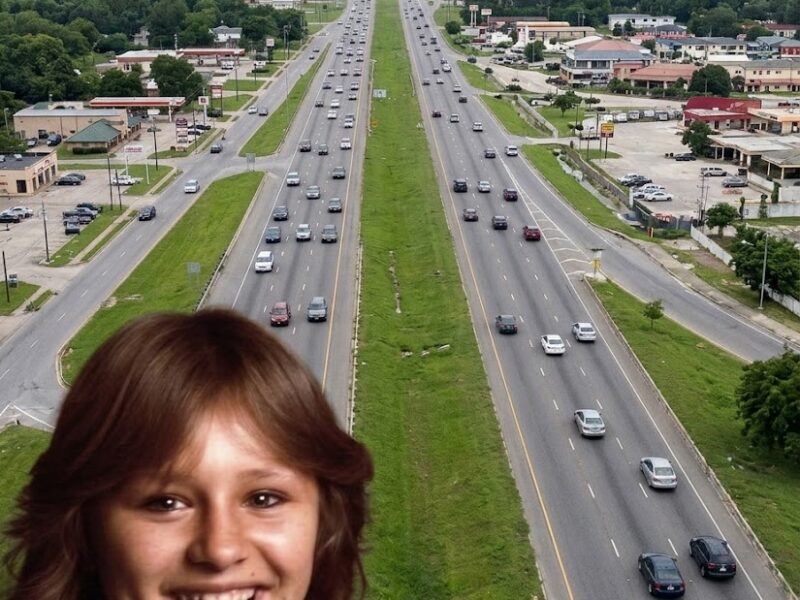
For 41 years, she was known only as “Walker County Jane Doe”—a teenage girl found murdered on the side of a Texas interstate, with no name, no family, and no answers. Then modern DNA technology finally gave her back her identity: Sherri Ann Jarvis, just 14 years old.
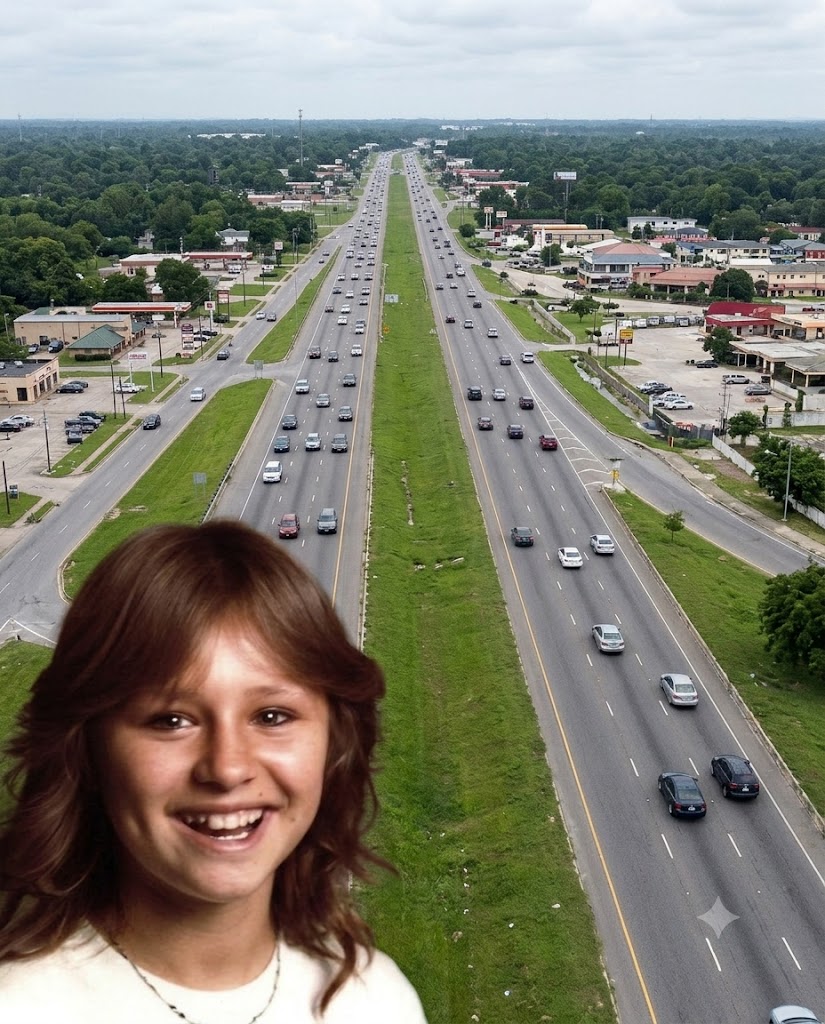
The marker in Oakwood Cemetery said only what no one could answer: Unknown White Female.
It sat in Huntsville, Texas, a prison town about seventy miles north of Houston, where Interstate 45 carries travelers past the oldest prison in the state and the place where Texas carries out its executions.
On the first morning of November 1980, a truck driver rolling along that interstate just outside town saw a body on the shoulder of the road and called for help.
She had been strangled.
She was fourteen years old.
No one who looked at her could say who she was.
Less than a day earlier, that same girl had walked into a Huntsville truck stop on Halloween night and asked for directions to the Ellis Unit, a state prison.
She told people she was from Rockport, Texas.
It was not true.
Detectives questioned prison employees and inmates.
They contacted authorities in Rockport.
Nobody knew her.
Nobody had reported her.
She was buried under a marker that read Unknown White Female.
Forty-one years would pass before anyone could call her by her name.
That name would come from a DNA sample preserved since her autopsy, a team of investigators who refused to let the file stay closed, and a family that had spent four decades without answers.
But when her name was finally spoken, it opened a question that, as far as public records show, has never been answered.
Who killed her?
This is the story of how a girl who was seen by so many strangers on Halloween became a file with no name, and how science and stubborn police work finally gave her back to her family.
It is also the story of what a name can and cannot fix.
Remember the red shoes.
They will come back.
The promise of this story is simple: you will learn how Sherry Ann Jarvis was identified after forty-one years.
The bet is harder: you will also learn why her identification did not put anyone in handcuffs.
The debt the file still carries is the one the district attorney named at a press conference in 2021, when he said he hoped the information would lead investigators to whoever did this, and if that person is still alive, they would be prosecuted to the fullest extent of the law.
That is the line between identification and resolution.
A name tells investigators who was killed.
It does not tell them who did it.
The red shoes were one of the few details that survived from her last known day.
They were recovered with her body.
Her yellow top and jeans were not.
That gap matters because clothing can carry fibers, stains, and trace evidence.
Clothing can be traced to a store, a household, or a person.
Without it, investigators in 1980 had fewer ways to connect her to a place and fewer ways to connect her to whoever was responsible.
The number that matters most in this story is forty-one.
Forty-one years under a marker with no name.
Forty-one years of a family carrying an absence they could not explain.
Forty-one years before a laboratory in The Woodlands, Texas, rebuilt a usable DNA profile from tissue that had been degrading since 1980.
And still, forty-one years later, no one has been charged.
Here is how it happened.
Friday, October 31, 1980, Halloween in Huntsville, Texas.
Huntsville is a prison town.
It is home to the oldest prison in Texas, and it is the place where the state carries out its executions.
The prisons are part of everyday life here, and so is Interstate 45, which runs through Walker County and carries a steady flow of travelers past the town.
Truck stops and service stations exist to serve the people passing through.
At some point that day, a girl begins turning up in the kind of places where strangers come and go at all hours.
Witnesses will later describe her as disheveled.
Some are unsure whether they saw a girl or a young woman.
Even her age is a guess to the people who see her.
She is wearing jeans, a yellow top with large pockets, and a necklace.
Several people remember red shoes.
What she wants is specific.
She asks for directions to the Ellis Unit, a state prison, sometimes called the Ellis Prison Farm.
She tells people she is from Rockport, Texas, a small town on the Gulf Coast, a long drive south of Huntsville.
It is a believable answer, and nothing about it invites doubt.
Keep that name in mind.
It matters later.
She is not seen only once.
Many people in Huntsville see her that day.
One account places her at the Hitchin’ Post truck stop.
Another places her at the South end Gulf Station.
The two sit at opposite ends of town, and both are just off a highway.
These are places where people stop briefly and move on.
Nobody has any reason to remember a single conversation.
Many people remember hers.
Each person gets a few minutes with her.
Each leaves with only one piece of the picture.
And none of them can see the rest.
This is 1980.
There are no cell phones, no security camera at every pump, no internet to spread a description in minutes.
A person is only as traceable as the memories of the people who saw her.
Taken one at a time, these are brief encounters with a stranger.
Taken together, they are the closest thing this case has to a record of her last known movements.
A yellow top, a necklace, red shoes, a question about a prison.
These details seem small now, but they will become the starting point for anyone who tries to learn who she was.
And every one of those memories leads back to the same question.
Why was a fourteen-year-old far from anyone who knew her trying to reach the Ellis Unit?
Within hours, she would be gone.
“She asked for directions to the Ellis Unit,” a clerk would later recall, according to the accounts that made it into the file.
“She said she was from Rockport.”
The clerk did not think twice.
People came through Huntsville all the time looking for the prison.
Families visited inmates.
Lawyers came and went.
Truckers asked for the quickest route to the gate.
A girl alone was unusual, but not impossible.
“She looked like she needed a map,” another witness said.
“She didn’t look like she needed help.”
That distinction would haunt the case for decades.
The girl who needed a map was easy to remember.
The girl who needed help was invisible.
The red shoes were the detail that stuck.
“She had on these red shoes,” a witness said.
“You don’t forget a thing like that.”
Investigators would later recover a pair of shoes with her body.
They did not recover the yellow top.
They did not recover the jeans.
The shoes became one of the few physical anchors to the witness accounts.
A girl in red shoes asking for a prison.
A body on the shoulder of Interstate 45.
The same girl, according to the timeline, less than a day apart.
The autopsy came back clear.
The cause of death was asphyxia by strangulation.
This was not an accident.
This was not a medical event.
It was a homicide, and it would be investigated as one.
The autopsy produced an estimate of her age and a physical description.
It did not produce a name.
Her age could only be approximated because nothing found with her established who she was or where she belonged.
Then there was the matter of her clothing.
Witnesses the day before described a yellow top and jeans.
Neither was found with her.
Her shoes were recovered.
The clothing was not.
Investigators now had a victim whose last known appearance was documented by memory and whose belongings did not match it.
That gap mattered.
Clothing can carry fibers, stains, and other trace evidence.
Clothing can also be traced to a store, a household, or a person.
Without it, investigators in 1980 had fewer ways to connect her to a place and fewer ways to connect her to whoever was responsible.
Walker County had an unidentified homicide victim and no one to notify.
In January, after the autopsy was complete and no one had come forward, she was buried in Huntsville’s Oakwood Cemetery.
The marker had no name on it.
It read Unknown White Female.
The marker recorded only what authorities did not know.
It did not record her age, her hometown, her family, or the reason she came to Huntsville.
It also did not record why a girl whom so many people had seen alive on Halloween could die within a day with no one reporting her missing.
Authorities had a body, a cause of death, a cemetery plot, and a case file.
What they did not have was her identity.
The file did not close.
It waited.
In the days that followed, the Walker County Sheriff’s Office had a homicide with no victim’s name attached to it.
Every investigation begins with the victim.
Who she was, who she knew, where she had been.
Detectives had none of that.
What they had was the one thing she said to strangers that pointed somewhere specific.
She had asked for the Ellis Unit.
So detectives went there.
“We interviewed inmates and employees at the prison,” a former investigator would later say, summarizing the first pass.
“It was the logical first step.”
A girl asks for directions to a particular prison and is found dead a day later.
Investigators had to learn whether anyone inside those walls knew who she was.
Nobody did.
Then Rockport.
She had told people that was home, so detectives contacted authorities there.
Again, nobody knew who the girl was.
Two leads, two empty answers, and the case had already run out of obvious places to look.
Consider what an investigator in 1980 was working with.
There was no national DNA database for an unidentified victim to be compared against.
Genetic genealogy did not exist.
There was no internet to circulate a description in an afternoon.
Identifying an unknown girl depended on one thing.
Someone, somewhere, reporting a daughter missing, and that report finding its way to this case.
That is the quiet problem with an unidentified victim.
A name is the key to everything else.
It gives detectives a family to interview, a last known address, a circle of friends, a timeline.
Without a name, every other question stays out of reach.
Detectives could describe her, but they could not find her story.
What remained was thin.
A description, a handful of sightings around Huntsville, a hometown that led nowhere.
The case stayed open, but the leads had run out, and a case with no leads does not close.
It waits.
Unidentified victims are among the easiest cases to lose.
They leave few records, and often no one is left asking questions on their behalf.
That is why this channel stays with them.
At Uncovering Crime, we follow unidentified victim cases from the first discovery through to their resolution.
So, if you want to see how this one ends, make sure you subscribe and turn on notifications.
For now, she was a file with no name.
The red shoes sat in an evidence log, waiting for someone to remember what they meant.
By 2015, thirty-five years had passed since a truck driver found a girl on the shoulder of Interstate 45.
The case file had barely changed in all that time.
Same description, same sightings, same unanswered question.
That year, the Walker County Sheriff’s Office officially reopened the case, and Detective Tom Bean took it on.
“We can take evidence that is very old,” Bean said in an interview, describing the new tools that had become available.
“DNA that’s been previously unsuitable or unusable on other methods and traditional testing processes, and we can pull genetic information, markers and such, from this evidence, and use that to build out long-distance relationships.”
Bean did not inherit a suspect.
He inherited a girl with no name, and the only way forward was a method detectives call process of elimination.
The logic is straightforward.
Somewhere, a family was missing a daughter.
So, every missing girl whose age and circumstances could fit became a possibility, and every possibility had to be tested.
The testing follows a set pattern.
Investigators locate a relative of the missing girl, a parent, a sibling, someone close enough to share her DNA.
That person provides a sample.
A laboratory compares it with the DNA of the unidentified girl.
The answer is one of two things.
Either the profiles show a family relationship, or they do not.
Most of the time, they do not.
Over the following years, Bean worked through dozens of missing girls this way.
Each was tested.
Each was excluded.
Each was shown not to be the girl from Walker County.
An exclusion is not a failure.
It is evidence.
Every name crossed off narrowed the field.
It was also a hard answer for another family, because the girl in Huntsville was not their daughter, and their own question stayed open.
But the method has a limit.
It can only test the girls someone thought to compare, and each candidate had to be identified, located, and matched to a living relative willing to give a sample.
Elimination could prove who she was not.
It could not tell investigators who she was.
By then, dozens of possibilities were gone, and her name was still out of reach.
“Every exclusion was a name crossed off,” Bean would later explain, “and every crossed-off name was another family still waiting.”
To find her, investigators would need a method that did not depend on someone already knowing where to look.
That method was already being built in a laboratory less than fifty miles away.
By 2020, the Walker County Sheriff’s Office had spent five years crossing names off a list.
Every exclusion told investigators who the girl was not.
None told them who she was.
The next step would not depend on anyone guessing correctly.
It would depend on the DNA she had left behind.
That year, the Walker County Sheriff’s Office contracted Othram, a company that specializes in analyzing DNA from trace or degraded samples.
Forty years is a long time for biological material to hold up, and this case needed exactly that kind of expertise.
Othram’s headquarters in The Woodlands sits less than fifty miles from Huntsville, and the case was already on its scientists’ radar.
In July 2020, Detective Bean took a call from the company.
The case was not left to one agency.
A multi-agency team formed around it, made up of the Sheriff’s Office, the Houston office of the FBI, the Texas Rangers, and the National Center for Missing and Exploited Children.
Their first job was to decide which evidence could still be used to identify her.
The answer had been in storage since 1980.
Tissue samples from her autopsy had been preserved.
The people who collected them could not have known what one day would be possible.
Othram’s scientists used those samples to rebuild a usable DNA profile from material that had been degrading for four decades.
This is where the method changed.
Bean’s earlier testing had required a candidate, a missing girl, someone already suspected.
Genetic genealogy does not.
Her profile could be compared against genetic data that people have chosen to share, searching for distant relatives.
Each match became a thread, each thread a family tree, and the trees were traced until one of them led to a missing daughter.
By March 2021, the work had produced results.
Six people were identified as close relatives of the girl, among them direct relatives, aunts and uncles.
Bean located candidate family members and spoke with them, and five of those relatives spoke with investigators.
A possible identity began to take shape.
Those conversations were not routine.
Investigators were approaching families with a question that could only have a painful answer, because any match would mean a girl had been dead for four decades.
“We have a possible match,” Bean told one relative, according to the general outline of the investigation that was later made public.
“We need to confirm it.”
The relative asked the question everyone asks.
“Is she alive?”
The answer was no.
She had been dead since 1980.
The family provided DNA samples.
The samples were sent to Othram to be compared with the sample from the unidentified girl.
It was a match.
The evidence was then compiled and delivered to the Harris County Institute of Forensic Science, which confirmed the identification.
The girl who spent forty years under a marker reading Unknown White Female was named Sherri Ann Jarvis.
She was fourteen years old and she was not from Rockport.
She was from Stillwater, Minnesota, more than a thousand miles from Huntsville, Texas.
The red shoes in the evidence log had belonged to a girl from a river town in the North.
The yellow top and jeans that were never found had belonged to her too.
And the question of why she asked for directions to a Texas prison was still unanswered.
Stillwater, Minnesota, sits on the St. Croix River east of Minneapolis and St. Paul.
It is well over a thousand miles from Huntsville, Texas, and it is where Sherri Ann Jarvis was from.
Not Rockport, not anywhere on the Gulf Coast.
For forty-one years, she was a description in a file.
Now there was a person behind it.
The details that exist about her are few, which makes each one matter.
At thirteen, Sherri was removed from her home in Stillwater by the state.
The reason, according to her family, was that she was frequently absent from school, a pattern known as habitual truancy.
It is a sparse fact for a record to hold about a child.
And the public record does not explain what lay behind it.
Truancy does not tell us who a girl is.
It tells us only that something in her daily life was not working and that adults had decided to step in.
In early 1980, at fourteen, she left.
Her family says she ran away.
She was a teenager with no adult beside her.
Shortly after she disappeared, her family says, a letter arrived.
In it, Sherry promised she would come home.
It is a small detail, but it changes how the story reads.
Whatever she was leaving behind, a promise to return is not how someone says goodbye.
She was a girl who still thought of home as a place she would go back to.
She never made it.
Her parents did not live to learn what became of their daughter.
They died without ever knowing what had happened to her.
What remained was a family that had carried an absence for four decades with no way to explain it.
When investigators finally reached relatives through DNA, the girl in the file was not a case number to them.
She was Sherry, the one who had left and said she would return.
Much of who she was has not been shared publicly.
As far as public records show, her family has said little about her friends, her interests, or her personality, and it is not for us to invent them.
What we can say is what the facts allow.
She was fourteen.
She was somebody’s daughter.
Her family says they love her and miss her very much, and she deserved a very different ending.
Sherry Ann Jarvis now has a name, a hometown, and a family who knows where she is.
What no one has announced, as far as public records show, is who was responsible for ending her life.
The case that gave her name back is still waiting to answer that.
Tuesday, November 9, 2021, Huntsville, Texas.
Sheriff Clint McRae steps in front of the cameras, flanked by colleagues from several agencies, and makes the announcement investigators had spent decades unable to make.
“The girl found on Interstate 45 in 1980 has a name,” he said.
“Sherry Ann Jarvis.”
A statement from her family is read aloud by Deputy Marlene Wells.
The family thanks everyone who worked to find her.
They say they have lived in bewilderment every day since losing Sherry, until now, when she has finally been found.
Then the question turns to the one that comes next.
District Attorney Will Durham says, speaking as a prosecutor, he hopes this information leads investigators to whoever did this, and if that person is still alive, he says, they will be prosecuted to the fullest extent of the law.
Chief Deputy Tim Whitecotton tells reporters that investigators have positive leads.
What those leads are has not been made public.
As far as public records show, no one has been charged.
That is the line between identification and resolution.
A name tells investigators who was killed.
It does not tell them who did it.
Sherry’s identity answered the question that had stood in the way for forty-one years, and it exposed the ones that had been waiting behind it.
First, how did Sherry get from Minnesota to Texas?
By what means, with whom, and when?
Nothing in the public record answers that.
Second, where was she before Halloween?
She left Stillwater in early 1980.
She appears in Huntsville on October 31.
Months sit between those two dates, and they are blank.
Who she met, where she stayed, and whether anyone helped her or harmed her along the way remain unknown.
Third, and most important, who killed her?
And behind all three sits the question from the truck stop.
Why did she want to reach the Ellis Unit?
As far as public records show, no one has said.
These are not questions a laboratory can settle.
DNA gave Sherry back her name, but it cannot say who she was in her last hours.
Answers like these are held by people, and the case still depends on someone coming forward.
On the morning of November 1, 1980, a truck driver traveling along Interstate 45 found a girl no one could name.
Today, we can.
Her name was Sherry Ann Jarvis.
She was fourteen years old.
She was from Stillwater, Minnesota, and her family spent forty-one years without knowing where she was.
A name does not close a case, though.
Someone killed Sherry, and as far as public records show, no one has been held responsible.
Somewhere, there may be a person who knows more than they have ever said.
Someone who remembers who she was with, where she stayed during those months, or what happened after she asked the way to a prison.
People often forget what they know until a story brings it back.
That is why this video matters beyond the telling.
The Walker County Sheriff’s Office tip line is open, and the number is in the description.
If this reaches the right person, it could be the piece investigators have been waiting for.
So, please share this video with anyone who might remember 1980, especially in Minnesota and Texas.
Sending it takes a few seconds, and it is one of the most useful things a viewer can do for this case.
If you want to know when this case moves, subscribe to Uncovering Crime and turn on notifications.
If there is ever a development in Sherry’s investigation, whether a lead, an arrest, or an answer, we will cover it, and subscribers will be the first to hear.
For forty-one years, nobody could say her name.
Now, everyone can.
Sherry Ann Jarvis.
Thank you for watching, and we will see you in the next case.
The red shoes were never just shoes.
They were the detail that made a witness remember a girl on Halloween.
They were the physical evidence that told investigators the witness was not imagining things.
And in the end, they became the symbol of a girl who was seen by dozens of people and known by none of them.
The file that waited for forty-one years now has a name on it.
But the file still has a question mark where the killer’s name should be.
The Walker County Sheriff’s Office has not closed the case.
The district attorney has said the law still applies.
And the family that spent four decades in bewilderment has asked, in effect, for the same thing every family in this situation asks for: the truth.
A name is not a closing.
It is a beginning with better questions.
Who was Sherry Ann Jarvis?
She was a fourteen-year-old from Stillwater, Minnesota, who was removed from her home at thirteen for habitual truancy, who ran away at fourteen, who wrote a letter promising to come home, and who never did.
She was a girl who asked for directions to a Texas prison and was found dead on the shoulder of Interstate 45 less than a day later.
She was a girl whose yellow top and jeans were never found, whose red shoes were recovered, and whose body was buried under a marker that said Unknown White Female.
She was a girl whose parents died without knowing what happened to her.
She was a girl whose name was finally spoken in a press conference in Huntsville, Texas, on November 9, 2021.
And she is a girl whose killer is still out there, as far as public records show.
If you know something, say something.
That is the only way the last question gets answered.
The marker in Oakwood Cemetery no longer says Unknown White Female.
It says Sherry Ann Jarvis.
But the story does not end at the marker.
It ends when someone comes forward.
Until then, the file waits.
And the red shoes remember.









