
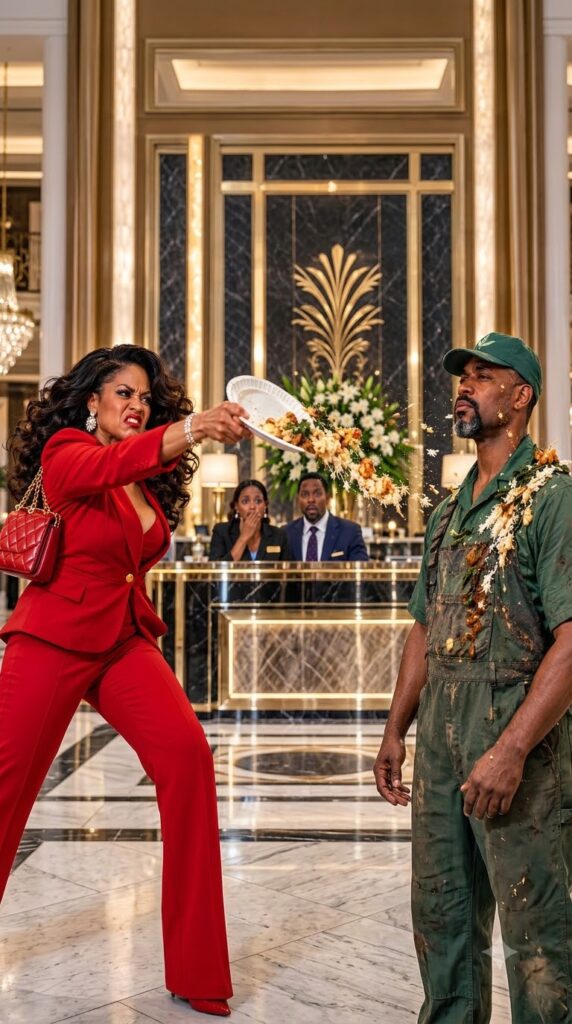
“Filthy gardener!” my ex-wife screamed, flinging trash at me in the hotel lobby. She had no idea she was begging for a discount at my hotel.
Patrice had just handed me everything I needed without realizing it.
The demand to meet the owner wasn’t a threat. It was an invitation.
She’d spent the last ten minutes telling a lobby full of people, including her new husband’s family, that hotels like this one fought to have her walk through their doors.
Now she was following a man in dirty work clothes down a hallway, certain she was about to get exactly what she came for. The only question was how far she’d push before she understood what she’d already set in motion.
If you’ve ever been dismissed by someone who thought they had you figured out, stick with me. This one’s for you.
And if you’re new here, I share stories like this every week. Hit subscribe so you don’t miss the next one.
My mother, Odessa, spent twenty-two years making other people’s beds.
She’d come home with her back aching and her knees swollen, and she never once called it beneath her. She’d say the work was honest, the work was hers, and anybody who couldn’t respect that wasn’t worth the breath it took to explain it to them.
I carried that with me. Even in the years when Patrice was trying to sand it out of me.
We were married for six years.
In the first two, I was doing everything by hand—trimming hedges, repairing irrigation lines, loading equipment into my truck before the sun came up. I had three crews by year three, a regional contract by year four.
I was building something real and I knew it, even when the money wasn’t there yet to prove it.
Patrice knew it differently.
She’d introduce me at dinner parties as working in property development. When I pointed out that I ran a landscaping company, she’d say she was just helping me put my best foot forward, that people made assumptions and she was simply managing them.
What she meant was that the truth embarrassed her. She never said it directly, but I knew.
I knew from the way she’d steer me toward a different room when her friends came over on weekends. The way she’d change the subject when someone asked what kind of work I did.
She wanted me to be the kind of man who stood inside beautiful places, not the kind who built them from the outside.
The marriage ended without a single dramatic confrontation. No screaming, no plates thrown. It ended the quiet way a lot of things end.
The day Patrice decided that the version of me she’d been waiting for wasn’t coming and the version standing in front of her wasn’t worth staying for.
She filed. We settled. The division was clean and final.
What she didn’t know—because it happened after the paperwork was signed—was what I did next.
I expanded the business, took on two more regional contracts, brought in an operations manager, and eventually sold the majority stake at a number that would have surprised her.
I took that capital and bought Brier Crest House, a boutique garden hotel in Richmond, Virginia. Twenty-two rooms, half an acre of landscaped grounds that I still maintained myself.
Not because I had no one else to do it, because that was where I thought most clearly. The garden was mine before the hotel was mine. In every sense, that actually mattered.
I hired Tobin Ree as operations director and built a steady team around him. Nia Corbin had been at the front desk for three years. She was precise, patient, and professional in a way that had nothing to do with how much she was paid to be.
That was the life I had built. A quiet one, a real one. And somewhere in the back of my mind on harder days, I could still hear Odessa’s voice.
The work is honest. The work is yours. And that was enough to keep moving.
I wasn’t thinking about Patrice when her new husband’s family booked five rooms for four nights. I wasn’t thinking about her at all.
Brena Rucker was the one who handled the reservation. She called the front desk, confirmed the dates, accepted the rate without negotiation, and received the written confirmation the same afternoon.
Clean transaction, exactly the kind we preferred.
I didn’t learn until later what Patrice had told the Rucker family before the trip.
She’d told them that hotels like Brier Crest House had a habit of reaching out to people like her—people with platforms, with audiences, with the kind of online presence that could move a booking curve in either direction.
She told them not to worry about the price. She’d handle it when they arrived. She had a relationship with places like this.
She had no relationship with us. She had never contacted the hotel. She had never proposed a collaboration, sent a media kit, or so much as tagged us in a post.
Brena had paid the standard rate and received the standard confirmation. What Patrice had given her new husband’s family was a promise she hadn’t earned and couldn’t keep, and she was counting on manufacturing the proof of it the moment she walked through our door.
The Rucker family arrived on a Saturday afternoon in early October.
I was on the south side of the property, checking the drip irrigation before the temperature dropped. I had dirt on my gloves, a pruning tool in my back pocket, and no particular reason to be anywhere else.
I heard the vehicles before I saw them. Two SUVs. The family came in together.
Desmond, his mother, Gloria, his sister, Brena, and a couple of others. Then I placed Patrice.
She was walking a half step ahead of everyone else. The way people do when they want to establish who’s leading.
She looked composed, polished in a way that takes real effort to make look effortless. Desmond walked beside her, a solid, even-tempered man who carried himself like someone who ran a real business and didn’t need anyone to know it.
Gloria moved with the unhurried attention of a woman who had spent decades watching people and drawing her own conclusions. Brena was on her phone.
Patrice saw me before I saw her see me. There was a beat—less than two seconds—where she could have kept walking. Could have nodded or not nodded and taken her family straight through the front entrance without making anything out of it.
She chose differently.
She slowed just enough to redirect the family’s attention toward me, then turned to them with a smile that was performing something I couldn’t quite name.
“That’s my ex-husband,” she said. Bright and easy, like she was pointing out a landmark. “Still doing yard work, as you can see.”
I held up a hand, a brief acknowledgement, and went back to the valve I’d been checking.
The irrigation wasn’t going to fix itself because my ex-wife had decided to use me as a talking point.
What I noticed—without making a production of noticing it—was that my stillness bothered her. She wanted something from me. Embarrassment or envy, or some visible wound she could let her new family see. When I gave her nothing, the smile stayed on her face, but something behind it went flat.
They went inside. I finished the valve check and came in through the side entrance a few minutes later to go over the weekend schedule with Nia.
I was still in my work clothes.
I heard Patrice before I saw her. She was at the front desk with Nia. And the tone was already the kind that tightens the back of your neck.
Not shouting—worse than shouting—the controlled, deliberate voice people use when they want everyone in the room to understand they are being very patient with someone who does not deserve their patience.
She was requesting a 35 percent reduction on the reservation, a room upgrade for the primary suite, and complimentary dinner for the family’s first evening.
In exchange, she explained, she would produce a series of social posts introducing her audience to the property.
Nia walked her through it correctly. Collaboration proposals required a separate review process. The reservation was confirmed at the agreed rate. She’d be happy to pass Patrice’s contact information to the right person on the team.
Patrice set a paper plate on the counter.
It still had food on it—something she’d apparently been eating on the way in. She wasn’t looking at Nia anymore. She was looking past her, playing to the family, standing a few feet behind.
I stepped up and suggested she use the trash bin just inside the entrance.
She turned and looked at me the way she used to look at me when I’d said something she’d already decided was beneath consideration. Then she picked up the plate and threw what was left of it at my shirt.
“Filthy gardener.” The words were unhurried, almost gentle. “You’re used to cleaning up messes, aren’t you?”
The lobby went still.
Desmond made a short, uncomfortable sound that wasn’t quite a laugh. His eyes moved around the room without landing anywhere. Gloria Rucker did not make a sound. She watched Patrice the way a person watches something they’re memorizing.
Brena looked at the floor.
Nia stepped out from behind the desk. I shook my head slightly—just enough—and she stopped. I told her to stay with the other guests who were waiting. She held my eyes for half a second before she turned back.
I looked down at my shirt. Then I looked at Patrice and asked her how much of a reduction she was looking for.
She laughed. “What gives you any right to ask?”
“Not much,” I said. “But I can get you in front of the owner.”
The calculation that crossed her face was fast and unguarded. She glanced at the family behind her, then looked back at me.
“Then stop wasting my time,” she said. “Take me to him and tell him ahead of time that my family is to be treated accordingly.”
She extended her bag toward me. I didn’t take it. I caught the attention of our bellman and gave him the nod to assist with luggage.
Then I told the family I’d bring them to a private sitting room where they could wait comfortably.
Patrice assumed I was doing her a favor. She assumed the man she’d just thrown food on was clearing the path in front of her.
On my way to find Tobin, I asked him to pull three things: the original reservation confirmation with the agreed rates, our media collaboration policy, and the front desk footage from the past fifteen minutes.
Not to build a case—just to make sure that when everything came out, and it was going to come out, it came out on paper, not on my word alone.
Because Patrice was right about one thing. She was about to meet the owner.
She just hadn’t thought to ask who she was already talking to.
The private sitting room at Brier Crest House was a small, well-appointed space off the main corridor—two sofas, a low table, natural light from a west-facing window.
We used it for quiet check-ins, for guests who needed a moment before their rooms were ready, occasionally for vendor meetings.
I asked the family to sit. The bellman had taken the bags. Nia had returned to the desk. Tobin was gathering the documents I’d requested.
Patrice sat across from me and arranged herself the way she arranged herself when she was about to perform competence—straight spine, hands folded, the expression of someone accustomed to having rooms accommodate them.
Desmond sat beside her. He had the look of a man who had decided somewhere on the drive in to defer to his wife on the specifics of this trip.
I recognized that posture. I had worn it myself once.
Gloria took the sofa to my left. She hadn’t said a word since the lobby. She was still doing that thing where she watched without appearing to watch, taking inventory behind very still eyes.
Brena sat at the far end of the second sofa, phone face down on her knee. That detail registered with me. Up until the lobby, the phone had been in her hand. She’d put it away.
I set a notepad on the table and asked Patrice to walk me through her proposal.
She named her platform. She quoted her follower count. She described—in the confident shorthand of someone who had told this story many times—the variety of properties that had competed for her attention.
A resort in Charleston, a hotel group in Nashville, a boutique property outside Asheville that had offered her a full weekend in exchange for two posts and a reel.
I listened. I wrote nothing down yet.
When she finished, I asked what she was committing to in exchange for the reduction, the upgrade, and the complimentary dinner.
She said, “Content. Exposure. The kind of visibility a property like this couldn’t buy at any advertising rate she’d care to name.”
I asked for specifics. How many posts? What format? What timeline? What would the hotel receive, and when and how would it be confirmed?
She waved a hand—not dramatically, but dismissively—as though the question itself revealed a misunderstanding of how these things worked.
“You’re a gardener,” she said. “You wouldn’t understand the mechanics of this.”
“That’s fair,” I said. “So help me document it clearly enough that the person making this decision doesn’t have to guess.”
I pushed the notepad across the table. She picked up the pen.
She wrote down what she wanted—the discount percentage, the room category, the meals. When she got to the section where her deliverables would go, she wrote the name of her platform and her follower count.
Again—no post count, no dates, no format.
I waited. She capped the pen and set it down.
I asked whether she’d be willing to commit to a specific number of posts and a completion date within the stay.
She said that wasn’t how she worked. Creativity couldn’t be scheduled. Brands that tried to constrain her creative process ended up with content that didn’t perform, and that was worse for everyone.
Desmond leaned forward then—not aggressively, but with the energy of a man who had been waiting for a place to enter.
“A hotel that’s still building its reputation should understand when an opportunity is sitting in front of them,” he said. “That’s just good business sense.”
I looked at him directly, not unkindly. “Did Patrice let you know before the reservation was confirmed that these benefits hadn’t been approved by the hotel yet?”
The question landed without fanfare.
Desmond looked at his wife. It was a different kind of look than the ones he’d given her in the lobby. Not supportive, not deferential. Searching.
Patrice changed the subject. She asked whether the person who made collaboration decisions would be joining us, because she felt like we were wasting time talking to the wrong level of the organization.
From the end of the sofa, Brena spoke for the first time.
“I booked the rooms,” she said. She wasn’t accusing anyone. She was stating a fact in the flat tone of someone clarifying the record. “Five rooms, four nights, standard rate. Nobody mentioned a discount was coming.”
Patrice looked at her.
“I told everyone not to worry about the price. You said you’d handle it,” Brena said. “That’s different from saying it was already arranged.”
The room held that for a moment.
I continued through the proposal point by point—the way you move through a checklist when the outcome matters more than the pace.
Each question I asked was reasonable. Each answer Patrice gave created a wider gap between what she was requesting and what she was offering in return. The notepad documented that gap without editorializing.
She knew what I was doing. I could see it in the way her posture changed by degrees—the spine still straight, but something in the shoulders pulling inward.
When I reached the end of my questions, I excused myself briefly and went to find Tobin in the hallway.
Patrice followed me out before I made it to the corridor. She pulled the door half closed behind her and dropped her voice to the register she used when she wanted something to feel like a confidence rather than a demand.
“Help me with this,” she said. “I’ll make sure I don’t say anything to them about those early years. The truck, the money, all of it.”
I looked at her for a moment.
“You already said something,” I told her. “Out in front. You introduced me to his family before you even said hello.”
Her jaw tightened. “You know what I mean.”
“I do,” I said. “But I don’t think you noticed who was paying the bills back then while you were deciding what to tell people I did for a living.”
She didn’t answer that. She pushed back into the room.
By the time I followed her in, her posture had shifted again—harder now. Less performance and more pressure. She addressed the room. Not just me.
“If this hotel is going to refuse a fair offer,” she said, “I’ll post about how this visit went. My audience is going to hear about this experience either way. I’d rather they hear something positive.”
The implication was not subtle.
The door opened. Tobin stepped in with the folder I’d requested and set it on the table in front of my chair—not in front of Patrice.
He looked at me and said, without any inflection that suggested theater, that here was the material I had asked for.
Patrice turned to him. “Can you deal with this?” She gestured in my direction. “The gardener is making this more complicated than it needs to be.”
Tobin looked at her. Then he looked at me.
“Mr. Sloan,” he said, “this is the decision that needs your sign-off.”
The room went still in a way that rooms go still when something irreversible has just been said.
I sat down at the head of the table. I opened the folder and briefly reviewed the first page—not because I needed to, but because I wanted the moment to settle without anyone rushing it.
Then I introduced myself to the room.
Not at length, not with figures or history or anything that resembled a speech. I said that I owned Brier Crest House, that I had been the one Patrice was asking to meet, and that I had taken her to him the moment she asked.
Gloria looked at Patrice—not with satisfaction, not with cruelty, with something closer to clarity. Like a picture that had been slightly out of focus had finally resolved.
Brena picked her phone back up. Desmond asked Patrice, in a voice that was very controlled and very level, why she had told him I was still just doing yard work.
Patrice had no answer. For the first time in the hour since her family had arrived, she had no answer at all.
She recovered quickly. That was something I had always understood about her. She did not stay exposed for long.
The armor went back up fast, and it went up in a different configuration than before. She told the room that the moment in the lobby hadn’t been what it looked like, that we had the kind of history where certain things were said without meaning, that it was shorthand between two people who had known each other for a long time, and that she hadn’t intended any real disrespect.
I asked whether Nia also had that kind of history with her.
Patrice didn’t answer.
I told her I was declining the collaboration proposal. Three reasons, stated plainly: no prior agreement existed; the terms she’d written down were unbalanced, with the commitment section nearly empty; and she had used the threat of a negative post to pressure a front desk employee into an arrangement the hotel had not agreed to.
The reservation itself was not canceled. The rooms were still available at the rate Brena had confirmed. The condition was straightforward. Patrice would need to stop directing threats at staff and stay within standard guest conduct.
Gloria spoke. Not to me—to Patrice.
“Apologize,” she said. “So we can move forward and everyone can enjoy this trip.”
It was not harsh. It was the voice of a woman making a practical suggestion to avoid further damage.
Patrice’s face moved through several things in quick succession. Then she told me—told all of us—that I had arranged this entire situation because I hadn’t been able to accept the end of our marriage.
That the real reason she wasn’t getting what she’d asked for was personal, not professional. That a man who bought a hotel after she left had something to prove, and he was proving it at her expense.
I put the confirmation page in the center of the table and let it sit there.
Then she pulled out her phone. She held it up, camera facing me, and told me to repeat my decision on the record.
I looked directly at the lens. I said it again—at the same pace, with the same words. The reservation was intact at the agreed rate. The collaboration request had been declined. The decision had nothing to do with our previous relationship and everything to do with the proposal in front of me.
There was nothing in that statement she could cut to make it look like something else.
She lowered the phone. She looked around the room—at Desmond, at Gloria, at Brena—and found none of the support she needed.
She turned toward where Nia would have been and told the room that if the bags were not brought up within the next few minutes, she would be naming the staff member who had handled check-in in whatever she posted next.
I closed the folder. I told Tobin the formal part of the meeting was concluded and asked him to take over from here on any remaining guest conduct concerns, following standard protocol.
Then I excused myself. I did it because the decision to remove Patrice from the property—if it came to that—should not rest on the word of an ex-husband. It should rest on documented conduct reviewed by the operations director, measured against the hotel’s stated policy. That was the cleaner outcome for the hotel, for the staff, and for the record.
Twenty minutes later, Tobin found me in the garden office. Before he could speak, my phone buzzed. Then again. Then again, in a pattern that meant volume, not individual notifications.
Patrice had posted from the parking area outside the property.
The post described Brier Crest House as a hotel that used personal history to discriminate against guests, that had failed to honor reasonable accommodation requests, and that had made her family feel targeted and unwelcome.
She described the moment in the lobby—the paper plate, the words she’d thrown at me—as a small, regrettable misunderstanding that the hotel had deliberately escalated.
She did not mention the discount request. She did not mention the threat. She did not mention the footage.
The comments arrived in the way comments arrive when an audience is already primed toward outrage. Fast, certain, and loud.
Tobin told me the front desk phone had started ringing. That a group in the middle of negotiating a weekend event rental had sent an email asking to pause discussions until things were clearer. That people had gone looking for Nia’s personal accounts, and that she had locked them all.
I walked to the staff break room.
Nia was sitting at the small table in the corner with her hands folded in front of her and her face doing the thing faces do when they are working very hard to stay composed.
She looked up when I came in.
“I did everything right,” she said. “I followed every protocol. I said exactly what I was trained to say.”
“You did,” I told her.
“So why is my name in comment sections?” Her voice stayed level, but the steadiness cost her something. “Why are strangers looking for my accounts? I didn’t do anything. I didn’t make any decision here.”
She wasn’t asking me to fix it. She was asking me to confirm that the equation made no sense. That she hadn’t missed something. That she wasn’t somehow at fault.
“You’re not,” I said. “None of what’s landing on you belongs to you.”
She looked at the table. “That doesn’t make it stop.”
“No,” I said. “It doesn’t.”
I sat down across from her—not to plan, not to strategize, just to not leave her alone in that room with what was sitting there.
I thought about Odessa then. The way she’d come home from a long shift and let the weight of it be what it was before she moved through it. She never pretended a hard day was over before it was. She said rushing past it only meant carrying it longer.
I told Nia the hotel would handle every incoming contact. That she would not have to respond to a single message, explain herself to a single stranger, or deal with any of this on her own.
I told her I’d work with Tobin to make sure the process for situations like this was better than it had been today, and that the gap in that process was mine to fix, not hers to absorb.
She nodded slowly.
“The reason this escalated,” I said, “is because I let the conversation run longer than I should have. The fallout from that landed on you. That’s on me to have read earlier.”
She looked up then. “What are you going to do?”
I had let Patrice walk into the truth herself, at her own pace, in front of the people she’d been performing for. That hadn’t been a wrong call.
But I hadn’t fully accounted for what happens when a person reaches the end of a hall and finds a wall instead of a door. Sometimes they stop. Sometimes they start knocking the wall down.
Nia had done nothing to deserve being on the other side of it.
“I’m going to put the facts somewhere people can find them,” I said. “All of them. And I’m going to let those facts do the work.”
I went back to the garden office, where Tobin was waiting, and we started building the file.
The file we put together was not complicated. Complexity would have been a liability.
We had the original reservation confirmation—five rooms, four nights, the agreed rate, Brena’s name on the booking.
We had the collaboration proposal that Patrice had written herself, her requests fully documented and the deliverables section carrying almost nothing.
We had written accounts of the lobby incident from Nia and from our bellman, documented independently before either of them spoke to the other.
And we had the front desk footage.
I watched the footage once. I didn’t need to watch it again.
Before we did anything public, I asked Tobin to send Patrice a written request—clean and factual. The post contained inaccurate characterizations of the lobby incident and of the hotel’s conduct. We were asking her to issue a correction or remove the post within two hours. The reservation remained available. We were not seeking further escalation.
Her response came back in under fifteen minutes.
She said the post would come down when the hotel honored a fair request from a guest. She put a number on it—20 percent, reduced from the original 35, as a gesture of goodwill on her part.
Tobin read it over my shoulder. Neither of us said anything for a moment.
She had now put in writing that a retraction of false public statements was contingent on financial concessions. That was no longer a dispute about customer experience. That was documentation of something else entirely.
I told Tobin we’d move forward.
The hotel’s public response was four paragraphs.
The first confirmed that the guest had arrived with a reservation made at the standard rate, with no prior collaboration agreement in place.
The second noted that a collaboration proposal had been submitted and declined during the visit, and that the original reservation had remained intact throughout.
The third stated that front desk staff had acted in accordance with hotel policy at every point.
The fourth said that the property had footage and documentation available for anyone with questions about the incident.
We published one image alongside it—a single frame from the lobby footage, cropped to show the counter and the two people at it. The guests visible in the background were blurred. Nia was in the frame, and I had asked her whether she consented to being included. She said yes. She said she wanted people to see that she had been standing there doing her job.
At the end of the post, in its own line, the hotel asked that no individual—including any staff member and including the guest who had posted about us—be contacted or harassed.
I meant that. I had watched what happened to Nia’s accounts, and I was not interested in turning that same machinery on anyone else.
I knew it wouldn’t fully work. People online do what they want. But putting the request in print meant there was no version of the story where the hotel had pointed anyone at Patrice or her family.
The response among her audience was uneven, in the way these things always are.
Some people who had been loudly outraged at Patrice’s post went quiet. Some acknowledged the correction. A portion dug in, as portions always do.
But among the people who actually followed her—who had engaged with her previous posts, who had built enough of a relationship with her to notice a gap—the question shifted. They were asking why she hadn’t mentioned requesting a discount. They were asking what the plate was about.
The story she had posted was starting to lose its shape.
A brand partnership that had been in late-stage negotiation with her sent a message asking to pause discussions, pending a fuller picture of the situation. That was not something I had caused. It was something she had caused by making the post, and the post requiring a documented correction.
The harder conversation happened inside the hotel.
Desmond knocked on the door of the garden office that same evening, a couple of hours after the hotel’s response had gone up. He came alone. He sat down across from me and put both hands flat on the table. Not aggressive—just deliberate. The posture of a man who had decided to stop managing the situation and start understanding it.
He said he’d seen the post. He’d seen the hotel’s response. He’d looked at the image. He’d talked to Brena and to his mother.
“She told me you were still cutting grass for other people,” he said. “She said it about six times in the two months before this trip. I’m not sure why it mattered that much to her, but she said it.”
“It mattered,” I said, “because she needed it to be true.”
He sat with that.
“She asked me to call you and get the post taken down,” he said. “She said if you still had any respect for what the two of you had, you’d do it.”
“The hotel’s response stays up,” I said. “Nia’s name is in comment sections right now. I’m not pulling accurate information so that inaccurate information can be the only version available.”
“I told her that’s probably what you’d say.”
“What did she say?”
“She said you were punishing her.”
I thought about how to answer that honestly. I spent six years being managed. “What I’m doing now is showing a documented record of what happened,” I said. “If the record is the punishment, then the problem is what’s in the record.”
Desmond was quiet for long enough that I stopped waiting for him to respond.
Then he said, “She told my family this trip was going to be something. That they were going to see how she operates. That she has a way of making things work out.”
“I know,” I said. “She always did.”
He stood up. He extended a hand across the table. I shook it.
At the door, he stopped without turning around. He said, “I need to have a real conversation with my wife.”
He left.
What happened within the Rucker family after that, I know only in pieces—from what Tobin was told at the front desk and from what Brena said to Nia before checking out.
Gloria and Brena had already decided they were staying. Not as a statement against Patrice, but because they had planned a trip, they had paid for rooms, and the staff of Brier Crest House had done nothing to deserve being penalized for someone else’s decisions.
Gloria apparently said something to Brena along those lines. Brena agreed.
Desmond brought Patrice’s bags to a car. She had been asked by Tobin—formally and in writing—to end her stay, following a second incident in which she had approached Nia in the hallway and repeated the threat about naming her online. It was the third documented conduct violation.
Tobin had handled it exactly as protocol required, without asking me and without my involvement. The decision to remove Patrice from the property did not belong to me. That was the point of stepping back.
A man with his ex-wife’s bags in his hands cannot be the one to make that call cleanly. So he didn’t. Tobin made it, documented it, and executed it.
Patrice left. Desmond came back. He said nothing at the desk. He collected his key and went upstairs.
He was still there when his mother and sister had dinner in the restaurant that evening. From what Nia told me, it was a quiet dinner. Nobody performed anything for anybody.
Outside the front entrance, Patrice stood near the gate. I wasn’t there to see it directly, but Tobin described it to me afterward. She was watching the entrance from the far edge of the drive, still on her phone.
Inside, Gloria and Brena were walking through the lobby toward the restaurant. The family she had built this entire trip around impressing was settling into the hotel she had just been removed from.
Nobody looked back.
When she said later—through a message sent to the hotel’s general address—that I had made her look foolish in front of people she cared about, I thought about that image for a long time before I responded.
I didn’t tell her what I actually thought, but I’ll say it here.
I hadn’t told the Rucker family a single thing about who she was. I hadn’t needed to. She had introduced herself—in the lobby, in the sitting room, in the post, in every move she made from the moment she recognized me on that lawn.
I didn’t make her look like anything. She just didn’t realize she had an audience she couldn’t control.
In the weeks that followed, Patrice posted a correction. Not an apology—a correction.
She said the initial post had described the hotel’s conduct as discriminatory, and that on reflection, she understood the hotel had been following its own policies. She said the situation had been more complicated than she had conveyed. She said she had chosen not to detail the full context.
It was the minimum possible acknowledgement, but it was in her own words, and it was public, and it was searchable.
The luggage partnership resumed discussions three weeks later. Whether it moved forward, I don’t know. That stopped being any of my business the moment her correction went up.
What I heard from Desmond, in a brief email he sent two months after the trip, was that he and Patrice were working through things. He said he was sorry the stay had gone the way it went. He said his mother had felt genuinely welcomed by the hotel, and that he appreciated how the staff had treated his family throughout.
He didn’t say anything else about Patrice, and I didn’t ask. The email told me enough. What had fractured between them wasn’t something I had caused. It was something Patrice had built—one decision at a time—long before she arrived at my hotel.
I changed the staff protocol after all of it. Not a complete overhaul—just the gaps that had shown themselves.
We added a clear trigger for escalating guest conduct situations to management before they reached a second incident. We built in an explicit policy for situations where a staff member’s personal accounts were targeted in connection with a workplace event—what the hotel would do, who would handle it, how quickly.
We created a written record process so that no employee ever had to rely on their word alone against a guest’s.
These were things I should have had in place already. The fact that I didn’t wasn’t Nia’s failure. It was mine.
I told her that directly, in a conversation about a week after everything had settled. She said she appreciated it. Then she said something I’ve thought about since.
She said the thing that had helped her most wasn’t the protocol or the documentation. It was the moment in the break room when I sat down and didn’t immediately try to fix anything.
“Most people,” she said, “when they come in and someone’s upset, they want to get you to the part where you’re okay again as fast as possible. Because you being upset is uncomfortable for them.”
She folded her hands on the table. “You didn’t do that. You just sat there.”
“My mother used to do the same thing,” I said. “She’d come home from a shift, and if it had been a hard one, she’d just let it be hard for a few minutes before she moved on. She said it doesn’t help to pretend a thing is over before it’s over.”
Nia nodded slowly. “She sounds like someone who knew what work actually costs.”
“She did,” I said. “She always did.”
On a Friday afternoon in late October, I was cutting back a damaged limb from the oak at the center of the lawn. The branch had been weakening since spring. I’d watched it through the summer, waiting to see whether it would recover.
It hadn’t.
Nia came across the lawn and told me a guest on the terrace wanted to speak with the owner before they left.
I set the saw down. I walked to the outdoor spigot at the garden wall and washed my hands. My work clothes were the same ones I’d worn all morning—soil at the knees, a faint grass stain on the left cuff.
Nia walked beside me back toward the terrace. Nobody at the door asked me to change.
Patrice used to think I needed to change my clothes before I could stand next to her. She thought the dirt on my hands was the problem. She thought the work itself was what kept me out of rooms like the ones at Brier Crest House.
The day she came to my hotel, I was still wearing the same clothes. Still had the same hands. The only thing that had changed was that she no longer had any say in what those things meant.
And here’s what I want to leave you with, because I think this story is about more than one difficult afternoon at a hotel.
There will always be people who decide early on what you’re worth. Who look at what you do and conclude that it tells them everything about where you belong.
Patrice made that call about me years before she ever walked into Brier Crest House. She’d already written the ending. She just didn’t know I’d kept building after her chapter closed.
The most dangerous thing about being underestimated isn’t the sting of it. It’s the temptation to prove the person wrong on their terms—to perform success in the exact language they would recognize.
I didn’t do that. I just kept working. And one Saturday afternoon in October, the work spoke for itself.
You don’t have to chase the people who counted you out. You just have to outlast their version of your story.
If this one resonated with you, I’d love for you to stick around. Subscribe if you haven’t yet. There are more stories here, and I think some of them might matter to you.
I’ll see you in the next one.









