Federal Operatives Seized a Journalist Before He Could Publish His Biggest Story—Until a Navy SEAL and His K9 Uncovered the Secret Everyone Wanted Buried
The dog smelled them before Ryan did.
Baron went rigid — not the slow stiffening of a dog catching a scent on the breeze, but the full-body lock of an animal that had been through three deployments and knew exactly what danger smelled like.
His ears came up sharp. His tail dropped low. He pressed hard against Ryan’s left leg and held his breath.
Ryan set down his coffee mug on the porch railing and looked out at the tree line.
The town of Caldwell Creek, Washington, sat at the edge of the Olympic Peninsula, where the Douglas firs grew so thick and tall that sunlight reached the ground for maybe four hours a day.
Ryan had chosen it for that reason. Nobody came to Caldwell Creek unless they had business here — and the people who had business here were fishermen and loggers who woke at 4:00 in the morning and minded their own lives.
He had been here eleven months. He had learned the names of two people. He intended to keep it that way.
“Easy,” he murmured to Baron.
The German Shepherd did not relax. Ryan was thirty-eight years old and had spent the last fourteen years as a Navy SEAL.
He was built lean and hard, with close-cut dark hair going silver at the temples and gray eyes that cataloged a room the way a camera shutter cataloged light — fast, complete, involuntary.
He was on leave. His commanding officer had used the word “indefinite” and the word “revenant” in the same sentence, which Ryan understood to mean that the men above him were not sure what to do with a man who had watched his entire squad die on a ridge in Kandahar Province and come home without explaining why.
He had not explained it. He did not plan to.
The leave suited him. He ran eight miles every morning through the firs with Baron beside him. He ate simply. He slept poorly. He did not call anyone back home in Tennessee because there was no one left there who was waiting.
That was the arrangement, and it worked, and he preferred it to the alternative. He picked up his coffee and went back inside.
The Pinewood Tap was the only bar in Caldwell Creek that stayed open past nine. It had four tables, a pool table missing one felt bumper, and a bartender named Pete who was sixty years old and understood that some customers wanted conversation and some customers wanted silence — and that the skill was knowing which was which.
Ryan was there on a Thursday. He had his usual booth in the far corner, back wall to the window, sightlines to both the front door and the back hallway. Baron lay across his boots. The fire was going. Ryan was on his second drink and had spoken a total of eleven words since sitting down.
The door opened at 9:47.
She came in fast — not the casual entrance of someone escaping the cold, but the specific body language of someone who had been moving with purpose and had not yet allowed themselves to stop. She was maybe thirty-two. Dark coat, dark hair cut short on one side, a canvas bag slung over her right shoulder that was too heavy for what a person normally carried into a bar.
She stood at the entrance and scanned the room the same way Ryan scanned rooms, except she was less practiced at hiding it. Her eyes found him. She started walking over. Baron lifted his head.
“Stay,” Ryan said quietly.
She stopped at the edge of his table. She did not sit down. She looked at him directly, which told him she had done this before — walked into a stranger’s space with something difficult to say, and had learned to lead with the eyes before the words.
“You’re Ryan Callaway,” she said. “Former SEAL, Third Naval Special Warfare Group. You were the only survivor of an operation in Kandahar Province eighteen months ago. The official report called it an intelligence failure. I believe it was not.”
Ryan did not move. He kept his voice completely flat. “You have the wrong person.”
“My name is Ava,” she said. “I’m a freelance investigative journalist. I’ve been following this story for seven months.”
“Leave.”
“I have documents that name the officer who sold your squad’s position to the Taliban network. I have bank records. I have intercepts. The man is currently a sitting member of a Senate Armed Services Subcommittee.”
Ryan picked up his glass. He took a slow sip. He set it down. “That’s an interesting fiction. I still don’t know who you are or what you want from me.”
Ava pulled out a chair and sat down anyway. Baron rumbled — not a bark, not a growl exactly, but the low-frequency warning sound the dog made when he was letting something know it was being measured. Ryan let it run for a second before pressing his hand to the dog’s flank.
Ava looked at Baron the way people who respected dogs looked at dogs. She did not reach for him. She did not speak to him. She just acknowledged him and looked back up.
“I’m not asking you to do anything,” she said. “I’m asking you to look at what I have. That’s all. Look at it and tell me if it matches what you remember. If you tell me I’m wrong, I’ll walk out of here and you’ll never hear from me again.”
“I don’t remember anything useful. You’re lying.”
Ryan stared at her. The fire popped. Somewhere at the bar, Pete refilled someone’s glass.
There was something in her face that was not fear, exactly. It was the expression of someone who had already passed through fear and come out the other side and was operating now on something more durable. He had seen it on operators before a particularly bad insertion. He had seen it on a field surgeon in Helmand Province who worked for eleven hours straight on a man who did not survive. It was the look of someone who had decided the cost did not matter.
He did not like that he recognized it.
“I said leave,” Ryan told her. “Last time.”
Ava placed a folded paper on the table. She stood up. She looked at him for one more second — not with anger, not with pleading, just with a kind of tired precision — and then she walked back out into the cold.
Ryan looked at the folded paper. He did not touch it. He finished his drink. He put money on the table, clipped Baron’s lead, and walked out.
He was in the parking lot behind the bar. Gravel. Three trucks, a single sodium lamp casting orange light through the rain. When Baron stopped hard and went back into that same locked posture from the porch that morning, this time Ryan heard it, too.
A struggle. Low and compressed, the way sounds got when someone was trying to keep them from carrying. He dropped the lead and moved without speaking.
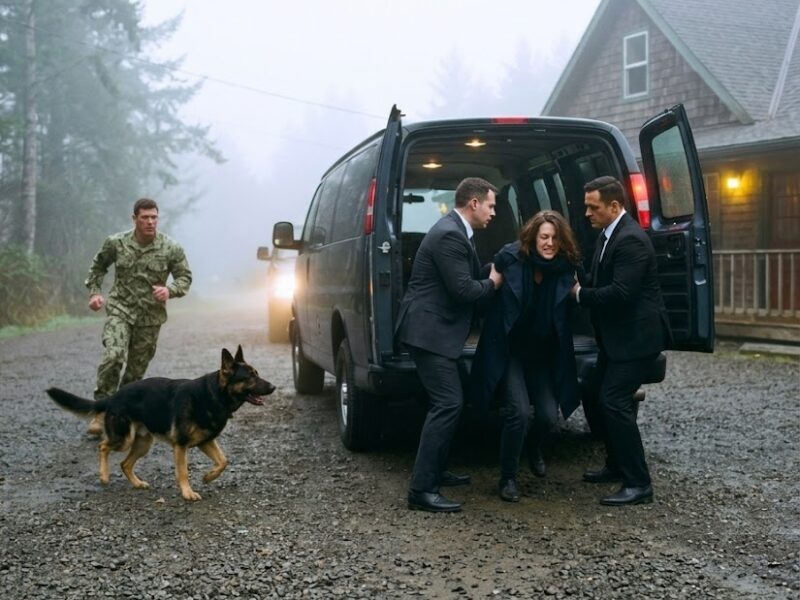
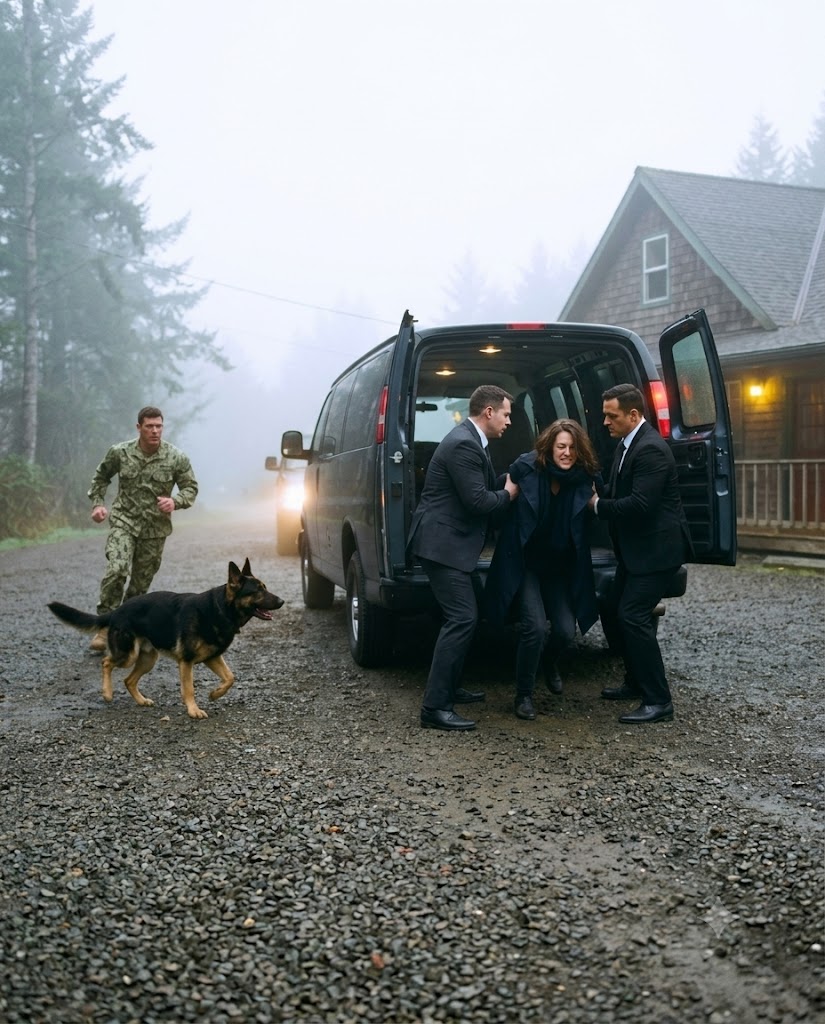
He came around the rear of a flatbed truck in time to see two men in identical dark coats forcing Ava against the side panel of a black transit van. One had his forearm across her throat. The other was pulling her canvas bag from her shoulder. The van’s back doors were open. The engine was running. There was a third figure in the driver’s seat.
Ava was fighting. She was not screaming — either she understood that screaming would not help, or the arm across her throat had already compressed the sound. She was driving her elbow back and her heel down, and she was not stopping.
Ryan moved in. He came up behind the man on her left, took him by the collar and the wrist, rotated the wrist past its natural limit, and put him face-first into the gravel. It was four seconds of work. The man did not make a sound when he went down. They rarely did when it happened correctly.
The second man spun and got his hand inside his jacket. Ryan stepped into him before the hand came back out. He drove his palm into the man’s chin — a short, precise strike. The man’s head snapped back against the van. He slid.
Ava leaned against the van’s side panel and pulled air. Baron stood at her feet, hackles up, watching the men on the ground.
Ryan looked at the driver. The driver was looking at Ryan. After two seconds, the driver put the van in reverse and left.
Ryan crouched over the man he had put down first. He patted the man’s jacket and found the credentials before the gun — federal agency. He recognized the format. He had been briefed by these people before overseas. He put the credentials back.
“How did they find you?” he asked.
Ava was still catching her breath. “I used a credit card at the motel in Port Angeles two days ago. I wasn’t careful enough.”
“Where’s your phone?”
“In my bag.”
The bag was on the ground. She picked it up.
“Take the battery out now.”
She did it without argument. That told him something.
Ryan stood up and looked at the two men on the gravel. They were breathing. They would be operational again in under ten minutes. The van would have a radio.
“How far is your car?”
“Half a block.”
“We’re not going to your car. Come with me.”
He moved. She moved with him. Baron fell in on his left side without being told.
Some men are shaped by what they lose. They carry the weight of it everywhere — in the set of their shoulders, in the economy of their speech, in the way they choose rooms that have two exits. Ryan Callaway was one of those men. He had buried five people he would have died for. And the official account of how they died had told him nothing that was true.
And he had chosen silence over fighting because fighting required believing that something could still be fixed. He was not sure when that had changed.
He navigated out of Caldwell Creek on back roads. His truck was a 2019 F-250 with 90,000 miles and a camper shell over the bed. He had kept a go bag in the locked box behind the seat since before he could legally buy a drink. He drove for forty minutes without speaking, watching the mirrors, taking turns without pattern.
Ava sat in the passenger seat with her canvas bag on her lap. She did not ask where they were going. She did not fill the silence with nervous talk. She watched the road.
“The men in the parking lot,” Ryan said finally, “they were federal.”
“Yes.”
“That means someone with serious authority is running this. Not a contractor, not a rogue element with a private budget. Someone who can task government personnel against a civilian journalist.”
“His name is Aldrich,” Ava said. “Senator Dale Aldrich. He sits on the Armed Services Subcommittee. Before that, he was a Deputy Assistant Secretary of Defense. Before that, he had a relationship with a private logistics company that handled supply chain contracts in Afghanistan. That company moved weapons.”
She looked at him. “I don’t know that for certain.”
“I do,” Ryan said. “That’s the structure. Supply chain company operating in theater. Relationship with a senior DoD official. Contracts that put them inside classified operational zones.”
He paused.
“Your squad accidentally documented something they shouldn’t have seen,” Ava said quietly. “I have an intercept from a signals analyst who has since disappeared. Your unit’s patrol route was transmitted outside of classified channels forty-eight hours before the ambush. The origin point was a server cluster used exclusively by Aldrich’s former office.”
Ryan kept his eyes on the road. The trees pressed close on both sides of the highway. The rain had gotten heavier. The wipers dragged across the windshield in long arcs.
The five men in his squad had names and faces and the specific weight of memory that came from years of proximity and shared danger. Carson, who collected baseball cards and made terrible coffee and could navigate in total darkness by feel alone. Webb, who had three kids and sent pictures of them to the group every single week. Tomas, who had grown up in San Antonio and wanted to open a food truck when he got out. Prentice, who was twenty-six and on his second deployment and had been three months from rotation home. Lieutenant Sorin, who had led them for four years and who Ryan had trusted more completely than he had ever trusted anyone.
They were dead. The official record said it was bad intelligence about a Taliban position. It said nothing about how the Taliban had known exactly where to find a six-man SEAL unit moving through a mountain pass at 0300 on a night with no moon.
Ryan had known. He had known from the moment the first rounds came in at exactly the angle that should have been impossible unless someone had transmitted their position. He had known, and he had said nothing, because saying something meant opening a door he did not know how to walk back through.
He drove, he thought. Baron rested his chin on Ryan’s right thigh and breathed slowly.
“What do you need from me?” Ryan said. It was not quite a question.
“Verification,” Ava said. “I have the documents. I have the intercept. I have a financial trail that connects Aldrich to three shell companies that received DoD contract payments, two of which are now defunct. But a journalist’s documents and a journalist’s testimony do not move a Senate subcommittee member. A surviving SEAL’s sworn account does.”
“I’m on leave.”
“I know.”
“If I open my mouth about an active mission, I’m in violation of security agreements that can put me in federal prison.”
“I know that, too.”
“And you’re asking me anyway.”
“I’m showing you what I have,” Ava said. “I told you back in the bar that the decision was yours.”
Ryan took an exit he had not planned on taking. He pulled onto a logging road and drove three miles into the trees and stopped in a clearing where the canopy overhead was thick enough to break up any thermal signature from above. He turned the truck off. He sat in the dark for a moment.
“Show me,” he said.
She opened the canvas bag. The tablet inside was military-grade ruggedized, with a heavy case and a screen that did not produce glare. She had clearly thought about the tools she would need for a story that required fieldwork.
She opened the first folder. The intercept was technical, but Ryan understood the format immediately. It was a radio signal log from a monitoring station in Bagram. The timestamp was 0214 hours, two days before his squad’s last patrol. The origin metadata pointed to a server node in Virginia — a routing address that matched the format of the office infrastructure Aldrich’s former department had used. His squad’s patrol route, coordinates, timing — translated from the classified brevity codes they used into plain notation.
Someone had given them up cleanly and professionally, like a man who had done it before and knew exactly what details mattered.
Ryan looked at the screen for a long time. He did not feel the thing people described — the catharsis, the flood of feeling that was supposed to come when a mystery resolved. He felt instead a hard, cold weight settling into place. The weight of a thing confirmed. The weight of knowing that the answer had always been what he suspected.
And that knowing it now did not give him back a single one of them.
“Tomas had a food truck he was planning,” Ryan said. His voice was very quiet.
Ava looked at him. She did not say anything.
“He’d already picked out the location. He had a name for it. He made us vote on the logo.”
Ryan kept his eyes on the tablet screen. “He would have been twenty-nine this April.”
Baron pushed his nose against Ryan’s forearm. Ryan pressed his hand against the dog’s head and held it there.
“All right,” he said. “I’ll tell you what I remember. Everything, in the order it happened. You’ll document it, and you’ll use it correctly.”
“I will,” Ava said.
“And we’re going to be smart about how this moves, because those men in the parking lot were not the last ones they will send.”
As if the night itself had been listening, Baron raised his head and turned sharply toward the tree line. Ryan killed the dome light. He watched the darkness through the rain-streaked windshield.
Two sets of headlights. Moving slowly, no high beams. The kind of approach that people used when they wanted to get close before being noticed. They did not want to be noticed.
“Out,” Ryan said.
He had the go bag from behind the seat before she had her door open. He handed her a compact rain shell from the top of the bag. He pulled his own jacket on over the holster. Baron was already on the ground, moving low. They went into the trees on the opposite side from the lights.
What followed was three hours of movement through Olympic Peninsula forest in the rain. Ryan had trained in worse conditions, but training had not included a civilian journalist with canvas shoes and no night vision. Ava moved better than he expected. She did not ask unnecessary questions. When she slipped on a muddy slope, she got up without waiting to be helped and kept her pace. Ryan adjusted his assessment of her upward for the second time that night.
He navigated by compass bearing and memory toward a section of the coast where he had walked with Baron in the first weeks of arriving in Caldwell Creek. A series of sea caves accessible at low tide, invisible from the road, deeply sheltered from the wind. He had noted them the way he noted all exits and all shelter — automatically, without planning to need them.
They arrived at the cliff edge in the dark. Ryan found the path down in the rock face and descended first, testing each hold. He talked Ava down behind him. Baron came last, with the casual ease of a dog who had repelled in combat gear and regarded a wet rock face as light exercise.
The cave was dry inside, cut deep enough into the granite that the wind could not find them. Ryan built a fire no bigger than a hand — enough heat to stop the shivering, small enough that the smoke dispersed before it reached the cave mouth. Ava sat across the fire from him with the tablet on her knees. She had wrapped herself in the rain shell and was typing. Her hands were steady.
“There’s something else in here,” she said after a while. “Something I didn’t tell you about yet.”
Ryan looked up.
“The weapons that Aldrich’s logistics company moved. I traced three shipments. One of them is not historical. The most recent manifest is dated six weeks ago.”
She turned the tablet around so he could see the screen. “It’s a scheduled transaction. A container arriving at a private port facility on the Washington coast. The paperwork lists agricultural equipment.”
Ryan looked at the manifest. He looked at the date. He looked at the port designation. He looked up at her.
“That facility is forty miles north of here,” Ava said, “and the container is scheduled for transfer in thirty-six hours.”
The fire between them was very small. The ocean outside was loud. Baron lay across both their feet — a habit he had developed during long still overwatch positions, keeping his handler warm, keeping himself grounded.
Ryan had two choices. He had known from the moment he saw the federal credentials in the parking lot that the two choices would eventually narrow to this.
He could take the documents and the intercept to someone he trusted in the chain of command and let the process work at the speed that processes worked. Months, investigations, legal reviews, delays — the slow grinding of a justice system confronting a man with power and allies and lawyers. That route might work. In three years it might work.
Or he could move in thirty-six hours with what he had and make sure the evidence became undeniable before Aldrich’s people had a chance to make it disappear.
He thought about Carson. He thought about Webb’s kids. He thought about Tomas and his food truck. He reached into the go bag and took out the satellite communicator. He had the device for emergencies. He had never used it.
He stared at it for a moment. Then he looked at Ava.
“Do you have a contact at a credible news organization? Not freelance. Somewhere with legal resources and a security team.”
She did not hesitate. “Yes. Two of them.”
“Get one of them on standby. Tell them you have a time-sensitive story that will require legal protection to publish safely. Don’t send anything yet.”
“All right.”
“When we move, we’ll need every document on that tablet transmitted to them simultaneously with transmission to a federal source I trust. The moment the data exists in two places they can’t control, Aldrich can’t suppress it by eliminating us.”
He paused. “The federal source is an NCIS agent I worked with three years ago. Her name is Brannigan. She’s not part of the normal chain. She owes me a conversation.”
“How do you know she’s not compromised?”
“I don’t. But the alternative is trusting no one, and that’s how they keep winning.”
Ava looked at him steadily. There was something in her expression that was different from the look in the bar. The calculation was still there, but underneath it something had shifted. She was looking at him the way you looked at someone when you had stopped wondering whether they were going to help and started thinking about what came next.
“Thank you,” she said quietly.
Ryan shook his head. “Don’t thank me yet.”
The thirty-six hours were not quiet.
By the next morning, Aldrich’s people had found Ryan’s truck abandoned two miles from the cliff path. Ryan had expected that. He had also expected that they would assume a man on foot with a civilian was limited in his options. That assumption was worth something.
He spent the daylight hours moving through the peninsula terrain with the kind of patience that came from having spent weeks in observation posts waiting for a target that might not come. He and Ava slept in shifts. Baron stood watch in the way that military dogs stood watch — not dramatically, not with continuous alertness, but with a deep background awareness that registered every change in the environment and brought it forward only when the change mattered.
The dog woke Ryan twice. The first time was a deer. The second time was a foot patrol — two men in civilian clothes moving through the tree line with communication earpieces. Ryan watched them for eleven minutes from a position forty yards upslope and let them pass.
They ate from the go bag rations and drank from a stream Ryan filtered twice. Ava did not complain about the food or the ground or the cold. She spent the hours she was not sleeping going back through the documents on the tablet, building a notes file that Ryan could see over her shoulder. Precise, well-organized. The work of someone who had thought carefully about how evidence and story fit together.
At one point, she looked up from the screen and found him watching. “You’re reading my notes,” she said — not an accusation, just an observation.
“Checking that you have the sequence of the patrol correct.”
“Do I?”
“Yes.”
She went back to typing.
At dusk on the second day, Ryan moved them toward the coast north of Caldwell Creek. The facility appeared through the trees exactly where the manifest coordinates placed it. It was larger than the paperwork implied — a private port operation with a main dock, two warehouse structures, a security perimeter that included cameras at every corner and a vehicle patrol running a twenty-minute loop. Ryan watched the loop twice to confirm the timing.
“They’re using the same contractor security firm Aldrich’s company used in Afghanistan,” Ava said. She had pulled up a corporate registration document on the tablet, keeping the screen brightness at zero. “I recognize the patch design.”
Ryan studied the facility layout. The container they needed would be in the secondary warehouse — the one closer to the dock, with the heavier lock array on the exterior doors. The container’s manifest number was in Ava’s documents. If he could photograph the container’s actual contents and cross-reference it with the manifest’s false declaration, the discrepancy alone was criminal evidence sufficient to compel an investigation that Aldrich could not stop.
“I need twenty minutes inside,” Ryan said. “Maybe less.”
“I go with you.”
“No.”
“You need someone operating the data transmission while you’re inside. If you’re photographing evidence, someone has to be simultaneously sending the files we already have to Brannigan and to my contact. The moment transmission begins, we’re on a clock. They’ll detect the satellite uplink.”
Ryan thought about it. She was right. He hated that she was right.
“You stay at the perimeter,” he said. “You do not enter the facility under any circumstances. When transmission is complete, you move north along the shoreline two hundred meters and you wait. If I’m not out in thirty minutes, you leave without me.”
Ava looked at him. “I’m not going to agree to that last part.”
“Then I’m not going to agree to you coming.”
A pause. Baron sat between them in the dark, looking at each of them in turn.
“Fine,” she said. “Thirty minutes.”
Ryan moved through the security gap the same way he had moved through a hundred gaps in a dozen countries — low, patient, in the rhythm of the environment, using the patrols’ own motions as cover. He was inside the secondary warehouse in six minutes. Baron, off-lead, ranged ten meters ahead of him, scenting for hidden personnel.
The container was third from the back. The manifest number matched. Ryan cut the seal with the blade on his multi-tool and pulled the door.
He stood in the dark for a moment, letting his eyes adjust and letting the reality register.
It was not agricultural equipment.
He documented everything. He worked fast and without wasted motion, which was the only way he had ever worked. Photographs of each distinct category, photographs of the container’s serial plate, a short audio recording of himself describing the contents against the manifest’s declared goods. A journalist’s technique, not a SEAL’s — and he had learned it watching Ava work.
Twelve minutes. He sealed the container back as well as he could and retraced his route to the perimeter.
Ava was where he had left her. She had the tablet open. The moment he reached her, she began the transmission. The satellite uplink indicator blinked green. Data moving.
From somewhere inside the facility, an alarm klaxon fired.
“How long?” Ryan said.
“Sixty percent. Maybe two minutes.”
Baron went rigid. He had caught the first edge of the response team moving toward them.
“Transmit what you have,” Ryan said. “Do not stop for anything.”
She did not stop. The response team came out of the facility’s east gate — four men moving fast with lights and weapons. Ryan positioned himself between them and Ava and made the geometry complicated for the approaching team. He did not fire unless fired upon. He did not need to.
The terrain worked for him, the way terrain always worked for a man who had studied it in daylight. The steep slope, the root system, the narrow path that narrowed further between two massive firs. The team slowed. They were good, but they were private contractors, not operators, and the difference was real in the dark on a wooded hillside.
“Ninety-eight percent,” Ava said, her voice controlled.
A round cut through the fir branches above them. Warning shot or bad aim, it did not matter.
“Move,” Ryan said.
He took her arm and ran. They went down the coastal slope the way he had planned — fast, using the incline, Baron angling ahead of them and then looping back. At the bottom was a rocky shoreline and a fifteen-foot drop into the surf.
“Transfer complete,” Ava said, breathing hard.
Ryan looked at the water. The tide was low. The rocks at the base were wet but visible.
“Can you swim?”
“Yes.”
“The rocks at the bottom are manageable. I’ll go first. Come down immediately after.”
He dropped. He landed correctly, rolled, came up. He called Baron down. The dog jumped without hesitation, military muscle memory.
Ava came down thirty seconds later. She landed badly on her right ankle, went down to one knee, and was up again before he reached her.
“How bad?” he said.
“Fine. Keep moving.”
They moved along the shoreline in the dark and the surf until they were two hundred meters north of the facility and the shouting behind them had faded beneath the sound of the ocean. Ryan stopped behind a rock outcropping and pulled out the satellite communicator. He keyed in Brannigan’s contact number.
She picked up on the second ring, which told him she had been waiting.
He spoke for three minutes. He told her everything that mattered in the order it mattered. He gave her the transmission verification code that Ava had sent simultaneously to her federal address. He told her the name Dale Aldrich.
Brannigan was quiet for a moment after he finished. “Ryan,” she said, “how long have you been sitting on this?”
“Long enough.”
Another pause. “I have the files. I’m looking at them right now. I’m going to need a chain of custody statement from you and from the journalist.”
“You’ll have it.”
“And Ryan — the men they sent after you, you’re going to have to be somewhere they can find you when this is over. You understand what I mean?”
“I understand.”
He ended the transmission.
Ava was sitting against the rock with her ankle extended. Baron had put his head in her lap without being invited, which the dog did sometimes with people he had decided to accept. She had her hand on his neck. She looked up at Ryan.
“Brannigan has the files,” he said.
“Your contact?”
“Confirmed receipt seven minutes ago. They have a legal team standing by.” She paused. “It’s going out.”
Ryan sat down on the rock. He looked at the water. The Pacific at night in October was a vast, cold, indifferent thing, and he found something appropriate about that.
“Carson collected baseball cards,” Ryan said.
It came out without particular intention, just a statement into the dark. Ava was quiet for a moment.
“Tell me about him.”
So he did.
He told her about Carson’s terrible coffee and his astonishing navigational instinct. He told her about Webb sending pictures of his kids every single week without fail — pictures of birthday cakes and soccer games and a kid’s first lost tooth, the continuity of an ordinary life preserved in small images sent to men in dangerous places. He told her about Tomas’s food truck, the name he had picked, the logo they had voted on. He told her about Prentice, twenty-six years old, three months from coming home. He told her about Lieutenant Sorin, who had known about every one of their personal projects and their families and their plans for after — and who had held all of it with a seriousness that Ryan had not fully understood until after Sorin was gone.
Ava listened without interruption. Baron lay between them and breathed slowly. At some point the clouds broke and the stars came out over the water.
“They deserved better,” Ryan said finally.
“Yes,” Ava said. “They did. And now people will know.”
He looked at her. She was looking at the water, her profile lit by faint starlight. Her ankle was probably worse than she was admitting. Her canvas bag was still over her shoulder with the tablet inside. She had been right about the importance of simultaneous transmission. She had been right about not leaving without him.
He thought that there were different kinds of courage, and that he had spent fourteen years in the company of men who had one kind and had not thought enough about the others.
Senator Dale Aldrich was placed in federal custody at his home in Virginia on a Tuesday morning, seven weeks after Ryan and Ava sat on a rock on the Washington coast and watched the stars come out.
The arrest was coordinated by the NCIS division where Brannigan worked and two other federal agencies whose involvement Ryan was not made privy to. The charges included bribery of a government official, illegal arms trafficking, and three counts related to the unauthorized disclosure of classified operational information — the legal language for what had happened on a ridge in Kandahar Province eighteen months earlier.
Ryan read about it on his phone. He was on the porch of the cabin in Caldwell Creek, back in the same town but with a different feeling about it. The fog was coming in off the water the way it always came in, thick and gray and moving slow. Baron was on the porch with him, watching the tree line the way he watched all tree lines.
The phone rang. It was Ava.
“You saw,” she said.
“Just now. The story published this morning — the full version. My editor says it’s the most-read piece they’ve run in four years.”
“That’s good,” Ryan said. “That’s the right outcome.”
“Brannigan called me. She said your cooperation was what made the difference. Without the chain of custody and the first-hand account, the documentary evidence alone wasn’t enough. Your documents did the heavy lifting.” She paused. “The families of the men in your squad — Webb’s wife has been contacted. She’s asking if there’s going to be a public acknowledgement.”
Ryan was quiet for a moment. “There will be,” he said. “I’m going to make sure of it.”
After he ended the call, he sat on the porch a while longer. The fog moved through the Douglas firs and the light on the water changed the way it always changed in the late afternoon — the Pacific going from gray to something almost copper.
Baron had moved from his post at the tree line and was sitting pressed against Ryan’s left leg, which was where the dog preferred to be when they were still. Ryan put his hand on the back of Baron’s neck.
He thought about Sorin, who had held all of it — the coffee and the soccer pictures and the food truck plans and all the small particular weight of five different lives — and had carried it with a seriousness Ryan had not fully understood. He understood it now. He was not done carrying it. He did not think he would ever be entirely done.
But there was a difference between carrying something and being buried by it. And for the first time in eighteen months, he could feel the difference clearly.
Baron leaned into his hand. The fog kept moving. The light kept changing. The water below the cliff was gray and wide and cold, and somewhere under the surface of it the currents ran deep and constant, indifferent to the lives played out above.
And yet somehow, impossibly, those lives persisted. They made meaning from motion. They kept moving forward into the fog.
I have told stories of men who carry more than the weight of their weapons. Ryan Callaway was one of them — a man who thought silence was the same as peace, who learned the hard way that peace requires action, that justice requires someone willing to stand in the dark parking lot and choose.
The dog named Baron knew before Ryan did. Dogs often do. They read the moment without the interference of self-protection.
In the end, the narrator’s role in a story like this is only to name what was already true. Loyalty is not passive, and truth does not stay buried. It waits. And eventually, someone walks through the right door on the right night with the right evidence. And the weight that has been pressing down for eighteen months shifts at last, and the living can begin again.









